- 104 -
Antioxidant Activities of Angelica keiskei L. and dried leaves of Raphanus sativus L.
Su-Jin Ji1, Dong-Jin Lee2, Sung-Hee Lim1, Woo-Jeong Shin1, Young-Suk Cho1, So-Young Kim1, Jung-Bong Kim1, and Se-Na Kim1†
1
Functional Food & Nutrition Division, Department of Agrofood Resoures,
National Academy of Agricultural Sciences, Rural Development Administration, Suwon 441-857, Korea
2College of Bio-Resources Sciences, Dankook University, Cheonan 330-714, Korea
신선초와 무시레기의 항산화 성분 및 활성 비교
지수진1․이동진2․임성희1․신우정1․조영숙1․김소영1․김정봉1․김세나1†
1농촌진흥청 국립농업과학원 농식품자원부 기능성식품과
2단국대학교 생명자원과학대학
Abstract
Dried leaves of Raphanus sativus L. and Angelica keiskei L. extracts have strong antioxidant potential and in consequence profound effects on ulcerative colitis. Present study was conducted to explore the effect of diet mixtures containing dried leaves of Raphanus sativus and Angelica keiskei powder on ulcerative colitis in mice and antioxidant potential of radish green and Angelica extracts as well. Both dried leaves of Raphanus sativus and Angelica keiskei extracts exhibited higher antioxidant activity due to the presence of polyphenols, favonoids and antioxidant enzymes like superoxide dismutase (SOD). Analyzed data indicate that Angelica keiskei extract had higher polyphenol and flavonoid contents compared with radish green, while maximum SOD activity was noted in dried leaves of Raphanus sativus extract Likewise, higher antioxidant (348.72 ± 31.65 µg/mL) and ABTS+ radical scavenging (17%) activities were noted in dried leaves of Raphanus sativus extract compared with Angelica keiskei.
Key words:Dried leaves, Raphanus sativus L., Angelica keiskei L., antioxidant activities
서 론
1)
경제 성장과 더불어 암, 노화와 같은 질환의 예방에 대한 관심이 높아지고 있다. 이러한 질병들은 산화적 스트레스 에 의해 생성되는 활성산소종(ROS; reactive oxygen species)에 기인하는데, 이들은 세포 내 DNA, 단백질, 지질, 탄수화물 등의 거대분자들과 반응하여 DNA분절, 단백질 의 불활성화, 불포화 지방산의 과산화 등의 문제를 낳아 생체기능을 저하 시킨다(1). ROS가 과잉 축적되면 DNA와 세포내 여러 분자에 손상을 가져오게 되므로 이를 방어하기 위해 체내에는 항산화 시스템이 존재하는 것으로 알려져 있다(2,3).
†Corresponding author. E-mail:[email protected] Phone:82-31-299-0512, Fax:82-31-299-0504
항산화 시스템의 주요 구성성분은 비타민 C, E, A와 무기 질, carotenoid와 같은 기능성 물질들로, 대부분 식물성 식품 을 통해 얻을 수 있다(4). 실제로 채소와 과일의 섭취가 여러 만성질병의 위험을 낮춘다는 가설이 여러 연구를 통해 입증되었다. 기존 연구의 예로, 정상인에게 8주간 포도주스 를 섭취하게 하였더니 혈장 내 자유 라디칼과 total cholesterol, low density lipoprotein cholesterol이 감소되었다 는 연구결과가 있으며(5), 정제된 비타민 C, 비타민 E 보다 는 채소와 과일 속의 천연비타민이 암예방과 더욱 밀접한 관계가 있다는 연구결과도 있었다(6). 또한 토마토, 양파, 도정하지 않은 곡물이 lymphocyte의 DNA 손상을 억제하는 효과가 입증되었으며(7), 피실험자들에게 3종류의 채소와 과일로 식단을 짜 각기 다른 기간 동안 섭취하게 했을 때, 종류에 상관없이 혈장의 항산화능이 증가했다고 한다(8).
이와같이 항산화 성분이 많이 함유된 식품의 섭취가 중요시
되면서 많은 연구가 진행되고 있다(9).
신선초는 비타민 C를 비롯한 각종 비타민과 칼륨, 칼슘, 철, 마그네슘 등의 무기질(16)은 물론 chalcone, coumarin, saponin, flavonoid 등과 같은 생리활성성분을 함유하고 있 으며, 항알러지효과(17), 항고혈압효과(18) 및 간 기능 향상 (19), 빈혈예방(20), 인슐린 분비 촉진 효능(21) 등을 나타내 는 것으로 보고되어 있다. 특히 신선초에 함유된 xanthoangelol 은 신경암, 혈액암, 루이스폐암세포 및 배꼽정맥내피세포 에서 세포사멸 유발과 암 대사를 저해하고, 종양 프로모토 활성 및 전이를 억제한다고 보고되었다(22). 이러한 연구결 과에 힘입어 각종 성인병 및 여러 질환을 예방하기 위한 즙, 분말, 차 등의 건강보조식품으로 많이 이용되고 있다 (44). 그러나 쓴맛과 독특한 냄새 그리고 질긴 특성으로 인하여 식품으로서 인식되지 않았다. 반면 무시레기는 건 물량 중 35% 이상의 식이섬유, 20% 내외의 단백질과 철분, 칼슘 등으로 구성되어 있으며, 특히 gluconasturtiin을 포함한 glucosinolate 류의 항암성분은 물론 유해활성산소 소거능 력이 뛰어난 β-carotene 및 안토시아닌까지 함유하고 있으 며(10,11), 최근에 무시레기 에탄올 추출물이 폐암세포 억 제 효과가 있으며(12), 위장 내 자극과 자궁 수축 활성(13), 장내 자극 변화(14) 및 기타 생리활성(15) 등을 가진다는 연구결과가 보고되면서 새로운 기능성 물질을 가진 연구대 상으로써의 가능성을 시사하고 있지만 양질의 식재료로써 의 가치를 넘어서지 못하고 있다.
따라서 본 연구에서는 무시레기 및 신선초 추출물의 항 산화 성분 및 활성 검정을 통해 앞으로 이들의 항산화 물질 의 작용기전 연구진행을 위한 기초 자료 및 기능성 식품으 로의 활용을 모색하고자 하였다.
재료 및 방법
연구재료
본 연구에서 사용한 무시레기, 신선초는 농협 하나로 마 트에서 구입하였으며, 동결건조 후 믹서기를 사용해 분쇄 하여 고운 입자형태의 파우더로 만든 다음, 시료정량의 20 배에 해당하는 70%의 EtOH로 24시간 3반복 추출하여 시료 로 사용하였다.
기기 및 시약
실험기기로는 VERSA max microplate reader (Molecular Devices Co., USA), micro-pipette (Gilson Inc., USA)이 사용 되었으며, 시약으로는 L-ascorbic acid, 2N folin-ciocalteu's phenol regent, 1,1-diphenyl-2- picrylhydrazyl (DPPH), gallic acid, 2,2-azinodi [3-ethlbenzthiazolne-6-sulfonic acid]등은 Sigma (St.Louis, MO, USA), tannin acid, SOD Kit, diethylenglycol 등은 Fluka (Fluka Co., EU), Sodium hydroxide와 Potassium
persulfate은 Junsei (Junsei Co., Japan)이 사용되었다.
총 폴리페놀 함량
총 폴리페놀 함량은 Kim 등(23)의 방법을 변형하여 측정 하였다. 농도 1.0 mg/mL의 무시레기, 신선초 추출물 200 μL에 2 % Na2CO32 mL을 넣어 섞어준 다음 1 M 페놀반응 시약(50% Folin-ciocalteu's phenol regent; 2N 100 mg/mL in 1st distilled water) (Sigma Co., USA) 200 μL를 첨가하여 실온에서 30분 동안 반응시키고 750 nm에서 흡광도를 측정 하였다. 대조군으로는 tannin acid을 사용하였으며, 총 폴리 페놀 함량은 측정된 흡광도 값으로부터 구하였다.
total polyphenols = Y×V/S
*Y : 시료의 흡광도 값을 검량선에 대입하여 얻은값 V : 시료 추출액의 조제단계에서 사용된 추출용매의 부피 S : 추출시료의 무게
총 플라보노이드 함량
총 플라보노이드 함량은 Kong 등(24)의 방법을 변형하여 측정하였다. 농도 1.0 mg/mL의 시료 추출물 1 mL에 diethylenglycol 10 mL을 넣어 섞어준 다음 1N NaOH 1 mL 을 첨가하여 상온에서 1시간 반응 후 420 nm에서 흡광도를 측정하였다. 대조군으로는 gallic acid를 사용하였으며, 함 량은 측정된 흡광도 값으로부터 산출하였다.
total flavonoids = Y×V/S
*Y : 시료의 흡광도 값을 검량선에 대입하여 얻은값 V : 시료 추출액의 조제단계에서 사용된 추출용매의 부피 S : 추출시료의 무게
전자 공여능
전자공여능(Electron Donating Ability : EDA)은 시료에 대한 DPPH의 전자공여에 따른 시료의 환원력을 측정하는 방법으로 Chu(25)의 방법을 변형하여 측정하였다. 1, 10, 100 μg/mL 농도별 희석한 시료추출물을 96 well plate의 각 well에 100 μL씩 분주하고, 다시 여기에 150 μM DPPH 용액 150 μL를 첨가하여 섞은 다음 실온에서 30분간 반응시 켜 518 nm에서 흡광도를 측정하였다. 대조군으로는 ascorbic acid를 사용하였으며, 항산화 활성은 측정된 흡광 도 값으로부터 구하였다.
inhibition concentration (%) = (1-D/C) × 100 IC50 = (0.5-b)/a
*D : 추출물첨가구의 흡광도 C : blank 흡광도
a (기울기), b (절편) : sample stock solution의 단계별 농도(X)에 대한 inhibition concentration (Y)에 작성된 방정식으로부터 얻었음.
ABTS radical 소거활성
무시레기와 신선초에 대한 ABTS radical 소거활성은 Van den Berg 등의 방법을 변형하여 측정하였다(27). 7.4 mM의 ABTS 시약과 2.6 mM potassium persulfate를 3차 증류수에 녹인 후 12시간 overnight 한 다음 50배 희석하여 735 nm에서 흡광도를 측정하였을 때 흡광도 값이 1.4-1.5 nm 사이로 나오도록 하였다. 농도100 μg/mL의 시료 10 μL와 ABTS 시약 200 μL를 혼합한 후 상온에서 30분간 반응시켰으며, ABTS radical 소거능은 측정된 흡광도 값을 통해 구하였다.
ABTS radical scavenging activity (%)
= (blank O.D-sample O.D.)/blank O.D. × 100
*blank : ascorbic acid + ABTS 시약의 흡광도 값 Superoxide dismutase (SOD) 유사 활성
SOD 유사활성은 Marklund 등(26)의 방법을 변형하여 측정하였다. 농도100 μg/mL의 시료 추출물 20 μL에 dilution buffer와 enzyme working solution을 20 μL씩 넣어준 후 상온 에서 20분간 반응시킨 다음 450 nm에서 흡광도를 측정하였 다. SOD 활성은 측정된 흡광도 값을 통해 구하였다.
SOD activity inhibition rate (%) =
{[(blank1-blank3)-(sample-blank2)]/(blank1-blank3)} × 100
*blank1 : distilled water와 WST working solution + enzyme working solution
blank2 : control group sample + WST working solution + dilution buffer
blank3 : WST working solution + WST working solution + dilution buffer
통계분석
실험결과는 SAS (Satistic Analysis System)을 이용하여 통계처리 하였으며, 평균±표준편차로 구하였다. 실험군 간 의 평균값의 차이를 검증하기 위하여 일원배치 분산분석 (one-way analysis of variance)를 한 후, 던칸다중검정 (Duncan’s multiple range test)으로 변인간의 차이를 검증하 였다. 모든 통계적인 유의성은 0.05 미만인 수준에서 실시 하였다. 또한 총 폴리페놀, 총 플라보노이드 함량과 항산 화 활성과의 상관관계는 선형회귀분석을 실시하여 검토 하였다.
결과 및 고찰
항산화 성분 및 전자공여능
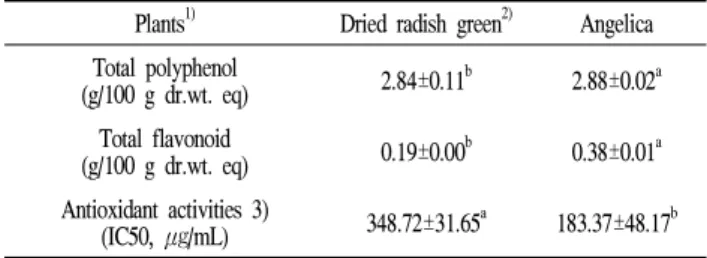
총 polyphenol 함량의 경우 무시래기 및 신선초 추출물은
2.84±0.11 g/100 g dr.wt. 및 2.88±0.02 g/100 g dr.wt.로, Ku 등(15)의 보고에서 건조무청 추출물의 총 polyphenol 함량 이 최하 4.90±0.04, 최고 6.20±0.01 g/100 g dr.wt.로 나왔으 나 Chu 등(28)의 연구에서 EtOH로 추출한 브로콜리, 시금 치, 양파, 감자, 오이 추출물의 총 polyphenol 함량이 0.08, 0.07, 0.06, 0.02, 0.01±0.00 g/100 g dr.wt.인 것을 참고할 때, 무의 품종과 재배조건, 추출 조건 및 실험 방법에 의한 차이에 따라 총 polyphenol 함량이 달라지는 것으로 사료되 었다.
항산화 활성을 나타내는 데에는 phenol 화합물이 크게 작용하는 것으로 보고되어 있으며(29,30), 함량이 높을수록 높은 활성을 나타내는 것으로 알려져 있다(31). 특히 DPPH radical을 이용한 항산화력 측정에서는 phenolic 화합물 중 flavonoid 계열이 우수한 항산화활성을 나타내었다고 보고 되었다(32). 총 flavonoid 함량은 총 polyphenol 함량보다 적게 나타났으며, 신선초는 무시래기보다 높게 나타났다.
이러한 결과는 DPPH radical 소거활성을 통한 항산화 활성 검정에서 신선초가 무시래기보다 높은 활성을 나타내는 데 영향을 미친 것으로 판단되었다. 따라서 polyphenol 화합 물 중 flavonoid가 증가할수록 항산화 활성 역시 높아진다는 연구결과와 일치하였을 뿐만 아니라(33), flavonoid계열의 화합물이 DPPH radical 소거활성에 중요한 영향을 미치는 것으로 확인되었다(32).
Table 1. Comparison of total polyphenols and total flavonoids in dried radish green and Angelica extracts.
(g/100 g, dry weight) Plants1) Dried radish green2) Angelica Total polyphenol
(g/100 g dr.wt. eq) 2.84±0.11b 2.88±0.02a Total flavonoid
(g/100 g dr.wt. eq) 0.19±0.00b 0.38±0.01a Antioxidant activities 3)
(IC50, ㎍/mL) 348.72±31.65a 183.37±48.17b
1)Each value is expressed as mean±SD of triplicate determinations.
2)Values with different superscript within the same column indicate significant differences (p<0.05) among groups by Duncan’s multiple range test
3)IC₅₀ : Inhibitory activity is expressed as the mean of 50% inhibitory concentration of triplicate determinations, obtained by interpolation of concentration-inhibition curve
ABTS+ radical 소거활성
ABTS+radical 소거능은 항산화 활성을 스크리닝 하는데 많이 이용하는 방법 중 하나이다. ABTS와 potassium persulfate를 암소에 방치하면 ABTS+이 생성되는데, 추출물 의 항산화 활성에 의해 ABTS+·이 소거되어 radical 특유의 색인 청록색이 탈색되는 정도로 활성을 측정한다(36).
무시레기와 신선초 추출물의 ABTS 양이온 radical 소거 활성을 100 μg/mL의 농도에서 측정한 결과, 무시레기 추출 물이 17%로 가장 높았으며, 대조군으로 사용된 ascorbic
acid가 13%, 신선초 추출물이 11%의 활성을 가진 것으로 나타났다.
Boo 등(37)이 여주 품종별 ABTS 양이온 소거활성을 분 석한 결과, 총 polyphenol 함량과 총 flavonoid 함량이 높을 수록 ABTS 양이온 소거활성도 높게 나타났으며, Lee 등 (38)도 polyphenol함량이 높을수록 양이온 소거활성 역시 높게 나타났다고 보고하였으나, 본 실험에서는 DPPH radical 소거능에서 신선초 추출물이 가장 높았던 것과는 대조되는 결과가 나타났다. 이는 DPPH radical 소거활성에 서 가장 높은 활성을 보인 부위와 ABTS 양이온 소거활성에 서 높은 활성을 보인 부위가 다르게 나타났다고 보고한 Jin(33)의 연구결과와 유사하였다. 이러한 차이는 소거하는 radical이라는 점에서는 같으나 종류가 다르기 때문에 즉, DPPH의 경우 free radical이지만 ABTS는 양이온 radical이 라는 점이 다르며, 또한 페놀물질의 종류가 다름에 따라 두 기질에 결합하는 정도가 다르므로 radical을 제거하는 능력에서 차이가 나는데 기인하는 것으로 사료된다.
Fig. 1 ABTS radical scavenging activity of dried radish green and Angelica extracts.
Bar with different letters are significantly different at p<0.05.
Superoxide dismutase (SOD) 유사활성
SOD (superoxide dismutase)는 세포에 해로운 superoxide 을 과산화수소로 전환시키는 반응을 촉해하는 효소로 30 kDa 이상의 분자량을 가진 단백질이어서 체내에 쉽게 흡수 되지 못하고 체외로 배출되며, 열과 pH에 불안정하다. 따라 서 SOD와 유사한 활성을 가지면서 SOD 단점을 보완할 수 있는 SOD 유사활성물질의 탐색에 대한 연구가 필요하 다. 이들 SOD 유사활성 물질은 효소는 아니지만 SOD와 유사한 역할을 하는 저분자 물질로 superoxide의 반응성을 억제하여 생체를 보호하는 것으로 알려져 있으며, phytochemical에 속할 뿐 아니라 식물체에 다량 존재한다 (33).
Hong 등(35)이 십자화과 식물에 속하는 브로콜리, 케일, 무착즙액의 SOD활성을 측정한 결과, 100 μg/mL의 농도에 서 41.7%, 26.7%, 24.1%의 활성을 가진 것으로 나타났으며,
Ku 등(11)의 연구에서도 데친 무시레기와 자연건조 무시레 기가 1.0 mg/mL의 농도에서 39%, 38%의 활성을 보인 것을 참고할 때, 유의적인 차이는 없지만 본 연구에서의 농도 100 μg/mL에서 보인 무시레기 63%, 신선초 58%의 활성은 비교적 높게 나타난 것으로 판단되었다. 무시레기는 DPPH radical 소거 활성과 반대로 신선초보다 약간 높게 나타났으 며, 두 시료 모두 합성항산화제인 BHT보다도 높은 활성을 나타내었다.
Fig. 2 Superoxide dismutase(SOD) like activity of dried radish green and Angelica extracts.
Bar with different letters are significantly different at p<0.05.
무시레기와 신선초의 항산화 성분 및 항산화 활성간의 상 관관계
총 flavonoid 함량과 항산화 활성에서는 특별한 상관관계 를 보이지 않았던 Kwak나 Kim 등의 연구결과(39,40)와 달 리 본 실험에서는 유의적 상관관계를 나타냈다(Table 2).
특히 총 flavonoid 함량은 ABTS 양이온 radical 소거활성 과 강력한 음의 관계가 있는 것으로 나타난 반면, DPPH radical 소거활성과는 정반대의 강력한 양의 관계가 있는 것으로 나타나 Ku 등의 연구결과와 유사한 것을 알 수 있었 다(41).
또한 총 polyphenol 함량과 항산화 활성에서는 유의한 상관관계가 없는 것으로 나타나 Kim 등이 보고한 polyphenol 함량과 DPPH radical 소거활성, hydroxy radical 소거활성, superoxide radical 소거활성에서 강한 양의 상관관계가 나 타났다는 연구결과와는 다른 것으로 확인되었다(42).
따라서 기존의 많은 연구들에서 flavonoid 화합물이 비타 민 C, E에 비해 3배 내지 5배 이상의 강력한 항산화 작용을 나타내었다고 보고(43)한 것을 볼 때, 본 연구에서 polyphenol 화합물 중 특히 flavonoid 화합물들이 free radical 소거활성 에 큰 영향을 미치는 것으로 추정된다. 신선초와 무시레기 추출물 속의 항산화 성분은 산화적 스트레스에 효과적으로 대처할 것으로 사료되며, 앞으로 무시레기와 신선초에 함 유된 성분들로부터 분자․세포적 측면에서의 항산화활성 기전에 대한 심층적 연구가 필요하다고 생각된다.
Table 2. Correlation cofficent between the contents of antioxidant and antioxidant effects by DPPH radical scavenging activity, SOD like activity, ABTS radical scavenging activity from dried radish green and Angelica extracts1).
Total polyphenol
contents Total flavonoid
contents radicalDPPH scavenging
activity
SOD like activity
radicalABTS scavenging
activity Total polyphenol
contents 1
Total flavonoid
contents 0.2821 1 DPPH radical
scavenging activity 0.2404 0.9804⁕ 1 SOD like activity -0.1005 0.4258 0.4865 1
ABTS radical
scavenging activity -0.3792 -0.9863 -0.9609⁕ -0.3035⁕ 1
1)Significant at p<0.05 among groups by linear regression analysis and correlation coefficient comes between -1 and 1.
요 약
무시레기와 신선초의 항산화 성분 및 활성을 분석하여 비교하였다. 무시레기와 신선초 추출물의 polyphenol 함량 은 각각 100 g당 2.84±0.11 g, 2.88±0.02 g이었으며, flavonoid 함량은 0.19±0.00 g, 0.38±0.01 g 으로 확인되었다.
항산화 활성 측정 결과, 무시레기 및 신선초 추출물이 DPPH radical 소거활성에서 IC₅₀값이 348.72±31.65 μg/mL, 183.37±48.17 μg/mL으로 나타났으며, ABTS+ radical 소거 활성은 17.8 %, 11.9 %의 활성을, SOD 유사활성에서는 63%, 58%의 활성을 가진 것으로 나타났다. 총 polyphenol 및 flavonoid 함량과 항산화 활성간의 상관관계에서 총 flavonoid 함량과 DPPH radical 소거능이 r=0.9804, ABTS+ radical 소거활성은 r=-0.9863의 상관관계를 보였으며, DPPH radical 소거활성은 ABTS+ radical 소거활성과 r=-0.9609, SOD 유사활성과는 r=0.4865로서 각각 유의한 부와 정의 상관관계를 나타내었다.
감사의 글
본 연구는 농촌진흥청 국립농업과학원 농업과학기술 연 구개발사업(과제번호: PJ006706)의 지원에 의해 이루어진 것입니다.
참고문헌
1. Volko M, Leibfritz D, Moncol J, Cronin MT, Mazur M,
Telser J (2007) Free radicals and antioxidants in Normal physiological functons and human disease. Int J Biochem Cell Biol, 39, 44-84
2. Fang YZ, Yang S, Wu G (2002) Free radicals, antioxidants, and nutrition. Nutr, 18, 872-879
3. Lee DJ, Kim HW, Park SG, Chu SM, Lee JS (2007) Antioxidant and anticancer activities of extracts from grains of the barley germplasms. Korean J Intl Agri, 19, 186-190
4. Andersen HR, Nielsen JB, Nielsen F, Grandjean P (1997) Antioxidative enzyme activities in human erythrocytes.
Clin Chem, 43, 562-568
5. Park YK, Kang MH (2002) Daily grape juice consumption reduces plasma free radical level in health subjects. FASEB Meeting experimental Biology 2002, Mew Orleans Louisiana, USA, April 20-24, A996 6. Kuladottir H, Tjoenneland A, Overvad K, Stripp C, Olsen
JH (2006) Dose high intake of fruit and vegetables improve lung cancer survival. Lung cancer, 51, 267-273 7. Cao G, Booth SL, Sadowski JA, Prior RL (1998) Increases in human plasma antioxidant capacity after consumption of controlled diets high in fruit abd vegetables. Am J Clin Nutr, 68, 1081-1087
8. Appel LJ, Moore TH, Obarzanek E, Vollmer WM, Svetkey LP, Sacks FM, Bray GA, Vogt TM, Cutler JA, Windhauser MM, Lin PH, Karanja N (1997) A clinical trial of the effects of dietary patterns on blood pressure.
N Enhl J Med, 336, 1117-1124
9. Enrique Cadenrs MD, Lester P (2002) Handbook of antioxidants. Marcel Dekker. New York, p317-318 10. Malisorn C, Suntornsuk W (2009) Improved β-carotene
production of Rhodotorula glutinis in fermented radish brine by continuous cultivation. Biochemical Engineering Journal, 43, 27-32
11. Ku KH, Lee KA, Kim YL, Lee YW (2006) Quality characteristics of hot-air dried radish(Raphanus sativus L.) leaves. J Korean Soc Food Sci Nutr, 34, 780-785 12. Yim HB, Lee GS, Chae HJ (2004) Cytotoxicity of ethanol extract of Raphanuse sativus on a human lung cancer cell line. J Korean Soc Food Sci Nutr, 33, 287-290 13. Ghayur MN, Gilani AH (2005) Gastrointestinal
stimulatory and uterotonic activities of dietary radish leaves extract are mediated through multiple pathways.
Phytother Res, 19, 750-755
14. Gilani AH, Ghayur MN (2004) Pharmacological basis for the gut stimulatory activity of Raphanus sativus leaves. J Ethnopharmacol, 95, 169-172
15. Ku KH, Lee KA, Kim YE (2008) Physiological activity of extracts from Rrdish (Raphanus sativus L.) leaves.
J Korean Soc Food Sci Nutr, 37, 390-395
16. Kim OK, Lee MW, Park WB, Ham SS, Kung SS (1992) The nutritional components of aerial whole plant and juice of Angelica keiskeiKoidz. Korean J Food Sci Technol, 24, 592-596
17. Toyoda M, Tanaka K, Hoshino K, Akiyama H, Tanimura A, Saito Y (1997) Profiles of potentially antiallergic flavonoids in 27 kinds of health tea and green tea infusions. J Agric Food chem, 45, 2561-2564 18. Shimizu E, Hayashi A, Takahashi R, Aoyagi Y,
Murakami T, Kimoto K (1999) Effects of angiotensin
Ⅰ-converting enzyme inhibitor from Ashitaba(Angelica Keiskei) on blood pressure of spontaneously hypertensive rats. J Nutr Sci Vitaminol, 45, 375-383
19. Ogawa H, Okada Y, Kamisako T, Baba K (2007) Beneficial effect of xanthoangelol, a chalcone compound from Angelica keiskei, on lipid metabolism in stroke-prone spontaneously hypertensive rats. Clin Exp Pharmacol Physiol, 34, 238-243
20. Fujita T, Sakuma S, Sumiya T, Nishida H, Fujimoto Y, Baba K, Kozawa M (1992) The effects of xanthoangelol E on arachidonic acid metabolism in the gastric antral mucosa and platelet of the rabbit. Res Commun Chem Pathol Pharmacol, 77, 227-240
21. Enoki T, Ohnogi H, Nagamine K, Kudo Y, Sugiyama K, Tanabe M, Kobayashi E, Sagawa H, Kato I (2007) Antidiabetic activities of chalcones isolated from japanese herb, Angelica Keiskei. J Agric Food Chem, 55, 6013-6017
22. Kimura Y, Baba K (2003) Antitumor and antimetastatic activities of Angelica keiskeiroots, partⅠ : isolation of an active substance, xanthoangelol. Int J Cancer, 106, 429-437
23. Kim YE, Yang JW, Lee CH, Kwon EK (2009) ABTS radical scavengng and anti-tumor effects of Tricholoma matsutake Sing.(Pne Mushroom). J Korean Soc Food Sci Nutr, 38(5), 555-560
24. Kong SH, Choi YM, Lee SM, Lee JS (2008) Antioxidant compounds and antioxidant activities of the methanolic extracts from milling fractions of black rice. J Korean Soc Food Sci Nutr, 37, 815-819
25. Chu SM (2007) Antioxidative and antimicrobial activities of medicinal plants collected from Nepal. Dankook University. MS Thesis
26. Marklund S and Marklund G (1974) Involvement of
superoxide anon radical in the oxidaton of pyrogallol and a convenient assay for superoxide dismutase. Eur J Biochem, 47, 468
27. Van den Berg R, Haenen GR, Van den Berg H. Bast A (1999) Applicability of an improved Trolox equivalent antioxidant capacity(TEAC) assay for evaluation of antioxidant capacity measurements of mixtures. Food Chem, 66, 511-517
28. Chu YF, Sun J, Wu X, Liu RH (2002) Antioxidant and antiproliferative activities of common vegetables. J Agric Food Chem, 50, 6910-6916
29. Lim HW, Yoon JH, Kim YS, Lee MW, Park SY, Choi HK (2007) Free radical scavenging and inhibition of nitric oxide production by four grades of pine mushroom (Tricholoma matsutake Sing.). Food Chem, 103, 1337-1342
30. Lee YS (2007) Antioxidant and physiologocal activity of extracts of Angelica dahurica leaves. Korean J Food Preserv, 14, 78-86
31. Matkowski A, Piotrowska M (2006) Antioxidant and free radical scavenging activities of some medicinal plants from the Lamiaceae. Fitoterapia, 77, 346-353
32. Villano D, Fernandez-Pachon MS, Moya ML, Troncoso AN, Garcia-Parilla MC (2007) Radical scavenging ability of polyphenolic compounds towards DPPH free radical.
Talanta, 71, 230-235
33. Jin SY (2011) Study on antioxidant activities of extracts from different parts of Korean and Iranian pomegranates.
J Korean Soc Food Sci Nutr, 40, 1063-1072
34. Kim MJ (2011) Antioxidant activity by total polyphenolic contents of regularly consumed 60 vegetables and fruits in Korea. Kyungnam University MS Thesis
35. Hong HD, Kang NK, Kim SS (1998) Superoxide dismutase like actvity of apple juice mixed wth some fruits and vegetables. Korean J Food Sci Technol, 30, 1484-1487
36. Park YK, Lee WY, Ahn JK (2006) Current review on the study of antioxidants development from forest resources. Trends in Agriculture & Lfe Sciences, 4, 1-13 37. Boo HO, Lee HH, Lee JW, hwang SJ, Park SU (2009) Different of total phenolics and flavonoids, radical scavenging activities and nitrite scavengng effects of Momordica charantia L. according to cultivars. Korean J Medicinal Crop Sci, 17, 15-20
38. Lee SO, Lee HJ, Yu MH, Im HG, and Lee IS (2005) Total polyphenol contents and antioxidant activities of methanol extracts from vegetables produced in Ullung
Island. Korean J Food Sci Technol, 37, 233-240 39. Kim BR, Park JH, Kim SH, Cho KJ, Chang MJ (2010)
Antihypertensive properties of dried radish leaves powder in spontaneously hypertensive rats. Korean J Nutr, 43, 561-569
40. Kwak CS, Kim SA, Lee MS (2005) The correlation of antioxidative effects of 5 Korean common edible seaweeds and total polyphenol content. J Korean Soc Food Sci Nutr, 34, 1143-1150
41. Ku KM, Kim SK, Kang YH (2009) Antioxidant activity and functional components of corn silk(Zea mays L.).
Koran J Plant Res, 22, 323-329
42. Kim EY, Baik IH, Kim JH, Kim SR, Rhyu MR (2004) Screening of the actioxidant activity of some medicinal plants. Korean J Food Sci Technol, 36, 333-338 43. Kim DO, Lee KW, Lee HJ, Lee CY (2002) Vitamin
C equivalent antioxidant capacity (VCEAC) of phenolic phytochemicals. J Agric Food Chem, 50, 3713-3717 44. Kang SK, Choi OJ, Kim YD (1999) Proximate, free sugar,
amino acid, dietary fiber and saponin composition of Angelica Keiskei Koidz. Korean J Plant Res, 12, 31-37 (접수 2012년 11월 2일 수정 2012년 12월 20일 채택 2012년 12월 28일)