276 Corresponding author: [email protected]✽
교잡어
,
참돔( Pagrus major ,
♀) ×
감성돔( Acanthopagrus schregeli ,
♂)
의 성장 및수온변화와 저염분 환경에서의 내성
김양수✽・지승철1・Biswajit Kumar Biswas・Amal Biswas・
정관식2・Osamu Murata・Kenji Takii
긴끼대학교 수산연구소, 1국립수산과학원 제주수산연구소,
2전남대학교 수산해양대학
Growth and Environmental Tolerances (Water
Temperature and Low Salinity) of Hybrid Female Red Sea Bream Pagrus major × Male Black Sea Bream
Acanthopagrus schregeli
Yang-Su Kim*, Seung-Cheol Ji
1, Biswajit Kumar Biswas, Amal Biswas, Gwan-Sik Jeong
2, Osamu Murata and Kenji Takii
Fisheries Laboratories, Kinki University, Wakayama 649-3633, Japan
1Jeju Sea Fisheries Research Institute, NFRDI, Jeju 690-192, Korea
2College of Fisheries and Ocean sciences, Chonnam National University, Yeosu 500-749, Korea
The growth and tolerance for water temperature and salinity were compared among red sea bream Pagrus major (RSB) black sea bream Acanthopagrus schregeli (BSB) and their hybrid (F1), female RSB × male BSB. The growth of the F1 fish did not differ until 27 days after hatching (dAH), after which the most rapid growth was observed until approximately 300 dAH, followed by RSB and BSB. However, the RSB had out grown the F1 fish by approximately 303 dAH. By 480 dAH, the RSB were largest, followed by the F1 and BSB groups. The tolerances for high and low water temperature were significantly different for each species and growth stage. The largest tolerance spectrum was observed in the BSB group, and the tolerance spectrums gradually decreased with increasing final body weight. During the salinity tolerance trials, all of the species started to die following transfer into freshwater (0 psu). BSB showed the highest survival rate when kept in fresh water for an average of 29.9 hours, while the F1 fish were more tolerant than the RSB fish. The fish were increasingly tolerant to fresh water and changes in water temperature as they grew, while the size of the temperature spectrum remained unchanged but shifted to a lower temperature range with growth. Our results demonstrate that F1 performed well in terms of growth compared to parental fish, with higher temperature and salinity tolerances than RSB, and is thus suggested to be a suitable aquaculture species for Korea and northeast China.
Key words: Hybrid, Red sea bream, Black sea bream, Growth, Environmental tolerance
서 론
수산양식 대상어종에 대한 육종법으로는 종래의 양식품종에 대한 선발 및 염색체조작과 함께, 신품종을 대상으로 한 사육 기술의 개발과 외래종의 도입 그리고 잡종유도에 의한 교잡종 의 생산 등이 있다. 이중, 교잡유도 기술을 이용한 육종법은 속․종․품종 간의 서로 다른 장점이 하나의 개체로 합쳐진 다양 한 잡종강세적 특징 (heterosis, hybrid vigor)을 이용하여, 단기 간에 적은 노력으로 유용생물의 생산량 및 이용부분의 증대, 유통가공성, 광역적응성, 내병성, 관리의 적합성 등의 중요형 질을 향상시키는 신품종 개발기법이다 (Gu et al., 2000). 이러
한 교잡육종에 의해 생산된 어종으로는 잉어류 (Bakos et al., 1978; Hulata, 1995), 메기류 (Lovell, 1979; Jantrarotai et al., 1998), 금붕어류 (Hume et al., 1983), 틸라피아류 (Shiau and Huang, 1989), muskellunge (Brecka et al., 1995), 미꾸라지류 (Park et al., 1997), 철갑상어류 (Shiraish et al., 1995), 송어류 (Gunther et al., 2005)등의 담수어종과 연어류 (Boeuf and Harache, 1984), 넙치류 (Imsland and Jonassen, 2001), 방어류 (Harada et al., 1971, 1977; Murata, 1998), 복어류 (Fujita, 1966), 돌돔류 (Harada et al., 1986; Kumai, 1984), 돔류 (Kitajima and Tsukashima, 1983; Arakawa and Yoshida, 1986; Harada, 1991;
Murata, 1998), 농어류 (Tuncer et al., 1990)등의 해수어종이 있으며, 몇몇 어종은 실제 양식 및 낚시 어종으로서 활용되어,
산업적으로 중요한 위치를 차지하고 있다.
농어목 (Perciformes)의 도미과 (Sparidae)에 속하는 참돔, Pagrus major (RSB)과 감성돔, Acanthopagrus schlegeli (BSB) 은 우리나라 양식돔류의 대표적인 어종으로서, 양식뿐만 아닌 자원 증식을 위한 방류 및 낚시 어종으로서도 각광받고 있다 (Choi et al., 2002; Yoo et al., 2003). RSB는 BSB보다 비교적 빠르게 성장하고, BSB는 RSB보다 다양한 환경변화에 대한 내성이 높아, 이 두 어종이 갖는 장점을 겸비한 새로운 품종을 탐색하고자, 교잡기술을 응용한 육종연구가 1964년 일본 긴끼 대학교에서 최초로 실시되었다 (Harada, 1991; Murata, 1998).
우선, BSB (♀)와 RSB (♂)사이의 교잡 1세대는 대부분이 형태이상 자어의 부화와 함께, 부화 후 약 1개월 내에 대부분이 폐사하는 등, 교잡열세적인 특징을 보인 반면 (Harada, 1991), RSB (♀)와 BSB (♂)사이의 교잡 1세대 (F1)에 대해서는 다양 한 교잡특성이 연구되어, RSB와 BSB의 중간적인 계측 및 계수형질 (Murata, 1998; Park, 2003)과 유전형질 (Murata, 1998; Park et al., 2004; Kim et al., 2005) 그리고 교잡불임 (Park et al., 2004; Murata, 1998)등의 생물학적 특징과 함께, RSB보다 낮은 vitamin C 요구량 (Kim et al., 2009a)과 높은 대두박 이용성 (Kim et al., 2009b)등의 영양학적인 교잡강세 등이 보고되고 있다.
일반적으로 어류의 기호환경은 성장함에 따라 변화한다 (Cuenco et al., 1985; Imsland and Jonassen, 2001; Handeland et al., 2008). RSB와 BSB는 자․치어기부터 성어기까지의 서식 지가 다르고 (Tanaka, 1971; Fukuhara, 1987; Kinoshita and Tanaka, 1990), 성장과 대사에너지의 분배율에서 차이가 있는 것으로 알려져 (Tang et al., 2003), 이들 사이의 교잡어의 성장 및 환경내성의 특징에 대한 다양한 추측들이 이야기 되어왔다.
이에, Murata (1998)는 RSB와 BSB 그리고 F1을 생산하여 어종 간의 고ㆍ저수온, 저염분 그리고 저산소에 대한 내성을 비교하 여, RSB와 BSB의 중간적인 환경내성의 특징에 대하여 보고 하였으나, 이들 환경에 대한 내성비교는 어느 특정 일령에 대해 단 일회에 한하여 실시한 결과로, 성장에 따른 이들 내성 의 변화 또는 유지에 관하여 지속적으로 관찰한 지견은 없다.
따라서, 본 연구에서는, 동일한 친어를 사용하여 생산된 RSB와 BSB 그리고 F1을 대상으로, 동일한 사육환경 및 방법 에 의해 부화 후 약 480일령까지 사육을 실시하였고, 그 기간 동안의 성장 및 고ㆍ저수온과 저비중에 대한 내성변화를 4단 계의 사육단계로 나누어 비교하였다.
재료 및 방법 채란 및 인공수정
일본, 와까야마현에 위치한 긴끼대학교 수산종묘센타 우라 가미 사업장 및 동교 수산연구소 시라하마 실험장에서 사육된 약 4년생의 암컷 RSB (4.5±0.4 kg, n=5) 과 약 2년생의 수컷 BSB (0.3±0.09 kg, n=4)를 사용하여, 복부압박법으로 채집한 성숙난과 정자를 건식법으로 수정시켜 F1 수정란을 생산하였 다. RSB와 BSB의 수정난은 F1생산에 사용된 친어들과 함께
RSB 수컷 (4.7±0.6 kg, n=3)와 BSB 암컷 (1.6±0.1 kg, n=3)로부 터 얻어진 정액과 성숙란을 사용하여 동일한 방법으로 생산하 였다. 3종의 수정난은 7 ton의 원형 수조 3면에 각각 나누어 약 5,000 - 7500 립/ton의 밀도로 수용하였다. 채란 및 채정에 사용된 각각의 친어들은 시판배합사료와 냉동새우 등을 공급 하여 관리하였고, 인위적인 일조시간조절 또는 호르몬 투여 등은 실시하지 않았다.
종묘생산
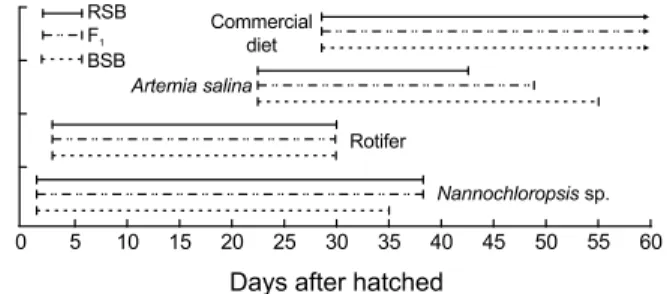
수정난의 수용후, 부화 2일령부터 여과 및 자외선 살균해수 를 5 L/min으로 주수하였고, Nanno-chloropsis sp.를 5×10⁶ cell/mL이 되도록 첨가하였다. 그리고, 먹이생물로 사용된 rotifer, Brachionus plicatilis, artemia, Artemia salina는 각각 10 inds./mL와 3 - 5 inds./mL이 되도록 1일 2회로 나누어 공급 하였고, 성장함에 따라 치어용 배합사료 순으로 먹이 종류와 사이즈를 바꾸어 공급하였다 (Fig. 1). Rotifer와 artemia는 시판 영양강화제 (Marine growth-EX, Nisshin Marinetech Co. Ltd., Japan)를 사용하여 6 - 8시간의 영양강화 후 공급하였다. 이 외 종묘생산기간의 모든 사육조건은 3어종에서 동일하게 실 시되었다.
Fig. 1. Feeding protocol during RSB, F1 and BSB rearing.
양성
부화 후 101, 107, 그리고 114일령의 RSB, F1 그리고 BSB는 긴끼대학교 수산연구소 우라가미실험장 인근 내만에 설치된 실험용 가두리 3면에 1,500 g/m3 밀도로 나누어 수용하였고, 성장함에 따라 사육밀도와 그물망 크기를 조절하였다. 사육기 간 중에는 시판배합사료 (Pia gold, Nisshin-feed, Japan)를 1주 일에 6일간, 하루 1 - 3회의 만복 공급을 실시하여, 약 480일령 까지 사육하였다. 사육기간 중에는 매일 수온 및 DO를 측정하 였다.
어체측정
3어종의 자․치어기 성장을 비교하기 위하여, 부화 후 44일령 까지는 2일 간격으로, 44-82일령까지는 5-10일 간격으로 매회 8 - 12미의 자․치어 대한 체장 및 체중을 광학현미경 (SZX12, OLYMPUS, Japan)과 만능투영기 (PJ300, DKSH Co. LTD., Japan) 그리고 전자저울을 이용하여, 각각 0.01 mm 및 0.001 g 단위까지 측정하였다. 또한, 치․약어기에 해당하는 80-470일 령까지의 성장은, 매달 10미씩 무작위로 채집하여 체장, 체중 등을 측정하였다.
Table 1. Initial measurements for the tolerance experiment to high and low temperatures (Values are provided as mean±SD)
dAH1 Body weight (g)
Body length (cm)
Water temperature
(℃)
Salinity (psu)
Fish no.
/tank Period I RSB 43 0.18±0.03 1.8±0.1 21.0 31.8 10
F1 43 0.18±0.04 1.8±0.1 21.0 33.4 10 BSB 53 0.20±0.07 2.0±0.2 21.0 28.2 10 Period II RSB 72 4.53±0.56 5.2±0.2 20.0 31.9 5 F1 69 2.88±0.52 4.6±0.3 21.0 28.2 5 BSB 92 3.15±0.45 4.6±0.2 21.0 32.4 5 Period III RSB 151 36.33±4.29 10.0±0.4 23.1 24.9 5 F1 162 45.65±7.80 11.0±0.5 23.6 32.5 5 BSB 164 31.17±4.49 9.8±0.3 23.5 31.7 5 Period IV RSB 349 164.9±19.2 17.6±0.6 20.2 32.4 3 F1 351 125.3±27.9 15.5±0.8 19.8 34.1 3 BSB 357 82.4±8.05 14.0±0.4 20.0 33.4 3
1Days after hatching.
Fig. 2. Environmental tolerance experimental tank setup.
고ㆍ저수온 내성비교
실험어는 부화 후 약 45일령 (Period I), 75일령 (Period II), 160일령 (Period III) 그리고 350일령 (Period IV) 전후의 치어 및 약어기의 RSB, F1 그리고 BSB를 사용하였다 (Table 1).
수온변화는 중탕식 실험수조 (Fig. 2)를 이용하여, 사육수온에 서부터 시간당 1℃씩 수온을 상승 및 하강시켰고, 각각의 설정 수온에 도달 시까지의 실험어의 행동을 관찰하였다. 실험어의 폐사확인은 1분 이상 아가미 뚜껑의 움직임이 없는 상태를 폐사로 정의하여 당시 수온을 측정하였다. 수용된 실험어의 반수가 폐사할 때의 수온을 측정하여 반수 폐사온도 (Ltemp.50) 로 정의하였다. 각각의 실험수조에는 통기를 실시하였고, 모 든 어종과 일령에 대하여 3반복으로 실시하였다.
저염분 내성비교
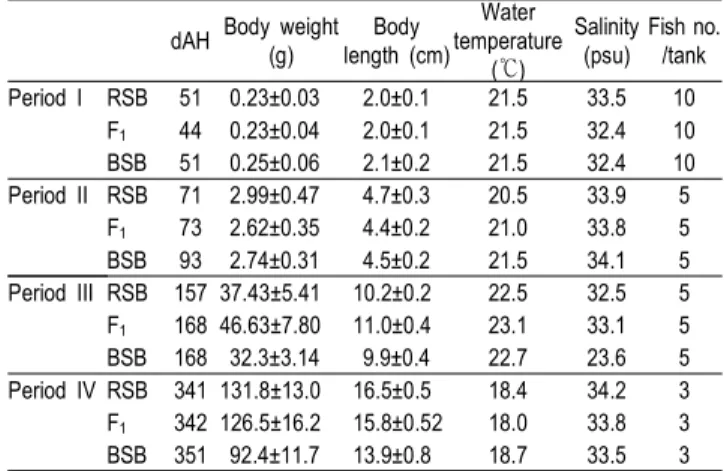
앞선 고ㆍ저수온내성 실험과 비슷한 시기의 RSB, F1 그리 고 BSB를 사용하였다 (Table 2). 염분조절은 사육수온으로 설정된 중탕식 실험수조 (Fig. 2)에 각각의 실험어를 수용 후, 사육해수의 염분으로부터 매시간당 25, 17, 9 그리고 0 psu가 되도록 단계적으로 탈염소 수도수로 희석하여 조절하였다.
또한, 0 psu는 탈염소 수도수를 가득 채운 수조에 실험어를 옮겨 관찰하였고, 앞서 서술한 방법으로 수용된 실험어의 반
Table 2. Initial measurements for the low salinity tolerance experiment*
dAH Body weight (g)
Body length (cm)
Water temperature
(℃)
Salinity (psu)
Fish no.
/tank Period I RSB 51 0.23±0.03 2.0±0.1 21.5 33.5 10
F1 44 0.23±0.04 2.0±0.1 21.5 32.4 10 BSB 51 0.25±0.06 2.1±0.2 21.5 32.4 10 Period II RSB 71 2.99±0.47 4.7±0.3 20.5 33.9 5 F1 73 2.62±0.35 4.4±0.2 21.0 33.8 5 BSB 93 2.74±0.31 4.5±0.2 21.5 34.1 5 Period III RSB 157 37.43±5.41 10.2±0.2 22.5 32.5 5 F1 168 46.63±7.80 11.0±0.4 23.1 33.1 5 BSB 168 32.3±3.14 9.9±0.4 22.7 23.6 5 Period IV RSB 341 131.8±13.0 16.5±0.5 18.4 34.2 3 F1 342 126.5±16.2 15.8±0.52 18.0 33.8 3 BSB 351 92.4±11.7 13.9±0.8 18.7 33.5 3
* Refer to table 1.
수가 폐사하는 시간을 측정하여 반수 폐사시간 (Ltime50)으로 정의하였다. 또한, 폐사한 실험어는 점액에 의한 실험수의 오염을 줄이기 위해 바로 제거하였다. 실험기간 동안에는 통 기를 실시하였고, 모든 어종과 일령에 대하여 3반복으로 설정 하였다.
통계처리
어종 및 성장단계에 따른 내성의 차이를 2-way ANOVA로 확인한 후 (P<0.001), 각 어종간 내성에 대한 유의차를 Duncan’s new multiple range test (Harter 1960)으로 판정하였다 (P<0.001, P<0.05). 또한 유의차 검정에는 SPSS의 통계처리 program (SPSS statistics ver. 12 for window)를 사용하였다.
Fig. 3. Comparison of body length for RSB, F1 and BSB from hatching to 100 days after hatching.
결 과 자ㆍ치어기의 성장
부화 후 약 100일령까지의 사육수온과 체장의 변화를 Fig.
3에 나타내었다. 각 어종의 체장은 경과일수의 증가에 따라 서서히 성장률이 증가하는 지수 함수적 성장패턴이 관찰되었 고, 이러한 성장곡선으로부터 지수식을 산출한 결과, RSB는 y=0.4e0.0312x, F1은 y=0.2539e0.0435x 그리고 BSB는 y=0.3441e0.0298x 의 관계식이 표현되었다. 위의 관계식에 의거하여 동일한 일 령에 대한 체장을 비교하면, 27일령까지는 어종간 큰 성장차 이가 관찰되지 않았으나 (RSB, 0.9 mm; F1, 0.8 mm; BSB, 0.8 mm), 이후 F1의 성장이 증가하기 시작하여, 41일령부터는 3어종 중 가장 우수한 성장을 보였다 (RSB, 1.4 mm; F1, 1.5 mm; BSB, 0.8 mm).
Fig. 4. Comparison of body length for RSB, F1 and BSB from 100 to 500 days after hatching (dAH).
치ㆍ약어기의 성장
부화 후 약 100일령부터 500일령까지의 사육수온과 체장의 변화를 Fig. 4에 나타내었다. 자․치어기의 성장에서와 동일하게 체장과 일령에 따른 지수식을 산출한 결과, RSB는
y=6.0497e0.0029x, F1은 y=7.2394e0.0023x, BSB는 y=6.2672e0.0022x의 관계식으로 표현되었다. 위의 관계식에 의거하여 체장을 비교 하면, 약 300일령까지는 F1이 가장 빠른 성장을 유지하였으나, 이후부터 RSB의 성장이 촉진되어 F1을 뛰어 넘기 시작하였다 (303일령의 체장 RSB, 14.6 mm; F1, 14.5 mm; BSB, 12.2 mm).
한편, BSB는 RSB와 F1에 비해 꾸준히 낮은 성장을 유지하였다.
고ㆍ저수온 내성
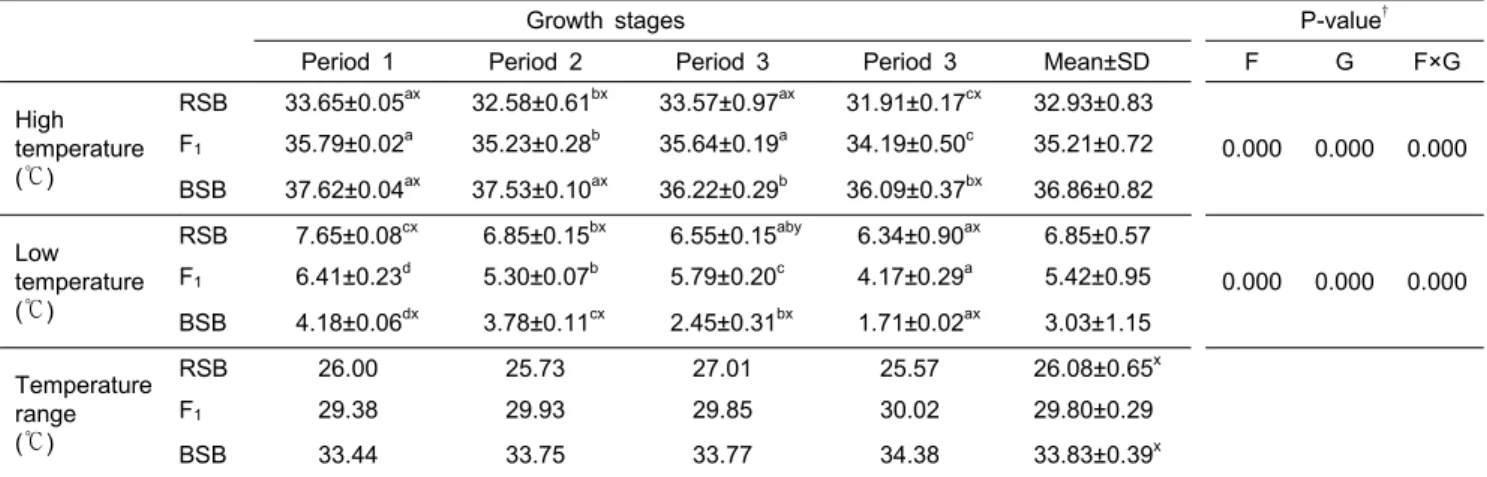
F1의 고ㆍ저수온에서의 Ltemp.50의 변화를 RSB 및 BSB와 함께 Table 3에 나타내었다. 수온변화에 따른 Ltemp.50의 값에 대한 어종과 성장단계의 상관관계를 2-way ANOVA로 검증한 결과, 어종과 성장단계 그리고 이 둘의 상관관계 모두 매우 유의적인 상관관계가 있음이 확인되었다 (P<0.001). 모든 어 종의 고․저수온 내성 (Ltemp.50)의 폭은 성장함에 따른 큰 변화는 없었으나, 서서히 낮은 수온대로 이동하는 것이 관찰되었다.
이들 어종간의 Ltemp.50의 수온 범위는 BSB가 가장 넓고, 이어서 F1과 RSB 순으로 좁아졌다 (P<0.001).
저염분 내성
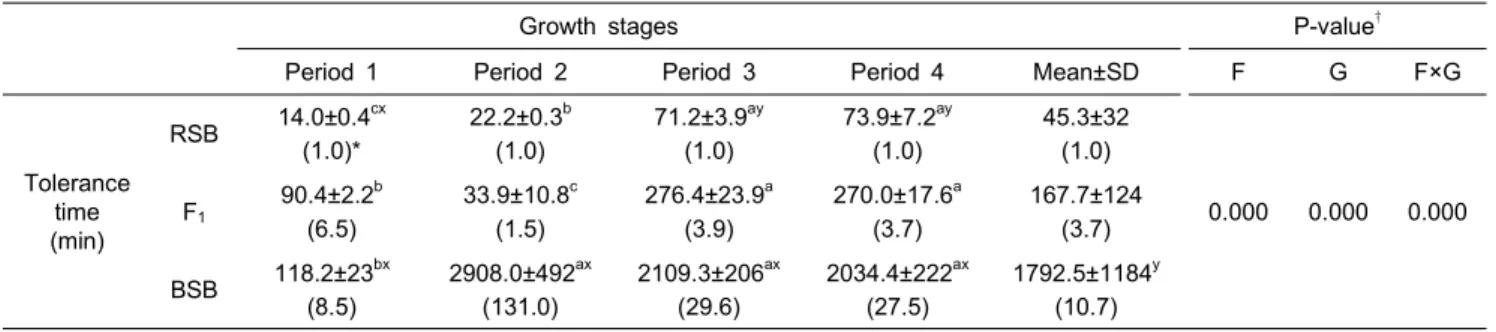
F1의 저염분에서의 Ltime50의 결과를 RSB 및 BSB와 함께 Table 4에 나타내었다. 모든 실험어종에서 높은 저염분내성과 함께, 0 psu로 옮기고서야 처음으로 전도 및 폐사가 확인되었 다. 어종과 성장단계의 상관관계를 2-way ANOVA로 검증한 결과 각각의 어종과 성장단계 그리고 이 둘의 교효작용에 있어서 매우 유의적인 상관관계가 있음이 확인되었다 (P<0.001). 성장함에 따른 모든 어종의 Ltime50값은 유의적으로 증가하여, RSB와 F1은 period Ⅲ에서부터, BSB는 period Ⅱ에 서부터 급격히 증가하는 경향을 보였다 (P<0.05). 또한, period
Ⅱ의 RSB와 F1을 제외한 모든 사육단계에서 실시된 Ltime50값 에서도 어종간의 유의적인 차이가 확인되었다 (P<0.001, P<0.05). RSB의 Ltime50값을 기준하여 F1과 BSB의 비교한 결과, 전체 사육기간에 있어 F1은 RSB의 3.7배, BSB는 10.7배의 높은 저염분 내성을 갖는 것으로 관찰되었다.
Table 3. Comparison of ontogenic tolerance (Ltemp.50) changes in high and low water temperatures for RSB, F1 and BSB
Growth stages P-value†
Period 1 Period 2 Period 3 Period 3 Mean±SD F G F×G
High temperature (℃)
RSB 33.65±0.05ax 32.58±0.61bx 33.57±0.97ax 31.91±0.17cx 32.93±0.83
0.000 0.000 0.000 F1 35.79±0.02a 35.23±0.28b 35.64±0.19a 34.19±0.50c 35.21±0.72
BSB 37.62±0.04ax 37.53±0.10ax 36.22±0.29b 36.09±0.37bx 36.86±0.82 Low
temperature (℃)
RSB 7.65±0.08cx 6.85±0.15bx 6.55±0.15aby 6.34±0.90ax 6.85±0.57
0.000 0.000 0.000 F1 6.41±0.23d 5.30±0.07b 5.79±0.20c 4.17±0.29a 5.42±0.95
BSB 4.18±0.06dx 3.78±0.11cx 2.45±0.31bx 1.71±0.02ax 3.03±1.15 Temperature
range (℃)
RSB 26.00 25.73 27.01 25.57 26.08±0.65x
F1 29.38 29.93 29.85 30.02 29.80±0.29
BSB 33.44 33.75 33.77 34.38 33.83±0.39x
a, b, c, d
Values (mean±SD) in a row sharing same superscripts are not significantly different (P>0.05).
x, y
Significantly different from the values of hybrids in same growth period (x, P<0.001; y, P<0.05).
† Result from 2-way analysis of variance (ANOVA); F, fish species; G, growth stages.
Table 4. Comparison of ontogenic tolerance (Ltime50) changes for RSB, F1 and BSB in freshwater
Growth stages P-value†
Period 1 Period 2 Period 3 Period 4 Mean±SD F G F×G
Tolerance time (min)
RSB 14.0±0.4cx (1.0)*
22.2±0.3b (1.0)
71.2±3.9ay (1.0)
73.9±7.2ay (1.0)
45.3±32 (1.0)
0.000 0.000 0.000 F1
90.4±2.2b (6.5)
33.9±10.8c (1.5)
276.4±23.9a (3.9)
270.0±17.6a (3.7)
167.7±124 (3.7) BSB 118.2±23bx
(8.5)
2908.0±492ax (131.0)
2109.3±206ax (29.6)
2034.4±222ax (27.5)
1792.5±1184y (10.7)
a, b, c, d
Values (mean±SD) in a row sharing same superscripts are not significantly different (P>0.05).
x, y
Significantly different from the values of hybrids in same growth period (x, P<0.001; y, P<0.05).
“* Magnification of RSB value”
† Result from 2-way analysis of variance (ANOVA); F, fish species; G, growth stages.
고 찰
교잡어는 반드시 교잡강세적 특징만을 갖고 있지는 않는 것으로 알려져 있다 (Hulata, 1995). Kitajima and Tsukashima (1983)는 청돔, Sparus sarba과 BSB사이의 교잡어들을 친어종 과 비교한 결과, 성장 및 환경내성 (저수온, 저염분)에 대한 교잡강세적 특징이 없는 것으로 확인하였다. 따라서, 본 연구 에서는 동일한 RSB과 BSB 친어를 사용하여, 인공수정에 의한 RSB와 BSB 그리고 F1를 생산하였고, 동일 조건하의 육상 및 해상사육을 통한 성장 및 고․저수온, 저염분에 대한 내성을 비교하여 F1의 양식생물학적 특징을 명확히 하고자 하였다.
본 실험결과 종묘생산시기에 해당하는 부화 후 약 27일령까지 의 성장은 뚜렷한 종간차이가 확인되지 않았다. 이 기간의 사육수온은 19℃전후로 비교적 낮게 유지되어, 3어종 모두 자․치어기에 해당할 것으로 보인다. 전자어기에는 내부영양 즉, 난황을 사용하여 소화관과 그 부속기관의 분화와 기능화 를, 이어서, 섭이가 시작되는 후자어기부터는 외부영양 즉, 먹이생물 및 사료의 소화흡수를 통하여 체형형성과 각종 장기 의 분화와 기능화가 이루어진다. 그러나 이 발육기간은 소화 흡수능력 및 먹이생물의 영양가가 낮기 때문에 3어종의 성장 또한 낮게 유지된 것으로 생각된다. 이와 비슷한 경향은 같은 돔류인 참돔 (♀)과 청돔 (♂)의 교잡어에서도 관찰되었다 (Murata, 1998). Miyashita (2002)는 참다랑어 Thunnus orientalis의 초기발육에 대하여 조사하여, 성장이 극단적으로 빠른 참다랑어 또한 먹이생물을 공급하는 부화 후 약 20일령 까지의 체장이 1 cm전후에 달하는 등, 자․치어기에는 RSB와 유사하게 낮은 성장을 보이는 것으로 보고하였다. 다른 어종 에서도 이와 유사한 경향이 관찰되어, 종묘생산 초기의 RSB, F1 그리고 BSB의 성장에 있어서 극단적인 종간차이는 없을 것으로 판단된다.
한편, 부화 후 약 40-320일령까지의 기간에서는 F1의 성장이 RSB와 BSB보다 우수하였다. 특히, 해상가두리에서 사육된 부화 후 약 190일령부터의 성장은 수온저하에 상관없이 높게 유지하였다. 이것은 교잡강세의 일환으로 간주된다. 일반적으 로, RSB는 BSB보다 우수한 성장을 보이는 것으로 알려져
있고, BSB는 RSB보다 높은 저수온내성을 갖는 것으로 보고되 고 있다 (Murata, 1998). 체중 약 100 g 전후의 F1에서는 이들 친어종 갖는 우수한 형질이 동반되어, 저수온기에도 우수한 성장을 유지한 것으로 추측된다. 그러나, 부화 후 약 320일령 이후부터는 RSB의 성장이 가속하여 F1보다 우수한 성장을 유지하였다. BSB의 성장은 균일하게 낮은 수준의 성장을 추 이하는 것으로 보아, 아마도, 이 기간의 수온상승을 계기로 두 어종의 형질발현에 차이가 발생한 것으로 생각된다. 또한, F1의 체장의 분산이 RSB와 BSB에 비교하여 극단적으로 넓어 진 것과 더불어, RSB와 BSB의 중간적인 F1의 외형적 계측 및 계수형질 (Matsukawa, 2006), 세포유전학적 특징과 교잡불 임 (Murata, 1998; Park et al., 2004) 등과 같은 교잡종으로서의 생물학적 특성이 발현된 것으로 생각된다. 이와 관련하여, Wohlfarth et al. (1984)는 교잡어에서 흔히 보이는 교잡강세는 비교적 빠른 성장단계에 한하여 관찰된다고 하였고, Bakos et al. (1978)은 잉어과 어류의 교잡종은 부화후 1 - 2년 내에 한하여 우수한 성장을 갖는다고 보고하였다. Murata (1998)는 RSB, F1 그리고 BSB에 대한 장기간의 사육실험을 실시한 결과, 본 실험과 유사한 성장의 변화와 종간차이에 대하여 관찰하였다. 또한, 2년간의 사육에서 F1이 체중 500 g에 달한 것과 반면, RSB와 BSB의 체중은 각각 900과 200 g정도인 것으로 보고하였다.
어류의 고․저수온내성과 저염분내성의 종간 차이는 세포수 준에서의 수복기능 (Yamashita, 1997), 염류세포의 기능 (Kaneko et al., 2002), 세포의 삼투압조절능력 (Kaneko et al., 2002), 조혈기능 (Nikinmaa, 2001), 헤모글로빈의 산소결합능 력 (Nikinmaa, 2001; Birchard and Tenney, 1991), 에너지 동원 (Ishibashi et al., 2002a, b), 영양소 대사능력 (Ishibashi et al., 2002a, c; Wegener et al., 1986; Van Ginneken et al., 1995) 등의 차이에 의한 것으로 알려져, 진화과정을 통하여 각각의 종이 서로 다르게 발달되어왔다 (Imsland and Jonassen, 2001).
약어기의 RSB는 고수온 및 저염분 환경에서, 성어기에는 저 수온 및 고염분의 환경하에서 주로 서식하고 (Ochiai and Tanaka, 1986), BSB는 넙치, Paralichthys olivaceus와 농어, Lateolabrax japonicas등과 같이 강하구역에 접근하여 서식하
는 등, 활발한 prolactin hormone합성을 통한 높은 저염분내성 을 유지할 수 있는 것으로 보고되고 있다 (Tanaka, 1991;
Tagawa and Kimura, 1991). Murata (1998)는 체중 180 g 전후의 F1 및 RSB와 체중 90 g의 BSB를 대상으로, 고․저수온, 저비중 및 저산소 내성에 대하여 조사한 결과, 본 연구 결과에서와 동일하게 F1은 높은 내성의 BSB와 낮은 내성의 RSB의 중간적 인 값을 갖는 것으로 보고하였다. 그러나, 본 연구에서와 같이 각각의 어종에 있어서 이들 내성은 성장과 함께 변화하였고, 특히, F1의 온도내성은 성장과 함께 낮은 수온대로 이동하는 것 그리고 저염분내성은 부화 후 약 75 일령의 중간육성기까 지는 RSB와 비슷하게 낮은 것 등이 관찰되어, 이후의 종묘생 산 및 양성에 관한 귀중한 응용적 지견을 얻었다. 몇몇 어류에 있어 고수온내성은 성장함에 따라 저하하는 것으로 알려져 있고 (Cuenco et al., 1985; Handeland et al., 2008), 참돔 (♀)과 청돔 (♂)의 교잡어를 포함한, 연어 및 송어류, 그리고 틸라피 아 속의 교잡어에서도 환경내성은 양친어종의 중간형을 갖는 것으로 보고되고 있다 (Boeuf and Harache, 1984; Murata 1998;
Kamal and Mair, 2005). 더나아가, Murata (1998)는, F1의 저산 소내성은 BSB와 동등하여, 치사 DO는 0.24 mg/L이었으나, RSB의 그것은 0.48 mg/L으로 높아, F1과 BSB는 우수한 것으 로 보고하였다. 이점을 더하여 생각하면, F1종묘의 대량생산 은 RSB보다 낮은 수온 및 DO에서 실시가능하고, 생산비용의 절감에 직결될 수 있는 가능성을 시사하였다.
사 사
본 연구는 일본 문부과학성의 21세기 COE 및 Global COE 프로그램의 연구비 지원에 의해 수행되었습니다.
참고문헌
Arakawa T and Yoshida N. 1986. Growth, survival and morphologic comparison between fry crossbred, Pagrus major with Evynnis japonica, and hatchery-reared Pagrus major. Bull Nagasaki Pref Ins Fish 12, 27-35.
Bakos J, Krasznai Z and Marian T. 1978. Cross-breeding experiments with carp, tench and Asian phytophagous cyprinids. Aquacult Hung 1, 51-57.
Birchard GF and Tenney SM. 1991. Relationship between blood oxygen affinity and blood volume. Respir Physiol 83, 365-373.
Boeuf G and Harache Y. 1984. Osmotic adaptation of the salmonid species Salmo trutta, Salmo gairdneri and Salvelinus fontinalis and the hybrid Salmo trutta
♀ × Salvelinus fontinalis ♂ to seawater. Aquaculture 4, 343-358.
Brecka BJ. Kohler CC and Wahl DH. 1995. Effect of dietary protein concentration on growth, survival and body composition of muskellunge Esox masquinongy
and tiger muskellunge Esox masquinongy × E.
luscious fingerlings. J World Aquacult Soc 4, 416-425.
Choi Y, Kim JH and Park JY. 2002 Marine fishes of Korea. Kyohak Publishing, Seoul, Korea, 645.
Cuenco ML, Stickney RR and Grant WE. 1985. Fish bioenergetics and growth in aquaculture ponds: II.
Effects of interactions among size, temperature, dissolved oxygen, unionzed ammonia and food on growh of individual fish. Ecol Mod 27, 191-206.
Fujita S. 1966. Abstract, Ann Meet. Jap Soc Fish Sci 20.
Fukuhara O. 1987. Larval development and behavior in early life stage of black sea bream reared in the laboratory. Nippon Suisan Gakkaishi 53, 371-379.
Gu HD, Lee SJ, Lee JM and Lee BC. 2000. Egg development and larval growth in hybridization of strongylocentrotus intermedius (A. Agassiz) and strongylocentrotus nudus (A. Agassiz). Bull Fish Res Dev 58, 71-78.
Gunther SJ, Moccia RD and Bureau DP. 2005. Growth and whole body composition of lake trout (Salvelinus namaycush), brook trout (Salvelinus fontinalis) and their hybrid, F1 splake (Salvelinus namaycush × Salvelinus fontinalis), from first-feeding to 16 weeks post first-feeding. Aquaculture 249, 195-204.
Handeland SO, Imsland AK and Stefansson SO. 2008.
The effect of temperature and fish size on growth, feed intake, food conversion efficiency and stomach evacuation rate of Atlantic salmon post-smolts.
Aquaculture 283, 36-42.
Harada T, Kumai H and Murata O. 1986. Artificial hybrid between Japanese parrot fish and spotted parrot fish.
Bull Japan Soc Sci Fish 52, 613-621.
Harada T, Mizuno K, Murata O, Miyashita S, Hurutani H, Kumai H and Nakamura M. 1971. Abstract, Ann Meet. Jap Soc Fish Sci 38.
Harada T, Murata O and Miyashita S. 1977. Ann Meet.
Jap Soc Fish Sci 75.
Harada T. 1991. Hybridization and select breeding of sea breams. SUISANZOSHOKU 39, 110-111.
Harter HL. 1960. Critical values for Duncan’s new multiple range tests. Biometrics 16, 671-685.
Hulata G. 1995. A review of genetic improvement of the common carp (Cyprinus carpio L.) and other cyprinids by crossbreeding, hybridization and selection. Aquaculture 129, 143-155.
Hume DJ, Flecthcer AR and Morison AK. 1983.
Interspecific hybridization between carp (Cyprinus
carpio L.) and goldfish (Carassius auratus L.) from victorian waters. Aust J Mar Freshw Res 34, 915-919.
Imsland AK and Jonassen TM. 2001. Regulation of growth in turbot (Scophthalmus maximus Rafinesque) and Atlantic halibut (Hippoglossus hippoglossus L.):
aspect of enviroment × genotype interactions. Rev Fish Biol Fish 11, 71-90.
Ishibashi Y, Ekawa H, Hirata H and Kumai H. 2002a.
Stress response and energy metabolism in various tissues of Nile tilapia Oreochromis niloticus exposed to hypoxic conditions. Fish Sci 68, 1374-1383.
Ishibashi Y, Hirata H and Kumai H. 2002b. Stress response and energy status in various tissues of red sea bream, Pagrus major, subjeced to hypoxic exposure. SUISANZOSHOKU 50, 315-323.
Ishibashi Y, Yonezawa H, Miyashita S, Kato K, Murata O, Hirata H and Kumai H. 2002c. Response of enzyme activities and metabolitc concentrations in various tissues of red sea bream, Pagrus major, subjected to hypoxic exposure. SUISANZOSHOKU 50, 325-331.
Jantrarotai W, Sitasit P, Jatrarotai P, Viputhanumas T and Srabua P. 1998. Protein and energy levels for maximum growth, diet utilization, yield of edible flesh and protein sparing of hybrid Clarias catfish (Clarias macrocephalus × Clarias gariepinus). J World Aquacult Soc 29, 281-289.
Kamal MAHM and Mair GC. 2005. Salinity tolerance in superior genotypes of tilapia, Oreochromis niloticus, Oreochromis mossambicus and their hybrid. Aquaculture 247, 189-201.
Kaneko T, Shiraishi K, Katoh F, Hasegawa S and Hiroi J. 2002. Chloride cells during early life stages of fish and their functional differentiation. Fish Sci 68, 1-9.
Kim BS, Kang JH, Kim JH, Kim KK, Lee JU, Lee JY and Park IS. 2005. Production of hybrid between female red seabream and male black seabream in Korea. Korean J Genetics 27, 133-140.
Kim YS, Biswas AK, Ji SC, Yong ASK, Biswas BK, Takaoka O, Murata O and Takii K. 2009b. Dietary soybean meal utilization with phytase supplementation for hybrid F1, red sea bream (♀) × black sea bream (♂). Aquaculture Sci 57, 46-51.
Kim YS, Biswas AK, Seoka M, Biswas BK, Yong ASK, Biswas BK, Takaoka O, Murata O and Takii K.
2009a. Dietary vitamin C requirement of hybrid, female red sea bream, Pagrus major × male black sea bream, Acanthopagrus schlegeli. SUISANZOSHOKU
57, 127-132.
Kinoshita I and Tanaka M. 1990. Differentiated spatial distribution of larvae and juveniles of the two sparids, red and black sea bream, in Shijiki Bay. Nippon Suisan Gakkaishi 56, 1807-1813.
Kitajima C and Tsukashima Y. 1983. Morphology, growth and low temperature- and low salinity-tolerance of sparid hybrids. Jap J Ichthy 30, 275-283.
Kumai H. 1984. Biological studies on culture of the Japanese parrot fish Oplegnathus fasciatus (Temminck et schlegel). Bull Fish Lab Kinki Univ 2, 1-127.
Lovell RT. 1979. Factors affecting voluntary food consumption by channel catfish. Proc World Symp Finfish Nutr Fish feed Technol 1, 555-564.
Matsukawa K. 2006. Kouzatsugyo madai × kurodai tsigyoki ni okeru hatsuiku to eiyou youkyuu ni kann suru kennkyuu. Master Thesis, University of Kinki, Shirahama, Japan.
Miyashita S. 2002. Studies on the seedling production of the pacific bluefin tuna, Thunnus thynnus orientalis. Bull Fish Lab Kinki Univ 8, 1-171.
Murata O. 1998. Studies on the breeding of cultivated marine fishes. Bull fish Lab Kinki Univ 6, 1-101.
Nikinmaa M. 2001. Haemoglobin function in vertevrates:
evolutionary changes in cellular regulation hypoxia.
Respir Physiol 128, 317-329.
Ochiai A and Tanaka M. 1986 Gyoryuigaku (Sita).
Koseisha koseikaku, Tokyo, Japan, 736-750.
Park IS, Kim BS, Hur JW, Syasina IG, Kim DS, Im JH and Park IS. 2004. Cytogenetic analysis of an artificial Red (♀) Black seabream (♂) Hybrid.
Korean J Genetics 26, 283-288.
Park IS, Kim BS, Im JH, Park HM, Nam YK, Jeong CH and Kim DS. 1997. Improved early survival in backcrosses of male mud loach (Misgurnus mizolepis) × cyprinid loach (M. anguillicaudatus) hybrid to female cyprinid loach. J Aquaculture 10, 363-371.
Park IS. 2003. Artificial hybridization between red seabream, Pagrus major and black seabream, Acanthopagrus schlegeli. Master Thesis, University of Maritime Management and technology, Pusan, Korea.
Shiau SY and Huang SL. 1989. Optimal dietary protein level for hybrid tilapia (Oreochromis niloticus × O.
aureus) reared in seawater. Aquaculture 81, 119-127.
Shirashi M, Fujii K and Maruyama T. 1995.
Characteristics of eggs and larval of bester F2 (hybrid
sturgeon). SUISANZOSHOKU 43, 407-413.
Tagawa M and Kimura S. 1991. Naibunpikinou no hatsugenn to sono yakuwari. In: Gyorui no syouki hatuiku. Tanaka M. ed. Koseisha koseikaku, Tokyo, Japan, 47-59.
Tanaka M. 1971. Studies on the structure and function of the digestive system in teleost larvae-III.
Development of the digestive system during postlarval stage. Jpn J Ichthyol 18, 167-174.
Tanaka M. 1991 Gyorui no syouki hatuiku. Koseisha koseikaku, Tokyo, Japan, 119-132.
Tang QS, Sun Y and Zhang B. 2003. Bioenergetics models for seven species of marine fish. J Fish Chn 27, 443-449.
Tuncer H, Harrell RM and Houde ED. 1990. Comparative energetics of striped bass (Morone saxatilis) and hybrid (M. saxatilis × M. chrysops) juveniles.
Aquaculture 86, 387-400.
Van Ginneken V, Van den Thillart G, Addink A and Erkelens C. 1995. Fish muscle energy metabolism measured during hypoxia and recovery: an in vivo 31P-NMP study. Am. J. Physiol 268, 1178-1187.
Wegener G, Michel R and Thuy M. 1986. Anoxia in lower vertebrates and insects: effects on brain and other organs. Zool Beitr 30, 103-124.
Wohlfarth GW, Feneis B, Von Lukowicz M and Hulata G. 1984. Application of selective breeding of the common carp to European aquaculture. In: Research on Aquaculture. Rosenthal H and Sarig S, eds. Eur Maricult Soc Spec Publ, Bredene, Belgium, 8, 177-193.
Yamashita T. 1997. Stress outou ni kakawaru idennsi.
In: Gyorui no DNA. Aoki T, Takashima F and Hirano T, eds. Koseisha koseikaku, Tokyo, Japan, 219-243.
Yoo JH, Hwang DJ, Yoon YH, Jeong GS and Go HJ.
2003. Initail adaptation of released fry black sea bream, Acanthopagrus schlegeli in Gamak bay, southern coast in Korea. J Korean Fish Soc 36, 365-371.
2011년 3월 4일 접수 2011년 5월 3일 수정 2011년 5월 12일 수리