Korean J Intern Med 2020;35:1497-1506 https://doi.org/10.3904/kjim.2018.374
Department of Internal Medicine,
1Gachon University College of Medicine, Incheon; 2Hallym University College of Medicine, Chuncheon; 3School of Medicine, Kyungpook National University, Daegu; 4Gyeongsang National University College of Medicine, Jinju; 5Yonsei University College of Medicine, Seoul; 6Korea University College of Medicine, Seoul; 7Dong-A University College of Medicine, Busan; 8Ewha Womans University College of Medicine, Seoul; 9Inje University College of Medicine, Busan; 10Keimyung University College of Medicine, Daegu; 11Yeungnam University College of Medicine, Daegu; 12Pfizer Pharmaceuticals Korea Ltd., Seoul, Korea
Received : October 16, 2018 Revised : February 28, 2019 Accepted : March 13, 2019 Correspondence to Yong Kyun Cho, M.D.
Department of Internal
Medicine, Gachon University Gil Medical Center, 21 Namdong- daero 774beon-gil, Namdong-gu, Incheon 21565, Korea
Tel: +82-32-460-8447 Fax: +82-32-460-8448
E-mail: [email protected]
Background/Aims: To investigate epidemiologic characteristics, clinical and eco-
nomic burdens, and factors associated with mortality in complicated skin and skin structure infection (cSSSI) patients in Korea.
Methods: A retrospective, observational, nationwide study was conducted between
April to July 2012 at 14 tertiary-hospitals in Korea
.Eligible patients were hospital- ized adults with community acquired cSSSI, who underwent surgical intervention and completed treatment between November 2009 and October 2011. Data on demography, clinical characteristics, outcomes and medical resource utilization were collected through medical record review. Direct medical costs were calculat- ed by multiplying quantities of resources utilized by each unit price in Korea.
Results: Of 473 patients enrolled, 449 patients (except 24 patients with no record
on surgical intervention) were eligible for analysis. Microbiological testing was performed on 66.1% of patients and 8.2% had multiple pathogens. Among culture confirmed pathogens (n = 297 patients, 340 episodes), 76.2% were gram-positive (Staphylococcus aureus; 41.2%) and 23.8% were gram-negative. The median duration of hospital stay was 16 days. Among treated patients, 3.3% experienced recurrence and 4.2% died in-hospital. The mean direct medical costs amounted to $4,195/
person, with the greatest expenses for hospitalization and antibiotics. The in-hos- pital mortality and total medical costs were higher in combined antibiotics ther- apy than monotherapy (p < 0.05). Charlson’s comorbidity index ≥ 3, standardized early warning scoring ≥ 4, sub-fascia infections and combined initial therapy, were all found to be associated with higher mortality.
Conclusions: Korean patients with community-onset cSSSI suffer from consider-
able clinical and economic burden. Efforts should be made to reduce this burden through appropriate initial treatment.
Keywords: Complicated skin and skin structure infection; Economic; Clinical bur-
den; Initial antibiotics
The clinical and economic burden of community- onset complicated skin and skin structure
infections in Korea
Yong Kyun Cho
1, Heung Jeong Woo
2, Shin Woo Kim
3, In-Gyu Bae
4, Young Goo Song
5, Hee Jin Cheong
6, Hyuck Lee
7, Sang Hoon Han
5, Hee Jung Choi
8, Chisook Moon
9, Seong Yeol Ryu
10, Jian Hur
11,
Ja Cob Lee
2, Yu Mi Jo
1, and Young Joo Kim
12INTRODUCTION
Skin and skin structure infection (SSSI) is an infection of the skin and associated tissues, and thus, the equivalent term of skin and soft tissue infections is identically used.
According to United States data, hospital admissions for adult patients due to SSSI are increasing [1]. The term
‘complicated’ SSSI (cSSSI) is often used when the infec- tion requires surgical intervention and/or the infectious process involves (suspected or confirmed) deeper soft tissue; however, there is no universally accepted criteria for defining cSSSIs [2-4]. Complicated SSSIs usually in- clude secondary infections of diseased, acute wound in- fections (traumatic, bite-related), surgical site infections (deep, organ-space), chronic wound infections (diabetic foot, venous stasis ulcers, pressure sores) and perianal cellulitis [5].
The etiology of CSSSIs is usually polymicrobial in na- ture. Most commonly implicated pathogens are gram positive cocci, and particularly Staphylococcus aureus.
Gram negative bacilli and anaerobic bacteria can be encountered in more complicated cases of cSSSI [4-6].
These etiological differences among CSSSIs can depend on the type of infection, as well as if the infection is community-acquired or nosocomial [7].
Complicated SSSIs have a high disease burden and are sometimes difficult to diagnose. Hence, cSSSIs may progress to severe necrotizing fasciitis entailing subcuta- neous connective tissues and stretch deep into other soft tissues [8,9]. These infections may be inexorably progres- sive despite treatment even when limb-or life-threaten- ing [5]. An estimated 3% of cSSSI patients face death and the mortality rate increases sharply to 29% when it pro- gresses to necrotizing fasciitis [9,10]. The high economic burden of treatment further exacerbates the problem;
treatment costs are estimated to be as high as United States dollar (USD) 48,033 per person, which increases if the patient has additional procedures, ICU admission, or any other treatments [11]. It follows that prompt diagno- sis and initiation of effective antibiotic therapy is crucial in the management of cSSSI patients.
Only a few studies have assessed the burden of cSSSI infections and factors incurring additional burden on patients with cSSSI in Korea. This study was conducted to provide the following information regarding com- munity-onset cSSSIs in Korea: (1) epidemiologic in-
formation, (2) clinical outcomes of treatment, (3) direct medical cost associated with treatment, and (4) factors associated with mortality in cSSSI.
METHODS
This retrospective, observational, nationwide study was conducted at 14 tertiary hospitals in Korea between April 2012 and July 2012. The study was approved by the Insti- tutional Review Boards (IRBs) of all participating hos- pitals. All procedures have, therefore, been performed in accordance with the ethical standards of the institu- tional and/or national research committees and with the 1964 Declaration of Helsinki and its later amendments or comparable ethics standards. The IRB approval number of the Gachon University College of Medicine, which is responsible for this study, is GIRBA-2655-2012.
Written informed consents was waived a retrospective nature of our study by the board. The IRB numbers for the other participating hospitals are as follows:
KUGH11243-001, 2011-280, 2011-12-123, 4-2011-0735; ECT 12-02A-29, 3-2011-0276; PCR-11-202, 11-317 12.16; KNUH 2011-12-019, 11-91, 11-199, 11-186, 2012-01-006.
Patients
Patients were considered eligible for enrollment if they met all of the following criteria: (1) aged ≥ 18 years; (2) required surgical interventions and were admitted to hospitals with the diagnosis of community-onset cSSSI according to the following international classification of disease (ICD)-10 codes; major abscess (L02.0 to L02.9), necrotizing cellulitis (L03.0 to L03.9), cellulitis merged with deep myositis (M60.0, M60.8, M60.9), pyomyositis (M60.0, M60.8, M60.9), necrotizing fasciitis (M72.6) and traumatic infection (T79.3); (3) culture-confirmed infec- tion within 48 hours of hospitalization or underwent treatment for culture-confirmed infection from the sur- gical specimen.
Patients who met at least one of following criteria
were excluded: (1) experienced an uncomplicated skin
and skin structure infection; (2) had hospital acquired
cSSSI; (3) recovered after treatment of more than 2 days
in another hospital; (4) transferred to another hospital
during treatment or was discharged against medical ad-
vice; (5) presented with osteomyelitis close to the infect-
ed area or deep site tissue infection other than skin and skin structure infection (e.g., deep neck infection, psoas abscess); (6) received plasmapheresis or hemoperfusion;
(7) had concurrent infection of non-removable prosthet- ic materials (e.g., permanent cardiac pacemaker battery packs or joint replacement prostheses); (8) suffered from neutropenia (absolute neutrophil count < 500 cells/mm
3) or human immunodeficiency virus of CD4 count < 100 cells/mm
3within the most recent 6 months; (9) received more than two immunosuppressants or received pred- nisolone dosage of 40 mg daily (or equivalent) for more than once a week within the most recent 3 months; (10) received chemotherapy or radiotherapy within the most recent 3 months; (11) was participating in some other clinical research; or (12) was deemed unsuitable for the study as judged by the researcher (e.g., tuberculosis or nontuberculous mycobacterial infection, fungal infec- tion, Vibrio vulnificus sepsis patient, etc.).
The 473 patients with cSSSI who completed treatment between November 2009 and October 2011 were en- rolled and the number of enrolled patients in each hos- pital was restricted to a maximum of 40 patients. Of the 473 patients, 24 patients who did not record the surgical intervention in their case report form were excluded.
The remaining 449 patients who met the inclusion cri- teria were analyzed in our study. Most patients’ medical charts were reviewed for cSSSI treatment throughout their first and last hospital visits.
Data collection & quantification of medical resource utilization
The following data were collected through the medical chart review: (1) demography data including age and gen- der; (2) clinical characteristics including disease severity (standardized early warning scoring [SEWS]), comorbid- ities (Charlson’s comorbidity index, CCI), and data on infections and its treatment; (3) clinical outcomes data including length of hospital stay, admission to intensive care unit (ICU), recurrence within 3 months of the treat- ment completion and in-hospital mortality (defined as death related and/or non-related with cSSSI).
All medical resource utilizations during the entire cSSSI treatment period were collected by retrospective review of patient medical records. The cSSSI treatment period was defined as the period between the first and last hospital visit. The direct medical costs were calcu-
lated by multiplying quantities of resources utilized by the unit price of each resource. The unit price of each resource was obtained from the Health Insurance Price List (Korea HIRA 2010), and the medication cost was from the weighted average cost (2010). Categories of costs included hospitalization (outpatient visit, emer- gency department visit, intensive care unit admission and general department admission), antibiotics, other medications (other than antibiotics), laboratory tests (blood and urine tests), imaging tests (X-ray, computed tomography, magnetic resonance imaging, sonogra- phy, etc.), diagnostic tests (culture, gram stain through blood culture, wound or drainage, etc. for etiological di- agnosis), and surgeries and procedures (e.g., incision &
drainage, etc.). All costs were presented in USD ($) using the exchange rate of 1,100 KRW = $1; this exchange rate approximately corresponds to the value of the average exchange rate of USD during the past 10 years.
Statistical analysis
Descriptive analysis was performed to assess demograph- ic and clinical characteristics, distribution of pathogens, and clinical and economic burden of disease. Contin- uous variables were shown as the mean with standard deviation (SD), or median with interquartile range (IQR).
Median with IQR was used to represent values when the data were not following a normal distribution. The cost was log-transformed since it did not follow a normal distribution. Frequency and proportions were calculat- ed for categorical variables. Chi-square test was used to evaluate differences in CCI, SEWS, depth of infection and clinical burden (except hospital length of stay) be- tween initial therapy types (monotherapy and combined therapy). Hospital length of stay between initial therapy types was compared with the Mann-Whitney test.
Logistic regression was performed to identify risk factors that were associated with the mortality of com- munity-onset cSSSI patients. The candidate variables, which were anticipated to be associated with mortality, were selected based on the literature and clinical expe- riences, and included in the model. Then, the variables were selected by the backward elimination method.
A two-sided p value of 0.05 was considered statistically
significant. All statistical analyses were performed using
SPSS statistical program version 20.0 (IBM Co., Armonk,
NY, USA).
RESULTS
Characteristics of patients
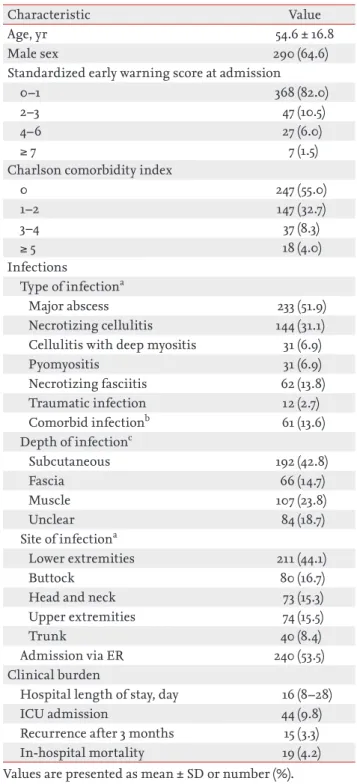
Patient characteristics are presented in Table 1. Of the 449 patients (mean age, 54 .6; 64.6% male) who were ad- mitted with a community-onset cSSSI, 415 (92.5%) were
≤ 3 in SEWS at the time of admission and 247 (55.0%) had no comorbidities. The leading type of infection was major abscess (n = 233, 51.9%), followed by necrotizing cellulitis (n = 144, 31.1%). More than two infectious diag- noses were made in 61 (13.6%) patients. The infections spread into subcutaneous tissues in 192 (42.8%) patients, reached below fascia in 173 (38.5%) patients and were most commonly found in the lower extremities (n = 211, 44.1%). More than half of the cSSSI patients were admit- ted via the emergency room (ER) (n = 240, 53.5%).
Clinical and economic burden
The median duration of hospital stay for cSSSI treat- ment was 16 days (IQR, 8 to 28). Admission to the inten- sive care unit (ICU) was necessary for 44 (9.8%) patients.
Recurrence of disease within 3 months was observed in 15 (3.3%) patients and 19 (4.2%) cases of in-hospital mor- tality were recorded (Table 1).
Table 1. Characteristics of study patients and clinical bur- den of community-onset complicated skin and skin struc- ture infections (n = 449)
Characteristic Value
Age, yr 54.6 ± 16.8
Male sex 290 (64.6)
Standardized early warning score at admission
0–1 368 (82.0)
2–3 47 (10.5)
4–6 27 (6.0)
≥ 7 7 (1.5)
Charlson comorbidity index
0 247 (55.0)
1–2 147 (32.7)
3–4 37 (8.3)
≥ 5 18 (4.0)
Infections
Type of infectiona
Major abscess 233 (51.9)
Necrotizing cellulitis 144 (31.1) Cellulitis with deep myositis 31 (6.9)
Pyomyositis 31 (6.9)
Necrotizing fasciitis 62 (13.8)
Traumatic infection 12 (2.7)
Comorbid infectionb 61 (13.6)
Depth of infectionc
Subcutaneous 192 (42.8)
Fascia 66 (14.7)
Muscle 107 (23.8)
Unclear 84 (18.7)
Site of infectiona
Lower extremities 211 (44.1)
Buttock 80 (16.7)
Head and neck 73 (15.3)
Upper extremities 74 (15.5)
Trunk 40 (8.4)
Admission via ER 240 (53.5)
Clinical burden
Hospital length of stay, day 16 (8–28)
ICU admission 44 (9.8)
Recurrence after 3 months 15 (3.3)
In-hospital mortality 19 (4.2)
Values are presented as mean ± SD or number (%).
ER, emergency room; ICU, intensive care unit.
aMultiple answers.
bThe patients who had comorbid infection of more than 2 type of infection.
cDeepest if multiple layers were involved.
Antibiotics 16%
Hospital care 31%
Surgery &
procedures 10% Imaging
16%test
Laboratory 14%test
Diagnostic test 3%
Other medications
10%
Economic burden
(Category of direct medical cost per person) Hospitalization cost
Antibiotics cost Other medications cost Diagnostic test cost Lab test cost Surgery & Procedures cost Imaging cost Total costs
Mean (KRW) ± SD
1,463,372 ± 1,338,877 726,373 ± 1,034,791 453,151 ± 1,674,181 128,948 ± 190,384 638,244 ± 946,410 725,708 ± 1,957,186 479,410 ± 539,396 4,614,997 ± 6,514,812
Mean (USD) ± SD
1,330 ± 1,217 660 ± 941 412 ± 1,522 117 ± 173 580 ± 860 660 ± 1,779 436 ± 490 4,195 ± 5,923
Figure 1. Economic burden of community-onset complicat- ed skin and skin structure infections. KRW, Korean won;
USD, United States dollar.
For cSSSI treatment, the mean total direct medical cost was $4,195 ± 5,923 per person. Hospitalization costs accounted for the maximum total direct medical cost, followed by the cost of antibiotics ($1,330 ± 1,217 and
$660 ± 941, respectively). Costs for surgical procedures and imaging tests were also high with a mean of $660 ± 1,779 and $436 ± 490, respectively (Fig. 1).
Distribution of pathogens
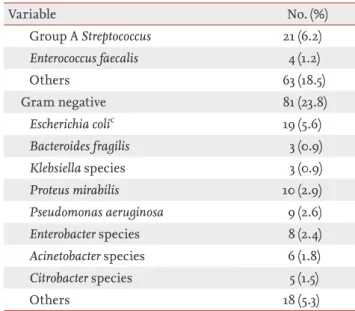
This study analyzed the tests of 449 patients whose spec- imens were obtained within 2 days after admission. As shown in Table 2, 297 (66.1%) of 449 patients were iden- tified by the microbiology test. Multiple pathogens were found in 37 (8.2%) patients; 13 (2.9%) had ≥ 2 gram-posi- tive pathogens, four (0.9%) had ≥ 2 gram-negative patho- gens, and 20 (4.5%) patients had both gram-positive and gram-negative pathogens (mixed pathogens). Superin- fection was observed in 69 patients, and among those
with superinfection 19 patients underwent two times of changes. Most specimens were taken from tissue, drain- age or an aspirated wound, and other specimens were taken from abscesses and pustules, while only 26 (8.6%) used blood cultures. Among culture confirmed patho- gens (episode = 340) which did not include coagulase negative Staphylococcus, Corynebacterium, Micrococcus spp.,
Bacillus spp. and gram-positive rods (episode = 9), mostof the infections were caused by gram-positive bacteria (episode = 259, 76.2%) which were mainly S. aureus (epi- sode = 140, 41.2%) and group B Streptococcus (episode = 31, 9.1%). There were 81 (23.8%) episodes of gram-negative bacterial infections.
Comparison by initial therapy
Initial therapy consisted of monotherapy and combined therapy. Monotherapy and combination therapy were determined according to the number of antibiotics in
Variable No. (%)
No growth 152 (33.9)
Any pathogen identified by microbiology test
297 (66.1)
Monomicrobial 260 (57.9)
Polymicrobial 37 (8.2)
≥ 2 Gram-positive pathogen (no gram-negative pathogens)
13 (2.9)
≥ 2 Gram-negative pathogen (no gram-positive pathogens)
4 (0.9) Mixed (both gram-positive and
-negative pathogens)
20 (4.5)
Superinfection
No 380 (84.6)
Yes 69 (15.4)
≥ 2 time 19 (4.2)
Specimen typea
Blood 26 (8.6)
Other 277 (91.4)
Microbiology results: culture-confirmed pathogens (episode case = 340)b
Gram positive 259 (76.2)
Staphylococcus aureus 140 (41.2)
Group B Streptococcus 31 (9.1)
Variable No. (%)
Group A Streptococcus 21 (6.2)
Enterococcus faecalis 4 (1.2)
Others 63 (18.5)
Gram negative 81 (23.8)
Escherichia colic 19 (5.6)
Bacteroides fragilis 3 (0.9)
Klebsiella species 3 (0.9)
Proteus mirabilis 10 (2.9)
Pseudomonas aeruginosa 9 (2.6)
Enterobacter species 8 (2.4)
Acinetobacter species 6 (1.8)
Citrobacter species 5 (1.5)
Others 18 (5.3)
aDefined as the first positive specimen during the episode.
Not counted if no specimen were positive. “Other” specimens included tissue, wound drainage or aspirate, and other mis- cellaneous specimens taken from abscesses, pustules, etc.
bDenominator for percent is the number of episodes with any positive pathogen (episode case = 340). Pathogen results were not mutually-exclusive. The following organisms were considered contaminants and not included: coagulase nega- tive Staphylococcus, Corynebacterium, Micrococcus spp., Bacillus spp., gram positive rods (episode case = 9).
cExtended spectrum β-lactamase producing bacteria was de- tected from Escherichia coli (1 case).
Table 2. Distributions of pathogens of community-onset complicated skin and skin structure infections (n = 449)
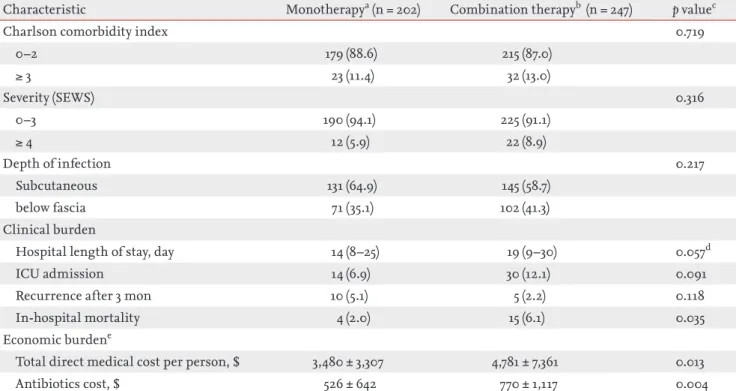
treatment. Regardless of the class counted in antibiot- ics, using only one antibiotic drug was defined as mono- therapy whereas using multiple antibiotics was consid- ered combination therapy. The proportion of CCI ≥ 3 in monotherapy and combined therapy were similar (11.4%
vs. 13.0%). The proportion of SEWS ≥ 4 and deep fas- cial space infections also were not significantly different (SEWS ≥ 4: 5.9% vs. 8.9%; and deep fascial space infec- tions: 35.1% vs. 41.3%, respectively). The median length of hospital stay for cSSSI treatment with combined ther- apy (19 days) was longer than but not significantly differ- ent from monotherapy (14 days). Admissions to the ICU in patients treated with monotherapy (6.9%) were low- er than combined therapy (12.1%), but a higher disease recurrence within 3 months was observed in patients
treated with monotherapy (5.1%) than combined thera- py (2.2%). However, these differences were not signifi- cant. The proportion of in-hospital mortality in patients treated with combined therapy (6.1%) was significantly higher than monotherapy (2.0%).
The total direct medical costs were compared accord- ing to the initial therapy for cSSSI treatment. The mean total cost for combined therapy was $4,781 ± 7,361 per person, which was higher than monotherapy ($3,480
± 3,307 per person). The antibiotic costs for combined therapy were also higher than monotherapy ($770 ± 1,117 and $526 ± 642, respectively). Both the mean total cost per person and antibiotic cost were significantly higher in combined therapy than monotherapy (Table 3).
Table 3. Comparison of clinical characteristics and economic burden by initial therapy for community-onset complicated skin and skin structure infections
Characteristic Monotherapya (n = 202) Combination therapyb (n = 247) p valuec
Charlson comorbidity index 0.719
0–2 179 (88.6) 215 (87.0)
≥ 3 23 (11.4) 32 (13.0)
Severity (SEWS) 0.316
0–3 190 (94.1) 225 (91.1)
≥ 4 12 (5.9) 22 (8.9)
Depth of infection 0.217
Subcutaneous 131 (64.9) 145 (58.7)
below fascia 71 (35.1) 102 (41.3)
Clinical burden
Hospital length of stay, day 14 (8–25) 19 (9–30) 0.057d
ICU admission 14 (6.9) 30 (12.1) 0.091
Recurrence after 3 mon 10 (5.1) 5 (2.2) 0.118
In-hospital mortality 4 (2.0) 15 (6.1) 0.035
Economic burdene
Total direct medical cost per person, $ 3,480 ± 3,307 4,781 ± 7,361 0.013
Antibiotics cost, $ 526 ± 642 770 ± 1,117 0.004
Values are presented as number (%), median (interquartile range), or mean ± SD.
SEWS, standardized early warning scoring; ICU, intensive care unit.
aMonotherapy and combination therapy were determined according to the number of antibiotics in treatment. In regardless of class counted in antibiotics, using only one antibiotic drug was defined as monotherapy whereas using multiple antibiotics was considered as combination therapy.
bUsing multiple antibiotics.
cp value by chi-square test.
dp value by Mann-Whitney test.
ep value by t test.
Factors related to mortality in cSSSI
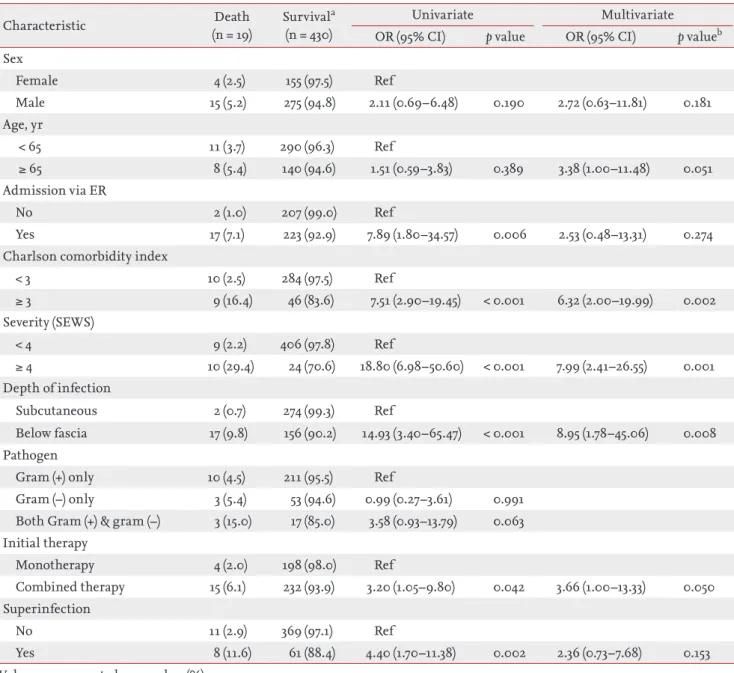
In terms of mortality factors, admission via the ER (odds ratio [OR], 7.89; p = 0.006), CCI ≥ 3 (OR, 7.51; p < 0.001), SEWS ≥ 4 (OR, 18.80; p < 0.001), deep fascial space in- fections (OR, 14.93; p < 0.001), combination therapy as initial therapy (OR, 3.20; p = 0.042) and the presence of pathogen change (OR, 4.40; p = 0.002) were significantly related to mortality as revealed by the univariate anal-
ysis by logistic regression. In the multivariate analysis adjusted by age, sex, and the statistically significant fac- tor noted in the univariate analysis, most factors were not significantly associated with mortality, except for comorbidity index, severity and depth of infection. In addition, combined initial therapy was marginally sig- nificant. These associations are presented in Table 4.
Table 4. Factors related with mortality in community-onset complicated skin and skin structure infections
Characteristic Death
(n = 19)
Survivala (n = 430)
Univariate Multivariate
OR (95% CI) p value OR (95% CI) p valueb Sex
Female 4 (2.5) 155 (97.5) Ref
Male 15 (5.2) 275 (94.8) 2.11 (0.69–6.48) 0.190 2.72 (0.63–11.81) 0.181
Age, yr
< 65 11 (3.7) 290 (96.3) Ref
≥ 65 8 (5.4) 140 (94.6) 1.51 (0.59–3.83) 0.389 3.38 (1.00–11.48) 0.051
Admission via ER
No 2 (1.0) 207 (99.0) Ref
Yes 17 (7.1) 223 (92.9) 7.89 (1.80–34.57) 0.006 2.53 (0.48–13.31) 0.274
Charlson comorbidity index
< 3 10 (2.5) 284 (97.5) Ref
≥ 3 9 (16.4) 46 (83.6) 7.51 (2.90–19.45) < 0.001 6.32 (2.00–19.99) 0.002
Severity (SEWS)
< 4 9 (2.2) 406 (97.8) Ref
≥ 4 10 (29.4) 24 (70.6) 18.80 (6.98–50.60) < 0.001 7.99 (2.41–26.55) 0.001
Depth of infection
Subcutaneous 2 (0.7) 274 (99.3) Ref
Below fascia 17 (9.8) 156 (90.2) 14.93 (3.40–65.47) < 0.001 8.95 (1.78–45.06) 0.008 Pathogen
Gram (+) only 10 (4.5) 211 (95.5) Ref
Gram (–) only 3 (5.4) 53 (94.6) 0.99 (0.27–3.61) 0.991
Both Gram (+) & gram (–) 3 (15.0) 17 (85.0) 3.58 (0.93–13.79) 0.063 Initial therapy
Monotherapy 4 (2.0) 198 (98.0) Ref
Combined therapy 15 (6.1) 232 (93.9) 3.20 (1.05–9.80) 0.042 3.66 (1.00–13.33) 0.050 Superinfection
No 11 (2.9) 369 (97.1) Ref
Yes 8 (11.6) 61 (88.4) 4.40 (1.70–11.38) 0.002 2.36 (0.73–7.68) 0.153
Values are presented as number (%).
OR, odds ratio; CI, confidence interval; ER, emergency room; SEWS, standardized early warning scoring.
aValues are number of patients and percentage in each group; p value by logistic regression.
bp = 0.942 by Hosmer and Lemeshow test.
DISCUSSION
In the present study, we identified epidemiological characteristics, clinical/economic burden and the fac- tors associated with the burdens of community-onset cSSSIs patients in Korea. Of the detected cSSSIs, ma- jor abscess and cellulitis were predominant. More than one-third of the patients had deep fascial space infec- tions. Approximately 40% of culture confirmed patho- gens were S. aureus. These results are consistent with previous epidemiologic studies in Europe and the Unit- ed States [10,12].
The clinical burden of community-onset cSSSI ob- served in our study was notable. The median hospi- talization period was > 2 weeks and almost 10% of the patients were admitted to the ICU. In addition, 3.3% of patients had a relapse within three months after treat- ment, and 4.2% of patients died while admitted to the hospital. A similar mortality rate is reported in a previ- ously conducted European study [10]. The factors indi- cating more severe conditions at baseline such as higher CCI score (≥ 3), higher SEWS (≥ 4) and infection below fascia were associated with increased mortality risk.
In addition to the baseline severity of infection, a high economic burden of disease was seen. The total medi- cal costs were $4,195 per person. These costs for cSSSI treatment are much lower than those reported in the USD $48,033 [11], especially when considering the pub- lic reimbursement system by the Korean government and economic gap between Korea and the United States.
Over 50% of the total medical costs were comprised of costs for admission and treatment in this study. Never- theless, total costs and mean cost of antibiotics for com- bined therapy were relatively higher than monotherapy.
Since higher clinical and economic burdens of CSSSI were proven, it is essential to investigate the potential factors associated with severe disease burdens. Among many factors, the failure of initial antibiotic therapy was found to be significantly related to the unfavorable clin- ical and economic outcomes [13]. In this study, we cate- gorized the initial therapy into two types, monotherapy versus combination therapy, and compared their clini- cal and economic outcomes. As a result, patients treated with combination therapy showed longer hospital stays and higher in-hospital mortality than those on mono- therapy. Likewise, medical costs were higher in combi-
nation therapy than monotherapy. However, direct as- sociation or causal relationship between two therapeutic types and disease outcomes might be clarified in further studies which should be well designed prospectively.
Several studies investigating epidemiological charac- teristics, clinical outcomes, and treatment cost of cSSSI patients have been conducted in foreign countries. To the best of our knowledge, this is the very first study that observed epidemiological characteristics, clinical and economic burden of community-onset cSSSI patients, reflecting real world clinical practice in Korea. Further- more, since this study was a nationwide study conduct- ed in multiple centers across Korea, its outcomes are representative of the population and are applicable to the general population. It follows that the results of this study are expected to improve awareness of the disease burden of community-onset cSSSIs in Korean patients, and will encourage clinicians to select appropriate monotherapy as the initial treatment option.
This study has several limitations, some of which stem from its retrospective design. This study exclud- ed a large number of patients with cSSSIs who did not complete treatment in the hospital; this was important since this study focused on the disease burden from di- agnosis to treatment completion. In addition, this study did not consider the events that occurred outside of the hospital, so the mortality rate should be interpret- ed carefully. Moreover, it should be acknowledged that due to the nature of cost data in non-normal distribu- tion, the data on medical cost was skewed to one side, which resulted in the large standardized deviation. So, the direct medical costs should be cautiously evaluated.
Finally, only direct medical costs were considered, and thus, the actual economic burden due to cSSSIs in Kore- an patients is higher when indirect costs are considered.
Further study of these medical expenses could provide a holistic understanding of cSSSI management from the Korean context.
KEY MESSAGE
1. The epidemiological characteristics of Korean
community-onset complicated skin and skin
structure infection (cSSSI) patients were similar
to patients with cSSSI in other countries. Kore-
an patients with community-onset cSSSI suffer
Conflict of interest
This study was sponsored by Pfizer Pharmaceuticals Ko- rea Ltd.
Acknowledgments
The following investigators also participated in the study: Yong Kyun Cho, Department of Internal Medi- cine, Gachon University Gil Hospital; Jacob Lee, De- partment of Internal Medicine, Kangnam Sacred Heart Hospital; Heung Jeong Woo, Department of Internal Medicine, Hangang Sacred Heart Hospital; Seong Yeol Ryu, Department of Internal Medicine, Keimyung Uni- versity Dongsan Medical Center; Chi Sook Moon, De- partment of Internal Medicine, Inje University Pusan Paik Hospital; Sang Hoon Han, Department of Internal Medicine, Severance Hospital, Yonsei University Health System; Young Goo Song, Department of Internal Med- icine, Kangnam Severance Hospital, Yonsei University College of Medicine; You Mi Jo, Department of Internal Medicine, Korea University Guro Hospital; Shin Woo Kim, Department of Medicine, Kyungpook National University Hospital; Hyuck Lee, Department of Internal Medicine, Dong-A University Hospital; In Gyu Bae, In- fection Control Office, Gyeongsang National University Hospital; Jian Hur, Department of Medicine, Yeungnam University Medical Center; Hee Jung Choi, Department of Medicine, Ewha Womans University Mokdong Hos- pital; Hee Jin Cheong, Department of Internal Medi- cine, Korea University Guro Hospital.
REFERENCES
1. Stevens DL, Bisno AL, Chambers HF, et al. Practice guide- lines for the diagnosis and management of skin and soft tissue infections: 2014 update by the Infectious Diseases Society of America. Clin Infect Dis 2014;59:e10-e52.
2. Center for Drug Evaluation and Research, Food and Drug Administration. Guidance for Industry: Uncomplicated and Complicated Skin and Skin Structure Infections—
Developing Antimicrobial Drugs for Treatment. Wash- ington, DC: Food and Drug Administration, US Depart- ment of Health and Human Services, 1998.
3. May AK, Stafford RE, Bulger EM, et al. Treatment of complicated skin and soft tissue infections. Surg Infect (Larchmt) 2009;10:467-499.
4. Nichols RL. Optimal treatment of complicated skin and skin structure infections. J Antimicrob Chemother 1999;44:19-23.
5. DiNubile MJ, Lipsky BA. Complicated infections of skin and skin structures: when the infection is more than skin deep. J Antimicrob Chemother 2004;53:ii37-ii50.
6. Doern GV, Jones RN, Pfaller MA, Kugler KC, Beach ML.
Bacterial pathogens isolated from patients with skin and soft tissue infections: frequency of occurrence and antimicrobial susceptibility patterns from the SENTRY Antimicrobial Surveillance Program (United States and Canada, 1997). SENTRY Study Group (North America).
Diagn Microbiol Infect Dis 1999;34:65-72.
7. Lee SY, Kuti JL, Nicolau DP. Antimicrobial management of complicated skin and skin structure infections in the era of emerging resistance. Surg Infect (Larchmt) 2005;6:283-295.
8. Hook EW 3rd, Hooton TM, Horton CA, Coyle MB, Ram- sey PG, Turck M. Microbiologic evaluation of cutaneous cellulitis in adults. Arch Intern Med 1986;146:295-297.
9. McHenry CR, Piotrowski JJ, Petrinic D, Malangoni MA.
Determinants of mortality for necrotizing soft-tissue in- fections. Ann Surg 1995;221:558-563.
10. Garau J, Ostermann H, Medina J, et al. Current manage- ment of patients hospitalized with complicated skin and soft tissue infections across Europe (2010-2011): assess- ment of clinical practice patterns and real-life effective- ness of antibiotics from the REACH study. Clin Microbi- ol Infect 2013;19:E377-E385.
11. Itani KM, Merchant S, Lin SJ, Akhras K, Alandete JC, Ha- toum HT. Outcomes and management costs in patients
from substantial clinical and economic burden;
they were admitted to the hospital for approx- imately 16 days, the infection recurred in 3.3%
of the patients within 3 months post treatment, 4.2% of the patients died, and overall $4,195 was spent per capita for cSSSI treatment.
2. The mortality rate increased in patients with
more severe baseline characteristics. This high-
lights the importance of reducing patients’ bur-
den of disease through appropriate and simple
initial treatment.
hospitalized for skin and skin-structure infections. Am J Infect Control 2011;39:42-49.
12. Zilberberg MD, Shorr AF, Micek ST, et al. Epidemiology and outcomes of hospitalizations with complicated skin and skin-structure infections: implications of health- care-associated infection risk factors. Infect Control Hosp
Epidemiol 2009;30:1203-1210.
13. Edelsberg J, Berger A, Weber DJ, Mallick R, Kuznik A, Oster G. Clinical and economic consequences of failure of initial antibiotic therapy for hospitalized patients with complicated skin and skin-structure infections. Infect Control Hosp Epidemiol 2008;29:160-169.