1. 서론1)
1.1. 연구의 배경 및 목적
미국의 에너지부에서 발표한 2011 Buildings Energy Data Book 에 의하면 건물부문에서 차지하는 조명에너지 사용량은 9%로 냉난 방 에너지 다음으로 높게 나타나고 있으며, 조명에너지 사용량은 점 차 증가할 것이라 예측하고 있다[1]. 또한, 에너지문제에 대한 심각 성이 부각되면서 건축환경 분야에서도 제로에너지를 지향하며, 이 를 위한 연구와 기술개발들이 지속적으로 진행 중에 있다. 이중 광선 반은 외부 자연광을 광선반 반사판의 반사를 통하여 실내 깊숙이 유 입시켜 조명에너지를 저감시키는 자연채광시스템으로 조명에너지 저감 및 실내 빛환경 개선의 효율을 인정받아 다양한 연구와 기술 개
pISSN 2288-968X, eISSN 2288-9698 http://dx.doi.org/10.12813/kieae.2017.17.3.083
발이 진행 중에 있다. 그러나 광선반은 창호에 부착되는 부착물로써 조망권을 훼손할 수 있으며, 운량이 많은 흐린 날의 경우에는 채광성 능이 현저히 떨어질 수 있다는 단점을 가지고 있으나 이를 해결하고 자 하는 연구는 부족한 실정이다. 최근까지 수행된 광선반 관련 선행 연구는 계절 및 시간대에 따른 특정 외부조도를 반영하고 있으나 기 상 등의 다양한 요인에 의하여 발생할 수 있는 외부조도를 변인으로 반영하지 않고 있다.
이에 본 연구는 일차적으로 실스케일의 테스트베드를 기반으로 하는 광선반 성능평가를 통하여 광선반의 채광성능을 확보할 수 있 는 외부조도의 기준을 마련하며, 이후 외부조도를 수집하여 광선반 의 채광성능이 현저하게 떨어지는 경우 광선반의 반사판의 높이 조 절을 통한 개폐 개념의 광선반 제안을 목적으로 한다.
1.2. 연구의 방법 및 범위
KIEAE Journal
Korea Institute of Ecological Architecture and Environment
85
개폐 개념의 높이 조절이 가능한 광선반 개발 연구
- 외부조도에 따른 광선반 성능평가 중심으로
Research of the Development of a Height-adjustable light-shelf based on an Open and Closed Concept
- Focusing on the light-shelf Performance Evaluation Depending on the External Illumination-
김수린*⋅이행우**⋅송석재***⋅김용성****
Kim, Surin*⋅Lee, Heangwoo**⋅Song, Seonkjae***⋅Kim, Yongseong****
* Dept. of Architectural Design, Graduate School of Techno Design, Kookmin University., South Korea ([email protected]) ** Dept. of Architectural Design, Graduate School of Techno Design, Kookmin University., South Korea ([email protected]) *** Dept. of Architectural Design, Graduate School of Techno Design, Kookmin University., South Korea ([email protected])
**** Dept. of Architectural Design, Graduate School of Techno Design, Kookmin University., South Korea ([email protected])
A B S T R A C T K E Y W O R D
Purpose: With the increase in the energy consumption in the building sector, many studies have recently been conducted to address this issue. Due to its efficiency, diverse studies on a light-shelf, which is a natural lighting system, are in progress. However, there has been no research on the external illumination that determines the performance of a light-shelf. Therefore, the present study aimed to prepare the external illumination standard for securing the lighting performance of a light-shelf through the light-shelf performance evaluation based on a 1:1 scale testbed, and to suggest a height-adjustable light-shelf based on an open and closed concept for the case in which the lighting performance of the light-shelf significantly deteriorates, by collecting the external illumination. Method: In this study, a 1:1 scale testbed was established for performance evaluation, and the external illumination standard for securing the performance of the light-shelf was prepared by comparing the lighting performance of the light-shelf depending on the open and closed condition of the light-shelf and the external illumination. Result: 1) In this study, a light-shelf that can be opened or closed depending on the external illumination was suggested. As a result, the prospect right can be secured by creating the condition where there is no light-shelf installation by moving the light-shelf to the top of the window when the lighting performance is not secured. 2) In the summer solstice, the external illuminations appropriate for lighting energy reduction were more than 75,000 lx and 60,000 lx for the light-shelf width of 0.3 m and 0.6 m, respectively. 3) In the intermediate period, the external illumination appropriate for lighting energy reduction was 60,000 lx. In the winter solstice, making the condition where there is no light-shelf installation by closing the light-shelf would be appropriate. 4) Based on the aforementioned results, the external illumination standard for the opening and closing of the height-adjustable light-shelf based on an open and closed concept suggested in this study was 60,000 lx, and the light-shelf with a width of 0.6 m would be advantageous for lighting energy reduction.
ⓒ 2017 KIEAE Journal 광선반 개폐 외부조도 성능평가 에너지저감
Light-shelf Opening and closing External Illuminance Performance Evaluation Energy Saving
A C C E P TA N C E I N F O Received Mar 22, 2017
Final revision received Apr 10, 2017 Accepted Apr 15, 2017
본 연구는 외부조도에 따른 광선반 조명에너지 저감 성능평가를 실시하며, 이후 외부조도에 따라서 채광성능이 떨어지는 경우 광선 반의 높이조절을 통한 개폐가 가능한 광선반을 제안하였다. 이를 위 하여 본 연구는 <Fig. 1>에서 나타나듯이 다음의 절차에 의거하여 진행하였다.
첫 번째, 문헌고찰 단계로 광선반의 개념 및 선행연구를 고찰하였 다. 또한, 광선반 성능평가를 위한 실내 적정조도 기준을 제시하기 위하여 국내의 조도기준을 고찰하였다. 두 번째, 외부조도에 따라서 채광성능이 떨어질 경우에는 광선반을 창의 상부로 이동시키는 개 폐 개념의 광선반을 제안하였다. 본 연구는 광선반의 성능평가를 위 하여 실스케일의 테스트베드를 구축하였으며, 외부조도에 따른 광 선반 채광성능 및 조명에너지 저감의 유효성을 파악하였다.
단, 본 연구는 외부조도의 설정을 용이하도록 인공태양광 조사장 치를 활용하였으며, 본 연구에서 사용된 인공태양광 조사장치의 기 기적 제약사항으로 인하여 정남향 방향에 국한하여 성능평가를 진 행하였다.
Literature review
• Concept of light-shelf
• Optimum indoor illumination standard
• Previous research on light-shelf
Suggestion of a height-adjustable light-shelf based on an open and closed concept
light-shelf performance evaluation depending on the external illumination
• Calculation of the indoor illumination distribution and lighting energy consumption depending on the external illumination and light-shelf variable
• Calculation of the optimum external illumination for securing the lighting performance of the light-shelf
Conclusion
Fig. 1. Flowchart of the study
2. 광선반의 개념 및 실내적정 조도 기준
2.1. 광선반의 개념 및 연구동향
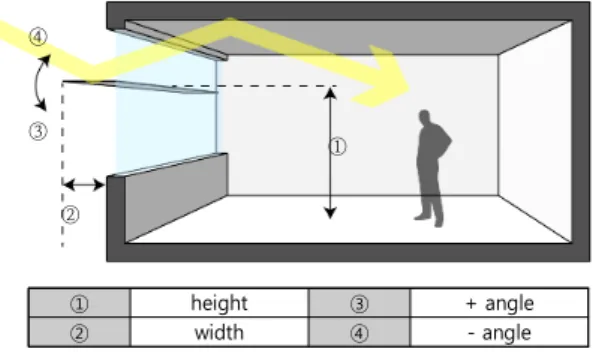
광선반은 <Fig. 2>에서 나타나듯이 외부 자연광을 광선반의 반사 판 및 실내공간의 천장면의 순서에 의한 반사로 실내 깊숙이 유입시 키는 자연채광시스템으로 효율적인 조명에너지 저감이 가능하다.
또한, 광선반은 창을 통하여 과도한 빛이 실내로 유입되는 것을 막 아서 균등한 실내 빛환경 조성의 역할도 한다. 이러한 광선반의 채 광성능을 결정하는 변인은 높이, 폭, 각도, 반사율이 있다.
②
③ ①
④
①② heightwidth ③④ + angle- angle Fig. 2. Concept and variable of light-shelf
광선반은 자연채광시스템으로 외부 환경요인에 의하여 성능이 결정되어지며, 이에 따라서 운량이 적은 맑은 날의 경우 광선반의 채 광성능은 우수할 수 있으나 야간 및 운량이 많은 흐린 날의 경우에 는 외부조도가 낮아져 광선반의 성능은 현저히 저하될 수 있다. 이러 한 측면에서 외부조도에 따른 광선반의 성능평가는 중요한 요인이 나 이에 관련한 연구는 부재한 상태이며[2-11], <Table 1>에서 나 타나듯이 광선반 관련 선행연구를 고찰 시 단순 절기에 의한 특정 조 도 및 시간대별 외부조도를 적용하는 수준으로 나타나고 있다.
Title of Study Year
Environmental factors relevant to external
illumination Analysis and estimate the
performance of lightshelf system using lightscape[2]
2003
Reflection of specific illumination depending on
the time Daylighting Performance Evaluation
of Lightshelf Window System by Lightscape[3]
2004
Development and Performance Evaluation of a Sloped Lightshelf
Daylighting System[4]
2004
Scale Model Experiment for Daylighting Performance by
Lightshelf Types[5]
2005
A Study on the Daylighting Performance in the Office Space
with Double-lightshelf[6]
2006
Reflection of illumination depending on the date
and time Daylighting Performance Evaluation
of window Integrated Light shelf System[7]
2007
Reflection of specific external illumination depending on the season Evaluation of Daylighting
Performance and Design of a Curved-Lightshelf by the Ray
Tracing Method[8]
2011
The daylighting and energy performance evaluation of a polycarbonate lightshelf[9]
2013 Reflection of specific illumination depending on
the time Development of Rolling type
Light-Shelf with adgustable Reflectivity[10]
2013
Performance of Mixed Type Light-shelf in Residential Space According to Angular Variations[11]
2014
Reflection of specific external illumination depending on the season Table 1. Advance research of Light-shelf
2.2. 실내공간의 적정조도 기준 고찰
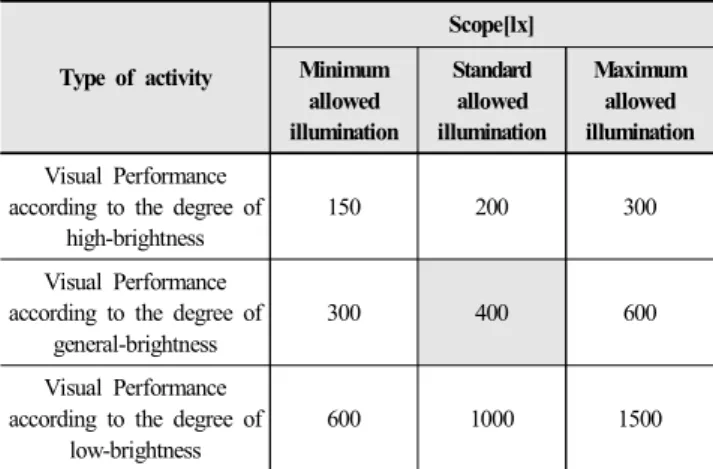
한국의 경우에는 실내공간의 조도기준을 <Table 2>에서 나타나 듯이 KS A 3011으로 제시하고 있으며, KS A 3011은 활동유형에 따 라서 실내 요구조도를 최저, 표준, 최고로 구분하여 제시하고 있다 [12]. 이에 본 연구는 성능평가를 위한 실내 적정 조도 및 조명제어를 위한 기준으로 일반 휘도 대비 시작업의 표준조도인 400 lx로 설정하 였다.
Type of activity
Scope[lx]
Minimum allowed illumination
Standard allowed illumination
Maximum allowed illumination Visual Performance
according to the degree of high-brightness
150 200 300
Visual Performance according to the degree of
general-brightness
300 400 600
Visual Performance according to the degree of
low-brightness
600 1000 1500
Table 2 KS A 3011 : Standard lux
3. 제안 및 성능평가
3.1. 개폐 개념의 높이 조절이 가능한 광선반 제안 본 연구는 <Fig. 3>에서 나타나듯이 높이 조절이 가능한 광선반 의 개폐 개념을 적용하였다. 광선반의 닫는 상태는 외부조도가 낮아 서 채광성능이 확보가 안되는 상태로 창의 상단으로 광선반이 이동 하여 90°로 닫혀지며, 이는 광선반 미설치와 동일한 형태를 가진다.
광선반이 열린 상태는 광선반의 채광성능이 확보 가능한 외부조도 가 유지될 경우 채광성능이 가장 우수하게 나타나는 높이 1.8m로 내 려오는 상태로 지정하였다[13]. 본 연구는 광선반의 채광성능 확보 가 가능한 외부조도에 대하여 3장 4절에 성능평가를 통하여 제시하 고 있다. 또한 광선반의 개폐를 결정짓는 외부조도를 측정하는 센서 는 광선반이 설치되는 창측의 상단부에 위치시켰다.
본 연구에서 제안하는 광선반의 가동 절차는 다음과 같다. 첫 번 째, 재실자가 입실전 광선반은 창측 상단에 90°로 닫혀진 상태로 위 치해 있으며, 두 번째, 재실자가 입실시 창호 상단에 부착된 조도센 서의 조도값을 모니터링 및 수집한다. 세 번째, 조도센서의 측정값 이 채광성능 확보를 위한 외부조도 기준을 만족하지 않을시 가동하 지 않으며, 이는 재실자에게 조망권 확보와 함께 광선반의 불필요한 차양으로 인한 실내 빛환경 쾌적도 저하를 막는다. 단, 조도센서의 측정값이 채광성능 확보를 위한 외부조도 기준을 만족시 광선반은 높이 1.8m로 이동하여 채광을 실시하며, 실시간으로 조도 값을 측 정하여 외부조도값이 광선반의 채광성능 확보를 위한 외부조도 기 준을 만족하지 못할시 창의 상단으로 재가동하여 닫히도록 하였다.
Illuminance sensor
Height control
Closed condition of the light-shelf (light-shelf angle: 90°)
Open condition of the light-shelf (-10°∼30° control)
1 Step) Before an occupant enters the room, the light-shelf is in the closed condition (90°).
2 Step) When an occupant enters the room, the illumination sensor senses the external illumination.
3 Step) The light-shelf is operated to be in the open condition depending on the external illumination.
4 Step) The light-shelf is re-operated to be in the closed condition when the light-shelf lighting performance is not secured.
Fig. 3. Concept and control of the height-adjustable light-shelf based on an open and closed concept
3.2. 성능평가를 위한 설정
테스트베드는 <Table 3>에서 나타나듯이 폭 4.9m, 깊이 6.6m, 높 이 2.5m의 크기이며, 광선반이 설치되는 창의 크기는 폭 2.2m, 높이 1.8m이다. 창의 크기는 국토해양부의 창호 설계 가이드라인에 제 시하는 창면적비 40%를 근거하여 조정한 결과이다. 또한, 테스트베 드 천장에 8단계 디밍 조명제어가 가능한 LED타입의 조명을 4개소 설치하였으며, 조명의 위치는 IES 4점범에 근거하였다.
테스트베드는 외부조도의 설정을 위하여 광원의 광량, 높이 및 각 도 조절이 가능한 인공태양광 조사장치를 구축하였으며, 앞서서 언 급하였듯이 본 연구의 인공태양광 조사장치는 기기의 제한적 특성 으로 인하여 정남향에 대하여만 성능평가를 진행하였다.
Room size, Material
4.9m(W) × 6.6m(D), 2.5m(Celling height) Reflexibility : Ceiling(86%), Wall(46%), Floor(25%)
Window size, Material
2.2m(W) × 1.8m(H), Pair glass 12mm (3mm + 6mm + 3mm)
Transmissivity : 80%
Illuminance sensor
Sensing element: NTC 10KΩ: AN Type Detection range: -40 ~ +90℃
Precision: ±0.3℃
Lighting
8 Level dimming(LED type), Electricity consumption according to the level of
dimming lighting control:
lv 1(12W), lv 2(18W), lv 3(22W), lv 4(28W), lv 5(34W), lv 6(39W),
lv 7(43W), lv8(51W)
Direction South
Table 3 Setting of test-bed
본 연구의 중요 변인의 외부조도는 관련연구를 근거하여 <Table 4>에서 나타나듯이 하지, 중간기, 동지에 대하여 각각 최대 80,000 lx, 60,000 lx, 30,000 lx로 설정하였으며[14], 5,000 lx 단위로 구분 하여 성능평가를 진행하였다. 또한, 하지, 중간기 및 동지의 외부조 도 최저값은 10,000 lx로 설정하여 성능평가를 진행하였으며, 이는 흐린 날의 외부조도가 5,000 lx에서 20,000 lx사이라는 내용을 근거 하였다[15].
Season Meridian transit
altitude External illumination setting
Summer 76.5 80,000 lx ∼ 10,000 lx
(at 5,000 lx intervals) Middle
season 53 60,000 lx ∼ 10,000 lx
(at 5,000 lx intervals)
Winter 29.5 30,000 lx ∼ 10,000 lx
(at 5,000 lx intervals) Table 4. External illumination and meridian transit altitude for
performance evaluation
성능평가를 위한 실내 조도센서의 위치는 <Fig. 4>에서 나타나듯이 실내 평균 조도를 측정하는 위치가 채광창으로부터 4.4m가 적합하다 는 연구를 근거하였으며[16], 공간의 크기를 고려하여 1.1m 간격으로 10개의 조도센서를 배치하였다. 또한, 조도센서의 높이는 KS 조도 측 정기준에서 제시하고 있는 바닥면 위 80±5cm를 근거하여 바닥으로 부터 75cm지점에 위치시켰다[12]. 본 연구의 외부조도를 측정하는 조 도센서는 광선반이 닫혀 있을 경우 간섭이 일어나지 않는 창의 상부 외
: Lighting, : Illumination sensor Solar simulation
system
Light-Shelf Chamber
1 2
4 3
Illumination sensor 1
Illumination sensor 2
Illumination sensor 3
Illumination sensor 4
Illumination sensor 5
Illumination sensor 6
Illumination sensor 7
Illumination sensor 8
Illumination sensor 9
Illumination sensor 10
Solar simulation
system
Light-Shelf external Illumination
sensor
Fig. 4. Plane and section of testbed
성능평가를 위한 광선반 변인 설정은 <Table 5>에서 나타나듯이 기존 연구를 근거하여 설정하였으며[17], 광선반의 높이는 열고 닫 히는 개폐의 개념으로 각각 1.8m 및 2.5m로 설정하였다. 또한, 광선 반의 폭은 성능이 우수하게 나타나는 0.3m, 0.6m로 설정하였으며, 광선반의 각도는 –10°에서 30°를 범위로 10° 단위 간격으로 설정 하였다.
Light-shelf variable Range
Width(m) 0.3, 0.6 (External type)
Height(m) 1.8, 2.5
Angle -10°~30° (at 10° intervals) Reflexibility specular reflection film (reflexibility 85%) Table 5 Setting of the light-shelf variables
3.3. 성능평가 방법
외부조도에 따른 광선반 성능평가 방법은 다음과 같다.
첫 번째, 본 연구는 외부조도에 따른 광선반의 성능평가를 실시하 였으며, 각 변인에 따른 실내조도 분포를 기반으로 최소조도, 평균 조도 및 균제도를 도출하였다. 두 번째, 외부조도 및 광선반 변인에 따라서 도출되는 실내 조도센서 값을 근거로 조명제어를 실시하였 으며, 본 연구에서 설정된 변인에 따라서 실내의 조도센서 측정값이 400 lx 미만의 값이 있을 경우 조명제어를 실시하도록 하였다. 조명 제어는 가장 낮은 조도 값을 보이는 실내 조도센서와 근접한 조명부 터 순차적으로 조명 디밍제어를 실시하도록 하였으며, 조명 디밍제 어 중 조도센서의 측정값이 모두 400 lx를 만족할 경우에는 조명제 어를 종료하도록 하였다. 세 번째, 본 연구는 조명 디밍제어 종료시
External Illuminance(lx)
Light-shelf Illumination(lx) Uniformity factor
Lighting dimming control : Lighting Number(Dimming level)
Lighting energy consumption(kWh)
Increase or decrease in the lighting energy relative to the
closed condition Width(m) Height(m) Angle Min. Ave.
80,000 0.3 2.5 90 87.5 365.1 0.240 1(8)→3(8) 0.102 -
1.8 -10 85.1 384.2 0.222 1(8)→3(8) 0.102 No increase or decrease
0 85.8 398.3 0.215 1(8)→3(8) 0.102 No increase or decrease
10 90.8 402.7 0.226 1(8)→3(8) 0.102 No increase or decrease
20 96.2 411.8 0.234 1(8)→3(7) 0.093 8.8% decrease
30 102.9 411.0 0.250 1(8)→3(7) 0.093 8.8% decrease
0.6 2.5 90 87.5 365.1 0.240 1(8)→3(8) 0.102 -
1.8 -10 86.7 362.6 0.239 1(8)→3(8) 0.102 No increase or decrease
0 85.9 420.3 0.204 1(8)→3(8) 0.102 No increase or decrease
10 91.2 427.3 0.213 1(8)→3(7) 0.093 8.8% decrease
20 105.3 434.1 0.243 1(8)→3(6) 0.089 12.7% decrease
30 107.8 434.8 0.248 1(8)→3(6) 0.089 12.7% decrease
75,000 0.3 2.5 90 82.1 342.3 0.240 1(8)→3(8) 0.102 -
1.8 30 96.4 385.3 0.250 1(8)→3(7) 0.093 8.8% decrease
0.6 2.5 90 82.1 342.3 0.240 1(8)→3(8) 0.102 -
1.8 20 98.7 407.0 0.243 1(8)→3(7) 0.093 8.8% decrease
30 101.0 407.6 0.248 1(8)→3(7) 0.093 8.8% decrease
70,000 0.3 2.5 90 76.6 319.4 0.240 1(8)→3(8) 0.102 No increase or decrease
1.8 -10 74.5 336.2 0.222 1(8)→3(8) 0.102 No increase or decrease
0 75.1 348.5 0.215 1(8)→3(8) 0.102 No increase or decrease
10 79.5 352.4 0.226 1(8)→3(8) 0.102 No increase or decrease
20 84.2 360.3 0.234 1(8)→3(8) 0.102 No increase or decrease
30 90.0 359.6 0.250 1(8)→3(8) 0.102 No increase or decrease
0.6 2.5 90 76.6 319.4 0.240 1(8)→3(8) 0.102 No increase or decrease
1.8 30 94.3 380.4 0.248 1(8)→3(7) 0.093 ````
60,000 0.6 2.5 90 65.6 273.8 0.240 1(8)→3(8)→2(1) 0.114 -
20 72.5 314.3 0.231 1(8)→3(8) 0.102 10.5% decrease
55,000 0.3 2.5 90 59.6 248.7 0.240 1(8)→3(8)→2(2) 0.120 -
1.8 -10 52.6 237.3 0.222 1(8)→3(8)→2(3) 0.124 3.2% increase
0 53.0 239.2 0.222 1(8)→3(8)→2(3) 0.124 3.2% increase
10 56.1 240.2 0.234 1(8)→3(8)→2(3) 0.124 3.2% increase
20 57.2 241.1 0.237 1(8)→3(8)→2(3) 0.124 3.2% increase
30 58.5 242.5 0.241 1(8)→3(8)→2(3) 0.124 3.2% increase
0.6 2.5 90 59.6 248.7 0.240 1(8)→3(8)→2(2) 0.120 -
1.8 -10 53.0 236.5 0.224 1(8)→3(8)→2(3) 0.124 3.2% increase
0 56.3 240.8 0.234 1(8)→3(8)→2(3) 0.124 3.2% increase
10 61.0 254.1 0.240 1(8)→3(8)→2(2) 0.120 No increase or decrease
20 60.5 258.5 0.234 1(8)→3(8)→2(2) 0.120 No increase or decrease
30 62.1 268.9 0.231 1(8)→3(8)→2(2) 0.120 No increase or decrease
50,000 0.3 2.5 90 54.7 228.2 0.240 1(8)→3(8)→2(3) 0.124 -
1.8 -10 42.6 192.1 0.222 1(8)→3(8)→2(5) 0.136 9.7% increase
0 42.9 199.2 0.215 1(8)→3(8)→2(5) 0.136 9.7% increase
10 45.4 201.4 0.226 1(8)→3(8)→2(5) 0.136 9.7% increase
20 48.1 205.9 0.234 1(8)→3(8)→2(4) 0.129 4.0% increase
30 51.4 205.5 0.250 1(8)→3(8)→2(4) 0.129 4.0% increase
0.6 2.5 90 54.7 228.2 0.240 1(8)→3(8)→2(3) 0.124 -
1.8 -10 43.4 181.3 0.239 1(8)→3(8)→2(5) 0.136 9.7% increase
0 42.9 210.1 0.204 1(8)→3(8)→2(5) 0.136 9.7% increase
10 45.6 213.6 0.213 1(8)→3(8)→2(4) 0.129 4.0% increase
20 52.6 217.0 0.243 1(8)→3(8)→2(4) 0.129 4.0% increase
30 53.9 217.4 0.248 1(8)→3(8)→2(4) 0.129 4.0% increase
Table 6. Light-shelf performance evaluation depending on the external illumination (summer)
External Illuminance(lx)
Light-shelf Illumination(lx) Uniformity factor
Lighting dimming control : Lighting Number(Dimming level)
Lighting energy consumption(kWh)
Increase or decrease in the lighting energy relative to the
closed condition Width(m) Height(m) Angle Min. Ave.
60,000 0.3 2.5 90 140.2 4868.9 0.029 1(8)→3(3) 0.073 -
1.8 -10 138.2 4798.5 0.029 1(8)→3(3) 0.073 No increase or decrease
0 140.3 4837.5 0.029 1(8)→3(3) 0.073 No increase or decrease
10 143.0 4844.8 0.030 1(8)→3(2) 0.069 5.4% decrease
20 148.2 4856.2 0.031 1(8)→3(2) 0.069 5.4% decrease
30 153.5 4857.3 0.032 1(8)→3(2) 0.069 5.4% decrease
0.6 2.5 90 140.2 4868.9 0.029 1(8)→3(3) 0.073 No increase or decrease
1.8 -10 130.7 4800.3 0.029 1(8)→3(3) 0.073 No increase or decrease
0 137.7 4807.0 0.027 1(8)→3(3) 0.073 No increase or decrease
10 140.1 4835.5 0.029 1(8)→3(3) 0.073 No increase or decrease
20 149.3 4856.7 0.031 1(8)→3(2) 0.069 5.4% decrease
30 151.4 4862.3 0.031 1(8)→3(2) 0.069 5.4% decrease
55,000 0.3 2.5 90 128.3 4462.2 0.029 1(8)→3(3) 0.073 -
1.8 -10 126.7 4398.6 0.029 1(8)→3(3) 0.073 No increase or decrease
0 128.6 4434.4 0.029 1(8)→3(3) 0.073 No increase or decrease
10 131.1 4441.0 0.030 1(8)→3(3) 0.073 No increase or decrease
20 135.8 4451.5 0.031 1(8)→3(3) 0.073 No increase or decrease
30 128.3 4462.2 0.029 1(8)→3(3) 0.073 No increase or decrease
0.6 2.5 90 128.3 4462.2 0.029 1(8)→3(3) 0.073 -
1.8 -10 114.6 4399.8 0.026 1(8)→3(3) 0.073 No increase or decrease
0 126.3 4407.3 0.029 1(8)→3(3) 0.073 No increase or decrease
10 128.4 4432.5 0.029 1(8)→3(3) 0.073 No increase or decrease
20 136.9 4452.0 0.031 1(8)→3(3) 0.073 No increase or decrease
30 138.8 4457.1 0.031 1(8)→3(3) 0.073 No increase or decrease
45,000 0.3 2.5 90 105.0 3650.9 0.029 1(8)→3(4) 0.079 -
1.8 -10 92.1 3199.0 0.029 1(8)→3(5) 0.085 7.6% increase
0 93.5 3225.0 0.029 1(8)→3(5) 0.085 7.6% increase
10 95.4 3229.8 0.030 1(8)→3(5) 0.085 7.6% increase
20 98.8 3237.5 0.031 1(8)→3(5) 0.085 7.6% increase
30 102.3 3238.2 0.032 1(8)→3(5) 0.085 7.6% increase
0.6 2.5 90 105.0 3650.9 0.029 1(8)→3(4) 0.079 -
1.8 -10 83.3 3199.8 0.026 1(8)→3(5) 0.085 7.6% increase
0 91.8 3205.3 0.029 1(8)→3(5) 0.085 7.6% increase
10 93.4 3223.6 0.029 1(8)→3(5) 0.085 7.6% increase
20 99.5 3237.8 0.031 1(8)→3(5) 0.085 7.6% increase
30 100.9 3241.5 0.031 1(8)→3(5) 0.085 7.6% increase
Table 7. Light-shelf performance evaluation depending on the external illumination (middle season)
External Illuminance(lx)
Light-shelf Illumination(lx) Uniformity factor
Lighting dimming control : Lighting Number(Dimming level)
Lighting energy consumption(kWh)
Increase or decrease in the lighting energy relative to the
closed condition Width(m) Height(m) Angle Min. Ave.
30,000 0.3 2.5 90 337.2 5318.5 0.063 1(1) 0.012 -
1.8 -10 340.8 5159.3 0.066 1(1) 0.012 No increase or decrease
0 314.9 5278.6 0.060 1(1) 0.012 No increase or decrease
10 330.9 5287.0 0.063 1(1) 0.012 No increase or decrease
20 330.9 5307.6 0.062 1(1) 0.012 No increase or decrease
30 332.3 5296.9 0.063 1(1) 0.012 No increase or decrease
0.6 2.5 90 337.2 5318.5 0.063 1(1) 0.012 -
1.8 -10 303.2 5230.2 0.058 1(1) 0.012 No increase or decrease
0 310.6 5258.3 0.059 1(1) 0.012 No increase or decrease
10 324.7 5280.5 0.061 1(1) 0.012 No increase or decrease
20 329.6 5287.8 0.062 1(1) 0.012 No increase or decrease
Table 8. Light-shelf performance evaluation depending on the external illumination (winter)
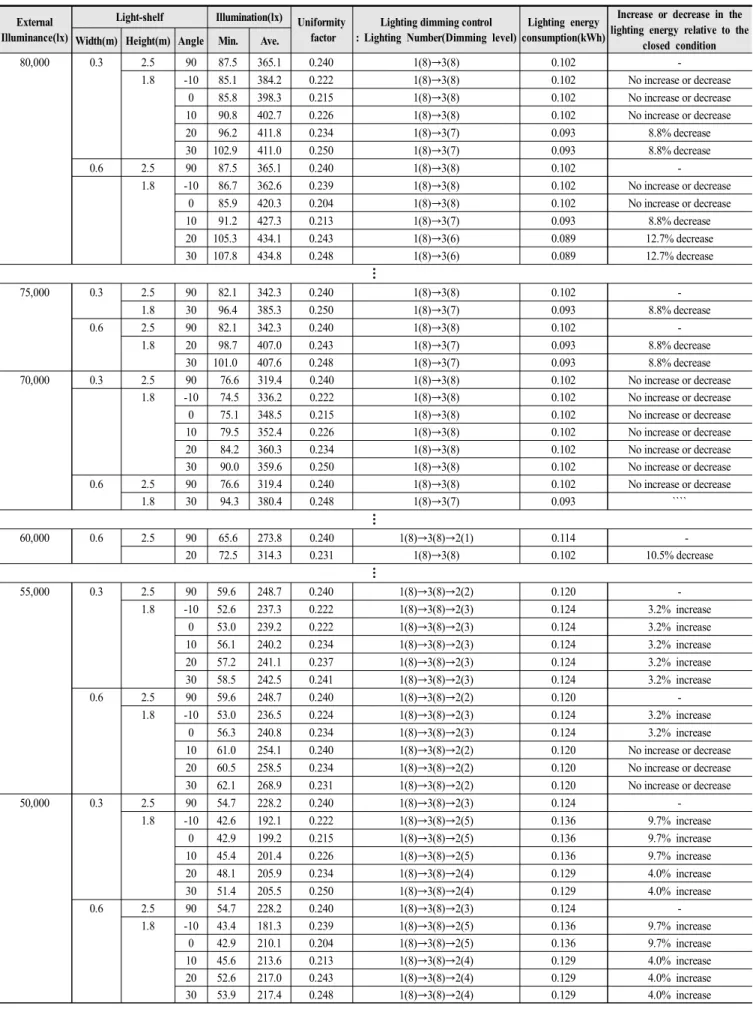
명에너지 사용량의 산출은 하지, 중간기 및 동지에 대하여 각각 1시 간의 시간을 반영하였다. 네 번째, 본 연구는 외부조도에 따른 광선 반의 성능평가를 진행하기 위하여 앞서서 설정하였듯이 열린 형태 인 높이 1.8m의 광선반과 닫는 형태인 높이 2.5m인 광선반의 조명 에너지 사용량을 비교 분석하였으며, 열린 형태의 광선반이 닫는 형 태의 광선반보다 조명에너지 사용량이 적게 나타날 경우 광선반의 채광성능이 유효하다고 간주하였다. 이때의 외부조도는 광선반의 채광성능 확보를 위한 유효 외부조도 범위로 설정하였다. 반대로 닫 는 형태의 광선반이 열린 형태의 광선반에 대비하여 조명에너지 사 용량이 같거나 높을 경우의 외부조도는 광선반의 채광성능 확보에 부적합한 외부조도의 범위로 설정하였다.
3.4. 성능평가 결과 및 논의
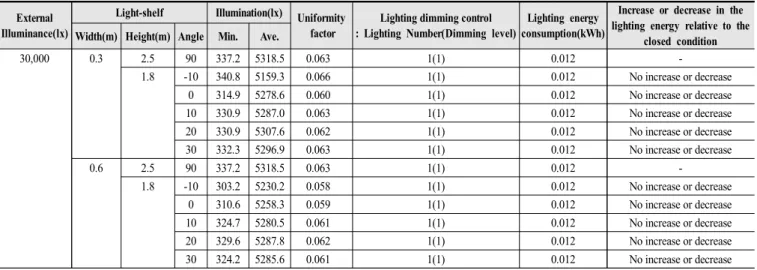
본 연구는 외부조도에 따른 광선반 성능평가를 진행하였으며, 그 에 따른 결과는 <Table 6>,<Table 7> 및 <Table 8>과 같다. 단, 본 연 구에서 제시하는 성능평가 결과는 유의미한 부분에 대하여만 제시 하였으며, 결과에 대한 분석 내용은 다음과 같다.
첫 번째, 하지의 외부조도에 따른 광선반 성능은 <Table 6>에서 나타나듯이 광선반 폭 0.3m 및 0.6m에 대하여 각각 외부조도 75,000 lx 및 60,000 lx 이상에서 조명에너지 저감에 유리한 것으로 분석된다. 또한, 광선반의 폭 0.3m 및 0.6m의 광선반은 외부조도 55,000 lx 및 50,000 lx 이하의 경우에는 조명에너지가 오히려 증가 하고 있어서 에너지 저감에 부적합하며, 이는 앞서서 제안한 개폐 개 념을 적용하여 광선반을 닫는 것이 조명에너지 저감에 유리한 것으 로 분석된다. 단, 광선반 폭 0.3m 및 0.6m의 광선반의 경우에는 조명 에너지 저감 측면을 미고려시 외부조도에 상관없이 광선반의 각도는 균제도를 높여 빛환경 개선에는 유리하게 나타나고 있다.
두 번째, 중간기의 외부조도에 따른 광선반 성능은 <Table 7>에 서 나타나듯이 광선반 폭 0.3m 및 0.6m에 대하여 60,000 lx이상인 경우에 조명에너지 저감에 유효하며, 55,000 lx 이하 50,000 lx 이상 의 경우에는 광선반의 미설치와 동일한 닫는 형태의 광선반의 성능 과 동일하게 나타난다. 또한, 외부조도 45,000 lx 이하의 경우에는 오히려 조명사용량이 닫는 형태의 광선반에 대비하여 높게 나타나 조명에너지 저감에 부적합하게 분석된다.
세 번째, 동지시의 외부조도에 따른 광선반 성능은 <Table 8>에 서 나타나듯이 30,000 lx의 외부조도에도 조명에너지 저감은 이루 어지지 않고 있으며, 이는 동지시의 경우 광선반은 닫는 형태를 유지 하는 것이 적합할 것으로 판단된다. 특히, 동지의 경우 광선반의 설 치는 난방에너지를 증가시켜 부적합하다는 기존의 연구 결과와 유 사하다[18].
네 번째, 위의 내용을 종합하면 외부조도의 변화에 대응하여 조명 에너지 저감 효율이 높은 광선반의 규격은 폭 0.6m로 나타나고 있으 며, 특히 외부조도가 60,000 lx 이상인 경우로 분석된다. 또한 외부조 도가 60,000 lx 미만인 경우에는 광선반을 통한 조명에너지 저감은 이 루어지지 않고 있다. 이에 따라서 본 연구가 제시하는 개폐 개념의 높 이 조절이 가능한 광선반은 유효할 것으로 판단되며, 광선반의 개폐를 위한 외부조도 기준은 60,000 lx 이다.
4. 결론
본 연구는 외부조도에 따른 광선반 성능평가를 통한 광선반 채광성 능 확보를 위한 외부조도의 기준을 제시하였으며, 이를 기반으로 개폐 개념의 높이 조절이 가능한 광선반을 제안하였다. 이에 대한 결론은 다음과 같다.
첫 번째, 본 연구는 외부조도를 측정하여 광선반을 개폐함으로써 광선반의 에너지저감 측면에 유효할 경우에는 열린 상태인 높이 1.8m 로 유지하도록 하였으며, 에너지저감에 부적합한 외부조도인 경우에 는 광선반은 창의 상단으로 이동시켜 광선반 각도 90°로 닫는 형태의 광선반을 제안하였다.
두 번째, 하지의 경우에는 조명에너지 저감에 적합한 외부조도는 광 선반 폭 0.3m 및 0.6m에 대하여 각각 75,000 lx 및 60,000 lx 이상에서 조명에너지 저감이 가능한 것으로 분석되며, 50,000 lx 이하인 경우 에 광선반은 오히려 조명에너지를 증가시켜 부적합하다.
세 번째, 중간기의 경우 조명에너지 저감에 적합한 외부조도는 60,000 lx이며, 동지의 경우에는 광선반 미설치와 동일한 닫는 형태 로 유지하는 것이 적합할 것으로 판단된다.
네 번째, 위의 내용을 종합 시 본 연구에서 제안하는 개폐 개념의 높이 조절이 가능한 광선반의 열고 닫는 외부조도 기준은 60,000 lx 이며, 폭 0.6m의 광선반이 조명에너지 저감에 유리할 것으로 파악 된다. 단 외부조도 60,000 lx 이하의 경우에는 조명에너지 저감에는 부적합 할 수 있으나 균제도를 높여 실내 빛환경 개선은 가능하다.
이에 따라서 공간의 성격 및 요구에 따른 광선반의 적절한 적용이 필 요할 것으로 판단된다.
본 연구는 광선반의 성능이 확보되지 않을 경우 광선반을 닫는 형 태로 유지함으로써 재실자의 조망권 확보가 가능하도록 하였다. 이 는 기존 광선반 연구와 차별화 및 고도화 된 요소이나, 성능평가 간 인공태양광 조사장치 등 인공 환경을 기반으로 진행하였다는 점은 본 연구의 제한 사항이다. 또한 향후에는 광선반 및 외부환경의 다양 한 변인을 고려하며, 실제 환경을 기반으로 한 후속 연구가 진행되어 야 할 것이다.
Acknowledgements
This work was supported by the National Research Foundation of Korea(NRF) grant funded by Korea gorvement (NRF-2015R1C1A1A01052784)
Reference
[1] Department of Energy, “2011 Buildings Energy Data Book”, 2011 [2] 조일식, 김기세, 윤종호, 이진숙, “Lightscape를 이용한 광선반의 주광
성능 해석 및 평가”, 한국태양에너지학회 춘계학술발표회, 2001 //
(Cho Ilsik, Kim, Yoon Jongho, Analysis and estimate the perfomance of lightshelf system using lightscape. The Korean Solar Energy Society, 2001.05)
[3] 문기훈, 김정태, “Lightscape를 이용한 광선반의 창호시스템의 채광성 능평가”, 한국생태환경건축학회 논문집, 제4권 제4호, 2004 // (Moon, Kihoon, Kim, Jeong Tai, Daylighting Performance Evaluation of Lightshelf Window System by Lightscape. Korea Institute of Ecological
Architecture and Environment, Vol.4, No.4, 2004.12)
[4] 김정태, 김기철, 김곤, “Mock-up model을 이용한 경사형광선반 채광시 스템의 개발 및 채광성능 평가에 관한 연구”, 한국태양에너지학회 , 제 24권 제 2호, 2004 // (Kim, Jeongtai, Kim, Kicheol, Kim, Gon, Development and Performance Evaluation of a Sloped Lightshelf Daylighting System, Development and Performance Evaluation of a Sloped Lightshelf Daylighting System, Vol.24, No.2, 2004)
[5] 김봉균, 김정태, “광선반 유형에 따른 실내 채광특성에 관한 축소모형 실험적 연구”, 한국생태환경건축학회 학술발표대회 논문집 , 2005 //
(Kim, Bongkyun, Kim, Jeong Tai, Scale Model Experiment for Daylighting Performance by Lightshelf Types. Korea Institute of Ecological Architecture and Environment, 2005.11)
[6] 장준호, 박병철, 최안섭, “광이중 광선반을 이용한 사무공간의 자연채 광 성능평가에 관한 연구 ”, 한국조명전기설비학회 추계 학술발표대회 논문집 , 2006 // (Chang, Junho, Park, Byoungchul, Choi, Anseop, A Study on the Daylighting Performance in the Office Space with Double-lightshelf. Korea Institute of Ecological Architecture and Environment, 2006.11)
[7] 정유근, “창호일체형 광선반 시스템 채광성능 평가”, 한국생태환경건 축학회 논문집, 제7권 제5호, 2007 // (Jung, Yugeun, Daylighting Performance Evaluation of window Integrated Light shelf System.
Journal of the Korean Institute of Educational Architecture and Environment, Vol.7, No.5, 2013.03)
[8] 김동수, 윤종호, 신우철, 이광호, “광선추적기법을 활용한 곡면형 광선 반시스템 설계 및 채광성능 평가”, 한국태양에너지학회 논문집,제3권 제4호, 20011 // (Kim Dongsu, Yoon, Jongho, Shin, Woochul, Lee, Kwangho, Evaluation of Daylighting Performance and Design of a Curved-Lightshelf by the Ray Tracing Method. The Korean Solar Energy Society, Vol.3, No.4, 2011.8)
[9] 이종수, “폴리카보네이트 광선반의 채광 및 에너지성능평가에 관한연 구”, 경희대학교 박사학위논문, 2013// (Lee, Jongsu, Cha Seonjun Yugeun, A study on the assessment of energy performance of photovoltaic light shelf system. A doctor´s thesis of of Kyung Hee University, 2013)
[10] 김경수, 심형준, 이행우, 서장후, 김용성 “반사율 변경이 가능한 롤링 타입형 광선반 개발”, 한국생태환경건축학회 제 26권 제 5호, 2016 // (Kim Kyungsoo, Shim, Hyungjun, Lee, Heangwoo, Seo, Janghoo, Kim, Yongseong , Development of Rolling type Light-Shelf with adgustable Reflectivity, KIEAE Journal, Vol.16 No.5, 2013)
[11] 채우리, “주거공간의 혼합형 광선반 각도 변화에 따른 채광성능 평 가”, 국민대 테크노디자인전문대학원 석사학위논문, 설비공학논문집, 제26권 9호 , 2015 // (Chae, Woori, Lee, Heangwoo, Sea, Janghoo, Kim, Yongseang, Performance of Mixed Type Light-shelf in Residential Space According to Angular Variations, Evaluation of Lighting, Vol.26 No.09, 2014)
[12] 한국표준정보망, 조도기준, KS A 3011, 1998 // (Korean Standards Service Network, Recommended levels of illumination, KS A 3011, 1998.07)
[13] 조동우, 윤경, 김강수, “Radiance 프로그램을 이용한 주거공간의 빛 환경 평가에 관한 연구”, 대한건축학회 대한건축학회논문집 제 27권 제 2호, 2011 // (Cho, Dong-Woo, Yun Gyeong, Kim, Kang-Soo, A Study on Visual Environment Evaluation of Residential Space Using the Radiance Program, Journal of the architectural institute of Korea planning & design, Vol.27 No.2, 2011)
[14] 권순현, 이행우, 서장후, 김용성, “주거공간 내 사용자인식기술 및 조 명 디밍제어 적용 광선반 시스템 성능평가 연구”, 대한건축학회논문 집 계획계, 제30권 제2호, 2014 // (Kwon Wunhyeon, Lee Heangwoo, Seo Janghoo, Kim Yongseong, A Study on Light Shelf System Performance Evaluation Applying User Awareness and Dimming Control in Housing. Journal of the architectural institute of Korea planning & design, Vol.30, No.2, 2014.02)
[15] 이경수, 친환경 기능성 유리, 광문각, 2009 // (Lee, Kyoungsu, Residental Windows, Kwangmoonkag, 2009.03)
[16] 정봉근, 최안섭, “광센서 조광제어시스템의 광센서 최적 방향성과 위 치에 관한 실험적 연구”, 조명·전기설비학회논문지, 제17권 제5호, 2003 // (Jung Bongkeun, Choi Anseop, An Experimental Study of the Optimum Spatial Characteristics and Location of Photosensor for Daylight Responsive Dimming Systems. Journal of the Korean institute of illuminating and electrical installation Engineers, Vol.17, No.5, 2003.09)
위치인식기술 적용 광선반 시스템 개발연구”, 설비공학논문집, 제26 권 제 6호, 2014 // (Kim Sanghun, Lee Heangwoo, Seo Janghoo, Kim Yongseong, A Study on Light-Shelf System using Location-Awareness Technology for Energy Saving in Residential Space. Korean Journal of Air-Conditioning and Refrigeration Engineering, Vol.26, No.6, 2014.06)
[18] 전강민, 이행우, 서장후, 김용성, “빛환경 및 냉난방환경 기반 광선반 성능평가 연구”, 한국생태환경건축학회, 제16권 제 5호, 2016 //
(Jeon, Gangmin, Lee, Heangwoo, Seo, Janghoo, Kim, Yongseong, Performance Evaluation of Light-Shelf based on Light Enviorment and Air Conditioner Enviorment. Korea Institute of Ecological Architecture and Environment, Vol.16, No.5, 2016)