국내 중고등학생들의 고카페인 에너지음료 소비패턴 및 부작용에 대한 분석
양영모 · 허완 · 정은* · 이재준* · 최은주# 조선대학교 약학대학, *조선대학교 식품영양학과
(Received September 30, 2014; Revised November 17, 2014; Accepted December 16, 2014)
An Analysis of Consumption Patterns of High-Caffeinated Energy Drinks and Adverse Effects by Surveys from Students at Middle and High Schools in Korea
Young-Mo Yang, Wan Huh, Eun Jeong*, Jae-Joon Lee* and Eun Joo Choi# College of Pharmacy, Chosun University, Gwangju 501-759, Korea
*Dept. of Food and Nutrition, Chosun University, Gwangju 501-759, Korea
Abstract — High Caffeinated Energy Drink (HCED) consumption among adolescents has been exponentially increasing.
The intake of HCED may cause various side effects. However, studies regarding intake of HCED in adolescents have been rarely implemented in Korea. The purpose of this study was to investigate HCED consumption patterns among adolescents and prevalence of adverse effects from HCED consumption and to compare them between middle and high school students.
The self-reported questionnaire with 31 questions was used to evaluate HCED consumption patterns and adverse effects.
Among 792 students, 455 who had drunken HCED were included in the analysis. Nine (4.0%) Middle School Students (MSSs) and 11 (4.8%) High School Students (HSSs) responded that they did not know HCED, and 188 (83.6%) MSSs and 221 (96.1%) HSSs had heard that HCED contains high amount of caffeine. Seventy-four (36.8%) MSSs drank their first HCEDs from curiosity and 63 (31.3%) MSSs to stay awake while studying. However, 134 (61.2%) HSSs consumed their first HCEDs to keep awake while studying, and 57 (26.0%) HSSs from curiosity. Twenty-eight (12.5%) MSSs and 46 (20.3%) HSSs had increase in heart rate, 52 (23.2%) MSSs and 83 (36.4%) HSSs insomnia, and 8 (3.6%) MSSs and 18 (7.9%) HSSs hand and facial tremor. As shown in this study, HCED consumption among adolescents in Korea was high. Thus, Korean government should continuously focus its efforts to educate not only children and adolescents but also their parents for HCEDs in order to increase parents’ awareness of HCEDs and conduct education regarding HCED intake at home above all.
Keywords □ adolescents, high caffeinated, energy drink, consumption patterns, adverse effects
High-Caffeinated Energy Drink (HCED) contains guarana extract, taurine, ginseng, amino-acids, B vitamins, glucurono- lactone, and sugar as well as high caffeine which usually causes adverse effects and toxicity related with HCEDs.1,2) Caffeine leads to increases in arousal, heart rate, blood pres- sure, and respiratory rate by stimulating central nervous and cardiovascular systems.3) As a result of these effects of caf- feine, average caffeine doses (85~250 mg) may give benefits
such as alertness, decreased fatigue, and better concentra- tion.3) However, several undesired effects (e.g., hyperactivity, nervousness, anxiety, insomnia, tremors, GI upset, vomit- ing, muscle spasms, myocardial arrhythmias, seizures, and increase in platelet aggregation) may occur at the higher doses (250~500 mg) of caffeine.3-6) For example, cardiac arrests may occur after excessive consumption of HCEDs.7,8)
Owing to these side effects, some countries have taken actions on excessive intake of HCEDs. Australia limits caf- feine doses of HCEDs to 80 mg per 250 ml can, the same dose of an instant cup of coffee, and labels on HCEDs have to include contents presenting consumption limit of HCEDs up to 500 ml (two cans) per day.9) In 2011, Canada imposed the regulation that a maximum amount of caffeine in HCEDs does not have to exceed 180 mg per a single-serve 종설
#Corresponding Author Eun Joo Choi
College of Pharmacy, Chosun University, 309 Pilmun-daero, Dong- gu, Gwangju 501-759, Korea
Tel.: 062-230-6382 Fax.: 062-222-5414 E-mail: [email protected]
†The first and second authors contributed equally to this manu- script.
container defined as an unresealable container or a reseal- able container ≤591 ml.10) Canada also enacted mandatory labeling of caffeine and other ingredients with an advisory statement presenting that this beverage is “Not recom- mended for children, pregnant or breastfeeding women, and individuals sensitive to caffeine.”10) Norway has restricted the sales of HCEDs to pharmacies.9) Korea has paid an attention to manage safety concerns from HCEDs, and it prohibits the sales of HCEDs at the convenient stores of schools and restricts TV advertisements regarding HCEDs.11)
Although some countries have taken these kinds of actions, HCEDs have been highly marketed to entice children (<12 years old), adolescents (12~18 years old), and young adults (19~25 years old) since “Red Bull” which is the current leading product in the HCED market was debuted in the U.S.A. in 1997.1,12-14) The marketing strategies for HCEDs are to emphasize the effects of them on improvement in energy, weight loss, concentration, mental alertness, and stamina.13,14) As a result of these efforts, the absolute con- sumption rate of HCEDs in young individuals has been rap- idly rising.15) In the study done in the U.S.A., over 30% of young individuals between 12- and 24-year-olds reported that they regularly consumed HCEDs.16) The study conducted in Germany also showed that among more than 1,000 young individuals, 94% knew HCEDs, 53% had drunk them, and approximately 25% drank them on the regular basis.14) The survey done with college students in Korea showed that 204 (88.3%) out of 228 participants responded that they had drunk HCEDs.17)
More than 500 brand-new HCEDs were launched world- wide in 2006, and HCEDs are currently consumed in more than 140 countries.1,14) In line with the global marketing trend of HCEDs, the HCED called “Hot Six” which is pro- duced by a Korean company was introduced into Korean market in 2010, and “Red Bull” started to be sold in Korea in 2011.18) Since the sales of these two products, the con- sumption rate of HCEDs in Korea has been growing in an exponential manner.18) In 2012, Koreans consumed 41,848 tons of HCEDs, which indicates approximately 770% increase in the consumption rate from the previous year.11)
The consumption of HCEDs especially by children and adolescents who are non-habitual caffeine users can possi- bly have significant negative effects on their health because they do not have fully-developed metabolic systems and may
show distinct sensitivity to caffeine toxicity compared with adults.19) In case of consuming HCEDs continuously, with- drawal syndrome as well as renal and heart disorders may occur to children and adolescents because they are highly sensitive to caffeine.19) High caffeine intake may also cause loss of calcium and potassium from bodies, which could neg- atively affect growth and development of children and ado- lescents.19)
The period of growth and development of children and adolescents is the most important in their lives. Therefore, the HCEDs consumed by children and adolescents have to be strictly managed, and studies regarding these must be also conducted. Several studies related with HCEDs have been performed with children and adolescents in many other countries.13,14,20) However, to our knowledge, there has been no research regarding HCED intake of children and adoles- cents although some studies about caffeine in children’s favorite foods (e.g., chocolate and carbonated beverage) have been conducted in Korea.19,21-23)
Thus, the purpose of this study was to investigate HCED consumption patterns and prevalence of adverse effects from HCED consumption among adolescents and to compare them between middle school students (MSSs) and high school stu- dents (HSSs) since the consumption rate of HCEDs in young individuals has been rapidly increasing in other countries.
METHODS
The study was implemented from July to September 2013.
Four schools (2 middle and 2 high) located at Gwangju in Korea were randomly selected. Self-reported questionnaires were distributed to study subjects after thoroughly explain- ing the purpose of this study, and completion of the survey was means for consent.
The questionnaire consisted of a total of 31 questions classified into five main categories: 4 demographic ques- tions, 3 questions about Knowledge of HCED, 8 questions about consumption patterns of HCED, 2 questions about the effects of HCED intake, and 14 questions about adverse effects from intake of HCED (Appendix I).
SPSS 20.0 for Windows (Chicago, IL, USA) was utilized to analyze HCED consumption patterns and prevalence of adverse effects from HCED consumption between MSSs and HSSs. Continuous variables were presented as mean (±S.D.),
and categorical variables as frequency (n) and percentage (%). T-test and chi-square test were utilized to compare the differences in means and proportions between two groups, respectively. Statistical significance was assumed for p<0.05.
RESULTS
Among 872 students participating in this study, 792 (90.8%) completed the survey. Of them, 455 students who had consumed HCED were included in the analysis. Two hundred sixty-eight (58.9%) were males, and 187 (41.1%) females. The mean age (±S.D.) of MSSs was 13.72 (±0.80) years old, and that of HSSs was 16.35 (±0.74) years old.
Table I described the other demographic characteristics of the study subjects.
Knowledge of study subjects about HCED was reported in Table II. Of 455 subjects, 9 (4.0%) MSSs and 11 (4.8%) HSSs responded that they did not know HCED. One hun- dred eighty-eight (83.6%) MSSs and 221 (96.1%) HSSs had heard that HCED contains high amount of a stimulant called caffeine with statistically significant difference between two groups (p<0.001).
Consumption patterns of HCED were presented in Table III. Forty-seven (20.9%) MSSs and 14 (6.1%) HSSs con-
sumed their first HCEDs prior to middle school. The major- ity of MSSs and HSSs drank their first HCEDs in the 1st grade with significantly more MSSs (51.6%) than HSSs (42.6%) (p<0.001). Seventy-four (36.8%) MSSs drank their first HCEDs from curiosity and 63 (31.3%) MSSs drank them to stay awake while studying. On the other hand, 134 (61.2%) HSSs consumed their first HCEDs to keep awake while studying and 57 (26.0%) HSSs consumed them from curiosity. The majority of MSSs and HSSs tended to con- sume 1 can of HCED per day. Staying awake while study- ing was the most common reason to consume HCEDs as indicated by 78 (34.8%) MSSs and 154 (67.0%) HSSs. In MSSs, “home” was the most common place to consume HCEDs followed by “academy”, and in HSSs, “home” was followed by “school”. Ninety-nine (49.0%) MSSs consumed HCEDs at ordinal times, and 80 (39.6%) consumed them during examination period. On the other hand, 145 (67.8%) and 59 (27.6%) HSSs drank HCEDs during test period and at ordinal times, respectively. Additionally, 33 (14.7%) MSSs and 44 (19.1%) HSSs had recommended HCEDs to other classmates by explaining its effects on school works.
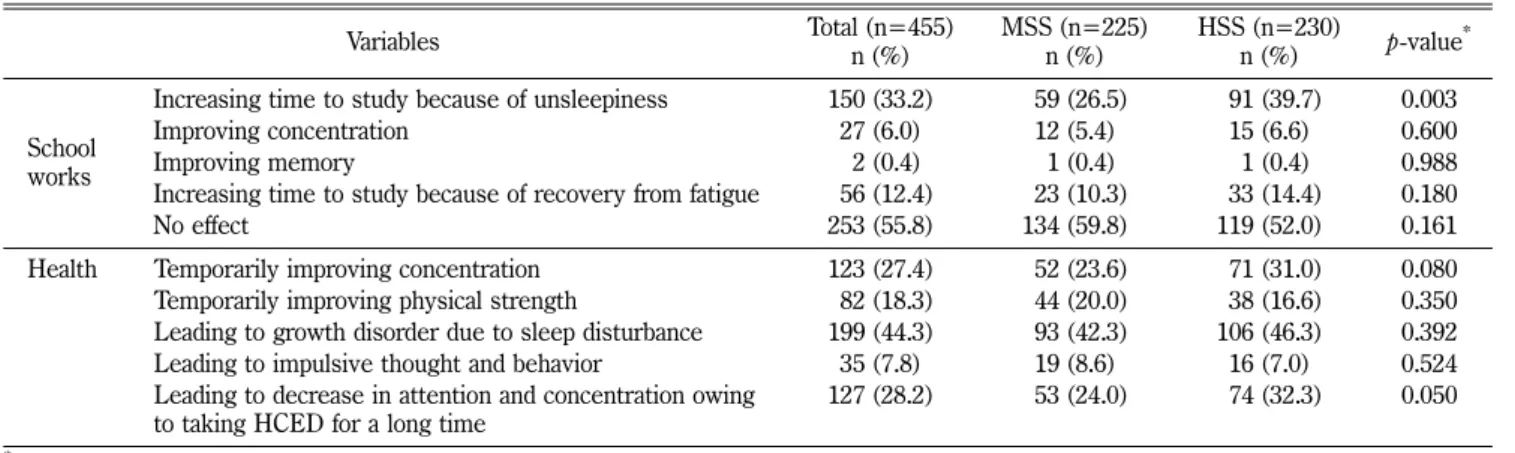
The effects of HCED consumption on school works and health were shown in Table IV. Most of MSSs (59.8%) and HSSs (52.0%) responded to “no effect on school works”.
Table I − Demographic characteristics of study subjects
Variables Total (n=455) MSS (n=225) HSS (n=230) p-value
Age (yr) 015.05±1.52* 13.72±0.80 16.35±0.74 <0.001****
Height (cm) 166.53±8.32* 163.63±7.550 169.38±8.070 <0.001****
Body weight (kg) 0057.02±11.21* 054.03±10.55 059.85±11.11 <0.001****
BMI (m/kg2) 020.41±3.11* 20.04±3.00 20.77±3.18 <0.015****
Gender
Male 268 (58.9)*** 125 (55.6) 143 (62.2)
<0.151****
Female 187 (41.1)*** 100 (44.4) 087 (37.8)
*mean±S.D.; **analyzed with t-test; ***n (%); ****analyzed with chi-square test.
MSS; Middle School Students, HSS; High School Students
Table II − Knowledge of study subjects on HCED
Variables Total (n=455)
n (%)
MSS (n=225) n (%)
HSS (n=230)
n (%) p-value*
Whether to know HCED Yes 435 (95.6) 216 (96.0) 219 (95.2)
<0.145
No 20 (4.4) 09 (4.0) 11 (4.8)
Whether to have heard that HCED contains caffeine
Yes 409 (89.9) 188 (83.6) 221 (96.1)
<0.001
No 046 (10.1) 037 (16.4) 09 (3.9)
Whether to have heard that HCED could have a negative effect on health
Yes 442 (97.6) 218 (97.3) 224 (97.8)
<0.732
No 11 (2.4) 06 (2.7) 05 (2.2)
*analyzed with chi-square test.
Table III − Consumption patterns of HCED in study subjects
Variables Total (n=455)
n (%)
MSS (n=225) n (%)
HSS (n=230)
n (%) p-value*
When to consume the 1st HCED
Prior to MS** 061 (13.4) 047 (20.9) 014 (6.1)
<0.001
1st grade at MS 124 (27.3) 116 (51.6) 008 (3.5)
2nd grade at MS 072 (15.8) 054 (24.0) 018 (7.8)
3rd grade at MS 087 (19.1) 008 (3.6 ) 079 (34.3)
1st grade at HS*** 098 (21.5) 000 (0.0) 098 (42.6)
2nd grade at HS 013 (2.9) 000 (0.0) 013 (5.7)
Motivations to consume the 1st HCED
Curiosity 131 (31.2) 074 (36.8) 057 (26.0)
<0.001 Recommendations from friends 036 (8.6) 024 (11.9) 012 (5.5)
TV advertisements & dramas 025 (6.0) 018 (9.0) 007 (3.2) Staying awake while studying 197 (46.9) 063 (31.3) 134 (61.2) Playing games for a long time 009 (2.1) 006 (3.0) 003 (1.4) Others (e.g., good taste) 022 (5.2) 016 (8.0) 006 (2.7)
Maximum No. of HCED can(s) to consume in a day (can)
1 238 (54.7) 118 (54.9) 120 (54.5)
0.643
2 122 (28.0) 057 (26.5) 065 (29.5)
3 052 (12.0) 026 (12.1) 026 (11.8)
≥4 018 (4.1) 010 (4.7) 008 (3.6)
Others 005 (1.1) 004 (1.9) 001 (0.5)
Main reasons to consume HCED
To stay awake while studying 232 (51.1) 078 (34.8) 154 (67.0) <0.001 Due to good taste 096 (21.1) 063 (28.1) 033 (14.3) <0.001
To exercise better 012 (2.6) 005 (2.2) 007 (3.0) 0.590
To relieve thirst 049 (10.8) 028 (12.5) 021 (9.1) 0.247
To relieve fatigue 107 (23.6) 041 (18.3) 066 (28.8) 0.008
To play games for a long time 019 (4.2) 011 (4.9) 008 (3.5) 0.446
Without any reasons 121 (26.7) 068 (30.5) 053 (23.0) 0.073
Main sites to consume HCED
School 062 (13.7) 024 (10.8) 038 (16.5) 0.075
Academy 055 (12.1) 034 (15.2) 021 (9.1) 0.046
Home 226 (49.9) 096 (43.0) 130 (56.5) 0.004
Playground 013 (2.9) 006 (2.7) 007 (3.0) 0.822
Arcade game room 020 (4.4) 011 (4.9) 009 (3.9) 0.597
When to usually consume HCED
Test period 225 (54.1) 080 (39.6) 145 (67.8)
<0.001
Physical activity 008 (1.9) 006 (3.0) 002 (0.9)
While playing computer games 008 (1.9) 005 (2.5) 003 (1.4)
At ordinal times 158 (38.0) 099 (49.0) 059 (27.6)
Others 017 (4.1) 012 (5.9) 005 (2.3)
Recommendations of HCED to other classmates
Yes 077 (17.0) 033 (14.7) 044 (19.1)
0.212
No 377 (83.0) 191 (85.3) 186 (80.9)
*analyzed with chi-square test; **MS: middle school; ***HS: high school.
Table IV − Effects of HCED intake on school works and health
Variables Total (n=455)
n (%)
MSS (n=225) n (%)
HSS (n=230)
n (%) p-value*
School works
Increasing time to study because of unsleepiness 150 (33.2) 059 (26.5) 091 (39.7) 0.003
Improving concentration 27 (6.0) 12 (5.4) 15 (6.6) 0.600
Improving memory 02 (0.4) 01 (0.4) 01 (0.4) 0.988
Increasing time to study because of recovery from fatigue 056 (12.4) 023 (10.3) 033 (14.4) 0.180
No effect 253 (55.8) 134 (59.8) 119 (52.0) 0.161
Health Temporarily improving concentration 123 (27.4) 052 (23.6) 071 (31.0) 0.080
Temporarily improving physical strength 082 (18.3) 044 (20.0) 038 (16.6) 0.350 Leading to growth disorder due to sleep disturbance 199 (44.3) 093 (42.3) 106 (46.3) 0.392
Leading to impulsive thought and behavior 35 (7.8) 19 (8.6) 16 (7.0) 0.524
Leading to decrease in attention and concentration owing to taking HCED for a long time
127 (28.2) 053 (24.0) 074 (32.3) 0.050
*analyzed with chi-square test.
Ninety-three (42.3%) MSSs and 106 (46.3%) HSSs answered
“leading to growth disorder due to sleep disturbance” and 52 (23.6%) MSSs and 71 (31.0%) HSSs responded to “tem- porarily improving concentration”.
The adverse effects from HCEDs were described in Table V. After consuming HCEDs, 28 (12.5%) MSSs and 46 (20.3%) HSSs had experienced increase in heart rate, and 52 (23.2%) MSSs and 83 (36.4%) HSSs had experienced insomnia. Hand and facial tremor had occurred in 8 (3.6%) MSSs and 18 (7.9%) HSSs.
DISCUSSION AND CONCLUSION
It has been known that excessive intake of caffeine in adolescents can not only cause various side effects but also significantly affect growth and development of them. How- ever, drinking HCEDs among adolescents is getting popular, so their intake of caffeine is becoming a hot issue in Korea.
Therefore, this study investigated HCED consumption pat- terns and prevalence of adverse effects from HCED con- sumption in the adolescents at middle and high schools located in Gwangju, Korea.
Among all respondents, 4.0% MSSs and 4.8% HSSs responded that they did not know HCED, so most of the students surveyed knew HCED. Approximately 84% MSSs and 96% HSSs had heard that HCED contains high amount of a stimulant called caffeine with significantly more HSSs than MSSs (p<0.001). In addition, most of MSSs and HSSs drank their first HCEDs in the 1st grade with significantly
more MSSs (51.6%) than HSSs (42.6%) (p<0.001). More- over, 20.9% MSSs and 6.1% HSSs consumed their first HCEDs prior to middle school. Thus, further studies regard- ing the actual consumption condition of HCEDs among chil- dren should be conducted because it is expected that the time when adolescents drink their first HCEDs is becom- ing earlier.
For the question about the motivation to consume the first HCED, 36.8% MSSs drank their first HCEDs from curiosity and 31.3% MSSs consumed them to stay awake while studying whereas most of HSSs (61.2%) consumed their first HCEDs to keep awake while studying. Addition- ally, for the question asking the maximum amount of HCEDs to consume for one day, most of MSSs (54.9%) and HSSs (54.5%) tended to drink 1 can of HCED per day.
According to the article released by the Korea Food and Drug Administration (KFDA) in 2012, the average amount of caffeine in HCEDs imported and produced domestically was 98.89 mg per can or bottle ranging from 30.00 mg to 207.35 mg.24) KFDA recommends caffeine of less than 2.5 mg/kg/day under 19 years old.11) For example, daily maxi- mum amount of caffeine for the adolescent with 60 kg is likely to be less than 150 mg. It is also considered that their daily intake of caffeine may be much higher than expected because snacks, chocolate, ice cream, milk, dairy products, and beverages which adolescents eat daily contain caf- feine.19,25) Accordingly, the frequency of taking caffeine con- tained in adolescents’ favorite foods and HCEDs should be investigated as well as the average daily caffeine intake of Table V − Frequency of adverse effects from HCED intake
Variables Total (n=455)
n (%)
MSS (n=225) n (%)
HSS (n=230)
n (%) p-value*
Increase in heart rate 074 (16.4) 28 (12.5) 46 (20.3) 0.026
Shortness of breath 18 (4.0) 9 (4.0) 9 (4.0) 0.977
Chest pain 20 (4.4) 11 (4.9)0 9 (4.0) 0.626
Insomnia 135 (29.9) 52 (23.2) 83 (36.4) 0.002
Dizziness 048 (10.6) 18 (8.0)0 30 (13.2) 0.074
Depression or weakness 21 (4.7) 8 (3.6) 13 (5.7)0 0.277
Headache 045 (10.0) 18 (8.0)0 27 (11.9) 0.172
Stress or irritation from an unknown reason 38 (8.4) 17 (7.6)0 21 (9.3)0 0.525
Anxiety or nervousness 28 (6.2) 9 (4.0) 19 (8.4)0 0.055
Hand or facial tremor 26 (5.8) 8 (3.6) 18 (7.9)0 0.047
Dry mouth 38 (8.4) 22 (9.8)0 16 (7.0)0 0.289
Nausea or vomiting 22 (4.9) 7 (3.1) 15 (6.6)0 0.086
Stomachache 27 (6.0) 9 (4.0) 18 (7.9)0 0.080
Diarrhea 20 (4.4) 8 (3.6) 12 (5.3)0 0.376
*analyzed with chi-square test.
them, and then the results should be utilized to improve the problems regarding caffeine intake of adolescents. Particu- larly, since children with Attention-Deficit Hyperactivity Dis- order (ADHD) were more likely to consume higher caffeine compared with normal children, the study regarding identify- ing the association between caffeine use and ADHD in chil- dren should be conducted in the near future.25,26)
For the question asking the main reasons for intake of HCED, staying awake while studying was the most common reason to consume HCEDs as indicated by 34.8% MSSs and 67.0% HSSs. Especially, in the case of HSSs, the motiva- tion to drink the first HCED and the main reason to con- sume HCEDs were to keep awake while studying. Thus, it is likely that intake of HCEDs in HSSs was associated with school works. In addition, for the question about the main places where to drink HCEDs, “home” was the most com- mon place to consume HCEDs in 43.0% MSSs and 56.5%
HSSs. This result may suggest that many middle and high school students tended to study at a school or an academy during the day, and they also had a tendency to study at home until late at night. Therefore, they may consume more HCEDs at home than at any other places in order to keep awake at night.
For the question about the periods when to often drink HCED, 67.8% HSSs drank HCEDs during test period. On the other hand, 49.0% MSSs consumed HCEDs at ordinal times, which may suggest that HCED consumption has been getting established as a culture between MSSs. The results from various studies showed that HCED consump- tion can cause other forms of substance-related problems like alcohol dependence, illicit drug use, and cigarette use in the future.9,27-29) Azagba et al. also reported that these kinds of risk behaviors were closely related with dose-depen- dency of caffeine consumed.30) Therefore, it is essential that
public institutions as well as schools should conduct educa- tion on these problems to adolescents for the prevention of occurring them.
For the question asking the effects of HCED consump- tion on school works, most of MSSs (59.8%) and HSSs (52.0%) responded to “no effect on school works”. On the other hand, 5.4% MSSs and 6.6% HSSs responded that HCED consumption improved concentration. Thus, it seems that HCEDs had insignificant effects on learning. This result could be contrary to concentration improvement emphasized in the advertisements of HCEDs targeting adolescents.13,14) For the question regarding the effects of HCED intake on health, 42.3% MSSs and 46.3% HSSs answered “leading to growth disorder due to sleep disturbance”.
In the responses to the questions about the adverse effects from HCEDs, 12.5% MSSs and 20.3% HSSs had experi- enced increase in heart rate, and 23.2% MSSs and 36.4%
HSSs had experienced insomnia. Hand and facial tremor had occurred in 3.6% MSSs and 7.9% HSSs. To date, the cases regarding serious adverse effects from HCEDs have not been reported in Korea. However, a number of serious adverse effects have taken place in many other countries (Table VI).31-33) Therefore, it is necessary to implement the studies regarding the adverse effects from HCED intake and to educate adolescents these adverse effects in order to help them recognize negative effects of HCED intake on their health.
This study is significant in that the actual conditions, fac- tors, and adverse effects of HCED consumption, which is rapidly increasing among adolescents, were investigated.
However, since the survey was confined in Gwangju, south- ern province of Korea, it may be difficult to apply the results from this study to other areas. In addition, high schools’
seniors were excluded from the survey due to the prepara- Table VI − Cases of adverse effects from HCED
Year Patient status Symptoms and signs Amount of HCED consumed
201231) Healthy 16 years old male
Palpitations for 1 week, blood pres- sure 140-160/80-100 mmHg, pulse 110/min
80-100 cans in 2 weeks (average 3 cans/day)
201132) Healthy 19 years old male Acute chest pain 2-3 cans “Red Bull” per day for 1 week
201133) Healthy 14 years old male Irregular heart rate at about 130
beats/min Unknown quantity of HCED
201133) 16 years old male with attention deficit hyperactivity disorder, asthma, and allergies
Intoxication and vomiting, irregular heart rate at 160 beats/min
Unknown quantity of “Red Bull”
with Vodka
tion for a college at this time, so they should be included in the following study in order to examine more accurate con- ditions of HCED consumption among HSSs in all three grades.
These days, to reduce caffeine intake of children and ado- lescents, KFDA is distributing the promotional posters which contain caffeine-induced adverse effects, maximum daily caf- feine dose, and strategies for reducing caffeine intake to ele- mentary, middle, and high schools. It also enacted the advisory labeling presenting “High Caffeine Contained”, a total amount of caffeine included, and “caution with children, pregnant women, and individuals sensitive to caffeine”.34) However, because the results from this study showed that numerous adolescents consumed HCEDs at home, KFDA should continuously focus its efforts to educate not only children and adolescents but also their parents for HCEDs in order to increase parents’ awareness of HCEDs and con- duct education regarding HCED intake at home above all.
References
1) Malinauskas, B. M., Aeby, V. G., Overton, R. F., Carpenter- Aeby, T. and Barber-Heidal, K. : A survey of energy drink consumption patterns among college students. Nutr. J. 6, 35 (2007).
2) Gunja, N. and Brown, J. A. : Energy drinks: health risks and toxicity. Med. J. Aust. 196, 46 (2012).
3) Rath, M. : Energy drinks: what is all the hype? The dangers of energy drink consumption. J. Am. Acad. Nurse Pract. 24, 70 (2012).
4) Iyadurai, S. J. and Chung, S. S. : New-onset seizures in adults:
possible association with consumption of popular energy drinks. Epilepsy Behav. 10, 504 (2007).
5) Goldfarb, M., Tellier, C. and Thanassoulis, G. : Review of published cases of adverse cardiovascular events after ingestion of energy drinks. Am. J. Cardiol. 113, 168 (2014).
6) Worthley, M. I., Prabhu, A., De Sciscio, P., Schultz, C., Sanders, P. and Willoughby, S. R. : Detrimental effects of energy drink consumption on platelet and endothelial function. Am. J. Med.
123, 184 (2010).
7) Rottlaender, D., Motloch, L. J., Reda, S., Larbig, R. and Hoppe U. C. : Cardiac arrest due to long QT syndrome associated with excessive consumption of energy drinks. Int. J. Cardiol.
158, e51-2 (2012).
8) Berger, A. J. and Alford, K. : Cardiac arrest in a young man following excess consumption of caffeinated “energy drinks”.
Med. J. Aust. 190, 41 (2009).
9) Trapp, G. S. A., Allen, K. L., O’Sullivan, T., Robinson, M., Jacoby, P. and Oddy, W. H. : Energy drink consumption among young Australian adults: associations with alcohol and illicit drug use. Drug Alcohol Depend. 134, 30 (2014).
10) Health Canada. Summary of comments on health Canada’s proposed approach to managing caffeinated energy drinks.
Available at: http://www.hc-sc.gc.ca/fn-an/alt_formats/pdf/
legislation/pol/energy-drinks-boissons-energisantes-eng.pdf (Accessed on December 13, 2013).
11) The Korean Ministry of Food and Safety. Available at: http://
www.mfds.go.kr/index.do?mid=675&seq=22107&cmd=v (Accessed on December 13, 2013).
12) Reissig, C. J., Strain, E. C. and Griffiths, R. R. : Caffeinated energy drinks - a growing problem. Drug Alcohol Depend. 99, 1 (2009).
13) Committee on nutrition and the council on sports medicine and fitness. Sports drinks and energy drinks for children and adolescents: are they appropriate?. Pediatrics 127, 1182 (2011).
14) Seifert, S. M., Schaechter, J. L., Hershorin, E. R. and Lipshultz, S. E. : Health effects of energy drinks on children, adolescents, and young adults. Pediatrics 127, 511 (2011).
15) Attila, S. and Cakir, B. : Energy-drink consumption in college students and associated factors. Nutrition 27, 316 (2011).
16) Simon, M. and Mosher, J. : Alcohol, energy drinks, and youth:
a dangerous mix. San Rafael, CA: Marin Institute. Available at:
http://alcoholjustice.org/images/stories/EnergyDrinkReport.
pdf (Accessed on December 13, 2013).
17) Lee, J., Huh, W. and Choi, E. J. : Pattern analysis of high- caffeine energy drink consumption and adverse effects among college students in a university. Yakhak Hoeji 57, 110 (2013).
18) Huh, W. and Choi, E. J. : Effects of high-caffeine energy drinks on the human body. J. Pharm. REC. C. S. Univ. 33, 25 (2012).
19) Chang, Y. E. and Chung, H. K. : Survey of caffeine intake from children’s favorite foods. Korean J. Nutr. 43, 475 (2010).
20) Gallimberti, L., Buja, A., Chindamo, S., Vinelli, A., Lazzarin, G., Terraneo, A., Scafato, E. and Baldo, V. : Energy drink consumption in children and early adolescents. Eur. J. Pediatr.
172, 1335 (2013).
21) Lee, E., Kim, H. J., Im, J., Kim, J., Park, H., Ryu, J. Y., Ko, K. R. and Kim, H. S. : Survey of caffeine levels in the favorite diets of children. J. Fd. Hyg. Safety 22, 173 (2007).
22) Yoon, M. H., Lee, M. J., Hwang, S. I., Moon, S. K., Kim, J. K., Jeong, I. H. and Yim, J. R. : A evaluation of the caffeine contents in commercial food. J. Fd. Hyg. Safety 16, 295 (2001).
23) Kim, S. D., Yun, E. S., Chang, M. S., Park, Y. A., Jung, S. O., Kim, D. G., Kim, Y. C., Chae, Y. Z. and Kim, M. Y. : Survey of daily caffeine intakes from children’s beverage consumption and effectiveness of nutrition education. J. Korean Soc. Nutr.
38, 709 (2009).
24) The Korean Ministry of Food and Safety. Available at: http://
www.mfds.go.kr/index.do?searchkey=title:contents&mid=
675&searchword=카페인 &pageNo=3&seq=18764&cmd=v (Accessed on April 26, 2014).
25) Walker, L. R., Abraham, A. A. and Tercyak, K. P. : Adolescent caffeine use, ADHD, and cigarette smoking. Children’s Health Care 39, 73 (2010).
26) Jang, C. B. and Kim, H. Y. : The relationship between attention deficit hyperactivity disorder, dietary habit and caffeine intake in upper-grade elementary school children. Korean J. Nutr. 45, 522 (2012).
27) Arria, A. M., Caldeira, K. M., Kasperski, S. J., Vincent, K. B., Griffiths, R. R. and O’Grady, K. E. : Energy drink consumption and increased risk for alcohol dependence. Alcohol Clin. Exp.
Res. 35, 365 (2011).
28) Miller, K. E. : Energy drinks, race, and problem behaviors among college students. J. Adolesc. Health 43, 490 (2008).
29) O’Brien, M. C., McCoy, T. P., Rhodes, S. D., Wagoner A. and
Wolfson, M. : Caffeinated cocktails: energy drink consumption, high-risk drinking, and alcohol-related consequences among college students. Acad. Emerg. Med. 15, 453 (2008).
30) Azagba, S., Langille, D. and Asbridge, M. : An emerging adolescent health risk: caffeinated energy drink consumption patterns among high school students. Prev. Med. 62, 54 (2014).
31) Usman, A. and Jawaid, A. : Hypertension in a young boy: an energy drink effect. BMC Res. Notes 5, 591 (2012).
32) Scott, M. J., El-Hassan, M. and Khan, A. A. : Myocardial infarction in a young adult following the consumption of a caffeinated energy drink. BMJ Case Rep. (2011).
33) Di Rocco, J. R., During, A., Morelli, P. J., Heyden, M. and Biancaniello, T. A. : Atrial fibrillation in healthy adolescents after highly caffeinated beverage consumption: two case reports. J. Med. Case Rep. 5, 18 (2011).
34) The Korean Ministry of Food and Safety. Available at: http://
www.mfds.go.kr/index.do?searchkey=title:contents&mid=
675&searchword=카페인 &pageNo=1&seq=23212&cmd=v (Accessed on May 2, 2014).
[Appendix I] Questionnaire Form
1. Gender? 1) Male 2) Female 2. Age? __________ years old
3. Name of school: _______________; Grade: _______________
4. Height: _______________; Weight: _______________
5. Do you know high caffeinated energy drink (HCED)?
5. 1) I know well 2) I know a little
5. 3) I have heard, but I do not know well 4) I never know
6. Have you heard that high caffeinated energy drink contains high amount of a stimulant called caffeine?
5. 1) I have heard 2) I have never heard
7. Have you heard that taking high amount of caffeine from HCED could have a negative effect on your health?
5. 1) I have heard 2) I have never heard 8. Have you drunk HCED? 1) Yes 2) No 5. (→ If you answer to No. 2, please stop the survey.) 9. When was your first time to drink HCED?
5. 1) Elementary 1st~3rd grade 2) Elementary 4th grade
5. 3) Elementary 5th grade 4) Elementary 6th grade 5) Middle 1st grade 5. 6) Middle 2nd grade 7) Middle 3rd grade 8) High 1st grade
5. 9) High 2nd grade 10) High 3rd grade 11) Others _______________
10. What was your motivation to drink the first HCED?
5. 1) Curiosity 2) Friend’s recommendation
5. 3) TV advertisement or drama 4) Staying awake while study 5. 5) Playing a game for a long time 6) Others _______________
11. How many cans of HCED have you drunk when drinking the most number of cans per day?
5. 1) 1 can 2) 2 cans 3) 3 cans
5. 4) Equal to or more than 4 cans 5) Others _______________
12. What is your main reason to drink HCED? (Multiple answers are allowed) 5. 1) To stay awake while studying 2) Due to good taste
5. 3) To exercise better 4) To relieve thirst 5) To relieve fatigue
5. 6) To play a game for a long time 7) Without any reason 8) Others: _______________
13. Where is your main site to drink HCED? (Multiple answers are allowed) 5. 1) School 2) Academy 3) Home
5. 4) Playground 5) Arcade game room 6) Others: _______________
14. When do you usually drink HCED?
5. 1) Test period 2) Physical activity 3) While playing a computer game 5. 4) At ordinal times 5) Others: _______________
15. What effects do you think that HCED intake have on school works? (Multiple answers are allowed) 5. 1) Increasing time to study because of unsleepiness
5. 2) Improving concentration 3) Improving memory 5. 4) Increasing time to study because of recovery from fatigue 5. 5) No effect 6) Others: _______________
16. Have you ever recommended HCED to other classmates by explaining its effect on school works?
5. 1) Yes 2) No
17. What effects do you think that HCED intake have on your health? (Multiple answers are allowed) 5. 1) Temporarily improving concentration
5. 2) Temporarily improving physical strength
5. 3) Leading to growth disorder due to sleep disturbance 5. 4) Leading to impulsive thought and behavior
5. 5) Leading to decrease in attention and concentration owing to taking HCED for a long time 5. 6) Others: _______________
※ If you experienced the following symptom after drinking HCED, please check the appropriate answer
No. Symptom Never experienced Experienced Experienced a lot
18 Increase in heart rate 1 2 3
19 Shortness of breath 1 2 3
20 Chest pain 1 2 3
21 Insomnia 1 2 3
22 Dizziness 1 2 3
23 Depression and weakness 1 2 3
24 Headache 1 2 3
25 Stress or irritation from an unknown reason 1 2 3
26 Anxiety or nervousness 1 2 3
27 Hand or facial tremor 1 2 3
28 Dry mouth 1 2 3
29 Nausea or vomiting 1 2 3
30 Stomachache 1 2 3
31 Diarrhea 1 2 3