논문 2008-3-4
Minimum Transmit Power Strategy for Poisson Distributed Wireless Ad-hoc Relay Networks in
Rayleigh Fading Channels
Nam-Soo Kim*, Beongku An**, Do-Hyeon Kim***, Ye Hoon Lee****
Abstract
In this paper, the transmit power minimization for Poisson distributed wireless ad-hoc relay networks in Rayleigh fading channels is considered. We investigate two power allocation methods one is a minimum power allocation (MPA) strategy and the other is an equal outage power allocation (EOPA) strategy. We analyze the total transmit power of two allocation methods under the given end-to-end outage probabilityconstraint. Our results show that the MPA achieves more power saving than EOPA, and the power saving is more significant as the number of relay nodes increases.
Key Words : component; relay power allocation fading ad-hoc network
*정회원, 청주대학교 전자정보공학부
**종신회원, 홍익대학교 컴퓨터정보통신공학과
***정회원, 제주대학교 통신컴퓨터공학과
****정회원, 서울산업대학교 전자정보공학부 접수일자 : 2007.10.15, 수정완료일자 : 2008.4.3
I. Introduction
Recently, wireless ad-hoc networks that can self-configure to form a network topology have been studied for many wireless applications.
Inherently the multi-hop routing in wireless ad-hoc networks is used to deliver messages from a source to a destination. Since most nodes of wireless ad-hoc networks are power-limited, the power consumption becomes a critical issue in modern ad-hoc network design [1], [2]. In [3], a power optimized
transmission to minimize the end-to-end outage probability of a relay network is considered in Rayleigh fading channels. The total power minimization in a wireless relay system is investigated in [4] subject to a given end-to-end outage probability in binary symmetric channels.
Most of previous works for transmit power optimization in wireless relay networks are based on the deterministic nodes [3]-[6]. In this paper, however, we assume the nodes of ad-hoc networks are randomly distributed. Then, we obtain the average distance between nodes from the probability density function (pdf) of the distance. We consider a minimum power allocation (MPA) strategy and an equal outage
power allocation (EOPA) strategy under the constraint of predetermined outage probability of an ad-hoc relay network in Rayleigh fading channels. We analyze the performance of two power allocation methods and show that the MPA attains significant power saving compared with the EOPA.
The rest of this paper is organized as follows. Section II and III describe the system model of the multi-hop relay and the dual hop relay system, respectively. In Section IV, the MPA and the EOPA are investigated, and the power consumption of two power allocation strategies is compared. Extension to multi-hop relay system is considered in Section V. In Section VI, the numerical resultsare given, and finally we conclude our work in Section VII.
II. System model
We assume that nodes are distributed uniformly with a density λ in a network area.
Then, the probability that there are Nnodes in an area Ais given by Poisson distribution [7]
( )
Pr[ s in ]
!
N
A A
N node A e
N
λ λ
= −
. (1) In a random network with uniform distribution and unit density (λ=1), the probability density function of the distance Rn to the nth nearest neighbor in a sector φ of source-destination (SD) axis in Fig.1 is given by [7]
2 1 2
( ) 2 ( 1)
n
n n fR r r
n
− ⎛ ⎞φ
= ⎜ ⎟⎝ ⎠ − (2)
And the mean distance between the source node to the nth nearest neighbor node that lie within a sector φ of source-destination axis in Fig.1 are given by [8]
( 1/ 2) ( ) 2 /
n ( ) E R n
φ Γ +n
= Γ (3)
where Γ ⋅( )is the Gamma function.
1 θ N φ
2
3 4
N - 1
5
Fig.1 The system model of a multi-hop relay
III. Dual hop relay system
In this section, we consider a dual-hop relay system which consists of three nodes. For convenience, we represent source node, relay node, and destination node instead of node1, node2, and node3 in Fig.1, respectively. Outage is declared if the received signal-to-noise (SNR) ratio is below the predetermined threshold SNR. Hence, outage probability of the dual-hop regenerative system at the destination node is given by [9]
1 1
1 exp[ ( )]
o th
R D
P γ
γ γ
= − − +
(4) where γ denotes the threshold SNR. th γ R and γ are the average SNRs of the relay node D and destination node, respectively.
We assume the propagation loss between a transmitter and a receiver is proportional to the inverse of the power of the path loss coefficients of the distance. Then the average SNR at relay node is written by
s s
R SR SR
R R
p p
R G
N N
γ = −α =
(5)
where ps is the transmit power at the source node, NRis the noise power at the relay node, RSR is the distances between the source nodeand the relay node, and GSR is the path gain between the source nodeand the relay node. The average SNR at the destination node γ and the threshold SNR D γ can be th represented by similar manner:
( / )
D pR ND GRD
γ = , γth= pth/Nth. We assume that the noise power at each node is the same.
There are following relations among distances,
2 2 2
2 cos
RD SR SD SR SD
R =R +R − R R θ (6)
where R is the distance between the SD source and the destination nodes, θ is the angle between the source-relay(SR) link and the source-destination(SD) link. The mean distances between nodes can be obtained by combining (3) and (6).
IV. Power optimization
In this section, we consider the minimization of the total transmit power subject to the predetermined end-to-end outage probability in ad-hoc networks.
A. Minimum Power Allocation (MPA) Method
We want to find a power allocation method to minimize the total transmit power of a dual-hop relay network. This problem is formulated as:
Minimize pS+pR = pT, (7) subject to
1 1
1 exp[ ( )]
0, 0
o th
R D
S R
P
p p
γ γ γ
= − − +
> > (8)
It is noted that (7) is a linear function and (8) is convex function. Therefore, we can obtain a unique optimal solution for the minimization problem [10]. Using the Lagrange method, the object function can be written as
1 1
{1 exp[ ( ) ]}
S R th o
R D
J p p λ γ P
γ γ
= + + − − + −
(9).
To solve this equation, taking derivative and replacing average SNR of (5) yield
2
2
1 exp 0
1 exp 0
1 1
1 exp 0
th th
S SR S SR S
th th
R RD R RD R
th o
SR S RD R
p p
J
p G p G p
p p
J
p G p G p
J p P
G p G p λ
λ λ
⎛ ⎞
∂ = − ⎜− ⎟ =
∂ ⎝ ⎠
⎛ ⎞
∂ = − ⎜− ⎟ =
∂ ⎝ ⎠
⎡ ⎛ ⎞⎤
∂ = − ⎢− ⎜ + ⎟⎥− =
∂ ⎢⎣ ⎝ ⎠⎥⎦ . (10)
From the first and the second equations of (10), λ is not equal to zero, and
2 2
SR S RD R
G p =G p . (11) Substituting (11) to (8), the optimal transmit power of the source node, p , and that of the S* relay node, p , can be obtained as*R
* 1 1
ln(1 )
th S
o SR SR RD
p p
P G G G
⎛ ⎞
= − − ⎜⎜⎝ + ⎟⎟⎠,
* 1 1
ln(1 )
th R
o RD SR RD
p p
P G G G
⎛ ⎞
= − − ⎜⎜⎝ + ⎟⎟⎠. (12)
Hence, the minimized total transmit power,
*
p , of the dual-hop system subject to the T
predetermined end-to-end outage probability is
* * *
1 1 2
ln(1 )
T S R
th
o SR RD SR RD
p p p p
P G G G G
= +
⎛ ⎞
= − − ⎜⎜⎝ + + ⎟⎟⎠ .
(13)
B. Equal Outage Power Allocation (EOPA) Method
If we assume that each node has the same outage probability under the given end-to-end outage probability, then the end-to-end outage probability can be written by
, ,
2 ,
1 (1 )(1 )
1 (1 )
o o SR o RD
o SR
P P P
P
= − − −
= − − (14)
where Po SR, and Po RD, are the outage probability of the source-relay link and the
relay-destination link, respectively. In Rayleigh fading channels, the outage probability can be written by
, 1 exp( / )
1 exp{ /( )}
o SR th SR
th SR s
P
p G p
γ γ
= − −
= − − . (15)
After rearrangement, we can obtain the transmit power of the source node and the relay node,
( )
( )
1 ln 1 1 ln 1
th s
SR o
th R
RD o
p p
G P
p p
G P
= − −
= − − . (16)
Therefore, the total transmit power of EOPA, p , can be obtained byeq
( )
1 1
ln 1
eq S R
th
SR RD
o
p p p
p
G G
P
= +
⎛ ⎞
= − ⎜ + ⎟
− ⎝ ⎠ (17) The power reduction ratioof the total transmit power achieved by the MPA relative to EOPA is defined as
*
1 1 2
1
2 1 1
T eq
SR RD SR RD
SR RD
p p
G G G G
G G
Κ =
⎛ ⎞
+ +
⎜ ⎟
⎜ ⎟
⎝ ⎠
= ⎛ ⎞
⎜ + ⎟
⎝ ⎠ . (18)
We can make two crucial observations from (18): first, the power reduction ratio is independent of the end-to-end outage probability second, there is no power reduction
when the path gain G and SR GRD are the same which means the distances R and SR RRD are equal. This result is identical to [4], [6].
V. Multi-hop relay system
A. MPA Method
The end-to-end outage probability of multi-hop relay systems in Rayleigh fading can be written by
1
1
1 exp 1
N
o th
i i
P γ
γ
−
=
⎛ ⎞
= − ⎜− ⎟
⎝
∑
⎠ (19) where γ is the average SNR of the ii th node.Similarly, the optimal transmit power of each node meeting the given end-to-end outage probability can be obtained as
1
* 1
12 2 12 ( 1)
( 1)
*
( 1) ( 1)
1 1
ln(1 )
, 2, 3, ..., 1
N th
o i i i
i i
i i
i i
p p
P G G G
p G p i N
G
−
= +
−
− +
⎛ ⎞
⎜ ⎟
= − +
⎜ ⎟
− ⎝ ⎠
= = −
∑
. (20)
Accordingly, the minimum total transmit power, pT*, is the sum of the transmit power of each node
∑
−=
=
1
1 N
i i
T p
p* *
. (21)
B.. EOPA Method
In the multi-hop case, the end-to-end outage probability can be written by
1 , ( 1)
1 (1 )N , 1, 2,...,
o o k k
P = − −P + − k= N (22)
where Po k k, ( +1)denotes the outage probability of the communication link between the kth node and the (k+1)th node. The transmit power of the ith node is given by
( 1)
1 , 1, 2,..., 1 ln(1 )
th i
i i o
p N
p i N
G + P
= − − = −
− (23)
Then, the total transmit power of the network is the sum of transmit power of each nodes.
VI. Numerical examples
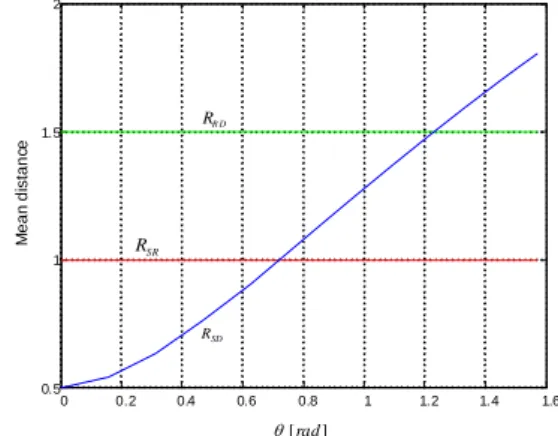
Fig.2 shows the normalized mean distances to the distance between the source node and the relay node (1st neighbor), RSR. It is noticed that the distance,RSD, is increasing with the angle θ between SR and SD link.
0 0.2 0.4 0.6 0.8 1 1.2 1.4 1.6
0.5 1 1.5 2
RSR
RR D
RSD
[rad] θ
Mean distance
Fig. 2 Mean distance vs. angle θ between SR and SD link.
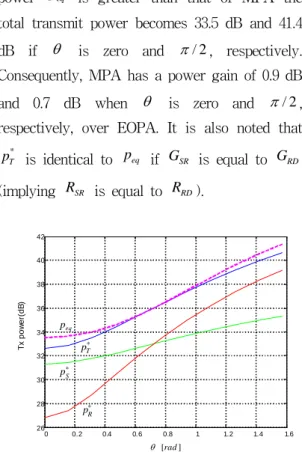
Fig. 3 is a plot of the transmit power of each node to meet the predetermined outage probability of 1 10× −3 for N equal to 3. If the angleθ between SR and SD link is equal to zero, p , *S p , and *R p is 31.3 dB, 26.8 dB, and T* 32.6 dB, respectively. The distance between the relay node and the destination node increases with θ . The total transmit power of MPA, p , T* becomes 40.7 dB if θ is equal to π/ 2. In the case of EOPA, however, the total transmit power p is greater than that of MPA the eq total transmit power becomes 33.5 dB and 41.4 dB if θ is zero and π/ 2, respectively.
Consequently, MPA has a power gain of 0.9 dB and 0.7 dB when θ is zero and π/ 2, respectively, over EOPA. It is also noted that
*
p is identical to T p if eq G is equal to SR GRD (implying R is equal to SR RRD).
[rad] θ
0 0.2 0.4 0.6 0.8 1 1.2 1.4 1.6
26 28 30 32 34 36 38 40 42
Tx power(dB)
*
pR
*
pS
*
pT
peq
Fig.3 Transmit power vs. angle θ between SR and SD link (Po =1×10⁻³,α=3,φ=π/2,pth =1).
Total transmit powers with θ=0 for several power allocation strategies are shown in Fig. 4.
On the outage probability of 1 10× −3, the total transmit power of MPA, EOPA, and the direct transmission are 32.6 dB, 33.5 dB, and 35.3 dB, respectively. The total transmit power of the direct transmission indicates the required transmit power to satisfy the given end-to-end outage probability where the communication link from the source node to the destination node is a direct path. We noticed that the MPA obtains power gains of about 0.9 dB and 2.7 dB over EOPA and the direct power allocation, respectively.
10-2 40
45 50
Tx power (dB)
direct Tx equal outage
min. power
10-4 -3
20 25 30 35
0
OutageP
Fig.4 Total transmit powers for each power allocation strategies (α=3,φ=π/2,θ=0,pth =1).
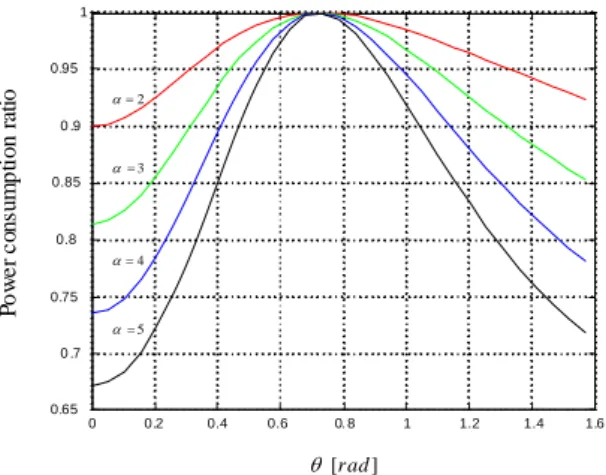
Fig.5 depicts the power reduction ratio as a function of θ when Po=1×10⁻³, φ=π/2,pth=10. It is noted that the power reduction ratio increases with the path loss coefficient α. The power reduction ratio is 18 % and 33 % when αis 3 and 5, respectively, when θ=0. It is found that the power reduction ratio increases to unity and then decreases with θ, because the increasing ratio of peq and pT* with respect
to θ is not the same as shown in Fig.2. When θ is about 0.72 [rad], especially, RSR is equal to RRD, the power reduction ratio becomes unity, which indicates no power reduction can be obtained.
0 0.2 0.4 0.6 0. 8 1 1.2 1.4 1.6
0.65 0 .7 0.75 0.8 0.85 0 .9 0.95 1
=2 α
=3 α
=4 α
=5 α
[rad] θ
Power consumption ratio
Fig. 5 Power reduction ratio vs. angle θ between SR and SD link
(Po=1×10⁻³, φ=π/2,pth=10).
For multi-hop relay routing, the total transmit powers as a function of the number of nodes is plotted Fig.6. It is shown that more total transmit power is required as the number of nodes increases. In multi-hop relay systems, the MPA can save more transmit power compared with the EPA or the direct transmission, and the power savings through the MPA method is significant with the number of nodes. It is seen that MPA reduces the power consumption of 2.60 dB and 6.86 dB over the EOPA and the direct transmission, respectively, of the multi-hop relay system with 7 nodes.
3 4 5 6 7
32 34 36 38 40 42 44
No. of Nodes
Tx power(dB)
direct Tx equal outage
min. power
Fig. 6 Total transmit powers of Multi-hop relay routing system.
( α=3, / 2, φ π= θ=0, 1, pth= Po= ×1 10−3)
VII. Conclusions
In this paper, we have modeled the wireless multi-hop relay system as a Poisson point process in Rayleigh fading channels. We have investigated two power allocation methods, the minimum power allocation (MPA) and equal outage power allocation (EOPA). We have analyzed the total transmit power of two power allocation methodsunder the given end-to-end outage probability. We have shown that the achievable power saving through the MPA method is significant over EOPA method, and the power saving increases with the number of nodes.
References
[1] C.-K. Toh, "Maximum battery life routing to support ubiquitous mobile computing in wireless ad hoc networks," IEEE Communications Magazine, vol.39, no. 6, pp.138-147, June 2002.
[2] G. Franceschetti and S. Stornelli, Wireless Networks, Ch. 6, Academic Press, 2006.
저 자 소 개 김남수(정회원)
∙1986년 ~ 1994년: ETRI(전자통 신 연구소) 이동통신 연구단 무선기술 실장 역임
∙1991년: 연세대학교 대학원 전 자공학과 공학박사
∙1991년 ~ 1991년: BNR(Bell Northern Research) 방문연구원
∙2002년 ~ 2003년: NJIT(New Jersey Institute of Technology) 교환교수
∙1994년 ~ 현 재: 청주대학교 전자정보공학부 교 수
∙2006년 ~ 2007: 청주대학교 학술정보처장
∙2008년: Marquis Who's Who in the World (세 계인명사전) 등재
<주관심분야 : Wireless mobile ad-hoc network, RF system design, digital modulation.무선 이동 통신 채널, 이동통신 시스템 설계>
김도현(정회원)
∙1988년: 경북대학교 전자공학과(공 학석사)
∙1990년: 경북대학교 전자공학과(공 학석사)
∙2000년: 경북대학교 전자공학과(공 학박사)
∙1990년 ~ 1995년: 국방과학연구소 연구원
∙1999년 ~ 2004년: 천안대학교 교수
∙2004년 ~ 현재: 제주대학교 교수
<주관심분야 : 유비쿼터스 서비스, 센서 네트워크, 이 동 컴퓨팅>
[3] M. O. Hasna and M.-S. Alouini, "Optimal power allocation for relayed transmissions over Rayleigh-Fading channels," IEEE Trans. on Wireless Communications, vol.3, no.6, pp.1999-2004, Nov. 2004.
[4] A. Lau and S. Cui, "Joint power minimization in wireless relay channels,"
IEEE Trans. on Wireless Communications, vol.6, no.8, pp.2820-2824, Aug. 2007.
[5] K. Seddik, A. Sadek, Weifeng Su, and K.
Liu, "Outage analysis and optimal power allocation for multimode relay networks,"
IEEE Signal Processing Letters, vol.14, no.6, pp.377-380, June 2007.
[6] X. Deng and A. M. Haimovich, "Power allocation for cooperative relaying in wireless networks," IEEE Communications Letters, vol.9, no.11, pp. 994-996, Nov.
2005.
[7] J. L. Devore,Probability and Statistics for Engineering and Sciences, 4th Ed., Duxbury Press, 1995.
[8] M. Haenggi, "On distances in uniformly random networks," IEEE Trans. on Information Theory, vol.51, no.10, pp.
3584-3586, Oct. 2005.
[9] M. O. Hasna and M.-S. Alouini,
"End-to-end performance of transmission systems with relay over Rayleigh-fading channels," IEEE Trans. on Wireless Communications, vol.20, no.6, pp.
1126-1131, Nov. 2003.
[10] D. G. Manolakis, Statistical and Adaptive Signal Processing, McGraw-Hill, 2000.
Acknowledgements : This work was supported by Korea Research Foundation Grant (KRF-2006-311-D00147)
안병구(종신회원)
∙1988년:경북대학교전자공학 (BS),
∙1996년:(미)Polytechnic Univ.
Dept. of Electrical &
Computer Eng.(MS),
∙2002년:(미)New Jersey Institute of Technology(NJIT), Dept. of Electrical & Computer Eng. (Ph.D),
∙1990년-1994년:포항산업과학기술연구(RIST), 선임연구원,
∙1998년-2002년:Lecturer, New Jersey Institute of Technology(NJIT). USA,
∙2003년-현재: 홍익대학교 컴퓨터정보통신공학과 교수,
∙2005년-208년: Marquis Who's Who in Science and Engineering (세계과학기술 인명사전) 등재,
∙2006-2008: Marquis Who's Who in the World (세계인명사전) 등재
<관심분야:Wireless Networks, Ad-hoc & Sensor Networks, Multicast Routing Protocols, Cross-Layer Technology, QoS, Mobility Management, Location-Based Technology>
이예훈(정회원)
∙2000년: 한국과학기술원 전기 및 전자공학과 (공학박사)
∙1994년 ~ 1997년: 한국전자통신연 구원 위촉연구원
∙2000년 ~ 2001년: LG 전자 선임연 구원
∙2001년 ~ 2002년: Research Associate, New Jersey Institute of Technology, NJ, USA
∙2004년: Visiting Scholar, Stanford University, USA
∙2003년 ~ 2995년: 삼성종합기술원 전문연구원
∙2005년 ~ 현재: 서울산업대학교 전자정보공학부 교수
<주관심분야> 통신이론, 이동통신, 초 광대역통신, 적 응변조복조>