INTRODUCTION
Over the past half-century, women's social activities have been constantly increasing. At the same time, the traditional family structure featuring the husband as breadwinner and the wife as homemaker has been replaced by the dual-earner family. These changes have let men and women do more complex and diverse responsibilities at work and home causing negative outcomes such as work-family conflict, lower job performance, job dissatisfaction, and turnover intention(Eby, Casper, Lockwood, Bordeaux &Brinley, 2005).
Situation in our country is no exception. According to one recent survey targeting domestic workers, the perceived level of work and family balance is only 5.4 points out of 10 (Policy Newsletter, 2014).
And the national happiness index ranked 33 among 34 OECD countries. Many experts have pointed out that long-time-working may be one of the main causes of the lowest happiness index. In fact, Average working hours in Korea are 10 hours 30 minutes and totally 2,090 hours per a year. Total working hours greatly exceed OECD countries' year working time 1776. In contrast, labor pro- ductivity per hour ranks 28. It is almost the lowest level also(Song, 2014). Even thought Korean workers usually spend much more time at work, productivity and happine ss index are very low compared to other countries.
Recently, the government realized the above mentioned situa-
tion and it has tried various attempts and policies to prompt people's happiness and the welfare at work and home. For ex- ample, since 2008, the exemplary company that operates family- friendly policies has been certificated as a good family-friendly company by the Ministry of Gender Equality and Family(Lee SE, 2014). And one national campaign named 'Il ga(家) yang dek' has been promoted since Feb.(Policy Newsletter, 2014). Also the mobile app named 'work-home toktok' has been generated by Ministry of Gender Equality and Family to make workers easily contact the information about work-family policies(Kang, 2014).
There is more evidence showing modern trends about the im- portance of family life. It's new word 'friendy(friend+daddy)' mea- ning fathers who seem like friends to their children. In order to do so, fathers have to well share their limited time and energy bet- ween work and home(Song, 2014). In modern society, work-family balance is getting more important in personal life.
By the way, the academic research on work-family balance is flowing to the other direction. Majority studies in the past were focusing on the effectiveness of the formal benefits or policies (e.g., introducing flexible working time, parental leave, childcare faci- lities support, child education, program family-friendly system) on work-family balance. However many new research trends are highlighting the informal workplace supports such as an orga- nizational work-family organizational support, supervisor sympa- thetic to work-family issue or peers' support (Kossek, Pichler, Bod-
Causal Relationships of Organizational Work-Family Support with Job Satisfaction, Organizational Commitment,
and Turnover Intention
Hyun Jung Choi¶
Dept. of Hotel Management, Tourism Division, Baekseok University, Cheonan 330-704, Korea
ABSTRACT: The aim of the present study is to investigate the structural relationships of organizational work-family support, job satisfaction, organizational commitment and turnover intention among Korean hotel employees. In order to achieve the study goal, frequency analysis, confirmatory factor analysis, reliability analysis, correlation analysis and covariance structure analysis were undertaken using SPSS(18.0) and AMOS(18.0). The result shows that organizational work-family support has a significantly positive effect on job satisfaction and it also positively impacts on organizational commitment. However, it doesn't have any significant effect on turnover intention. This study also suggests that each of job satisfaction and organizational commitment has a significantly negative effect on turnover intention. Through the abovementioned results, we can find out that each of job satisfaction and organizational commitment can completely mediate the relationship between organizational work-family support and turnover intention.
Keywords: Organizational Work-Family Support, Job Satisfaction, Organizational Commitment, Turnover Intention, Hotel Employee
§ Corresponding Author: Hyun Jung Choi, Assistant Professor, Dept. of Hotel Management, Tourism Division, Baekseok University. Munam-ro, Dongnam-gu, Cheonan-si 330-704, Chungcheongnam-do, Korea, Tel. +82-10-5425-5829, Fax. +82-41-550-2528, E-mail: [email protected]
Received: 27 August, 2014, Revised: 8 October, 2014, Accepted: 20 October, 2014.
ner & Hammer, 2011).
Extending this view, this study focuses on the causal rela- tionships of informal workplace support (e.g., positive work-family organizational climate) with employees' job outcomes (e.g., job satisfaction, organizational commitment, turnover intention). Upon this backdrop, this study develops new structural model to explore the effects of organizational work-family support on job satis- faction, organizational commitment and turnover intention am- ong domestic hotel employees. The present study will provide new academic direction and empirical results to encourage future hospitality research applying informal workplace supports.
LITERATURE REVIEW AND HYPOTHESES
Organizational Work-Family Support (OWFS)Organizational support is defined as the degree to which em- ployees form general impressions that their organization appre- ciates their contributions and it is supportive and cares about their employees' wellbeing (Eisenberger, Stinglhamber, Vandenberghe, Sucharski & Rhoades, 2002). It is also a term presenting the per- ceived degree to which an employer values employees, cares about their well-being, and supports their needs by providing resources to assist with managing a demand or role. Organiza- tional support can also be applied to a specific domain such as employees' family-supportive organizational perceptions which is the degree that an organization is seen as family supportive (Allen, 2001). In this study, organizational work-family support is defined as a perception that one's employer cares about an employee's ability to effectively perform work and family responsibilities and one's supervisor empathizes with an subordinate's desire to seek balance between work and family roles (Kossek et al., 2011).
There have been a lot of studies showing empirical evidence of organizational work-family support's significance on individual outcomes. Behson(2005) suggests that employer's informal su- pport like supervisor's sharing work-family concern may be a more important determiner of employee's well-being than the provision of formal family-friendly practices. There are also more explo- rations of a positive relationship between the perception of high managerial work-family support and the use of work-life balance initiatives by employees (Batt & Valcour, 2003; Frye & Breaugh, 2004). Additional researchers have argued that supervisory family support may elicit positive responses from their employees (Th- ompson et al., 1999). Specifically, when employees believe that their employer cares about their family needs, they may respond by having more positive perceptions of their work environment, in the form of more satisfaction with their jobs and greater willing- ness to continue their employment with the organization(Bagger &
Li, 2014). That is why organization pays more attention to informal workplace support such as organizational work-family support.
Turnover Intention, Job Satisfaction, Organizational Commitment and Hypotheses
Internationally, service industries are well known to be plagued with high staff turnover level. That makes 'turnover intention' become one of the most troubling issues for hospitality business and researchers (Griselli et al., 2001; Ryan et al., 2011). Specially, high turnover is generally acknowledged as one of the distin-
guishing features of the hotel industry (Worsfold, 1999). Employee turnover results high personnel costs incurred because of ad- vertising, recruiting and training new replacements (Cheng &
Brown, 1998; Ryan et al., 2011). Accordingly, employers need to treat voluntary turnover as amanagerial problem that requires attention.
Job satisfaction has been considered as one significant antece- dent of customer satisfaction (Magnini et al., 2011). And service moods and manners conducted by service staff reflect how much they are satisfied with their job (Gu& Siu, 2009; Choi & Kim, 2012).
Indeed, staffs on a higher level of job satisfaction are usually prone to do greater service performance (Brown & Peterson, 1993).
Considering the relationship of job satisfaction to customer sa- tisfaction, it is very important for service organizations to know how their employees feel at the workplace and how much they are satisfied with their current workplace (Gallardo et al., 2010, Choi &
Kim, 2012).
Anderson, Coffey, and Byerly (2002) investigated that organi- zational family support (e.g., supervisory family support) had a significantly positive effect on the levels of job satisfaction and negative effect on turnover intentions among wage and salaried workers. Hammer, Kossek, Bodner, Anger and Zimmerman (2011) provided results that employees who perceived informal work- place support like supervisory family support showed higher level of job satisfaction and lower turnover intention. More recently, Bagger and Li(2014) also tested the effect of supervisory family support on job satisfaction and turnover intention among educa- tional employees. It showed a positive relationship between su- pervisory family support and job satisfaction and a negative re- lationship between supervisory family support and turnover in- tention as before.
In this study, organizational commitment is added to study model as a consequence variable. Organizational commitment is a kind of emotional attachment to one's organization. It is defined as
"the relative strength of an individual's identification with and involvement in a particular organization"(Steer, 1977, p.46). The staff on the higher level of organizational commitment is likely to do the better job performance and to show the higher level of job motivation (Ko& Seo, 2012). Erickson and Roloff(2007) provides empirical study that supervisory support significantly and posi- tively affects employees' job satisfaction and organizational co- mmitment. More recently, Agarwala et al. (2014) shows that there is a positive relationship of managerial family support and orga- nizational commitment. According to the aforementioned re- search findings, this study also empirically tests whether orga- nizational work-family support may enhance organizational co- mmitment of hotel employees.
Therefore, the hypotheses are as follows;
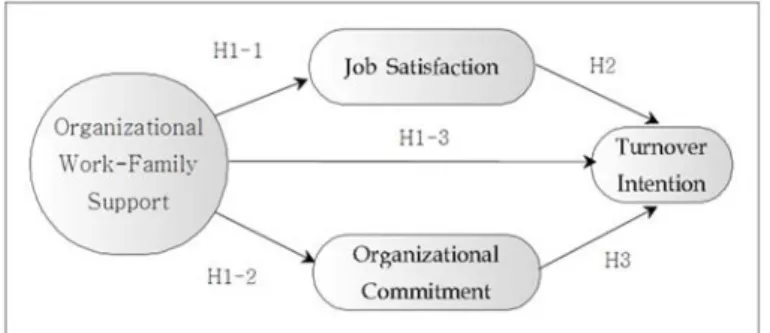
Hypothesis 1-1: Organizational work-family support is positively related to job satisfaction.
Hypothesis 1-2: Organizational work-family support is positively related to organizational commitment.
Hypothesis 1-3: Organizational work-family support is negati- vely related to turnover intentions.
Organizational commitment's role as a predictor of turnover
intention has been presented in the papers(e.g., Joo & Park, 2009;
Fulford, 2005; Gunlu et al., 2010). Investigating job satisfaction and turnover intention, a significantly negative association between them has been found also(e.g., Karatepe et al., 2006; Chuang et al., 2008; O'Leary & Deegan, 2005). Accordingly, as informed by the literature, the following two hypotheses are proposed in order to test the casual relationships of job satisfaction and organizational commitment with turnover intention;
Hypothesis 2: Job satisfaction is negatively related to turnover intention.
Hypothesis 3: Organizational commitment is negatively related to turnover intention.
Through testing the aforementioned structural model, we can additionally confirm the mediating roles of job satisfaction and organizational commitment between organizational work-family support and turnover intention as follows;
Hypothesis 4: Job satisfaction mediates the effect of organiza- tional work-family support on turnover intention.
Hypothesis 5: Organizational commitment mediates the effect of organizational work-family support on turnover intention.
RESEARCH METHODOLOGY AND DESIGN
Research ModelThe primary objective of the study was to investigate in an integrated manner the association of organizational work-family support, job satisfaction, organizational commitment and turnover intention of hotel employees currently working in Korea. In order to achieve the study goal, the research model is proposed as Fig. 1.
Measurement Tools
The questionnaire was adopted based on the literature in which measurement scales were already empirically tested. Responses to all scale items (organizational work-family support, job satisfaction, organizational commitment and turnover intention) were rated on a 5-point scale (1=strongly disagree to 5=strongly agree).
Organizational work-family support
Organizational work-family support was measured using 3 items derived from work-family culture scales(three dimensions; mana- gerial support, organizational time demands, negative conse- quences associated with devoting time to family) developed by
Fig. 1. Research model.
Lyness, Thomptson, Francesco, & Judiesch(1999). The items mea- sure the degree to which employees believe that their orga- nization and supervisors facilitate their efforts to balance work and family responsibilities.
Job satisfaction
Job satisfaction measures were adapted from Wright &Cro- panzano(1998) using A five-items scale. The items measure the degree how much employees are satisfied with the work, co- worker, supervision, total pay and promotional opportunities.
Organizational commitment
Organizational commitment was measured using five-items from Mowday et al.(1979). The items assess the strength of an employee's emotional attachment to an organization.
Turnover intention
A three item measure of turnover intention was used from O'Driscoll and Beehr(1994). The items are measuring whether respondents think about leaving their job, plan to look for a new job and will actively search for a new job outside the firm.
Demographic information
Participants were asked to answer questions on gender, marital status, age, job position, working division, organizational tenure, employment form and the number of children. Gender, marital status and employment form was coded as a binary variable. Job position and working division were coded a three-point scale. Age and the number of children were measured using a four-point scale. Organizational tenure items were measured using a five- point scale.
The Sample and Analyzing Methods
To comply with objectives and test research hypotheses, data for this study were obtained from hoteliers on full-time working position in hotels (8 five-star hotels, 1 four star hotel) located at Seoul and Daejeon in Korea. The data collection was carried out between July, 1 and July, 30, 2012. Before the survey was admi- nistered, its academic purpose was explained to the human re- source manager in each hotel. The questionnaires were then dis- tributed to employees with a full explanation of the goals of the study. A total of 320 self-administrated questionnaires were dis- tributed. After discarding unusable responses, 277 useful respon- ses were coded for analysis.
In order to analyze data, frequency analysis, correlation analysis, reliability analysis was conducted using SPSS 18.0. To test hypo- theses, confirmatory factor analysis and covariance structural ana- lysis were undertaken using AMOS 18.0 software program.
RESULTS
Sample Characteristics
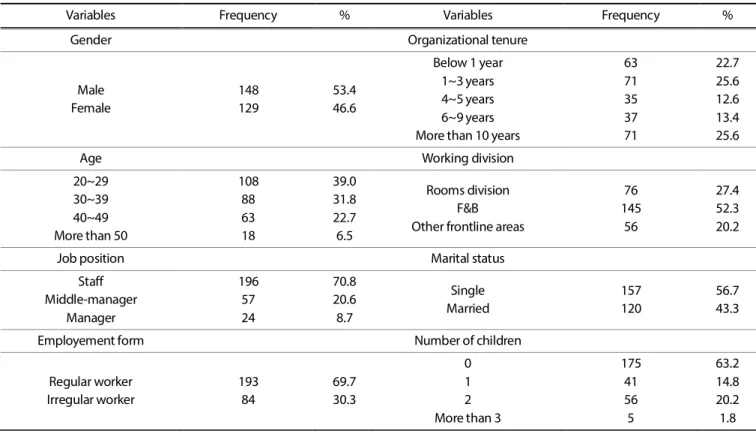
The demographic profile of the respondents was presented in Table 1 as follows.
Measurement Model
The measures were subjected to a series of confirmatory factor
Table 2. Results of confirmatory factor analysis
analysis to confirm whether the proposed model was adequate as well as to support for the issue of convergent and discriminant validity (Anderson & Gerbing, 1988). The results of confirmatory
factor analysis showed that the proposed theoretical four-factor model was very acceptable with the good model fit (χ2/df=2.18, GFI=0.915, CFI=0.950, TLI=0.937, NFI=0.913, RMSEA=0.065). As re- Table 1. Characteristics of the respondents (N=277)
Variables Frequency % Variables Frequency %
Gender Organizational tenure
Male Female
148 129
53.4 46.6
Below 1 year 1~3 years 4~5 years 6~9 years More than 10 years
63 71 35 37 71
22.7 25.6 12.6 13.4 25.6
Age Working division
20~29 30~39 40~49 More than 50
108 88 63 18
39.0 31.8 22.7 6.5
Rooms division F&B Other frontline areas
76 145 56
27.4 52.3 20.2
Job position Marital status
Staff Middle-manager
Manager
196 57 24
70.8 20.6 8.7
Single Married
157 120
56.7 43.3
Employement form Number of children
Regular worker Irregular worker
193 84
69.7 30.3
0 1 2 More than 3
175 41 56 5
63.2 14.8 20.2 1.8
Factor Items
Standardized factor estimate
t-Value AVE
Organizational work-family support
1. In this organization, employees can easily combine career and family.
2. The management of this organization is generally quite accommodating of family- related needs.
3. In this organization, it is generally acceptable to talk about one's family with the supervisor.
0.819 0.844 0.610
9.718 9.723
-
0.611
Job satisfaction
1. I'm satisfied with the work.
2. I'm satisfied with co-workers.
3. I'm satisfied with supervisor.
4. I'm satisfied with total pay.
5. I'm satisfied with promotional opportunities.
0.863 0.719 0.663 0.516 0.538
- 12.165 11.001 8.519 8.825
0.501
Organizational commitment
1. My value and those of the hotel are similar.
2. I really care about the future of this hotel.
3. I'm proud to tell others that I work for this hotel.
4. I'm willing to put in a great deal of effort beyond that normally expected in order to help the hotel to be successful.
5. For me, this is the best of all possible organizations for which to work.
0.633 0.699 0.791 0.653 0.685
9.292 10.139 11.186 9.617
-
0.517
Turnover intention
1. I have thought about leaving this job.
2. I plan to look for a new job over the next 12 months.
3. I would actively search for a new job outside this firm.
0.764 0.955 0.910
- 17.159 16.662
0.742
Model fit χ2=204.464 df=94,χ2/df=2.18, CFI=0.950, TLI=0.937, NFI=0.913, RMSEA=0.065, GFI=0.915
( ) ; the squared correlation coefficient.
ported in Table 2, all of the standardized factor loadings ranged from 0.516 to 0.955, and all t-values ranging from 8.519 to 17.159 were significant. These results show that the measurement model has acceptable convergent validity (Hair et al., 2006).
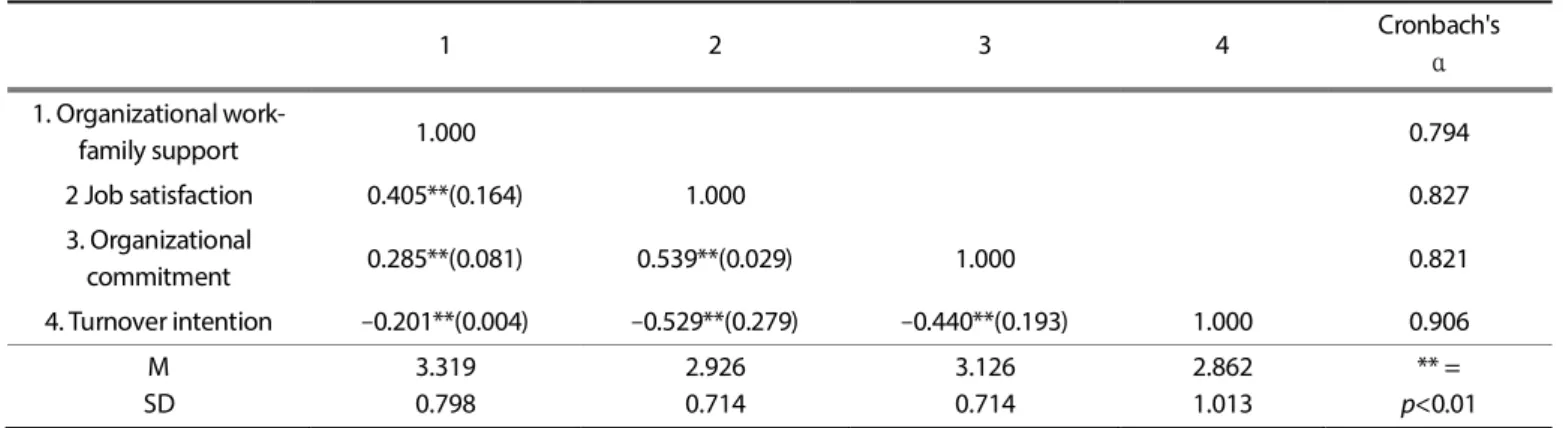
In order to check the issue of discriminant validity, the average variance extracted and coefficients of the squared correlations between pairs of the constructs were compared. As Table 2 and Table 3 shows, all of the average variance extracted were higher than the squared correlations between the pairs of constructs.
Hence, discriminant validity was also ensured.
In addition, Table 3 also shows, all constructs had internal reli- ability estimates above the cut-off level of 0.70 as recommended by Nunnally(1978). These results provide that all coefficient alphas were deemed acceptable.
The Structural Model and Test Results for the Hypotheses
To test the structural theory, covariance structural analysis was undertaken using AMOS 18.0. Test results to see the structural
model's fitness were found to be acceptable with the good model fit (χ2/df=2.17, GFI=0.914, CFI=0.950, TLI=0.937, NFI=0.913, RM- SEA=0.065).All of these fit indices indicate that the proposed hypothesized structural model fits the data well.
Hypothesis 1-1 suggested that Organizational work-family su- pport is positively related to job satisfaction. The standardized regression weight was 0.438 (t=6.183) with p=0.000. Accordingly, Hypothesis 1-1 was supported. Hypothesis 1-2 stated that Or- ganizational work-family support is positively related to organi- zational commitment. The standardized regression weight was 0.361 (t=4.555) with p=0.000. Accordingly, Hypothesis 1-2 was also supported. Hypothesis 1-3 suggested that organizational work- family support is negatively related to turnover intention. The standardized regression weight was 0.075 (t=1.120) with p=0.263.
Therefore, Hypothesis 1-3 was rejected. Hypothesis 2 predicted that job satisfaction has a negative effect on turnover intention.
The standardized regression weight was –0.439 (t=–4.572) with p=0.000. Thus, Hypothesis 2 was accepted. Hypothesis 3 suggested Table 3. Correlation among the variables, means, standard deviations, Cronbach's alpha
1 2 3 4 Cronbach's
α 1. Organizational work-
family support 1.000 0.794
2 Job satisfaction 0.405**(0.164) 1.000 0.827
3. Organizational
commitment 0.285**(0.081) 0.539**(0.029) 1.000 0.821
4. Turnover intention –0.201**(0.004) –0.529**(0.279) –0.440**(0.193) 1.000 0.906 M
SD
3.319 0.798
2.926 0.714
3.126 0.714
2.862 1.013
** = p<0.01
Table 4. Results of covariance structural analysis
Hypothesis Path direction Standardized regression
weights t-value P-
value Results
H 1
H1-1 Organizational work-family support
→Job satisfaction 0.438 6.183 *** Accept
H1-2 Organizational work-family support
→Organizational commitment 0.361 4.555 *** Accept
H1-3 Organizational work-family support
→Turnover intention 0.075 1.120 0.263 Reject
H 2 Job satisfaction →Turnover intention –0.439 –4.572 *** Accept
H 3 Organizational commitment
→Turnover intention –2.234 –2.640 0.008 Accept
Mediating role between organizational work-family support and turnover intention
H 4 Job satisfaction Complete mediation Accept
H 5 Organizational commitment Complete mediation Accept
that organizational commitment has a negative effect on turnover intention. The standardized regression weight was –0.234 (t=
–2.640) with p=0.008. Thus, Hypothesis 3 was accepted. Hypothesis 4 and 5 was to test the mediating role of job satisfaction and organizational commitment between organizational work-family support and turnover intention. As we can see Table 4, job sa- tisfaction and organizational commitment shows a completely mediating role each between organizational work-family support and turnover intention. Hence, Hypothesis 4 and 5 are supported.
The results of standardized regression weights for each path are presented in Table 4.
DISCUSSION AND IMPLICATIONS
Majority studies in the past were focusing on the effectiveness of the formal benefits and workplace policies (e.g., introducing flexible working time, parental leave, childcare facilities support, child education program, family-friendly system) for facilitating employees' work-family balance. But recently, scholars who have been studying work-family balance are highlighting the power of informal workplace supports such as an organizational work-family organizational support, supervisor sympathetic to work-family issue and peers' support (Kossek et al., 2011).
Extending this view, the primary objective of the study was to investigate the structural relationships of organizational work- family support which is well known as one of the informal work- place supports with job outcomes such as job satisfaction, or- ganizational commitment and turnover intention of Korean hotel employees. Additionally, this study tested whether job satisfaction and organizational commitment mediate the relationship between organizational work-family support and turnover intention.
Based on the findings gained in this study, the followings are the key points. First, consistent with prediction, organizational work- family support was positively associated with job satisfaction and organizational commitment. Even though organizational work- family support did not directly affect on turnover intention, it can have an indirect influence on turnover intention through enhan- cing job satisfaction and organizational commitment. This finding confirms the significant power of organizational work-family su- pport on job outcomes. In other words, organizational climate to care about employees' work-family balance, supervisor's well- listening to employees' family matters can be effective to make employees be more satisfied with their job and commit more to their organization.
In modern society, personal happiness is getting more im- portant. Organization should not overlook the fact that each employee is one of the members not only in the company but also in the family. We have to focus on this point. This study results empirically showed that employee satisfaction and organizational commitment could be higher also, when organization supports employee's family life in informal ways. Supervisor is a person who has direct influence on employees very closely. His or her role is really important. This study argues the fact that if supervisor pays more attention to staff's work-family balance and shares more about employees' family matters, employees are more satisfied with their job, show more commitment to their organization and
less turnover intention. Eventually, the author hopes that these study results can be a useful source on building better personnel policies for hoteliers in Korea.
Despite some notable contributions, the author would like to acknowledge some limitations. This study set an informal support (e.g., organizational work-family support) as one dimensional an- tecedent affecting job outcomes. The extending model including some more antecedent variables regarding to informal workplace supports and job outcomes would be recommended in further researches.
ACKNOWLEDGEMENTS
This work was supported by 2014 Research Funds of Baekseok University in Korea.
RREFERENCES
Allen T. D. (2001). Family-supportive work environments: The role of organizational perceptions. Journal of Vocational Behavior, 58, 414-435.
Agarwala, T., Arizkuren-Eleta, A., Castillo, E. D., Muniz-Ferrer, M., &
Gartzia, L. (2014). Influence of managerial support on work-life conflict and organizational commitment: an international comparison for India, Peru and Spain. The International Journal of Human Resource Management, 25(10), 1460-1483.
Anderson, S. E., Coffey, B. S., & Byerly, R. T. (2002). Formal organi- zational initiatives and informal workplace practices: Links to work-family conflict and job-related outcomes. Journal of Management, 28, 787-810.
Anderson, J. C., & Gerbing, D. W. (1988). Structural equation mo- deling in practice: A review and recommended two-step app- roach. Psychological Bulletin ,103(1): 411-423.
Bagger, J., & Li, A. (2014). How does supervisory family support influence employees' attitudes and behaviors? A social ex- change perspective. Journal of Management, 40(4), 1123-1150.
Brown, S. P., & Peterson, R. A. (1993). Antecedents and consequ- ences of salesperson job satisfaction: meta-analysis and asse- ssment of casual effects. Journal of Marketing Research, 30, 63- 77.
Batt, R., & Valcour, P. M. (2003). Human resources practices as predictors of work-family outcomes and employee turnover.
Industrial Relations, 42, 189-220.
Behson, S. J. (2005), The relative contribution of formal and in- formal organizational work-family support. Journal of Voca- tional Behavior, 66, 487-500.
Cheng, A., & Brown, A. (1998). HRM strategies and labour turnover in the hotel industry: A comparative study of Australia and Singapore. The International Journal of Human Resource Ma- nagement, 9(1), 136-154.
Choi, H. J., & Kim, Y. T. (2012). Work-family conflict, work-family facilitation and job outcomes in the Korean hotel industry.
International Journal of Contemporary Hospitality Management, 24(7), 1011-1028.
Chuang, N. -K., Yin, D., & Dellman-Jenkins, M. (2008). Intrinsic and extrinsic factors impacting casino hotel chef's job satisfaction.
International Journal of Contemporary Hospitality Management,
21(3), 323-340.
Eby, L. T., Casper, W. J., Lockwood, A., Bordeaux, C., & Brinley, A.
(2005). Work and family research in IO/OB: Content analysis and review of the literature (1980~2002). Journal of Vocational Behavior, 66, 124-197.
Eisenberger, R., Stinglhamber, F., Vandenberghe, C., Sucharski, I. L.,
& Rhoades, L. (2002). Perceived supervisor support: contribu- tions to perceived organizational support and employee re- tention. Journal of Applied Psychology, 87, 565-573.
Erickson, R. A., & Roloff, M. E. (2007). Reducing attrition after do- wnsizing: Analyzing the effects of organizational support, su- pervisor support, and gender on organizational commitment.
International Journal of Organizational Analysis, 15, 35-55.
Fulford, M. D. (2005). That’s not fair! The test of a model of orga- nizational justice, job satisfaction, and organizational commit- ment among hotel employees. Journal of Human Resources in Hospitality & Tourism, 4(1), 73-84.
Frye, N. K., & Breaugh, J. A. (2004). Family-friendly policies, super- visor support, work-family conflict, family-work conflict, and satisfaction. A test of conceptual model. Journal of Business and Psychology, 19, 197-220.
Gallardo, E., Sánchez-Cañizares, S., López-Guzmán, T. and Jesus, M.
M. N. (2010). Employee satisfaction in the Iberian hotel industry - The case of Andalusia (Spain) and the Algarve (Portugal)".
International Journal of Contemporary Hospitality Management, 22(3), 321-334.
Ghiselli, R. F., La Lopa, J. M., & Bai, B. (2001). Job satisfaction, life satisfaction and turnover intention. Cornell Hotel and Restaurant Administration Quarterly, 42(2), 28-37.
Gu., Z., & Siu, R. (2009). Drivers of job satisfaction as related to work performance in Macao casino hotels. International Journal of Contemporary Hospitality Management, 21(5), 561-78.
Gunlu, E., Aksarayli, M., & Percin, N. S. (2010). Job satisfaction and organizational commitment of hotel managers in Turkey.
International Journal of Contemporary Hospitality Management, 2(5), 693-717.
Hair, J. E., Black, W. C., Babin, B. J., Anderson, R. E., & Tatham, R. L.
(2006). Multivariate Data Analysis, 6th ed., Pearson Prentice Hall, Upper Saddle River, NJ.
Hammer, L. B., Kossek, E. E., Bodner, T., Anger, K., and Zimmerman, K. (2011). Clarifying work-family intervention processes: the ro- les of work-family conflict and family-supportive supervisor be- haviors. Journal of Applied Psychology, 96(1), 134-150.
Joo, B. K., & Park, S. (2009). Career satisfaction, organizational co- mmitment and turnover intention. Leadership and Organiza- tional Development Journal, 31(6), 482-500.
Kang. (2014). '여성가족부 일가정 톡톡 모바일 앱 보급'. Data- net. 6월 18일 뉴스.
Karatepe, O. M., Uludag, O., Menevis, I., Hadzimehmedagic, L., &
Baddar, L. (2006). The effects of selected individual charac- teristics on frontline employee performance and job satisfac- tion. Tourism Management, 27, 547-560.
Ko, S. H., & Seo, J. H. (2012). The effect of the transformational leadership, perceived organizational support and the indivi- dual’s needs for achievement on the organizational commitment:
Focused on the Role of Self-Leadership. The Korean Journal of Business Administration 25(1),435-459.
Kossek, E. E., Pichler, S., Bodner, T., & Hammer, L. B. (2011). Work- place social support and work-family conflict: a meta-analysis clarifying the influence of general and work-family specific supervisor and organizational support. Personnel Psychology, 64, 289-313.
Lee, S. E. (2014). '가족친화기업인증이란?'. 5월 13일, 일간스포 츠신문.
Lyness, K., Thompson, C., Francesco, A., & Judiesch, M. (1999). Work and pregnancy: individual and organizational factors influ- encing organizational commitment timing of maternity leave and return to work. Sex Roles, 41(1): 485-508.
Magnini, V. P., Lee, G., & Kim, P. (2011). The cascading affective consequences of exercise among hotel workers. International Journal of Contemporary Hospitality Management, 23(5), 624- 643.
Mowday, R. T., Streers, R. M., & Porter, L. W. (1979). The mea- surement of organizational commitment. Journal of Vocational Behavior, 14, 224-247.
O'Driscoll, M. P., & Beehr. T. (1994). Supervisor behaviors, role stressors and uncertainly as predictors of personal outcomes for subordinates. Journal of Organizational Behavior, 15(2), 141- 151.
O’'Leary, S., & Deegan, J. (2005). Career progression of Irish tourism and hospitality management graduates. International Journal of Contemporary Hospitality Management, 17(5), 421-432.
Policy Newsletter (2014). '바꿔! 장시간 근로, 꿈꿔! 가족의 행복’. 3월 14일, 정책뉴스.
Ryan, C., Ghazali, H., & Mohsin, A. (2011). Determinants of intention to leave a non-managerial job in the fast-food industry of West Malaysia. International Journal of Contemporary Hospitality Management. 23(3), 344-360.
Song, J. Y. (2014). '저녁이 있는 삶 살고 있습니까?'. 5월 12일 MK 뉴스.
Steers, R. M. (1977). Antecedents and outcomes of organizational commitment. Administrative Science Quarterly, 22, 4-11.
Thompson, C. A., Beauvais, L. L., & Lyness, K. S. (1999). When work- family benefits are not enough: The influence of work-family culture on benefit utilization, organizational attachment, and work-family conflict. Journal of Vocational Behavior, 54, 392- 415.
Wright, T. A., & Cropanzano, R. (1998). Emotional exhaustion as a predictor of job performance and voluntary turnover. Journal of Applied Psychology, 83, 486-493.
Worsfold, P. (1999). HRM, performance, commitment and service quality in the hotel industry. International Journal of Contempo- rary Hospitality Management, 11(7), 340-348.