ABSTRACT
PURPOSES :This paper, presents the results of a laboratory study aimed to verify the suitability of a particular type of Electric Arc Furnace (EAF) steel slag to be recycled in the lithic skeleton of both dense graded and porous asphalt mixtures for flexible pavements.
METHODS :Cyclic creep and stiffness modulus tests were performed to evaluate the mechanical performance of three different asphalt mixtures (dense graded, porous asphalt, and stone mastic) prepared with two types of EAF steel slag. For comparison purposes, the same three mixtures were also designed with conventional aggregates (basalt and limestone).
RESULTS :All the asphalt mixtures prepared with EAF steel slag satisfied the current requirements of the European standards, which support EAF steel slag as a suitable material for flexible pavement construction.
CONCLUSIONS :Based on the experimental work, the use of waste material obtained from steel production (e.g. EAF steel slag) as an alternative in the lithic skeleton of asphalt mixtures can be a satisfactory and reasonable choice that fulfills the “Zero Waste”objective that many iron and steel industries have pursued in the past decades.
Keywords
electric arc furnace (EAF) steel slag, recycling, cyclic creep test, stiffness modulus test, porous asphalt, dense graded asphalt, zero waste.
Remarks on the use of Electric Arc Furnace (EAF) Steel Slag in Asphalt Mixtures for Flexible Pavements
Electric Arc Furnace (EAF) Steel Slag의 아스팔트 포장 혼합물 내 대체 골재로서 적용 가능성에 대한 고찰
Augusto Cannone Falchetto Senior Researcher(Ph.D.)·Technical University of Braunschweig·Department of Architecture·Civil Engineering and Environmental Sciences-Pavement Engineering Centre(ISBS) (E-mail : [email protected]) Ki Hoon Moon 문`기`훈 Member·Senior Researcher (Ph.D.)·Samsung Construction and Trading Corporation·Corresponding Author
(E-mail : [email protected])
1. INTRODUCTION
The potential use of marginal materials as components of road infrastructures has been studied for many years in field of asphalt pavement engineering (Robert et al., 2002; Dunster, 2002;
Rockliff et al., 2002; Bonilla et al, 2009; Krayushkina et al., 2012, Mahmoud et al., 2013). In particular, their physical and mechanical performances and characteristics have been evaluated, to identify the most effective use for roadway constructions. Since Corresponding Author : Ki Hoon Moon, Senior Researcher
Samsung Construction and Trading Corp.
5th Floor, Daeryung Gangnam Tower 826-20, Yeoksam1-Dong, Gangnam-Gu, Seoul, 135-935, Korea
Tel : +82.2.2145.6507 Fax : +82.2.2145.6500 E-mail : [email protected]
International Journal of Highway Engineering http://www.ksre.or.kr/
ISSN 1738-7159 (print) ISSN 2287-3678 (Online)
Received Oct. 5. 2014 Revised Oct. 8. 2014 Accepted Jan. 8. 2015 Int. J. Highw. Eng. Vol. 17 No. 1 : 25-33 February 2015
http://dx.doi.org/10.7855/IJHE.2015.17.1.025
1989, Permanent International Association of Road Congress (PIARC) has been classifying the various types of alternative materials, to build more rigorous, reasonable and acceptable material performance definitions (Dunster, 2002). As a result, the following three material categories have been identified based on their feasibility for pavement construction (Dunster, 2002; Rockliff et al., 2002; Pascal et al., 2009; Mahmoud et al., 2013):
Traditional natural materials (e.g. rocks and soils);
Industrial by-products
(e.g. from metallurgical industry, thermal electric power stations, chemical industry etc.);
Industrial wastes
(e.g. mining & quarrying, municipal & industrial wastes, dredging sludge).
Several examples can be found on the use of metallurgical industry by-products: for example, road surface layers composed of Blast Furnace (e.g. crystallized and vitrified) granulated slag (BF) and Basic Oxygen steel slag (BO) are commonly used in many European countries such as England and France (Dunster, 2002; Rockliff et al., 2002, Pascal et al., 2009, Morone et al., 2014). Electric Arc Furnace (EAF) steel slags, an artificial aggregate which is produced after a specific industrial production process, are, instead, more diffused in Italy and Germany (Ellis et al., 1999; Jens A., 2002, Morone et al., 2014).
Two main technologies are currently used to produce steel: the integral cycle, which starts from mineral iron, and the electric cycle, which uses scrap metals. A consistent amount of the steel produced in Italy and Germany (i.e. approximately 55%) comes from Electric Arc Furnace (EAF), which every year, results into approximately two million tons of slag (Ellis et al., 1999; Dunster, 2002; Morone et al., 2014). The recycling of this waste product to obtain new high-quality raw materials would reduce both the tremendous exploitation of limited natural resources and the amounts of waste to landfill, which in the case of EAF, accounts for approximately 60% of the total steel slags produced in the in the European Union (EU), (Ellis et al., 1999; Jens A., 2002, Morone et al., 2014).
The various origins of scrap metal (e.g. waste from mechanical manufacturing, industrial and civil demolition, car bodywork, etc.) implies that the by-products generated by the smelting (slags and ashes) have different elements, varying in composition, also depending on the steel type to be produced and the consequent
inclusion of binding and melting elements during the production process (Jens A., 2002, Morone et al., 2014). For this reason, Electric Arc Furnace (EAF) slag derived from iron and steel, unlike the Blast Furnace (BF) remnant utilized for cement, which contains a more uniform composition due to its origination: a more standardized cycle, has not been seriously focused in the past. Therefore, the possibility of re-using EAF slags have never been fully considered and developed in Europe even though steel slag has been used for road building material in other countries widely since 1980’s (Emery J. 1984; Ellis et al., 1999; Chaurand et al., 2007; Morone et al., 2014).
2. ELECTRIC ARC FURNACE (EAF) STEEL SLAGS
Slag from the iron and steel industry are obtianed from the rapid cooling process of the oxidized and superficial liquid phase present in electric arc furnaces, from circa 1,300℃, to room temperature (Ellis et al., 1999; Jens A., 2002, Sofilic et al., 2010;
Morone et al., 2014). The blocks solidify in air, sometimes accelerating the process by water spray. Through this process, a quantity of free calcium oxide may remain inside the blocks, potentially subject to hydration or carbonation. These modification can be the major cause of uneven expansion and disintegration of the material. For this reason, slag from electric furnace is conditioned outside by exposing the material to air for a period of time (at least for two months), during this process the unbound fraction of calcium oxide stabilizes. At the end of this process, the material may still contain some metal, represented by steel inclusions, which must be extracted, usually by a magnet and/or by crushing. At the end, the raw slag is crushed, first with a jaw breaker and then with a cone crusher in order to obtain the desired grading fractions (Ellis et al., 1999; Sofilic et al., 2010).
From a chemical point of view, slags are mainly composed of calcium, iron, aluminum, magnesium and silicon oxides, which together account for an average of approx. 90% of the weight of the material (Ellis et al., 1999; Pascal et al., 2009; Sofilic et al., 2010). The principal component is iron, the presence of which is due to the action of the oxidative regime of the electric arc furnace on the liquid metal bath. Of the remaining components, some elements (e.g. calcium or silicon) derive from the raw materials added to the bath as additives, some derive in part from the attack of the liquid bath on the refractory lining of furnaces (e.g.
magnesium) and yet others are impurities associated to the quality of the metal scrap utilized (e.g. chromium, copper, etc.).
A vast amount of literature on the use and evaluation of EAF steel slag performances is available. Some of the more relevant with respect to the present research are briefly summarized.
Pascal et al. (2009) investigated the feasibility of re-using 10 year old EAF steel slag embedded in asphalt pavement structures by based on Scanning Electron Microscopy (SEM) and leaching test.
They observed that the EAF steel slag samples extracted from center of a pavement were almost identical to virgin slag;
however, in the case of EAF steel slags obtained from the pavement side significant differences were found due to carbonation and leaching process.
Sofilic et al. (2010) evaluated the feasibility of applying EAF steel slag as alternative aggregate source in asphalt pavement by performing a number of micro-structure analyses: Optical Microscopy (OM), X-Ray Diffraction (XRD), Scanning Electron Microscope (SEM) and Energy Dispersive Spectrometry (EDP).
As a result it was found that EAF steel slag does not contain environmentally harmful element and fulfills the requirements (EN 13043, 2002) for aggregate that can be used for asphalt pavement construction and surface treatments.
Liapis and Likoydis (2012) evaluated several mechanical performance parameters (skid resistance, permeability, porosity and surface texture) of EAF steel slag added asphalt mixtures by performing field testing of highway sections (Egnatia highway:
approximately12km, Greece) paved between 2007 and 2008. It was observed that mixtures prepared with EAF steel slag show reasonable mechanical performances compared to the conventional asphalt pavements and that they meet the performance requirements establish by the local road authorities.
Recently, the possibility of using EAF steel slag for preparing Warm Mix Asphalt (WMA) mixtures in substitution of natural limestone (LS) was investigated by Mahmoud and co-workers (2013). SEM analysis and several mechanical testing were performed showing that porosity and roughness of EAF steel slag are higher compared to those of LS. In addition, enhanced Marshall stability, resilient modulus, tensile strength, together with reduced moisture sensitivity and permanent deformation were observed in EAF steel slag added mixtures compared to conventional mixtures.
As EAF steel slags present physical-mechanical characteristics considerably identical to those of natural stone aggregates, and full chemical compatibility with the hydrocarbon binders used in
flexible pavement roadway construction, a particularly interesting application for EAF steel slags is undoubtedly that of the construction of asphalt pavement, in substitution for or integration with traditional aggregates.
3. MATERIAL PREPARATIONS
In this study the effect of two different EAF steel slags (type A and type B) on the performance of three types of asphalt mixtures was studied and evaluated. The following mixture mixtures were selected for the present research:
Stone Mastic Asphalt (SMA);
Wearing Course Asphalt Mixture (WCAM);
Porous Asphalt (PA)
The three asphalt mixtures were prepared with natural crushed limestone and basalt aggregate, limestone filler and combinations of two types of Electric Arc Furnace Steel Slag (EAFSS: Type A and Type B, from different providers, see Figure 1) having three different particle fractions: 0/5, 5/10, 10/15 mm; “hard”modified asphalt binder was used for SMA and PA mixtures, while
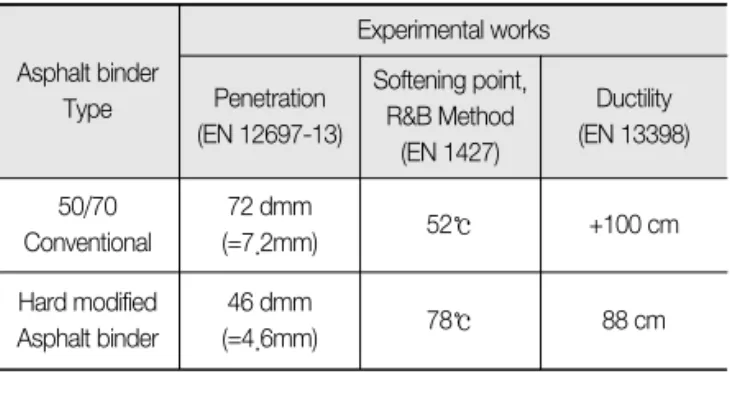
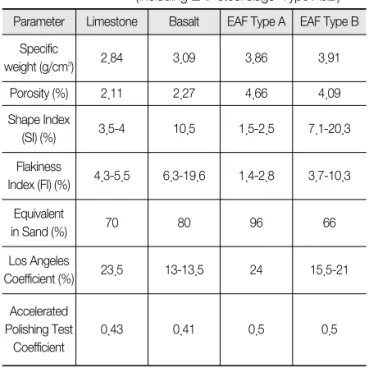
“normal”asphalt binder (50/70pen = 5/7mm) was used for WCAM. Table 1 summarizes the values obtained from the acceptance tests conducted on the two asphalt binders used in this study, while Table 2 provides the results of characterization tests on the different aggregates investigated.
(a) Type A (b) Type B
Fig. 1 Prepared Electric Arc Furnace (EAF) Steel Slags
Table 1. Summary of used Asphalt Binders in This Study
Asphalt binder Type
Experimental works
Penetration (EN 12697-13)
Softening point, R&B Method
(EN 1427)
Ductility (EN 13398)
50/70 Conventional
72 dmm
(=7.2mm) 52℃ +100 cm
Hard modified Asphalt binder
46 dmm
(=4.6mm) 78℃ 88 cm
The two different types of asphalt binder prepared in this research are shown in Figure 2.
According to the European directives (2008/98/EC, 2008) slag is conventionally defined as “non-hazardous and special non-toxic”refuse and, specifically, steel slag is a solid material, greyish in color and odor-free. The pH of EAF Type A steel slag is 10.7, whereas that of EAF Type B steel slag is 12.2. In terms of material composition EAF Type A steel slag presents higher content (evaluated in mg/kg) of chromium (2,460), zinc (660), copper (420), as well as lead, nickel, iron (as oxide) and silica. EAF Type B steel slag shows higher concentration (evaluated in mg/kg) of zinc (2,430), chromium (1,580), lead (930), copper (560), as well as nickel, iron and calcium (as oxide) and silica.
4. ASPHALT PAVEMENT MIXTURE DESIGN
Table 3 presents the design grading composition of the asphalt mixtures investigated. The overall EAF steel slag content is equal to 59% for SMA, 30% for WCAM and 39% for PA. For each of the three mixtures types, the amounts of asphalt binder were selected at intervals of 0.5% by weight of aggregate within specific ranges (4.5 ~ 6% for PA and WCAM, 5.5 ~ 7.0% for SMA).
The classic Marshall procedure (EN 12697-34, 2012) was used for determining the optimal binder content, along with the indirect tensile strength test (EN 12697-23, 2003). The asphalt mixtures characterized by maximum Marshall Stability, Marshall Stiffness and maximum Indirect Tensile Strength at 25℃ were considered as optimal. In order to evaluate the influence (i.e. effect) of EAF steel slag on the mechanical behavior of the various types of asphalt mixture, a series of Marshall test were also conducted on specimens produced only with natural (conventional) aggregate Table 2. Aggregate Characteristics
(Including EAF steel slags: Type A&B) Parameter Limestone Basalt EAF Type A EAF Type B
Specific
weight (g/cm3) 2.84 3.09 3.86 3.91
Porosity (%) 2.11 2.27 4.66 4.09
Shape Index
(SI) (%) 3.5-4 10.5 1.5-2.5 7.1-20.3
Flakiness
Index (FI) (%) 4.3-5.5 6.3-19.6 1.4-2.8 3.7-10.3 Equivalent
in Sand (%) 70 80 96 66
Los Angeles
Coefficient (%) 23.5 13-13.5 24 15.5-21 Accelerated
Polishing Test Coefficient
0.43 0.41 0.5 0.5
Fig. 2 Prepared Asphalt Binders
Table 3. Mix design: Aggregate Type and Particle Size Distribution
Mixture composition Fraction (mm) Quantity (%)
SMA WCAM PA
Crushed Limestone
0/5 - 15 -
5/10 - 45 -
10/15 30 - -
Basalt
0/5 - - -
5/10 - - 11
10/15 - - 45
EAF steel slag Type A
0/5 - 10 -
5/10 - 5 -
10/15 - - 10
EAF steel slag Type B
0/5 12 5 13
5/10 32 10 4
10/15 15 - 12
Filler - 11 10 5
Mixture composition Fraction (mm) Quantity (%)
SMA WCAM PA
Crushed Limestone
0/5 12 30 13
5/10 32 60 15
10/15 45 - 67
Basalt
0/5 - - -
5/10 - - -
10/15 - - -
Filler - 11 10 5
(a) Mixtures with EAFSS
(b) Mixtures without EAFSS (natural aggregates only)
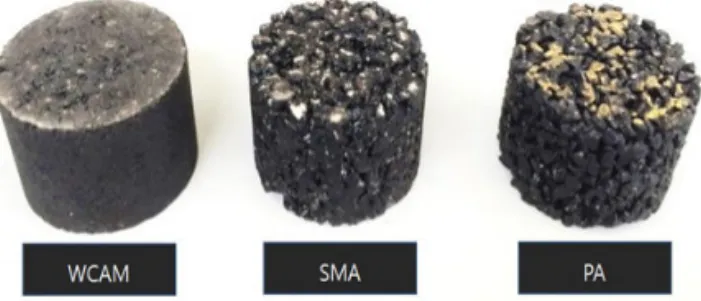
(e.g. basalt and/or limestone), with the compositions described in Table 3 and with the same optimal binder content as the corresponding mixture with EAF steel slag aggregate. The samples of the asphalt mixtures prepared in this study are presented in Figure 3.
Table 4 presents the results of the optimization and Marshall tests; all the mixtures produced with EAF steel slag satisfied the requirements thus resulting as suitable for application in roadway building (EN 12697-34, 2012). The result of the indirect tensile strength test (EN 12697-23, 2003) was particularly satisfactory;
measured strength values were always higher than 1.0 N/mm2(=MPa).The increase in Marshall Stiffness(=daN/mm) associated to the use of EAF steel slag in the stone aggregate matrix was significant for all three types o f asphalt mixtures:
from 14.7% and 17.9% for the dense mixtures(WCAM),tomore than36.1%in the open graded one(see Table 3).
5. PERFORMANCE EVALUATION OF EAFSS MIXTURES
In this section the mechanical performance of the three types of mixtures investigated is evaluated based on cyclic creep (EN 12697-25, 2005) and stiffness modulus (EN 12697-26, 2004) tests.
5.1. Cyclic Creep Test (EN 12697-25, 2005) The resistance to the permanent deformation (i.e. rutting) has been investigated by means of the Repeated Load Axial Test (RLAT) with confined condition, following the specifications of EN 12697-25 standard (Method A: Uniaxial cyclic compression test with confinement, 2005). For each optimized asphalt mixture, specimens of 150 mm in diameter (D) and 60mm in height(h), were tested with a cyclic axial block-pulse applied using an upper metal plate having diameter=100mm. In this test, the specimen is divided in to a “virtual”internal cylinder with 100 mm of diameter, directly loaded by the overhead plate, and a “virtual”
cylindrical ring of surrounding the inner material with 25mm of radius, which is not axially loaded and that develops a confined action that impedes the free lateral expansion. During the test procedure, the change of specimen height ( , mm) at specified numbers o f load applications is recorded. Finally, values of the cumulative axial strain( : permanent deformation), creep rate ( ) and creep modulus( ) of the tested asphalt mixture are determined as a function of the load application repetitions (see Equations 1 to 3).
Where
=the cumulative axial strain of specimen after n load application (%);
=the average height measured by displacement transducers (mm);
=the average height measured by displacement transducers after load applications (mm).
In Equation (1) value of is calculated at 3600 pulses (
=3600).
Fig. 3 Prepares Asphalt Mixtures (with EAF steel slag)
Table 4. Marshall Optimizing Results
(a) Marshall Stability, Marshall Flow and Marshall Stiffness
Mix ID
Optimum Binder Content
with EAFSS (a) without EAFSS (b) Difference,%
[((a)-(b))/(a)]
Marshall Stability (daN)
Marshall Flow (mm)
Marshall Stiffness (daN/mm)
Marshall Stability (daN)
Marshall Flow (mm)
Marshall Stiffness (daN/mm)
Marshall Stability (daN)
Marshall Flow (mm)
Marshall Stiffness (daN/mm) WCAM 5.0% 1221 2.81 435 1213 3.26 371 0.66 16.48 14.7
PA 5.0% 626 2.63 238 485 3.19 152 22.52 21.31 36.1 SMA 6.0% 1024 2.92 351 1000 3.47 288 2.34 19.02 17.9
Mix ID
Binder Content
with EAFSS (a)
without EAFSS (b)
Difference,%
[((a)-(b))/(a)]
ITT (N/mm2=MPa)
WCAM 5.0% 1.36 1.34 1.47
PA 5.0% 1.38 1.11 19.57
SMA 6.0% 1.15 1.13 1.74
(b) Indirect Tensile Test (ITT)
(1)
(2)
Where
=the value of creep rate in micro-strain/loading pulse;
=the cumulativ eaxial strain after or load applications(see Equation (1));
=the number of cyclic load applications.
(in this test values of =2,000seconds,
=7,200seconds)
Where
= the creep modulus after n load applications (MPa);
= he applied stress (=1002 kPa);
=the cumulative axial strain of specimen after load applications (%).
The European standard (EN 12697-25, 2005) prescribes 3,600 pulses of a 1002 kPa stress, with loading and unloading times fixed as 1s, at 40℃. Therefore, the total duration of this test was 7200 seconds (3600seconds: loading + 3600seconds: unloading).
The major concept and aim of this cyclic creep test (EN 12697- 25, 2005) is that a “stress-strain condition”is reproduced similarly to that in situ, where the material surrounding the area of a pavement directly under the tires load imposes a confining action.
The schematic of cyclic creep test is shown in Figure 4.
Typically, three stages can be identified in a creep curve of a viscoelastic-plastic material (see Figure 5): a first phase (i.e. stage 1), with a decreasing creep rate, a second phase (i.e. stage 2) with a constant creep rate, with a quasi-constant slope and a final phase (i.e. stage 3) associated to a significant and sudden increase in the
strain rate till failure. In this study, the third phase of the creep curve could not be achieved due to the short duration of the specific testing procedure (i.e. 7200 seconds limit).
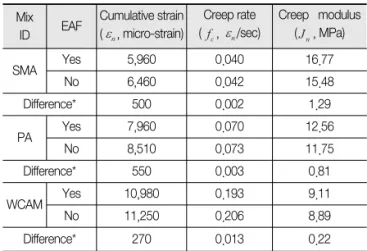
In this study, two samples were prepared, tested and finally the mean values were calculated and compared. All the results of the cyclic creep tests performed in this study are presented in Figure 6 and Table 5, respectively.
(3)
Fig. 4 Schematic of Cyclic Creep Test
(a) Testing Setup (b) Stress and Strain Curve
Fig. 5 Example of a Typical Creep Curve
Fig. 6 Results of Cyclic Creep Test
Mix
ID EAF Cumulative strain ( , micro-strain)
Creep rate ( , /sec)
Creep modulus ( , MPa)
SMA Yes 5,960 0.040 16.77
No 6,460 0.042 15.48
Difference* 500 0.002 1.29
PA Yes 7,960 0.070 12.56
No 8,510 0.073 11.75
Difference* 550 0.003 0.81
WCAM Yes 10,980 0.193 9.11
No 11,250 0.206 8.89
Difference* 270 0.013 0.22
Table 5. Results of Cumulative Strain, Creep Rate and Creep Modulus (@7,200Seconds)
Difference = ABS[(Mixturewith EAF - Mixture)]
Based on the results in Figure 6 and Table 5, some consistent trends could be observed. First, all the asphalt mixtures with EAF steel slag showed lower amount of cumulative strain and creep rate and higher creep modulus than control asphalt mixtures. This indicates that asphalt mixtures prepared with EAF steel slag show higher rutting resistant than the control asphalt mixtures (i.e.
mixtures containing only conventional aggregates). Moreover, it was found that, in all test cases, SMA and PA mixtures clearly present better performances in term of cumulative strain, creep rate and creep modulus than asphalt mixtures for wearing course (i.e. WCAM). The creep rate of SMA and PA mixtures were approximately 5 and 3 times lower than that of WCAM. Based on these preliminary results, it can be concluded that EAF steel slag can be successfully incorporated in the aggregate skeleton of conventional asphalt mixtures since this can potentially enhance the level of rutting resistance of asphalt pavement.
5.2. Stiffness Modulus Test (EN 12697-26, 2004) Dynamic Indirect tension test was performed to compute the stiffness modulus (Sm,MPa) on the asphalt mixtures with EAF steel slag(and without EAF steel slag). The testing procedure d escribed in the European EN12697-26 standard(2004) was followed: this requires a loading frame for indirect tensile strength configuration (IT-CY: Indirect Tension to Cylindrical Specimens, 2004), with peak horizontal deformation set at 5㎛, 124ms of load rise-time (micro-second, recommended value is current EN standard), 62ms and 31ms, corresponding to a frequency of approximately 2Hz. A schematic on applied loading conditions and stiffness modulus testing set up is presented in Figure 7.
The stiffness modulus computation is based on the average of 5 load pulses (see Figures 4 and 7); the stiffness modulus for each of tested mixtures is determined as:
Where
= stiffnessmodulus (MPa);
= the peak value of applied vertical load (N);
= the amplitude of horizontal deformation obtained during the load cycle (mm, See Figure 8);
= the mean thickness of the specimen (mm);
= the Poisson’s ratio (approximately 0.35).
The measured stiffness modulus ( ) was adjusted to a load area factor of 0.60 by using the following equation (see Equation (5)).
Where
= the adjusted stiffness modulus (MPa);
= the measured load area factor.
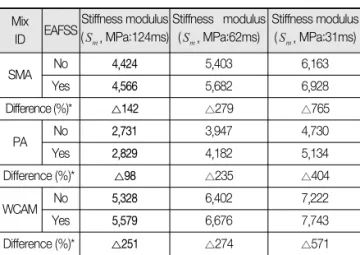
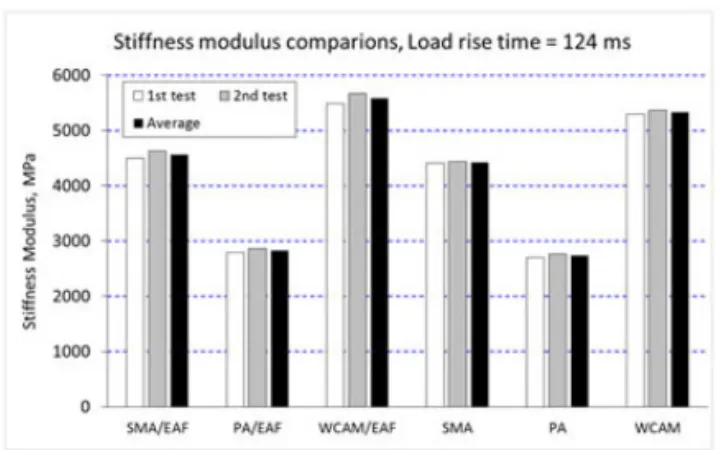
Testing temperature was set to 20℃ and two replicates were used for each mixture type. The average results of the stiffness modulus are shown in Figure 9 and Table 6.
Fig. 7 Schematic of Stiffness Modulus Test (a) Testing Setup (b) Form of Load Pulse
(4)
Fig. 8 Deformation Amplitude
(5)
Table 6. Results of Stiffness Modulus Mix
ID EAFSSStiffness modulus ( , MPa:124ms)
Stiffness modulus ( , MPa:62ms)
Stiffness modulus ( , MPa:31ms)
SMA No 4,424 5,403 6,163
Yes 4,566 5,682 6,928
Difference (%)* △142 △279 △765
PA No 2,731 3,947 4,730
Yes 2,829 4,182 5,134
Difference (%)* △98 △235 △404
WCAM No 5,328 6,402 7,222
Yes 5,579 6,676 7,743
Difference (%)* △251 △274 △571
Difference = ABS[(Mixture - Mixturewith EAF)], MPA
The results of Figure 9 and Table 6 show higher values of for SMA and WCAM mixtures compared to the porous mixtures in all comparison cases. It was also found that the computed stiffness modulus, , of EAF steel slag asphalt mixtures is slightly higher than the control mixtures in all cases(i.e.difference:3.1%(min)~10.3%(max):seeTable6); this further supports the use of EAF Steel Slag in the asphalt pavement industry, due to the beneficial effects on the material stiffness. As expected, the rise time significantly influences the stiffness modulus for all the bituminous mixtures. The PA
modulus increases by approximately 48% and 81% for load-rise times of 62ms and 31ms respectively, in comparison with the reference standard value of 124ms. In case of SMA mixture approximately an increase of 24% and 52% in stiffness modulus were found compared to that measured for 124ms. The smallest differences in stiffness modulus were observed for WCAM mixture (i.e. 24% and 51% of for 62ms and 31ms condition compared to 124ms, respectively). Therefore, PA and SMA mixtures present over all better performance not only in terms of rutting resistances but also for fatigue cracking compared to WCAM mixtures.
6. SUMMARY AND CONCLUSIONS
In this study, the possibility of using Electric Arc Furnace (EAF) steel slag as alternative aggregate for asphalt pavement mixtures was investigated based on two different mechanical tests: cyclic creep test and stiffness modulus test as specified in the current European standards. Three different types of asphalt mixtures, Stone Mastic Asphalt (SMA), Wearing Course Asphalt Mixture (WCAM) and Porous Asphalt (PA), were prepared with two types of steel slag.
The experiment results have verified that the use of waste material from steel production in the lithic skeleton of asphalt mixtureisatechnicallysatisfactorychoice that fulfils the “Zero Waste”objective that the several iron and steel industries have pursued for past decades. All the mixtures with steel slags meet the requirements for acceptance within the European technical standards, thus providing feasibility in the construction of road infrastructure applications. In conclusion, it was found that the use of steel slag for pavement mixture can provide not only reasonable and positive mechanical performances, but presents also the significant potential of limiting the environmental impact together with cost benefit (i.e. reducing the constriction costs) in comparison to conventional asphalt mixture technologies.
In this research, only three different types of mixtures were prepared and only two types of mechanical tests were performed for determining high and intermediate temperature properties.
Unfortunately, no testing pavement cells were available for verifying the field performance at this stage of the research.
Therefore, along with considerations of field evaluations, performance investigations of steel slag mixtures at low temperature and advanced analysis of the mixture microstructure
(a) Load Rise Time set as 124ms (load rise time)
(b) Load Rise Time set as 62ms (load rise time)
(c) Load Rise Time set as 31ms (load rise time)
Fig. 9 Results of Computed Stiffness Modulus
by Digital Image Processing (DIP) coupled with mathematical and statistical analysis tools are recommended to fully understand the characteristics and suitability of using steel slags in conventional asphalt mixtures. In addition, in the light of the present German-Korean research cooperation, the analysis of the EAF-added asphalt mixtures on the basis of Korean standards would further provide a term of comparison for the experimental results obtained in this study and give solid support for fully validating the use of steel slag in asphalt pavement. This represents the objective of a future research effort.
BIBLIOGRAPHY
Bonilla S.H., Almeida C.M.V.B., Giannetti B.F., Huisingh D., (2009), “The roles of cleaner production in the sustainable development of modern societies: an introduction to this special issue”, J. Cleaner prod. 18(1): 1-5.
Chaurand P., Rose J., Briois V., Olivi L., Hazemann J. L., Proux O., et al., (2007), “Environmental impacts of steel slag reused in road construction: a crystallographic and molecular (XANES) approach”, J. of Hazard Mater, 139:537-42.
Dunster A.M., (2002), “The use of blast furnace slag and steel slag as aggregates”, Proceedings 4th European Symposium on Performance of Bituminous and Hydraulic Materials in Pavements, Nottingham, April, 2002.
European Commission Directorate-General Environment, (2008), Guidance on the interpretation of key provisions of Directive 2008/98/EC on waste.
Ellis C., Widyatmoko, (1999), “Performance and durability aspects of asphalts incorporating electric arc furnace steel slag aggregates designed for use in thin pavement surfaces”, Proceedings 3rd European Symposium on Performance and Durability of Bituminous Materials and Hydraulic Stabilized Composites, Leeds, April, 1999, 221-238.
Emery J. J., (1982), “Slag utilization in pavement construction”, Extending Aggregate Resources, ASTM STP 774, American Society for Testing and Materials, 95-118.
European Standards: EN 12697-23, (2003), “Bituminous mixtures - Test methods for hot mix asphalt - Part 23: Determination of the indirect tensile strength of bituminous specimens (English version)”, European Committee for Standardization.
European Standards: EN 12697-25, (2005), “Bituminous mixtures - Test methods for hot mix asphalt, Part 25: Cyclic compression test (English version)”, European Committee for Standardization.
European Standards: EN 12697-26, (2004), “Bituminous mixtures-
Test methods for hot mix asphalt, Part 26: Stiffness (English version)”, European Committee for Standardization.
European Standards: EN 12697-34, (2012), “Bituminous mixtures - Test methods for hot mix asphalt - Part 34: Marshall test (English version)”, European Committee for Standardization.
European Standards: EN 13043, (2002), “Aggregates for bituminous mixtures and surface treatments for roads, airfields and other trafficked areas (English version)”, European Committee for Standardization.
Jens A., (2002), “Electric Arc Furnace Slag-a product not waste:
saving or earning money by using slag as a building material”, BSE corp. web publications, 1-5, Available from:
http://www.bseamerica.com/wEnglisch/Downloads/publication s_pdf/Electric_Arc_Furnace_Slag_a_product_not_waste.pdf.
[17 August 2014].
Liapis I., Likoydis S., (2012), “Use of electric arc furnace slag in thins skid-resistant surfacing”, Procedia-Social and Behavior Scoences, 48: 907-918.
Krayushkina K., Prentkovskis O., Bieliatynskyi A., Junevicˇius R., (2012), “Use of steel slags in automobile road construction”, Transport, 27(2):129-37.
Mahmoud A., Saeid H., Hadi G., (2013), “Laboratory evaluation of warm mix asphalt mixtures containing Electric Arc Furnace (EAF) steel slag”, Construction and Building materials, 49:
611-617.
Morone M., Costa G., Polettini A., Pomi R. and Baciocchi R.,, (2014), “Valorization of steel slag by a combined carbonation and granulation treatment”, Mineral Engineering, 59: 82-90.
Pascal S., Jan-Erik L., Maria A., Paul F. K., (2009), “Reproducing ten years of road ageing-Accelerated carbonation and leaching of EAF steel slag”, Science of the Total Environment, 407:5110-5118.
Robert K. H., Schmidt-Bleek B., De Larderel J.A., Basile G., Jansen J.L., Kuehr R. et al., (2002), “Strategic sustainable development- selection, design and synergistic applied tools”, J. Cleaner Prod.
10(3):363-366.
Rockliff D., Moffett A., Thomas N., (2002), “Recent developments in the use of steel slag aggregates in asphalt mixtures in the UK”, Proceedings 4th European Symposium on Performance of Bituminous and Hydraulic Materials in Pavements, Nottingham, April, 2002.
Sofilic T., Maldenovic A., and Sofilic U., (2010), “Characterization Of The EAF Steel Slag As Aggregate For Use In Road Construction.”Chemical engineering transactions, 19:117-123.