음식물 침출수를 처리하는 막결합 고온혐기성 소화시스템에서 교차여과와 막간압력이 파울링에 미치는 영향
김 영 오·전 덕 우·윤 성 규*·장 정 희·배 재 호**·유 관 선**·김 정 환**
,†현대건설 연구개발본부 연구개발실, *한양대학교 공학대학 건설환경공학과, **인하대학교 사회기반시스템공학부 환경공학과 (2011년 12월 1일 접수, 2011년 12월 26일 수정, 2011년 12월 26일 채택)
Effect of Cross-flow Velocity and TMP on Membrane Fouling in Thermophilic Anaerobic Membrane Bioreactor Treating Food Waste Leachate
Youngo Kim, Dukwoo Jun, Seongkyu Yoon*, Chunghee Chang, Jaeho Bae**, Kwansun Yoo**, and Jeonghwan Kim**,†
R&D Center, Hyundai Engineering and Construction Co., Yongin 446-716, Korea
*Department of Civil and Environmental Engineering, Hanyang University, Seoul 133-791, Korea
**Department of Environmental Engineering, Inha University, Incheon 402-751, Korea (Received December 1, 2011, Revised December 26, 2011, Accepted December 26, 2011)
요 약: 음식물 폐기물 침출수를 처리하는 분리막 결합 고온 혐기성소화공정(생물학적 반응조) (Anaeorobic Membrane Bioreactor, AnMBR)의 파일럿 운전에서 분리막의 교차여과 속도와 막간압력이 파울링에 미치는 영향을 관찰하였다. 연구 결과 정압여과 하에서 교차여과 속도가 증가할수록 파울링의 속도는 현격히 감소되었다. 그러나 이와 같은 영향은 낮은 막 간압력에서 더욱 효과적이었다. 막간압력이 증가할수록 여과대상 물질의 압축성으로 인해 투과성이 상대적으로 낮은 파울 링층(혹은 케익층)이 분리막 표면에 형성된 것에 기인된 듯하다. 여과대상 시료의 입도분석을 해 본 결과 입자크기는 약 10
∼100 µm 범위에서 분포하였고 이에 따라 브라운확산에 의한 역수송보다 분리막 표면에서 교차여과에 의해 발생하는 전단 력이 입자의 역수송에 더욱 기여하고 있음을 예측할 수 있었으며 이는 AnMBR의 연속운전을 통해 재확인할 수 있었다. 운 전 후 막 부검을 실시한 결과 유기 및 무기 파울링이 모두 관찰되었으나 어느 것이 지배적인 파울링 기작을 나타내는지는 앞으로 더욱 연구가 필요하다. 무기 파울링의 경우 대부분 분리막 표면에서 스케일링 형성이 지배적이었으며, 따라서 분리 막의 공극 막힘에 주로 기여하는 작은 콜로이드성 유기물질의 경우 분리막 표면에서 전단력에 의한 역수송 효과는 그다지 크지 않을 것으로 사료된다.
Abstract: The effect of cross-flow velocity and transmembrane pressure (TMP) on membrane fouling was observed from pilot-scale operation of thermophilic anaerobic membrane bioreactor (AnMBR) treating food waste leachate. It was found that fouling rate was reduced significantly as cross-flow velocity increased at constant TMP mode of operation while this effec- tiveness was more pronounced at lower TMP. Higher TMP resulted in less permeable fouling layer possibly due to compres- sibility of foulant material on membrane surface. Particle sizes of membrane concentrate ranged from 10 to 100 µm, imply- ing that shear-induced diffusion enhance back transport of these particle sizes away from the membrane effectively. From the continuous operation of AnMBR, it was confirmed that shear rate played an important role in the reduction of membrane fouling. Membrane autopsy works at the end of operation of AnMBR showed clearly that both organic and inorganic fouling were significant on membrane surface. Surface shear by cross-flow velocity was expected to be less effective to remove irre- versible fouling which can be mainly caused by the adsorption of organic colloidal materials into membrane pores.
Keywords: cross-flow velocity, TMP, membrane, anaerobic bioreactor, food waste leachate
1)
†교신저자(e-mail: [email protected])
will be prohibited strictly from the year of 2012.
The use of anaerobic treatment for the food waste leachate should be attractive because the leachate con- tains high concentration of biodegradable organic material. Most of all, the anaerobic treatment is consid- ered as an energy-producing rather than energy-con- suming because it can produce useful energy in the form of methane [2]. Although there has been upsurge of interests in the anaerobic treatment for the high- strength wastewater which is generally higher than 1,500 mg/L as soluble COD, the anaerobic treatment has still difficulty to maintain high amount of active biomass in the bioreactor since the growth rate of anaerobes in anaerobic reactor is very slow. Biomass retention is necessary feature for the successful appli- cation of anaerobic digestion for wastewater treatment.
Biofilms and granule formation are the traditional way to achieve such retention, enabling reactor operation at high biomass concentrations, and therefore at high or- ganic loading rates [3,4].
Anaerobic membrane bioreactor (AnMBR) combines anaerobic treatment with membrane filtration. The suc- cess of anaerobic wastewater treatment can be attrib- uted to an efficient uncoupling of the solids retention time from the hydraulic retention time through biomass retention [5]. An advantage of membrane is that it can prevent washout of microorganisms from the bioreactor due to complete physical retention of suspended solids [6]. Since biomass is physically retained inside the re- actor, there is no risk of washout of cells and the solid retention is not dependent on the formation of biofilms or granules. Therefore, long solid retention time can be achieved while operating short hydraulic detention
capital and operational cost by increasing transmem- brane pressure at constant flux mode of operation or decreasing permeate flux at constant pressure mode of it. Membrane fouling increases frequency of chemical cleaning and requires replacement with new membrane eventually. Thus, reducing membrane fouling is very critical for the sustainable operation of AnMBR.
Several studies have been conducted with the AnMBR to reduce membrane fouling. Introduction of large por- tion of biogas produced in submerged AnMBR was re- cycled to control membrane fouling by providing phys- ical scouring effect with gas sparging along membrane surface [4]. It was also reported that application of ac- tivated carbon such as powdered activated carbon (PAC) along the membrane surface reduced membrane fouling by both adsorption and scouring effects [8-10].
These fouling mitigation methods were studied with
submerged AnMBR where the membranes are im-
mersed directly into anaerobic bioreactor [9,10]. In the
case of hard-shell encased membrane module as
side-stream for anaerobic bioreactor, the applications of
these methods may be limited because membranes are
encased in pressurized vessel. Instead, both cross-flow
velocity and transmembrane pressure (TMP) should be
main operating parameters feasible to control mem-
brane fouling. Nevertheless, little information on the
combined effects of both parameters on the reduction
of membrane fouling in AnMBR are available partic-
ularly for the treatment of high strength wastewater
such as food waste leachate. The objective in this
study was to observe combined effects of cross-flow
velocities and TMP on the reduction of membrane
fouling from the pilot-scale AnMBR in order to better
Fig. 1. Schematic diagram of AnMBR system treating food waste leachate.
Fig. 2. Combined effect of cross-flow velocity and TMP on permeate flux.
understand fouling behavior in the pilot-scale AnMBR treating food waste leachate.
2. Experimental
A pilot-scale AnMBR system was installed within the municipal food waste treatment plant (Incheon, Korea) managed by the Environmental Cooperation of Incheon. Fig. 1 shows schematics of pilot-scale design of AnMBR treating food waste leachate. The main sys- tem of the AnMBR consisted of thermophilic acido- genic reactor, methanogenic reactor and one-channel tubular ultrafiltration (UF) membrane (Jinshui Membrane, China). The membrane was composed of PVDF and the pore size of the membrane used was 0.01 µm. The effluent from the methanogenic reactor was pressurized into the hard-shell encased tubular UF membrane module. Membrane concentrate was recycled back into the methanogenic reactor to prevent wash-out of anae- robes and maintain high concentration of biomass in the reactor.
The feed flow rate and organic loading rate (OLR) of food waste leachate for the methanogenic reactor were 3 m
3/day and 5.0 kg COD
Cr/m
3/day, respectively.
The total HRT was 20 days and operating temperature of the anaerobic reactor was 55 ± 1°C. The average COD
Crand suspended solids concentration of the meth- anogenic sludge were about 26,600 mg/L and 15 g/L, respectively. A PVDF one-channel tubular UF mem- brane module was installed as a side stream to treat
the effluent from thermophilic methanogenic reactor.
Seven tubular membranes were encased in one module.
The membrane module was operated under cross-flow filtration at constant TMP and total recycle mode of operation. The diameter of tubular one-channel UF membrane was 11 mm and total membrane surface area in this study was 13.1 m
2. The operational con- ditions of cross-flow velocity and TMP ranged from 1 to 3 m/s, and from 1 to 3 bar, respectively. Membrane permeate effluent was further treated by ammonia stripping for the nitrogen removal followed by aerobic MBR for the treatment of remaining organics to meet effluent quality standards. At the end of operation, membrane surface was observed by energy-dispersive X-ray analysis (SEM-EDX, Hitachi, S-4200) in order to quantify inorganic components in foulant materials.
Fourier Transform Infrared (FTIR) analysis (Bruker, Vertex 80V) was also performed to analyze organic fraction of foulant layer.
3. Results and Discussion
3.1. Combined Effect of TMP and Cross-flow Velocity on Permeate Flux
Fig. 2 shows the combined effects of TMP and
cross-flow velocity on permeate flux in AnMBR. Result
indicates that permeate flux increase as cross-flow ve-
locity increases at fixed TMP, suggesting that cross-
Fig. 3. Particle size distribution of feed suspension and membrane concentrate.
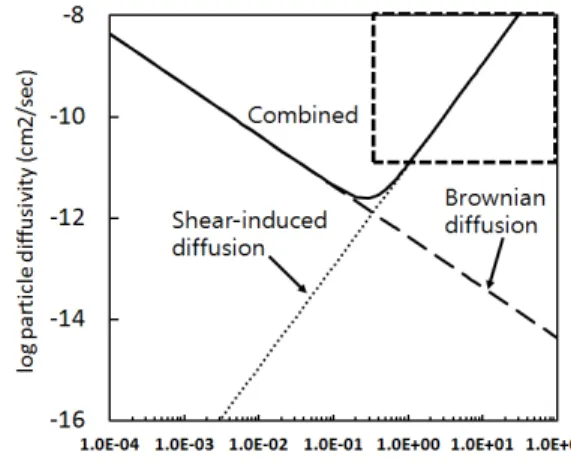
Fig. 4. Back transport diffusivity as a function of particle size (cross-flow velocity = 1.5 m/s).
flow velocity influence fouling mitigations. Fig. 3 in- dicates that particle sizes of feed solution in AnMBR range from 10 to 100 µm. However, the particle sizes were shifted to be smaller in membrane concentrate possibly due to break-up of microbial flocs under high shear rate along membrane surface [11]. It was ex- pected that higher shear rate at higher cross-flow ve- locity should improve back transport of these particle sizes away from membrane surface. However, the per- meate flux was relatively independent upon TMP. This can be explained by the fact that increasing resistance and/or thickness of fouling layer (or cake layer) on membrane surface should be countered by increasing TMP, thus the permeate flux is approached to limiting flux.
The particle back diffusivity as a function of particle size can be estimated from using equations (1) and (2).
The Brownian back diffusion coefficient (D
B) for small colloids and macromolecules can be calculated from equation (1) of the Stokes-Einstein equation. Assuming that volume fraction of the cake on membrane has maximum packing density, shear-induced diffusivity (D
s) can be calculated as a function of shear rate which is estimated by equation (2).
(1)
(2) where k
Bis Boltzmann constant, T is absolute tem-
perature, r
pis particle radius,
is shear rate, U is cross-flow velocity and d is diameter of tubular membrane. Results in Fig. 4 showed that the back transport of particles bigger than about 0.2 µm of par- ticle size was dominated by shear-induced back dif- fusion (D
S) while Brownian back-diffusion (D
B) was more important with particles smaller than 0.2 µm.
This result shows that shear rate controlled by cross-flow velocity can be an important way to in- crease back diffusion of foulant away from membrane in the AnMBR treating food waste leachate. Since ef- fluent from anaerobic bioreactor contains wide range of particles, however, interaction between particles of dif- ferent sizes can also affect the back-transport of each while the mechanisms by which such interactions still need to be explored.
3.2. Combined Effect of TMP and Cross-flow Velocity on Fouling Resistance
Total fouling resistance was measured using per- meate flux (J) data at different TMPs and cross-flow velocities using Darcy’s equation described below.
From Equation (3), the permeate flux is proportional to
TMP but inversely proportional to the total resistance
(R
tot) and viscosity of feed suspension (µ). Total resist-
ance was assumed to be summation of cake resistance
on membrane surface (R
c) and membrane resistance
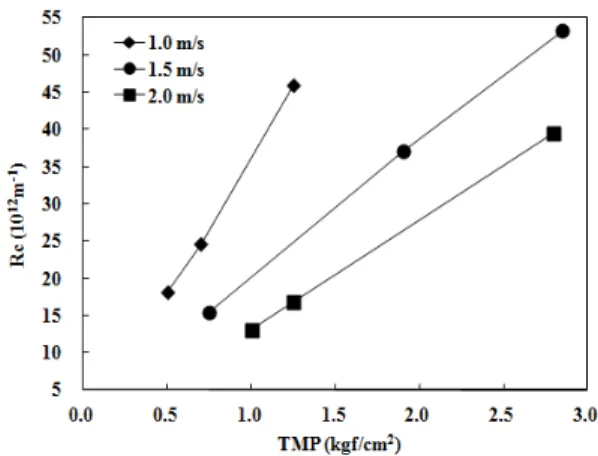
Fig. 5. Effect of TMP on fouling resistance at different cross-flow velocities.
Fig. 6. Effect of cross-flow velocity on fouling resistance at different TMPs.
(R
m). It is true that irreversible fouling resistance which is mainly caused by adsorption of foulant into membrane pores can be included in total resistance.
Since particle size distribution in feed solution to the membrane ranged from 1 to 100 µm (Figure 3) and membrane pore size was about 0.01 µm, however, it was assumed that cake resistance on membrane surface should be dominant fouling resistance.
total
R J TMP
=µ
(3)
m
C R
J R =TMP−
µ
(4)
It was found that cake resistance increased with in- creasing TMP while the extent of the increase was more pronounced at lower cross-flow velocity (Fig. 5).
Since biologically generated particles found in AnMBR are deformable, the fouling layer should be charac- terized compressible. The compressibility can lead to higher fouling resistance at higher TMP since it is re- lated to the TMP using a power-law equation below.
P
nΔ
= α
0α (5)
where α and n are average specific cake resistance of entire cake depth on membrane and compressibility,
respectively. The specific cake resistance ( α, m/kg) can be estimated by using equation (6).
P R A V P C A V
t m
+ Δ
⎟⎠
⎜ ⎞
⎝
⎛
=μαΔ μ
2 ) /
( 0