1. INTRODUCTION
High quality wood resources are increasingly scarce as long-term population growth has impacted forestlands. The poplar is a vital fast-growing wood, widely utilized as an en- vironmentally friendly and sustainable raw material for paper and plywood as it features acceptable strength and working properties including light weight, rapidly-growing, low
density, simple processing, and soft texture.
Compared to other traditional solid wood species utilized in furniture; however, dis- advantages of poplar related to strength, stiffness, physical and mechanical properties, and surface appearance have limited its broader application in furniture production.
In order to solve the various defects of fast-growing poplar and enlarge its application scope, poplar wood is commonly modified to
Original Article
Optimization of L-shaped Corner Dowel Joint in Modified Poplar using Finite Element Analysis with Taguchi Method1
Qing Ke2⋅Fan Zhang2,†⋅Yachi Zhang2
ABSTRACT
Modified poplar has emerged as a potential raw material for furniture production. Lack of specific modified poplar strength information; however, restricts applications in the furniture industry especially as related to strength in corner-joints. Optimization of strength in L-shaped corner dowel modified poplar joints under compression loads utilizing finite element analysis (FEA) by Taguchi method with the focus of this study. Four experiment factors (i.e., Structure Style, Tenon Length, Tenon Diameter, and Tenon Gap), each at three levels, were conducted by adopting a L9-34 Taguchi orthodoxy array (OA) to determine the optimal combination of factors and levels for the von Mises stress utilizing ANSYS software. Results of Signal-to-Noise ratio (S/N) analysis and the analysis of variance (ANOVA) revealed the optimal L-shaped corner dowel joint in modified poplar is 45° Bevel Butt in structure style, 24 mm in tenon length, 6 mm in tenon diameter, and 20 mm in tenon gap. Tenon length and tenon gap are determined to be significant design factors for affecting von Mises Stress. Confirmation tests with optimal levels and experimental test indicated the predicted optimal condition is comparable to the actual experimental optimal condition.
Keywords : finite element analysis, modified poplar, furniture joint, Taguchi method
1 Date Received January 4, 2016, Date Accepted February 25, 2016
2 College of Materials Science and Technology, Beijing Forestry University, Tsinghua East road 35, Haidian, Beijing, 100083, P.R. China
† Corresponding author: Fan Zhang (e-mail: [email protected])
resolve various defects utilizing chemical, phys- ical, and biological methods to improve dimen- sional stability against moisture and bio-deterio- ration, mechanical properties, and weathering resistance (Hill et al., 2011). Evaluation of fur- niture structure performance quality assesses these properties. Furniture corner-joints are deemed the weakest points against heavy weights in furniture construction technology (Cetin Yerlikaya, 2012), thus improved design for strengthening methods in modified poplar furniture corner joints is vital. The L-shaped corner-joint is a significant furniture structure type manufactured and employed for connecting legs, transoms, and handrails. A joint style typi- cally utilized in the L-shaped corner-joint is re- ferred to as a butt joint with dowels with the dowel as a solid cylindrical rod typically com- posed of wood. The dowel joint is employed in numerous, diverse applications in furniture structure including structural reinforcements in cabinet making and furniture shelf supports and applies aligned bored holes in both receiving objects for insertion of a conjoining dowel pin.
Applications are either currently minimal or may not exist for the L-shaped dowel furniture corner joint composed of modified poplar.
Several studies of L-shaped furniture cor- ner-joint consisting of hard wood or wood-based panel have been conducted experimentally and by numerical simulations including the ANSYS Finite Element analysis. The joints were exam- ined for diagonal tension and compression (Tankut and Tankut, 2009; 2010). Diagonal tensile strength of the L-shaped corner-joint was
reported to be greater than the diagonal com- pressive strength. Atar et al. (2009) investigated tensile and compressive performance of cor- ner-joints constructed with solid wood biscuits for case furniture. Best performance was ach- ieved with melamine-coated fiberboards and Desmodur Vinil Trie Ketonol Acetate (DVTKA) adhesive. Studies conducted on Dowel-welded L-shaped joints (Segovia et al., 2010) indicated considerable difference only in mortise and te- non L-shaped joints between tension and com- pression test results on the same L-joint, with such joints yielding higher strength in com- pression than in tension. Tankut, A. N. et al.
(2005) discovered that rectangular end mortise and tenons are approximately 15% stronger than both round end mortise and tenons and rec- tangular end tenons designed to fit into round end mortise joints while joint geometry sig- nificantly affects strength of those particular joints. Oktaee et al. (2014) reported that opti- mum results of simple and haunched mortise and tenon furniture joints under tension and compression loads were obtained with joints constructed utilizing 10 mm thick tenons that were 37.5 mm wide by 30 mm long. Tenon length was revealed to exert a superior effect on joint capacity while tenon width was found to exert a much less significant effect. Dalvand et al. (2014) investigated the bending moment resistance under diagonal compression load of corner doweled joints with plywood members.
Experimental results indicated that bending mo- ment resistance under diagonal compressive load was increased by increasing the dowel’s depth
of penetration. Joints constructed with dowels of beech wood featured higher resistance than dow- els of hornbeam wood.
Finite Element method is widely applied in biomechanics and bioengineering to determine the stresses and strains in complicated mechan- ical systems (Dar et al., 2002). Finite Element analysis (FEA) is proven to assist in identi- fication of areas prone to weakness and failure and researchers have demonstrated that FEA is an effective technique for analyzing furniture construction (Eckelman et al., 1984; Cai et al., 1993; Smardzewski, 1998; Colakoglu et al., 2012).
Studies on L-shaped furniture corner- joint utilizing the Finite Element method often focus on the enhancement of strength and stiffness by enlarging furniture components and parts.
Investigation of the optimal methods has im- proved configuration properties; however, an increase in the cost of materials and variance of structure performance characteristics has pro- duced a setback. Efficient control of design factors utilizing an appropriate optimization method, such as the Taguchi Method, is critical during corner joint furniture manufacturing.
Taguchi method was developed by Taguchi and Konishi (Taguchi et al., 1987) and has been widely applied in engineering to optimize performance characteristics within a combina- tion of design parameters and in design of qual- ity systems. The method has been proven as a simple and effective solution for experimental design (Taguchi et al., 1987; Taguchi, 1990;
Ross, 1996). An orthogonal array (OA) with a
minimum set of test data was applied in the Taguchi Method application to also reduce the time and cost. The method typically applies loss function to measure the performance char- acteristic deviation from the target value. Loss function is further transformed into a Signal-to-Noise ratio (S/N) to determine the quality of characteristics that are insensitive to noise factors. The combination of factor level with the higher S/N ratio indicates a better per- formance characteristic and the design project consistent with the highest S/N ratio con- sistently yields optimal quality characteristics with minimum variance. Signal-to-Noise ratio may be categorized into three types for the Taguchi Method: 1) the lower the better; 2) the higher the better; and 3) the more nominal the better (Gu et al., 2014; Wu et al., 2000). The S/N ratio featuring 1) the lower the better char- acteristic, may be expressed as:
S/N = -10lg ⎟
⎠
⎜ ⎞
⎝
⎛n1∑i=n1 yi2 ··· (1)
The S/N ratio featuring 2) the higher the bet- ter characteristic, may be expressed as:
S/N = -10 ⎟⎟⎠⎞
⎜⎜⎝⎛
∑i=n
yi
n 1 2
1
lg 1 ··· (2)
The S/N ratio featuring 3) the more nominal the better characteristic, may be expressed as:
S/N = -10lg ⎟
⎠
⎜ ⎞
⎝
⎛ns1 ∑i=n1 yi2 ··· (3)
Where yi is the ith experiment at the test, n is the total number of trials in the test, and s is the standard deviation of yi .
The goal of FEA utilizing ANSYS software in this study is to optimize design factor levels to obtain the lowest von Mises stress in the weakest point of L-shaped corner dowel joint in modified poplar. The lower the von Mises stress is, the safer the L-shaped corner-joint is, thus the S/N ratio for von Mises stress with the lower the better characteristic equation (Eq.(3)) was chosen to obtain an optimal design pa- rameter and factor of L-shaped corner dowel joint in modified poplar. Analysis of variance (ANOVA) was then performed to identify the significant contribution of each design factor to the variability in product performance (Gijo et al., 2010). The most significant design factor effecting structure strength through ANOVA will be optimized in the Taguchi Method. A confirmation test may then be conducted to ver- ify optimal design factors obtained from the pa- rameter design. If the S/N ratio obtained in the optimal set is similar to predicted values with the experimental results, the additive model uti- lized in L9 (34) OA is assumed to be the actual approximation model.
The effect of structure design factors on the von Mises stress of L-shaped corner dowel
joints in modified poplar was investigated in this study utilizing Finite Element Analysis and the Taguchi method to optimize the factor com- bination of furniture structure and to reduce cost while strengthening modified poplar furni- ture structure to achieve a more robust response to external disturbance factors.
2. MATERIALS and METHODS
The modified poplar (populous euromericana Cv.) samples in this study were obtained from Beijing, China and featured moisture content of approximately 7.6% with density of 0.56 g/cm3. In this study, fast-growing poplar was modified with urea-formaldehyde prepolymer, which was synthesized in the laboratory. The physical and mechanical properties tests were conducted in accordance with GB/T 15777-1995 and GB/T 1928-2009 of Technical Institute of Physics and Chemistry, CAS. The physical and mechanical properties of modified poplar utilized for the Finite Element Analysis (FEA) were tested and are displayed in Table 1. Test equipment in- cluded: SANS CMT5000 MTS series micro- computer control electronic universal testing machine and the CryoLab system at temperature (4.2 K - 200 K).
Two types of numerical models in 40 mm ×
Density (g/cm³)
Moisture content (%)
Bending strength (MPa)
Modulus of rigidity (MPa)
Modulus of elasticity
(MPa) Poisson’s ratio
ρ MC MOR GLR GLT GRT EL ER ET µLR µLT µRT
0.56 7.6 115.8 1355 75 120 3397 252 253 0.28 0.67 0.04
*L, R and T are the longitudinal, radial and tangential directions of wood
Table 1. Physical and Mechanical Properties of Modified Poplar utilized in FEM
40 mm × 300 mm (radial × tangential × longi- tudinal) and 40 mm × 40 mm × 260 mm (radial × tangential × longitudinal) dimensions of L-shaped corner wooden dowel joint were constructed with three different joint styles (90° Post on the Rail, 90° Post under the Rail, 45° Bevel Butt) in the PROE 5.0 software (Beijing, Shuohe Technology Co., Ltd.) (Fig.
1a). Each test sample consists of the two ele- ments, post and rail. Modified poplar wood dowels were employed to connect two portions of L-shaped corners. The joint was simplified to benefit analysis time by utilizing an interfer- ence fit joint without glue. Hole diameter was
nearly equal to the tenon diameter for the joints without glue and the hole depth was approx- imately equal to half of the tenon length.
Dowels were drilled to center sections of post and rail (Fig. 1b) with the tenon gap as the dis- tance between the two dowels axes.
Simulation analysis of L-shaped corner wood- en dowel joint in modified poplar was con- ducted utilizing ANSYS 10.0 software (China, Aonesoft Inc). The Finite Element model, ac- cording to the previous researches, was built with ANSYS 8 node 185 element type and meshed in 8 mm wide triangle element.
Material properties in Table 1 were defined in Fig. 1. Numerical Models: a) Size Sketch of Modified Poplar L-shaped Corner dowel Joint with Three Different Structure Styles; b) Size Sketch of Tenon Diameter and Tenon Gap; c) Size Sketch of Load and Constraint.
Preprocessor Element Type, for analysis of the von Mises stress of the corner-joint, to simulate the orthotropic characteristic of wood in three perpendicular directions. External load value on the corner-joint was determined during the ex- periments from actual usage, ergonomic fac- tors, and the furniture mechanics performance test of the China national standard (GB/T 10357.2-2013). Degree of freedom UX, UY, and UZ at the post bottom was totally con- strained and the vertical static load (1500 N) along the Y axis direction was applied to the end of middle node in the rail as displayed in (Fig. 1c).
Analysis of the selected design factors, in- cluding values of the von Mises stress, allowed
the deviation level to be calculated to identify significant changing factors for the experiment.
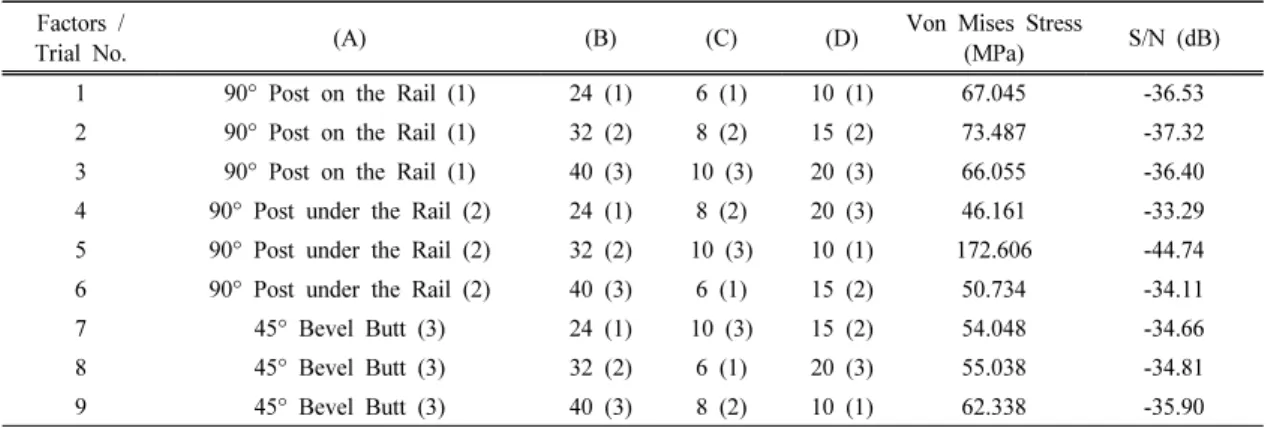
The full experimental design, with four factors and three levels on each, requires 34 = 81 pos- sible combinations of tests. Conducting this ex- cessive number of experiments for all combina- tions is impractical, thus the Taguchi method employs an orthogonal array (OA) to examine quality properties by reducing the number of experiments. Structure style, tenon length, tenon diameter, and tenon gap were selected as four controllable design factors, each at three levels, in this study (Table 2). L9 (34) Taguchi OA (Table 3) was then selected to study the four structural design factors of L-shaped corner wooden modified poplar dowel joint. Each trial
Factor / Leve l Level 1 Level 2 Level 3
Structure Style 90° Post on the Rail 90° Post under the Rail 45° Bevel Butt
Tenon Length 24 mm 32 mm 40 mm
Tenon Diameter 6 mm 8 mm 10 mm
Tenon Gap 10 mm 15 mm 20 mm
Table 2. Factors and Values at Different Levels
Factors /
Trial No. (A) (B) (C) (D) Von Mises Stress
(MPa) S/N (dB)
1 90° Post on the Rail (1) 24 (1) 6 (1) 10 (1) 67.045 -36.53
2 90° Post on the Rail (1) 32 (2) 8 (2) 15 (2) 73.487 -37.32
3 90° Post on the Rail (1) 40 (3) 10 (3) 20 (3) 66.055 -36.40
4 90° Post under the Rail (2) 24 (1) 8 (2) 20 (3) 46.161 -33.29
5 90° Post under the Rail (2) 32 (2) 10 (3) 10 (1) 172.606 -44.74
6 90° Post under the Rail (2) 40 (3) 6 (1) 15 (2) 50.734 -34.11
7 45° Bevel Butt (3) 24 (1) 10 (3) 15 (2) 54.048 -34.66
8 45° Bevel Butt (3) 32 (2) 6 (1) 20 (3) 55.038 -34.81
9 45° Bevel Butt (3) 40 (3) 8 (2) 10 (1) 62.338 -35.90
Total mean of Von Mises Stress = 71.946 Total mean of S/N = -36.416
Table 3. L9 (34) Orthogonal Array Utilized in the Experiment
was repeated 5 times to gain average.
3. RESULTS and DISCUSSION 3.1. Analysis of the Finite Element
Software
Significant effects of varying design factors appear on the von Mises stress according to the ANSYS software analytical results (Table 3).
From Fig. 2a) and 2b) we learn that the highest von Mises stress (172.606 MPa) of the modi- fied poplar L-shaped corner dowel joint was obtained in No. 5 trial, while the lowest (46.161 Mpa) was acquired in No. 4 trial.
Maximum von Mises joints stress in the No. 5 trial was approximately 273.9 % higher than joints stress in the No. 4 trial, substantially be- low the bending strength value of Modified poplar. The structure in the No. 5 trial gets more possibilities of damage in reality.
Furthermore, the simulation we obtained clearly
showed that von Mises stress reached the high- est values at the place where the loading force was applied and tenon components in trial No.
5, while for the joint in trial No. 4, maximum Von Mises stress value was obtained in the joint of the horizontal rail and vertical post for the joint. Von Mises stress in trial No. 4 addi- tionally features significantly more gradually varied distribution than in trial No. 5. In addi- tion, the total mean of von Mises stress and S/N ratio for the nine experiments is also calcu- lated and listed in Table 3.
3.2. Analysis of the S/N ratio
Results of the robustness for von Mises stress obtained from the Finite element analysis for each trial were statistically analyzed in this study utilizing Signal-to-Noise ratio (S/N) equa- tions based on the lower the better character- istic displayed in Eq.(1). The S/N ratio for von Mises stress of structure style, tenon length, te- Fig. 2. Analysis of the Finite Element Software: a) Von Mises Stress of Modified poplar L-shaped Corner Dowel Joint (No. 5); b) Von Mises Stress of Modified Poplar L-shaped Corner Dowel Joint (No. 4).
non diameter, and tenon gap for all nine trials are summarized in Table 3.
The largest S/N ratio is approximately -33.29 dB in the No. 4 trial, while the lowest S/N ra- tio is nearly -44.74 dB in the No. 5 trial. The mean S/N ratio of 9 trials is approximately -36.416 dB.
Experimental design for the von Mises stress and S/N ratio is orthogonal, thus it is possible to separate each design factor effect at different levels. The mean S/N ratios for structure style at three different levels, for example, may be calculated by averaging the S/N ratios for ex- periments 1 to 3, 4 to 6, 7 to 9, respectively displayed in Eqs.(4), (5) and (6).
mA1=3
1(η1+η2+η3) ··· (4) mA2=3
1(η4+η5+η6) ··· (5) mA3=3
1(η7+η8+η9) ··· (6)
Based on the equation above, the ηηηη(dB) re- sponse table for each design factor level (structure style, tenon length, tenon diameter, and tenon gap) is created in an integrated man- ner with the ηηηη(dB) response values for von
Mises stress at each level displayed in Table 4 and a total mean S/N ratio of approximately -36.42 dB.
Results for the ANOM of the S/N ratio for von Mises stress at each level are illustrated in Fig. 3 with the conclusion that any alteration in the four design factors would manifest as either improvement or degradation of the von Mises stress. The difference among ratio values is minimal for the three levels of factor A with the S/N ratio value of A3 as the largest. The S/N ratio value initially decreases with design factors increase for the three levels of factor A and B, followed by an increasing trend with further increases in design factors. The S/N ra- tio value decreases with tenon diameter de-
Symbol Design factor Level 1 Level 2 Level 3 Max-min
(A) Structure Style -36.75 -37.38 -35.12 2.26
(B) Tenon Length -34.83 -38.96 -35.47 4.13
(C) Tenon Diameter -35.15 -35.50 -38.60 3.45
(D) Tenon Gap -39.06 -35.36 -34.83 4.23
Total mean S/N ratio = -36.42
Table 4. Mean S/N Ratio for Von Mises Stress at Each Level
Fig. 3. Analysis of Means (ANOM) of Signal-to-Noise Ratio for Von Mises stress.
crease for the three levels of factor C with ratio value of C1 as the largest. The S/N ratio value increases with tenon gap increase for the three levels of factor D with ratio value of D3 as the largest. Structure design factors with the highest S/N ratio indicate a lower value of von Mises Stress thus the optimal set of L-shaped corner dowel joints for von Mises stress is acknowl- edged as A3, B1, C1, and D3, indicating that structure style is 45° bevel butt, tenon length is 24 mm, tenon diameter is 6 mm and tenon gap is 20 mm.
3.3. Analysis of Variance (ANOVA)
The analysis of variance (ANOVA) purpose is identification of each factor’s contribution to performance variability of the product (Gijo et al., 2010).
Sum of Square (SS) from the total mean S/N ratio ηηηηm may first be calculated as Eq.(7):
SS =∑i=n1(ηi −ηm)2 ··· (7)
Where n is the number of experiments in the orthogonal array and ηi is the mean S/N
ratio for the i-th experiment.
Each design factor features the mean of square (MS) calculated as:
MS = DOF
SS ··· (8)
Where DOF represents the degree of freedom related to congruency in design factors. As a result of Freedom is non-existent in this study as a result of the orthostichous orthogonal array utilized in estimating error variation. Factors A features lower squares and is selected with the
“Capture Method” to estimate average error variation in the analysis of variance. Variance ratio (F-value) is obtained from the ratio of mean square (MS) to mean square error (SSe) and may be interpreted as greater structure per- formance characteristics effects are due to ma- jor design factors change. The F-value is tradi- tionally applied to determine the significance of each factor and the contribution percentage (%) is defined as the significance rate of design fac- tors on the von Mises stress.
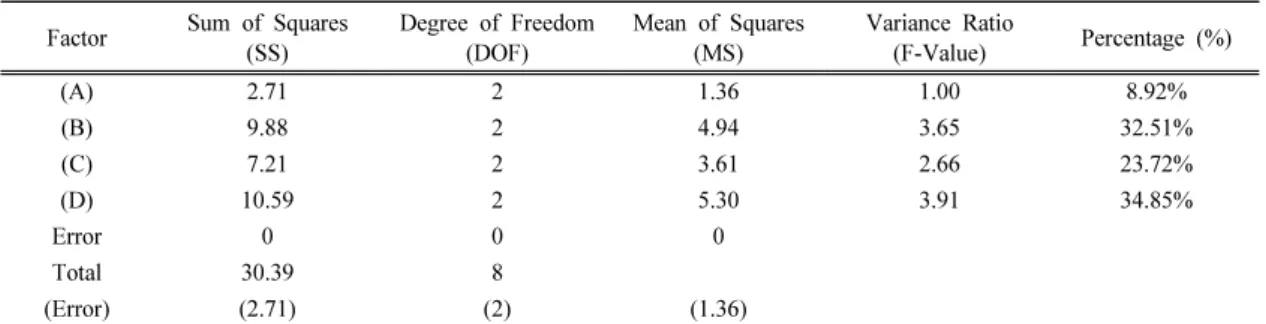
Table 5 displays the ANOVA of S/N ratio for von Mises stress revealing that contribution percentage for Factor A (structure style) is the
Factor Sum of Squares (SS)
Degree of Freedom (DOF)
Mean of Squares (MS)
Variance Ratio
(F-Value) Percentage (%)
(A) 2.71 2 1.36 1.00 8.92%
(B) 9.88 2 4.94 3.65 32.51%
(C) 7.21 2 3.61 2.66 23.72%
(D) 10.59 2 5.30 3.91 34.85%
Error 0 0 0
Total 30.39 8
(Error) (2.71) (2) (1.36)
Table 5. ANOVA of S/N Ratio for von Mises Stress
lowest at 8.92% while contribution percentages for Factor D (tenon gap) is the highest at 34.85%. Factor D (tenon gap) then was con- cluded to exert the most significant effect on the von Mises stress in the focus area while the effect of Factor A (structure style) is negligible.
Typically design factors changes exert a sig- nificant effect on structure quality character- istics when F > 4. The analysis of variance re- veals that Factor B (tenon length) and Factor C (tenon gap) are the significant design factors for affecting von Mises stress. Variance ratio for Factor A is no more than 1; however, indicat- ing structure style exerts a minimal effect on structure performance characteristics for von Mises stress.
3.4. Confirmation Test
Confirmation test is the final and most cru- cial step of the Taguchi method and is applied to verifying whether optimal results obtained in the experiment is expected to improve. Optimal design factors listed in Table 6 were applied to conduct the test.
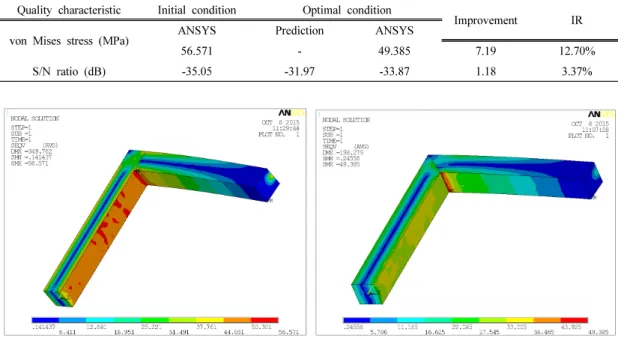
Fig. 4a) and 4b) present the simulative ex- perimental results of initial condition and opti- mal condition for von Mises stress utilizing finite element software analysis. The highest von Mises stress (56.571 MPa) of L-shaped corner dowel joint in modified poplar appears in the top connection portion of the corner. The post part of L-shaped corner appears large area of stress concentration which leads to material
Quality characteristic Initial condition Optimal condition
Improvement IR
von Mises stress (MPa) ANSYS Prediction ANSYS
56.571 - 49.385 7.19 12.70%
S/N ratio (dB) -35.05 -31.97 -33.87 1.18 3.37%
Table 6. Result of Confirmation Test for optimal precept
Fig. 4. a) Initial Condition of Von Mises Stress; b) Optimal Condition of Von Mises Stress.
damage easily (Fig. 4a). Fig. 4b reveals that Von Mises stress (49.385 MPa) is located in the bottom of the corner commissure, sub- stantially below the value of bending strength of modified poplar. The decrement of the von Mises stress from initial joint structure to the optimal joint structure is 7.186 dB while the improvement of S/N ratio for von Mises stress is about 1.18 dB. Improvement ratio (IR) is ap- plied to calculate the proportional ratio of Taguchi optimization results compared to the initial condition presented as Eq.(9).
IR =
optimal optimal initial
P P
P −
× 100% ··· (9)
Improvement ratio results are displayed in Table 6, indicating that IR for the von Mises stress and the S/N ratio from the initial con- dition to the optimal condition is approximately 12.70% and 3.37%, respectively. The improve- ment ratio result for the von Mises stress is also much higher from mean value of 9 trials to the optimal condition which is almost one third. The Taguchi method utilizing FEM, as revealed in the above result, may not only obviously reduce the von Mises stress to improve strength of the L-shaped corner dowel joint, but also effectively increase the S/N ratio to optimize robustness of structure performance characteristics. The optimal con- dition owns better strength and robustness in L-shaped corner structure in modified poplar.
The confirmation experiment purpose in this study is to validate optimal conditions (A3, B1,
C1, D3) suggested by the experiment as corre- sponding with the predicted values calculated by Eq.(10):
∑=
+
= o
i 1 i m
opt ηm (η -η )
η ··· (10)
Where ηm is the total mean S/N ratio, ηi is the mean S/N ratio at the optimal level, and o is the number of main design parameters affecting the quality characteristic. The S/N ratio for predicted optimal condition is cal- culated as:
m) - (m m) - (m
m Ai Bi
opt= + + +
η
m m) - m ( m) - m
( Ci + Di = A3+
3m - m m mB1+ C1+ D3 +
= -35.12 - 34.83 - 35.15 - 34.83 + 3
× 36.42 = -30.67dB
···· (11)
The predicted optimal condition; however, is commonly calculated utilizing the η-value with high percentage (%) to avoid producing higher improvement of predicted optimal condition than actual experimental optimization, leading to high-end prediction. Factor B, factor C and factor D are then chosen to predict the S/N ratio of optimal condition with the S/N ratio for predicted optimal condition calculated as:
m) - (mc m) - (m
m B1 1
opt= + + +
η
2m - m mc m m) - m
( D3 = B1+ 1+ D3
= -34.83 - 35.15 - 34.83 + 2 × 36.42
= -31.97dB
··· (12)
Predicted value for the S/N ratio is -31.97 dB and the experimental result by Finite Element Analysis for S/N ratio is -33.87 dB. Results of the predicted optimal condition approximately align with the actual experimental optimal con- dition indicating the additive model applied in the Taguchi orthogonal test for prediction close- ly approximates the practical model. The or- thogonal test and the design factors analyzed in this study then are reasonable and effective.
Results obtained from the ANSYS Finite Element Simulation Analysis were also com- pared with the results obtained from the ex- perimental test (Table 7). The ultimate load in the L-shaped corner dowel Joint under optimal conditions was greater than under initial con- ditions indicating the optimal structure of the modified poplar L-shaped corner joint yields su- perior strength and robustness over initial conditions.
From the above experiment we can come to the conclusion that the finite element method with the Taguchi Method was determined to be a general and suitable method when exact nu- merical calculations are employed to check loads imposed on structures and may be utilized as a suitable, non-destructive technique for cal- culating structural strength at various times.
4. CONCLUSION
1) Overall, an optimized joint based on FEM simulations with Taguchi method for the L-shaped corner dowel in modified poplar, consisting of structure style (A) of 45°
Bevel Butt, tenon length (B) of 24 mm, tenon diameter (C) of 6 mm, and tenon gap (D) of 20 mm, was partly predicted to show a better robustness compared to the initial test sample. As a result of the ANOVA, tenon gap (D) and tenon length (B) were identified as the important fac- tors for improving strength and robustness of the modified poplar L-shaped corner dowel joint.
2) Confirmation test results validate the effec- tiveness and efficiency of the Taguchi Method utilizing FEA for optimizing the structure design factor with multiple per- formance characteristics. The orthogonal test and the design factors analyzed in this study then were determined to be mainly reasonable and effective.
3) Finite element analysis with Taguchi meth- od were revealed in the study as effective in applications to optimize the combination of structure design factors to attain max- imum structure performance and minimize quality variation of L-shaped corner dowel
Experiment test ANSYS simulation
Quality characteristic Initial condition Optimal condition Quality characteristic Initial condition Optimal condition Ultimate load
Pmax (N) 1220 1450 Von Mises stress (MPa) 56.571 49.385
Table 7. Comparison of experimental testing with numerical simulation
joints in modified poplar, contributing to cost savings and time efficiency compared to traditional methodologies. The opti- mization approach for structure strength and robustness of L-shaped corner dowel joint in modified poplar utilizing the Finite Element and Taguchi orthogonal ex- perimental method may be applied in the future to additional fast-growing wood and classical corner joints in furniture structure.
ACKNOWLEDGEMENT
The authors are very grateful for financial support from Special Fund for Forestry Scientific Research in the Public Welfare (Project 201204702) and Co-building Program of Beijing Municipal Commission of Education (BLCXY201521).
REFERENCES
Atar, M., Ozcifci, A., Altinok, M., Celiket, U. 2009.
Determination of diagonal compression and ten- sion performance for case furniture corner joints constructed with wood biscuits. Material &
Design 30(3): 665∼670.
Cai, L.P., Wang, F.H. 1993. Influence of the stiff- ness of corner joint on case furniture deflection.
Holz als Roh-und Werkstoff 51(6): 406∼408.
Cetin, Y.N. 2012. Effects of glass-fiber composite, dowel, and minifix fasteners on the failure load of corner joints in particleboard case-type furniture. Material & Design 39: 63∼71.
Colakoglu, M.H., Apay, A.C. 2012. Finite Element analysis of wooden chair strength in free drop.
International Journal of Physical Sciences 7(7):
1105∼1114.
Dalvand, M., Ebrahimi, G., Tajvidi, M., Layeghi, M.
2014. Bending moment resistance of dowel cor- ner joints in case-type furniture under diagonal compression load. Journal of Forestry Research 25(4): 981∼984.
Dar, F.H., Meakin, J. R., Aspden, R.M. 2002.
Statistical methods in Finite Element analysis.
Journal of Biomechanics 35(9): 1155∼1161.
Eckelman, C.A., Rabiej, R. 1984. A comprehensive method of analysis of case furniture. Forest Products Journal 35(4): 62∼68.
GB/T 15777-1995 (1995) Method for determination of the modulus of elasticity in compressive par- allel to grain of wood. Chinese National Standard.
GB/T 1928-2009 (2009) General requirements for physical and mechanical tests of wood. Chinese National Standard, Beijing, China.
GB/T 10357.2-2013 (2013) Test of mechanical prop- erties of furniture—Part 2: Stability of chairs and stools. Chinese National Standard, Beijing, China.
Gu, F., Hall, P., Miles, N.J., Ding, Q.W., Wu, T.
2014. Improvement of mechanical properties of recycled plastic blends via optimizing processing parameters using the Taguchi method and princi- pal component analysis. Material & Design 62:
189∼198.
Gijo, E.V., Scaria, J. 2010. Reducing rejection and rework by application of Six Sigma method- ology in manufacturing process. International Journal of Six Sigma and Competitive Advantage 6(1/2): 77∼90.
Hill, A.S., Callum, A.S. 2011. Wood Modification.
Bioresources 6(2): 918∼919.
Oktaee, J., Ebrahimi, G., Layeghi, M., Ghofrani, M., Eckelman, C.A. 2014. Bending moment capacity of simple and haunched mortise and tenon furni-
ture joints under tension and compression loads.
Turkish Journal of Agriculture and Forestry 38(2): 291∼297.
Ross, P.J. 1996. Taguchi techniques for quality en- gineering New York: McGraw-Hill.
Segovia, C., Renaud, A., Pizzi, A. 2011.
Performance of Dowel-Welded L-Joints for Wood Furniture. Journal of Adhesion Science and Technology 25(15): 1829∼1837.
Smardzewski, J. 1998. Numerical analysis of furni- ture constructions. Wood Science and Technology 32(4): 273∼286.
Tankut, A.N., Tankut, N. 2005. The effects of joint forms (shape) and dimensions on the strengths of mortise and tenon joints. Turkish Journal of Agriculture and Forestry 29(6): 493∼498.
Tankut, A.N., Tankut, N. 2009. Investigations the ef- fects of fastener, glue, and composite material
types on the strength of corner joints in case-type furniture construction. Material &
Design 30(10): 4175∼4182.
Tankut, A.N., Tankut, N. 2010. Evaluation the ef- fects of edge banding type and thickness on the strength of corner joints in case-type furniture construction. Material & Design 31(6): 2956∼ 2963.
Taguchi, G., Konishi, S. 1987. Taguchi Methods Orthogonal Arrays and Linear Graphs: Tools for Quality Engineering. Dearborn, Michigan:
American Supplier Institute.
Taguchi, G. 1990. Introduction to Quality Engineering, Asian Productivity, Tokyo, Japan.
Wu, Y., Wu, A. 2000. Taguchi methods for robust design. New York: The American Society of Mechanical Engineers.