Enhanced Production of Gellan by Sphingomonas paucibilis NK-2000 with Shifts in Agitation Speed and Aeration Rate after Glucose Feeding into the Medium
Nam-Kyu Lee, Hyung-Phil Seo, Young-Bai Cho, Chang-Woo Son
1, Wa Gao
2,3and Jin-Woo Lee
2,4*
Marine-Bioindustry Development Center, Busan 619-912, Korea1Korea Biosolution Co., Busan 612-020, Korea
2BK21 Bio-Silver Group of Dong-A University, Busan 604-714, Korea
3Depatment of Medical Science of Graduate School of Dong-A University, Busan 604-714, Korea
4Department of Biotechnology, Dong-A University, Busan 604-714, Korea Received February 3, 2010 /Accepted June 14, 2010
Optimal agitation speed and aeration rate for the production of gellan by Sphingomnas paucibilis NK2000 in a 7 l bioreactor were found to be 400 rpm and 1.0 vvm. The best time for glucose feeding into the medium for enhanced production of gellan by S. paucibilis NK2000 was 36 hr after cultivation.
The concentrations of gellan produced by S. paucibilis NK2000 from 1) 20.0 g/l glucose without addi- tional feeding, 2) 20.0 g/l glucose with feeding of 200.0 g/l glucose at 36 hr, in which the final con- centration in the medium was 10.0 g/l, 3) 20 g/l glucose with feeding of 200.0 g/l glucose and a shift in an agitation speed from 400 to 600 rpm, 4) 20.0 g/l glucose with feeding of 200.0 g/l glucose at 36 hr and shifts in an agitation speed from 400 to 600 rpm and an aeration rate from 1.0 to 1.5 vvm, 5) and 20.0 g/l glucose with feeding of 200.0 g/l glucose at 36 hr and shifts in an agitation speed from 400 to 600 rpm and an aeration rate from 1.0 to 2.0 vvm, were 5.19, 5.74, 6.73, 7.93, and 9.40 g/l, respectively, and their conversion rates from glucose were 26.0, 19.1, 22.4, 26.4, and 31.3%, respectively. Compared to those developed using a normal process, production of gellan by S. paucibi- lis NK2000 from 20.0 g/l glucose was 1.81 times higher, and and its conversion rate was 1.20 times higher when the optimized process developed in this study was used.
Key words : Sphingomnas paucibilis, gellan, glucose feeding, agitation speed, aeration rate
*Corresponding author
*Tel:+82-51-200-7593, Fax:+82-51-200-7505
*E-mail : [email protected]
Introduction
Gellan, a commercial gelling agent, is an extracellular pol- ysaccharide produced by Sphingomnas paucibilis (formerly Pseudomonas elodea) [9,17]. Gellan consists of linear repeating tetrasaccharides, which is composed of D-glucose (Glc), D-glucuronic acid (GlcA), and L-rhamnose residues (Rha) [8,9]. Gellan exhibits good stability, which is a distinct ad- vantage in fruit-based products [12]. It has approval in the USA and EU for food use as gelling, stabilizing and suspend- ing agents [19]. Gellan has also been used for immobilization of enzymes and cells as well as gel electrophoresis. Recent reports indicate that the annual production of gelatin is near- ly 326,000 tons [13]. One of the possible gelatin alternatives for the food industry is gellan [18].
Factors that affect the production of gellan are carbon and nitrogen sources, temperature, the initial pH of the medium, and oxygen supply [1,4,14]. Effects of agitation and aeration
on the production of gellan and its molecular weight have been reported [7]. Agitation speed and aeration rate, which affect the concentration of dissolved oxygen (DO) in culture broths are important in aerobic fermentation processes par- ticularly in polysaccharide production, since the broth be- comes highly viscous and limits mass and oxygen transfer which influence the cellular activities and secondary metab- olite production [3]. Production of gellan is accompanied by a considerable increase in viscosity as the time of cultivation passes, which leads to a reduction of oxygen supply [6]. Due to viscous and pseudoplastic characteristics of its culture broth, the production of gellan requires high agitation to promote enough concentration of dissolved oxygen in the medium [6,22]. However, an increase in agitation speed means more energy consumed for the production of gellan, and can lead to mechanical damage to the polysaccharide [20]. Studies on strategy for control of agitation speed for enhanced production of gellan by S. paucimobilis have been scarce.
Production of gellan is a closely growth-associated proc- ess, and thus a factor or process variable that stimulate cell
growth should enhance it production [21]. The carbon source supporting the maximum cell growth results in the max- imum production of gellan [2]. However, higher concen- trations of carbon sources, especially glucose, inhibit cell growth as well as the production of gellan due to their catab- olite repression [21]. The concentrations of gellan produced by S. paucimobilis ranged from 6.0 to 17.7 g/l dependent on kinds of carbon sources and their concentration [2,11,21].
Higher concentration of starch can enhance the production of gellan, however, which interferes with the recovery of gellan from culture broth [2]. Higher production and con- version rate of gellan from glucose were obtained in a fed-batch fermentation, which overcame the catabolite re- pression and supported the higher production of gellan [11,21].
Previous study was to develop cheap nitrogen sources in- stead of yeast extract or peptone for the production of gellan by S. paucimobilis NK-2000 [10]. Soybean pomace was sub- stituted for yeast extract as a nitrogen source for production of gellan, which could reduce the cost. Soybean pomace is a by-product from the soy sauce industry and about 20,000 tons are generated each year in the Republic of Korea. In this study, the effect of agitation speed and aeration rate as well as shifts in agitation speed and aeration rate after glucose feeding into the medium on the production of gellan was investigated in order to solve the problem regarding mixing and oxygen supply, which is believed to enhance its productivity.
Materials and Methods
Bacterial strain and medium
Sphingomnas paucibilis NK2000 (formerly Pseudomonas elo- dea) is a UV-induced mutant of S. paucibilis ATCC 31461, which was purchased from American Type Culture Collection (ATCC). The medium used for cell growth and production of gellan contained 20.0 g/l glucose, 10.0 g/l soy- bean pomace, 0.5 g/l K2HPO4, 0.1 g/l MgSO4·7H2O, and 0.1 ml mineral salt solution [10]. The mineral salt solution con- tained 1.8 g/l MnCl2·4H2O, 2.49 g/l FeSO4·7H2O, 0.29 g/l H3BO3, 27.0 g/l CuCl2, 21.0 g/l ZnCl2, 74 g/l CoCl2·6H2O, 23.0 g/l MgMoO4, and 2.1 g/l sodium tartrate (dihydrate).
The pH of the medium was adjusted to 6.5-6.8 before sterilization. The carbon source was autoclaved separately for 15 min at 121oC and added to the medium under aseptic conditions. The soybean pomace used in this study was a
by-product from a domestic factory (O-Bok Food Co., Korea), which produces traditional Korean foods.
Production of gellan
Starter cultures were prepared by transferring cells from agar slants to 100 ml of the medium with 20.0 g/l glucose and 2.5 g/l yeast extract in 500 ml Erlenmeyer flasks. These cultures were incubated at 30oC for 1 day with an agitation speed of 200 rpm. These starter cultures were used as in- oculum for a 5 l medium with 20.0 g/l glucose and 10.0 g/l soybean pomace in a 7 l bioreactor (Ko-Biotech Co., Korea). Working volumes of the 7 l bioreactors were 5 l and inoculum size of batch fermentations for production of gel- lan by S. paucibilis NK2000 was 5.0% (v/v). Agitation speeds ranged from 200 to 400 rpm and aeration rates ranged from 0.5 to 2.0 vvm. Samples were periodically withdrawn from the culture to determine cell growth and production of gellan.
To isolate gellan, the culture broth was heated at 95oC for 15 min in a boiling water bath. The pH of the heated culture broth was adjusted to 10.0 by 2.0 N NaOH and neu- tralized with 2.0 N H2SO4. The pretreated broth was centri- fuged at 12,000× g for 20 min to separate the cells. The super- natant was mixed with 2 vol of isopropanol and then kept overnight at 4oC. This precipitated gellan was centrifuged at 8,000× g for 30 min and dried at 100-105oC until constant weight [16].
Analytical methods
Cell growth was determined by directly weighing bio- mass after drying to a constant weight at 100-105oC.
Production of gellan and reducing sugar were determined by a method described in a previous report [10].
Results and Discussion
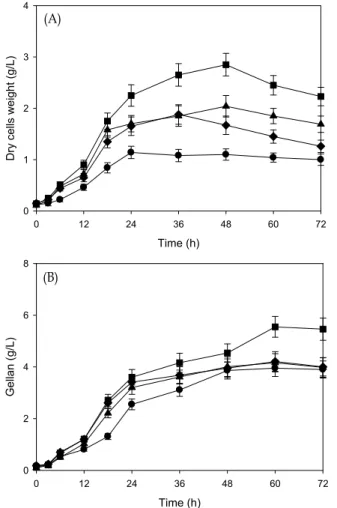
Effect of agitation speed on production of gellan The effect of agitation speed on cell growth and the pro- duction of gellan by S. paucibilis NK2000 was investigated in a 7 l bioreactor (Ko-Biotech Co., Korea). Agitation speed ranged from 200 to 500 rpm and aeration rate was 1.0 vvm.
The temperature and initial pH of the medium for the pro- duction of gellan by S. paucibilis NK2000 were 30oC and 6.8, respectively. A higher agitation speed, which resulted in an increase of dissolved oxygen in the medium, enhanced cell growth, as shown in Fig. 1A. The optimal agitation speed
for cell growth of S. paucibilis NK2000 was found to be 400 rpm. Production of gellan by S. paucibilis NK2000 also in- creased with elevated agitation speed, as shown in Fig. 1B.
The optimal agitation speed for production of gellan was also 400 rpm. The highest production of gellan by S. paucibi- lis NK2000 was 5.55 g/l from 20.0 g/l glucose and 10.0 g/l soybean pomace as carbon and nitrogen sources. Production of gellan was increased according to cell growth of S. paucibi- lis NK2000 [10]. It seems that higher concentrations of dis- solved oxygen in the medium promote cell growth of S. pau- cibilis NK2000, which results in higher production of gellan.
Effect of aeration rate on production of gellan The effect of aeration rate on cell growth and the pro- duction of gellan by S. paucibilis NK2000 was also investigated. Aeration rate ranged from 0.5 to 2.0 vvm and agitation speed was 400 rpm. Optimal aeration rates for cell
Time (h)
0 12 24 36 48 60 72
Dry cells weight (g/L)
0 1 2 3 4
(A)
Time (h)
0 12 24 36 48 60 72
Gellan (g/L)
0 2 4 6 8
(B)
Fig. 1. Effect of agitation speed on cell growth (A) and the pro- duction of gellan (B) by S. paucibilis NK2000 (●, 200 rpm;
▲, 300 rpm; ■, 400 rpm, and ◆, 500 rpm).
growth of S. paucibilis NK2000 as well as for production of gellan were 1.0 vvm, as shown in Fig. 2. The highest pro- duction of gellan by S. paucibilis NK2000 was 5.65 g/l with an agitation speed of 400 rpm and an aeration rate of 1.0 vvm. The concentration of dissolved oxygen in the medium can be influenced by agitation speed, aeration rate, and the inner pressure of bioreactors [6,7]. It seems that higher dis- solved oxygen in the medium due to higher aeration rates and agitation speeds, leads to enhance cell growth, which resulted in improved production of gellan.
Effect of glucose feeding time on production of gellan
The effect of glucose feeding into the culture broth at dif- ferent time on cell growth and the production of gellan by S. paucibilis NK2000 was investigated. Agitation speed and aeration rate for the production of gellan by S. paucibilis
Time (h)
0 12 24 36 48 60 72
Dry cells weight (g/L)
0 1 2 3 4
(A)
Time (h)
0 12 24 36 48 60 72
Gellan (g/L)
0 2 4 6 8
(B)
Fig. 2. Effect of aeration rate on cell growth (A) and the pro- duction of gellan (B) by S. paucibilis NK2000 (●, 0.5 vvm;
▲, 1.0 vvm; ■, 1.5 vvm, and ◆, 2.0 vvm).
Time (h)
0 12 24 36 48 60 72
Reducing sugar (g/L)
0 10 20 30 40
(A)
Time (h)
0 12 24 36 48 60 72
Dry cells weight (g/L)
0 1 2 3 4
(B)
Time (h)
0 12 24 36 48 60 72
Gellan (g/L)
0 2 4 6 8
(C)
Fig. 3. Effect of feeding time for the final concentration of 100.0 g/l glucose into the medium on reducing sugars (A), cell growth (B), and the production of gellan by S. paucibilis NK2000 (C) in a 7 l bioreactor (●, no adding; ■, feeding at 0 hr*; ▲, feeding at 24 hr*; ○, feeding at 36 hr*; and
□, feeding at 48 hr*; Significance of each value was analyzed by DPS software version 3.01 (DPS Co., Middlesex, UK).
Values with different letters are significantly different at p<0.05.)
Table 1. Effect of feeding time for the final concentration of 10.0 g/l glucose in the medium on cell growth and the production of gellan by S. paucibilis NK2000 for 72 hr cultivation
Feeding
time (hr) Final pH DCW
(g/l)
Gellan (g/l)
Reducing
sugars (g/l) Yx/s1
Yp/s2
Yp/x3
No feeding 0 24 36 48
5.6 5.5 5.6 5.8 6.0
2.21±0.22c4 2.89±0.24b 3.44±0.22a 3.02±0.23b 2.71±0.18b
5.07±0.32b 5.45±0.34ab*4
5.87±0.35ab*
6.16±0.42a*
5.63±0.33ab*
2.11±0.25d 3.32±0.28c*
3.91±0.36c*
4.84±0.42b*
6.37±0.49a*
0.11 0.10 0.11 0.10 0.09
0.25 0.18 0.20 0.21 0.19
2.29 1.89 1.71 2.04 2.00
1yield of g dry cells weight/g glucose
2yield of g gellan/g glucose
3yield of g gellan/g dry cells weight
4*Values with different letters are significantly different at p<0.05.
NK2000 were 400 rpm and 1.0 vvm. Concentration of glu- cose in the feeding solution was 200.0 g/l and its final con- centration of glucose fed into the medium was 10.0 g/l.
Reducing sugars in culture broths increased from 18.9 to 29.2 g/l, from 8.4 to 18.2 g/l, from 4.4 to 14.1, and from 2.4 to 12.1 g/l with glucose feeding after 0, 24, 36, and 48 hr culti-
vation, respectively, as shown in Fig. 3A. Production of gel- lan from 20.0 g/l glucose without glucose feeding was 5.07 g/l, whereas those from 20.0 g/l glucose with feeding of glucose feeding at a different time ranged from 5.45 to 6.16 g/l, as shown in Table 1. Significance of each value was analyzed by DPS software version 3.01 (DPS Co., Middlesex,
Time (h)
0 12 24 36 48 60 72
DO (%)
0 20 40 60 80 100 120
(A)
Time (h)
0 12 24 36 48 60 72
Dry cells weight (g/L)
0 1 2 3 4 5
(C)
Time (h)
0 12 24 36 48 60 72
Reducing sugars(g/L)
0 5 10 15 20 25
(B)
Time (h)
0 12 24 36 48 60 72
Gellan (g/L)
0 2 4 6 8 10 12
(D)
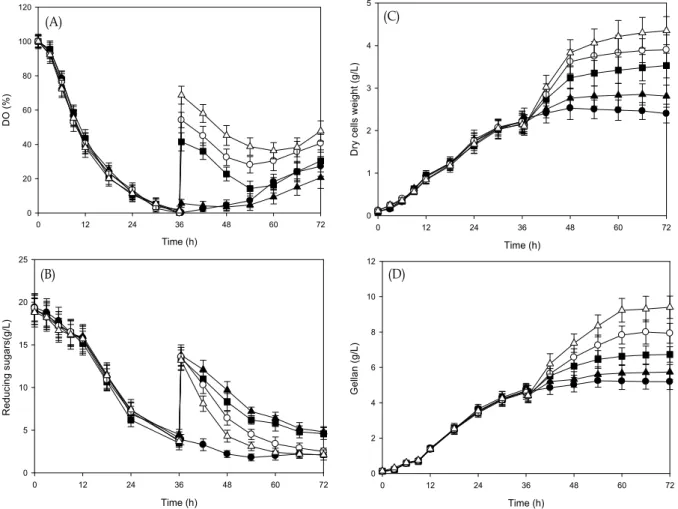
Fig. 4. Effect of feeding of the final concentration of 10.0 g/l glucose and shifts of agitation speed and aeration rate on dissolved oxygen in the medium (A), reducing sugars (B), cell growth (C), and the production of gellan (D) by S. paucibilis NK2000 (●, without feeding; ▲, feeding at 36 hr; ■, feeding at 36 hr and a shift of a agitation speed from 400 to 600 rpm*; ○, feeding at 36 hr and shifts of an agitation speed from 400 to 600 rpm and an aeration rate from 1.0 to 1.5 vvm*, and △, feeding at 36 hr and shifts of an agitation speed from 400 to 600 rpm and an aeration rate from 1.0 to 2.0 vvm*).
UK). Values with different letters are significantly different at p<0.05.
The best feeding time of glucose for cell growth was not the same as that for the production of gellan by S. paucibilis NK2000, as shown Fig. 3B and C. The highest cell growth of S. paucibilis NK2000 was obtained when 200.0 g/l glucose was fed into the culture broth after 24 hr cultivation, where- as the highest production of gellan was obtained when the same concentration of glucose was fed into the culture broth after 36 hr cultivation. Glucose, as a carbon source, seems to be first utilized for cell growth of S. paucibilis NK2000 and then biosynthesis of precursors for production of gellan.
The highest production of gellan from 20.0 g/l glucose with feeding of 200.0 g/l glucose after 36 hr of cultivation was 6.16 g/l, which conversion rate was 20.5%. Fed-batch culture
is a batch culture fed continuously or sequentially with sub- strate without the removal of fermentation broth, which is generally superior to batch and continuous cultures [5].
Effect of shifts in agitation speed and aeration rate on production of gellan
Cell growth and production of gellan by five different processes were compared to investigate the effect of shifts in agitation speed and aeration rate after feeding of glucose into the medium. Its final concentration of glucose fed into the medium was 10.0 g/l. Concentrations of dissolved oxy- gen in culture broths rapidly decreased and reached around 0% after 36 hr of cultivation. Concentrations of dissolved oxygen after a shift in an agitation speed from 400 to 600 rpm, shifts in an agitation speed from 400 to 600 rpm and
Table 2. Effect of shifts in agitation speed and aeration rate after glucose feeding on cell growth and the production of gellan by S. paucibilis NK2000
Process Glucose1
(g/l)
Agitation speed (rpm) Aeration rate (vvm) DCW (g/l)
Gellan (g/l)
Before2 After3 Before After
1 2 3 4 5
20 30 30 30 30
400 400 400 400 400
400 400 600 600 600
1.0 1.0 1.0 1.0 1.0
1.0 1.0 1.0 1.5 2.0
2.40±0.32c4 2.81±0.24c 3.53±0.31b*
3.90±0.36ab*
4.35±0.42a*
5.19±0.42d 5.74±0.36cd*4
6.73±0.58c*4 7.93±0.61b*
9.40±0.85a*
1final concentration of glucose as a carbon source in the medium after feeding of 200.0 g/l glucose
2agitation speed before 36 hr cultivation
3agitation speed after 36 hr cultivation
4* Values with different letters are significantly different at p<0.05.
an aeration rate from 1.0 to 1.5 vvm, and shifts in an agi- tation speed from 400 to 600 rpm and an aeration rate from 1.0 to 2.0 vvm were increased to 41.5, 54.2, and 68.7%, re- spectively, as shown in Fig. 4A. Reducing sugars in culture broths were about 3.0 g/l after 36 hr cultivation and those after glucose feeding increased to about 13.0 g/l.
Consumption rates of reducing sugars after glucose feeding increased with elevated agitation speeds and aeration rates, as shown in Fig. 4B. Elevated concentrations of dissolved oxygen (DO) in the culture broth by shifts in agitation speeds were reported to enhance productivity of microbial metabolites [14,22].
Cell growths of S. paucibilis NK2000, measured as dry cells weight (DCW), from 20.0 g/l glucose without feeding, 20.0 g/l with feeding of 200.0 g/l glucose at 36 h, 20.0 g/l glucose with feeding of 200.0 g/l glucose at 36 hr and a shift in an agitation speed from 400 to 600 rpm, 20.0 g/l glucose with feeding of 200.0 g/l glucose at 36 hr and shifts in an agitation speed from 400 to 600 rpm and an aeration rate from 1.0 to 1.5 vvm, and 20.0 g/l glucose with feeding of 200.0 g/l glucose at 36 hr and shifts in an agitation speed from 400 to 600 rpm and an aeration rate from 1.0 to 2.0 vvm, were 2.40, 2.81, 3.53, 3.90, and 4.35 g/l, respectively, as shown in Table 2 and Fig. 4C. Productions of gellan by S. paucibilis NK2000 from those of five different processes were 5.19, 5.74, 6.73, 7.93, and 9.40 g/l, respectively, and their conversion rates from glucose as a carbon source were 26.0, 19.1, 22.4, 26.4, and 31.3%, as shown in Table 2 and Fig. 4D. Production of gellan and its conversion rate by S.
paucibilis NK2000 from 20.0 g/l glucose as a carbon source with feeding of 200.0 g/l glucose at 36 hr and shifts in an agitation speed from 400 to 600 rpm and an aeration rate of 1.0 to 2.0 vvm were 9.40 g/l and 31.3%, which were 1.81
and 1.20 times higher than those without feeding as well as shifts in an agitation speed and an aeration rate. The in- vestigation of intermediate two-step addition of glucose un- der identical conditions of fermentation showed an en- hanced production of gellan with a concentration of 8.1 g/l as compared with the control of 6.0 g/l [11]. There are sev- eral reports with respect to the application of shifts in an agitation speed, an aeration rate, temperature, and/or pH of culture medium during cultivation to enhance pro- ductivity of microbial metabolites [15,23-25]. In this study, a simple process was developed to enhance production of gellan with shifts in an agitation speed and an aeration rate after glucose feeding at an optimal time.
Acknowledgment
This study was supported by research funds from Dong-A University, Busan, Korea.
References
1. Arockiasamy, S. and R. M. Banik. 2008. Optimization of gel- lan gum production by Sphingmonas paucimobilis ATCC 31461 with nonionic surfactants using central composite design. J. Biosci. Bioeng. 105, 203-210.
2. Bajaj, I. B., P. S. Saudagar, R. S. Singhal, and A. Pandey.
2006. Statistical approach to optimization of fermentative production of gellan gum from Sphingomonas paucimobilis ATCC 31461. J. Biosci. Bioeng. 102, 150-156.
3. Banik, R. M. and A. Santhiago. 2006. Improvement in pro- duction and quality of gellan gum by Sphingomonas paucimo- bilis under high dissolved oxygen tension levels. Biotechnol.
Lett. 28, 1347-1350.
4. Banik, R. M., A. Santhiagu, and S. N. Upadhyay. 2006.
Optimization of nutrients for gellan gum production by Sphingmonas paucimobilis ATCC-31461 in molasses based me-
dium using response surface methodology. Bioresource Technol. 98, 792-797.
5. Ding, S. and T. Tan. 2006. L-lactic acid production by Lactobacillus casei fermentation using different fed-batch feeding strategies. Process Biochem. 41, 1451-1454.
6. Dreveton, E., F. Monot, D. Ballerini, J. Lecourtier, and L.
Choplin. 1994. Effect of mixing and mass transfer conditions on gellan production by Auromonas elodea. J. Ferment. Bioeng.
77, 642-649.
7. Giavasis, I., L. M. Harvey, and B. McNeil. 2006. The effect of agitation and aeration on the synthesis and molecular weight of gellan in batch cultures of Sphingomonas paucimobilis. Enzyme Microb. Technol. 38, 101-108.
8. Harding, N. E., Y. N. Patel, and R. J. Coleman. 2004.
Organization of genes required for gellan polysaccharide bi- osynthesis in Sphingomonas elodea ATCC 31461. J. Ind.
Microbiol. Biotechnol. 31, 70-82.
9. Jansson, R. E., B. Lindberg, and P. L. A. Sandford. 1983.
Structural studies of gellan gum, an extracellular poly- saccharide elaborated by Pseudomonas elodea. Carbohydr. Res.
124, 135-139.
10. Jin, H., N. K. Lee, M. K. Shin, S. K. Kim, D. L. Kaplan, and J. W. Lee. 2003. Production of gellan gum by Sphingomanas paucimobilis NK200 with soybean pomace.
Biochem. Eng. J. 16, 357-360.
11. Kanari, B., R. R. Banik, and S. N. Upadhyay. 2002. Effect of environmental factors and carbohydrate on gellan gum production. Appl. Biocehm. Biotechnol. 102-103, 129-140.
12. Kang, K. S., G. T. Veeder, P. J. Mirrasoul, T. K. Kaneko, and L. W. Cottrell. 1982. Agar-like polysaccharide produced by a Pseudomonas species: production and basic properties.
Appl. Environ. Mircobiol. 43, 1086-1091.
13. Karim, A. A. and R. Bhat. 2009. Fish gelatin: properties, chal- lenge, and prospects as an alternative to mammalian gelatins. Food Hydrocolloids 23, 563-576.
14. Lee, N. K., Y. B. Jo. I. H. Jin, C. W. Son, and J. W. Lee.
2009. The effect of potassium phosphate as a pH stabilizer on the production of gellan by Sphingmonas paucibilis NK-2000. J. Life Sci. 8, 1033-1035.
15. Li, Y., J. Hugenholtz, J. Chen, and S. Lun. 2002. Enhancement
of pyruvate production by Torulopsis glabrata using a two-stage oxygen supply control strategy. Appl. Microbiol.
Biotechnol. 60, 101-106.
16. Lim, S. M., J. R. Ru, J. W. Lee, and S. K. Kim. 2003.
Optimization of culture condition for the gellan production by Pseudomonas elodea ATCC 31461. J. Life Sci. 13, 705-711.
17. Martin, L. O., A. M. Fialho, P. L. Rodrigues, and I.
Sa-Correia. 1996. Gellan gum production and activity of bio- synthetic enzymes in Sphingomonas paucimobilis mucoid and non-mucoid variants. Biotechnol. Appl. Biochem. 4, 47-54.
18. Morrison, N. A., G. Sworn, R. C. Clark, Y. L. Chen, and T. Talashek. 1999. Gelatin alternatives for the food industry.
Prog. Coll. Polym. Sci. 114, 127-131.
19. Sá-Correia, I., A. M. Fialho, P. Videria, L. M. Moreira, A.
R. Marques, and H. Albano. 2002. Gellan gum biosynthesis in Sphingomonas paucimobilis ATCC 31461: genes, enzymes and exopolysaccharide production engineering. J. Ind.
Microbiol. Biotechnol. 29, 170-176.
20. Schilling, B. M., U. Rau, U. T. Maier, and P. Fankhause.
1999. Modeling and scale-up of the unsterile scleroglucan production process with Sclerotium rolfsii ATCC 15205.
Bioprocess Eng. 20, 195-201.
21. Wang, X., Y. Yuan, C. Liu, D. Zhang, Z. Yang, C. Yang, and C. Ma. 2006. Modeling for gellan gum production by Sphingomonas paucimobilis ATCC 31461 in a simplified medium. Appl. Environ. Microbiol. 72, 3367-3374.
22. West, T. P. 2002. Isolation of a mutant strain Pseudomonas sp. ATCC 31461 exhibiting elevated polysaccharide production. J. Ind Microbiol. Biotechnol. 29, 185-188.
23. Yan, G.., G. Du, Y. Li, J. Chen, and J. Zhong. 2005.
Enhancement of microbial transaminase production by Streptoverticillium mobaraens: application of a two-stage agi- tation speed control strategy. Process Biocehm. 40, 963-968.
24. Zheng, M. Y., G. C. Du, J. Chen, and W. F. Guo. 2001. A temperature-shift strategy in batch MTG fermentation with S. mobaraense. Process Biochem. 36, 525-530.
25. Zheng, M. Y., G.. C. Du, and J. Chen. 2002. pH control strat- egy of batch microbial transglutaminase production with Streptoverticillium mobaraense. Enzyme Microb. Technol. 31, 477-481.
초록:Sphingomonas paucibilis NK-2000 균주가 생산하는 젤란의 생산 농도 향상을 위한 포도당 첨가 및 교반속도와 통기량 변화 방법의 최적화
이남규․서형필․조영배․손창우1․고 와2,3․이진우2,4*
(해양생물산업육성센터, 1한국바이오솔루션, 2동아대학교 BK21 생물자원 실버바이오사업 인력양성사업단,
3동아대학교 대학원 의생명과학과, 4동아대학교 생명공학과)
Sphingomnas paucibilis NK2000 균주를 사용한 젤란의 최적 교반속도 및 통기량은 각각 400 rpm 및 1.0 vvm이 었다. 이 균주를 사용하여 젤란의 생산성을 향상시키기 위한 포도당의 최적 첨가시기는 배양을 시작한 36시간 이었다. 젤란의 생산성을 향상시키기 위한 5가지 방법, 1) 포도당을 첨가하지 않는 방법, 2) 배양 36시간 후에 포 도당을 첨가하지만 교반속도 및 통기량을 변화시키지 않는 방법, 3) 배양 36 시간 후에 포도당을 첨가하고 교반속 도를 400 rpm에서 600 rpm으로 변화시키는 방법, 4) 배양 36 시간 후에 포도당을 첨가하고 교반속도를 400 rpm 에서 600 rpm으로 증가시키고 통기량을 1.0 vvm에서 1.5 vvm으로 증가시키는 방법 및 5) 배양 36 시간 후에 포도당을 첨가하고 교반속도를 400 rpm에서 600 rpm으로 증가시키고 통기량을 1.0 vvm에서 2.0 vvm으로 증가 시키는 방법 등을 실험한 결과, 젤란의 생산성은 각각 5.19, 5.74, 6.73, 7.93, 및 9.40 g/l이었으며, 변환률은 각각 26.0, 19.1, 22.4, 26.4, and 31.3%이었다. 최적의 방법으로 생산한 젤란의 생산농도 및 포도당 전환율은 포도당을 첨가하지 않은 방법으로 생산한 젤란의 생산농도 및 포도당 전환율에 비하여 각각 1.81 및 1.20 배 증가하였다.