유산소 트레이닝과 식사조절 병행이 비만아동의 혈중지질과 아포지단백에 미치는 효과
박 태 곤*
부산대학교 체육과
Received July 11, 2008 /Accepted October 9, 2008
Effects of Aerobic Training Plus Diet on Blood Lipids and Apolipoproteins in Obese Children. Tae Gon Park*. Department of Physical Education, Pusan National University, Busan 609-736, Korea - The pur- pose of this study was to find out the effects of aerobic training plus diet on blood lipids and apolipo- proteins (Apo) in obese children. Sixteen healthy obese boys (ages 10.9; body mass index (BMI) ≥95th percentiles for age and sex) participated in this study. The aerobic training program consisted of 40 minutes hiking on a mountain, 60 minute of basketball and football dribbling at an intensity of 60-70%
of HRmax, and was performed 5 days a week for 9 weeks. The diet prescription was 2,100 kal/day according to the recommended dietary allowance for 10-12 year old Koreans. All subjects stayed in a training camp for 9 weeks. The results of this study were as follows; Blood lipid profiles including total cholesterol (TC), triglyceride (TG) high density lipoprotein cholesterol (HDL-C) and TC/HDL-C ratio were significantly improved after the 9 week program, but there was no significant change in low density lipoprotein (LDL-C). Apolipoprotein profiles, Apo AⅠ, AⅡ, B, CⅡ and CⅢ were all sig- nificantly decreased after the 9 week program, but there were no significant difference in Apo AⅠ/A
Ⅱ ratio and Apo B/AⅠ ratio. These results indicate that aerobic training together with a healthy diet can induce positive changes on blood lipid profiles, Apo AⅡ, B and CⅡ in obese children.
Key words : Obese, aerobic training, diet, blood lipids, apolipoproteins
*Corresponding author
*Tel:+82-51-510-1627, Fax:+82-51-515-1991
*E-mail : [email protected]
서 론
오늘날 사회ㆍ경제적 여건의 향상과 영양과잉 및 신체활 동부족 등에 의해 비만아동과 청소년들이 선진국과 개발도 상국을 가릴 것 없이 증가함에 따라 세계적인 문제로 대두되 고 있다[19]. 비만아동의 경우 이들의 약 40% 정도가 성인이 되어서도 여전히 비만상태에 머물고[22], 이상지혈증, 고혈 압, 제2형 당뇨병과 같은 관상동맥 심장질환(coronary heart disease; CHD) 위험인자의 발병 위험을 증가시킨다[5,32]. 이 같은 비만아동의 CHD 발병 위험성은 부검연구를 통해 동맥 경화성 병변과 소인이 확인됨으로서 입증되었다[3].
Freedman 등[12]이 Bogalusa Heart Study (1973~1994)의 5-17세 사이의 아동과 청소년 9,167명의 자료를 바탕으로 CHD 위험인자와 과체중 및 비만과의 관련성을 분석한 결과 체질량지수 백분위수(body mass index; BMI) 85이상인 아동 과 청소년의 총 콜레스테롤(total cholesterol; TC), 저밀도지단 백 콜레스테롤(low density lipoprotein cholesterol; LDL-C), 고밀도지단백 콜레스테롤(high density lipoprotein cholester- ol; HDL-C), 중성지방(triglyceride; TG), 혈압이 정상아동과 청소년보다 비정상적인 수치를 나타낼 위험성(odds ratio)이 각각 2.4, 3.0, 3.4, 7.1, 4.5배 높은 것으로 나타났다. 더군다나 보다 최근의 연구결과에 따르면 BMI가 99이상인 고도 비만아
동은 이들의 59%가 2가지 이상의 CHD 위험인자를 가지고 있으며 매우 위험한 인체의 생화학적 이상을 보이고, 고도 성 인비만의 증상을 나타내는 것으로 밝혀져 매우 적극적인 아동 비만 처치의 필요성이 제기되고 있다[13].
Epstein과 Goldfield [10]는 아동비만의 예방과 치료에는 규칙적인 운동과 함께 식사조절 및 행동수정요법이 중심이 되어야한다고 하였다. 특히 유산소 트레이닝은 비만아동과 청소년[21] 및 비만성인[20]의 혈중지질과 지단백인 TC, TG, HDL-C, LDL-C 등을 바람직한 방향으로 조절ㆍ개선시켜 순 환계 질환을 예방할 수 있는 것으로 보고되고 있다. 한편 Leon과 Sanchez [23]는 운동 또는 운동과 식사조절을 병행한 프로그램 실시에 따른 혈청지질과 지단백의 반응에 대한 메 타분석 연구에서 일반적으로 TC, LDL-C의 감소를 동반한 HDL-C의 증가현상을 보인다고 하였지만, 개선정도는 일치 하지 않았고 용량-반응(dose- response)의 관련성은 없었다 고 하였다.
지난 30여 년간 높은 TC 농도 그 중 특히 높은 LDL-C 농
도가 CHD의 발병에 있어 주요 위험인자로 인식되어져 왔지
만 최근 여러 연구결과 지단백의 기능과 대사에 대한 이해가
확대되면서 LDL-C 농도가 동맥경화성 CHD 발병에 관련된
유일한 주요 예측인자가 아님이 확인되었으며[36], 또한
Alaupovic [1]는 CHD의 예측에 있어 전통적인 위험인자인
TC, TG, HDL-C, LDL-C의 농도를 측정하는 것보다 혈중지
질과 지단백을 구성하는 아포지단백(apolipoproteins; Apo)
들의 농도를 측정하는 것이 그 예측력이 더 높다고 하였다.
유산소 트레이닝 또는 유산소 트레이닝과 식사조절을 병 행한 프로그램의 실시에 따른 혈중지질과 지단백 반응에 대 한 연구는 성인과 아동 및 청소년에 있어서는 다수 보고되었 지만[18,27,31,35], 혈중 Apo의 반응에 대한 연구는 성인의 경우는 몇 편의 연구가 실시되었으나[7,16,37,38] 아동의 경 우는 Ferguson 등[11]이 연구한 것을 제외하면 매우 미흡한 실정인데 대부분의 연구가 Apo AⅠ, AⅡ, B, Apo AⅠ/AⅡ ratio, Apo B/AⅠ ratio의 변화를 비교 분석 하였을 뿐 Apo CⅡ와 CⅢ의 변화를 비교분석한 연구결과는 아직 없다. 따 라서 본 연구는 9주간 유산소 트레이닝과 식사조절을 병행한 체중조절 프로그램을 초등학교 비만 남학생에게 적용하여 이들의 혈중지질과 지단백 및 Apo에 미치는 효과를 규명하 기 위해 실시하였다.
재료 및 방법
연구 대상
본 연구의 대상은 초등학교 4,5학년 남학생 중 연령과 성 별에 따른 체질량지수 백분위수가 95 이상(10세: ≥22.7, 11 세: ≥23.9 kg/m
2; 대한아소과학회, 1998)에 해당하는 비만아 동으로서 본 연구의 취지와 실험내용에 동의한 지원자 가운 데 부모의 동의를 받아 건강상태를 전문의의 문진을 실시하 여 이상이 없다고 판정된 16명으로 하였다. 실험 시작 전 6개 월 이내에 규칙적인 운동에 참여하였거나 비만 관련합병증 으로 치료를 받고 있는 학생은 본 연구에서 제외하였다. 이 들은 실험 기간 9주 동안 합숙생활을 하였으며 대상자들의 신체적 특징은 Table 1과 같다.
측정 항목 및 방법 인체 측정
신장은 이동식 신장계를 이용하여 0.1 cm 단위까지, 체중 은 디지털체중계(CASS digital. Korea)를 이용하여 0.1 kg 단 위까지 측정하였으며, 체질량지수는 체중(kg)을 신장의 제곱 값(m
2)으로 나누어 구하였다.
혈액 검사
12시간 이상 공복 상태에서 전완 주정맥으로부터 정맥혈 10 ml를 채혈하여 자동혈액분석기(Hitachi 736-20, Japan)를 이용하여 TC, TG, LDL-C 농도는 효소비색법으로, HDL-C 농 도는 침전법으로 분석하였으며, Apo AⅠ과 B는 micropippet
Table 1. Physical characteristics of the subjects (N=16) Age (yr) Heigh (cm) Weight (kg) BMI (kg/m2) Pre
Post
10.9±1.1 ㆍ
144.7±6.4 145.6±6.6***
53.3±8.5 46.3±6.8***
25.4±2.8 21.8±2.2***
Value are mean±SD.
BMI: body mass index, *** p<0.001
을 이용하여 면역비탁법으로, Apo AⅡ, CⅡ, CⅢ는 small test tube를 이용하여 면역확산법으로 분석하였다. 모든 혈액 검사 는 S 임상검사센터에 의뢰하였다.
유산소 트레이닝 프로그램 및 식사 조절
유산소 트레이닝 프로그램은 등산과 축구 및 농구 드리블 을 최대심박수(HRmax)의 60-70%의 강도로 1일 100분 내외, 주 5회, 9주간 실시하는 것으로 구성하였다. 등산은 아침에 초등학교 부근 야산 등산로를 이용하여 40분간 실시하였고, 축구와 농구 드리블 운동은 운동 전ㆍ후에 각각 5분 내외의 가볍게 걷기 및 스트레칭을 준비운동과 정리운동을 포함하 여 학교 운동장에 앞뒤 간격은 3 m 옆 간격은 4 m로 하여 2줄로 평행하게 각각 7개씩 총 14개의 포인터를 설치하여 왼 쪽에서 출발하여 지그재그 드리블로 14개의 포인터를 통과 하는 방법으로 2가지 운동을 60분간 실시하였다. 1주일간의 적응기간을 두어 피험자들이 농구와 축구 드리블의 기본동 작을 익히게 하였으며, 목표 심박수 범위 대에서 운동을 수 행할 수 있도록 하기 위해 X-trainer (Polar. Co. Finland)를 이용하여 자신의 목표심박수 범위를 인식할 수 있게 하였으 며, 축구와 농구 드리블은 체육전공 보조자와 연구자가 함께 지도하였다.
식사 조절은 한국인 남자 10-12세에게 권장되는 1일 영양 권장량 2,200 kcal에 준하는 2,100 kcal를 피험자들에게 필요 한 필수영양소를 충분히 포함시킨 9주간의 식단(탄수화물 65%, 지방 20%, 단백질 15%)을 전문영양사의 도움을 받아 작성하여 제공하였다(한국영양학회, 2000).
자료 처리
수집된 자료는 SPSS Ver. 12.0 패키지를 이용하여 각 측정 항목에 대한 평균값(M)과 표준편차(SD)를 산출하였다. 프로 그램 실시에 따른 사전과 사후 평균치 변화 대한 차이검정은 paired t-test를 이용하였으며, 통계적 유의수준은 α=0.05로 하였다.
연구 결과
혈중지질과 지단백의 변화
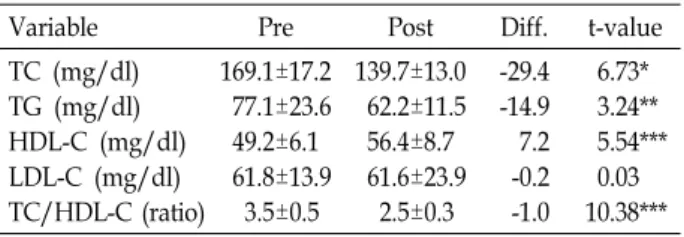
9주간 프로그램 실시에 따른 혈중지질과 지단백의 변화 결과는 Table 2와 같다. TC (p<0.05)와 TG (p<0.01) 농도는 사전에 비해 사후에 각각 29.4, 14.9 mg/dl 감소하였으며, HDL-C (p<0.001) 농도는 사전에 비해 사후에 7.2 mg/dl 증 가하였고, TC/HDL-C비(p<0.001)는 3.5±0.5에서 2.5±0.3으로 감소하였으나 LDL-C (p>0.05) 농도는 변화가 없는 것으로 나타났다.
혈중 Apo의 변화
9주간 프로그램 실시에 따른 혈중 Apo의 변화 결과는
Table 2. Changes of lipid and lipoproteins after 9 weeks pro- gram (N=16)
Variable Pre Post Diff. t-value
TC (mg/dl) TG (mg/dl) HDL-C (mg/dl) LDL-C (mg/dl) TC/HDL-C (ratio)
169.1±17.2 77.1±23.6 49.2±6.1 61.8±13.9 3.5±0.5
139.7±13.0 62.2±11.5 56.4±8.7 61.6±23.9 2.5±0.3
-29.4 -14.9 7.2 -0.2 -1.0
6.73*
3.24**
5.54***
0.03 10.38***
Value are mean±SD.
Diff. is mean difference between pre and post program.
* p<0.05, ** p<0.01, *** p<0.001
Table 3. Changes of apolipoproteins after 9 weeks program (N=16)
Variable Pre Post Diff. t-value
Apo AⅠ (mg/dl) Apo AⅡ (mg/dl) Apo B (mg/dl) Apo CⅡ (mg/dl) Apo CⅢ (mg/dl) Apo AⅠ/AⅡ (ratio) Apo B/AⅠ (ratio)
205.6±43.8 28.1±6.6 119.9±21.1 3.4±1.6 6.4±2.0 8.2±4.8 0.6±0.2
118.7±29.1 21.3±4.9 79.0±16.7 2.3±1.2 5.2±1.9 6.0±2.3 0.7±0.1
-86.9 -6.8 -40.9 -1.1 -1.2 -2.2 0.1
8.04***
3.49**
4.91***
2.46*
3.29**
1.76 1.56 Value are mean±SD.
Diff. is mean difference between pre and post program.
* p<0.05, ** p<0.01, *** p<0.001
Table 3과 같다. Apo AI (p<0.001), AII (p<0.01), B (p<0.001), CⅡ (p<0.05), CⅢ (p<0.01)의 농도는 모두 사전에 비해 사후 에 각각 86.9, 6.8, 40.9, 1.1, 1.2 mg/dl 감소하였으며, Apo A
Ⅰ/AⅡ와 Apo B/AⅠ비는 감소하였지만 유의성은 없는 것 으로 나타났다.
고 찰
규칙적인 유산소성 운동에 따른 혈중지질과 지단백에 미치 는 영향은 잘 알려져 있다. 일반적으로 TC는 트레이닝에 의해 잘 감소하지 않으며 기저 농도나 운동 기간에도 영향을 받지 않는 것으로 보고되고 있지만[8], 체중과 체지방의 감량 및 식 이성 지방 섭취량의 감소와 더불어 유산소성 트레이닝을 실시 한 경우에는 감소하기도 한다[18]. TG는 일반적으로 유산소성 트레이닝에 의해 감소하며 특히 기저 농도가 높았던 비활동적 인 사람들에서 더 많이 감소하는 것으로 알려져 있다[8].
HDL-C는 에너지소비량과 비례하여 증가하는 것으로 알려져 있지만 항상 증가하는 것은 아니며[30,31], 식사조절과 병행하 여 체중과 체지방량이 감소하는 경우에는 더 증가하는 것으로 알려져 있다[27]. LDL-C는 전통적인 CHD 위험인자로서 고지 방 식사를 하는 이들에게서 높게 나타나며[8], 일반적으로 잘 감소하지 않지만 그렇지 않는 경우도 있다[39].
본 연구결과 TC, TG, TC/HDL-C비는 감소하였고 HDL-C 는 증가하였으나 LDL-C는 변화가 없었다. 이와 같은 결과를 Sasaki 등[27]이 비만아동을 대상으로 유산소성 운동을 실시 한 결과 HDL-C는 증가하였으나 TC, TG는 변화가 없었다는 보고, Becque 등[2]이 비만청소년을 대상으로 운동과 식사조 절을 병행한 프로그램을 실시한 결과 HDL-C는 증가하였지 만 TC, TG, LDL-C는 변화가 없었다는 보고, Tolfrey 등[35]
이 초등학생들을 대상으로 12주간 유산소성 운동을 실시한 결과 TC, TG, LDL-C, HDL-C 모두 변화가 없었다는 보고 와 비교해 볼 때, 유산소성 운동 단독 또는 유산소성 운동과 식 사조절을 병행한 프로그램 실시에 따른 혈중지질과 지단백 의 반응이 서로 일치하지 않음을 알 수 있다. 이 같은 반응의 차이는 일상생활에서의 신체활동의 정도, 트레이닝의 양, 체 지방률, 운동 강도, 기저 지질과 지단백의 농도 차이, 식사조 절, 유전적 요인 등에 영향을 받기 때문인 것으로 알려져 있 다[29,34]. 그렇지만 Epstein과 Goldfield [10]가 비만아동을 대상으로 체중 조절 프로그램을 적용한 연구들을 고찰한 연 구에 의하면 적절한 식사 조절을 병행한 운동프로그램이 운 동만 실시한 프로그램보다 혈중지질 반응이 더 긍정적이었 다고 하였다. 따라서 본 연구의 이 같은 결과는 비만아동일 경우라도 규칙적인 운동과 이들의 성별과 연령에 따른 1일 영양권장량에 준하는 에너지섭취(2,100 kcal)가 체중감량 (Table 1)과 더불어 CHD 위험인자인 혈중지질과 지단백에 긍정적인 효과를 미칠 수 있음을 확인하였다.
Apo는 여러 형태의 지단백을 구성하는 주요단백질로 인 체조직 수용체들의 리간드(ligand) 역할을 통한 지질의 운반 및 재분배 기능과 지단백 대사에 관련된 여러 효소들의 활성 을 촉진 또는 억제시키는 조효소 작용을 하는 것으로 알려져 있다[8]. Apo A는 AⅠ, AⅡ, AⅣ로 나누어지고 HDL-C를 구 성하는 주요단백질이다. 이 중 Apo AⅠ은 HDL-C와 정적인 상관관계가 있으며 Apo AⅠ의 발현정도는 혈중 HDL-C 농 도를 결정하고, 인체조직의 지나친 콜레스테롤의 제거와 HDL-C에 콜레스테롤을 이동ㆍ결합시켜 간으로 역수송시키 는 기능을 지닌 lecitin cholesterol acly transferase (LCAT)를 활성화시키는 조효소 작용을 한다[36]. 한편 Apo AⅡ는 형 질전환 쥐(mice)를 대상으로 실시한 연구결과 간 리파제와 지단백 리파제의 활성을 억제시켜 혈중 TG 농도는 증가시키 고 HDL-C 농도는 감소시키는 기능을 하는 것으로 밝혀졌으 며[17], 지단백 대사과정에서 Apo AⅡ는 동맥경화를 예방하 는 작용은 없으며 적어도 CHD의 발병과 관련하여 그 농도 의 증가는 오히려 해롭다고 하였다[4].
본 연구결과 Apo AⅠ과 AⅡ는 감소하였고, Apo AⅠ/A
Ⅱ비는 감소하였지만 통계학적인 유의성은 없었다. Apo A
Ⅰ의 이 같은 감소는 선행 연구결과 유산소 트레이닝 후 증
가하였다는 보고[28,37], 변화가 없었다는 보고[11,33] 및 감
소하였다는 보고[7]가 있어 운동에 따른 반응이 일치하고 있
지 않지만, 대사적인 측면에서 Apo AⅠ의 항 동맥경화 작용 을 고려해 볼 때 부정적인 결과로 해석할 수 있다. 일반적으 로 Apo AⅠ는 정상인의 경우 유산소성 트레이닝에 의해 합 성작용(synthesis)은 증가하고, 이화작용(catabolism)은 감소 하여 증가하는 것으로 알려져 있다[33]. 아직 비만아동을 대 상으로 Apo AⅠ역동성(kinetic)을 연구한 결과는 없지만 고 중성지방혈증을 지닌 성인의 경우 이들의 Apo AⅠ합성속도 가 정상인보다 느리다는 보고[9]와 비만성인과 정상인을 대 상으로 Apo AⅠ역동성을 비교한 결과 비만인이 정상인들보 다 Apo AⅠ의 합성속도와 분획의 이화속도가 유의하게 빠 르고, 또한 비만인은 Apo AⅠ합성속도에 비례하여 과다이 화반응(hypercatabolism)을 보이는 것으로 나타나 비만인의 Apo AⅠ 농도를 결정하는 인자는 합성속도라는 것이 밝혀 졌다[25]. 따라서 본 연구의 Apo AⅠ의 감소는 Apo AⅠ의 합성속도와 관련이 있을 것으로 추정되지만 현재로는 비만 아동에 관련된 자료는 부족한 실정이다.
한편 Apo AⅡ의 이 같은 감소는 Woof-May 등[38]이 걷 기운동을 18주간 실시한 결과 감소하였다는 보고와는 유사 하였으나, Williams 등[37]이 식사조절과 유산소성 운동을 실시한 결과 증가하였다는 보고와는 상반되었다. Apo AⅡ 의 지단백 대사 측면에서 볼 때 이 같은 감소 결과는 긍정적 인 변화를 가져온 것으로 해석할 수 있지만, 아직 Apo AⅡ 의 대사적 기능과 CHD에 미치는 작용에 대한 연구가 진행 중에 있음으로 본 연구결과를 뒷받침할 후속연구가 더 필요 한 것으로 생각된다.
Apo B는 Apo B-48과 Apo B-100의 2가지 형태가 있지만 일반적으로 2가지를 합친 총 Apo B 농도를 동맥경화성 질환 을 평가하는 지표로 이용하고 있으며, LDL, 중간밀도지단백 (IDL), 초저밀도지단백(VLDL) 입자를 구성하는 주요단백질 로 LDL 수용체에 LDL 입자를 결합시켜 세포의 콜레스테롤 흡수를 돕는 작용을 한다. 또한 혈중 높은 Apo B 농도는 동 맥경화증을 유발ㆍ악화시키는 주요인자로 알려져 있다[36].
본 연구결과 Apo B는 감소하였다. 이 같은 결과는 Crouse 등[7]이 고콜레스테롤혈증 성인을 대상으로 유산소운동을 실 시한 결과 Apo B가 감소하였다는 보고, Janseen 등[16] 폐경 전 비만여성을 대상으로 유산소성 운동과 식사제한을 실시 한 결과 감소하였다는 보고와 유사하였다. 따라서 이 같은 결과는 유산소 트레이닝과 식사조절 병행이 성인의 경우와 유사하게 비만 남자아동들에게도 동맥경화성 질환의 예방에 효과적인 방법이 될 수 있음을 증명하는 결과라고 생각된다.
Apo C는 CⅠ, CⅡ, CⅢ로 나누어지고 유미지립 (Chylomicron), VLDL, HDL-C를 구성하는 단백질이다. 이 중 Apo CⅡ는 지단백리파제를 활성화시켜 TG의 가수분해 를 자극하여 혈중 TG 농도를 조절하는 것으로 알려져 있다 [6]. Apo CⅢ는 지단백 리파제의 활성을 억제함으로써 TG 분해과정을 지연시킴과 동시에 순환계에서 TG 제거를 방해
하여 혈중 TG 농도를 증가시키며, 혈중 높은 Apo CⅢ 농 도는 동맥화증의 발생 위험성을 증가시키는 것으로 알려져 있다[26].
본 연구결과 Apo CⅡ와 CⅢ는 감소하였다. 이 같은 결과 는 유산소성 트레이닝에 따른 변화를 연구한 선행연구가 아 직 없어 운동에 따른 변화를 해석하는데 어려움이 있다. 그 렇지만 Apo CⅡ와 CⅢ에 관련된 대사적 작용과 임상 사례 군(case) 즉 CHD 환자와 대조군(control) 즉 정상인을 대상 으로 진행된 역학적 연구결과를 바탕으로 본 연구결과를 해 석해 보고자 한다. 먼저 Apo CⅡ의 변화는 대사적 측면에서 볼 때는 부정적인 반응으로 해석 할 수 있지만, Geber 등[14]
이 임상 사례군으로 CHD 환자 352명과 대조군으로 건강한 성인 395명의 Apo CⅡ 농도를 비교한 결과 사례군의 농도가 대조군보다 유의하게(5.3 mg/dl vs 4.2 mg/dl) 높았다는 보 고를 고려해 볼 때는 긍정적인 반응이라고 볼 수도 있을 것 같다. 따라서 본 연구의 Apo CⅡ의 변화는 아직 부정적 또 는 긍정적 반응이라고 단정하기에는 의문점이 존재하는 것 으로 생각된다. 다음으로 본 연구에서 Apo CⅢ가 감소한 결 과는 Onat 등[24]과 Geber 등[15]이 CHD 임상 사례군과 대 조군을 대상으로 실시한 연구결과 사례군이 대조군보다 Apo CⅢ의 농도가 높았던 것으로 보고한 점과 대사적인 측 면에서도 Apo CⅢ의 감소는 바람직한 반응으로 볼 수 있으 므로 긍정적인 결과라고 해석할 수 있을 것으로 생각된다.
하지만 아직 까지 Apo CⅢ에 대한 명확한 대사적 메커니즘 이 밝혀지지 않은 상태이고 운동에 따른 반응에 대한 연구도 부족하기 때문에 해석에는 주의를 기울이 필요성이 있는 것 으로 생각된다.
요 약
비만 남자 초등학생을 대상으로 식사 조절과 병행한 유산 소운동을 HRmax의 60-70% 강도로 1일 100분, 주 5회, 9주간 실시하여 이들의 혈중지질과 아포지단백에 미치는 효과에 대해 알아보았다. 혈중지질의 TC, TG, HDL-C 농도와 TC/
HDL-C비가 개선되었는데 이는 규칙적인 유산소운동과 에
너지섭취량 제한(식사제한)이 아닌 1일 영양권장량에 준하는
정상적인 에너지 섭취를 통해 비만아동의 체중감량과 더불
어 CHD 위험인자인 혈중지질에 긍정적인 효과를 미칠 수
있음을 확인하였다. 또한 아포지단백의 Apo AⅡ, B, CⅢ 농
도가 감소하였는데 이는 유산소운동과 식사조절 병행이 성
인의 경우와 유사하게 비만 남자아동들에게도 동맥경화성
질환의 예방에 효과적인 방법이 될 수 있음을 증명하는 결과
로 사료된다. 그렇지만 아직 운동에 따른 Apo 반응에 대한
연구들이 미흡하고 특히 Apo CⅡ와 CⅢ에 대한 연구는 더
욱 미흡한 상황이므로 향후 이에 관련된 후속 연구가 진행되
어야할 것으로 생각된다.
References
1. Alaupovic, P. 1996. Significance of apolipoproteins for structure, function, and classification of plasma lipo- proteins. Methods Enzymol. 263, 32-60.
2. Becque, M. D., V. L. Katch, A. P. Rocchini, C. R. Marks and C. Moorehead. 1988. Coronary risk incidence of obese adolescents: reduction by exercise plus diet intervention.
Pediatrics 81, 605-612.
3. Berenson, G. S., S. R. Srinivasan, W. Bao, W. P. Newman, R. E. Tracy and W. A. Wattigney. 1998. Association be- tween multiple cardiovascular risk factors and athro- sclerosis in children and young adults. The Bogalusa Heart Study. N. Engl. J. Med. 338, 1650-1656.
4. Blanco-Vaca, F., J. C. Escola-Gil, J. M. Martin-Campos and J. Julve. 2001. Role of apoA-II in lipid metabolism and atherosclerosis: advances in the study of an enigmatic protein. J. Lipid Res. 42, 1727-1739.
5. Botton, J., B. Heude, A. Kettaneh, J. M. Borys, A. Lommez, J. L. Bresson, P. Ducimetiere and M. A. Charles. 2007.
Cardiovascular risk factor levels and their relationships with overweight and fat distribution in children: the Fleurbaix Laventie Ville Santé II study. Metabolism 56, 614-622.
6. Brewer, H. B. 1999. Hypertriglyceridemia: changes in the plasma lipoproteins associated with an increased risk of cardiovascular disease. Am. J. Cardiol. 83, 3-12.
7. Crouse, S. F., B. C. O‘Brien, P. W. Grandjean, R. C. Lowe, J. J. Rohack and J. S. Green. 1997. Effects of training and single session of exercise on lipids and apolipoproteins in hypercholesterolemicmen. J. Appl. Physiol. 83, 2019-2028.
8. Durstine, J. L., P W. Grandjean, C. A. Cox and P. D.
Thompson. 2002. Lipids, lipoproteins, and exercise. J.
Cardiopulm. Rehabil. 22, 385-398.
9. Eisenberg, S. 1984. High density lipoprotein metabolism. J.
Lipid Res. 25, 1017-1058.
10. Epstein, L. H. and G. S. Goldfield. 1999. Physical activity in the treatment of childhood overweight and obesity: cur- rent evidence and research issues. Med. Sci. Sports Exerc.
31, 553-559.
11. Ferguson, M. A., B. Gutin, N. A. Le, W. Karp, M. Litaker, M. Humphries, T. Okuyama, S. Riggs and S. Owens. 1999.
Effects of exercise training and its cessation on compo- nents of the insulin resistance syndrome in obese children.
Int. J. Obes. Relat. Metab. Disord. 23, 889-895.
12. Freedman, D. S., M. K. Serdula, S. R. Srinivasan and G. S.
Berenson. 1999. Relation of circumferences and skinfold thicknesses to lipid and insulin concentrations in children and adolescents: the Bogalusa Heart Study. Am. J. Clin.
Nutr. 69, 308-317.
13. Freedman, D. S., Z. Mei, Srinivasan, G. S. Berenson and W. H. Dietz. 2007. Cardiovascular risk factors and excess adiposity among overweight children and adolescents: the Bogalusa Heart Study. J. Pediatr. 150, 12-17.
14. Gerber, Y., U. Goldbourt, H. Cohen and D. Harats. 2002.
Association between serum apolipoprotein C (II) concen- tration and coronary heart disease. Prev. Med. 35, 42-47.
15. Gerber, Y., U. Goldbourt, S. Segev and D. Harats. 2003.
Indices related to apo CII and CIII serum concentrations and coronary heart disease: a case-control study. Prev.
Med. 37, 18-22.
16. Janssen, I., A. Fortier, R. Hudson and R. Ross. 2002.
Effects of an energy-restrictive diet with or without ex- ercise on abdominal fat, intermuscular fat, and metabolic risk factors in obese women. Diabetes Care 25, 431-438.
17. Kalopissis, A. D. and J. Chambaz. 2000. Cholesterol ho- meostatic mechanisms in transgenic mice with altered ex- pression of apoproteins A-I, A-II and A-IV. Int. J. Tissue React. 22, 67-78.
18. Katzmarzyk, P. T., A. S. Leon, T. Rankinen, J. Gagnon, J.
S. Skinner, J. H. Wilmore, D. C. Rao and C. Bouchard.
2001. Changes in blood lipids consequent to aerobic ex- ercise training related to changes in body fatness and aerobic fitness. Metabolism 50, 841-848.
19. Katzmarzyk, P. T., I. Janssen and C. I. Ardern. 2003.
Physical inactivity, excess adiposity and premature mortality. Obes. Rev. 4, 257-290.
20. Kelley, G. A. and K. S. Kelley. 2006. Aerobic exercise and lipids and lipoproteins in men: a meta-analysis of randomized controlled trials. J. Mens Health Gend. 3, 61-70.
21. Kelley, G. A. and K. S. Kelley. 2007. Aerobic exercise and lipids and lipoproteins in children and adolescents: a meta- analysis of randomized controlled trials. Atherosclerosis 191, 447-453.
22. Klish, W. J. 1995. Childhood obesity: pathophysiology and treatment. Acta. Paediatr. Jpn. 37, 1-6.
23. Leon, A. S. and O. A. Sanchez. 2001. Response of blood lipids and lipoproteins to exercise training alone or com- bined with dietary intervention. Med. Sci. Sports Exerc. 33, 502-515.
24. Onat, A., G. Hergenc, V. Sansoy, M. Fobker, K. Ceyhan, S. Toprak and G. Assmann. 2003. Apolipoprotein C-III, a strong discriminant of coronary risk in men and a deter- minant of the metabolic syndrome in both genders.
Atherosclerosis 168, 81-89.
25. Ooi, E. M., G. F. Watts, M. S. Farvid, D. C. Chan, M. C.
Allen, S. R. Zilko and P. H. Barrett. 2005. High-density lipoprotein apolipoprotein A-I kinetics in obesity. Obes.
Res. 13, 1008-1016.
26. Sacks, F. M., P. Alaupovic, Moye, L. A., Cole, T. G., B.
Sussex, Stampfer, M. J., M. A. Pfeffer and E. Braunwald.
2000. VLDL, apolipoproteins B, CIII, and E, and risk of re- current coronary events in the Cholesterol and Recurrent Events (CARE) trial. Circulation 102, 1886-1892.
27. Sasaki, J., M. Shindo, H. Tanaka, M. Ando and K.
Arakawa. 1987. A long-term aerobic exercise program de- creases the obesity index and increases the high density lipoprotein cholesterol concentration in obese children. Int.
J. Obes. 11, 339-345.
28. Schwartz, R. S. 1987. The independent effects of dietary weight loss and aerobic training on high density lip-
oproteins and apolipoprotein A-I concentrations in obese men. Metabolism 36, 165-171.
29. Schwartz, M. W. and J. D. Brunzell. 1997. Regulation of Body Adiposity and the Problem of Obesity. Arteriosclerosis, Thrombosis and Vascular Biology 17, 233-238.
30. Seip, R. L., P. Moulin, T. Cocke, A. Tall, W. M. Kohrt, K.
Mankowitz, C. F. Semenkovich, R. Ostlund and G.
Schonfeld. 1993. Exercise training decreases plasma choles- teryl ester transfer protein. Arterioscler. Thromb. 13, 1359-1367.
31. Stefanick, M. L., S. Mackey, M. Sheehan, N. Ellsworth, W.
L. Haskell and P. D. Wood. 1998. Effects of diet and ex- ercise in men and postmenopausal women with low levels of HDL cholesterol and high levels of LDL cholesterol. N.
Engl. J. Med. 339, 12-20.
32. Thomas, N. E., S. M. Cooper, S. P. Williams, J. S. Baker and B. Davies. 2007. Relationship of fitness, fatness, and coronary-heart-disease risk factors in 12- to 13-year-olds.
Pediatr. Exerc. Sci. 19, 93-101.
33. Thompson, P. D., E. M. Cullinane, S. P. Sady, M. M.
Flynn, D. N. Bernier, M. A. Kantor, A. L. Saritelli and P.
N. Herbert. 1988. Modest changes in high-density lip- oprotein concentration and metabolism with prolonged exercise training. Circulation 78, 25-34.
34. Tolfrey, K., A. M. Jones and I. G. Campbell. 2000. The ef- fect of aerobic exercise training on the lipid-lipoprotein profile of children and adolescents. Sports Med. 29, 99-112.
35. Tolfrey, K., A. M. Jones and I. G. Campbell. 2004.
Lipid-lipoproteins in children: anexercise dose-response study. Med. Sci. Sports Exerc. 36, 418-427.
36. Walldius, G. and I. Jungner. 2004. Rationale for using apo- lipoprotein B and apolipoprotein A-I as indicators of car- diac risk and as targets for lipid-lowering therapy. J.
Intern. Med. 255, 188-205.
37. Williams, P. T., R. M. Krauss, K. M. Vranizan, J. J. Albers and P. D. Wood. 1992. Effects of weight-loss by exercise and by diet on apolipoproteins A-I and A-II and the par- ticle-size distribution of high-density lipoproteins in men.
Metabolism 41, 441-449.
38. Woolf-May, K., E. M. Kearney, A. Owen, D. W. Jones, R.
C. Davison and S. R. Bird. 1999. The efficacy of accumu- lated short bouts versus single daily bouts of brisk walk- ing in improving aerobic fitness and blood lipid profiles.
Health Educ. Res. 14, 803-815.
39. Ziogas, G. G., T. R. Thomas and W. S. Harris. 1997.
Exercise training, postprandial hypertriglyceridemia, and LDL subfraction distribution. Med. Sci. Sports Exerc. 29, 986-991.