• 검색 결과가 없습니다.

Convergence Evaluating Food Safety Knowledge, Attitude, and Practice regarding Food handler

N/A
N/A
Protected

Academic year: 2021

Share "Convergence Evaluating Food Safety Knowledge, Attitude, and Practice regarding Food handler"

Copied!
6
0
0

로드 중.... (전체 텍스트 보기)

전체 글

(1)

Convergence Evaluating Food Safety Knowledge, Attitude, and Practice regarding Food handler

Junghyun Kim 1 , Youngtae Cho 2*

1

Ph.D. Candidate, Department of Public Health, Graduate School of Public Health, Seoul National University

2

Professor, Department of Public Health, Graduate School of Public Health, Seoul National University

식품취급자의 식품안전에 대한 지식, 인식 및 행태의 융합적 평가

김정현 1 , 조영태 2*

1

서울대학교 보건대학원 보건학과 박사과정수료,

2

서울대학교 보건대학원 보건학과 교수

Abstract This study aimed to assess the level of food safety knowledge, attitude and practices (KAP) among 500 Food handlers of hospitals in Korea and to explore the association between their knowledge, attitude and practices (KAP) and the socio-demographic characteristics. Self-reported questionnaire contains 50 questions: 15 for knowledge, 15 for attitude, and 20 for practice on food safety. The results showed that the overall mean of the knowledge score is 3.25, attitude 3.65, and practice 3.36 respectively. There was a significant difference between the mean score for knowledge, practice and overall KAP in three aged groups. Also, the overall KAP scores were significantly ( p < 0.05) affected by the education level, where the average scores increased with the level of education. Public health preventive education and program should be provided to the food handlers in order to minimize foodborne hazards.

Key Words : Convergence, Knowledge, Attitude, Practices, Food safety, Food handler

요 약 본 연구는 국내 의료기관 500명의 식품 취급자들의 식품안전에 관한 지식, 인식 및 행태 수준을 평가하고 지식, 인식, 행태와 사회인구학적 특성과의 연관성을 분석하였다. 자가보고 설문지는 식품안전에 관한 지식 15문항, 인식 15 문항, 행태 20문항 등 총 50문항으로 구성되었으며 연령별, 교육수준별, 경력별에 따른 지식, 인식, 행태와 KAP과의 관련성분석은 t 또는 ANOVA test를 실시하였다. 분석 결과 식품안전에 관한 평균 지식점수는 3.25, 인식 3.65, 행태 3.36으로 나타났다. 연령그룹별 식품안전에 관한 지식, 인식, KAP score는 차이가 나타났으며, KAP과 교육수준과의 관련성은 교육수준이 증가할수록 KAP score가 증가하는 것을 확인하였다(P < 0.05). 식품위해를 최소화하기 위해서 식품 취급자에게 공중보건학적차원의 지속적인 식품안전 예방교육 및 프로그램을 제공해야 할 것으로 사료된다.

주제어 : 융합, 지식, 인식, 태도, 식품안전, 식품취급자

*Corresponding Author : YoungtaeCho([email protected]) Received April 16, 2019

Accepted June 20, 2019

Revised May 31, 2019 Published June 28, 2019

1. Introduction

Although the complexity of food safety problems is growing, the government's food safety management policy and administrative system

are not responding appropriately to these

changes. Millions of people worldwide suffer

from food-borne illness and disease resulting

from the consumption of contaminated food,

which has become one of the most wide spread

(2)

public health problems in the contemporary world[1]. Food-borne diseases are attributed to a large number of bacteria, parasites, viruses and toxic chemicals[2]. Knowledge, attitude and practice (KAP) play major role in the incidence of food poisoning[3]. Food poisoning is not only the ignorance of food hygiene, but also the lack of applying the acquired knowledge[4]. Especially, there are chances of food handlers spreading food poisoning by dealing contaminated food[5].

There are some studies which has evaluated food handlers’ knowledge, attitude, and practice towards food safety[5-13]. Also, High School and college students other than food handlers were evaluated on food safety by the Knowledge, attitude and practice (KAP) and based on this data, research was conducted[14-21]. According to the Knowledge, attitude and practice (KAP) evaluation research, the food handlers who received education on food safety scored higher on the assessment than the group who did not[5, 9-10]. As for the college students, male students were superior on knowledge and practice than female students and students who were majoring in health related studies scored higher on knowledge and attitude[14-17]. Many studies were conducted to evaluate Food safety knowledge, attitude and practices on university students. Only target populations for Knowledge, attitude and practice (KAP) studies on food safety were university students and there were no studies which examined the knowledge and practice of food poison among staff or food handlers in hospital. Thus, the aim of this study was to assess the knowledge, attitudes and self-reported practices relevant to food safety of Food handler of hospital in Korea.

2. Materials and Methods 2.1 Sample collection and variables

A cross-sectional study was conducted among food handlers through self-reported questionnaires during1

st

September to 31

st

December in 2016.

We examined a total of 516 consecutively enrolled food handlers working in hospital located in two regions in Korea (Seoul and Gyonggi) during this period. Subjects with less than the age and those who didn’t comply with questionnaires were excluded from this study.

The final study sample included 500 subjects.

Written consent forms were signed by the study participants. Self-reported questionnaire contains 50 questions: 15 for knowledge addressing ‘foodborne disease standards’, 15 for attitude addressing of

‘contamination prevention and disinfection procedures’, ‘safe times and temperatures for cooking’ and storing food’, and 20 for practice addressing ‘foods that increase risk of foodborne disease’ and ‘common food sources of foodborne disease pathogens’ on food safety.

Each correct answer scored 1 point and incorrect answer scored 0 point and score for knowledge, attitude, and practice ranged from 1 to 5 using Likert-scale. Cronbach’s alpha reliability coefficient for valid questionnaire was 0.824. In the study, demographic variable included gender, age, educational level, carriers (service period). Age was categorized into three groups: 30-39, 40-49, and over 50. Educational level was divided into less than high school and over college. The Carrier was classified into three groups: less than 3, 3-5 and more than 5 years in current job position.

2.2 Statistical analysis

STATA software(version 12.0: StataCorp,

College Station, TX) for Window was used for the

statistical analysis. Descriptive statistics were

used to analyze general characteristics. T-test

and ANOVA test was used for comparison of

knowledge, attitude, practice, and Knowledge,

attitude and practice (KAP) according to

(3)

education level, carrier, and age respectively. The results were presented as mean (SD) or frequency (percentage). Two-sided P-value < 0.05 was considered statistically significant.

3. Result and discussion

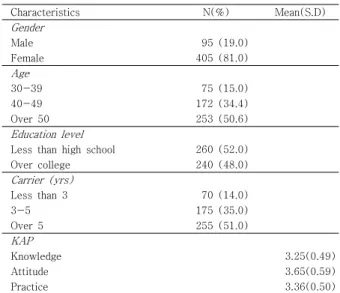
General characteristics of the study participants was shown in Table 1. Overall, male subjects are 19% and female ones are 81%. Among age variable, age is 30-39(15.0%), 40-49 (34.4%), and over 50 (50.6%) respectively. In educational level, the respondents have acquired a less than high school (52.0%) or over college (48.0%). The Carrier duration is less than 3 (14.0%), 3-5 (35.0%), and over 5yrs (51.0%). The overall mean of the knowledge score is 3.25, attitude 3.65, and practice 3.36.

Difference of knowledge, attitude and practice according to age, education, and carrier was presented in Table 2. There was a significant difference between the mean score for knowledge, practice and overall Knowledge, attitude and practice (KAP) in three aged groups:

“30-39”, “40-49”, and “over 50”. However, only the mean score of attitude in three aged groups was not significantly different (p >0.05), the aged 30-39 mean Knowledge, attitude and practice (KAP) score was 3.35±0.49 and that for 40-49 and Over 50 was 3.42± 0.47 and 3.49± 0.46 separately. The mean scores for Knowledge, attitude and practice (KAP) were higher for the aged over 50 compared to those for 30-39 and 40-49.

The overall Knowledge, attitude and practice (KAP) scores, knowledge, attitude, and practice were significantly (P < 0.05) affected by the education level, where the average scores increased with the level of education. This study was carried out to investigate the Knowledge, attitude and practice (KAP) regarding the prevention of food poisoning of employees in Korean hospital. The subjects’ knowledge,

attitude, and practic e (KAP) were evaluated on Likert-scale (5 point) and it was found out that the average point of knowledge was 3.25, attitude 3.65, and practice 3.36; the Knowledge, attitude and practice (KAP) score regarding to food poisoning prevention of the subjects were average. The research shows that scores on knowledge tended to be lower than the attitude and practice scores, and this characteristic is a common phenomenon in other research conducted from different groups of people as well[22-27].

However, several research[8-13] that were based on another group of handlers showed that the score on knowledge were the highest, followed by attitude and practice; for the college students, the knowledge score was the highest as well[2,15-16].

The subjects’ socioeconomic status (SES) and their scores on the Knowledge, attitude and practice (KAP) were compared and it was found out that the more elderly the subjects, the higher were the scores on the attitude and practice on food safety. Also the more education received, higher scores on knowledge, attitude, and practice were noted.

The research of the correlation of age and

Knowledge, attitude and practice (KAP) scores on

food handlers[7] as well as the research done on

college students[14] showed that the more elderly

the subjects, the Knowledge, attitude and

practice (KAP) scores were higher. However,

according to the Siow Oi Nee[14], the age of the

restaurant employees did not have any

significant effect on the Knowledge, attitude and

practice (KAP) scores, and also the college

student study[8,25] did not show any significant

correlation between the students’ age (or their

school year) and the Knowledge, attitude and

practice (KAP) food safety scores. Just like the

many other studies[7-9], the tendency of highly

educated people scoring high on the Knowledge,

attitude and practice (KAP) on this evaluation

has led to the conclusion that the level of

education has significant effect on the Knowledge,

(4)

Characteristics Knowledge p

a

Attitude p

a

Practice p

a

KAP p

a

Age

0.013** 0.087 0.011** 0.013**

30-39 3.18(0.53) 3.58(0.59) 3.30(0.49) 3.35(0.49)

40-49 3.26(0.52) 3.66(0.57) 3.33(0.44) 3.42(0.47)

Over 50 3.31(0.45) 3.71(0.60) 3.45(0.53) 3.49(0.46)

Education level

0.039** 0.048** 0.001** 0.014**

Less than high school 3.19(0.54) 3.61(0.58) 3.37(0.50) 3.41(0.51)

Over college 3.30(0.44) 3.69(0.60) 3.35(0.48) 3.45(0.42)

Carrier (yrs)

0.623 0.293 0.009** 0.334

Less than 3 3.23(0.50) 3.69(0.59) 3.25(0.47) 3.39(0.49)

3-5 3.25(0.49) 3.59(0.59) 3.39(0.49) 3.41(0.46)

Over 5 3.27(0.48) 3.67(0.59) 3.44(0.50) 3.46(0.47)

All values are shown as mean ± SD for continuous nonparametric variable, or n (%) for categorical variables.

a

Calculated by t test or ANOVA test.

**
Significant difference between the means ( p <0.05)

Table 2. Difference of knowledge, attitude and practice according to age, education, and carrier attitude and practice (KAP) scores.

Careers of food handlers, as shown in other study[8-13], have not significantly affected Knowledge, attitude and practice (KAP) scores. On the contrary, Siow Oi Nee[14] reported that the mean percentage score in Knowledge was significantly higher food handlers of carrier 6-10 years than those of carrier less than 1 year. Other studies carried out in Italy demonstrated that Careers of food handlers have significantly affected Knowledge, attitude and practice (KAP) scores[6-7]. According to this study, the subjects scored 3 out of 5 on the Knowledge, attitude and practice (KAP) evaluation which is about average. The Knowledge, attitude and practice (KAP) of the food handlers who handle food in the hospital is the main cause of the food poisoning.[2,11]. In order to prevent the food poisoning in hospitals, consistent education on food safety must be given to the food handlers so that they can make better scores on the Knowledge, attitude and practice (KAP). Several studies that[7,16,24] subjects who participated in the food safety education had higher scores than the ones who did not get the education; and other studies also assert the need of continuous education on food safety. Therefore, proper preventive education system to increase the Knowledge, attitude and practice (KAP) scores of food handlers regarding food safety must be developed, as well as the policy that ensures continuous preventive edu cation. Especially, since there is a high

correlation between food handlers’ age and education level with Knowledge, attitude and practice (KAP) scores of food safety prevention, education must vary depending on the characteristics of the individual food handlers. One limit of this study is that the evaluation on knowledge, attitude, and practice levels were based on self-reports of the subjects. There is a report that self-reports scales by the subjects on food safety did not match with the observed results. Thus, consistent preventive education must be provided to the food handlers in hospitals, and continuous study based on direct observation on food safety actions must be executed in the future.

Characteristics N(%) Mean(S.D)

Gender

Male 95 (19.0)

Female 405 (81.0)

Age

30-39 75 (15.0)

40-49 172 (34.4)

Over 50 253 (50.6)

Education level

Less than high school 260 (52.0)

Over college 240 (48.0)

Carrier (yrs)

Less than 3 70 (14.0)

3-5 175 (35.0)

Over 5 255 (51.0)

KAP

Knowledge 3.25(0.49)

Attitude 3.65(0.59)

Practice 3.36(0.50)

KAP: knowledge, attitude, and practice

Table 1. General characteristics

N=500

(5)

4. Conclusion

This study was carried out to evaluate the level of knowledge, attitude, and pract ice (KAP) regarding the food safety of food handlers inside Korean hospitals. Also, this was about whether the age, education, and jobs of the subjects had any impact on their Knowledge, attitude and practice (KAP). It turned out that food handlers within the Korean hospitals typically showed low level of knowledge compared to the attitude and practice. The more elderly subjects showed higher level of knowledge, practice, and Knowledge, attitude and practice (KAP) scores, while people with higher level of education scored better on the Knowledge, attitude and practice (KAP). In conclusion, Public health preventive education and program on food safety should be provided to the food handlers in order to increase the Knowledge, attitude and practice (KAP) scores of the food handlers and to minimize foodborne hazards in hospital. Even when important issues regarding food safety occur nationally, the government will effectively cope with the issue and establish a law that can reassure the people, which will strengthen the food safety management system and greatly increase the level of food safety of our people. This study could provide valuable information about the level of knowledge, attitude, and practice (KAP) in food safety of food handlers in Korean hospital. Further study should be done for more Knowledge, attitude and practice (KAP) studies on food poisoning in different target populations especially in hospital.

REFERENCES

[1] P. Seaman & A. Eves. (2006). The management of food safety—the role of food hygiene training in the UK service sector. International Journal of Hospitality Management, 25(2), 278-296.

[2] L. Sharif & T. Al-Malki. (2010). Knowledge, attitude

and practice of Taif University students on food poisoning. Food Control, 21(1), 55-60.

[3] I. F. Angelillo, M. R. Foresta, C. Scozzafava & & M.

Pavia. (2001). Consumers and foodborne diseases:

knowledge, attitudes and reported behavior in one region of Italy. International Journal of Food Microbiology, 64(1), 161-166.

[4] F. L. Bryan. (1988). Risks of practices, procedures and processes that lead to outbreaks of foodborne disease. Journal of Food Protection, 51(8), 663-673.

[5] L. Sharif, M. M. Obaidat, & M. Al-Dalalah. (2013). Food hygiene knowledge, attitudes and practices of the food handlers in the military hospitals. Food and Nutrition Sciences, 4(3), 245.

[6] C. Buccheri, C. Mammina, S. Giammanco, M.

Giammanco, M. La Guardia & A. (2010). Knowledge, attitudes and self-reported practices of food service staff in nursing homes and long-term care facilities.

Food Control, 21(10), 1367-1373.

[7] L. McIntyre, L. Vallaster, L. Wilcott, S. B. Henderson, &

T. Kosatsky. (2013). Evaluation of food safety knowledge, attitudes and self-reported hand washing practices in FOOD SAFE trained and untrained food handlers in British Columbia, Canada. Food Control, 30(1), 150-156.

[8] N. A. Abdul-Mutalib, M. F. Abdul-Rashid, S. Mustafa, S.

Amin-Nordin, R. A. Hamat & M. Osman. (2012).

Knowledge, attitude and practices regarding food hygiene and sanitation of food handlers in Kuala Pilah, Malaysia. Food Control, 27(2), 289-293.

[9] H. Zhang, L. Lu, J. Liang & Q. Huang (2015).

Knowledge, attitude and practices of food safety amongst food handlers in the coastal resort of Guangdong, China. Food Control, 47, 457-461 N. A.

Abdul-Mutalib,

[10] S. Mukherjee, T. K. Mondal, A. De, R. Misra & A. Pal.

(2018). Knowledge, attitude and practice of food hygiene among street food vendors near a tertiary care hospital in Kolkata, India. International. Journal Of Community Medicine And Public Health, 5(3), 1206-1211.

[11] C. Bou-Mitri, D. Mahmoud, G. N. El & M. A. Jaoude.

(2018). Food safety knowledge, attitudes and practices of food handlers in lebanese hospitals: A cross-sectional study. Food control, 94, 78-84.

[12] T. E. Gemeda, T. T. Asayehu, M. Abdisa & H. Fekadu.

(2018). Assessment of knowledge, attitude and practices of food handlers in nekemtereferral hospital, Wollega, Ethiopia. Journal of Nutritional Health & Food Engineering, 8(1), 87-92.

[13] R. Fariba, J. K. Gholamreza, N. Saharnaz, H. Ehsan &

Y. Masoud. (2018). Knowledge, attitude, and practice

among food handlers of semi-industrial catering: a

cross sectional study at one of the governmental

organization in Tehran. Journal of Environmental

(6)

Health Science and Engineering, 16(2), 249.

[14] T. M. Osaili, B A. Obeidat, D. O. A. Jamous & H. A.

Bawadi . (2011). Knowledge, attitude and practices regarding food hygiene and sanitation of food handlers in Kuala Pilah, Malaysia. Food Control, 22(2), 269-276.

[15] H. F. Hassan & H. Dimassi. (2014). Food safety and handling knowledge and practices of Lebanese university students. Food Control, 40, 127-133.

[16] L. Yarrow, V. M. Remig & M. M. Higgins. (2009). Food safety educational intervention positively influences college students' food safety attitudes, beliefs, knowledge, and self-reported practices. Journal of environmental health, 71(6), 30-35.

[17] N. Unklesbay, J. Sneed & R. Toma. (1998). College students’ attitudes, practices, and knowledge of food safety. Journal of Food Protection, 61(9), 1175-1180.

[18] C. C. Ferk, B. L. Calder & M. E. Camire. (2016).

Assessing the Food Safety Knowledge of Uni�versity of Maine Students. Journal of Food Science Education, 15, 14-22.

[19] X. Luo et al. (2019). Food safety related knowledge, attitudes, and practices (KAP) among the students from nursing, education and medical college in Chongqing, China. Food control, 95, 181-188.

[20] H. Rezaee et al. (2018). The impact of education on knowledge, attitude and practice about Food Poisoning in students of Shahid Sadoughi University of Medical Sciences, Yazd. Iran. Tolooebehdasht, 17(3), 39-51.

[20] K. J. DIPLOCK, J. A. DUBIN, S. T. LEATHERDALE, D.

HAMMOND, A. JONES-BITTON, & S. E. MAJOWICZ.

(2018) Observation of High School Students' Food Handling Behaviors: Do They Improve following a Food Safety Education Intervention?. Journal of Food Protection, 81(6), 917-925.

[22] E. Gomes-Neves, A. C. Araújo, E. Ramos & C.S.

Cardoso. (2007). Food handling: Comparative analysis of general knowledge and practice in three relevant groups in Portugal. Food Control, 18(6), 707-712.

[23] S. O. Nee & N. A. Sani. (2011). Assessment of knowledge, attitudes and practices (KAP) among food handlers at residential colleges and canteen regarding food safety. Sains Malaysiana, 40(4), 403-410.

[24] B. Tokuç, G. Ekuklu, U. Berberolu, E. Bilge & H.

Dedeler. (2009). Knowledge, attitudes and self-reported practices of food service staff regarding food hygiene in Edirne, Turkey. Food Control, 20(6), 565-568.

[25] I. F. Angelillo, N. M. Viggiani, R. M. Greco, D. Rito &

et al. (2010). HACCP and food hygiene in hospitals knowledge, attitudes, and practices of food-services staff in Calabria, Italy. Infection Control & Hospital Epidemiology, 22(6), 363-369.

[26] M. Bacs, A. Ersun & G. KıvanG. (2006). The evaluation of food hygiene knowledge, attitudes and practices of food handlers in food businesses in Turkey. Food Control, 17(4), 317-322.

[27] M. Jevšnik, V. Hlebec & P. Raspor. (2008). Food safety knowledge and practices among food handlers in Slovenia. Food Control, 19(12), 1107-1118.

[28] E. J. Green & P. L. Knechtges. (2015). Food safety knowledge and practices of young adults. Journal of environmental health, 77(10), 18-24.

[29] T. Lazou, M. Georgiadis, K. Pentieva, & A.

McKevitt,. (2012). Food safety knowledge and food-handling practices of Greek university students:

A questionnaire-based survey. Food Control, 28(2), 400-411.

[30] M. Tomaszewska, J. Trafialek, P. Suebpongsang & W.

Kolanowski. (2018). Food hygiene knowledge and practice of consumers in Poland and in Thailand-A survey. Food Control, 85, 76-84.

김 정 현(Junghyun Kim) [정회원]

· 2009년 8월 : 서울대학교 보건학과 (보건학석사)

· 2012년 2월 : 서울대학교 보건학과 (보건학박사수료)

· 관심분야 : 지역사회보건

· E-Mail : [email protected]

조 영 태(Youngtae Cho) [정회원]

· 1999년 5월 : University of Texas-Austin(사회학 석사)

· 2002년 8월 : University of Texas–

Austin(인구학 박사)

· 2002년 9월 ∼ 2004년 7월 : Utah State University 사회학과 조교수

· 2004년 8월 ∼ 현재 : 서울대학교 보 건대학원 교수

· 관심분야 : 인구와 미래사회, mHealth, 인구와 개발, 비즈 니스 인구학

· E-Mail : [email protected]

수치

Table  2.  Difference  of  knowledge,  attitude  and  practice  according  to  age,  education,  and  carrierattitude  and  practice  (KAP)  scores.

참조

관련 문서

'Special act on children's dietary life safety management' was explained, and the education curriculum included proper hand-washing for prevention of food poisoning,

Effects of ‘Dietary Education for Children’s Health UP’ on the Changes in Knowledge, Attitudes, and Practice of Nutrition and Food Safety in 5 th Grade Elementary School Students

SON, A Study on Nursing Students’ Knowledge, Attitude, Confidence in Performance and Practice in Safety Management, Unpublished master's dissertation,

Objectives : The study examined the correlation the between smoking and the actual smoking con- dition, knowledge, attitude and practice on the dental health of

Personal hygiene practice of children was significantly affected by gender, self hygiene evaluation and the knowledge level of food safety.. Providing more food

This study suggests that food safety education for foodservice workers should be conducted con- tinuously and repetitively, and the development of proper education materials

Key words: perception on foodborne illness prevention, personal hygiene practice, knowledge of foodborne illness, education of food safety and sanitation.. 식재료 비 절감,

performance of standard precaution for healthcare associated infection control and prevention in nursing students: focused on patient safety attitude,