Print ISSN: 2288-4637 / Online ISSN 2288-4645 doi:10.13106/jafeb.2020.vol7.no9.781
Psychological Capital, Personality Traits of Big-Five, Organizational Citizenship Behavior, and Task Performance: Testing Their Relationships
Udin UDIN
1, Ahyar YUNIAWAN
2Received: July 03, 2020 Revised: July 25, 2020 Accepted: August 10, 2020
Abstract
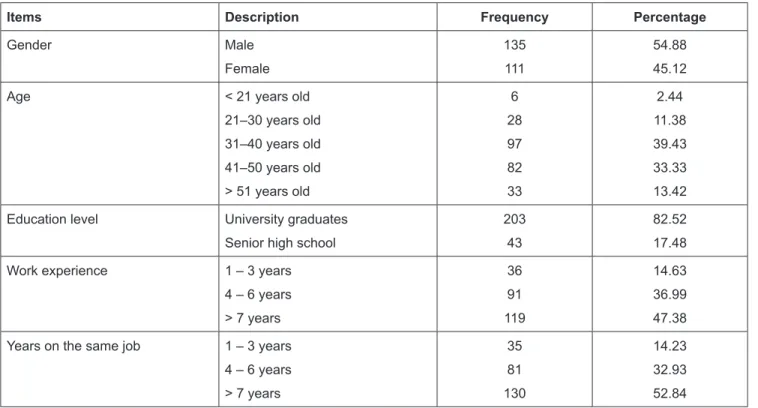
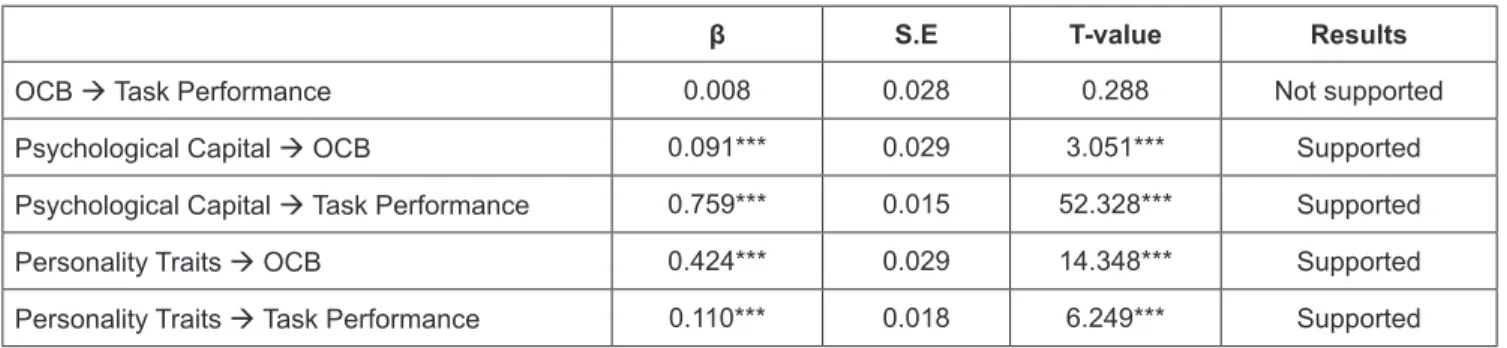
This study’s primary purpose is to explore the psychological capital roles and personality traits of Big-Five in predicting OCB (organizational citizenship behavior) and performance of task in Indonesia’s electricity sector. The data were gathered from the employees of four major cities in Indonesia, in Southeast Sulawesi, comprising 246 employees. The data were analyzed utilizing a PLS (partial least squares) based SEM (structural equation modeling) technique. The findings indicate that the psychological capital and personality traits of Big-Five relate significantly to OCB and the performance of task. Nevertheless, against our expectations, OCB does not significantly relate to the performance of task. This study also discusses the findings’ further implications. In terms of practical implications, the findings of this research stipulate that psychological capital and Big-Five personality traits aimed to improve employee performance and can be most effective if specifically targeted at OCB. Given that both variables play an important role to promote OCB, caring training initiatives that focus on mutual help can be very valuable for organizational improvement. In a managerial perspective, organizations can increase OCB by conducting open communication strategies between managers and employees to further stimulate and strengthen the ability of employees to display extra-role behaviors.
Keywords: Psychological Capital, Personality Traits, Big-Five, OCB, Performance of Task JEL Classification Code: D19, D22, D23
making and decide the organization’s survival (Buchko, Buscher, & Buchko, 2017). Employees are the power and energy source in the frictions, activities creation, and actions inside the organization. With no participation of the employees, the organization will not be able to increase the effectiveness, productivity, and efficiency in chasing the general goals (Buchko et al., 2017; Kang & Sung, 2017;
Poulsen & Ipsen, 2017). The employee-level participation inside the organization is highly controlled by the employee’s individual characteristics. The diverse employee characteristics would impact her/his behavior in completing the tasks. One characteristic that affected the behavior of each employee is the psychological capital, which could assist the employees to increase performance in the working environment (Karatepe & Talebzadeh, 2016; Kim et al., 2017; Tüzün, Çetin, & Basim, 2018).
The employee’s psychological capital investment is meant to improve his/her adequate competence to overcome the globalization challenges and develop citizenship of organization that, in turn, is directed to the effectiveness of the organization (Pradhan, Jena, & Bhattacharya, 2016).
Employees who are more positive psychologically would
1. Introduction
Immense technological and economic changes, development in culture, and globalization have impacted the organizational competition’s structure and intensity.
They have also influenced other sectors in Indonesia and particularly the electricity sector. In the developing economy, the organization should be skilled to retain and encourage greatly talented employees to keep a competitive edge.
Employees are an organization’s crucial element since those who start their formation have a vital part in decision-
1
First Author and Corresponding Author. Lecturer, Business and Economic Faculty, Universitas Muhammadiyah Yogyakarta, Indonesia [Postal Address: Jl. Brawijaya, Tamantirto, Kec. Kasihan, Yogyakarta, 55183, Indonesia] Email: [email protected]
2
Associate Professor, Business and Economic Faculty, Universitas Diponegoro, Semarang, Indonesia
© Copyright: The Author(s)
This is an Open Access article distributed under the terms of the Creative Commons Attribution Non-Commercial License (https://creativecommons.org/licenses/by-nc/4.0/) which permits unrestricted non-commercial use, distribution, and reproduction in any medium, provided the original work is properly cited.