• 검색 결과가 없습니다.

Advanced Forecasting Approach to Improve Uncertainty of Solar Irradiance Associated with Aerosol Direct Effects

N/A
N/A
Protected

Academic year: 2021

Share "Advanced Forecasting Approach to Improve Uncertainty of Solar Irradiance Associated with Aerosol Direct Effects"

Copied!
14
0
0

로드 중.... (전체 텍스트 보기)

전체 글

(1)

ORIGINAL ARTICLE

Advanced Forecasting Approach to Improve Uncertainty of Solar Irradiance Associated with Aerosol Direct Effects

Dong Hyeok Kim, Jung Woo Yoo

1)

, Hwa Woon Lee

1)*

, Soon Young Park

2)

, Hyun Goo Kim

3)

Seohaean Research Institute, ChungNam Institute, Hongseong 32258, Korea

1)

Department of Atmospheric Environment, Pusan National University, Busan 46241, Korea

2)

Institute of Environmental Studies, Pusan National University, Busan 46241, Korea

3)

New & Renewable Energy Resource Center, Korea Institute of Energy Research, Daejeon 34129, Korea

Abstract

Numerical Weather Prediction (NWP) models such as the Weather Research and Forecasting (WRF) model are essential for forecasting one-day-ahead solar irradiance. In order to evaluate the performance of the WRF in forecasting solar irradiance over the Korean Peninsula, we compared WRF prediction data from 2008 to 2010 corresponding to weather observation data (OBS) from the Korean Meteorological Administration (KMA). The WRF model showed poor performance at polluted regions such as Seoul and Suwon where the relative Root Mean Square Error (rRMSE) is over 30%. Predictions by the WRF model alone had a large amount of potential error because of the lack of actual aerosol radiative feedbacks. For the purpose of reducing this error induced by atmospheric particles, i.e., aerosols, the WRF model was coupled with the Community Multiscale Air Quality (CMAQ) model. The coupled system makes it possible to estimate the radiative feedbacks of aerosols on the solar irradiance. As a result, the solar irradiance estimated by the coupled system showed a strong dependence on both the aerosol spatial distributions and the associated optical properties. In the NF (No Feedback) case, which refers to the WRF-only stimulated system without aerosol feedbacks, the GHI was overestimated by 50–200 W m

-2

compared with OBS derived values at each site. In the YF (Yes Feedback) case, in contrast, which refers to the WRF–CMAQ two-way coupled system, the rRMSE was significantly improved by 3.1–3.7% at Suwon and Seoul where the Particulate Matter (PM) concentrations, specifically, those related to the PM

10

size fraction, were over 100 g m

-3

. Thus, the coupled system showed promise for acquiring more accurate solar irradiance forecasts.

Key words : Solar irradiance forecasting, Numerical Weather Prediction (NWP), WRF CMAQ two-way coupled system, Aerosol direct effect

1. Introduction 1)

Solar energy is an eco-friendly and renewable source that is rapidly being deployed around the globe (IEA, 2015). South Korea is planning to increase new and renewable energy supplies by 11%,

and out of this amount, 14% will be composed of solar energy by 2035 (Ministry of Trade, Industry, and Energy, 2014). Solar irradiance, which is the source for solar power generation, is highly dependent on weather conditions (e.g., the presence of clouds and fog) and atmospheric turbidities.

Received 18 October 2017; Revised 27 October, 2017;

Accepted 27 October, 2017

*
Corresponding author: Hwa Woon Lee, Department of Atmospheric Environment, Pusan National University, Busan 46241, Korea Phone : +82-51-510-2291

E-mail : [email protected]

ⓒ The Korean Environmental Sciences Society. All rights reserved.

This is an Open-Access article distributed under the terms of the Creative Commons Attribution Non-Commercial License (http://

creativecommons.org/licenses/by-nc/3.0) which permits unrestricted

non-commercial use, distribution, and reproduction in any medium,

provided the original work is properly cited.

(2)

Because of irregularities in the weather and air quality that could reduce the reliability of supplies from power systems and associated economic profits, it is important to forecast solar irradiance to make local power systems stable and thus enhance their resilience to weather-related and atmospheric fluctuations (Pelland et al., 2013).

Two types of methods can be used to forecast the solar irradiance, i.e., statistical approaches and Numerical Weather Prediction (NWP) models. The statistical approaches require techniques such as simple regression models (Martin et al., 2010), artificial neural network models (Cao and Cao, 2006), and simple tools to predict the movement patterns of clouds (Hammer et al., 1999; Perez et al., 2010), which may be based on both satellite-retrieved and ground-based cloud imagery; these techniques are typically used to estimate the downward solar flux reaching the ground. Typically, statistical approaches are suitable for short-term forecasts within a timeframe of 6 h (Diagne et al., 2013). However, 24-h forecasts or even longer ones are needed to obtain accurate estimations of power supplies for the next day, which are used in plans for the efficient distribution of energy throughout power networks (Mathiesen and Jan, 2011).

Forecasting solar irradiance with the use of NWP models involves either the direct use of data from Global Circulation Models (GCMs) or the utilization of results from Regional Climate Models (RCMs), which are dynamically downscaled from GCMs (Mathiesen and Jan, 2011; Lara-Fanego, 2012;

Diagne et al., 2013; Kim et al., 2014). A NWP model can create large prediction errors on cloudy days because the physics related to cloud formation, i.e., such processes are complicated and difficult to account for in those situations (Mathiesen and Jan, 2011; Lara-Fanego et al., 2012; Mathiesen et al., 2013). To overcome this source of error, satellite -retrieved cloud imagery data are usually assimilated

into the Weather Research and Forecasting (WRF) model (Mathiesen et al., 2013). Currently, there are a number of ongoing studies to improve the forecasting accuracy of solar irradiance by applying post-processing methods such as Kalman filtering (Lara-Fanego et al., 2012; Diagne et al., 2013) to the NWP results.

As solar radiation passes through the atmosphere, it becomes reduced by scattering, absorption, and reflection processes. During clear sky conditions, scattering and absorption occur because of the presence of trace gases, vapors, aerosols, and so forth in the atmosphere (Lacis and Hansen, 1974). Light scattering aerosols such as sulfate and nitrate directly cause large back scattering effects, and black carbon and soot reduce incoming solar radiation via absorption processes in the atmosphere (Chýlek et al., 1995; Solomon, 2007). In cases where smoke from forest fires is present, the NWP approach can cause critical errors in solar irradiance forecasting because it cannot account for the intermittent variations of aerosols (Ramanathan et al., 2001; Wong et al., 2012).

In South Korea, erratic atmospheric pollution may make it difficult to estimate accurate solar irradiance during NWP forecasting. Although atmospheric concentrations of many primary pollutants (e.g., carbon monoxide, sulfur oxides, nitrogen oxides) in South Korea have decreased in recent years because of new emission reduction policies, the concentrations of aerosols, ozone, and other secondary pollutants are still increasing. Furthermore, aerosols coming from China can also elevate atmospheric pollutant concentrations over South Korea throughout the year (Kim et al., 2011). Thus, radiative feedbacks of aerosols must be considered along with NWPs to enhance the performance of solar irradiance predictions.

This study aims to (1) evaluate the NWP model

performance for producing solar irradiance estimates

over the Korean Peninsula, and this was done by

comparing modeling results to observed data collected

by the Korean Meteorological Administration (KMA),

(3)

and (2) determine how much the variability and properties of aerosols will affect the solar irradiance estimates, especially in severely polluted areas. A coupled NWP Air Quality Model (AQM) system is introduced to quantify the radiative feedbacks of aerosols and improve the accuracy of solar irradiance predictions.

2. Methods

2.1. Numerical weather prediction model

The WRF version 3.4 model is the main system used for numerical simulations in this study. The WRF model, which was developed by the National Center for Atmospheric Research (NCAR) and the National Oceanic and Atmospheric Administration (NOAA)’s National Centers for Environmental Prediction (NCEP), is a three-dimensional mesoscale model that is in widespread use in many atmospheric research and other relevant applications. The Global Forecast System (GFS) is provided with lateral boundary fields in WRF. The GFS is a weather forecasting model that was created by the NCEP, and it is comprised of the following four sub-models:

atmosphere, ocean, earth/soil, and sea ice models.

The GFS data have a spatial resolution of 1° and a temporal resolution of 3 h ( http://www.emc.ncep.

oaa.ovGFSdoc.php) . For the topography data in WRF, Digital Elevation Model (DEM) data from the Shuttle Radar Topography Mission (SRTM) were used; these data have a horizontal resolution of 90 m.

The DEM data were originally produced by the National Aeronautics and Space Administration (NASA), and the data are distributed freely by the U.S. Geological Survey (USGS) (Farr et al., 2007).

Land cover data from the Environmental Geographic Information System (EGIS) with horizontal resolutions of 30 m were used in WRF, and these data were provided by Korea’s Ministry of Environment.

Physics in the WRF model comprise radiation,

microphysics, land surface, boundary layer, and cloud physics (NCAR, 2015). In this study, the Rapid Radiative Transfer Model for GCMs (RRTMG) was chosen as the radiation model. With this model, it is possible to compute the extinction process for shortwave radiation in the atmosphere caused by aerosols. In practice, 14 spectral bands were categorized to calculate all of the shortwave radiative flux, and the Aerosol Optical Depth (AOD), Single Scattering Albedo (SSA), and Asymmetry Factor (AF) were parameterized in each spectral band for five aerosol groups (Lacis and Hansen, 1974; Iacono et al., 2008).

Other options for the remaining physics processes are shown in Table 1.

2.2. Coupled system with the air quality model The RRTMG that can consider atmospheric radiative feedbacks of aerosols requires background concentration profiles for aerosols. The input conditions for aerosols used in radiation models can be determined either by data from the European Centre for Medium-Range Weather Forecasts (ECMWF) or by user specific datasets (NCAR, 2015). In the former, the monthly averaged profiles of aerosols are typically used;

hence, when short-term forecasts are performed, it is

difficult to capture intermittent aerosol variations in

the radiative calculations. Since the vertical and

horizontal distributions of aerosols can also be

changed by the diurnal boundary layer evolution and

by wind-driven advection (Yu et al., 2006), these

variations must be applied in WRF. This can be

accomplished by assimilating the concentration data

from satellites (Lara-Fanego et al., 2012) or by obtaining

real-time (online) data from AQMs (Ramanathan et

al., 2001; Chapman et al., 2009). In this study,

aerosol effects on solar irradiance forecasting were

applied by employing a WRF CMAQ coupled

system (where CMAQ is the Community Multiscale

Air Quality model, version 5.0.2); specifically,

results from the coupled system (Yes Feedback: YF)

(4)

Fig. 1. Procedure used for the WRF–CMAQ two-way coupled system. Circular boxes indicate the couplers between the WRF and CMAQ ( Wong et al., 2012) .

were compared to that from the control experiment (No Feedback: NF) where the WRF model was applied alone. The WRF CMAQ two-way coupled system was developed by the U.S. Environmental Protection Agency (EPA), and its performance has been verified with a forest fire case (Ramanathan et al., 2001). Fig. 1 shows the flow of the procedures used to implement the WRF CMAQ online coupled system. The CMAQ is a sub-model of the WRF model in this system. The AOD, SSA, and AF are introduced into the radiation model within WRF through a coupler based on the components of aerosols and the associated size distributions that were calculated by the CMAQ model. The CMAQ model requires emission data along with meteorological data as shown Fig. 1. For this study, the emission inventories were obtained from the Intercontinental Chemical Transport Experiment-Phase B (INTEX-B) at intervals of 0.5° in areas covering East Asia (Zhang et al., 2009).

2.3. Modeling periods and statistical metrics Solar irradiance predictions for the WRF-only simulated system were obtained for three years, specifically, from 2008 to 2010. For comparative purposes, solar irradiance predictions were also

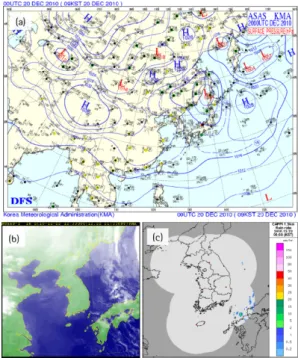
created with the WRF CMAQ two-way coupled system on December 20, 2010. On this cloudless day with no rainfall, a high-pressure area had settled over the Korean Peninsula and the atmosphere was stable, as shown in Fig. 2. However, concentrations of PM

10

Fig. 2. Surface weather map (a), MTSAT-2 infra-red cloud

image (b), and radar precipitation image (c) at 1200

LST on December 20, 2010.

(5)

Fig. 3. Average 24 h PM

10

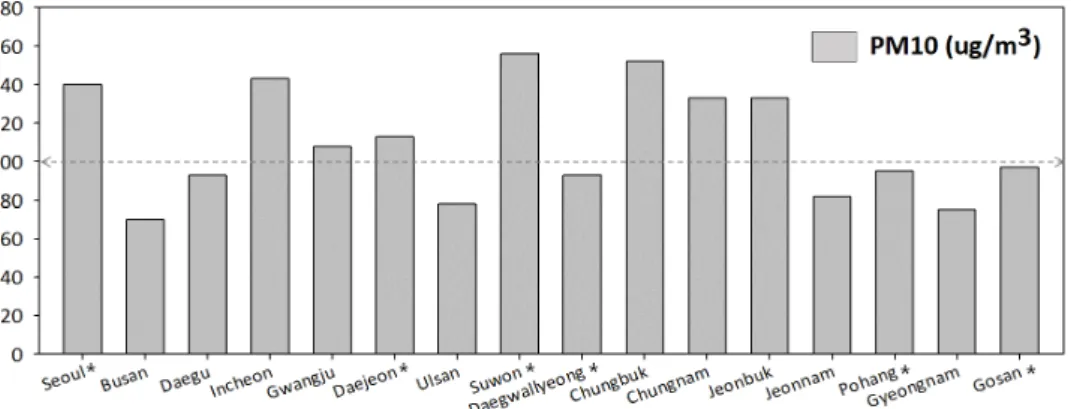
concentrations on December 20, 2012, at 18 sites over South Korea. The dashed line indicates the national standard, and the asterisk symbols (*) denote the representative sites used for the time series and statistical analyses in Section 3.

(where PM represents particulate matter) were high throughout the nation (Fig. 3). In Seoul, Gyeonggi including in Suwon, and other major cities, the PM

10

concentrations exceeded the 24 h standard of 100 mg m

-3

, and concentrations continued to increase by 25%

throughout the day compared to the day before. In mid-western areas of South Korea, sulfates, nitrates, and ammonium constituted up to 45.1% of the total aerosol amounts (Jeon et al., 2014). Because aerosols can have a large effect on the solar irradiance on such days, more deviations between the measurements and the predictions are to be expected. The modeled data were verified with the solar irradiance data collected at 22 weather stations for the same period from 2008 to 2010. The locations of the weather stations are depicted in Fig. 4 along with the accumulated solar irradiance. In order to quantify the performance of the WRF model and the WRF CMAQ coupled system, the relative Root Mean Square Error (rRMSE) is introduced. Since the rRMSE is normalized with the mean of observed irradiance at each site, this represents a more desirable way to compare the accuracy between two or more different sites; the relevant equation is as follows:

where and indicate the modeled and observed values at time , respectively.

3. Results

3.1. Evaluation of solar irradiance archived by the WRF system

Fig. 4 shows the spatial distributions of the annual solar irradiance that were obtained by the WRF predictions and the weather station data. WRF data were acquired over a 3-y period from 2008 to 2010, and weather station data were acquired over a 20-year period from 1991 to 2000 at 22 meteorological sites.

According to the WRF results in Fig. 4b, we can see that more solar irradiance occurred in the mid-eastern inland region (approximately 6000 MJ m

-2

). In contrast, less solar irradiance occurred along the east coast including in the region of the Taebaek Mountains where terrain-induced clouds appeared more frequently (Park and Lee, 2007). It should be noted that the WRF model results for solar irradiance in the mid-western areas including Seoul, Suwon, and Daejeon are clearly higher than the actual solar irradiance obtained from the weather station data.

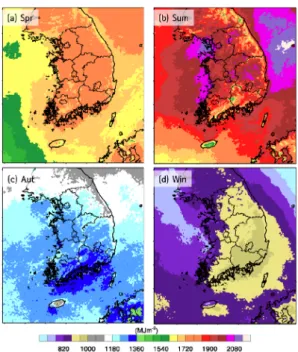
The seasonally accumulated solar irradiance from

the WRF model results is shown in Fig. 5. The

irradiance was much higher during the summer

season compared to the other seasons because of the

higher solar altitude and longer daytime lengths.

(6)

Fig. 4. Map of the annual solar irradiance over the Korean Peninsula from OBS (a) and WRF (b) data. OBS data were acquired over a 20-year period from 1991 to 2000 at 22 meteorological sites, and WRF data were acquired over a 3-y period from 2008 to 2010.

Fig. 5. Spatial distribution of accumulated solar irradiance for each season over the Korean Peninsula as computed from the WRF predictions. Spatial variability of the solar irradiance was largest during the summer season.

Conversely, the solar irradiance was substantially less during the wintertime because of the lower solar altitude and shorter daytime lengths. In particular, the spatial variability and gradient of solar irradiance were the largest in the summer season, which may have been due to unpredictable regional rainfall and topographically induced clouds.

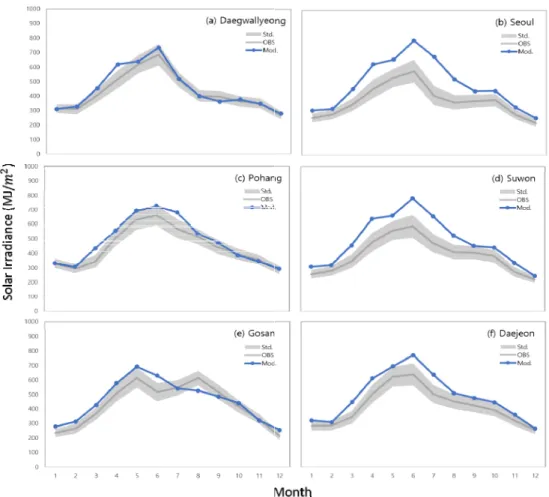
Fig. 6 shows the monthly variations of accumulated solar irradiance in the following six different regions:

Daegwallyeong, Gosan in Jeju Island, Pohang, Seoul,

Suwon, and Daejeon. Daegwallyeong, Jeju, and

Pohang (left panel in Fig. 6) represent relatively clean

sites, whereas Seoul, Suwon, and Daejeon (right

panel in Fig. 6) are considered to be polluted. The

clean regions were associated with small differences

in solar irradiance between the model results and

observations. However, in large cities such as Seoul,

Suwon, and Daejeon, the solar irradiance was

overestimated by the model results when compared to

the observation data; this tendency is also apparent in

(7)

Fig. 6. Monthly variations of the solar irradiance from the WRF model corresponding to six different sites. Left panels show data for the clean sites, and right panels show data for the polluted sites.

Fig. 4, where the annually accumulated amount of solar irradiance was overestimated in terms of the horizontal distribution. Thus, for regions with severe air pollution, prediction errors can be noticeable because of the scattering and absorption effects of aerosols (Ramanathan et al., 2001), and this can lead to overestimations in solar irradiance when NWP models are used. In addition, during the summer season (i.e., June, July, and August), the deviations became larger than those during the other seasons at those sites because the rainy season had set in, which resulted in larger model errors (Byun and Lee, 2007;

Mathiesen and Jan, 2011). However, Daegwallyeong,

Pohang, and Gosan, which have relatively clear atmospheric conditions, showed less error than that at the polluted regions regardless of the season. Importantly, it should be noted that predicted values at all polluted sites are largely biased unlike the values with small variances at clean sites.

The rRMSE for the data from all of the sampling sites is shown in Fig. 7. The percentage of rRMSE was the highest at 30% in Suwon and the lowest at 6% in Daegwallyeong. In the capital area including Suwon and Seoul, in particular, significant errors of more than 22% were found.

By comparing the results of the WRF model’s long

(8)

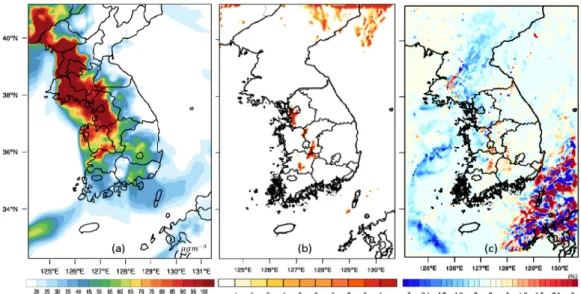
Fig. 8. Concentration of PM-10 (a), Cloud fraction (b) and reduction of relative humidity at 1200 LST on Dec 20, 2010 from YF experiment. A Reduction of relative humidity is clear by 3 % in mid-western inland areas (c).

Fig. 7. Relative Root Mean Square Error (rRMSE) at 22 meteorological sites. Red circles represent situations where the rRMSE was over 22%, and almost all such instances were located in the mid-western area.

-term predictions with observed data at representative sites, it is apparent that in large cities with severe air

pollution, predictions derived by the WRF model alone have a large amount of potential error because of the lack of actual aerosol radiative feedbacks.

3.2. Case study: improvement of solar irradiance forecasting by the WRF–CMAQ coupled system Fundamentally, when the radiative flux reaching the surface is simulated by the WRF model, aerosols in the atmosphere are not considered exactly, but scattering and adsorption processes caused by ozone and vapor are parameterized (Chýlek et al., 1995).

Because of these features, when the concentration of airborne dust in the atmosphere fluctuates, the prediction error increases. This study used a WRF CMAQ two-way coupled system to quantify aerosol direct effects on solar irradiance forecasting.

We analyzed the data that were obtained on

December 20, 2010, with the coupled model, as

mentioned in Section 2.3. Figs. 2 and 3 show that this

day had cloudless skies and that high concentrations

of PM

10

were present at the surface. The results for

concentrations of PM

10

, cloud fractions, and reductions

in the relative humidity for the YF experiment at

(9)

Fig. 9. Results for the Global Horizontal Irradiance (GHI), Direct Normal Irradiance (DNI), and Diffused Horizontal Irradiance (DHI) from the YF experiment. Lower panels shows the differences in GHI, DNI, and DIF between the YF and NF experiments (YF – NF). Negative values for GHI and DNI indicate a reduction in the value itself, which was caused by the employment of the coupled system.

12:00 LST are shown in Fig. 8. In the mid-western area, the concentration of PM

10

was predicted to be greater than 100 mg m

-3

(Fig. 8a), and no cloud fraction was apparent except for that in the southwestern

inland areas, as shown in Fig. 8b. These results

demonstrate that the air quality and meteorological

conditions are well simulated in the WRF CMAQ

two-way coupled system.

(10)

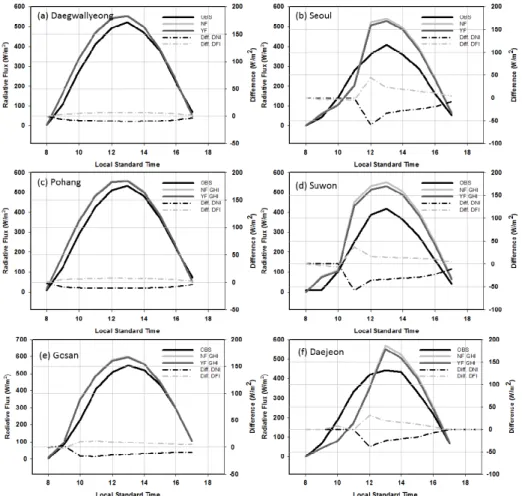
Fig. 10. One-day-ahead forecasts for the Global Horizontal Irradiance (GHI) determined with Observations (OBS) and absolute differences for the Direct Normal Irradiance (DNI) and Diffused Horizontal Irradiance (DHI) corresponding to six representative sites. Left and right panels show the results from clean and polluted sites, respectively.

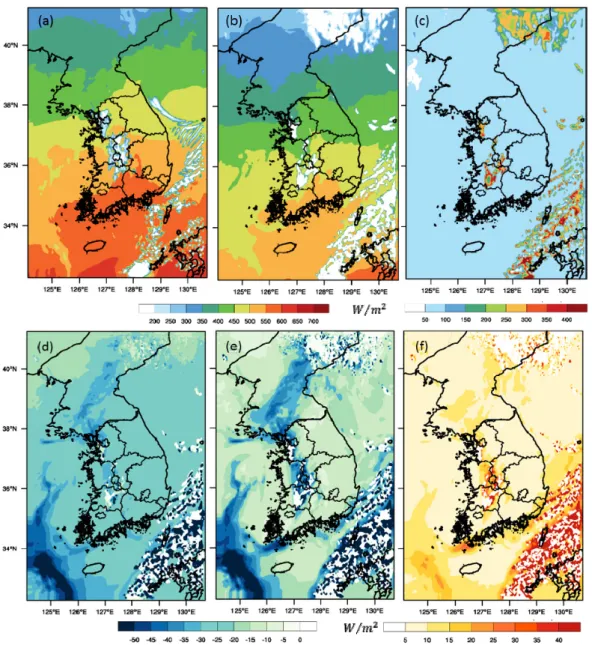
The upper panel in Fig. 9 shows the results for the Global Horizontal Irradiance (GHI), Direct Normal Irradiance (DNI), and Diffused Horizontal Irradiance (DHI) from the YF experiment (Figs. 9a, b, and c), and the lower panel shows the differences between the YF and NF experiments (Figs. 9d, e, and f), i.e., the spatial variation of GHI, DNI, and DHI due to the aerosol feedback in WRF. As shown in Figs. 9a and b, spatial distributions of GHI and DNI could be characterized in accordance with the latitude. The DHI increased significantly to over 200 W m

-2

in

central western areas where the concentration of

PM

10

was high (Fig. 8a). This indicates that the DHI

in clear weather conditions is influenced greatly by

the radiative effects of aerosols, which is illustrated

very well in the lower panel of Fig. 9f. In dry

atmospheric conditions, the diameters of sulfate

particles are expected to be small because the

diameter is proportional to the relative humidity

(Nemesure et al., 1995). This means that the particle

size of aerosols decreased as the relative humidity

was relatively low, as shown in Fig. 8c. In the central

(11)

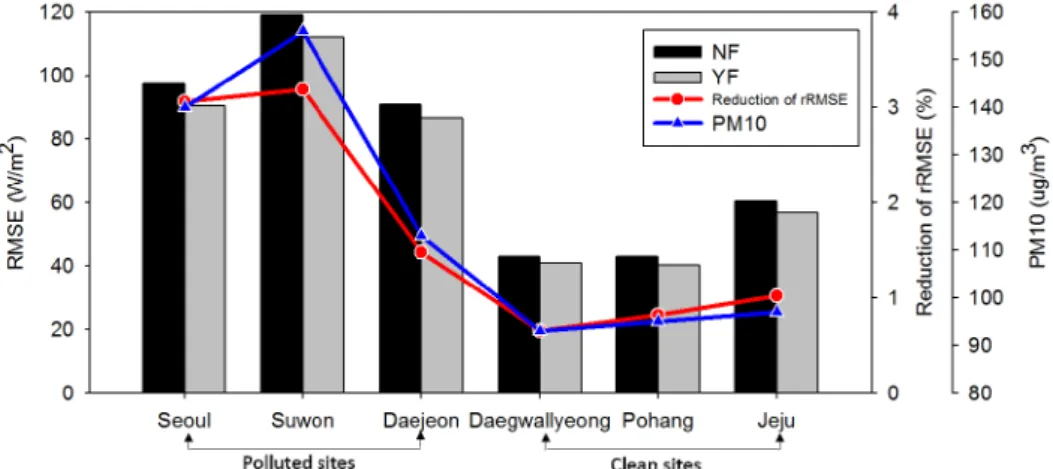
Fig. 11. Reductions in the relative Root Mean Square Error (rRMSE) along with concentrations of PM

10

at six representative sites. Bar charts show the RMSE for the NF and YF experiments at each site.

western area, the reduction of GHI was as low as 5-10 W m

-2

(Fig. 9d). In this area, the DNI decreased while the DHI increased, which brought about slight reductions in the GHI. According to Mie scattering (Penner, 2001), decreases in the diameter of aerosol particles will cause the DHI to increase. Since sulfates and nitrates were the main contributors to the aerosol composition (as described in Section 2.2) and the relative humidity was relatively low (as shown in Fig. 8c), allowing for large radiative indices;

additionally, forward scattering was dominant in the atmosphere. However, in the case of large forest fires, aerosols like black carbon can have large absorption effects, which will cause a large reduction in the incoming solar radiation (Penner et al., 2001;

Ramanathan et al., 2001). No change of DNI and DHI in inland areas was revealed because of clouds induced by orographic effects, as shown in Fig. 8b.

Although a day with cloudless skies was chosen for the consideration of aerosol feedbacks in this study (Fig. 2), locally formed clouds may have caused the critical prediction errors in the central mountainous area.

One-day-ahead forecasts of solar irradiance in the six regions as discussed in the previous section are

shown in Fig. 10. In Seoul, Suwon, and Daejeon (right panel in Fig. 10), quite overestimations of GHI were detected at the polluted sites (right panel) from 11:00 LST up to 16:00 LST, which means that aerosol direct effect in the atmosphere led to a large amount of GHI extinctions. Here, it is important to note that the NF experiment cannot estimate this effect. This should be clear by viewing the amount of DNI and DHI differences (i.e. dashed-dot lines in Fig.

10) between the YF and NF experiments. For example, rather large reductions of DNI and corresponding increments in DHI along with the associated negative budget for these values at the polluted sites brought about a significant reduction of GHI in the YF experiment. However, perturbations of DNI and DHI at clean sites (left panel in Fig. 10) were small, which did not create any reductions of GHI in the YF experiment.

The improvements to the forecasting accuracy for solar irradiance by the advanced system, as illustrated by the YF experiment results compared to the NF experiment results at six sites along with the concentrations of PM

10

, are quantified in Fig. 11.

Here, it is important to note that the reduction of

rRMSE at each site was fully correlated with the

(12)

concentration of PM

10

. Suwon had the highest PM

10

concentrations and the largest reductions of rRMSE, whereas the lowest PM

10

concentrations and the smallest reductions of rRMSE occurred at Daegwallyeon. By taking aerosol feedbacks into consideration, the YF experimental results indicate that Suwon was associated with an error reduction ratio of approximately 3.7%. Thus, the coupled system improved the forecasting accuracy of solar irradiance under highly polluted and cloudless weather conditions.

4. Concluding remarks

The purpose of this study was to evaluate the forecasting system for solar irradiance based on an NWP model over the Korean Peninsula, and modeled data were compared with measured data to identify sources of uncertainties in the system. First, long-term predictions for the Korean Peninsula from 2008 to 2010 were obtained by using the WRF model, and the dataset showed high solar irradiance values in the southeastern inland area. Seasonally, the solar irradiance was higher during summer and lower during winter because of the changes in the solar altitude, duration of daylight hours, and weather conditions. Regionally, the model results for the mid-western areas including Seoul and Suwon, where air pollution is severe, yielded overestimations of the solar irradiance, as indicated by comparisons with observation data from weather stations. This was because the WRF model does not directly take into account the extinction of solar irradiance caused by fluctuations of aerosols in the lower atmosphere. Thus, we decided to use a WRF CMAQ two-way coupled system to consider aerosol feedbacks when estimating the solar irradiance.

Although the WRF CMAQ model was recently developed and verified through forest fire tests, no studies have implemented this system for predicting solar irradiance. The experiment was conducted on

December 20, 2010, which is when the concentration of PM

10

was high throughout the urban areas. As a result, reductions in solar irradiance occurred in the mid-western inland areas where the PM

10

concentration was particularly high. By using the WRF CMAQ two-way coupled system, which reflects aerosol feedback, the prediction accuracy increased up to approximately 3.7%, which suggests that this model will be useful for solar irradiance predictions and solar energy planning.

Aerosols in the lower atmosphere caused the DNI to decrease and the DHI to increase, while slight decreases in the GHI were detected. However, earlier studies have shown that depending on the components of aerosols, the effects on the atmosphere, such as via the temperature, boundary layer, and cloud condensation nuclei (CCN), can be varied (Solomon, 2007). Moreover, the WRF CMAQ coupled system currently reflects only the direct effects such as scattering and absorption and fails to reflect the indirect effects like those from CCN and instabilities caused by temperature reductions in the upper parts of clouds.

Nevertheless, since we chose a clear, cloudless day for the experiment, we have concluded that the direct effects were enough to evaluate the extent to which solar irradiance can be affected. Although a cloudless day was chosen, the appearance of local clouds in some regions in the mountainous inland areas of South Korea caused the WRF model results to show prediction errors. Thus, we recommend that corrections be made in future studies to lower the prediction errors caused by clouds.

Acknowledgements

This research was supported by Policy Support

Task of ChungNam Institute and supported by Basic

Science Research Program through the National

Research Foundation of Korea (NRF: 2014R1A6A

3A01059648).

(13)

REFERENCES

Byun, H. R., Lee, D. K., 2002, Defining three rainy seasons and the hydrological summer monsoon in Korea using available water resources index, Korean Journal of Atmospheric Sciences, 2, 80(1), 33-44.

Cao, J. C., Cao, S. H., 2006, Study of forecasting solar irradiance using neural networks with preprocessing sample data by wavelet analysis, Energy, 31, 3435-3445.

Chapman, E. G., Gustafson, Jr. W. I., Easter, R. C., Barnard, J. C., Ghan, S. J., Pekour, M. S., Fast, J. D., 2009, Coupling aerosol-cloud-radiative processes in the WRF-Chem model: Investigating the radiative impact of elevated point sources, Atmospheric Chemistry and Physics, 9(3), 945-964.

Chýlek, P., Videen, G., Ngo, D., Pinnick, R. G., Klett, J.

D., 1995, Effect of black carbon on the optical properties and climate forcing of sulfate aerosols, Journal of Geophysical Research: Atmospheres (1984 -2012), 100(D8), 16325-16332.

Diagne, M., David, M., Lauret, P., Boland, J., Schmutz, N., 2013, Review of solar irradiance forecasting methods and a proposition for small-scale insular grids, Renewable and Sustainable Energy Reviews, 27, 65-76.

Farr, T. G., Rosen, P. A., Caro, E., Crippen, R., Duren, R., Hensley, S., Alsdorf, D., 2007, The shuttle radar topography mission, Reviews of Geophysics, 45(2).

Hammer, A., Heinemann, D., Lorenz, E., Lückehe, B., 1999, Short-term forecasting of solar radiation: A Statistical approach using satellite data, Solar Energy, 67(1), 139-150.

Iacono, M. J., Delamere, J. S., Mlawer, E. J., Shephard, M.

W., Clough, S. A., Collins, W. D., 2008, Radiative forcing by long lived greenhouse gases: Calculations with the AER radiative transfer models, Journal of Geophysical Research: Atmospheres (1984-2012), 113(D13).

IEA, 2015, Medium-term renewable energy market report 2015: Market analysis and forecasts to 2020, OECD/IEA, Paris, France.

Jeon, W. B., Lee, H. W., Lee, S. H., Park, J. H., Kim, H. G., 2014, Numerical study on the characteristics of high PM

2. 5

episodes in Anmyeondo area in 2009, Journal of

Environmental Science International, 23(2), 249-259.

Kim, D. H., Lee, H. W., Park, S. Y., Yu, J. W., Park, C., Park, J. H., 2014, Correction of surface characteristics to diagnostic wind modeling and its impact on potentials of wind power density, Journal of Renewable and Sustainable Energy, 6(4), 042012.

Kim, N. K., Kim, Y. Y., Kang, C. H., 2011, Long-term trend of aerosol composition and direct radiative forcing due to aerosols over Gosan: TSP, PM

10

, and PM

2.5

data between 1992 and 2008, Atmospheric Environment, 45(34), 6107-6115.

Lacis, A. A., Hansen, J., 1974, A Parameterization for the absorption of solar radiation in the earth's atmosphere, Journal of the Atmospheric Sciences, 31(1), 118-133.

Lara-Fanego, V., Ruiz-Arias, J. A., Pozo-Vázquez, D., Santos-Alamillos, F. J., Tovar-Pescador, J., 2012, Evaluation of the WRF model solar irradiance forecasts in Andalusia (southern Spain), Solar Energy, 86(8), 2200-2217.

Martín, L., Zarzalejo, L. F., Polo, J., Navarro, A., Marchante, R., Cony, M., 2010, Prediction of global solar irradiance based on time series analysis:

Application to solar thermal power plants energy production planning, Solar Energy, 84(10), 1772- 1781.

Mathiesen, P., Collier, C., Kleissl, J., 2013. A High-resolution, cloud-assimilating numerical weather prediction model for solar irradiance forecasting, Solar Energy, 92, 47-61.

Mathiesen, P., Jan, K., 2011, Evaluation of numerical weather prediction for intra-day solar forecasting in the continental United States, Solar Energy, 85(5), 967-977.

Ministry of Trade, Industry and Energy, 2014, Fourth basic plan for technology development, Application and Development of New & Renewable Energy (2014-2015), Seoul, Korea, 20.

NCAR, 2015. ARW version 3 modeling system user’s guide.

Nemesure, S., Wagener, R., Schwartz, S. E., 1995, Direct shortwave forcing of climate by the anthropogenic sulfate aerosol: Sensitivity to particle size, composition, and relative humidity, Journal of Geophysical Research-all Series, 100, 26-105.

Park, S. K., Lee, E., 2007, Synoptic features of

(14)

orographically enhanced heavy rainfall on the east coast of Korea associated with Typhoon Rusa (2002), Geophysical Research Letters, 34(2).

Pelland, S., Remund, J., Kleissl, J., Oozeki, T., De Brabandere, K., 2013, Photovoltaic and solar forecasting: State of the art, IEA PVPS, Task 14.

Penner, J. E., Andreae, M. O., Annegarn, H., Barrie, L., Feichter, J., Hegg, D., Pitari, G., 2001, Aerosols, their direct and indirect effects, In climate change 2001: The scientific basis, Contribution of Working Group I to the Third Assessment Report of the Intergovernmental Panel on Climate Change, Cambridge University Press, 289-348.

Perez, R., Kivalov, S., Schlemmer, J., Hemker, K., Renne´, D., Hoff, T. E., 2010, Validation of short and medium term operational solar radiation forecasts in the US, Solar Energy, 84(12), 2161-2172.

Ramanathan, V., Crutzen, P. J., Kiehl, J. T., Rosenfeld, D., 2001, Aerosols, climate, and the hydrological cycle, Science, 294(5549), 2119-2124.

Solomon, S. (Ed.), 2007, Climate change 2007-the

physical science basis, Working Group I Contribution to the Fourth Assessment Report of the IPCC, 4, Cambridge University Press.

Wong, D. C., Pleim, J., Mathur, R., Binkowski, F., Otte, T., Gilliam, R., Kang, D., 2012, WRF-CMAQ two-way coupled system with aerosol feedback: Software development and preliminary results, Geoscientific Model Development, 5(2), 299-312.

Yu, H., Kaufman, Y. J., Chin, M., Feingold, G., Remer, L.

A., Anderson, T. L., Balkanski, Y., Bellouin, N., Boucher, O., Christopher, S., DeCola, P., Kahn, R., Koch, D., Loeb, N., Reddy, M. S., Schulz, M., Takemura, T., Zhou, M., 2006, A Review of measurement-based assessments of the aerosol direct radiative effect and forcing, Atmos. Chem. Phys., 6, 613-666.

Zhang, Q., Streets, D. G., Carmichael, G. R., He, K. B.,

Huo, H., Kannari, A., Yao, Z. L., 2009, Asian

emissions in 2006 for the NASA INTEX-B mission,

Atmospheric Chemistry and Physics, 9(14), 5131-

5153.

수치

Fig. 2. Surface weather map (a), MTSAT-2 infra-red cloud  image (b), and radar precipitation image (c) at 1200  LST on December 20, 2010.
Fig. 3. Average 24 h PM 10  concentrations on December 20, 2012, at 18 sites over South Korea
Fig.  5. Spatial distribution  of accumulated  solar  irradiance  for each season over the Korean Peninsula as computed  from the WRF predictions
Fig. 6. Monthly variations of the solar irradiance from the WRF model corresponding to six different sites
+5

참조

관련 문서

It is expected to be used for forecasting and analysis of precipitation structure and characteristics of mesoscale system causing heavy rainfall using the

Table 4.1 Efficiency parameters in the flat plate solar collector using MWCNT nanofluid and water ··· 40.. Table 4.2 Efficiency parameters in the evacuated tube solar

In this study, thermal efficiency of a flat-plate solar collector and a U-tube solar collector using a CuO nanofluid and water as a working fluid was investigated according to

The data are corrected for temperature error due to solar radiation and the effect of low temperature on the anerod capsule and curvature of the surface of

In SCP, a solar collector field is con- nected to a conventional distillation plant to provide thermal energy for the desalination process because fossil fuel is not

효율적인 태양광 발전을 위해 필요한 조건들을 생 각해보자..

Green (University of New South Wales), and Reuben Collins (Colorado School of Mines) MRS Bulletin (2008)... World

Solar energy generator Frame setting for Solar PV Install Hydropower generator. The village with lights Installed