Print ISSN: 2288-4637 / Online ISSN 2288-4645 doi:10.13106/jafeb.2021.vol8.no3.0705
Impact of Administrative Post and Gender on Lecturers’ Research Motivation in Vietnam*
Thi Kim Nhung TRAN
1, Thanh Do NGUYEN
2, Thanh Van PHAM
3, Thi Lien Huong NGUYEN
4, Minh Duc GIANG
5, Ngoc Thang HA
6Received: November 20, 2020 Revised: January 26, 2021 Accepted: February 03, 2021
Abstract
This study examines the simultaneous impact of gender and administrative post on the research motivation of university lecturers. There are 475 selected questionnaires that are qualified for data processing and the collected data are analyzed by two-way analysis of variance (ANOVA). The results show the relationship between administration involvement and scientific research of lecturers. In general, lecturers with administrative post have higher research motivation than lecturers without administrative post. More specifically, the level of administrative post has positive correlation with research motivation of female lecturers, but has negative correlation of male lecturers. It means that a female lecturer with higher administrative post also has more motivation to conduct research. Conversely, the higher administrative post a male lecturer has, the less research motivation he is. The cause of this difference is the pressure of earning money on Asian men, including Vietnamese men, who are considered to be main breadwinners of their family. When having an administration post, the more chances male lecturers have to earn money, the less time they can spend for scientific research. This suggests that the solution for managers is to perform annual assessment, fulfill promotion process, build up motivation and reward system, and establish recruitment and promotion policies.
Keywords: Motivation, Expectancy Theory, Administrative Post, Gender, Lecturers, Faculty Members JEL Classification Code: J23, M10, M12, M19
1. Introduction
Lecturers play an important role in improving the quality of higher education (Hung & Tuan, 2020). World university
*Acknowledgments:
This research is funded by National Economics University, Hanoi, Vietnam.
1
First Author and Corresponding Author. National Economics University, Hanoi, Vietnam [Postal Address: No. 207 Giai Phong Street, Dong Tam Ward, Hai Ba Trung District, Hanoi, 10000, Vietnam] Email: [email protected]
2
Professor, Former Vice Rector, National Economics University, Vietnam. Email: [email protected]
3
Lecturer, National Economics University, Vietnam.
Email: [email protected]
4
Lecturer, National Economics University, Vietnam.
Email: [email protected]
5
Ph.D. Student, National Economics University, Vietnam.
Email: [email protected]
6
Lecturer, National Economics University, Vietnam.
Email: [email protected]
© Copyright: The Author(s)
This is an Open Access article distributed under the terms of the Creative Commons Attribution Non-Commercial License (https://creativecommons.org/licenses/by-nc/4.0/) which permits unrestricted non-commercial use, distribution, and reproduction in any medium, provided the original work is properly cited.
rankings are based on the index of curriculum quality and academic activities of faculty members and students (Hu & Gill, 2000). As the competition among universities is getting higher, research is becoming increasingly important.
Because scholarly activities and research productivity are used to measure the success of universities, it is becoming an increasingly important issue for universities to motivate faculty to be more productive in doing research. The rewards that a lecturer receives (i.e., finance, promotion and prestige, respect, etc.) relate quite closely to their research efforts (Chen, Gupta, & Hoshower, 2006).
Previous studies demonstrated that there is a positive correlation between research productivity and research motivation (Duc, Pham, Bui, Vu, & Nguyen, 2020; Chen, Gupta, & Hoshower, 2006; Tien, 2000). Specifically, those express a higher level of total motivation achieving better research performance. Therefore, the limitation of research activities is due to the lack of research motivation of lecturers.
There are two research streams in the faculty research
motivation. In the first stream, researchers examine personal
and institutional factors that impact the research productivity
of faculty members (Buchheit & Collins, 2001; Hu & Gill, 2000). According to these studies, personal characteristics such as ability, qualities, curiosity, and work attitude certainly have influences, but there are still other characteristics that may be important factors to academic achievement. In the second streams, studies have examined the changes of personal goals at different career stages (Englebrecht, Iyer,
& Patterson, 1994; Read & Raghunandan, 1998). Studies have found that publication requirements for promotions and tenure have changed before and after receiving rewards.
Tien (2000) has found that there is a difference in faculty’s motivation of doing research at different times in his career, namely, before and after being promoted. According to Hu and Gill (2000), research productivity rises sharply in the first stages of a career, peeks at the time of tenure, and then begins to decline. The author could not find any previous studies that showed the impact of administrative posts on publication requirements. In addition, a few studies, which analyze gender differences, like Chen and Zhao (2013), have found gender differences in the faculty motivation of doing research. These studies’ results show that male and female lecturers are motivated by different research rewards at different stages of their careers. Female lecturers are more motivated to do research than male and female lecturers also have higher internal motivation.
In developed countries, administration and research are two separated tasks; therefore, researchers tend to pay attention to conducting research, while managers focus on their administration tasks. However, in developing countries with weak science like Vietnam, administration tasks are not separated from doing research. One of the main goals of doing research is to be promoted to higher administrative posts. In another hand, Eastern cultures (typically Vietnam) consider man as the breadwinner in the family (Brickell, 2013). This consideration has created pressure on men to earn money whenever they have chances, like holding an administration post. This also creates the differences among administrators and researchers. Therefore, this study continues to follow the second research stream, which means changes in personal goals would be considered at different career stages, with and without administration post.
2. Literature Review and Research Framework
2.1. Motivation of the Study
Human motivation theories have been researched from the perspective of psychology and behavioral sciences.
Different researchers and psychologists have provided various definitions of this term. Motivation is considered as an inner state of mind that makes a person behave in a certain way to achieve settled goals (Iwu-James, 2011). Motivation
is something, which forces a person to act, a reason of behavior. Lockwood, Marshall, and Sadler (2005) define motivation as internal and external forces within a person that cause him or her to behave in a specific, goal-directed manner. In the sense of the process, research motivation of lecturers is the process in which a lecturer is stimulated, oriented, strengthened, and persistent in doing research (Venkatesh & Sharma, 2015; Mitchell, 1997).
Lecturers’ research is any academic research, which is carried out by lecturers to contribute new knowledge about rules, phenomena (Creswell, 1986; Lertputtarak, 2008).
Defined by Lertputtarak (2008), lecturers’ research includes any academic activity that academic lecturers perform when they conduct a research, such as identifying research problems, conducting literature review, collecting data, analyzing data or writing research reports.
The majority of studies about lecturers’ motivation for doing research consider the influence of internal and external factors on research motivation (Bailey, 1999; Chen, Gupta
&, Hoshower, 2006; Hu & Gill, 2000). According to Hu and Gill (2000), research productivity rises sharply in the first stages of a career, peeks at the time of tenure, and then begins to decline. They also point out that research productivity before tenure is influenced by external factors, while research productivity after tenure is enhanced by internal factors. In his study, Chen and Zhao (2013) also mention achievement motivation along with external motivation and internal motivation. Achievement motivation can be defined as the need for success or excellent performance. Individuals will satisfy their needs through different means, and they are driven to succeed for various reasons, including both internal and external reasons. Based on achieving success and ambitions in life, achievement motivation represents a desire to demonstrate competence, and this motivation can affect the way a person performs a task (Harackiewicz, Barron, Carter, Lehto, & Elliot, 1997). Some studies about the transformation between external and internal motivation, namely, Ryan’s study (2014) and Blackmore and Kandiko (2011), find other factors concerning the research context.
It is possible that research context will impact changes in personal needs in general and the need for success in particular (Achievement Motivation).
2.2. Hypotheses
There are many theoretical frameworks that are used to explain faculty’s doing research. Some striking studies by Chen, Gupta, and Hoshower (2006); Tien (2000);
Lertputtarak (2006) use Vroom’s Expectancy Theory as
the basic theory. While other theories focus on explaining
external and internal motivational factors, Expectation
Theory can explain these factors in more detail. Vroom’s
Expectancy Theory is explained by the equation:
V
kI
kM = E. k n =1 (V
k I
k ) In developed countries, administration and research are two separated tasks; therefore, researchers tend to pay attention to conducting research, while managers focus on M means Motivation Force (motivation for conducting
behaviors)
E means “Expectancy”. “Expectancy” is defined by Vroom (1964, p.20) as a temporary belief related to the possibility that a given behavior is going to match up with or lead to a specific outcome. This relates to an individual’s perception that his or her effort is positively correlated with the good performance. If you increase your efforts, will your work results increase or not?
means “Valence”. Vroom (1964, p.17) defines
“Valence” as referring to “the interest and importance or the value a person places on a “k” reward”. A reward has low or no value if that person does not wish to receive the reward and vice versa.
means “Instrumentality”. Instrumentality is the perception that a given level of performance is related to a
“k” outcome. Vroom (1964, p.22) argues that “a means of expressing an individual’s perception of the possibility that his performance will give him a commensurate reward”.
k is the k
threward, k runs from 1 to n, which means an unlimited number of rewards. This unlimited number of rewards has also been tested in some studies; k includes external and internal rewards.
However, as the expected component E has low predictability, some previous studies, such as Tien (2000), Chen, Gupta, and Hoshower (2006) multiple the reward value (V ) with the ability to receive a reward (I ) to have
their administration tasks. However, in developing countries with weak science like Vietnam, a person could not afford the living expenses of his family and himself if he only focuses on researching. As a result, he has to research and earn money at the same time. Studies in developed countries like Taiwan show that administration post is the lowest goal of lecturers when conducting research. While in Vietnam, Nguyen, Klopper, and Smith (2016) shows that promotion in career is a factor that promotes research productivity. In fact, the majority of Vietnamese lecturers start their maturity stage of research while they start to be an administrator. This provides a good condition for lecturers to be more active in research. Other studies suggest that confidence positively affects research productivity and motivation (Bailey, 1999; Vasil, 1993). According to Bailey (1999), the higher self-confidence will help individuals persevere and persist with tasks that are more difficult and challenging. Vasil (1993) suggested that this personal confidence increases with lecturers’research experience and qualifications. On the other hand, lecturers with administration post also have higher academic goals (like professor and vice professor), so they can continue achieve higher administration positions, due to the current mechanism in Vietnam universities. Therefore, in the context of Vietnam, while the publication of international research is relatively new, administration post is determined to have strong impact on research motivation of lecturers.
Therefore, we propose the following research hypotheses:
k k
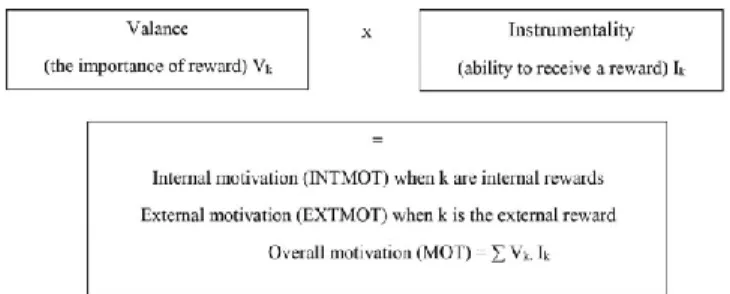
extrinsic motivation (EXTMOT) and intrinsic motivation (INTMOT). Therefore, the overall research motivation (MOT) is equal to the sum of EXTMOT and INTMOT (Figure 1).
Our first goal is to examine the different impacts of administration post to overall motivation, internal motivation and external motivation. In Vietnam, holding an administration post is a need that many lecturers care about.
Chen and Zhao (2013) mention administration post as an external factor that has very limited impacts on research motivation of Taiwan lecturers.
Figure 1: The Extended Expectancy Theory
H1: The overall research motivation of lecturers with an administration post is higher than lecturers without an administration post.
H1a: The internal research motivation of lecturers with an administration post is higher than lecturers without an administration post.
H1b: The external research motivation of lecturers with an administration post is higher than lecturers without an administration post.
Tien (2000) finds that there is a difference in faculty’s motivation of doing research at different times in lecturers’
career, namely, before and after being promoted. In Chen and Zhao (2013), the time leading to the difference in research motivation is before and after tenure. This study’s results show that male and female lecturers are motivated by different research rewards at different stages of their career. Female lecturers are more motivated to do research than male; and they also have higher internal motivation.
Thus, there is a particularly profound gender difference
among the male and female faculty after tenure. Female
lecturers find internal research rewards more attractive and
k k
more important than male. Following this research direction, besides clarifying the difference in research motivation of faculty with and without administrative post, we set out the second goal: examining if the interaction between gender and administrative post of lecturers affects their research motivation or not.
Many young lecturers have to face many obstacles from their family, like childcare and living expense cost at the beginning of their career, when they don’t have an administration post. However, at later stages of their career, these obstacles are removed. In addition, female lecturers, who have administration post, also receive the support from their family. This support, combining with their personal effort and strong will, has promoted their research productivity (Nguyen, 2013). Together with changes in gender roles, new family models have expanded the economical role of women and encouraged man to get involved more in family tasks, like childcare (Oláh, Kotowska, & Richter, 2018).
In developing countries like Vietnam, man is considered to be the breadwinner of the family, which also brings them high pressure of earning money. Vietnamese has the phrase “men build the house, women build the home” and this culture is revealed by Brickell (2013). Therefore, when having an administration post, men have more chances of making money and developing their careers from the role of administrators rather than researchers (writing magazine articles, seminars, etc.). As a result, the time they spend for scientific research would decrease. Therefore, we propose the following research hypotheses:
H2: Female administrators have higher research motivation than male administrators.
H2a: Female administrators have higher internal motivation than male administrators.
H2b: Female administrators have higher external motivation than male administrators.
3. Research Methodology 3.1. Sample and Data Collection
The subject of the study are lecturers who are teaching and researching in the fields of economic, management and business administration at universities in Vietnam.
The research applied the convenient sampling method.
The questionnaires were directly sent to lecturers at scientific conferences, sent out via e-mail and Facebook, the questionnaires were designed on google docs and directly sent to the lecturers. The detailed sample includes 475 questionnaires as follows: 69.7% female lecturers and 30.3% male lecturers; 30.7% of lecturers hold administrative posts and 69.3% of lecturers do not hold administrative posts.
3.2. Scale and Questionnaire Development
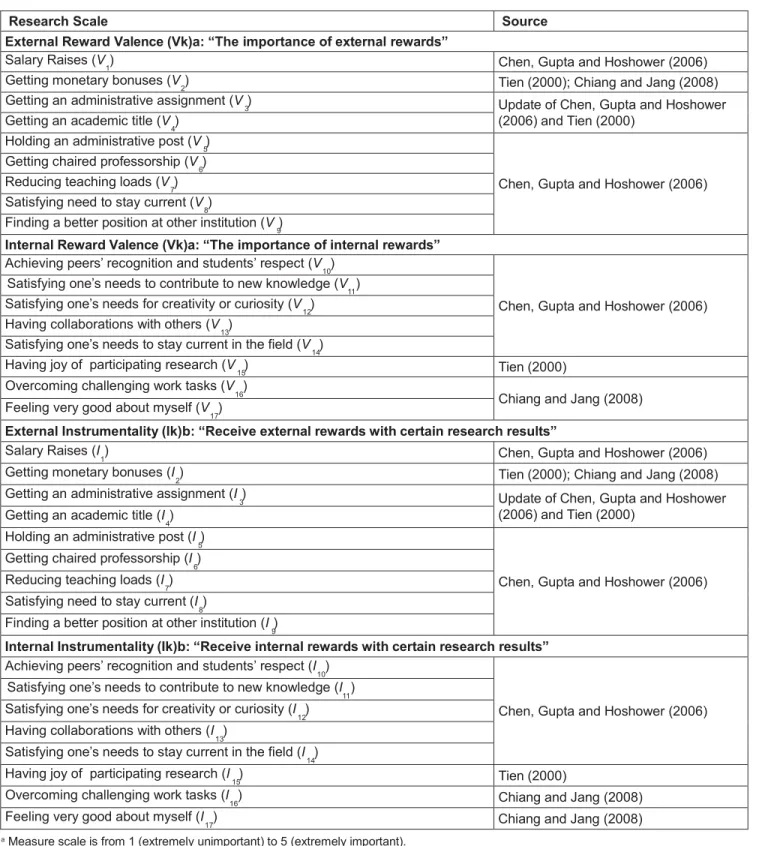
In order to collect data for this study, the questionnaire is developed based on basis indicators that measure definition in the research model. But before establishing the questionnaire with a small scale, we interview 11 lecturers to examine the definitions of variables and indicators (i.e., indicator of promotion rewards is replaced by rewards of academic/ career titles and indicator of payroll rewards is eliminated as it is not suitable in Vietnam). In addition, the questionnaire also includes demographic questions, such as gender, age and academic title. All indicators are translated to Vietnamese though a forward and reverse process. After that, the questionnaire is tested with a small amount of lecturers to avoid the misunderstanding of content and to adjust the final format. The final indicators, which are used in our official research, are shown in Table 1.
This study summarizes 17 rewards that can be achieved from scientific research activities, including 9 external rewards and 8 internal rewards. Indicators of “Valence”
variable indicate the importance of rewards and are measured from 1 (extremely unimportant) to 5 (extremely important).
Indicators of “Instrumentality” indicate the possibility of receiving these rewards with certain research results and are measured from 1 (totally disagree) to 5 (totally agree).
The corresponding values of external motivation of external rewards (EXTMOT) and internal motivation of internal rewards (INTMOT) are equal to the reward value (V ) multiplied by the ability to receive a reward (I ). According to The Expectation Theory, the overall motivation (MOT) is equal to the sum of the external motivation (EXTMOT) and the internal motivation (INTMOT).
3.3. Data Analysis
To examine the proposed hypotheses, the study uses Two-way Anova analysis and Post-hoc Anova by Tukey Test, using SPSS software version 23. All testing variables include Administrative post (No = 0, Yes = 1) and Gender (Female = 0, Male = 1).
4. Research Results
4.1. Results of Hypotheses H1, H1a, H1b
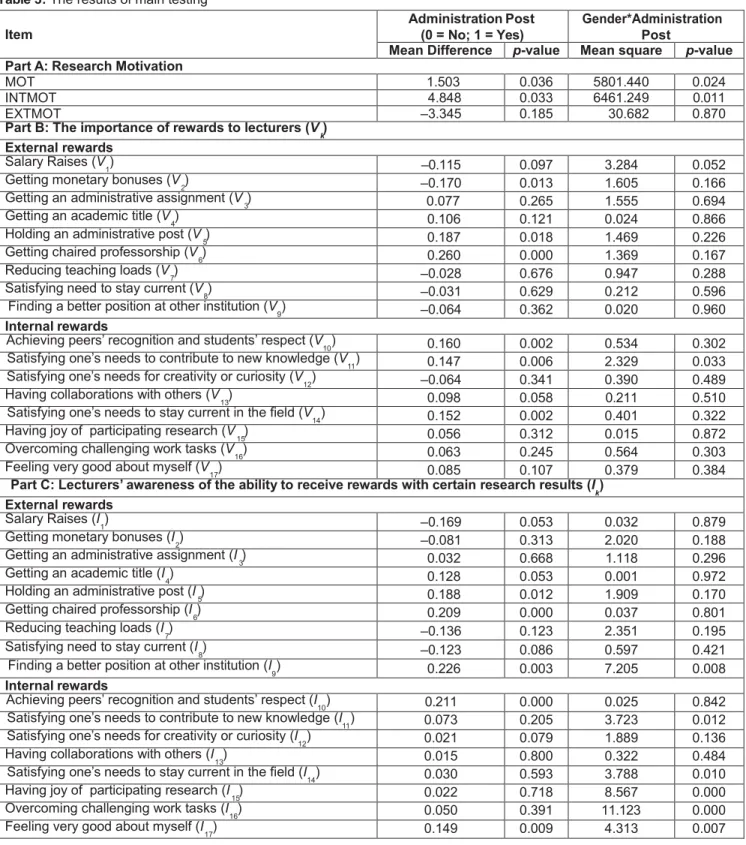
Table 2 shows Levene’s test results of all dependent
variables, including MOT, INTMOT, and EXTMOT. All
these variables have p-value greater than 0.1, which means the
variance of all above variables have no statistical difference
between gender and administration post. Therefore, ANOVA
analysis results can be used. By using Post-hoc ANOVA
Analysis through Turkey testing, we have the main results
in Table 3.
Table 1: Research Indicators and Scale
Research Scale Source
External Reward Valence (Vk)a: “The importance of external rewards”
Salary Raises (V )
1Chen, Gupta and Hoshower (2006)
Getting monetary bonuses (V )
2
Tien (2000); Chiang and Jang (2008)
Getting an administrative assignment (V )
3
Update of Chen, Gupta and Hoshower
(2006) and Tien (2000) Getting an academic title (V )
4
Holding an administrative post (V )
5Chen, Gupta and Hoshower (2006) Getting chaired professorship (V )
6
Reducing teaching loads (V )
7
Satisfying need to stay current (V )
8Finding a better position at other institution (V )
9
Internal Reward Valence (Vk)a: “The importance of internal rewards”
Achieving peers’ recognition and students’ respect (V )
10
Chen, Gupta and Hoshower (2006) Satisfying one’s needs to contribute to new knowledge (V )
11
Satisfying one’s needs for creativity or curiosity (V )
12Having collaborations with others (V )
13
Satisfying one’s needs to stay current in the field (V )
14
Having joy of participating research (V )
15
Tien (2000)
Overcoming challenging work tasks (V )
16
Chiang and Jang (2008)
Feeling very good about myself (V )
17
External Instrumentality (Ik)b: “Receive external rewards with certain research results”
Salary Raises (I )
1
Chen, Gupta and Hoshower (2006)
Getting monetary bonuses (I )
2
Tien (2000); Chiang and Jang (2008)
Getting an administrative assignment (I )
3
Update of Chen, Gupta and Hoshower
(2006) and Tien (2000) Getting an academic title (I )
4
Holding an administrative post (I )
5
Chen, Gupta and Hoshower (2006) Getting chaired professorship (I )
6
Reducing teaching loads (I )
7
Satisfying need to stay current (I )
8
Finding a better position at other institution (I )
9
Internal Instrumentality (Ik)b: “Receive internal rewards with certain research results”
Achieving peers’ recognition and students’ respect (I )
10
Chen, Gupta and Hoshower (2006) Satisfying one’s needs to contribute to new knowledge (I )
11
Satisfying one’s needs for creativity or curiosity (I )
12
Having collaborations with others (I )
13
Satisfying one’s needs to stay current in the field (I )
14
Having joy of participating research (I )
15
Tien (2000)
Overcoming challenging work tasks (I )
16
Chiang and Jang (2008)
Feeling very good about myself (I )
17
Chiang and Jang (2008)
a
Measure scale is from 1 (extremely unimportant) to 5 (extremely important).
b
Measure scale is from 1 (totally disagree) to 5 (totally agree).
Table 2: Levene’s’ Test of Equality of Error Variances
Dependent Variable F p-value
MOT 1.577 0.193
INTMOT 0.548 0.649
EXTMOT 3.406 0.117
Table 3: The results of main testing Item
Administration Post (0 = No; 1 = Yes)
Gender*Administration Post
Mean Difference p-value Mean square p-value Part A: Research Motivation
MOT 1.503 0.036 5801.440 0.024
INTMOT 4.848 0.033 6461.249 0.011
EXTMOT –3.345 0.185 30.682 0.870
Part B: The importance of rewards to lecturers (V )
kExternal rewards
Salary Raises (V )
1–0.115 0.097 3.284 0.052
Getting monetary bonuses (V )
2–0.170 0.013 1.605 0.166
Getting an administrative assignment (V )
30.077 0.265 1.555 0.694
Getting an academic title (V )
40.106 0.121 0.024 0.866
Holding an administrative post (V )
5
0.187 0.018 1.469 0.226
Getting chaired professorship (V )
6
0.260 0.000 1.369 0.167
Reducing teaching loads (V )
7
–0.028 0.676 0.947 0.288
Satisfying need to stay current (V )
8
–0.031 0.629 0.212 0.596
Finding a better position at other institution (V )
9
–0.064 0.362 0.020 0.960
Internal rewards
Achieving peers’ recognition and students’ respect (V )
10
0.160 0.002 0.534 0.302
Satisfying one’s needs to contribute to new knowledge (V )
11
0.147 0.006 2.329 0.033
Satisfying one’s needs for creativity or curiosity (V )
12
–0.064 0.341 0.390 0.489
Having collaborations with others (V )
13
0.098 0.058 0.211 0.510
Satisfying one’s needs to stay current in the field (V )
14
0.152 0.002 0.401 0.322
Having joy of participating research (V )
150.056 0.312 0.015 0.872
Overcoming challenging work tasks (V )
160.063 0.245 0.564 0.303
Feeling very good about myself (V )
170.085 0.107 0.379 0.384
Part C: Lecturers’ awareness of the ability to receive rewards with certain research results (I )
kExternal rewards
Salary Raises (I )
1–0.169 0.053 0.032 0.879
Getting monetary bonuses (I )
2–0.081 0.313 2.020 0.188
Getting an administrative assignment (I )
30.032 0.668 1.118 0.296
Getting an academic title (I )
4
0.128 0.053 0.001 0.972
Holding an administrative post (I )
5
0.188 0.012 1.909 0.170
Getting chaired professorship (I )
6
0.209 0.000 0.037 0.801
Reducing teaching loads (I )
7
–0.136 0.123 2.351 0.195
Satisfying need to stay current (I )
8
–0.123 0.086 0.597 0.421
Finding a better position at other institution (I )
9
0.226 0.003 7.205 0.008
Internal rewards
Achieving peers’ recognition and students’ respect (I )
10
0.211 0.000 0.025 0.842
Satisfying one’s needs to contribute to new knowledge (I )
11
0.073 0.205 3.723 0.012
Satisfying one’s needs for creativity or curiosity (I )
12
0.021 0.079 1.889 0.136
Having collaborations with others (I )
130.015 0.800 0.322 0.484
Satisfying one’s needs to stay current in the field (I )
140.030 0.593 3.788 0.010 Having joy of participating research (I )
15
0.022 0.718 8.567 0.000
Overcoming challenging work tasks (I )
16
0.050 0.391 11.123 0.000
Feeling very good about myself (I )
17