• 검색 결과가 없습니다.

The Impact of Employee Engagement on Employee Performance: A Case Study of Multinational Corporations in Thailand

N/A
N/A
Protected

Academic year: 2021

Share "The Impact of Employee Engagement on Employee Performance: A Case Study of Multinational Corporations in Thailand"

Copied!
7
0
0

로드 중.... (전체 텍스트 보기)

전체 글

(1)

Print ISSN: 2288-4637 / Online ISSN 2288-4645 doi:10.13106/jafeb.2021.vol8.no5.1091

The Impact of Employee Engagement on Employee Performance:

A Case Study of Multinational Corporations in Thailand

Ngaochai SUNGMALA

1

, Amara VERAWAT

2

Received: February 10, 2021 Revised: April 05, 2021 Accepted: April 15, 2021

Abstract

The purpose of this research was to investigate the relationship between employee engagement and individual performance outcomes (including growth, achievement, contribution, and customer satisfaction) in large firms in Thailand, which is rapidly growing as an international business hub. The study took place in Thai offices of multinational corporations, whose performance is both very important for Thailand’s overall economy and for the firm’s continued presence in Thailand. The study was conducted using a survey methodology.

A convenience sample of employees of multinational corporations (n = 423) completed a survey on employee engagement and individual performance outcomes. The data were analyzed using linear regression analysis. The results showed that there was a significant, positive relationship between employee engagement and all four performance outcomes that were targeted. The strongest effect was observed for achievement (β = 0.899), followed by growth (β = 0.887), contribution (β = 0.872), and customer satisfaction (β = .867). These findings indicate that employee engagement is a significant and strong factor that determines the individual performance of employees of multinational corporations. This implies that companies do need to consider how to promote employee engagement. There were some limitations, especially social response bias and the self-reported nature of performance, that limit these findings.

Keywords: Employee Engagement, Employee Performance, Multinational Corporations JEL Classification Code: M12, M19, M54

half of Thailand’s manufacturing by 2016 (Janssen, 2016).

In addition to supporting Thailand’s economic development, MNCs create and diffuse new knowledge and technologies by engaging in local research and development (Worasinchai et al., 2010).

Although MNCs can provide major benefits for Thailand in terms of economic growth, job creation, and innovation, their ability to support economic development varies based on their effectiveness, which in turn depends on the performance of their employees. There is evidence that employee engagement contributes to all aspects of performance, including growth as indicated by profitability (Harter et al., 2002; Sorenson, 2013), achievement of divisional or organisational goals due to good task performance (Alsafadi

& Altahat, 2021; Anitha, 2014), individual goal achievement (Alsafadi & Altahat, 2021), innovation (Bedarkar & Pandita, 2014), contribution in terms of effort (Anitha, 2014), productivity (Bedarkar & Pandita, 2014; Harter et al., 2002;

Sorenson, 2013), and the ability to satisfy customers (Chi &

Gursoy, 2009; Harter et al., 2002; Sorenson, 2013).

The aim of this research was to investigate the effects of employee engagement on four employee performance

1

First Author and Corresponding Author. Doctor of Philosophy Programme in International Business (International Program), Silpakorn University, Thailand [Postal Address: 909 Teprat Road, Bangna, Bangna Nea, Bangkok, 10260, Thailand]

Email: [email protected]

2

Assistant Dean for Student Development and Quality Assurance, Silpakorn University International College (SUIC). Silpakorn University, Bangkok, Thailand. Email: [email protected]

© Copyright: The Author(s)

This is an Open Access article distributed under the terms of the Creative Commons Attribution Non-Commercial License (https://creativecommons.org/licenses/by-nc/4.0/) which permits unrestricted non-commercial use, distribution, and reproduction in any medium, provided the original work is properly cited.
1. Introduction

Multinational companies (MNCs) have proliferated in the era of globalization, and Thailand’s government has been implementing regulatory changes and offering business incentives to attract them (TMF Group, 2018).

These policies have been highly effective thus far, both for

retaining emerging MNCs that originated in Thailand and

encouraging foreign MNCs to choose Thailand, as evidenced

by the fact that Japanese MNCs accounted for more than

(2)

Ngaochai SUNGMALA, Amara VERAWAT / Journal of Asian Finance, Economics and Business Vol 8 No 5 (2021) 1091–1097

1092

outcomes (growth, achievement, contribution, and customer satisfaction) for MNCs operating in Thailand. This topic has not been investigated by other researchers despite the increasingly important role MNCs are playing in Thailand’s national economy and evidence that employee engagement predicts performance in other contexts. Therefore, this study addresses a gap in the literature and provides insights into how the performance of employees at Thailand-based MNC divisions could be enhanced by increasing engagement.

2. Literature Review 2.1. Employee Engagement

Employee engagement has been defined in various ways.

One definition emphasizes “the level of commitment and involvement an employee has towards their organization and its values (Anitha, 2014, p. 308).” Another highlights the emotional components of engagement, describing it in terms of the “passion and commitment,” and “willingness to invest oneself and expand one’s discretionary effort to help the employer succeed (AbuKhalifeh & Som, 2013, p. 41).” Some definitions include additional elements such as employee enthusiasm and satisfaction as subfactors of engagement (Harter et al., 2002; Nguyen & Pham, 2020).

Many workplace variables may contribute to employee engagement, including leadership (Anitha, 2014; Bedarkar &

Pandita, 2014; Nguyen & Pham, 2020), work environment, co-workers and work teams, compensation, organisational policies, general workplace well-being (Alsafadi &

Altahat, 2021; Anitha, 2014; Nguyen & Pham, 2020), communication (AbuKhalifeh & Som, 2013; Bedarkar &

Pandita, 2014), rewards and recognition, extended employee care (AbuKhalifeh & Som, 2013), training and career development opportunities (AbuKhalifeh & Som, 2013;

Alsafadi & Altahat, 2021; Anitha, 2014; Nguyen & Pham, 2020), and work-life balance (Bedarkar & Pandita, 2014;

Nguyen & Pham, 2020; Vu, 2020). Additional factors that may affect employee engagement include career optimism, organizational fairness, and organizational entrepreneurship commitment (Mappamiring et al., 2021), as well as religiosity or the overall level of religious belief (Vu, 2020). However, these factors have been less studied in general than the others mentioned. There are also individual-level factors that may influence employee engagement, such as organizational citizenship behavior (OCB) (Hermawan et al., 2020).

2.2. Employee Performance

Employee performance can be defined based on the behaviors and effort exerted to achieve particular workplace goals or the outcomes of those behaviors and efforts (Pradhan & Jena, 2017). Input-based definitions focus on

what employees contribute to their organizations, so they conceptualize performance as arising from ability and effort (Obisi, 2011), the latter of which is related to engagement (Anitha, 2014). Outcome-based definitions focus on results, defining performance as the financial and non-financial consequences of employee behaviors that affect the success of their organizations (Anitha, 2014). Pradhan and Jena have argued for a three-factor definition of performance that differentiates task-related, adaptive, and contextual behaviors and outcomes.

Growth: Actual growth and growth potential have typically been defined and measured based on the profitability of a division or organization (Harter et al., 2002; Sorenson, 2013). There is evidence that growth depends on employee performance (Obisi, 2011).

Achievement: Achievement can be defined in terms of results, such as meeting specified goals (Dugguh & Ayaga, 2014). Thus, achievement is the degree to which employees help their divisions, work teams, or organizations achieve their objectives. Measures such as revenues per employee or customer within a particular division have been used to assess achievement (Harter et al., 2002).

Contribution: Contribution encompasses all employee competencies and behaviors that help organizations or divisions achieve particular goals. It can be defined based on various inputs such as ability, effort, time, commitment, flexibility, enthusiasm, tolerance, determination, personal sacrifice, supportiveness (Dugguh & Ayaga, 2014), productivity, quality of work, and (low) rate of absenteeism (Sorenson, 2013).

Customer satisfaction: Customer satisfaction, an indicator of customer service performance, arises from the customer’s post-purchase evaluation of the quality of a service or product (Cengiz, 2010) and it can be assessed with customer ratings (Sorenson, 2013). Customer satisfaction contributes to business success by promoting customer loyalty in the form of repeat business and recommendations (Chi & Gursoy, 2009). When companies take good care of their employees, employees tend to be more satisfied and engaged, so they take better care of their customers (Chi &

Gursoy, 2009).

2.3. Impact of Employee Engagement on Employee Performance

The positive effects of employee engagement on the performance of both individual workers and the organizations where they work are well established in the literature (AbuKhalifeh & Som, 2013; Anitha, 2014;

Bedarkar & Pandita, 2014; Harter et al., 2002; Sorenson,

2013; Tonvongval, 2013). Sorenson (2013) reports the

findings of a multinational meta-analysis that included

263 studies encompassing nearly 1.4 million employees

(3)

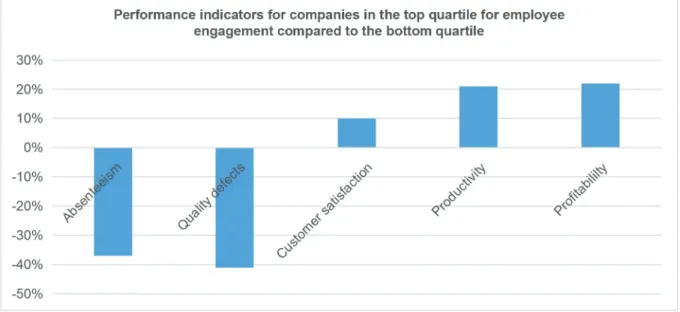
at 49,928 work units in 192 organizations spanning 49 different industries. This research provided strong evidence for the performance benefits of employee engagement (see Figure 1). Collectively, the studies demonstrate that growth indicators such as profitability improve in conjunction with employee engagement scores. Companies that averaged 9.3 engaged employees per disengaged employee reported 147% higher earnings per share (EPS) compared to their competitors, whereas those with only 2.6 engaged employees per disengaged employee had EPS 2% below competing companies, on average. Moreover, companies with a higher percentage of engaged employees were able to grow their EPS more rapidly. The collective findings of the studies included in this meta-analysis also indicate that engagement scores predict aspects of achievement and contribution such as quality and productivity, and that customer satisfaction ratings improve in conjunction with employee engagement scores as well.

Another large-scale study that examined engagement effects on performance at the business unit level yielded similar results. Meta-analytical evidence from the research of Harter et al. (2002), which included 7,939 business units within 36 companies, indicates that employee productivity, customer satisfaction, and overall profits increase in conjunction with employee engagement. However, as in many other studies of this nature, engagement was examined in conjunction with employee satisfaction rather than independently.

Engagement effects on performance are probably attributable to the ways in which engagement influences

employee behavior. Engaged employees tend to be more committed, motivated, and creative, thereby making their organizations more innovative and competitive (Bedarkar

& Pandita, 2014). Engaged employees also receive higher ratings in the areas of task performance, effort, and organizational citizenship behavior (Anitha, 2014). These employees are more productive overall (Anitha, 2014;

Bedarkar & Pandita, 2014; Harter et al., 2002). They also tend to be more aware of the context in which their organizations operate and willing to work effectively with their teams to improve performance (AbuKhalifeh & Som, 2013), and they do a better job of satisfying customers (Anitha, 2014;

Chi & Gursoy, 2009; Harter et al., 2002).

2.4. Framework and Hypotheses

A conceptual model for the effects of employee engagement on performance outcomes was developed based on the literature review (see Figure 2). This model proposes that employee engagement is an independent variable that directly influences four performance outcome variables: growth, contribution, achievement, and customer satisfaction.

Other researchers have found relationships between employee engagement and growth, achievement, contribution, customer satisfaction, or outcomes related to these performance indicators (AbuKhalifeh & Som, 2013;

Anitha, 2014; Bedarkar & Pandita, 2014; Harter et al., 2002;

Sorenson, 2013). Based on the findings of these studies, four hypotheses were developed and tested for this research:

Figure 1: Performance of Work Units in the Top Quartile for Employee Engagement Compared to the Bottom Quartile

(Sorenson, 2013)

(4)

Ngaochai SUNGMALA, Amara VERAWAT / Journal of Asian Finance, Economics and Business Vol 8 No 5 (2021) 1091–1097

1094

H1: Employee engagement can lead to employee performance in terms of growth.

H2: Employee engagement can lead to employee performance in terms of achievement.

H3: Employee engagement can lead to employee performance in terms of contribution.

H4: Employee engagement can lead to employee performance in terms of satisfying customers.

3. Methodology

This research was conducted as a quantitative survey study. A self-administered questionnaire was used to make participation convenient for respondents and allow for rapid data collection from a large sample. Using this method also enabled participants to respond anonymously, thereby protecting their privacy. This was an important ethical consideration because the respondents were asked about their engagement and work performance, and this information could have negative consequences for them if they were identified,

The questionnaire was a new instrument developed for this study based on a literature review of employee engagement effects on workplace performance. Survey items included basic demographic questions (gender, age, education level, and marital status), a question designed to assess engagement, and a series of questions regarding

the four performance outcomes: growth, achievement, contribution, and customer satisfaction.

The sample included 423 employees of MNCs that have divisions in Thailand, recruited via a convenience sampling approach. The sample size was based on the calculation for a population of unknown size (Lind et al., 2012), which gives a sample of 384. However, additional participants were recruited to provide extra surveys that would compensate if any were submitted with incorrect or incomplete responses.

The data were analyzed using SPSS software to produce descriptive statistics (frequencies and percentages for demographics, engagement rates, and performance factor ratings) and inferential statistics. Multiple regression analysis was used to test the hypotheses regarding the effects of employee engagement on the four performance outcomes.

4. Results

Table 1 summarizes the demographic characteristics

of the sample. Female respondents comprised nearly two-

thirds (65.2%) of the participants, most of whom were young

and middle-aged adults. Those between 21 and 50 made up

90.5% of the sample, while those under 20 and over 50 years

of age were minimally represented. Most of the respondents

had post-secondary degrees, with more than half (53.9%)

holding bachelor’s degrees, 18% with master’s degrees,

0.7% with doctoral degrees, and 12.1% having unspecified

Figure 2: Conceptual Model

(5)

diplomas or vocational degrees, while only 15.4% reported no higher qualifications. Many of the respondents were single (61.2%), just over one-third were married (35.7%), and only 3.1% reported their status as widowed, divorced, or separated.

The study participants were asked whether they considered themselves to be engaged, disengaged, or neither at work (see Table 2). The majority (61.7%) described themselves as engaged, whereas only 1.9% said they were disengaged and just over one-third (36.4%) fell within the neutral range, saying they were neither fully engaged nor disengaged. Representation of disengaged employees was very low overall. However, it is possible that some of those who felt disengaged from their work chose not to identify themselves as such because they thought this would be perceived negatively.

Employee performance was assessed in terms of growth, achievement, contribution, and satisfying customers (see Table 3). Regression analysis confirmed all four hypotheses by determining that there were statistically significant, positive relationships between engagement and each of the employee performance outcomes (p = 0.000 in all cases).

The effects of engagement on performance were very strong for all four outcome factors (β > 0.8 in all cases). The largest effect was seen for achievement (β = 0.899), followed by growth (β = 0.887), contribution (β = 0.872), and satisfying customers (β = 0.867). However, the scores were close for all four performance outcomes. The R

2

values (>0.7 in all cases, and >0.8 for achievement) indicate that the model explained much of the variance in performance outcomes, thereby demonstrating strong predictive power. The findings support the overall proposition that employee engagement is critical to performance.

5. Discussion and Conclusion

The findings of this study add to the evidence for a relationship between employee engagement and performance provided by other researchers who have examined this relationship in Thailand (Tonvongval, 2013) and in other cultural contexts (AbuKhalifeh & Som, 2013; Anitha, 2014;

Bedarkar & Pandita, 2014; Harter et al., 2002; Sorenson, 2013). Individual engagement effects on all performance outcomes were strong, particularly for achievement. This accords with the findings of other research that engaged employees are more committed to their work (Bedarkar &

Pandita, 2014), perform better at required tasks (Anitha, 2014), and are more motivated and creative overall, thereby Table 1: Respondent Demographics

Demographic Information Frequency (n = 423) %

Gender Male 147 34.8

Female 276 65.2

Age 20 and under 26 6.1

21 to 30 140 33.1

31 to 40 146 34.5

41 to 50 97 22.9

51 to 60 11 2.6

61 and over 3 0.7

Educational

Level Lower than Diploma

degree 65 15.4

Diploma/Vocational

degree 51 12.1

Bachelor’s degree 228 53.9

Master’s degree 76 18.0

Doctoral degree 3 0.7

Marital

Status Single 259 61.2

Married 151 35.7

Widow/Divorce/

Separated 13 3.1

Table 2: Employee Engagement Level of Employee

Engagement Frequency

(n = 423) %

Level Disengaged 8 1.9

Neither engaged nor

disengaged 154 36.4

Engaged 261 61.7

Table 3: Hypothesis Test Results

Independent Variable Dependent Variables β value P value R

2

Results

Employee Engagement Growth 0.887 0.000 0.787 Accepted

Achievement 0.899 0.000 0.808 Accepted

Contribution 0.872 0.000 0.761 Accepted

Satisfying customers 0.867 0.000 0.752 Accepted

(6)

Ngaochai SUNGMALA, Amara VERAWAT / Journal of Asian Finance, Economics and Business Vol 8 No 5 (2021) 1091–1097

1096

supporting the fulfillment of organizational goals such as greater innovation and enhanced competitiveness (Bedarkar

& Pandita, 2014).

A similarly strong engagement effect was found for growth, which was expected based on the findings of other research linking growth (as indicated by profitability) to employee engagement (Harter et al., 2002; Sorenson, 2013).

Employee engagement also influenced the contribution employees made to their divisions, in line with other research that has found a positive relationship between engagement and productivity (Anitha, 2014; Bedarkar & Pandita, 2014;

Harter et al., 2002; Sorenson, 2013). Engagement predicted customer satisfaction as well, in accordance with prior research, which has demonstrated that engaged employees offer higher quality customer service (Anitha, 2014)and that customer satisfaction ratings rise in conjunction with employee engagement scores (Chi & Gursoy, 2009; Harter et al., 2002; Sorenson, 2013). Overall, the findings support the conceptual model for this research and indicate that the engagement-performance relationship is strong for employees working at Thailand-based MNC divisions.

It should be noted that the low representation of unengaged employees in the sample may have affected the results. Because the rate of disengagement was minimal, it may have been difficult to detect disengagement effects on performance outcomes. It is also possible that the rate of disengagement was actually higher than indicated by participants, only appearing to be low because some study participants were unwilling to identify themselves as disengaged or underperforming, given the sensitivity of these issues. Social desirability bias can affect the results of survey research in cases where respondents will not admit to certain feelings, attitudes, or behaviors they perceive as negative (Krumpal, 2013). Thus, it is possible that certain study participants felt uneasy about describing themselves as unengaged or low-performing even on an anonymous survey, which caused them to provide inaccurate self-assessments.

6. Conclusion and Recommendations

This research was conducted to determine whether employee engagement predicts four performance outcomes:

growth, achievement, contribution, and customer satisfaction (an indicator of customer service). Employees working at Thailand-based MNC divisions were surveyed to determine their levels of engagement and performance, and regression analysis was used to assess engagement effects on performance. This analysis indicated that engagement affects all four aspects of employee performance.

Two conclusions can be drawn from the findings of this study. First, the key to improving employee performance (and by extension, overall organisational performance) is increasing employee engagement. Second, engagement has particularly

powerful effects on the achievement of organisational goals and overall growth, which indicates that MNCs can improve their competitiveness and profitability by developing strategies to increase engagement. These findings have several implications for MNCs with divisions in Thailand.

First, MNCs should develop strategies and programs for increasing employee engagement. Unfortunately, there is little information available to guide these efforts in Thailand, though the findings of research conducted by Tonvongval (2013) suggest that at the managerial level, engagement can be increased with interventions designed to promote transformational leadership approaches at foreign-owned companies with Thailand-based divisions. However, more studies are needed to identify best practices for increasing engagement among Thai MNC employees.

Second, MNCs should conduct research with their employees to determine how they could improve engagement.

This research could be undertaken with focus groups or by administering anonymous surveys, though the latter approach may be more effective given the sensitive subject matter, as many employees may be unwilling to speak candidly about workplace issues if they can be personally identified. After conducting this research, MNCs could develop appropriate interventions and follow their implementation with longitudinal assessments to evaluate long-term performance effects in the areas of growth, achievement, contribution, and customer satisfaction ratings.

Third, MNCs that have low levels of employee engagement should conduct additional research to determine why their staff is largely disengaged, as disengagement is likely to reduce profits, productivity, innovation capability, and overall competitiveness. Issues that are negatively affecting engagement should then be addressed with appropriate corrective measures.

Recommendations can also be made for additional academic research to further investigate the effects of engagement on performance and address the limitations of this study. A multinational study of engagement effects on performance would indicate whether the relationship is stronger or weaker in various cultural contexts. However, an additional advantage of conducting a larger and more comprehensive study would be the use of a much larger sample, as this would increase the representation of disengaged employees, thereby providing a more accurate assessment of disengagement effects on performance. Including survey questions on the reasons for disengagement and the ways in which engagement could be increased would also be useful, as this would provide guidance for developing effective interventions.

References

AbuKhalifeh, A. N., & Som, A. P. M. (2013). The antecedents affecting employee engagement and organizational performance. Asian Social Science, 9(7), 41–46. https://doi.

org/10.5539/ass.v9n7p41

(7)

Alsafadi, Y., & Altahat, S. (2021). Human Resource Management Practices and Employee Performance: The Role of Job Satisfaction. Journal of Asian Finance, Economics and Business, 8(1), 519–529. https://doi.org/10.13106/jafeb.2021.

vol8.no1.519

Anitha. (2014). Determinants of employee engagement and their impact on employee performance. International Journal of Productivity and Performance Management, 63(3), 308–323.

https://doi.org/10.1108/IJPPM-01-2013-0008

Bedarkar, M., & Pandita, D. (2014). A Study on the Drivers of Employee Engagement Impacting Employee Performance.

Procedia - Social and Behavioral Sciences, 133, 106–115.

https://doi.org/10.1016/j.sbspro.2014.04.174

Cengiz, E. (2010). Measuring Customer Satisfaction: Must or Not?

Journal of Naval Science and Engineering, 6(2), 76–88.

Chi, C. G., & Gursoy, D. (2009). Employee satisfaction, customer satisfaction, and financial performance: An empirical examination. International Journal of Hospitality Management, 28(2), 245–253. https://doi.org/10.1016/j.ijhm.2008.08.003 Dugguh, S. I., & Ayaga, D. (2014). Job satisfaction theories:

Traceability to employee performance in organizations. IOSR Journal of Business and Management, 16(5), 11–18. https://

doi.org/10.9790/487x-16511118

Harter, J. K., Schmidt, F. L., & Hayes, T. L. (2002). Business-unit- level relationship between employee satisfaction, employee engagement, and business outcomes: A meta-analysis.

Journal of Applied Psychology, 87(2), 268–279. https://doi.

org/10.1037/0021-9010.87.2.268

Hermawan, H., Thamrin, H. M., & Susilo, P. (2020). Organizational Citizenship Behavior and Performance: The Role of Employee Engagement. Journal of Asian Finance, Economics and Business, 7(12), 1089–1097. https://doi.org/10.13106/

JAFEB.2020.VOL7.NO12.1089

Janssen, P. (2016). Thailand strives to be international corporate hub. Nikkei Asian Review, July 22. https://asia.nikkei.com/

Business/Thailand-strives-to-be-international-corporate-hub Krumpal, I. (2013). Determinants of social desirability bias in

sensitive surveys: a literature review. Quality and Quantity, 47(4), 2025–2047. https://doi.org/https://doi.org/10.1007/

s11135-011-9640-9

Lind, D. A., Marchal, W. G., & Wathen, S. A. (2012). Statistical techniques in business and economics. New York, NY:

McGraw-Hill Irwin.

Mappamiring, M., Halim, A., & Kusuma, P. (2021). Understanding Career Optimism on Employee Engagement: Broaden-Built and Organizational Theory Perspective. Journal of Asian Finance, Economics and Business, 8(2), 605–616. https://doi.

org/10.13106/jafeb.2021.vol8.no2.0605

Nguyen, L. G. T., & Pham, H. T. (2020). Factors affecting employee engagement at not-for-profit organizations: A case in Vietnam.

Journal of Asian Finance, Economics and Business, 7(8), 495–507. https://doi.org/10.13106/JAFEB.2020.VOL7.NO8.495 Obisi, C. (2011). Employee performance appraisal and implications

of the individual and organisational growth. Australian Journal of Business and Management Research, 1(9), 92–97.

Pradhan, R. K., & Jena, L. K. (2017). Employee Performance at Workplace: Conceptual Model and Empirical Validation.

Business Perspectives and Research, 5(1), 69–85. https://doi.

org/10.1177/2278533716671630

Sorenson, S. (2013). How Employee Engagement Drives Growth.

Gallup Business Journal, 41–44. http://www.gallup.com/

businessjournal/163130/employee-engagement-drives-growth.

aspx

TMF Group. (2018). Doing Business in Thailand: What you should know. Retrieved December 2, 2021 from: https://www.

tmf-group.com/en/news-insights/articles/2018/december/

doing-business-in-thailand/?utm_source=Mondaq&utm_

medium=syndication&utm_campaign=View-Original

Tonvongval, S. (2013). Impact of Transformational Leadership Intervention on Employee Engagement and Firm Performance:

Social Research Reports, 25, 34–49.

Vu, H. M. (2020). Relationship between Work-Life Balance, Religiosity and Employee Engagement: A Proposed Moderated Mediation Model. Journal of Asian Finance, Economics and Business, 7(10), 339–345. https://doi.org/10.13106/jafeb.2020.

vol7.n10.339

Worasinchai, L., Aurelie, A., & Bechina, A. (2010). The Role of Multinational Corporations (MNCs) in Developing R&D in Thailand: The Knowledge Flow Between MNCs and University.

Electronic Journal of Knowledge Management, 8(1), 171–180.

수치

Figure 1:  Performance of Work Units in the Top Quartile for Employee Engagement Compared to the Bottom Quartile  (Sorenson, 2013)
Table 1 summarizes the demographic characteristics  of the sample. Female respondents comprised nearly  two-thirds (65.2%) of the participants, most of whom were young  and middle-aged adults
Table 3:  Hypothesis Test Results

참조

관련 문서

This research further enriches the previous research on the influencing factors of employee organizational commitment and OCB, which help Chinese companies

The purpose of this study is to identify how the Customer Satisfaction (CS) policy affects the employees'level of stress and satisfaction, and to minimize the

The purpose of this study is to analyze the effects of service quality on customer satisfaction and revisit intention perceived by Chinese golf range

Objective: The purpose of this study is to investigate the relationship between employee satisfaction and patient safety and quality improvement after compulsory certification

 waiting time for service, customer complaints, waiting time for service, customer complaints, cleanliness, food quality, order accuracy,. cleanliness, food quality,

™ The first nested query, which is correlated, retrieves the project numbers on which the employee works, which is different for each employee tuple because of the

As shown in the results of this study through research methods and data processing described above, since customer service is increasingly important, dance

This paper has significant as a study of case marker reflecting the colloquialism in Yanbian region in China which neglected by the studies on relying on
