Effects of Ca-Gluconate on Fruit Firmness and Softening Enzyme Activities in Tomato using Hydroponics Systems
Soo-Jeong Kwon*, Guang-Jae Lee**, Swapan-Kumar Roy***, Kab-Yeon Cho*, Young-Ja Moon*, Jin-Woong Cho****, Sun-Hee Woo***, and Hag-Hyun Kim*
†*Department of Food Nutrition and Cookery, Woosong College, Daejeon 300-715, Korea
**Division of Horticultural Life Research, Chungbuk Agricultural Research and Extension Service, Cheongwon 363-883, Korea
***Department of Crop Science, Chungbuk National University, Cheong-ju 361-763, Korea
****College of Agricultural and Life Sciences, Chungnam National University, Daejeon 305-764, Korea
539
†
Corresponding author: (Phone) +82-10-8919-3911 (E-mail) [email protected]
<Received 1 October 2014; Accepted 10 November 2014>
한작지(Korean J. Crop Sci.), 59(4): 539~546(2014) DOI : http://dx.doi.org/10.7740/kjcs.2014.59.4.539
ABSTRACT This study was carried out to investigate the effects of Ca-gluconate (Ca-glu) on fruit firmness and softening enzyme activities of hydroponically grown tomato (Solanium esculentum Mill.). The obtained results revealed that the rate of weight loss was markedly increased from at storage to 5 days after storage (DAS) in control, and was constantly increased until 7 DAS as 4.1% in Ca-glu treatment. Fruit firmness was more rapidly decreased in Ca-glu induced fruit compared to control. Results showed that fruit firmness in control and Ca-glu treated fruit were 0.67 and 0.95 kg·φ12 mm
-1, respectively. In our investigation, no difference was revealed in Hunter’s ‘a’ value between control and Ca-glu treated fruit. Total carotenoids content of control fruit were rapidly increased while the Ca-glu treated fruit were gently increased. Lycopene content was higher (63.3 μg․g
-1FW) in control than Ca-glu treatment (56.8 μg․g
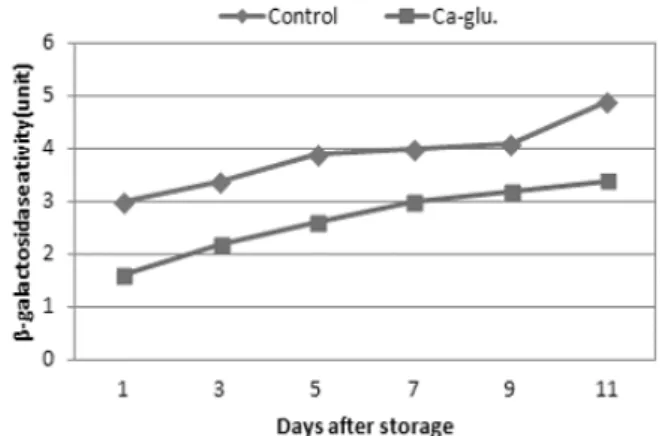
-1FW). The activity of Polygalacturonase (PG) was rapidly increased with increasing storage period as from 0.4 to 1.2 units whereas the PG activity of Ca-glu treatment was gently increased from 1 to 7 DAS, and rapidly increased from 7 to 11 DAS. However, the pectinesterase (PE) activity was rapidly increased in control fruit, when the storage period was increased, but interestingly, the Ca-glu treated fruit was slowly increased from 1 to 7 DAS, and rapidly increased 7to 11 DAS. β-galactosidase activity of Ca-glu induced fruit was rapidly increased from 1 to 7 DAS as from 1.6 to 3.0 units, and gently increased from 7 to 11 DAS. β-galactosidase activity of control were higher than Ca-glu treatment.
Keywords : β-galactosidase, lycopene, pectinesterase, polyga- lacturonase, storage, weight loss
Ripening of tomato fruits is accompanied by major changes in the pectin components of the cell walls. Ripening, including pectin degradation and softening, may be controlled by the presence and amount of Ca in tomato fruit (Hong and Lee, 1996). Application of Ca ions inhibits respiration, prevents ethylene production, delays senescence, alleviates various physiological disorders, and increases resistance to fungal infection (Tingwa and Young, 1974). Poovaiah (1986) reported that Ca ion inhibited polygalacturonase (PG) action and delayed ripening in many fruits and vegetables. Ripening appears to be dependent upon the combined action of polygalacturonase (PG), pectinesterase (PE) and Ca, and a timing sequence of these actions may be important in ripening mechanism (Park and Lee, 1991).
The softening enzymes of cell wall components were poly- galacturonase, cellulase, pectinesterase, and α- and β-galac- tosidase. The PG is one of the very strong enzymes in cell wall solubilization (Aspinall, 1980). PG appears to be responsible for the degradation of the pectin-rich component of the middle lamella of cell walls (Crookes and Grierson, 1983).
Ripening of tomato fruit is thought to be co-operated by major changes in the pectin components of the cell walls during ripening. This exemplified by increased solubility, depolymerisation and de-esterification (Tucker and Grierson, 1987).
PG attacks the pectic substances and leads to cell wall disruption (Sawamura et al., 1979), and the activity of PG can release the cell wall-bound Ca ion which forms the ionic
ISSN 2287-8432(Online)