http://dx.doi.org/10.15204/jkobgy.2016.29.4.046
자연분만 후 발생한 비골신경마비 환자에 대한 Muscle Energy Technique(MET)의 병행치료 효과 증례보고
세명대학교 제천한방병원 침구의학과 조나영, 노정두
ABSTRACT
The Effects of Muscle Energy Technique (MET) for Peroneal Nerve Palsy after Normal Delivery: A Case Report
Na-Young Jo, Jeong-Du Roh
Dept. of Acupuncture & Moxibustion Medicine,
Je-Cheon Hospital of Traditional Korean Medicine, Se-Myung University Objectives: The purpose of this study is to evaluate the clinical effects of Muscle Energy Technique (MET) for peroneal nerve palsy after normal delivery.
Methods: Two patients with peroneal nerve palsy were treated with acupuncture, moxibustion, cupping and MET. MET was performed in piriform, gluteus medius, anterior tibial and adductor muscles. To evaluate the effect of MET, we analyzed Ankle dorsiflexion range of motion (ROM), Manual Muscle Test (MMT), Numerical Rating Scale (NRS) and Ankle Hindfoot Scale (AHS).
Results: In Case 1, ROM score was changed from -5 to 20, and MMT score was changed from 0 to 4. NRS score was changed from 5 to 1, and her AHS score was changed from 54 to 94 after treatment.
In Case 2, ROM score was changed from 0 to 20, and her MMT score was changed from 1 to 5. NRS score was changed from 4 to 1, and her AHS score was changed from 64 to 97 after treatment.
Conclusions: MET may be a useful treatment for patients who, shortly after childbirth or while breastfeeding, strongly refuse to treat the irritation.
Key Words: Muscle Energy Technique, Normal Delivery, Peroneal Nerve Palsy, Lithotomy Position, Korean Medicine
1)
Corresponding author(Jeong-Du Roh) : Dept. of Acupuncture & Moxibustion Medicine, Je-Cheon Hospital of Traditional Korean Medicine, Se-Myung University, 66 Semyung-ro, Sinwoul-dong, Jecheon city,
Chungbuk, 27136, Republic of Korea
Tel : +82-43-649-1816 Fax : +82-43-645-1382 E-mail : [email protected]
Ⅰ. Introduction
Normal delivery is usually done in lithotomy position. The lithotomy position is commonly used in urology and gynecology surgery. According to existing studies, this posture may lead to damage to sensory or motor nerves 1) . The cause of this damage is usually the compression or traction of the femoral nerve. This is also the cause of the damage of the peroneal nerve or obturator nerve. Among them, peroneal nerve palsy is most common.
Typical symptoms of peroneal nerve palsy are foot drop, decreased sensation, and muscle weakness 2) .
Foot drop is a condition in which dorsiflexion of the ankle joint is impossible 3) . It may be accompanied by a decrease in the sensation of a specific body part.
In addition, patients may complain of paresthesia or muscle weakness 4) . The gait of patients with peroneal nerve palsy shows a special form, caused by the lack of dorsiflexion of the ankle joint, called steppage gait.
Causes of peroneal nerve palsy include injury, surgery, fracture, stroke, etc 5) . A common feature of these causes is damage, compression, or traction to the nerves.
Pulling or pressure on the nerves can cause peroneal nerve palsy.
Peroneal nerve palsy falls within the scope of Wei Symptoms (痿證) in Korean medicine. In Korean medicine, acupuncture, herbal medicine, physical therapy, taping therapy, etc. have been performed to
address Wei Symptoms (痿證). Therefore, these methods are also used in the treatment of peroneal nerve palsy. In addition, these days, various additional treatments have been attempted, such as electroacupuncture, sweet bee venom pharmacopuncture, and acupotomy therapy 6-11) . Chuna manual therapy is one of the Korean medical treatments. It involves balancing the unbalanced state of musculoskeletal conditions 12) . Among them, the Muscle Energy Technique (MET) is used for diseases associated with the muscles. By pulling the muscle, pain in the adhesive soft tissues is relieved. This action provides effective pain relief, muscle function recovery, and blood circulation improvement. In addition, it can be used for joint displacement, muscle injury, stiffness, and numbness. In clinical settings, MET is used to treat musculoskeletal disorders, such as acute lower back pain and nuchal pain 13) .
It is estimated that the causes of peroneal nerve palsy are associated with the musculoskeletal system, and an analysis of previous studies suggests that MET is effective for peroneal nerve palsy.
MET is able to simultaneous perform with any Korean treatment such as acupuncture, moxabution, cupping, etc.
MET will be varied in the treatments
on peroneal nerve palsy after normal
delivery patients. However, studies on the
effect of MET on peroneal nerve palsy
are not enough. Thus, we performed MET
on peroneal nerve palsy after normal
delivery. And we report them.
Ⅱ. Subjects and Method
1. Subjects
The research involved two patients who were hospitalized at the Acupuncture
& Moxibustion Department of Semyung University Korean Medicine Hospital for peroneal nerve palsy after normal delivery from January 1, 2014 to December 31, 2014. They were diagnosed with peroneal nerve palsy, visited the Western Medicine Clinic for initial treatment. The symptoms began shortly after childbirth. The purpose of the study, procedures, and adverse reactions were explained to participants, and all participants agreed to participate voluntarily.
2. Treatment Method 1) MET
MET was performed once a day, five times per week during hospitalization.
Treatment was done by a Korean medical doctor with more than three years of clinical experience. The doctor had completed the regular MET course.
(1) Piriform muscle
The patient lies in the supine position with the ipsilateral hip and knee joint bent. The foot is positioned on the other side of the outer knee. The operator’s hands are in contact with the knee of the affected side and the hip joint adduction. The patient applies an outward force in response to the force of the operator. The patient contracts for 5-7 seconds, and then relaxes for
5-7 seconds. The operation is repeated seven times.
(2) Gluteus medius muscle
The patient lies in the prone position.
The operator stands on the affected side of the patient. The operator palpates the sore point of the gluteus medius muscle. The operator holds the lower leg of the patient and pulls the hip joint of the patient. The operator searches for the position where the pain disappears.
The operator stops the movement at that position. The patient breathes slowly while maintaining the breath of the patient for 7 seconds and repeats to slowly breathe. After the pain disappears, the hip joint is put back into place.
The operation is repeated seven times.
(3) Anterior tibial muscle
The patient lies in the supine position.
The operator stands on the affected side of the patient. The operator’s hands are in contact with the dorsum of the foot of the affected side and the ankle joint plantarflexion. The patient applies a force to the dorsiflexion in response to the force of the operator. The patient contracts for 5-7 seconds and then relaxes for 5-7 seconds. The operation is repeated seven times.
(4) Adductor muscles
The patient lies in the supine position.
The operator stands on the affected side
of the patient. The operator’s hands are
in contact with the Anterior Superior
Iliac Spine (ASIS) and knee joint of the
affected side and the hip joint abduction.
The patient applies a force to the adduction in response to the force of the operator. The patient contracts for 5-7 seconds and then relaxes for 5-7 seconds.
The operation is repeated seven times.
2) Acupuncture treatment
The acupuncture needles were disposable, stainless-steel filiform needles (0.30 mm×40 mm) from Dongbang Acupuncture. Following the meridian points, the acupuncture was operated at the Dokbi (ST 35 ), Joksamni (ST 36 ), Jogu (ST 38 ), Yangneungcheon (GB 34 ), Sinmaek (BL 62 ), Gollyun (BL 60 ), Taegye (KI 3 ), and Taechung (LR 3 ) of the affected patient. The acupuncture needle-retaining time was 15 min. These points were based on The Korean Acupuncture Textbook 14) . Acupuncture treatment was performed once a day while the patients were in the hospital.
3) Moxibustion and cupping treatment Moxibustion treatment was performed around the tibialis anterior muscle. Following the meridian points, the moxibustion
treatment was operated at the Dokbi (ST 35 ), Joksamni (ST 36 ), Jogu (ST 38 ), Sanggeoheo (ST 37 ), and Haggeoheo (ST 39 ) of the affected patient. The moxibustion operation was repeated five times, once per implementation. Cupping treatment was performed around the piriform muscle and gluteus medius muscle. Cupping treatment was performed five times per week while the patients were in the hospital.
3. Investigation Analytical Method 1) Ankle dorsiflexion range of motion
(ROM)
The angle was measured while the patient was sitting astride. The angle was set to zero when the foot was horizontal.
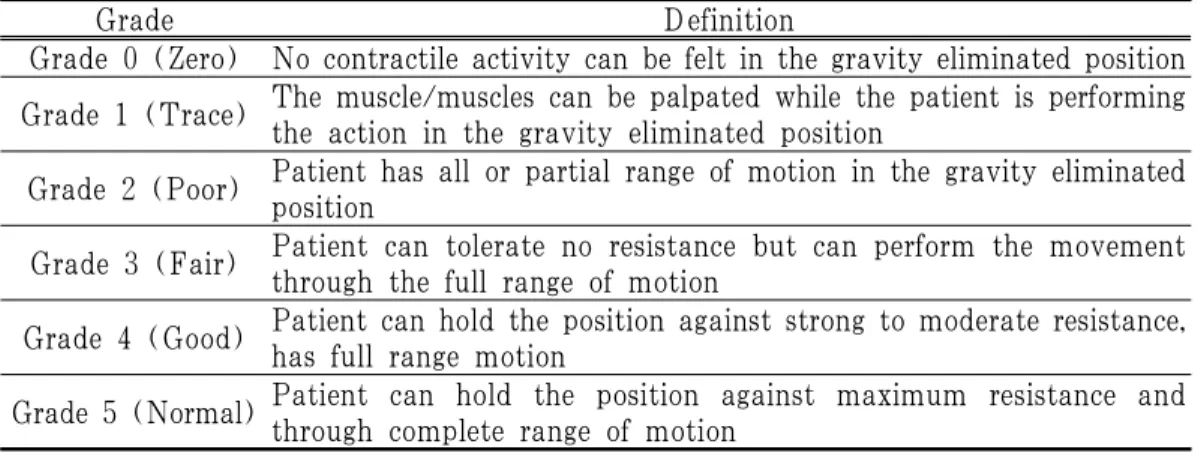
2) Manual Muscle Test (MMT) MMT was used to evaluate the muscle strength of the extensor hallucis longus muscle. MMT is composed of six steps (Table 1).
Grade Definition
Grade 0 (Zero) No contractile activity can be felt in the gravity eliminated position Grade 1 (Trace) The muscle/muscles can be palpated while the patient is performing the action in the gravity eliminated position Grade 2 (Poor) Patient has all or partial range of motion in the gravity eliminated position Grade 3 (Fair) Patient can tolerate no resistance but can perform the movement through the full range of motion Grade 4 (Good) Patient can hold the position against strong to moderate resistance, has full range motion Grade 5 (Normal) Patient can hold the position against maximum resistance and through complete range of motion
Table 1. Manual Muscle Testing (MMT)
3) Numerical Rating Scale (NRS) NRS is a tool to objectively measure the subjective symptoms of the patient.
Symptoms of the patient are represented by a number from 0 to 10, where 0 is the absence of symptoms and 10 is the most severe symptoms.
4) Ankle Hindfoot Scale (AHS) This is a measure for evaluating the ankle joint. The American Orthopedic Foot and Ankle Society created this in 1994. This evaluates the function and stability of the ankle joint. AHS consists of pain (40 points), function (50 points), and alignment (10 points). A perfect AHS score is 100 points.
Ⅲ. Case Reports
Case 1
1. Name : Park ⃝⃝
2. Sex/Age : F/32
3. Chief complaint and current medical history : Lt. foot drop, gait disturbance, mild decreased sensation
4. Onset : 2014. 1. 7 (normal delivery) 5. Hospitalization period : 2014. 1. 27-
2014. 2. 24
6. Past medical history : None 7. Obstetrical history 1-0-0-1 8. Family medical history : None 9. Result of medical examination
1) Needle EMG (2014. 2. 4) : Reduced number of voluntary motor unit action potentials in mainly left S1 distributions
2) Nerve conduction study (Motor NCV,
Sensory NCV) (2014. 2. 7)
(1) Low evoked potential amplitudes of left peroneal motor nerve (2) Normal amplitudes of superficial
peroneal sensory nerve
(3) Normal latencies of bilateral posterior tibial reflexes
10. Change of Ankle dorsiflexion range of motion ROM : Ankle dorsiflexion ROM was changed from -5 to 20 (Table 2).
11. Change of Manual muscle test (MMT) : MMT was changed from 0 to 20 (Table 2).
12. Change of Numerical Rating Scale (NRS) : NRS was changed from 5 to 1 (Table 2).
13. Change of Ankle Hindfoot Scale (AHS) : AHS was changed from 54 to 94 (Table 2).
1/27 2/3 2/10 2/17 2/14 Ankle
dorsiflexion
ROM -5 0 5 14 20
MMT score 0 1 3 3 4
NRS score 5 5 4 2 1
AHS score 54 63 78 88 94 Table 2. The Change of ROM, MMT, NRS and AHS about Case 1
Case 2
1. Name : Byun ⃝⃝
2. Sex/Age : F/30
3. Chief complaint and current medical history : Lt. foot drop and gait disturbance
4. Onset : 2014. 6. 4 (normal delivery)
5. Hospitalization period : 2014. 7. 7-2014.
8. 8
6. Past medical history : None 7. Obstetrical history 1-0-0-1 8. Family medical history : None 9. Result of medical examination
1) Nerve conduction study (Motor NCV, Sensory NCV) (2014. 6. 19)
(1) Normal amplitudes of superficial left peroneal motor & peroneal sensory nerve
(2) Normal latencies of bilateral posterior tibial reflexes
10. Change of Ankle dorsiflexion range of motion (ROM) : Ankle dorsiflexion ROM was changed from 0 to 20 (Table 3).
11. Change of Manual muscle test (MMT) : MMT was changed from 1 to 5 (Table 3).
12. Change of Numerical Rating Scale (NRS) : NRS was changed from 4 to 1 (Table 3).
13. Change of Ankle Hindfoot Scale (AHS) : AHS was changed from 64 to 97 (Table 3).
7/7 7/14 7/21 7/28 8/4 Ankle
dorsiflexion
ROM 0 5 15 20 20
MMT score 1 2 3 5 5
NRS score 4 4 3 2 1
AHS score 64 77 81 93 97 Table 3. The Change of ROM, MMT, NRS and AHS about Case 2
Ⅳ. Discussion
Foot drop can be caused by peroneal nerve palsy. The peroneal nerve includes nerve fibers L5 and S1. Therefore, it affects the associated muscles. Peroneal nerve palsy causes pressure neuropathy due to the pressure exerted from the outside or inside of the body 15) . Peripheral nerve injury causes movement or sensory disorders in which nerves are distributed area 16) . This disease requires a time of three months on average for complete recovery if treated conservatively. If there is no change in symptoms even after the three-month period after the onset, doctors consider Western medical surgery 17) .
In previous studies, peroneal nerve palsy was primarily treated with acupuncture.
Most previous peroneal nerve palsy cases used acupuncture with additional treatments in Korean medicine 6-10) . Acupuncture was used to remove extravasated blood and to help with harmony of Qi-Blood (氣穴).
In this study, acupuncture was operated at the Dokbi (ST 35 ), Joksamni (ST 36 ), Jogu (ST 38 ), Yangneungcheon (GB 34 ), Sinmaek (BL 62 ), Gollyun (BL 60 ), Taegye (KI 3 ), and Taechung (LR 3 ) of the affected patient. These meridian points have Meridian Muscle in the lower abdomen, legs, and hip muscles. These points also removes extravasated blood, harmony of Qi-Blood (氣穴) and relaxes muscles 18) . So we chose these meridian points.
MET helps with the relaxation and
strengthening of the muscles. It is widely
used in chronic diseases and musculoskeletal
disorders in Korean medicine 19) . In recent years, MET has been used in the field of orthopedic diseases. In addition, in Ahn’s study 20) , MET was used in nuchal pain patients. In Kim’s study 13) , MET was used in lower back pain patients.
Moreover, in Ahn and Hong’s 21,22) studies, MET was used in frozen shoulder patients.
Previous studies have used MET for foot drop due to HIVD 23) . After a review of previous studies, it was inferred effective in peroneal nerve palsy. However, it is very low in relation to this article, and there are very few studies on this topic.
During childbirth, the mother contracts the muscles of the lower abdomen, legs, and hips. On admission, both patients’
lower abdomen, leg, and hip muscles were rigid. The excessive use of these muscles is assumed to be the cause of peroneal nerve palsy after normal delivery, because a similar motivative case has been reported in previous papers 24) . The purpose of MET for peroneal nerve palsy after normal delivery is to restore muscle movement, prevent strain, and promote nerve regeneration.
A scale that can accurately grasp the degree of paralysis in order to objectively evaluate the effect of treatment is necessary.
Ankle ROM, MMT, NRS, and AHS are most often used for the evaluation of peroneal nerve palsy. Therefore, we employed these indicators.
In Case 1, she complained of Lt. foot drop, gait disturbance, and mild decreased sensation. She was unable to perform
dorsiflexion of the big toe. Symptoms occurred immediately after delivery. It was her first childbirth, and she gave birth to a girl at the end of 8 hours of labor. She was administered painkillers for a painless childbirth. She inquired about the symptoms to the responsible obstetrician. The doctor said she would feel better soon, but the symptoms did not change after three weeks. After declining birth sequelae, she visited our hospital. In obstetrics, it did not prescribe related symptoms. She did not undergo an examination or treatment at another hospital before visiting our hospital. she could not move her big toe and complained of feeling a little hypoesthesia. She had a tendency to drag her left leg. After treatment, her ROM score was changed from -5 to 20, and her MMT score was changed from 0 to 4. Her NRS score was changed from 5 to 1, and her AHS score was changed from 54 to 94.
In Case 2, she did not complain of decreased sensation. She could perform dorsiflexion of the big toe slightly.
Symptoms occurred immediately after
delivery. It was her first childbirth, and
she gave birth to a girl at the end of
10 hours of labor. She was administered
painkillers for a painless childbirth. She
inquired about the symptoms to the
responsible obstetrician. The doctor said
they would be better soon, but the
symptoms did not change after four
weeks. After declining birth sequelae,
she visited our hospital. In obstetrics, it
did not prescribe related symptoms. She received an orthopedic examination with normal results before coming to our hospital. she could perform dorsiflexion of the big toe slightly. She was capable of walking, and she did not have a tendency to drag leg either. However, her left leg was uncomfortable. After treatment, her ROM score was changed from 0 to 20, and her MMT score was changed from 1 to 5. Her NRS score was changed from 4 to 1, and her AHS score was changed from 64 to 97.
Although the number of cases in this study was small, the cases had slightly higher therapeutic effects as compared to previous studies. In Kim’s study 23) , they used acupuncture, physiotherapy and herbal medicine for treatment. After 5 weeks of treatment, the range of motion (ROM) was almost normal. However, this study took four weeks to reach that state. An objective comparison is difficult because of the differences in the conditions and symptoms of the patients. However, MET may be a useful treatment for patients who have just experienced childbirth or are breastfeeding. MTT is capable of suitably adjusted to the conditions of the patient and it is able to simultaneous perform with any Korean treatment. The effects related to the disease comes from
the stiffness in the muscles has been demonstrated in previous studies 12,13) .
This study included relatively few cases, so the statistical analysis was difficult. There were no side effects after treatment, and the patients were satisfied with the treatment. Judging from the results of this study, MET for peroneal nerve palsy after childbirth may be an effective treatment, and we hope that further studies on peroneal nerve palsy after childbirth and MET will be performed.
This study will serve as important prior material for further research on MET for peroneal nerve palsy after childbirth.
Ⅳ. Conclusion
Through our research, we obtained the following conclusions. In these cases study, we found that MET can change the MMT and AHS scores of patients with peroneal nerve palsy after childbirth.
The symptoms of both patients were improved. MET may be a useful treatment for patients of peroneal nerve palsy after childbirth.
□ Received : Oct 21, 2016
□ Revised : Oct 26, 2016
□ Accepted : Nov 16, 2016
국문초록