Current Photovoltaic Research 3(3) 71-74 (2015) pISSN 2288-3274
Synthesis and Characterization of Soluble Polyaniline and TiO 2 Composite
Byoung-Ju Kim ․ Kwang-Sun Kang*
Department of New and Renewable Energy, Kyungil University, 50 Gamasilgil Hayangup Gyeongsan, Gyeongbuk 38428, South Korea
ABSTRACT: Soluble polyaniline was synthesized by attaching titanium isoproxide (Ti(OPr)
4) to the amine group of the aniline.
Approximately 1 to 1 molar ratio of aniline and Ti(OPr)
4was mixed and polymerized with ammonium persulfate. The FTIR result showed clear difference between TiO
2-aniline composite (TiO
2An) and TiO
2-polyaniline composite (TiO
2PAn). Although the TiO
2An had negligible UV-visible absorption, the TiO
2PAn showed strong absorption in the UV-visible region. Photoluminescence (PL) peaks of TiO
2An were shifted toward red with the reduction of the excitation energy, which could be due to the multiple emission centers. The luminescence peak shift stopped at 501 nm. The PL spectra of TiO
2PAn exhibited three emission peaks at 2.88 eV (430 nm), 2.48 eV (501 nm) and 2.22 eV (558 nm). The new emission center (2.22 eV) was observed after polymerization. Field emission scanning electron microscope image showed crack-free composite film.
Key words: Soluble polyaniline, TiO
2, Composite, Photoluminescence
*Corresponding author: [email protected]
Received July 21, 2015; Revised July 24, 2015;
Accepted July 29, 2015
ⓒ 2015 by Korea Photovoltaic Society
This is an Open Access article distributed under the terms of the Creative Commons Attribution Non-Commercial License (http://creativecommons.org/licenses/by-nc/3.0)
which permits unrestricted non-commercial use, distribution, and reproduction in any medium, provided the original work is properly cited.
1. Introduction
Titanium dioxide (TiO
2) has been a great deal of research subject during the last decades due to the unusual structural, optical, magnetic and chemical properties. As a result, TiO
2has been developed enhanced device applications including gas sensors
1), photoluminescence (PL) devices
2), energy efficient windows
3), photocatalysts
4), water and air purification systems
5), UV protection creams
6), and dye-sensitized solar cells
7). Composites of inorganic metal oxides and organic conducting polymers have been considerable interest in research and development of various application fields. Nano- or micro-structures of TiO
2and conducting polymers, such as polyaniline (PAn), polypyrrole (PPy), polythiophene, poly (3, 4-ethylenedioxythiophere) (PEDOT), and their derivatives have been shown promising for application devices including sensors, biosensors, electrochromic devices, and rectification diodes.
Many researchers have been investigated the preparation of TiO
2-PEDOT
8), TiO
2-PPy
8,9), and nano-TiO
2-PAn
10-12). Among the conjugate polymers, PAn is one of the most important conducting polymers. It has been extensively investigated for
various applications including corrosion protections
12), transparent conductors
13), sensors
14), battery applications
15), active electrodes
16), rechargeable batteries
17), and electrochromic displays
18). Although the PAn has large variety of application fields, the major drawback of PAn is its insolubility in common solvents and its infusibility at elevated temperature, which makes poor processability.
However, alkyl substitution to the aromatic ring of the aniline largely enhances its solubility. Only a few investigations of mono- or di-substituted PAn have been reported. Conductive core-shell microparticles with thin PAn layer have been fabricated in the presence of colloidal core particles. We report the synthetic process of soluble PAn with TiO
2and the characteristics of TiO
2and PAn composite including FTIR, UV-visible spectra, photo- luminescence, and field emission scanning elctronmicroscope (FESEM) image.
2. Experimental
2.1 Materials
Titaniumisopropoxide (Ti(Opr)
4, 97%), aniline (An, 99.5%), acetic anhydride (98%), and 2-propanol (99.5%) were purchased from Sigma Aldrich Co. Ltd. and used without further purification.
71
B.J. Kim and K.S. Kang / Current Photovoltaic Research 3(3) 71-74 (2015) 72
Fig. 1. Schematic representation of the synthetic processes of
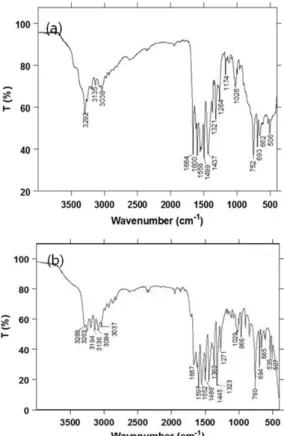
TiO2An and TiO2PAn Fig. 2. FTIR spectra of (a) TiO2An and (b) TiO2PAn
2.2 Synthesis
Schematic view of the synthetic process is depicted in Fig. 1.
To the 100 ml of round bottom flask with a magnetic stirring bar, 25 ml of 2-propanol, and 1 ml of aniline were added, and then 4 ml of Ti(OPr)
4was added to the flask. Finally, 1.2 ml of acetic anhydride was added to the flask and stirred at room tem- perature. Finally, the aniline and Ti(OPr)
4composite was polymerized by adding ammonium persulfate (TiO
2PAn).
2.3 Measurements
The TiO
2An or TiO
2PAn was directly dropped, dried to a KBr plate, and obtained FTIR transmission spectra using Nicolet iS5 FTIR spectrometer. Approximately 7 ml of methanol was added to a UV-visible cuvette, and added TiO
2An or TiO
2PAn to the cuvette, and obtained UV-visible spectra using Thermo Schentific Genesys 10S UV-visible spectrometer. PL spectra of TiO
2An or TiO
2PAn were obtained with Hitachi F-450 fluorescence spec- trometer with the methanol-TiO
2An or methanol TiO
2PAn solution.
The polymerized TiO
2PAn was spin-coated on a silicon wafer, and the FESEM image was obtained with field emission scanning microscope (JEOL ISM-7401F).
3. Results and Discussion
Heterostructures comprised of organic conducting polymers and inorganic oxides have been discovered an extensive interest in research and development for many practical applications with nono- and micro structures of TiO
2and PAn. Since the Ti(OPr)
4is very quickly hydrolyzed by trace of water to form Ti(OH)
4and precipitate from the solution, many researchers have used diethanolamine as a stabilizer for Ti(OPr)
4. The aniline was used as a stabilizer for Ti(OPr)
4instead of diethanolamine
and used as a polymer backbone. Schematic view of synthetic processes is shown in Fig. 1. The synthesized TiO
2An color slowly changed from intense yellow to dark after addition of ammonium persulfate as shown in Fig. 1.
Fig. 2(a) and 2(b) show the FTIR spectra of TiO
2An and TiO
2PAn, respectively. The sharp and strong absorption peak at 3259 cm
-1is due to the -N-H stretching vibration for TiO
2An.
The absorptions peaks at 3070, 3038, 2974, 2929, 1600, 1555, 1540, 1498 cm
-1are attributed to –CH stretching vibration. The absorption peaks at 1618, 1600, 1478 and 1437 cm
-1were observed due to the ring stretching vibration of the aniline. The bending vibrations of –CH bonds are appeared at 1174, 1153, 1122 and 997 cm
-1. Deformations of –CH bonds are at 905 and 752 cm
-1. The absorption peaks at 1663 and 1264 cm
-1represent the C=C stretching vibration of the benzene ring and C-N stretching vibration, respectively. The absorption peaks at 1026 and 662 cm
-1are due to the stretching vibration of Ti-O-Ti.
Additional new peaks of –N-H stretching vibration appear at
3263, 3194, and 3084 cm
-1after polymerization. Most of the
absorption peaks of the TiO
2PAn are slightly shifted toward
higher frequency, which implies that the polymerized molecule
has more rigid structure than TiO
2An.
B.J. Kim and K.S. Kang / Current Photovoltaic Research 3(3) 71-74 (2015) 73
Fig. 3. UV-visible spectra of (a) TiO2An and (b) TiO2PAn in methanol
Fig. 4. PL spectra of (a) TiO2An and (b) TiO2PAn, (c) FESEM image of a TiO2PAn film
The colors of TiO
2An and TiO
2PAn are intense yellow and dark green, respectively, and the UV-visible spectra of various amounts of TiO
2An and TiO
2PAn in methanol are shown in Fig.
3 (a) and (b), respectively. Visible range absorption is negligible for TiO
2An with the increase of the amount of TiO
2An. However, UV-visible range absorption is drastically increased with increasing the amount of TiO
2PAn. The absorption peak obtained by UV-visible differential absorption spectrum with 77 mg of TiO
2PAn was at 365 nm.
Since the luminescence process competes with nonradiative process and exciton dissociation, the PL quenching is closely related with the degree of exciton dissociation and nonradiative process. Therefore, large amount of PL quenching indicates the possible success of solar cell development
19). The PL spectra in methanol for TiO
2An and TiO
2PAn with various excitation wavelengths are shown in Fig. 4 (a) and (b), respectively. The emission bands are at around 450 ~ 470 nm for TiO
2An with the excitation wavelengths between 360 to 400 nm. The emission peak is at around 490 nm for TiO
2PAn with the short excitation wavelengths (380 ~ 400 nm). However, when the excitation wavelengths increase, the second emission band becomes major emission band at 540 nm, which corresponds to the long tail of
the absorption band. Compared with the emission intensities of
TiO
2An and TiO
2PAn, TiO
2PAn intensity is much less than the
emission intensity of TiO
2An, which implies that the charge
separation process is preferred process than emission process
for the TiO
2PAn. The TiO
2PAn film was fabricated to the
silicon wafer to identify the polymer film. Fig. 4 (c) shows the
FESEM image of the TiO
2PAn film with a crack-free.
B.J. Kim and K.S. Kang / Current Photovoltaic Research 3(3) 71-74 (2015) 74
4. Conclusions
A soluble PAn and TiO
2composite was fabricated by adding 2-propanol, aniline, Ti(OPr)
4, acetic anhydride and ammonium persulfate. The aniline was used as a stabilizer for Ti(OPr)
4. The PAn with Ti-OH became a soluble conjugate polymer in 2-propanol.
The FTIR spectrum TiO
2PAn showed more complicate and rigid structure than that of TiO
2An. Although the UV-visible absorption of TiO
2An is negligible, the UV-visible absorption of TiO
2PAn is greatly increased. The luminescence peak shifted toward longer wavelength with increasing the excitation wavelength for both TiO
2An and TiO
2PAn due to the multiple emission centers. The emission intensity of the TiO
2PAn was much less than that of TiO
2An, which indicated that the charge separation process of the exciton was preferred process for the TiO
2PAn.
Acknowledgments
This work has been supported by Kyungil University in Korea.
References
1. Nasirian, S., Moghaddam, H. M., “Polyaniline assisted by TiO2:SnO2 nanoparticles as a hydrogen gas sensor at environ- mental conditions,” Vol. 328, pp 395-404, 2015.
2. Rajabi, S., Shogh, A., Iraji, zad., “Defect study of TiO2 nano- rods grown by a hydrothermal method through photolumines- cence spectroscopy,” J. Luminescence Vol. 157, pp 235-242, 2015.
3. Zheng, J., Bao, S., Jin, P., “TiO2(R)/VO2(M)/TiO2(A) multi- layer film as smart window: Combination of energy-saving, an- tifogging and self-cleaning functions,” Nano Energy, Vol. 11, pp 136-145, 2015.
4. Wang, J., He, B., Kong, X. Z., “A study on the preparation of floating photocatalyst supported by hollow TiO2 and its per- formance,” Applied Surface Sci. Vol. 327, pp 406-412, 2015.
5. Sarantopoulos, C., Puzenat, E., Guillard, C., Hermann, J. M., Gleizes, A. N., Maury, F., “Microfibrous TiO2 supported pho- tocatalysts prepared by metal-organic chemical vapor infiltra- tion for indoor air and waste water purification,” Applied Catalysis B: Environmental Vol. 91, pp 225-233, 2009.
6. Salvador, A., Pascual-Marti, M. C., Adell, J. R., Requeni, A., March, J. G., “Analytical methodologies for atomic spectro-
metric determination of metallic oxides in UV sunscreen creams,”
J. Pharmaceutical Biomedical Analysis, Vol. 22, pp 301-306, 2000.
7. Parthiban, S., Anuratha, K. S., Arunparabaharan, S., Abinesh, S., Lakshminarasimhan, N., “Influence of FO incorporation in TiO2 nanofibers on the electrode efficiency in dye-sensitized so- lar cells,” Ceramics Inter. Vol. 41, pp 1205-1212, 2015.
8. Dziewonski, P. M., Grzeszczuk, M., “Towards TiO2-conducting polymer hybrid materials for lithium ion batteries,” Electrochimica Acta Vol. 55, pp 3336-3347, 2010.
9. Barman, S., Deng, F., McCreey, R. L., “Conducting polymer memory devices based on dynamic doping,” J. Am. Chem.
Soc. Vol. 130, pp 11073-11081, 2008.
10. Gurunathan, K., Amalnerkar, D. P., Trivedi, D. C., “Synthesis and characterization of conducting polymer composite (PAn/TiO2) for cathode material in rechargeable battery,” Mater. Lett. Vol.
57, pp 1642-1648, 2003.
11. Mahulikar, P. P., Jadhav, R. S., Hundiwale, D. G., “Performance of polyaniline/TiO2 nanocomposites in epoxy for corrosion re- sistant coatings,” Iranian Poly. J. Vol. 20, pp 367-376, 2011.
12. Radhakrishnan, S., Siju, C. R., Mahanta, D., Patil, S., Madras, G., “Conducting polyaniline-nano-TiO2 composites for smart corrosion resistant coatings,” Electrochimica Acta Vol. 54, pp 1249-1254, 2009.
13. Xu, H., Cao, Q., Wang, X., Li, W., Li, X., Deng, H.,
“Properties and chemical oxidation polymerization of polyani- line/neutral red/TiO2 composite electrodes,” Mater. Sci. Eng.
B Vol. 171, pp 104-108, 2010.
14. Nasirian, S., Moghaddam, H. M., “Polyaniline assisted by TiO2:SnO2 nanoparticles as a hydrogen gas sensor at environ- mental conditions,” Applied Surface Sci. Vol. 328, pp 395-404, 2015.
15. Li, J., Zhao, X., Zhang, Z., Lai, Y., “Facile synthesis of hollow carbonized polyaniline spheres to encapsulate selenium for ad- vanced rechargeable lithium-selenium batteries,” J. Alloys and Compounds Vol. 619, pp 794-799, 2015.
16. Bian, C., Yu, A., Wu, H., “Fibriform polyaniline/nano-TiO2 composite as an electrode material for aqueous redox super- capacitors,” Electrochem. Commun. Vol. 11, pp 266-269, 2009.
17. Gurunathan, K., Amalnerkar, D. P., Trivedi, D. C., “Synthesis and characterization of conducting polymer composite (PAn/TiO2) for cathode material in rechargeable battery,” Mater. Lett. Vol.
57, pp 1642-1648, 2003.
18. Fu, X., Jia, C., Wan, Z., Weng, X., Xie, J., Deng, L., “Hybrid electrochromic film based on polyaniline and TiO2 nanorods array,” Organic Electronics Vol. 15, pp 2702-2709, 2014.
19. Kwong, C. Y., Choy, W. C. H., Djuristic, A. B., Chui, P. C., Cheng, K. W., Chan, W. K., “Poly(3-hexylthiophene):TiO2
nanocomposites for solar cell applications,” Nanotechnol. Vol.
15, pp 1156, 2004.