https://doi.org/10.7585/kjps.2017.21.3.324
Open Access
324
현미 도정과정에 따른 살균제 Hexaconazole, Tricyclazole 및 살충제 Etofenprox, Imidacloprid 잔류량 변이
노진호
†,*·임성진
†·진용덕·김단비·최근형·김상수·이학원·박지현 농촌진흥청 국립농업과학원 농산물안전성부
Residue Patterns of Hexaconazole, Tricyclazole, Etofenprox and Imidacloprid in Polished and Unpolished Rice
Jin-ho Ro
†,*, Sung-Jin Lim
†, Yong-duk Jin, Danbi Kim, Geun-Hyoung Choi, Sang-Su Kim, Hak-won Lee, and Ji-hyun Park
National Institute of Agricultural Sciences, Rural Development Administration (Received on July 19, 2017. Revised on September 25, 2017. Accepted on September 25, 2017)
Abstract This study was performed to elucidate pesticide residues of hexaconazole, tricyclazole, etofenprox and imidacloprid in polished and unpolished rice. The pesticides were sprayed two and three times onto the crops at recommended and double dose, and the residue of them were determined in polished and unpolished rice after harvested. Hexaconazole residues of polished and unpolished samples were <LOD-0.04 and <LOD- 0.09 mg/kg, respectively. Tricyclazole residues of polished and unpolished samples were 0.17-0.88 and 0.32- 1.37 mg/kg, respectively. Etofenprox was not detected on polished samples at recommended and double dose, but the residues in unpolished samples were 0.03-0.26 mg/kg. Imidacloprid residues of polished and unpolished samples were <LOD-0.02 and <LOD-0.07 mg/kg, respectively. The pesticide residues were notably decreased in polished rice. These results showed that polishing would be an effective method to reduce the residue of hexaconazole, tricyclazole, etofenprox and imidacloprid residues in rice.
Key words Pesticide residue, Polished and unpolished rice, Safety
서 론
쌀은 전세계 인구의 절반이상이 주식으로 삼는 매우 중요 한 곡물이다(Guraya et al., 1985; Lee, 2012). 국내에서는 2016 년에 778,734 ha의 재배면적에서 419만 7천톤의 쌀이 생산되어 농산물 중 생산량 1위로 중요한 위치를 점유하고 있다(KOSIS, 2017). 쌀은 벼 재배과정을 거쳐 수확된 조곡 (unhulled rice) 의 최외각층인 왕겨(hull)만 벗긴 현미 혹은 도정한 백미로 이용한다(Choi et al., 2008; Sung et al., 2011). 소비자들은 거친 식감 등의 이유로 현미보다 백미를 과거에는 선호하였으나 근래에는 백미에 비해 현미에는 섬 유질을 비롯한 각종 식이섬유, γ-amino butyric acid (GABA),
비타민(B1, B2, E), 지방, 단백질이 풍부하며 칼슘, 철분을 비롯한 미네랄 등이 다량으로 함유되어 있기 때문에 당뇨예 방, 혈당강하 등의 건강증진을 목적으로 현미섭취를 선호하 고 있다(Kim et al., 2011; Krishna et al., 2001; Sung et al., 2011).
현재 쌀 중 농약잔류량 시험은 현미시료를 대상으로 수행 하게 되어 있다(MFDS, 2017). 잔류농약 분석기준인 현미로 생산된 쌀의 농약잔류량을 분석 시 잔류기준치를 초과하였 으나, 백미에서의 분석결과가 잔류기준에 적합하다면 농민 에게는 경제적 손실, 소비자에게는 혼란 및 농식품 불신 등 이 야기될 수 있다. 농약잔류량은 농약의 작물잔류성, 작물 체 표면의 굴곡, 융모의 양과 형태, 중량에 대한 표면적 비 등에 따라 달라지므로 쌀 중 농약잔류량의 정확한 분석을 위해서는 현미와 백미에 대한 비교연구가 필요하다(Kwon et al., 2004; Ha and Ra, 2016; Wang and Liu, 2007; Kim
*Corresponding author E-mail: [email protected]
†These authors contributed equally to this work
ORIGINAL ARTICLES
et al., 2011).
국내에서는 벼 재배 시 침투이행성, 내우성 농약으로 예 방 및 치료효과가 좋은 ergosterol biosynthesis inhibitor (EBI) 계 살균제 hexaconazol, 도열병 방제에 많이 사용되는 침투성 농약으로 melanin 생합성을 저해하는 살균제 tricyclazole, 멸구류 등 다양한 해충의 동시 방제가 가능한 비침투성 농약인 살충제 etofenprox 및 약효지속기간이 길 고 침투이행성인 살충제 imidacloprid가 많이 사용되고 있다 (KCPA, 2016; Kim et al., 2012; Manclús et al., 2008;
Otake et al., 2008; Pareja et al., 2011; Tomlin, 2009;
Tsochatzis et al., 2011). 따라서 본 연구에서는 벼 재배 시 많이 사용되고 있는 hexaconazole, tricyclazole, etofenprox 및 imidacloprid를 살포하고, 벼 수확 후 현미 및 백미 중 이 들의 잔류량을 분석·비교하여 쌀 도정에 따른 농약잔류량 의 감소효과를 구명하고자 하였다.
재료 및 방법
시험포장 및 대상작물
전북 완주군의 시험포장에 2016년 4월에 파종한 조평벼 를 5월에 이앙하였다. 처리구는 30 m
2(폭 10.0 m × 길이 3.0 m) 크기로 3반복을 무작위로 배치하였다. 교차오염을 방 지하기 위해 처리구 사이에 완충지대(폭 10.0 m × 길이 1.0 m) 를 설치하였으며 대조구(폭 10.0 m × 길이 9.0 m)를 동일 포장 내에 배치하였다.
시험약제, 약제살포 및 시료조제
시험약제는 모두 시중에서 구입하였고, 농약안전사용기준 에 따라 hexaconazole+tricyclazole (4.5+22.5%, 액상수화제)은
750배, etofenprox (10%, 유탁제)는 1,000배, imidacloprid (8%, 액상수화제)는 5,000배 희석하여 조제한 다음 표준살 포농도(기준량)와 이의 희석배수가 1/2인 2배농도(배량)를 배부식 동력분무기(Maruyama, Tokyo, Japan)로 살포하였다.
시험에 사용된 약제의 특성, 종류 및 안전사용기준은 Table 1과 Table 2에 나타냈다.
Hexaconazole과 tricyclazole 3회 처리구는 수확 전 44- 37-30, 2 회 처리구는 수확 전 44-37일에 처리, etofenprox와 imidacloprid 3 회 처리구는 수확 전 30-21-14, 2회 처리구는 수확 전 21-14일에 처리하였다. 수확 후 탈곡(SY21F.TH.PS, Ssangyong, Incheon, Korea)하여 일광건조하고 제현기 (FC2K, Otake, Ama, Japan)로 왕겨를 제거하여 현미시료를 준비하였고, 현미 시료 중 절반을 정미기를 사용하여 시중 백미와 동일한 12분도로 도정(VP-32T, Yamamoto, Higashine, Japan) 한 다음 분쇄하고 40 mesh 이상 통과분을 시료로 사 용하였다. 또한, 모든 시료는 균질화한 다음 폴리에틸렌백에 넣어 냉동보관(–20
oC)하며 일정량을 취하여 분석에 사용하 였다.
표준품 및 시약
농약표준품 etofenprox (97.7% purity), hexaconazole (99.0% purity), imidacloprid (98.0% purity) 및 tricyclazole (98.5% purity) 은 Dr. Ehrenstorfer (Augsburg, Germany)에 서 구입하여 사용하였다. 분석시료의 전처리에 필요한 acetone, acetonitrile, Celite 545, dichloromethane, ethyl acetate, n-hexane, sodium chloride 및 sodium sulfate는 Merck 사(Darmstadt, Germany)의 HPLC grade 제품을 사용 하였고, Florisil solid phase extraction (SPE) cartridge (1,000 mg, 6 mL), Silica SPE cartridge (1,000 mg, 6 mL)과
Table 2. Pesticide products for spraying and their safe guidelines
Pesticide Formulation A.I. content
a(%)
Dilution rate (times)
Safe use guideline PHI
b(day) MAF
c(time)
Hexaconazole+tricyclazole SC
d(4.5+22.5) 750 30 3
Etofenprox EW
e10 1,000 14 3
Imidacloprid SC 8 5,000 14 3
aActive ingredient.
bPre-harvest interval.
cMaximum application frequency
dSuspension concentrate.
eEmulsion in water.
Table 1. Physico-chemical properties and MRLs of the pesticides
Pesticide Vapor Pressure (mPa) Log K
owWater solubility (g/L) MRL in rice (mg/kg)
Hexaconazole 0.018 (20
oC) 3.9 0.017 (20
oC) 0.3
Tricyclazole 5.86 × 10
−4(20
oC) 1.42 0.596 (20
oC) 0.7 Etofenprox 8.13 × 10
−4(25
oC) 6.9 2.25 × 10
−2(25
oC) 1.0
Imidacloprid 9 × 10
−7(25
oC) 0.57 0.61 (20
oC) 0.05
NH
2SPE cartridge (1,000 mg, 6 mL) 는 Agilent사(California, USA) 제품을 사용하였다.
잔류분석
추출마쇄한 시료 20 g에 증류수 20 mL를 첨가하여 1시간 동 안 습윤시키고, acetone 100 mL를 가하여 homogenizer (IKA, Staufen, Germany) 로 5분간 균질화한 후 추출물을 Celite 545 를 사용하여 흡인여과하고, 여분의 50 mL acetone 으로 잔사와 용기를 씻어내어 앞의 여액과 합하였다. 여액을 농축한 다음 증류수 100 mL와 포화식염수 50 mL를 가하고 dichloromethane (100+50 mL) 으로 2회 분배·추출하였다 (hexaconazole 은 n-hexane (100+50 mL)으로 2회 분배·추출).
정제
Hexaconazole 은 n-hexane 추출액을 anhydrous sodium sulfate 로 탈수하고 40
oC 에서 감압농축한 다음 2 mL n- hexane 에 재용해하여 정제에 사용하였다. n-Hexane 5 mL를
사용하여 활성화한 Florisil SPE (1,000 mg, 6 mL)에 시료액 2 mL를 loading한 후 n-hexane 5 mL를 흘려버리고, n- hexane/acetone (90/10, v/v) 15 mL로 용출시킨 용리액을 감 압농축하고, 이를 acetone 2 mL에 재용해하여 Table 3의 조 건에서 GC-ECD로 분석하였다.
Tricyclazole은 dichloromethane 추출액을 anhydrous sodium sulfate로 탈수하고 40
oC 에서 감압농축한 다음 2 mL n-hexane에 재용해하여 cartridge 정제에 사용하였다. n- Hexane 5 mL 를 사용하여 활성화한 Silica SPE (1,000 mg, 6 mL)에 시료액 2 mL를 loading한 후 n-hexane/ethyl acetate (40/60, v/v) 5 mL 를 흘려버리고, ethyl acetate 15 mL로 용 출시킨 용리액을 감압농축하고, 건고물을 acetonitrile 2 mL 에 재용해하여 Table 4의 조건에서 HPLC-UVD로 분석하 였다.
Etofenprox 는 dichloromethane 추출액을 anhydrous sodium sulfate로 탈수하고 40
oC 에서 감압농축한 다음 2 mL n- hexane 에 재용해하여 cartridge 정제에 사용하였다. n- Hexane 5 mL 를 사용하여 활성화한 Silica SPE (1,000 mg,
Table 4. HPLC conditions for tricyclazole, etofenprox and imidacloprid analysis
Items Analytical condition
Instrument HP-1100 series with UV (Agilent, California, USA)
Column C
18(INNO, 250 × 4.6 mm, 5 µm, 120 Å, YoungJin Biochrom, Gyeonggi, Korea) Column temperature 40
oC
Injection volume 10 µL Flow rate 1.0 mL/min
Mobile phase
Tricyclazole
Time (min) Water (%) Acetonitrile (%)
0 90 10
15 70 30
35 90 10
Etofenprox Water/Acetonitrile (20/80, v/v) Imidacloprid Water/Acetonitrile (25/75, v/v) Wavelength Etofenprox: 214 nm, Imidacloprid: 275 nm, Tricyclazole: 225 nm Retention time Etofenprox: 14.4 min, Imidacloprid: 8.3 min, Tricyclazole: 22.3 min Table 3. GC conditions for hexaconazole analysis
Items Analytical condition
Instrument Agilent 7890A series with ECD (Agilent, California, USA)
Column HP-5 (30 m × 0.25 mm I.d., 0.25 µm film thickness, Agilent, California, USA) Carrier gas 1.0 mL/min
Makeup gas N
2, 60 mL/min
Oven temperature 200
oC (5 min hold), 50
oC/min to 300
oC (13 min hold) Detector temperature 300
oC
Inlet temperature 270
oC
Split ratio 30:1
Injection volume 1.0 µL
Retention time 6.6 min
6 mL) 에 시료액 2 mL를 loading한 후 n-hexane 3 mL를 흘 려버리고, n-hexane/ethyl acetate (95/5, v/v) 5 mL로 용출시 킨 용리액을 감압농축하고, 건고물을 acetonitrile 2 mL에 재 용해하여 HPLC-UVD로 분석하였다(Table 4).
Imidacloprid 는 dichloromethane 추출액을 anhydrous sodium sulfate 로 탈수하고 40
oC 에서 감압농축한 다음 2 mL dichloromethane 에 재용해하여 cartridge 정제에 사용하 였다. Dichloromethane 5 mL를 사용하여 활성화한 NH
2SPE (1,000 mg, 6 mL) 에 시료액 2 mL를 loading한 후 dichloromethane/methanol (97/3, v/v) 6 mL 로 용출시킨 용 리액을 감압농축하고, 건고물을 acetonitrile 2 mL에 재용해 하여 HPLC-UVD로 분석하였다(Table 4).
분석법의 유효성 검증
시험약제의 정량분석을 위한 시험방법의 유효성은 검량선 의 직선성, 검출한계(limit of detection, LOD), 회수율을 사 용하여 검증하였다. 검량선의 직선성은 약제를 각각 100 mL acetonitrile에 용해하여 100 mg/L의 stock solution을 제 조하고, 이를 동일 용매로 희석하여 hexaconazole 및 eto- fenprox는 0.005-5 mg/L, tricyclazole 및 imidacloprid는 0.1- 10.0 mg/L 표준용액을 제조한 다음 검량선을 작성하였다.
현미, 백미 중 모든 시험약제의 LOD는 아래의 식으로부터
산출하였다.
국내의 회수율 시험 기준은 분석성분의 처리수준을 검출 한계의 5-10배(저농도)와 50-100배(고농도) 농도의 2 수준 에서 수행할 것을 요구하고 있다. 본 시험에서는 무처리 시 료 20 g에 LOD의 10배 및 50배 농도수준인 hexaconazole 및 etofenprox는 0.05 및 0.25, tricyclazole및 imidacloprid는 0.05 및 0.25 mg/kg 수준으로 첨가하였다. 시험약제 첨가 후 균일하게 혼합한 다음 30분간 방치하고, 상기의 잔류분석 방법에 따라 3회 반복 수행하였다. 회수율은 각 물질의 검 량선에 대입하여 얻은 농도와 첨가농도의 비를 백분율(%) 로 산출하였다.
결과 및 고찰
검량선, 회수율 및 검출한계
Hexaconazole과 etofenprox, tricyclazole과 imidacloprid의 검량선은 각각 0.005-5, 0.1-10 mg/L 표준용액을 제조한 다 음 Table 3과 Table 4의 기기조건에서 분석하고, 각 성분의 피크면적으로부터 작성하였다. Hexaconazole, tricyclazole, LOD (mg/L) = 최소검출량 (ng) × 최종재용해량 (mL)
기기주입량 (µL) × 시료량 (mL)
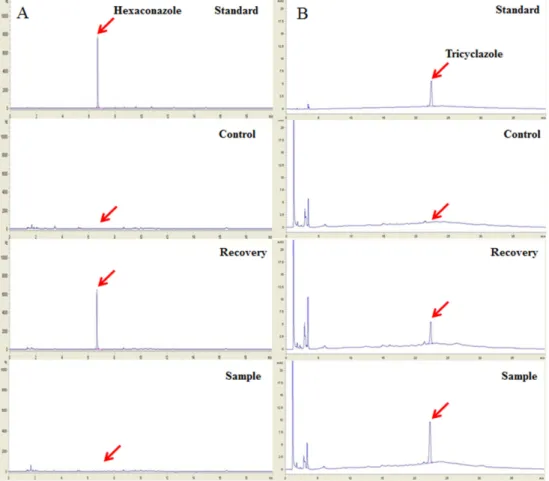
Fig. 1. Representative standard, control, recovery and sample chromatogram of hexaconazole (A) and tricyclazole (B).
etofenprox 및 imidacloprid의 머무름 시간은 각각 6.6, 17.2, 14.4 및 8.3분 이었고(Fig. 1, Fig. 2), 검량선의 회귀방정식 은 각각 y=5939.7x-974.66 (R
2=0.9992), y=75.394x+0.652 (R
2=0.9999), y=45.299x-0.8564 (R
2=0.9996) 및 y=45.884x- 4.4133 (R
2=0.9969)으로 검량선의 직선성과 결정계수(R
2) 는 모두 양호하였다.
시험농약 hexaconazole, tricyclazole, etofenprox 및 imidacloprid 의 LOD는 각각 0.005, 0.01, 0.005 및 0.01 mg/
kg 이었고, 현미와 백미 중 회수율과 상대표준편차(RSD, relative standard deviation) 는 각각 hexaconazole 80.5-91.1, tricyclazole 72.7-88.0, etofenprox 72.8-96.6 및 imidacloprid 77.6-96.6%, 2.4-5.4, 0.3-5.1, 0.5-3.4 및 1.1-1.5%로 농촌진 흥청에서 권장하는 회수율 70-120%, RSD 20% 이내의 조 건을 충족하였다(RDA, 2016, Table 5).
현미와 백미 중 시험농약의 잔류 양상 비교
현미와 백미 중 시험농약의 농약잔류 양상은 농약안전사 용의 기준량과 2배량으로 각각 hexaconazole과 tricyclazole
을 수확 전 2회(37, 30 일)처리 및 3회(44, 37, 30일)처리, etofenprox와 imidacloprid를 수확 전 2회(21, 14일)처리 및 3회(30, 21, 14일)처리하고, 수확 후 농약잔류량을 조사하여 비교하였다(Table 6, 7)
Hexaconzole 은 기준량 처리구에서 현미와 백미 모두 잔 류량이 검출한계 미만이었고, 배량 처리구에서 현미 0.05- 0.08, 백미 0.03-0.04 mg/kg 수준으로 검출되어 현미에서 백 미 보다 1.7-2.0배 높은 잔류량을 나타냈으나 쌀 중 hexaco- nazole 최대잔류허용량(maximum residue level, MRL) 0.3 mg/kg 보다는 현저히 낮은 수준이었다(Table 6, 7).
Tricyclazole은 기준량 처리구에서 현미 0.33-0.42, 백미
0.17-0.22 mg/kg 수준으로 검출되어 현미에서 백미 보다 1.9
배 높은 잔류량을 나타냈고, 배량 처리구에서 현미 0.93-
1.22, 백미 0.64-0.79 mg/kg 수준으로 검출되어 현미에서 백
미 보다 1.5배 높은 잔류량을 나타냈다. 이상의 결과는
tricyclazole 기준량 처리구에서는 쌀 중 MRL 0.7 mg/kg 보
다 현저히 낮은 수준이었으나, 배량 처리구에서는 2회 처리
백미를 제외하고 모두 MRL을 초과하는 결과를 나타냈다
Fig. 2. Representative standard, control, recovery and sample chromatogram of etofenprox (A) and imidacloprid (B).
(Table 6, 7).
Etofenprox 는 백미의 경우 기준량 및 배량 처리구에서 모 두 잔류량이 검출한계 미만이었고, 현미의 경우 기준량 처 리구에서 0.03-0.04, 배량 처리구에서 0.16-0.21 mg/kg 수준 으로 검출되어 etofenprox 기준량 및 배량 처리구 모두 쌀 중 MRL 1.0 mg/kg 보다 현저히 낮은 수준으로 잔류하는 결과를 나타냈다(Table 6, 7).
Imidacloprid 는 기준량 처리구에서 현미와 백미 모두 잔류 량이 검출한계 미만이었고, 배량 처리구에서 현미 0.06-
0.07, 백미 0.02 mg/kg 수준으로 검출되어 현미에서 백미 보 다 3.0-3.5배 높은 잔류량을 나타냈다. 이상의 결과는 기준 량 처리구의 현미 및 백미, 배량 처리구의 백미의 경우 imidacloprid의 쌀 중 MRL 0.05 mg/kg 보다 현저히 낮은 수준이었나, 배량 처리구 현미의 경우는 MRL을 초과하는 결과를 나타냈다(Table 6, 7).
상기의 현미 및 백미 중 hexaconazole, tricyclazole, etofenprox 및 imidacloprid 잔류량 시험결과는 벼 재배 시 농약안전사용 기준을 준수하여 농약을 살포하면 안전한 농 Table 5. Recoveries and limit of detection for tested pesticides
Pesticide Part Fortification (mg/kg) Recovery (%)
aRSD
bLOD (mg/kg)
cHexaconazole
UR
d0.05 91.0±2.2 2.4
0.005
0.25 83.1±4.5 5.4
PR
e0.05 88.5±2.8 3.2
0.25 84.6±4.2 5.0
Tricyclazole
UR 0.1 86.9±1.2 1.3
0.5 83.7±0.3 0.3 0.01
PR 0.1 81.7±2.8 3.4
0.5 77.3±3.9 5.1
Etofenprox
UR 0.05 96.2±0.5 0.5
0.005
0.25 87.6±1.0 1.2
PR 0.05 76.8±2.6 3.4
0.25 75.3±2.5 3.3
Imidacloprid
UR 0.1 90.0±2.2 2.5
0.5 79.7±2.8 3.5 0.01
PR 0.1 95.5±1.1 1.1
0.5 84.0±4.3 5.1
aMeans±standard deviation of three replicates
bRelative standard deviation (SD/Average × 100)
cLimit of detection
dUnpolished rice
ePolished rice
Table 6. Pesticide residues in unpolished/polished rice with recommended dose Pesticide Application
(times)
Residues (mg/kg)
MRL (mg/kg)
cUR
aPR
bHexaconazole 2 <LOD
d<LOD
3 <LOD <LOD 0.3
Tricyclazole 2 0.33±0.01 0.17±0.00
3 0.42±0.01 0.22±0.00 0.7
Etofenprox 2 0.03±0.00 <LOD
3 0.04±0.00 <LOD 1.0
Imidacloprid 2 <LOD <LOD
3 <LOD <LOD 0.05
aUR: Unpolished rice
bPR: Polished rice
cMaximum residue level in rice
dLOD: Limit of detection
산물을 확보할 수 있고, 현미 중 4개의 시험농약 잔류량이 백미에 비해 1.7배 이상 높은 결과를 나타내어 백미로의 가 공이 잔류량을 감소시키는 효과적인 방법임을 확인하였다.
본 연구의 결과는 쌀 중 침투성 농약 isoprothiolane과 acephate 의 현미 중 잔류량이 백미에 비해 2-4배 높게 나타 난 결과와 동일하였고, 이러한 차이는 현미를 백미로의 가 공과정에서 작물표면 특성, 비표면적 등의 변화로부터 기인 된 것으로 판단된다(Baik et al., 1982; Kwon et al., 2004).
또한 본 연구의 결과에 나타난 바와 같이 쌀의 도정 여부에 따라 농약의 잔류량이 현저히 달라짐에도 우리나라 식품의 약품안전처(Ministry of Food and Drug Safety, MFDS)는 잔류허용기준을 쌀로 설정하고 있고, 쌀 중 농약 잔류량 시 험은 현미시료를 대상으로 수행하게 되어 있다(MFDS, 2017). KOSIS 에 따르면 2016년도에 현미는 778,734 ha 농 경지에서 4,517,430 ton이 생산되어 4,083,756 ton (90.4%) 이 12분도의 백미로 도정되었고, Lee and Kim (2011)은 우 리나라에서 쌀은 식미 향상을 위해 현미를 도정하여 백미로 소비되고 있음을 보고한 바 있다. 따라서 생산된 쌀의 대부 분이 백미로 소비되므로 농약의 잔류허용기준을 현미와 백 미에 대하여 각각 설정하고, 농약 잔류량 시험의 시료 또한 현미와 백미를 구분하여 수행되어야 할 것으로 판단된다.
감사의 글
본 연구는 농촌진흥청 국립농업과학원 농업과학기술 연구 개발사업(과제번호: PJ010161022015)의 지원에 의하여 이 루어진 것입니다.
Literature Cited
Baik, O. R., J. K. Roh and T. J. Kim (1982) Degradation and
residue of fujione and ortran in Korean rice paddy system. J.
Korean Agric. Chem. Soc. 25(2):93-98.
Choi, Y. H., S. L. Kim, E. G. Jeong, J, Song, J. T. Kim, J. H., Kim and C. G. Lee, (2008) Effects of low-temperature storage of brown rice on rice and cooked rice quality.
Korean J. Crop Sci. 53(2):179-186.
Guraya, H. S., R. S. Kadam and E. T. Champagne (1985) Effect of rice starch-lipid complex on in vitro digestibility, complexing index viscosity. Cereal Chem. 74(5):561-565.
Ha, S. S and W.S, Ra (2016) Investigation of pesticide residues by polishing on rice, brown rice and white rice. 2016 Annual Meeting of the KSPS. pp68.
KCPA (2016) Using guideline of crop protection agents. Korea Crop Protection Association, Samjung Inc. Seoul, Korea pp410, 594-597, 614-617.
Kim, D. J., S. K. Oh, M. R. Yoon, A.R. Chun, I. S. Choi, D. H.
Lee, J. S. Lee, K. W. Yu and Y. K. Kim (2011) The Change in Biological Activities of Brown Rice and Germinated Brown Rice. J. Korean Soc. Food Sci. Nutr. 40(6):781-789.
Kim, J. H., G. H. Choi, J. H. Lee and O.K. Kwon (2012) Investigation of residual tricyclazole and its risk assessment in Korean sundried salts. Kor. J. Pesti. Sci 16(3):257-260.
KOSIS (Korean statistical information system) (2017) Crop Production Survey. http://kosis.kr/statisticsList/statisticsList _01List.jsp?vwcd=MT_ZTITLE&parentId=F#SubCont.
Accessed 13 April 2017.
Krishna, A. G. G, S. Khatoon, P. M. Shiela, C. V. Sarmandal, T.
N. Indira and A. Mishra (2001) Effect of Refining of Crude Rice Bran Oil on the Retention of Oryzanol in the Refined Oil. J. Am. Oil Chem. Soc. 78(2):127-132.
Kwon, H. Y., J. B. Kim, H. D. Lee, Y. B. Ihm, K. S. Kyung, I.
H. and J. Choi (2004) Estimate of pesticide residues in tomato varieties using ratio of surface area to weight. Kor. J.
Pesti. Sci. 8(1):30-37.
Lee, N. Y. (2012) Starch and Pasting Characteristics of Various Rice Flour Collected from Markets. Korean J. Food Preserv.
Table 7. Pesticide residues in unpolished/polished rice with double dose Pesticide Application
(times)
Residues (mg/kg)
MRL (mg/kg)
cUR
aPR
bHexaconazole 2 0.05±0.00 0.03±0.00
3 0.08±0.01 0.04±0.00 0.3
Tricyclazole 2 0.93±0.25 0.64±0.04
3 1.22±0.15 0.79±0.09 0.7
Etofenprox 2 0.16±0.00 <LOD
d3 0.21±0.05 <LOD 1.0
Imidacloprid 2 0.06±0.00 0.02±0.00
3 0.07±0.00 0.02±0.00 0.05
aUR: Unpolished rice
bPR: Polished rice
cMaximum residue level in rice
dLOD: Limit of detection