†These authors contributed equally to this work.
*Corresponding author: Byung-Jun Park Phone: +82-63-238-3238; Fax: +82-63-238-3837;
E-mail: [email protected]
Korean J Environ Agric. 2016;35(1):6-14. Korean Online ISSN: 2233-4173
Published online 2016 March 23. http://dx.doi.org/10.5338/KJEA.2016.35.1.05 Print ISSN: 1225-3537
딸기 시설재배지 토양 및 농산물 중
잔류성유기오염물질(POPs)의 잔류량 – 유기염소계 농약
임성진†, 오영탁†, 조유성, 노진호, 최근형, 양지연, 박병준*
국립농업과학원 농산물안전성부 화학물질안전과
Persistent Organic Pollutants (POPs) Residues in Greenhouse Soil and Strawberry Organochlorine Pesticides
Sung-Jin Lim
†, Young-Tak Oh
†, You-Sung Jo, Jin-Ho Ro, Geun-Hyoung Choi, Ji-Yeon Yang and Byung-Jun Park
*(Chemical Safety Division,Department of Agro-Food Safety& crop Protection, National Institute of Agricultural Sciences, Wanju 55365, Korea)
Received: 7 March 2016 / Revised: 15 March 2016 / Accepted: 19 March 2016 Copyright ⓒ 2016 The Korean Society of Environmental Agriculture
This is an Open-Access article distributed under the terms of the Creative Commons Attribution Non-Commercial License (http://creativecommons.org/licenses/by-nc/3.0) which permits unrestricted non-commercial use, distribution, and reproduction in any medium, provided the original work is properly cited.
ORCID Sung-Jin Lim
http://orcid.org/0000-0002-9945-6176 Young-Tak Oh
http://orcid.org/0000-0001-7122-9855
6
Abstract
BACKGROUND: Residual organochlorine pesticides (OCPs) are chemical substances that persist in the environment, bioaccumulate through the food web, and pose a risk of causing adverse effect to human health and the environment. They were designated as persistent organic pollutants (POPs) by Stockholm Convention. Greenhouse strawberry is economic crop in agriculture, and its cultivation area and yield has been increased. Therefore, we tried to investigate the POPs residue in greenhouse soil and strawberry.
METHODS AND RESULTS: Extraction and clean-up method for the quantitative analysis of OCPs was developed and validated by gas chromatography (GC) with electron capture detector (ECD). The clean-up method was established using the modified quick, easy, cheap, effective, rugged, and safe(QuEChERS) method for OCPs in soil and strawberry. Limit of quantitation (LOQ) and recovery rates of OCPs in greenhouse soil and strawberry were 0.9-6.0 and
0.6-0.9 μg/kg, 74.4-115.6 and 75.6-88.4%, respectively.
The precision was reliable sincerelative standard deviation (RSD) percentage (0.5-3.7 and 2.9-5.2%) was below 20, which was the normal percent value. The residue of OCPs in greenhouse soil was analyzed by the developed method, and dieldrin, β-endosulfan and endosulfan sulfate were detected at 1.6-23, 2.2-28.4 and 1.8-118.6 μg/kg, respectively. Those in strawberry were not detected in all samples.
CONCLUSION: Dieldrin, β-endosulfan and endosulfan sulfate in a part of investigated greenhouse soil were detected. But those were not detected in investigated greenhouse strawberry. These results showed that the residue in greenhouse soil were lower level than bioaccumulation occurring.
Key words: Greenhouse, Residual organochlorine pesticides, Persistent organic pollutants, Strawberry
서 론
잔류성유기오염물질(POPs, persistent organic pollutants) 은 독성, 생물농축성, 잔류성 및 장거리 이동성으로 인하여, 이들의 감소를 목적으로 지정 물질의 제조, 사용, 수×출입 금 지 또는 제한하는 스톡홀름 협약이 2001년 5월에 채택되어 2004년 5월에 발효되었다. 우리나라는 2007년에 이를 비준하
Research Article Open Access
Residual Organochlorine Pesticides in Greenhouse Soil and Strawberry 7
여 현재 잔류성유기오염물질 관리법에 의해 POPs 물질을 관 리하고 있다(Shin 등, 2010). 현재 POPs로 지정된 것은 22 종으로 이들 중 polychlorinated dibenzodioxins (PCDDs), polychlorinated dibenzofurans (PCDFs), polychlorinated biphenyls (PCBs), hexachloro benzene (HCB), aldrin, dieldrin, endrin, mirex, heptachlor, chlordane, dichloro diphenyl trichloro ethane (DDT), toxaphene 등 12종이 2004년 발효 당시 POPs로 지정되었다(Rodan et al ., 1999).
여기에 제5차 스톡홀름 협약(스위스 제노바, 2009) 당사국 총회에서 α-hexachloro cyclohexane (HCH), β-HCH, hexabromo benzene (HBB), chlordecone, pentachloro benzene (PeCB), lindane, tetra-brominated diphenyl ether (BDE), penta-BDE, hexa-BDE, hepta-BDE, perfluorooctane sulfonate (PFOS) 및 endosulfan 10종이 추가되었고 (Hwang et al ., 2010), endosulfan은 2011년부터 우리나라 에서 제조 및 사용이 금지되었다.
이들 중 HCH, aldrin, dieldrin, endrin, heptachlor 및 DDT는 1950-1960년대에 농경지에 살충제 농약으로 광범위 하게 사용되다(Namiki et al ., 2013) 1970년대에 제조 및 사 용이 금지되었음에도 불구하고, 이로부터 40년이 경과한 지 금도 환경 및 작물에서 검출되고 있다(Jorgenson, 2001;
White, 2001; Hashimoto, 2005; Jurado et al ., 2005;
Seike et al ., 2007). 또한 국립농산물품질관리원은 “2014년 농산물 등 안전관리 결과” 보고서(2015)에서 최근 우리나라 에서 제조 및 사용 금지된 endosulfan이 2014년 조사대상 농산물 47,827건 중 455회 검출되었고, 이중 감자(1회), 건고 추(2회), 냉이(1회), 들깻잎(2회), 미나리 (2회), 부추(1회), 생 강(1회), 수삼(3회), 시금치(2회), 알타리무(1회), 양상추(1회), 쪽파(4회), 콩(1회), 풋고추(1회), 호박잎(1회) 및 홍고추(3회) 16개 작물에서 27회 부적합이었음을 보고한 바 있다.
장미과에 속하는 딸기는 전세계적으로 중요한 원예작물의 하나로 시설재배 농가의 주요 소득 작물로 자리하고 있다 (Park et al ., 2012). 농림축산식품부의 2012년 시설채소 온 실현황 및 채소류 생산실적(2013)에 따르면 딸기는 노지재배 가 감소하고 시설재배가 증가하여 재배면적 6,435 ha (시설 6290 ha, 노지 145 ha), 생산량 192,140 ton (시설 188,998 ton, 노지 3,142 ton)으로 재배면적과 생산량에 있어서 시설 재배가 전체의 97.7과 98.4%를 차지하고 있다. 따라서 본 연 구에서는 우리나라에서 사용되다 제조 및 사용 금지된 잔류 성유기염소계 농약류(residual organochlorine pesticides, ROCPs) 19종에 대한 딸기 시설재배지의 오염실태를 파악하 기 위하여 딸기 시설재배지 토양 및 작물에 대한 분석법을 확 립하고, 딸기 시설재배지 60지점의 토양 및 작물 중 이들의 잔류실태를 파악함과 동시에 위해성을 평가하고자 하였다.
재료 및 방법
시약 및 표준품
잔류성유기염소계 농약 α-hexachloro cyclohexane (α-
HCH, purity 98.0%), β-HCH (purity 97.7%), γ-HCH (purity 99.0%), δ-HCH (purity 98.5%), hexachloro benzene (purity 99.5%), heptachlor (purity 98.5%), heptachlor epoxide (purity 98.5%), aldrin (purity 99.0%), dieldrin (purity 98.3%), endrin (purity 99.0%), α-endosulfan (purity 97.0%), β-endosulfan (purity 99.5%), endosulfan sulfate (purity 98.5%), 2,4-dichloro diphenyl dichloro ethylene (DDE, purity 97.0%), 4,4-DDE (purity 98.5%), 2,4-dichloro diphenyl dichloro ethane (DDD, purity 99.5%), 4,4-DDD (purity 99%), 2,4-dichloro diphenyl trichloro ethane (DDT, purity 98.0%) 및 4,4-DDT (purity 98.0%)는 Dr. Ehrenstorfer GmbH (Augsburg, Germany)로부터 구입하였고, 시료 전 처리를 위한 activated carbon, magnesium sulfate, sodium chloride 및 sodium citrate는 Sigma-Aldrich (Saint Louis, USA), Q-sep® QuEChERS dSPE Tube (150 mg magnesium sulfate, 50 mg primary secondary amine, 50 mg C
18, 2mL, Pennsylvania, USA)는 Restek 제품을 사용하였다.
시료채취 및 조제
토경으로 재배되고 있는 딸기 시설재배지의 토양 및 작물 시료는 우리나라 딸기 주산지인 전라남도 담양군과 충청남도 논산군에서 각각 27과 33점을 채취하였다. 토양시료는 토양 시료채취기를 이용하여 10 cm 깊이로 10개 지점에서 각각 100-200 g 채취하여 혼화한 다음 500 g 정도를 취하여 음건 하고, 2 mm 체를 통과시켜 분석 시료로 사용하였다. 작물시 료는 10개 지점에서 100-200 g 채취한 다음 1 kg을 믹서기 로 분쇄하여 혼화한 후 분석시료로 사용하였다.
잔류성 유기염소계 농약 분석
딸기 시설재배지 농경지 토양 중 시험대상 19종 잔류성유
기염소계 농약의 잔류량 분석을 위한 전처리는 QuEChERS
방법을 다소 변형하여 수행하였고, 이를 Fig. 1에 나타냈다
(Park et al ., 2014). 토양 50 g을 칭량하여 삼각플라스크에
넣고, magnesium sulfate 20 g, sodium chloride 5 g,
sodium citrate 5 g을 첨가한 다음 acetone으로 2회
(100+50 mL) 진탕 추출하였다. 추출물을 40℃에서 감압 농
축한 다음 4 mL acetonitrile으로 재 용해하고, 1.5 mL를
QuEChERS dSPE Tube에 넣고 5분간 진탕한 다음 3000
rpm으로 원심분리(Combi 514R, Hanil, Incheon, Korea)
하였다. 상등액을 syringe filter (0.22 μm)로 여과한 다음
gas chromatography (GC, Agilent Technologies, Santa
Clara, USA)-micro electron capture detector (μECD)를 이
용하여 Table 1의 기기조건에서 분석하였다. 딸기 중 잔류성
유기염소계 농약의 잔류량은 사용 및 제조가 금지되어 사용
되지 않는 약제이므로 딸기 시설재배지 토양을 분석한 후 검
출된 농약만을 분석대상으로 하였고, 딸기 과실 10 g을 칭량
하여 삼각플라스크에 넣고, sodium chloride 1 g, sodium
Fig. 1. Flow chart for residual organochlorine pesticides in soil (left) and strawberry (right). QuEChERSdSPE : quick, easy, cheap, effective, rugged, and safe dispersive solid phase extraction, GC-μECD : gas chromatography-micro electron capture detector.
Table 1. Analytical conditions for residual organochlorine pesticides
Items Analytical conditions
Column RTX-5 (30 m×0.25 mm, 0.25 μm, Restek, Pennsylvania, USA)
Injection vol. 1 μL
Inlet temp. 250℃
Detector temp. 300℃
Oven temp.
Stage Rate (℃/min) Temp. (℃) Hold time (min)
Initial - 60 2
Ramp 1 20 130 3
Ramp 2 1.5 210 4
Ramp 3 10 240 3
citrate 1 g 및 activated carbon 1 g을 첨가한 다음 acetone으로 2회(100+50 mL) 진탕 추출하였다. 추출물을 40℃에서 감압 농축한 다음 4 mL acetonitrile으로 재 용해 하고, 1.5 mL를 QuEChERS dSPE Tube에 넣고 5분간 진 탕한 다음 3000 rpm으로 원심분리(Combi 514R, Hanil, Incheon, Korea) 하였다. 상등액을 syringe filter (0.22 μm) 로 여과한 다음 GC-μECD를 이용하여 Table 1의 기기조건 에서 분석하였다. 또한 GC-μECD 분석을 통해 확인된 토양 및 딸기 중 잔류성유기염소계 성분에 대해서는 GC-mass spectrometry (MS) (Agilent Technologies, Santa Clara, USA)를 활용하여 동일성분임을 재확인하였다.
시험방법의 유효성 검증
시험대상 19종 잔류성유기염소계 농약 α-HCH, β-HCH, γ-
HCH, δ-HCH, hexachloro benzene, heptachlor, heptachlor
epoxide, aldrin, dieldrin, endrin, α-endosulfan, β-
endosulfan, endosulfan sulfate, 2,4-DDE, 4,4-DDE,
2,4-DDD, 4,4-DDD, 2,4-DDT 및 4,4-DDT의 정량분석을
위한 시험방법의 유효성은 검량선의 직선성, 정량한계(limits
of quantitation, LOQ), 회수율 및 상대표준편차를 사용하
여 검증하였다. 검량선의 직선성은 효율적인 분석을 위하여 2
개의 그룹(Group I 10종, Group II 9종)으로 분류하여 검증
하였다(Fig. 2). 19종의 잔류성유기염소계 농약을 각각 100
mL acetone에 용해하여 100 mg/L의 stock solution을 제
조하고, 각 그룹에 해당하는 stock solution을 혼합하여
1-5000 μg/L의 혼합표준품을 제조한 다음 검량선을 작성하
였고, S/N비(signal to noise ratio)가 10이 되는 농도를 분
석대상 19종 잔류성유기염소계 농약의 LOQ로 정하였다.
Residual Organochlorine Pesticides in Greenhouse Soil and Strawberry 9
Fig. 2. The structure of residual organochlorine pesticides. DDE : diphenyl dichloro ethylene, DDD : dichloro diphenyl dichloro ethane, DDT : dichloro diphenyl trichloro ethane.
두 그룹에 대한 토양 중 회수율 시험은 토양 50 g에 분석 대상 19종 잔류성유기염소계 농약을 4, 20 및 40 μg/kg 수준 으로 처리한 다음 상기의 분석방법에 따라 3회 반복 수행하였
다. 작물 중 회수율 시험은 딸기 10 g에 토양시료에서 검출된
dieldrin, b-endosulfan 및 endosulfan sulfate를 10 및 20 μ
g/kg 수준으로 처리한 다음 상기의 분석방법에 따라 3회 반
Fig. 3. Chromatogram of residual organochlorine pesticides. DDE : diphenyl dichloro ethylene, DDD : dichloro diphenyl dichloro ethane, DDT : dichloro diphenyl trichloro ethane.
복 수행하였다. 회수율은 각 물질의 검량곡선에 대입하여 얻 은 농도와 첨가농도의 비를 통해 산출하였다. 실험실 내 정밀 성(intermediate precision)은 5반복 수행한 값을 상대표준편 차(relative standard deviation, RSD, %)로 나타냈다.
결과 및 고찰
검량선, 회수율 및 정량한계
분석대상 19종 잔류성유기염소계 농약의 머무름 시간은 α -HCH 23.55, β-HCH 26.12, γ-HCH 26.85, δ-HCH 30.07, hexachloro benzene 23.63, heptachlor 34.46, heptachlor epoxide 43.26, aldrin 38.22, dieldrin 50.99,
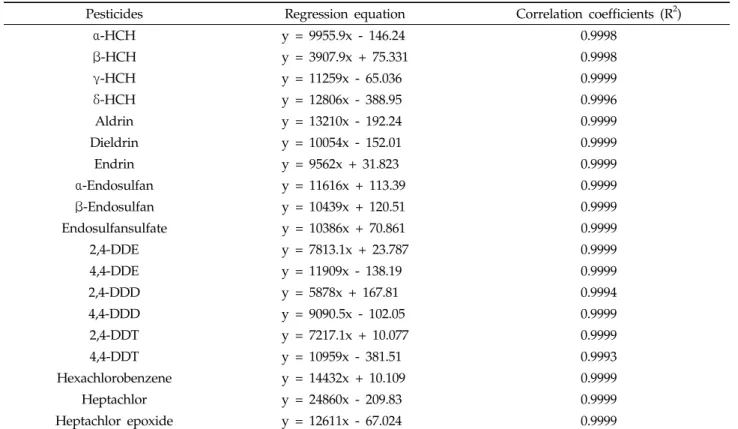
endrin 52.06, α-endosulfan 46.79, β-endosulfan 53.52, endosulfan sulfate 58.05, 2,4-DDE 46.53, 4,4-DDE 49.92, 2,4-DDD 50.45, 4,4-DDD 55.18, 2,4-DDT 55.25 및 4,4-DDT 59.45분으로 나타났다(Fig. 3). 분석대상 19종 잔류 성유기염소계 농약의 검량선 직선성과 결정계수(R
2)는 모두 양호하였다(Table 2).
토양 중 분석대상 19종 잔류성유기염소계 농약의 회수율 시험결과는 74.4-115.6%, 상대표준편차(relative standard deviation, RSD) 0.5-3.7% 이었으며, 정량한계는 0.9-6.0 μg/
kg이었다(Table 3). 딸기 중 dieldrin, β-endosulfan 및
endosulfan sulfate의 회수율 시험결과는 75.6-88.4%, 상대
표준편차 2.9-5.2% 이었으며, 정량한계는 0.6-0.9 μg/kg이었
Residual Organochlorine Pesticides in Greenhouse Soil and Strawberry 11
Table 2. Linearity and correlation coefficient of residual organochlorine pesticides
Pesticides Regression equation Correlation coefficients (R2)
α-HCH y = 9955.9x - 146.24 0.9998
β-HCH y = 3907.9x + 75.331 0.9998
γ-HCH y = 11259x - 65.036 0.9999
δ-HCH y = 12806x - 388.95 0.9996
Aldrin y = 13210x - 192.24 0.9999
Dieldrin y = 10054x - 152.01 0.9999
Endrin y = 9562x + 31.823 0.9999
α-Endosulfan y = 11616x + 113.39 0.9999
β-Endosulfan y = 10439x + 120.51 0.9999
Endosulfansulfate y = 10386x + 70.861 0.9999
2,4-DDE y = 7813.1x + 23.787 0.9999
4,4-DDE y = 11909x - 138.19 0.9999
2,4-DDD y = 5878x + 167.81 0.9994
4,4-DDD y = 9090.5x - 102.05 0.9999
2,4-DDT y = 7217.1x + 10.077 0.9999
4,4-DDT y = 10959x - 381.51 0.9993
Hexachlorobenzene y = 14432x + 10.109 0.9999
Heptachlor y = 24860x - 209.83 0.9999
Heptachlor epoxide y = 12611x - 67.024 0.9999
DDE : diphenyl dichloro ethylene, DDD : dichloro diphenyl dichloro ethane, DDT : dichloro diphenyl trichloro ethane
Table 3. Recovery ofresidual organochlorine pesticides in soil
Pesticides Recovery (%) LOQ
(μg kg-1)
RSD (%)
4 μg/kg 20 μg/kg 40 μg/kg 4 μg/kg 20 μg/kg 40 μg/kg
α-HCH 91.7±2.3 90.1±1.7 92.3±0.8 1.8 2.5 1.9 0.9
β-HCH 112.3±3.2 109.4±1.2 115.6±0.6 3.0 2.8 1.0 0.5
γ-HCH 104.0±2.4 90.9±1.0 94.8±0.8 4.5 2.3 1.2 0.9
δ-HCH 102.6±1.7 93.7±1.3 93.8±1.7 1.5 1.7 1.5 1.8
Aldrin 76.3±2.8 77.8±0.8 75.7±2.3 0.9 3.7 1.0 2.4
Dieldrin 79.4±2.6 83.4±0.7 80.3±3.2 3.0 3.3 1.0 3.4
Endrin 107.0±2.3 108.3±1.4 114.0±2.7 4.5 2.1 1.2 2.3
α-Endosulfan 112.4±3.0 108.4±1.1 109.9±1.7 2.1 2.7 0.9 1.6
β-Endosulfan 113.4±1.8 106.2±2.8 109.7±1.4 2.1 1.6 2.6 1.3
Endosulfan sulfate 110.3±2.8 106.4±1.9 106.6±2.1 3.0 2.5 1.7 1.9
2,4-DDE 94.6±2.0 87.4±1.2 86.3±1.4 3.0 2.1 1.4 1.6
4,4-DDE 78.8±2.2 89.7±0.8 87.8±1.2 1.8 2.8 1.2 1.6
2,4-DDD 101.4±2.6 101.3±3.6 102.3±1.8 4.8 2.6 3.5 2.0
4,4-DDD 78.8±2.0 84.7±1.5 84.3±1.2 6.0 2.5 1.7 1.4
2,4-DDT 110.3±3.2 98.0±1.5 103.2±1.1 3.6 2.9 1.7 1.1
4,4-DDT 93.4±2.7 80.7±2.0 74.4±1.1 1.5 1.2 2.2 1.4
Hexachloro benzene 84.4±2.8 76.8±0.8 75.6±2.1 0.9 3.3 1.1 2.3
Heptachlor 78.3±1.4 76.3±0.6 76.2±1.8 1.2 1.8 0.9 1.7
Heptachlor epoxide 88.4±2.7 76.8±0.8 75.6±2.1 3.6 3.1 1.1 2.3
DDE : diphenyl dichloroethylene, DDD : dichloro diphenyl dichloro ethane, DDT : dichloro diphenyl trichloro ethane, LOQ : limit of quantitation, RSD : relative standard deviation
Table 4. Recovery of dieldrin, β-endosulfan, and endosulfan sulfate in strawberry
Pesticides Recovery (%) LOQ
(μg/kg)
RSD (%)
10 μg/kg 20 μg/kg 10 μg/kg 20 μg/kg
Dieldrin 81.5±2.4 86.4±3.4 0.9 2.9 3.9
β-Endosulfan 75.6±3.2 80.2±4.2 0.6 4.2 5.2
Endosulfan sulfate 88.4±3.2 84.6±2.8 0.6 3.6 3.3
LOQ : limit of quantitation, RSD : relative standard deviation
Table 5. Residue of residual organochlorine pesticides in soil
Pesticides Detection range (μg/kg) Detection number (Ratio of detection, %)
α-HCH <LOQ -
β-HCH <LOQ -
γ-HCH <LOQ -
δ-HCH <LOQ -
Aldrin <LOQ -
Dieldrin 1.6-2.3 2 (3.3)
Endrin <LOQ -
α-Endosulfan <LOQ -
β-Endosulfan 2.2-28.4 21 (35.0)
Endosulfan sulfate 1.8-118.6 23 (38.3)
2,4-DDE <LOQ -
4,4-DDE <LOQ -
2,4-DDD <LOQ -
4,4-DDD <LOQ -
2,4-DDT <LOQ -
4,4-DDT <LOQ -
Hexachloro benzene <LOQ -
Heptachlor <LOQ -
Heptachlor epoxide <LOQ -
DDE : diphenyl dichloroethylene, DDD : dichloro diphenyl dichloro ethane, DDT : dichloro diphenyl trichloro ethane, LOQ : limit of quantitation
다(Table 4). 이상의 결과는 EU 가이드라인의 회수율 70- 120%, RSD 20% 이하의 잔류분석법 기준에 적합한 결과를 나타냈다(SANCO/10684/2009 document).
딸기 시설재배지 토양 중 OCPs 잔류수준
우리나라 딸기주산지 2개 지역의 시설재배지 토양(60지 점)에 대한 잔류성유기염소계 농약류의 잔류수준 결과를 Table 5에 나타냈다. 조사대상 딸기 시설재배지 토양 중 잔 류성유기염소계 농약류의 잔류수준은 Table 5에서 보는 바와 같이 dieldrin, β-endosulfan 및 endosulfan sulfate만이 각각 2, 21 및 23지점에서 검출되었고, 이들의 검출범위는 각각 1.6-2.3, 2.2-28.4 및 1.8-118.6 μg/kg이었다. GC-μECD 분 석을 통해 딸기 시설재배지 토양에서 검출된 dieldrin, β -endosulfan 및 endosulfan sulfate 성분에 대해서 GC- MS 질량스펙트럼의 대표적 이온분자량 ( m/z ) dieldrin 79,
81, 82, β-endosulfan 195, 237, 241 및 endosulfan sulfate 272, 274, 387을 확인하여 동일성분임을 확인하였다.
우리나라 시설재배지 토양 중 잔류성유기염소계 농약의
잔류수준에 대해서는 dieldrin (1999년 금지) 등 잔류성유기
염소계 농약 중 일부(Park and Ma, 1981; Suh et al .,
1984)와 endosulfan (2011년 제조 및 사용 금지, Park,
2011)에 대해 제한적으로 보고된 바 있다. 이들에 따르면 본
연구의 시설재배지 토양에서 검출된 잔류성유기염소계 농약
dieldrin, β-endosulfan 및 endosulfan sulfate의 잔류수
준이 dieldrin은 1980년대 초‧중반에 240과 90 μg/kg 수준,
endosulfan (total)은 2008년 최대 155 μg/kg 수준이었다
(Park and Ma, 1981; Suh et al ., 1984; Park, 2011). 본 연구
에서의 시설재배지 토양 중 잔류성유기염소계 농약 dieldrin
및 endosulfan 잔류수준 2.3 및 147.0 (β-endosulfan 28.4,
endosulfan sulfate 118.6 μg/kg) μg/kg 이었다. 본 연구
Residual Organochlorine Pesticides in Greenhouse Soil and Strawberry 13
Table 6. Residue of residual organochlorine pesticides in strawberry
Pesticides Detection range (μg/kg) Detection number (Ratio of detection, %)
Dieldrin <LOQ -
β-Endosulfan <LOQ -
Endosulfan sulfate <LOQ -
LOQ : limit of quantitation
에서 α-endosulfan이 검출되지 않은 것은 α-endosulfan(반 감기 12-39일)이 토양에서 β-endosulfan (반감기 108- 264 일)과 endosulfan sulfate (반감기 117-137일)에 비해 빠르 게 분해되기 때문인 것으로 판단된다(NRA, 1998; GFEA, 2004). 상기의 연구결과는 동일지역의 동일 시설재배지에서 채취한 시료를 대상으로 하지 않았기 때문에 선행연구와 동 등·비교하는 것은 어려우나, 선행연구의 결과가 당시의 우리 나라 시설재배지의 보편적인 잔류성유기염소계 농약의 잔류 수준이라면 dieldrin은 당시의 1.0-2.6%, endosulfan은 94.8% 수준으로 나타나 약제간 차이가 있었다. 이러한 약제 간 감소율 차이는 조사시기(dieldrin 30여년, endosulfan 7 년)와 제조 및 사용금지 시기(dieldrin 1999년, endosulfan sulfate 2011년)에 따른 차이로부터 기인한 것으로 판단된다.
딸기 시설재배지 작물 중 OCPs 잔류수준
우리나라 딸기주산지 2개 지역의 시설재배 딸기(60점)에 대한 잔류성유기염소계 농약류의 잔류수준 결과를 Table 6에 나타냈다. 시설재배 딸기 중 잔류성유기염소계 농약류 잔류수 준은 Table 6에서 보는 바와 같이 dieldrin, β-endosulfan 및 endosulfan sulfate는 검출되지 않았다. 따라서 본 연 구결과는 우리나라 딸기 시설재배지 토양에서 dieldrin, β-endosulfan 및 endosulfan sulfate 3종의 잔류성유기염 소계 농약이 낮은 농도수준(시설재배지 토양 중 최대치, 각각 2.3, 28.4 및 118.6 μg/kg)으로 검출되었으나 시설재배지 토 양 중 이들 3종의 잔류수준에서는 딸기의 과실부위로 흡수×이 행되지 않는 결과를 나타냈다.
Acknowledgment
This study was carried out with the support of Research Program for Agricultural Science & Technology Development (PJ010117, PJ010922, PJ0108962016 and PJ011435) and Postdoctoral Fellowship Program of Chemical Safety Division, National Academy of Agricultural Science, Rural Development Administration, Republic of Korea.
References