• 검색 결과가 없습니다.

The Effectiveness of ACT and CBT to Reduce Vulnerability to Depression and Anxiety among University Students: A Preliminary Analysis

N/A
N/A
Protected

Academic year: 2021

Share "The Effectiveness of ACT and CBT to Reduce Vulnerability to Depression and Anxiety among University Students: A Preliminary Analysis"

Copied!
7
0
0

로드 중.... (전체 텍스트 보기)

전체 글

(1)

Corresponding author: Kyunghee Lee, Department of Counseling Psychology, Open Cyber University, 102, Gyeongun-dong, Jongno-gu, Seoul 151-746, Korea.

Tel: +82-2-2197-4182, E-mail: [email protected] Received October 28, 2011, Revised December 3, 2011 Accepted December 17, 2011

This work was supported by a Korea Research Foundation Grant funded by the Korean Government (MOEHRD; KRF-2006--321-H00043).

The Effectiveness of ACT and CBT to Reduce Vulnerability to Depression and Anxiety among University Students: A Preliminary Analysis

*Department of Counseling Psychology, Open Cyber University,

Department of Psychology, Seoul National University, Seoul, Korea,

Department of Psychology, University of British Columbia, Vancouver, Canada

Kyunghee Lee*, Hoon-Jin Lee

, Sheila R. Woody

Preliminary efficacy of Acceptance and Commitment Therapy (ACT) and Cognitive Behavior Therapy (CBT) was tested in a group of 16 college students at risk for anxiety and depression. Students with high levels of rumination and worry were randomly assigned to eight weekly sessions of ACT or CBT. Thirteen participants completed treatment and provided pre- and post-test data.

Results suggested both ACT and CBT are promising treatments for reducing symptoms of depression, anxiety, worry, and rumination, as well as reducing endorsement of dysfunctional beliefs and negative automatic thoughts and increasing psychological acceptance. Because of their apparent effects on cognitive constructs associated with vulnerability to anxiety and depression, these interventions may be useful as preventive approaches in young adults, with prevention applicability. (Korean J Str Res 2011;19:383∼389)

Key Words: Depression, Anxiety, ACT, CBT, Prevention

INTRODUCTION

Anxiety and depression are negative affects that characterize general psychological distress (Watson et al., 1988). Because of the relevance to public health, researchers have been especially interested in understanding risk and protective factors for negative affect as well as developing relevant intervention programs.

Worry and rumination appear to play mediating roles between

neuroticism and psychological outcomes such as anxiety and depression (Kuyken et al., 2006). Metacognitive awareness and acceptance appear to be a protective factor, perhaps increasing resilience and reducing risks of relapse of depression (Singer et al., 2007). Lee KH et al.(2009) have replicated these vulnerability and resilience factors among Koreans using structural equation modeling.

Cognitive therapy is efficacious in the treatment of unipolar depression and generalized anxiety disorder (Dobson, 1989;

Borkovec et al., 2001). Acceptance and Commitment Therapy

(Hayes et al., 1999) is an integrative therapeutic model that

facilitates psychological acceptance for private events. Zettle et

al.(1989) presented evidence of the efficacy of group approaches

to Acceptance and Commitment Therapy (ACT) and Cognitive

Behavioral Therapy (CBT) in reducing depression. Can the skills

taught in cognitive therapy for depression and anxiety also be

(2)

useful as a preventive strategy among individuals at risk for depression? The answer seems to be yes, but there has been relatively little research on this possibility. Seligman et al.(1999) found a significant prevention effect using a targeted cogni- tive-behavioral intervention for college students at elevated risk for depression. The term “targeted intervention” means that participants in the study are at risk for depression, whereas a

“universal intervention” is applied to everyone - not limited to those at elevated risk (Seligman et al., 2007). Not surprisingly, individuals with an elevated risk profile appear to benefit more from preventive intervention than do individuals who are not classified as “at risk” (Clark et al., 2001).

In Korea, the concept of prevention in mental health is slowly gaining popularity among the general public, but thus far little research has examined constructs that may be important in prevention of psychological disorders. Accordingly, this study was undertaken to conduct a preliminary test of the effects of ACT and CBT in reducing risk factors and increasing protective factors in young Korean adults at risk for developing anxiety or depressive disorders. The intervention, the first of its kind in Korea, was designed in a small group format. Based on previous research on ACT and CBT, both treatments were expected to reduce symptoms of depression and anxiety.

MATERIALS AND METHODS

1. Participants

Participants were recruited among 301 undergraduate students (150 male, 146 female, 5 missing gender information; mean age=21.5 years) who had taken part in an earlier study of vulnerability and resiliency factors of negative emotions (Lee KH et al., 2009). Seventy students who had scored in the top quartile of both rumination and worry were contacted about the present study; 20 of these students who reported no positive history of psychiatric disorders expressed interest in participating in the intervention study. Ten students each were randomly assigned to ACT and CBT, but four students (three assigned to ACT and one assigned to CBT) were unable to participate due to scheduling conflicts with their classes. Of the seven who began ACT and the nine students who began in CBT, 13 completed the program (six in ACT and seven in CBT). Data from one participant in CBT

was subsequently excluded because she disclosed a positive psychiatric history (including pharmacological treatment) at the conclusion of the program, and therefore, she did not fit the inclusion criteria. In all other cases, attrition was due to sche- duling conflicts related to students’ midterm examinations. This study received approval from the university ethics board, and students gave informed consent before participating.

2. Interventions and program leaders

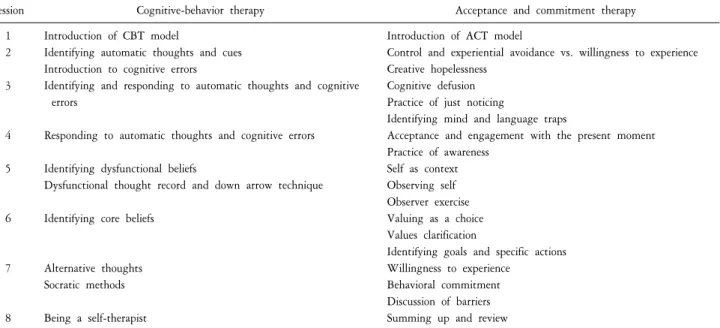
Six students completed eight 90-minute sessions of group ACT focused on the promotion of acceptance, present-focused awareness, and engagement in values-based action. The ACT protocol used in the present study was adapted from the ACT program Moon HM(2006) had developed for use in a Korean setting, based on the work of Hayes et al.(1999). Briefly, the ACT therapists introduced the possibility that change is possible, but perhaps not through symptom reduction. Students learned mindfulness practice and engaged in exercises to help them clarify their personal values. Numerous strategies were used to raise awareness of language-based influences on action, including observation of thoughts, discussion of willingness - especially related to meaningful living, and the “fear-act” technique.

Seven students completed eight 90-minute sessions of group CBT targeting intrapersonal aspects of negative emotions. The protocol was adapted from Judith Beck(1995) and the group program from Bieling et al.(2006). Treatment began with a focus on the CBT model and rationale for the program and moved on to training in self-monitoring of environmental, somatic, imaginal, and mental (especially rumination and worry) cues that trigger negative emotion. Therapists helped the students to understand the role of cognition in negative emotion; to become aware of their automatic thoughts and to recognize the early stages of worry; and to identify predictions, interpretations, assumptions and beliefs related to the threat value of events or cues. The CBT approach also emphasized logical analysis, including examination of evidence supporting or refuting automatic thoughts and dysfunctional beliefs, labeling of logical errors, generating alternative thoughts and coping strategies. Students were encouraged to become a self-therapist.

The programs were led by two professional clinical psycho-

logists who had more than three years of training in a psychiatric

(3)

Table 1. Summary of intervention protocols.

Session Cognitive-behavior therapy Acceptance and commitment therapy

1 2

3

4

5

6

7

8

Introduction of CBT model

Identifying automatic thoughts and cues Introduction to cognitive errors

Identifying and responding to automatic thoughts and cognitive errors

Responding to automatic thoughts and cognitive errors

Identifying dysfunctional beliefs

Dysfunctional thought record and down arrow technique

Identifying core beliefs

Alternative thoughts Socratic methods

Being a self-therapist

Introduction of ACT model

Control and experiential avoidance vs. willingness to experience Creative hopelessness

Cognitive defusion Practice of just noticing

Identifying mind and language traps

Acceptance and engagement with the present moment Practice of awareness

Self as context Observing self Observer exercise Valuing as a choice Values clarification

Identifying goals and specific actions Willingness to experience

Behavioral commitment Discussion of barriers Summing up and review

hospital unit and more than five years of training in clinical and counseling psychology. The program leaders were blind to the main hypotheses of the study and followed a written protocol that provided a detailed description of the intervention components and the suggested order in which to cover them. Table 1 illustrates a brief summary of the protocols.

3. Materials

The Beck Depression Inventory (BDI) is a widely used 21-item measure of depression. The present study used a Korean version of the original BDI adapted by Lee YH et al.(1991), who showed good internal consistency and two-week test-retest reliability in both nonclinical and depressed samples.

The State-Trait Anxiety Inventory Form Y (STAI-Y) measures state or trait anxiety, with each item assessed on a 4-point scale.

The present study used the State Anxiety scale from the Korean version of the scale (Hahn DW et al., 1996), who showed good internal consistency of both state and trait anxiety in the translated version.

Rumination was measured with the 10-item Rumination subscale from the Response Mode Questionnaire, a Korean measure developed by Shin WS(2006) based on the Response Style Questionnaire (Nolen-Hoeksema et al., 1993). On five-point scales, respondents rate the frequency with which they experience

ruminative thoughts during periods of low mood, such as, “What does it mean that I feel this way?” Shin WS(2006) showed good internal consistency and two-week test-retest reliability.

Worry was assessed with the Penn State Worry Questionnaire (PSWQ), a 16-item measure of overly generalized and uncontro- llable worry. The present study used a Korean version of the PSWQ adapted by Kim JW(1998), which showed good internal consistency.

The Acceptance and Action Questionnaire assess acceptance of internal experiences without experiential avoidance, efforts to control, negative evaluation of internal experiences, and the ability to act despite the occurrence of emotional pain. An example item is, “It’s OK to be depressed or anxious”. Items are rated on a 7-point scale, with higher scores indicating greater degree of psychological acceptance or psychological flexibility. The Korean version of the AAQ was developed by Moon HM(2006) using a translation and back-translation method. Moon HM(2006) repo- rted internal consistency of α=.82.

The Dysfunctional Attitude Scale-40 (DAS) is a frequently used 40 item self-report that measures the presence of more permanent dysfunctional attitudes to life, which may predispose an individual to depression. In this study, a Korean version of the DAS (Kwon SM, 1994) was used.

The Automatic Thought Questionnaire (ATQ) is a self-report

(4)

Table 2. Pre- and post-treatment means (SD/range) of treatment completers.

Population

CBT

Z d

ACT

Z d

Pretest N=6

Posttest N=6

Pretest N=6

Posttest N=6 BDI

STAI

RRMS

PSWQ

AAQ

DAS

ATQ

6.9 (6.7)

52.5 (15.5)

27.9 (8.5)

51.8 (11.8)

51.0 (6.9)

*

*

13.8 (8.5/6∼30)

65.3 (9.7/57∼83)

35.7 (5.3/30∼44)

61.5 (5.6/54∼67)

47.2 (4.3/41∼53)

167.3 (18.9/−16∼33)

70.2 (13.9/54∼89)

3.2 (2.6/0∼7)

46.2 (3.2/40∼49)

25.8 (4.2/21∼32)

45.5 (2.4/42∼49)

55.2 (6.2/44∼61)

136.8 (16.7/−38∼4)

50.2 (5.7/43∼57)

−2.20

−2.20

−2.21

−2.21

−2.23

−1.99

−2.20

1.69

2.64

2.07

3.71

−1.50

1.71

1.88

17.8 (5.7/11∼22)

70.2 (17.3/41∼87)

37.0 (3.1/34∼41)

70.3 (8.1/57∼79)

42.3 (8.9/32∼66)

168.2 (17.4/−14∼29)

73.0 (17.3/51∼93)

5.5 (7.3/0∼20)

50.2 (16.1/27∼75)

26.7 (7.1/14∼33)

59.5 (8.5/48∼70)

55.0 (5.2/49∼63)

143.5 (20.9/−44∼11)

50.2 (18.0/37∼96)

−2.21

−2.20

−2.20

−2.20

−2.20

−2.20

−1.99

1.88

1.20

1.88

1.30

−1.74

1.28

1.29

BDI: beck depression inventory, STAI: state-trait anxiety inventory, RRMS: rumination response mode scale, PSWQ: penn-state worry questionnaire, AAQ: acceptance awareness questionnaire, DAS: dysfunctional attitude scale, ATQ: automatic thought questionnaire. Population means (and standard deviations) are drawn from an unselected sample of 301 students at the same university as participants in this study (*not measured). Z scores reflect within-groups Wilcoxon Signed Ranks Tests, all values were p<.05. d scores reflect effect sizes from Cohen’s d all values were larger than Cohen’s standard large, d=.8.

instrument designed to assess frequency of 30 different negative thoughts related to depressed mood on a 5-point scale. The internal consistency of the Korean version of the ATQ is .93 (Kwon et al., 1994).

4. Procedure

At baseline and end of the intervention, participants completed self-report measures of anxiety, depressive symptoms, worry, rumination, dysfunctional attitudes, and automatic thoughts.

Participants attended the group for eight weekly sessions, each 90 minutes long. Students who were unable to attend a given session met with a program leader during the week or just before the next session to catch up on material covered in the missed session.

RESULTS

Table 2 shows the mean scores of all outcome measures at baseline and post-treatment compared with population means drawn from an unselected sample of 301 students at the same university as participants in this study. At baseline, participants'

mean scores on the BDI and STAI were markedly higher (and AAQ scores considerably lower) than the population mean, although formal statistical comparison was not done due to the small sample size. As would be expected from such a small sample, several differences between the groups were apparent at baseline. The mean scores of the PSWQ were higher for participants randomized to the ACT condition than for those in the CBT condition (Z=−2.17, p<.05), but even those in the CBT condition were nearly a full standard deviation higher than the population mean. The gender ratio also differed between groups, being 5 : 1 (male : female) in CBT and 2 : 4 in ACT.

Due to the small number of participants, nonparametric

analyses were conducted. Wilcoxon signed ranks tests were used

to examine change between baseline and post-intervention on

each outcome measure; these results are shown in Table 2. All

outcome measures showed significant decreases over time in both

groups. Baseline scores were substantially above the population

mean for depression, anxiety, worry, and rumination. Following

participation in the group program, students scored below the

population mean on every outcome measure with the exception of

PSWQ, which remained 0.65 standard deviations above the

(5)

population mean for the ACT group but was below the population mean for the CBT group.

Mann-Whitney U-tests were calculated to compare change scores of the two groups. Results show similar differences over time for the two groups. Contrary to expectation, the groups did not differ in the degree to which change was apparent on treatment-specific cognitive measures (AAQ, DAS, and ATQ).

DISCUSSION

The present study examined a series of cases of university who were at risk for developing depression and anxiety disorders by virtue of high scores on vulnerability factors of rumination and worry. Some, but not all, participants also had elevated scores on depression and anxiety measures, but they were selected due to rumination and worry. Following eight sessions of either ACT or CBT, students showed reduced levels of anxiety and depression, with most participants being within normal limits by the end of treatment. Perhaps more importantly, students completing both programs reported less rumination and worry, which are considered to be vulnerability factors for development of depression and anxiety, and greater psychological acceptance and awareness, which are thought to represent resiliency factors for negative emotion in the face of life events. In both programs, reductions were observed in endorsement of dysfunctional automatic thoughts associated with depression. Changes observed during the intervention were similar for the two approaches.

The theories upon which ACT and CBT are based differ in what they propose to be the central mechanism for change in negative affect. We had anticipated that dysfunctional attitudes and negative automatic thoughts would show specificity to CBT, whereas psychological acceptance or flexibility would show speci- ficity to ACT. Instead, we observed a similar degree of change for all these hypothesized mediators across both intervention prog- rams. These results suggest that ACT and CBT share common therapeutic factors, possibly due to the fact that ACT was developed within the umbrella paradigm of cognitive behavioral approaches (Hayes et al., 1999).

On the other hand, these results are also consistent with the observations of some writers who suggest an important mecha- nism of symptom alleviation in CBT may lie in the change of

perspective toward negative thoughts and increased metacognitive awareness about dysfunctional cognitive products rather than shifting of negative cognitive contents or changing dysfunctional schemata (Sheppard et al., 2004). Psychological acceptance is a type of metacognition, and there are clearly many ways to change cognition. Oei et al.(2006), in a recent study on the process of CBT for depression, used covariance structure modeling to show that symptom reduction brought about change in negative automatic thoughts and dysfunctional attitudes, rather than the other causal direction suggested by cognitive theory of depression.

Clearly, deeper investigation into the mechanisms of change in ACT and CBT is required (Zettle et al., 1989).

This study represents the first attempt to test a preventive mental health intervention in Korea, where the concept of prevention in mental health is just beginning to be explored.

Although the study was small and did not have the ability to test whether the interventions reduced subsequent occurrence of depression or anxiety disorders, results showed change in vulnerability and resiliency factors among normal university students. The study represented a relatively unusual effort to examine the effects of a primary prevention intervention targeting individuals who endorse elevated levels of vulnerability factors but who have not (yet) developed depression or anxiety disorders. The approach we used was to target vulnerability factors for both anxiety and depression. As anxiety and depression frequently co-occur with each other and with other mental disorders (Mineka et al., 1998), intervention for vulnerability and resiliency of general negative affect may not only prevent depression or anxiety disorders, but also contribute to the overall enhancement of mental health. Future large-scale studies should assess the degree to which these prevention efforts delay or avoid development of anxiety disorders and major depression.

However, the present study has some limitations. First, although participants were randomly assigned to intervention, the total number of participants was small, limiting generalizability.

Although the consistency in participants' change brought about

statistically significant results, still the small sample size is a main

limitation of the present study. Thus the main contribution may

be to suggest a fruitful avenue for future prevention research

efforts using a randomized trial with a larger sample and longer

follow-up period to determine the stability of the changes

(6)

observed in these brief interventions as well as the degree to which they have actual preventive effects in relation to maintain- ing a healthy mental condition. Of interest in a longer-term follow-up study would be the comparative effects of ACT and CBT, as Hayes et al.(2006) have argued that ACT may have better follow-up effects. Finally, the present study was focused only on factors associated with psychopathology. To promote young adults’ mental and emotional skills for good mental health, it may also be helpful to target and assess positive qualities, such as quality or meaning of life, sense of happiness, and self-esteem.

REFERENCES

Beck JS (1995) Cognitive therapy: basics and beyond. New York:

Guilford Press.

Bieling PJ, McCable RE, Antony MM (2006) Cognitive-behavioral therapy in groups. New York: Guilford Press.

Borkovec TD, Ruscio AM (2001) Psychotherapy for generalized anxiety disorder. Journal of Clinical Psychiatry 62(Suppl 11):37-42.

Clark G, Hornbrook M, Lynch F et al. (2001) A randomized trial of group cognitive intervention for preventing depression in adolescent offspring of depressed patients. Archives of General Psychiatry 58:1127-1134.

Dobson KS (1989) A meta-analysis of the efficacy of cognitive therapy for depression. Journal of Consulting and Clinical Psychology 57:414-419.

Hahn DW, Lee CH, Chon KK (1996) Korean adaptation of Spielberger’s STAI (K-STAI). Korean Journal of Health Psychology 1:1-14.

Hayes SC, Luoma JB, Bond FW et al. (2006). Acceptance and Commitment Therapy: Model, process and outcomes. Behaviour Research and Therapy 44:1-25.

Hayes SC, Strosahl KD, Wilson KG (1999) Acceptance and commitment therapy: an experiential approach to behavior change. New York: Guilford Press.

Kim JW, Min BB (1998) The relationship between worry, low tolerance for uncertainty, and problem-solving strategies. Paper presented at the annual conference of the Korean Psychological Association.

Kuyken W, Watkins E, Holden E et al. (2006) Rumination in adolescents at risk for depression. Journal of Affective Disorders 96:39-47.

Kwon SM (1994) Reliability, validity and factor structure of the Korean version of the dysfunctional attitudes scale. Psychological Science 3:100-111.

Kwon SM, Yoon HK (1994) Construction and utilization of the Korean version of the automatic thoughts questionnaire. Student Studies 29:10-25.

Lee KH, Lee HJ, Woody SR (2009) Mediating effects of worry, rumination, acceptance, and coping style in the links among life stress, temperaments, and negative affect. Korean Journal of Stress Research 17:265-276.

Lee YH, Song JY (1991) A study of the reliability and validity of the BDI, SDS, and MMPI-D Scales. The Korean Journal of Clinical Psychology 10:98-113.

Mineka S, Watson D, Clark LA (1998) Comorbidity of anxiety and unipolar mood disorders. Annual Review of Psychology 49:377-412.

Moon HM (2006) Development and validation of the program for facilitation of psychological acceptance based on the acceptance and commitment therapy model. Unpublished doctoral disser- tation. The Catholic University of Korea, Seoul, Korea.

Oei TPS, Bullbeck K, Campbell JM (2006) Cognitive change process during group cognitive behaviour therapy for depression. Journal of Affective Disorders 92:231-241.

Seligman ME, Schulman P, Tryon AM (2007) Group prevention of depression and anxiety symptoms. Behaviour Research and Therapy 45:1111-1126.

Seligman MEP, Schulman P, DeRubeis RJ et al. (1999) The prevention of depression and anxiety. Prevention and Treatment 2, Article 8, posted December 21.

Sheppard LC, Teasdale JD (2004) How does dysfunctional thinking decrease during recovery from major depression? Journal of Abnormal Psychology 113:64-71.

Shin WS (2006) The classification of self-focused response style to depressed mood. Unpublished master's thesis. Seoul National University, Seoul, Korea.

Singer AR, Dobson KS (2007) An experimental investigation of the cognitive vulnerability to depression. Behaviour Research and Therapy 45:563-575.

Watson D, Clark LA, Carey G (1988) Positive and negative affec- tivity and their relation to anxiety and depressive disorders.

Journal of Abnormal Psychology 97:346-353.

Zettle RD, Raines JC (1998) Group cognitive and contextual

therapies in treatment of depression. Journal of Clinical Psychology

45:438-445.

(7)

= 국문초록 =

우울과 불안의 취약성을 지닌 16명의 대학생들을 대상으로 CBT와 ACT의 효과성에 대한 예비검증을 하였다. 우울과 불안의 취약요인인 걱정과 반추 수준이 높은 대학생들을 8주간 실시되는 CBT와 ACT 프로그램에 무선배정하였다.

그 중 13명이 프로그램을 마쳤으며 참가 전과 후의 결과들을 비교한 결과, CBT와 ACT 모두 우울과 불안 증상을 비롯한 걱정, 반추, 그리고 역기능적인 신념과 부정적 자동사고 수준이 감소하였으며 반면 불안과 우울의 회복요인 인 심리적 수용수준은 증가하였다. 이러한 결과들은 불안과 우울의 취약성과 관련된 인지적 구성에 명백한 효과를 보이고 있음을 보여주므로 CBT와 ACT가 대학생들을 위한 예방적 접근과 도구로 유용할 수 있음을 보여주고 있다.

중심단어: 우울, 걱정, CBT, ACT, 예방적 접근

수치

Table  1.  Summary  of  intervention  protocols.
Table  2.  Pre-  and  post-treatment  means  (SD/range)  of  treatment  completers. Population CBT Z d ACT   Z   d Pretest N=6 PosttestN=6 PretestN=6 PosttestN=6 BDI STAI RRMS PSWQ AAQ DAS ATQ   6.9  (6.7)   52.5  (15.5)27.9  (8.5)  51.8  (11.8)51.0  (6.9)

참조

관련 문서

avoidance: Theory, research, and treatment. Procrastination, negative self-evaluation, and stress in depression and anxiety. Johnson, & McCown

Christians at self-acceptance, sense of self and ego-identity, and the non-Christian middle school students were superior to the non- Christian high

Purpose: The study was to investigate the organizational culture of middle and small sized hospital workers on organizational effectiveness and controlling effect of

Objective: This study aims to identify the levels of anxiety and depression of the medical institution workers regarding COVID-19, and to provide the database for the

The hospital anxiety and depression scale (HADS) and the 9-item patient health questionnaire (PHQ-9) as screening instruments for depression in patients with cancer.. Age

Objective : The study aim was to estimate the prevalence of sleep disturbance and depressive symptoms as well as to examine the moderating effect of

The program intervenes in self-efficacy, anxiety, and time-managing behavior, which respectively stands for cognitive, emotional, and behavioral variables verified to affect

An examination of the relationship between emotion dysregulation and intolerance of uncertainty in worry and generalized anxiety disorder (Doctoral