pISSN 1229-3008 eISSN 2287-6251
Progress in Superconductivity and Cryogenics
Vol.20, No.3, (2018), pp.11~14 https://doi.org/10.9714/psac.2018.20.3.011
```
1. INTRODUCTION
Since the discovery of superconductivity in MgB2 many fundamental and industrial research have been carried out worldwide for the practical applications in future [1-4]. It has been the main issue and important topic to increase the superconducting critical currents under the external magnetic fields at the targeted temperature [1-3].
Significant enhancement of the magnetic vortex pinning properties of MgB2 can be effectively and routinely obtained with the partial substitution of boron sites with carbon. It should be noted that the carbon provided by many carbon based compounds maybe the only candidate leading to the marked enhancement of critical current density (Jc) at higher fields [1-5]. On the contrary it is well known that Jc at lower fields are sacrificed when doped with carbon, which are more or less affected by the connectivity between the MgB2 grains [6-8].
There are several factors to be considered when dealing with the starting powders of MgB2 such as its size, purity, composition ratio, mixing process, etc for the good reaction and formation of MgB2 phases and finally higher in-field Jc
properties. It is recognized that as-purchased raw powders may have some drawbacks such as oxides of raw powders like MgO and B2O3, some organic pollutants from the dust, moisture when exposed to air or during the delivery and dealing of powders.
To reduce the oxides contained in Mg and B raw powders, simple reducing heat-treatment can be adopted and was conducted on boron powders using the inert gas with the mixed hydrogen at elevated temperature and the
improvement of superconducting properties of MgB2 are thus confirmed [9-11]. For the Mg powders the native oxide, MgO, is very easily formed on the surface of Mg and it is quite dense. So, it will be very difficult to reduce and hardly avoided even after any removal treatment.
Meanwhile, a kind of pollutants on the surface of raw powders like the various organic materials, moisture, etc are not paid much attention and even ignored so far in the research of MgB2 superconductors, not only with short bulk samples but also long-length wires.
Therefore, in this work, we have investigated the surface treatment, “simple washing method” of boron powders, which is less sensitive than Mg powders, using the common chemical solvents like acetone, ethanol, methanol, even water to remove any pollutants on the surface. The effect of chemical washing on boron powders and successful enhancement of MgB2 superconducting bulk samples will be discussed.
2. EXPERIMENTAL
For the surface treatment of boron powders (99%, <100 nm, Specialty Materials Inc, US), the common chemical solvents are used. Acetone (Extra pure, 99.5%, Samchun chemicals, Korea), ethyl alcohol (anhydrous, Special grade, 99.9%, Samchun chemicals, Korea), methanol (anhydrous, 99.8%, Sigma-Aldrich, US), and water (HPLC reagent, Samchun chemicals, Korea) were prepared and used as-purchased. To eliminate any possible re-contamination of the treated boron powders, chemical washing process was conducted inside the glove box, which was circulated
Effects of surface-treated boron powder using chemical solvents on MgB2 bulk superconductors
J. Y. Lima,b, J. H. Ahna, M. Ranotb, Y. S. Ohb, S. H. Kangb, S. H. Jangc, D. Y. Hwangc, and K. C. Chungb,*
a Department of Materials Engineering, Andong National University, Republic of Korea
b Korea Institute of Materials Science, Changwon 51508, Republic of Korea
c Kiswire Advanced Technology Ltd, Daejeon 34026, Republic of Korea
(Received 1 September 2018; revised or reviewed 21 September 2018; accepted 22 September 2018)
Abstract
MgB2 superconducting properties have been investigated with the surface-treated boron powders using the chemical solvents.
Various solvents were used such as acetone, ethanol, methanol, and water to possibly modify the surface condition of raw boron powders as received. This treatment was done at an argon gas environment inside the glove box to reduce the further contamination during and after chemical treatments. It was found that Tc values were increased to 37.58-37.73 K from the pure sample of 37.50 K when they were treated in inert environment. High- fields Jc at both 5 & 20 K was all increased regardless of any kinds of chemical treatments mentioned above. It is also noted that the Jc at low-fields were increased in the order of solvents: ethanol > acetone >
pure MgB2 = methanol > water.
Keywords: MgB2, superconductor, chemical treatment, surface reaction
* Corresponding author: [email protected]
Effects of surface-treated boron powder using chemical solvents on MgB2 bulk superconductors
with inert Ar gas. Oxygen and moisture level have been maintained less than 10 ppm during the experiment.
~1g of boron powders was put into the beaker and soaked for 1 h with the above solvents. Then solvents are poured away and boron powders are dried inside the beaker overnight. In case of boron powders treated with water, it was well dispersed and separation was not occurred between the boron powders and water. So, evaporation of water was done using the hotplate at ~100oC until the boron powders were left only.
Then, chemically-treated boron powders were mixed and milled properly with a stoichiometric amount of Mg powders (99%, ~5 µm, Tangshan Weihao, China). The mixed powders were pelletized under 10 ton pressure using uniaxial hydraulic press. Pure MgB2 pellet was also prepared for reference. The MgB2 pellets were heat treated at a temperature of 700°C for 30 min under the flow of high-purity Ar gas and furnace-cooled down to room temperature in a continuous gas flow.
The phase analysis of pure and chemically-treated MgB2
samples was performed by X-ray diffraction (Rigaku, D/Max 2500, Japan) using Cu Kα radiation. The microstructures of all the samples were observed by field-emission scanning electron microscopy (FE-SEM).
The magnetization, magnetization vs. temperature (M-T) and magnetization hysteresis (M-H) properties were measured on all samples by using a quantum design vibrating sample magnetometer option (PPMS, Quantum Design). The Jc was calculated from M–H loops by Bean’s critical state model of Jc = 20ΔM/a(1-a/3b), where ΔM is the height of the M–H loop, a and b are the thickness and width of the sample with the dimension (1x2x3 mm3), respectively.
Fig. 1. (a) X-ray diffraction patterns of pure and chemically-treat MgB2 samples with the solvents indicated, (b) the enlarged view of (002) plane and (c) (100) and (110) planes of MgB2.
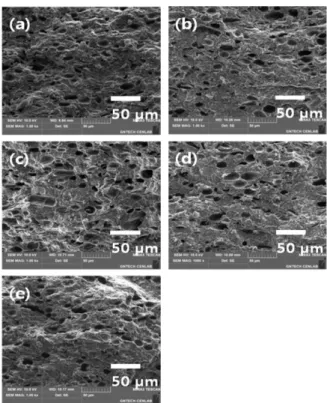
Fig. 2. FE-SEM images of MgB2 bulk samples of (a) pure and (b)-(e) chemically treated with Acetone, Ethanol, Methanol, and Water, respectively.
3. RESULTS AND DISCUSSION
Chemically-treated and pure MgB2 samples are analyzed first with the phase formation with XRD measurements and their diffraction patterns and indexing are shown in Fig. 1.
Main MgB2 phases are well formed at all the samples with the small impurity phases like MgO and B. It is found that there is not any noticeable change between the chemically-treated MgB2 and pure one. As shown in Fig.
1(b) and 1(c) there is also no shift of angles with (002), (100), (110) planes of MgB2 Bragg reflections, indicating that the lattice are not deformed and strained with the chemical treatment. Also, relative content of MgO, which is always found in MgB2 samples, was not changed to main MgB2 phases when it is compared between the MgO(220) and MgB2(102) planes[1-5].
Actually, it is not expected that it is likely to have any carbon supply from all these chemical solvents used here.
All the chemicals except water have a carbon as recognized from their formula. There are acetone of C3H6O, ethanol of C2H6O, and methanol of CH4O. Since all the chemical treatments were performed almost at room temperature, chemical solvents are not likely to decompose to release the carbon behind for doping into the MgB2. Also oxygen from the solvents does not seem to influence the MgO contents as discussed above.
Figure 2 shows the FE-SEM images of pure and chemically-treated MgB2 samples at low magnification. It is seen that all the MgB2 samples shows the typical microstructure and morphology of well known bulk-type. It is consisted of round type pores with the well-connected
J. Y. Lim, J. H. Ahn, M.Ranot, Y . S. Oh, S. H. Kang, S. H. Jang, D. Y. Hwang, and K. C. Chung
Fig. 3. Temperature dependence of magnetization easured in an applied field of 10 Oe for pure and chemically-treated MgB2 bulk samples.
dense grains. The sizes of pores are more or less 5-30 µm ranges which are formed after the Mg are evaporated during the high temperature heat treatment process. Also there is no noticeable variance of morphologies among the MgB2 samples measured at higher magnification (not shown here).
Since boron powders are covered by the oxide, which formed naturally on the outer shell, along with small amount of the existing B2O3 powders besides [9-11], both boron oxides can react with the chemical solvents like the water and methanol and it is reported that B2O3 is soluble in water and partially in methanol, thus these oxides may be reduced or removed after the chemical treatment in this work [12]. Hence, the connectivity between the MgB2
grains can be improved with the better reactivity between the Mg and B [6-8] .
In this work, due to the re-contamination of boron powders after the chemical treatment all the process including mixing and grinding with Mg powders have been carried out inside the glove box with the inert atmosphere.
Fig. 4. Critical current density as a function of magnetic fields for pure and chemically-treated MgB2 bulk samples at both 5 and 20 K.
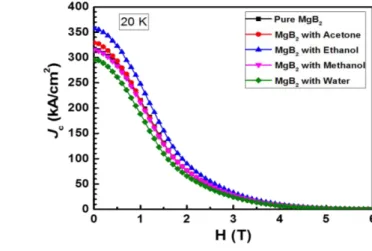
Fig. 5. Magnetic field dependence of critical current density of pure and chemically-treated MgB2 bulk samples at 20 K with linear scale.
So, any reduced and removal of boron oxides are not proved and not confirmed. However, it is verified recently by the authors that B2O3 phases are almost removed from boron powders by chemical treatment through the X-ray diffraction measurement [13]. Further detailed effect of chemical treatment on microstructure and crystallinity of boron using TEM analysis is going on.
Superconducting properties of all the MgB2 samples are checked with the magnetization versus temperature measurements as shown in Fig. 3. The superconducting transition temperature (Tc) of 37.50 K was obtained for the pure MgB2. It is interesting to note that Tc was increased when boron powders are treated chemically with solvents.
Tc of 37.69 K (acetone), 37.69 K (ethanol), 37.73 K (methanol), and 37.58 K (water) was measured.
The curves of ZFC measurement also shows the sharp transition of the chemically-treated MgB2 compared to pure one owing to the better connectivity between the superconducting grains. Also, it is worth noting that the diamagnetic magnetization of the chemically-treated MgB2
is larger than the pure one as evident from the Fig. 3. The nearly flat ZFC curve up to 36.5 K are of bulk superconductivity and improved inter-grain connectivity and magnetization values indicate the superconducting volume fractions increased.
In Fig. 4, the magnetic field dependence of critical current densities of MgB2 samples are shown. Both at 5 and 20 K, Jc of the chemically-treated samples at higher fields are increased compared to the pure MgB2. Since no doping was designed in this work and no sign of any carbon substitution into the B sites are detected as mentioned above from XRD analysis, it is surely not from the typically observed carbon doping phenomena. It is rather speculated that the strong inter-grain connectivity, removal of impurities like B2O3, and uniform grain size distribution from the clean surface of boron powders after the chemical treatment.
It is also found that Jc at lower fields are enhanced with chemical treatment of the ethanol solvents as shown in Fig.
5. This plot of Jc-B was transformed to the linear from the log scale of ordinate axis to show the change of Jc at lower
Effects of surface-treated boron powder using chemical solvents on MgB2 bulk superconductors
fields better. It is seen that the maximum Jc of ~350 kA/cm2 at the self-field and 20 K are obtained with the ethanol treatment, which is much larger than the Jc of ~310 kA/cm2 of pure MgB2. It should be kept in mind that the absolute values of increase of 40 kA/cm2 at self-field is much larger than the increased values of about 2 kA/cm2 at higher field of 9 T.
In the case of acetone and methanol treatment, low-field Jc is quite similar to the pure MgB2 sample. It should be noted that Jc is a little bit decreased with the water treatment, which is very likely to the case with the usual carbon doping. It is believed that evaporation of water at higher temperature to remove may influence the surface properties of boron powders left behind. Even if this trend at lower fields is not well understood at this moment, the grain connectivity, that is, density of MgB2 is the key factor to be considered at this field range.
4. CONCLUSION
Surface-treated boron powders using the chemical solvents provided the simple and effective way to improve the superconductivity of MgB2. Chemical treatment using the common solvents of acetone, ethanol, methanol, and water are used to possibly modify the surface condition of raw boron powders. Tc values of all the MgB2 samples showed the increase to 37.58-37.73 K compared to the pure sample of 37.50 K and the superconducting volume fraction of MgB2 increased as well. It was found that Jc at both temperatures of 5 & 20 K at higher fields was all increased about an order of magnitude regardless of the chemical solvents. In addition, it is worth mentioning that the Jc at low-fields can be enhanced when the boron powders are treated chemically with the solvents of ethanol and acetone than that of pure MgB2.
ACKNOWLEDGMENT
This work was supported by Industrial Technology Innovation Program (Grant No.: 10053590) funded by the Ministry of Trade, Industry and Energy (MOTIE), Korea.
REFERENCES
[1] J. H. Kim, et al., “Microscopic role of carbon on MgB2 wire for critical current density comparable to NbTi,” NPG Asia Materials, vol. 4, e3, 2012.
[2] J. H. Kim, et al., “Tailed materials for high-performance MgB2
wire,” Adv. Mater., vol. 23, pp. 4942-4946, 2011.
[3] A. Ballarino and R. Flukiger, “Status of MgB2 wire and cable applications in Europe,” Journal of Physics: Conf. Series, vol. 871, pp. 012098, 2017.
[4] Shaon Barua, et al., “Superior critical current density obtained in MgB2 bulks through low-cost carbon-encapsulated boron powder,”
Scripta Materialia, vol. 104, pp. 37-40, 2015.
[5] S. Ye, A. Matsumoto, Y. Zhang and H. Kumakura, “Strong enhancement of high-field critical current properties and irreversibility field of MgB2 superconducting wires by coronene active carbon source addition via new B powder carbon-coating method,” Supercond. Sci. Technol., vol. 27, pp. 085012, 2014.
[6] Qingshuang Ma, et al., “Improved grain connectivity and critical current density in ex-situ MgB2 superconductors prepared by two-step sintering,” Materials Chemistry and Physics, vol. 204, pp.
62-66, 2018.
[7] A. Yamamoto, et al., “Limiting factors of normal-state conductivity in superconducting MgB2: an application of mean-field theory for a site percolation problem,” Supercond. Sci. Technol., vol. 20, pp.
658-666, 2007.
[8] M. Kodama, et al., “Mechanism for high critical current density in in situ MgB2 wire with large area-reduction ratio,” Supercond. Sci.
technol., vol. 27, pp. 055003, 2014.
[9] J. Jiang, et al., “Influence of boron powder purification on the connectivity of bulk MgB2,” Supercond. Sci. Technol., vol. 19, pp.
L33-L36, 2006.
[10] X. Xu, et al., “Effect of boron powder purity on superconducting properties of MgB2,” Supercond. Sci. Technol., vol. 19, pp.
466-469, 2006.
[11] S. K. Chen, et al., “Strong influence of boron precursor powder on the critical current density of MgB2,” Supercond. Sci. Technol., vol.
18, pp. 1473-1477, 2005.
[12] Website : https://en.wikipedia.org/wiki/Boron_trioxide
[13] K. C. Chung, et al., “Surface modification of boron precursor by the chemical treatment”, unpublished.