• 검색 결과가 없습니다.

Impact of Coronary Artery Anatomy on Clinical Course and Prognosis in Apical Hypertrophic Cardiomyopathy: Analysis of Coronary Angiography and Computed Tomography

N/A
N/A
Protected

Academic year: 2022

Share "Impact of Coronary Artery Anatomy on Clinical Course and Prognosis in Apical Hypertrophic Cardiomyopathy: Analysis of Coronary Angiography and Computed Tomography"

Copied!
6
0
0

로드 중.... (전체 텍스트 보기)

전체 글

(1)

Korean Circulation Journal

Introduction

Hypertrophic cardiomyopathy (HCM) has had a variety of names because of its diverse clinical manifestations since it was first de-

http://dx.doi.org/10.4070/kcj.2015.45.1.38 Print ISSN 1738-5520 • On-line ISSN 1738-5555

Impact of Coronary Artery Anatomy on Clinical Course and Prognosis in Apical Hypertrophic Cardiomyopathy:

Analysis of Coronary Angiography and Computed Tomography

Dong Geum Shin, MD 1 , Jung-Woo Son, MD 2 , Ji Young Park, MD 3 , Jae Woong Choi, MD 3 , and Sung Kee Ryu, MD 3

1

Division of Cardiology, Yonsei Cardiovascular Hospital, Yonsei University College of Medicine, Seoul,

2

Division of Cardiology, Chuncheon Sacred Heart Hospital, Hallym University, Chuncheon,

3
Division of Cardiology, Department of Internal Medicine, Seoul Eulji Hospital, Eulji University School of Medicine, Seoul, Korea

Background and Objectives: Apical hypertrophic cardiomyopathy (AHCM) is an uncommon variant of hypertrophic cardiomyopathy with a relatively benign course. However, the prognostic factors of AHCM–particularly those associated with coronary artery disease (CAD) and its anatomical subtypes–are not well known.

Subjects and Methods: We enrolled 98 consecutive patients with AHCM who underwent coronary angiography or coronary computed tomography scanning at two general hospitals in Korea from January 2002 to March 2012. Patient charts were reviewed for information regarding cardiovascular (CV) risk factors, symptoms, and occurrence of CV events and/or mortality. We also reviewed echocardiographic data and angiography records.

Results: The mean age at the time of enrollment was 61.45±9.78 years, with female patients comprising 38.6%. The proportions of mixed and pure types of AHCM were 34.4% and 65.6%, respectively. CAD was found in 31 (31.6%) patients. The mean follow-up period was 53.1±60.7 months. CV events occurred in 22.4% of patients, and the mortality rate was 5.1%. The mixed-type was more frequent in CV event group although this difference was not statistically significant (50% vs. 30%, p=0.097). The presence of CAD emerged as an independent risk factor for CV events in univariate and multivariate Cox regression analysis after adjusting for other CV risk factors.

Conclusion: Coronary artery disease is an independent risk factor for CV events in AHCM patients. However, AHCM without CAD has a be- nign natural course, comparable with the general population. (Korean Circ J 2015;45(1):38-43)

KEY WORDS: Cardiomyopathy, hypertrophic; Coronary artery disease; Coronary angiography; Multidetector Computed Tomography.

Received: June 23, 2014

Revision Received: September 3, 2014 Accepted: September 24, 2014

Correspondence: Sung Kee Ryu, MD, Division of Cardiology, Department of Internal Medicine, Seoul Eulji Hospital, Eulji University School of Medicine, 68 Hangeulbiseok-ro, Nowon-gu, Seoul 139-711, Korea

Tel: 82-2-970-8671, Fax: 82-2-970-8878 E-mail: [email protected]

• The authors have no financial conflicts of interest.

This is an Open Access article distributed under the terms of the Creative Commons Attribution Non-Commercial License (http://creativecommons.

org/licenses/by-nc/3.0) which permits unrestricted non-commercial use, distribution, and reproduction in any medium, provided the original work is properly cited.

scribed in detail by Braunwald et al. in 1964.

1)2)

Owing to these vari- ations in the clinical course, the prognosis and natural course of HCM differs across patient cohorts. Few definite risk factors have been identified for morbidity and mortality in HCM, except a family history of sudden cardiac death (SCD). Recent studies have report- ed that the natural course of HCM, particularly in older age groups, is better than previously considered, irrespective of the presence of well-known risk factors.

2)3)

Apical hypertrophic cardiomyopathy (AHCM) is an uncommon morphologic variant of HCM wherein the hypertrophy of the myo- cardium predominantly involves the apex of the left ventricle (LV).

4)5)

This entity is very rare in non-Asian populations, with most reports suggesting an overall prevalence of 1–3% in HCM patients.

6-8)

Most AHCM patients present with mild or no symptoms and good

prognosis.

5)9)

However, clinical presentations with wide QRS tachy-

cardia, subendocardial myocardial infarction, atrial flutter, and LV

(2)

aneurysm have been reported in some cases.

10-14)

Despite these re- ports, the natural course of AHCM remains obscure as compared to that of classical asymmetric septal HCM. AHCM has been classified as pure and mixed types, based on the extent of myocardial involve- ment. Mixed-type AHCM–which involves the myocardium from the apex to the interventricular septum–is supposed to have poor prognosis compared to pure AHCM; however, there is no definite data to support this.

5)

Symptoms of angina are a major clinical manifestation of many variants of HCM, including HCM with ventricular hypertrophy, myo- cardial bridging, and compression. A previous study revealed that coronary artery disease (CAD) diagnosed by coronary angiography is associated with increased mortality in HCM patients. Moreover, CAD with HCM is associated with higher mortality than HCM with normal LV function.

15)

Our study aimed to investigate the impact of CAD on the natural course of AHCM. We also analyzed the general clinical course of AHCM and evaluated other risk factors for cardiovascular (CV) events and the clinical impact of the subtypes of AHCM.

Subjects and Methods

Patients

We enrolled 98 consecutive patients with AHCM 30 years and old- er who underwent coronary angiography or coronary computed to- mography (CT) scans in Yonsei Cardiovascular Hospital and Eulji General Hospital (Korea) between January 2002 and March 2012.

AHCM was diagnosed based on two-dimensional (2D) echocar- diography. The diagnostic criteria of AHCM was LV hypertrophy which was mainly confined to the apex with wall thickness ≥15 mm and ratio of maximal apical thickness to posterior wall ≥1.5. A com- plete medical history of all patients was recorded, including diabetes, hypertension, smoking history, atrial fibrillation, previous cerebro- vascular accidents, the presence and severity of symptoms such as angina and dyspnea, and medication for any of these conditions.

Two-dimensional and Doppler echocardiography was used to as- sess left atrial diameter, LV end-systolic and end-diastolic dimen- sions, LV wall thickness, and presence of obstruction in the intra- ventricular space or LV outflow tract. Classification as to pure or mixed type was done in 90/98 patients. In the remaining 8/98 pa- tients, classification was unavailable due to a lack of echocardio- graphic imaging record. The pure type was defined as hypertrophy limited to the apical portion of the LV below the papillary muscle lev- el, whereas the mixed type was defined as apical hypertrophy with coexistent hypertrophy in other LV segments. For AHCM in the

“mixed” type, the greatest wall thickness had to be located in the apical segments.

5)

Significant CAD was defined as presence of luminal narrowing

>50% in at least one vessel of the coronary arteries. Apart from the diagnosis of CAD, the dominancy, blood supply to the apex, and presence of myocardial bridging (only in coronary angiography) were recorded.

This study was approved by the International Review Board at Eulji Hospital.

Clinical follow-up

Using chart reviews, past clinical history, including CV risk factors, was assessed for all the patients. The index of clinical outcome was adverse CV events, including death, non-fatal myocardial infarction or stroke, heart failure (HF), coronary artery revascularization, and hospital admission due to CV disease.

Statistical analysis

All values were expressed as mean±standard deviation. Patients were grouped according to the degree of CAD (absent CAD vs. CAD) and the type of AHCM (pure vs. mixed). We compared continuous variations with independent t-test and categorical variables by Pear- son’s chi-square test. Differences in the duration of CV event-free survival were evaluated using the Kaplan-Meier survival analysis (log rank test) and Cox proportional-hazards regression model.

All statistical analyses were performed with Statistical Package for the Social Sciences (SPSS) version 18.0 (SPSS Inc., Chicago, IL, USA). P<0.05 was considered statistically significant.

Results

Baseline characteristics

Overall, 98 patients were enrolled in this study. The mean age at the time of enrollment was 61.45±9.78 years, and 38.6% of the pa- tients were female. The proportions of mixed and pure types of AHCM were 34.4% (n=31) and 65.6% (n=59), respectively. In eight patients, discrimination of AHCM type was impossible. The preva- lence of hypertension, diabetes, and smoking were 62.2%, 25.5%, and 37.8%, respectively. Beta-blockers and calcium-channel blockers (CCB) were prescribed for 45.9% and 30.6% of patients, respec- tively. Overall, 74.5% of patients were symptomatic, with chest discomfort (57.1%) being the most common symptom (Table 1).

Coronary angiography and CT scans were performed in 72.4%

(n=71) and 27.6% (n=27) of patients, respectively. Significant CAD

was found in 31 (31.6%) patients (1-, 2-, 3-vessel disease, and left

main disease in 15.3%, 9.2%, 6.1%, and 1.0%, respectively). Myocar-

dial bridging was found in 20.4% (n=20/71) of patients. In the 27

patients who underwent CT scans, determining of myocardial bridging

was impossible.

(3)

Clinical follow-up data

The mean follow-up period was 53.1±60.7 (median 45.6) months, and CV events occurred in 22.4% (22/98) patients. Mortality

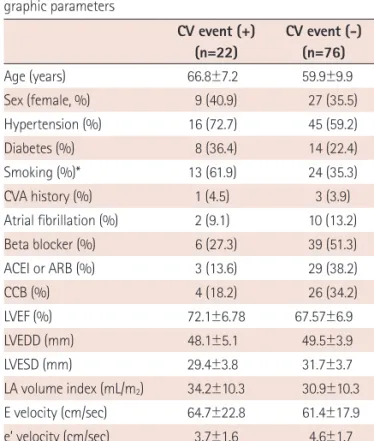
occurred in five (5.1%) patients; the cause of death was HF in two cas- es and cancer in one case. In two cases we could not find the defi- nite cause of death because it occurred outside of the study hospital, but the patients had already been diagnosed as having the CV event (myocardial infarction, revascularization) 14–15 months earlier (Ta- ble 2). The patients with CV events were older than those without CV events (mean age, 66.8±7.5 years vs. 59.9±9.9 years). Further, in the CV event group, the smoking rate and LV ejection fraction were higher and the LV end systolic diameter (LVESD) was smaller.

Prevalence of mixed-type AHCM was higher in the CV event group, although this difference was not statistically significant (mixed vs.

pure AHCM, 50% vs. 30%, p=0.097). Prescription rates of drugs act- ing on the sympatho-renal axis, such as beta-blockers, angiotensin converting enzyme (ACE) inhibitors, and angiotensin II receptor blockers (ARB) reduced the prevalence of CV events (Table 3). CV events were more frequent in patients with CAD, being more ap- parent in patients with multi-vessel disease. Myocardial bridging, dominancy, and difference in blood supply to the apex did not af- fect the clinical outcome (Table 4). At baseline, 12 (12.2%) patients had atrial fibrillation, and during the follow-up period, new onset Table 1. Baseline characteristics

Parameters

Age (years) 61.45±9.78

Sex (female, %) 36 (36.7)

Hypertension (%) 61 (62.2)

Diabetes (%) 25 (25.5)

Smoking (%) 37 (41.6)

Current smoker (%) 25 (27.8)

Symptomatic (%) 73 (74.5)

Chest discomfort 56 (57.1)

Dyspnea 9 (9.2)

Syncope 4 (4.1)

Palpitation 1 (1.0)

Chest discomfort+dyspnea 3 (3.1)

CVA history (%) 4 (4.1)

Atrial fibrillation (%) 12 (12.2)

Medication history (%)

Beta blockers 45 (45.9)

ACE inhibitor or ARB 32 (32.7)

CCB 30 (30.6)

Coronary artery disease (%) 31 (31.6)

Type (pure type, %) 59/90* (65.6)

LVEF (%) 68.55±7.05

LA volume index (mL/m

2

) 31.7±10.3

LVEDD (mm) 49.2±4.2

E/e’ 15.2±5.5

*In 8 patients, typing was unavailable. CVA: cerebrovascular accident, ACE:

angiotensin converting enzyme, ARB: angiotensin II receptor blocker, CCB:

calcium channel blocker, LVEF: left ventricular ejection fraction, LVEDD: LV end-diastolic diameter, LA: left atrium

Table 2. Follow-up data of CV events

N (%)

No events 76 (77.6)

Events 22 (22.4)

Death* 1 (1.0)

Non-fatal myocardial infarction 4 (4.1)

Non-fatal stroke 2 (2.0)

Heart failure 6 (6.1)

Revascularization 6 (6.1)

Admission due to CV cause 3 (3.1)

*Total mortality cases were 5; death was the first CV event in 1 case: non-car- diac (cancer) death/non coronary artery disease group,

1 unstable angina without revascularization, 1 syncope, 1 third-degree atrioventricular block.

CV: cardiovascular

Table 3. Comparison of CV events according to clinical and echocardio- graphic parameters

CV event (+) (n=22)

CV event (-)

(n=76) p

Age (years) 66.8±7.2 59.9±9.9 0.003

Sex (female, %) 9 (40.9) 27 (35.5) 0.645

Hypertension (%) 16 (72.7) 45 (59.2) 0.249

Diabetes (%) 8 (36.4) 14 (22.4) 0.185

Smoking (%)* 13 (61.9) 24 (35.3) 0.031

CVA history (%) 1 (4.5) 3 (3.9) 0.901

Atrial fibrillation (%) 2 (9.1) 10 (13.2) 0.608

Beta blocker (%) 6 (27.3) 39 (51.3) 0.046

ACEI or ARB (%) 3 (13.6) 29 (38.2) 0.031

CCB (%) 4 (18.2) 26 (34.2) 0.151

LVEF (%) 72.1±6.78 67.57±6.9 0.009

LVEDD (mm) 48.1±5.1 49.5±3.9 0.154

LVESD (mm) 29.4±3.8 31.7±3.7 0.012

LA volume index (mL/m

2

) 34.2±10.3 30.9±10.3 0.208

E velocity (cm/sec) 64.7±22.8 61.4±17.9 0.481

e’ velocity (cm/sec) 3.7±1.6 4.6±1.7 0.051

E/e’ 16.1±6.6 14.9±5.2 0.412

RV pressure (mm Hg) 28.4±7.4 27.7±7.0 0.751

Mixed type (%) 10/20 (50.0) 21/70 (30.0) 0.097

*In 9 patients, information about smoking was unavailable. CV: cardiovas- cular, CVA: cerebrovascular accident, ACEI: angiotensin converting enzyme inhibitor, CCB: calcium channel blocker, LVEF: left ventricular ejection frac- tion, LVEDD: LV end-diastolic diameter, LVESD: LV end-systolic diameter, LA:

left atrium, RV: right ventricle

(4)

atrial fibrillation occurred in 10 (10.0%) patients. There was no sig- nificant difference in the prevalence of new onset atrial fibrillation according to the presence of CAD {CAD- 11.9% (n=8) vs. CAD+ 6.5%

(n=2), p=0.497}.

Comparison of cardiovascular event-free survival

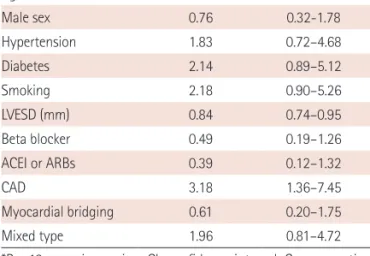
In Cox univariate regression analysis, the CV event-free survival rate was significantly worse in the CAD group {hazard ratio (HR)=

3.18, 95% confidence interval (CI): 1.36–7.45, p=0.008}. Higher age (HR=2.12 per 10 years increase, p=0.005) and smaller LV systolic di- ameter (HR=0.84 with LVESD increase, p=0.006) were related with poorer prognosis. Myocardial bridging did not affect the CV event- free survival in AHCM patients (HR=0.61, 95% CI: 0.20–1.75, p=

0.362). Pure-type AHCM showed a tendency toward better survival without statistical significance (HR=1.96, 95% CI: 0.81–4.72, p=

0.134) (Table 5).

Coronary artery disease persisted as an independent risk factor for CV events (HR=2.91, 95% CI: 1.19–7.13, p=0.021) after adjusting for age and LVESD, which were significantly related with shorter event-free survival in univariate analysis or adding other CV risk fac- tors (Table 6). Kaplan-Meier survival analysis also revealed better

survival in patients without CAD {p=0.005 by Log Rank test (Man- tel-Cox)} (Fig. 1).

Discussion

Our findings demonstrated CAD diagnosed by coronary angiog- raphy or coronary CT scan to be an important risk factor for CV events in AHCM patients, with increasing risk associated with the increasing severity of CAD. Age, smoking, increased LV contractility, and no prescription of beta-blockers, ARB, and/or ACE inhibitors Table 4. Comparison of CV events according to coronary angiographic

parameters

CV event (+) (n=22)

CV event (-)

(n=76) p

CAD (%) 13 (59.1) 18 (23.7) 0.003

Severity of CAD (%)* 0.022

Normal 3 (13.6) 28 (36.8)

Minimal 6 (27.3) 30 (39.5)

1 VD 5 (22.7) 10 (13.2)

2 VD 4 (18.2) 5 (6.6)

3 VD 3 (13.6) 3 (3.9)

Left main disease 1 (4.5) 0 (0.0)

Myocardial bridging (%)* 4/19 (21.1) 16/52 (30.8) 0.420

Dominancy (%) 0.594

Right 17 (85.0) 57 (75.0)

Left 2 (10.0) 10 (13.2)

Balanced 1 (5.0) 9 (11.8)

Blood supply to apex (%) 0.595

LAD only 9 (45.0) 20 (30.8)

LAD+RCA 5 (25.0) 19 (29.2)

LAD+LCX 4 (20.0) 21 (32.3)

LAD+LCX+RCA 2 (10.0) 5 (7.7)

*Unavailable in 27 (27.6%) patients who underwent CT scans. In 2 patients, discrimination of dominancy was unavailable. In 13 patients, determination of the vessels supplying apex was not possible. CV: cardiovascular, CAD: cor- onary artery disease, VD: vessel disease, LAD: left anterior descending coro- nary artery, RCA: right coronary artery, LCX: left circumflex coronary artery

Table 5. Cox univariate analysis for time to CV event according to CAD and other echocardiographic, clinical, and angiographic factors

Hazard ratio 95% CI p

Age* 2.12 1.25–3.60 0.005

Male sex 0.76 0.32-1.78 0.522

Hypertension 1.83 0.72–4.68 0.207

Diabetes 2.14 0.89–5.12 0.089

Smoking 2.18 0.90–5.26 0.084

LVESD (mm) 0.84 0.74–0.95 0.006

Beta blocker 0.49 0.19–1.26 0.141

ACEI or ARBs 0.39 0.12–1.32 0.129

CAD 3.18 1.36–7.45 0.008

Myocardial bridging 0.61 0.20–1.75 0.362

Mixed type 1.96 0.81–4.72 0.134

*Per 10 years increasing. CI: confidence interval, Cox proportional hazard analysis, univariate, CV: cardiovascular, LVESD: left ventricle end-systolic diameter, ACEI: angiotensin converting enzyme inhibitor, ARB: angiotensin receptor blocker, CAD: coronary artery disease

Table 6. Independent risk factors for shorter CV event-free survival duration

Hazard ratio 95% CI p

Model 1

CAD 2.513 1.053–5.997 0.038

Age* 1.891 1.115–3.206 0.018

Model 2

CAD 2.907 1.186–7.127 0.020

LVESD (mm) 0.836 0.738–0.948 0.005

Model 3

CAD 3.032 1.156–7.951 0.024

LVESD (mm) 0.837 0.738–0.949 0.005

Model 4

CAD 2.976 1.109–7.986 0.030

LVESD (mm) 0.832 0.726–0.953 0.008

Model 1: adjusted for age, Model 2: adjusted for age and LVESD, Model 3:

adjusted for age, sex, and LVESD, Model 4: adjusted for age, sex, diabetes, hypertension, and LVESD. Cox proportional hazard analysis, multivariate.

*Per 10 years increasing. CV: cardiovascular, CI: confidence interval, CAD:

coronary artery disease, LVESD: left ventricle end-systolic diameter

(5)

were significantly related to CV events in univariate analysis. Over- all, mortality occurred in five patients; however, no cases of defi- nite SCD were observed. AHCM without CAD showed an excellent prognosis even in the advanced age group, with a survival rate of 97.0% and CV event-free survival rate of 86.6% for over 50 months of follow-up. The presence of mixed-type AHCM did not significantly increase the risk of CV events.

Apical hypertrophic cardiomyopathy is a rare disease that occurs only in small proportion of HCM patients. Its natural course is known to be benign; however, some controversial data has been reported in Japanese and western AHCM populations, including the occurrence of SCD and apical aneurysms.

5)14)16)

Eriksson et al.

5)

re- ported the long-term clinical outcomes of AHCM in a comparatively large number of patients (Canada, n=105) for a mean follow-up pe- riod of 13.6 years; they demonstrated a low mortality but an in- creased rate of CV events, including myocardial infarction (10%) and atrial fibrillation (12%), as compared to the general population.

Thus, AHCM was shown to have a benign prognosis; however, it was associated with an increased rate of CV events, including 11 cases of myocardial infarction. Unfortunately, this study provided coro- nary artery anatomical data for only some of the patients (42/105), which were obtained in the course of follow-up.

A previous study concerning HCM (not “AHCM”) patients that in- cluded the results of coronary angiography, showed that the pres- ence of severe CAD increased mortality rates in these patients.

15)

Another study reported on coexistent CAD in HCM patients who suffered SCD but did not have the risk factors typically associated

with SCD, suggesting that CAD may be an unfavorable prognostic factor in HCM patients.

17)

To the best of our knowledge, our study is the first to investigate the impact of CAD on the natural course of AHCM with coronary imaging data for all patients. The impact of CAD in AHCM was greater than in HCM, which may be due to the relatively benign clinical course of AHCM. Further, considering the higher mean age of the patients in the present study as com- pared to that in the previous study (61.45 years vs. 41.4 years), AHCM patients without CAD had a benign natural course that was comparable to the results of the Korean Heart Study which re- vealed that the 15 year follow-up CV hospitalization rate was 12.6%

(54472/430920), and mortality was 2.3% (9943/430920) for 430920 members of the general population aged 30–74 years.

18)

Several pathophysiological features of HCM predispose individu- als to the development of ischemia, which may be induced by an in- creased demand for myocardial oxygen or a reduction in the myo- cardial blood flow and oxygen supply.

19)

Factors that increase the myocardial oxygen demand include myocyte hypertrophy and in- creased myocardial mass. Factors that reduce myocardial blood flow include impaired vasodilation and compression of intramural vessels due to myocardial bridging.

2)19)

Thus, various factors have been proposed to explain ischemia in HCM. As discussed above, the inherent abnormalities of HCM along with the concurrent pres- ence of CAD have a synergistic effect in the induction myocardial ischemia. Therefore, CAD could be an independent prognostic fac- tor by aggravating the inherent ischemic features of AHCM.

In the present study, myocardial bridging was evaluated only in the coronary angiography group; however, it was not observed to affect the natural course of AHCM, similar to a previous study on HCM.

20)

Mixed type AHCM, which involves part of LV other than the apex, is supposed to have worse clinical prognosis because of its wider involvement. A previous report showed mixed-type AHCM to be as- sociated with the severity of symptoms but not the clinical out- come.

5)

The present findings also did not reveal any definitive ef- fects of the AHCM type on the clinical outcomes. Determining the precise extent of myocardial involvement with echocardiography is technically difficult; moreover, in mixed-type AHCM, the extent of involvement is considerably diverse. If magnetic resonance imag- ing were used to differentiate between pure-type and mixed-type AHCM, the results may differ. However, extensive myocardial in- volvement apart from the apex does not lead to hemodynamic com- promise, such as LV outflow tract obstruction or mitral regurgita- tion; therefore, it is reasonable that the risk of CV events does not increase significantly in mixed-type AHCM.

Our results revealed that increased LV systolic function and re- duced LV end-systolic diameter resulting in advanced hypertrophy Fig. 1. Kaplan-Meier survival curve shows a significantly longer CV event-

free survival period in patients without CAD {p=0.005 by Log Rank test (Mantel-Cox)}. CV: cardiovascular, CAD: coronary artery disease.

100

80

60

40

20

0

Follow-up (months)

CV event free survival (%)

0 20 40 60 80 No CAD

CAD

(6)

were associated with an increased prevalence of CV events. The use of beta-blockers, ACE inhibitors, and ARB–but not CCB–had a pro- tective effect against CV events. These drugs affect the activities of the sympathetic nervous system, suggesting that increased sym- pathetic nervous activity may adversely affect the prognosis of AHCM. However, in survival analysis, these factors did not signifi- cantly affect the event-free survival rate; therefore, the relationship between sympathetic activity and clinical outcomes in AHCM re- mains unclear.

Limitations

The retrospective nature of this study is a major limitation. As com- pared to general AHCM patients, the present AHCM cohort was at a comparatively higher risk for CAD and CV events, since coronary imaging studies were not performed randomly, but rather for the evaluation of suspected coronary artery obstructive disease, with 74.5% of the patients being symptomatic and over 50% of the pa- tients reporting chest discomfort. This may have led to a selection bias.

Conclusion

Coronary artery disease diagnosed by coronary angiography or CT scan is one of the most important risk factors for CV events in AHCM patients. AHCM is frequently accompanied by myocardial ischemia and it is associated with a higher CV risk. CAD might ag- gravate the ischemia of AHCM and lead to worse clinical outcomes.

In the absence of CAD, AHCM patients over 30 years of age have a good prognosis, comparable with that of the general population.

The benign natural course of AHCM compared to CAD also contrib- utes to the major impact of CAD on AHCM to some degree. To pre- vent CV events in AHCM with CAD, active CV risk reduction inter- vention may be needed.

References

1. Braunwald E, Lambrew CT, Rockoff SD, Ross J Jr, Morrow AG. Idiopathic hypertrophic subaortic stenosis. I. A description of the disease based upon an analysis of 64 patients. Circulation 1964;30:Suppl 4:3-119.

2. Maron BJ, Maron MS. Hypertrophic cardiomyopathy. Lancet 2013;381:

242-55.

3. Maron BJ, Rowin EJ, Casey SA, et al. Risk stratification and outcome of patients with hypertrophic cardiomyopathy >=60 years of age. Circu- lation 2013;127:585-93.

4. Sakamoto T. Apical hypertrophic cardiomyopathy (apical hypertrophy):

an overview. J Cardiol 2001;37 Suppl 1:161-78.

5. Eriksson MJ, Sonnenberg B, Woo A, et al. Long-term outcome in pa-

tients with apical hypertrophic cardiomyopathy. J Am Coll Cardiol 2002;

39:638-45.

6. Klues HG, Schiffers A, Maron BJ. Phenotypic spectrum and patterns of left ventricular hypertrophy in hypertrophic cardiomyopathy: morpho- logic observations and significance as assessed by two-dimensional echocardiography in 600 patients. J Am Coll Cardiol 1995;26:1699- 708.

7. Kitaoka H, Doi Y, Casey SA, Hitomi N, Furuno T, Maron BJ. Comparison of prevalence of apical hypertrophic cardiomyopathy in Japan and the United States. Am J Cardiol 2003;92:1183-6.

8. Maron MS, Finley JJ, Bos JM, et al. Prevalence, clinical significance, and natural history of left ventricular apical aneurysms in hypertrophic car- diomyopathy. Circulation 2008;118:1541-9.

9. Yang HS, Song JK, Song JM, et al. Comparison of the clinical features of apical hypertrophic cardiomyopathy versus asymmetric septal hy- pertrophy in Korea. Korean J Intern Med 2005;20:111-5.

10. Partanen J, Kupari M, Heikkilä J, Keto P. Left ventricular aneurysm as- sociated with apical hypertrophic cardiomyopathy. Clin Cardiol 1991;

14:936-9.

11. Gavaliatsis IP, Kouvousis NM, Rallidis LS, et al. Recurrent atrial flutter in apical hypertrophic cardiomyopathy. Jpn Heart J 1992;33:499-504.

12. Cubukçu AA, Scott PJ, Williams GJ. Apical hypertrophic cardiomyopa- thy presenting as acute subendocardial myocardial infarction. Int J Car- diol 1993;38:329-32.

13. Mitchell MA, Nath S, Thompson KA, Pagley PR, DiMarco JP. Sustained wide complex tachycardia resulting in myocardial injury in a patient with apical hypertrophic cardiomyopathy. Pacing Clin Electrophysiol 1997;20:1866-9.

14. Okishige K, Sasano T, Yano K, Azegami K, Suzuki K, Itoh K. Serious ar- rhythmias in patients with apical hypertrophic cardiomyopathy. In- tern Med 2001;40:396-402.

15. Sorajja P, Ommen SR, Nishimura RA, Gersh BJ, Berger PB, Tajik AJ. Ad- verse prognosis of patients with hypertrophic cardiomyopathy who have epicardial coronary artery disease. Circulation 2003;108:2342-8.

16. Suganuma Y, Shinmura K, Hasegawa H, Tani M, Nakamura Y. [Clinical characteristics and cardiac events in elderly patients with apical hyper- trophic cardiomyopathy]. Nihon Ronen Igakkai Zasshi 1997;34:474-81.

17. Elliott PM, Poloniecki J, Dickie S, et al. Sudden death in hypertrophic cardiomyopathy: identification of high risk patients. J Am Coll Cardiol 2000;36:2212-8.

18. Jee SH, Batty GD, Jang Y, et al. The Korean Heart Study: rationale, ob- jectives, protocol, and preliminary results for a new prospective cohort study of 430,920 men and women. Eur J Prev Cardiol 2014;21:1484- 92.

19. Pasternac A, Noble J, Streulens Y, Elie R, Henschke C, Bourassa MG.

Pathophysiology of chest pain in patients with cardiomyopathies and normal coronary arteries. Circulation 1982;65:778-89.

20. Sorajja P, Ommen SR, Nishimura RA, Gersh BJ, Tajik AJ, Holmes DR.

Myocardial bridging in adult patients with hypertrophic cardiomyop-

athy. J Am Coll Cardiol 2003;42:889-94.

수치

Table 3. Comparison of CV events according to clinical and echocardio- echocardio-graphic parameters CV event (+)  (n=22) CV event (-)(n=76) p Age (years) 66.8±7.2 59.9±9.9 0.003 Sex (female, %) 9 (40.9) 27 (35.5) 0.645 Hypertension (%) 16 (72.7) 45 (59.2)
Table 5. Cox univariate analysis for time to CV event according to CAD  and other echocardiographic, clinical, and angiographic factors

참조

관련 문서