• 검색 결과가 없습니다.

Pentraxin 3 as a Novel Marker Predicting Congestive Heart Failure in Subjects With Acute Coronary Syndrome

N/A
N/A
Protected

Academic year: 2022

Share "Pentraxin 3 as a Novel Marker Predicting Congestive Heart Failure in Subjects With Acute Coronary Syndrome"

Copied!
7
0
0

로드 중.... (전체 텍스트 보기)

전체 글

(1)

370

Open Access

Received: November 11, 2009 Revision Received: December 22, 2009 Accepted: February 5, 2010

Correspondence: Hui-Kyung Jeon, MD, Division of Cardiology, Depart- ment of Internal Medicine, College of Medicine, The Catholic University of Korea, 65-1 Geumo-dong, Uijeongbu 480-821, Korea

Tel: 82-31-820-3593, Fax: 82-31-841-7897 E-mail: [email protected]

cc

This is an Open Access article distributed under the terms of the Cre- ative Commons Attribution Non-Commercial License (http://creativecom- mons.org/licenses/by-nc/3.0) which permits unrestricted non-commer- cial use, distribution, and reproduction in any medium, provided the ori- ginal work is properly cited.

Introduction

Inflammation plays a key role in the initiation, develop- ment and progression of atherosclerosis. The association of

increased serum levels of acute-phase proteins with the pro- gression of atherosclerosis and with the occurrence of ath- erosclerosis-related adverse events, such as coronary heart disease and myocardial infarction (MI), has been well docu- mented in several epidemiological studies.

1-6)

Currently, the pentraxin protein family is divided into two subfamilies based on size: the classical “short” pentraxin (25 kDa) and the “long” pentraxin (40-50 kDa). Pentraxin 3 (PTX3) is a “long” pentraxin that is highly expressed in the heart, whereas C-reactive protein (CRP) is a “short” pentrax- in and is produced from the liver.

7)

In several recent stud- ies,

8)9)

PTX3 appeared to be not only an early indicator of ir- reversible myocyte injury, but also a prognostic marker in pa- tients with acute myocardial infarction (AMI).

The global registry of acute coronary events (GRACE)

Pentraxin 3 as a Novel Marker Predicting Congestive Heart Failure in Subjects With Acute Coronary Syndrome

Dong-Hyeon Lee, MD, Hui-Kyung Jeon, MD, Ji-Han You, MD, Mi-Yeon Park, MD, Seung-Jae Lee, MD, Sung-Sik Kim, MD, Byung-Joo Shim, MD, Yun-Seok Choi, MD, Woo-Seung Shin, MD, Jong-Min Lee, MD, Chul-Soo Park, MD, Ho-Joong Youn, MD, Wook-Sung Chung, MD and Jae-Hyung Kim, MD

Division of Cardiology, Department of Internal Medicine, College of Medicine, The Catholic University of Korea, Seoul, Korea ABSTRACT

Background and Objectives: Pentraxin 3 (PTX3) was shown to be elevated in the acute phase of acute myocardial infarc- tion (AMI) and to have prognostic significance in AMI patients. The aim of this study was to estimate whether the value of PTX3 could be used as a prognostic biomarker, with the global registry of acute coronary events (GRACE) risk assessment tool, in patients with acute coronary syndrome (ACS). Subjects and Methods: Between July 2007 and June 2008, 137 pa- tient subjects (mean age : 61 ± 12 years, M : F=108 : 29) with ACS who underwent coronary intervention, but did not have a prior percutaneous coronary intervention (PCI) and/or follow-up coronary angiogram, were enrolled. We estimated the all- cause mortality or death/MI, in-hospital and to 6 months, using the GRACE risk scores and compared these estimates with serum PTX3 concentrations. Results: The serum PTX3 concentration showed a significant increase in ST segment eleva- tion myocardial infarction (STEMI) greater than the unstable angina pectoris (UAP) group (2.4 ± 2.1 ng/mL vs. 1.3 ± 0.9 ng/

mL, p= 0.017, respectively), but did not show a significant difference between non-ST segment elevation myocardial infarction (NSTEMI) and the UAP group (1.9 ± 1.4 ng/mL vs. 1.3 ± 0.9 ng/mL, p=0.083, respectively). The serum PTX3 concentration was closely related to death/MI in-hospital (r=0.242, p=0.015) and death/MI to 6 months (r=0.224, p=0.023), respectively. The serum PTX3 concentration was not related to all-cause mortality in-hospital (r=0.112, p=0.269) and to 6 months (r=0.132, p=0.191), respectively. Among the parameters determining the GRACE risk scores, the degree of Killip class in congestive heart failure (CHF) was independently associated with the supramedian PTX3 concentration [odds ratio: 2.229 (95% confi- dence interval: 1.038-4.787), p=0.040]. Conclusion: The serum PTX3 level provides important information for the risk stratification of CHF among the parameters determining the GRACE risk scores in subjects with ACS. (Korean Circ J 2010;40:370-376)

KEY WORDS: Pentraxin 3; Myocardial infarction; Acute coronary syndrome; Heart failure.

(2)

risk score,

10)11)

designed in 94 hospitals and 14 countries, has been used as a tool to predict death in-hospital

12)

and death after discharge

13)

in patients with acute coronary syndrome (ACS). The GRACE risk score is represented by the following three categories; ST segment elevation MI (STEMI), non-ST segment elevation MI (NSTEMI), and unstable angina pec- toris (UAP). ACS represents a broad spectrum of ischemic myocardial events including UA, NSTEMI, and STEMI that are associated with high morbidity and mortality despite early diagnosis, medical intervention and management.

14)

Our hypothesis is that PTX3 is a prognostic biomarker in patients with ACS. We estimated the all-cause mortality or death/MI, in-hospital and to 6 months, using the GRACE risk scores and compared these estimates to serum PTX3 con- centrations. The aim of this study was to prove whether the value of PTX3 could be a prognostic marker, with the use of the GRACE risk assessment tool, in ACS patients.

Subjects and Methods

Subjects

Between July 2007 and June 2008, at the Uijeongbu St.

Mary’s Hospital, 137 patient subjects with ACS, with or with- out ST segment elevation, underwent percutaneous coronary intervention (PCI); those who had no prior PCI and/or fol- low-up coronary angiography were enrolled.

There were 108 male and 29 female patients enrolled, with a mean age of 61±12 years. Our institutional review com- mittee approved this study. Patients were informed of the in- vestigative nature of the study, and written informed consent was obtained before enrollment.

Definition of acute coronary syndrome

Patients with ACS were classified into the following stan- dard subtypes: STEMI, NSTEMI and UAP. The GRACE di- agnostic criteria of inclusion for AMI, according to the ra- tionale and design of the GRACE investigators, was met if patients had a cardiac ischemic symptom and at least one of the following increases in cardiac enzymes: 1) creatine kinase MB fraction (CK-MB) >2 times upper limit of the hospital’s nor- mal range, and/or 2) positive Troponin T result.

10)

NSTEMI was defined as occurrence of acute MI with positive cardiac enzyme results, with or without accompanying electrocar- diographic changes other than ST segment elevation. STEMI was defined as persistent ST segment elevation of ≥1 mm in 2 contiguous electrocardiographic leads or the presence of a new left bundle branch block with positive cardiac enzyme results.

10)

The diagnostic inclusion criteria for UAP, according to the rationale and design of the GRACE investigators, was met if patients had a cardiac ischemic symptom with serial en- zymes and ST segment elevation negative for MI.

10)

Patients were excluded if they had 1) prior PCI and/or follow-up cor-

onary angiogram, or 2) prior coronary artery bypass graft (CABG).

The global registry of acute coronary events risk as- sessment tool

Each patient’s individual GRACE risk score, including the parameters of age, heart rate, systolic blood pressure, serum creatinine level, Killip class, presence of cardiac arrest at ad- mission, ST segment deviation, and elevated cardiac enzymes for all-cause mortality, in-hospital and to 6 months, was cal- culated using the published risk score calculator from the GRACE registry. Full details of the GRACE risk assessment tool have been previously published.

10)

We estimated the all- cause mortality or death/MI, in-hospital and to 6 months, us- ing the GRACE risk scores and compared it with serum PTX3 concentrations.

Percutaneous coronary intervention

A coronary angiogram was performed using the Judkins’

method, following the puncture of the femoral artery or via a radial artery approach according to current guidelines from the American College of Cardiology/American Heart Asso- ciation/Society for Cardiovascular Angiography and Inter- vention (ACC/AHA/SCAI) 2005 guideline update for PCI.

15)

Significant stenosis was defined as a diameter stenosis of 50%

or greater. A standard antiplatelet therapy and other medica- tions for ACS were provided according to current guidelines from the ACC/AHA

16)17)

and the European Society of Cardi- ology (ESC).

18)

In all patients, aspirin (300 mg/day) and clopi- dogrel (600 mg/day) were loaded before procedure. An intra- venous bolus of 100 U/kg weight of unfractionated heparin was given, and then additional heparin boluses were given to maintain an activated clotting time of 250-300 seconds during the procedure.

19)20)

Assays

During the procedure, blood was drawn into ethylenedia- minetetraacetic acid vacuum containers. PTX3 was assayed with a noncommercial enzyme linked immuno sorbent assay (ELISA), based on the monoclonal antibody MNB10 and rab- bit anti-serum. The ELISA assay did not cross-react with the short pentraxin CRP.

Statistical analysis

Continuous variables are expressed as mean±standard de-

viation (SD). Group comparisons for continuous variables of

baseline clinical characteristics were performed using the anal-

ysis of variance test, and analysis for categorical data was per-

formed using the χ

2

test. Comparisons between the groups for

serum PTX3 concentration were analyzed using an indepen-

dent t-test, which was conducted using the SAS statistical soft-

ware, version 9.1 (SAS Institute, Cary, NC, USA). In multivariate

(3)

logistic regression analysis, the value for median serum PTX3 concentration was used as a cut-off point to determine an independent parameter for all-cause mortality in-hospital and to 6 months. Statistical significance was set at p<0.05.

Results

Baseline characteristics

A total of 137 consecutive patients with ACS (mean age, 61±

12 years, M : F ratio 108 : 29), including 76 (55.5%) with STEMI, 38 (27.7%) with NSTEMI, and 23 (16.6%) with UAP, were studied. The baseline clinical and laboratory findings of the three groups were summarized in Table 1.

Serum pentraxin 3 concentration

The serum PTX3 concentration was not correlated with CRP (r=0.199, p=0.058), CK-MB (r=0.022, p=0.830), ischemia modified albumin (r=-0.103, p=0.375), brain natriuretic pep- Table 1. Baseline clinical and laboratory characteristics

Variables STEMI (n=76) NSTEMI (n=38) UAP (n=23) p

Age, years 060±13 063±11 058±12 0.232

Gender, male, n (%) 64 (83.2) 26 (68.4) 18 (78.3) 0.150

Hypertension, n (%) 32 (42.1) 21 (55.3) 13 (56.5) 0.283

Diabetes mellitus, n (%) 21 (27.6) 10 (26.2) 2 (8.7) 0.165

Smoking, n (%) 52 (68.4) 20 (52.6) 14 (60.9) 0.147

Body mass index (kg/m

2

) 23.8±4.1 24.1±2.6 24.8±2.8 0.481

Systolic blood pressure (mmHg) 126±25 134±25 134±30 0.211

Diastolic blood pressure (mmHg) 076±14 076±15 075±17 0.957

Heart rate (BPM) 082±25 079±37 065±13 0.038

Respiratory rate (bpm) 23±9 026±17 22±9 0.452

Killip class, n (%)

I 32 (42.1) 20 (52.6) 20 (87.0) 0.001

II 30 (39.5) 12 (31.6) 1 (4.3) 0.009

III 14 (18.4) 06 (15.8) 2 (8.7) 0.537

Serum creatinine (mg/dL) 01.04±0.30 01.54±2.16 01.16±0.99 0.123

Total cholesterol (mg/dL) 169±41 173±33 186±31 0.228

Triglyceride (mg/dL) 103±75 119±63 168±75 0.003

HDL-C (mg/dL) 38±9 42±9 41±9 0.076

LDL-C (mg/dL) 109±37 105±29 113±26 0.689

C-reactive protein (mg/dL) 02.63±3.94 01.84±2.62 00.37±0.36 0.014

PTX3 (ng/mL) 02.4±2.1 01.9±1.4 01.3±0.9 0.036

CK-MB (ng/mL) 023.8±39.5 016.7±32.3 03.8±1.5 0.056

Troponin T (ng/mL) 00.50±1.07 00.28±0.45 00.02±0.04 0.050

Ischemia modified albumin (U/mL) 097±51 087±22 0120±109 0.203

BNP (pg/mL) 0255±570 00633±1340 037±40 0.137

pro-BNP (pg/mL) 00977±3022 03375±8440 0552±552 0.178

Cardiac arrest, n (%) 4 (5.3) 2 (5.3) 1 (4.3) 0.811

Door to balloon time (hours) 02.6±2.4 08.9±9.7 17.2±7.2 0.001

GRACE risk scores (in-hospital) (%)

All-cause mortality 05.3±5.7 03.1±3.8 01.4±1.8 0.001

Death/MI 18.5±7.0 10.1±5.8 06.4±3.1 <0.0001

GRACE risk scores (to 6 months) (%)

All-cause mortality 09.9±9.1 07.9±8.3 03.6±4.9 0.008

Death/MI 030.0±11.4 021.4±11.1 14.0±7.3 <0.0001

STEMI: ST segment elevation myocardial infarction, NSTEMI: non-ST segment elevation myocardial infarction, UAP: unstable angina

pectoris, BPM: beats per minute, bpm: breaths per minute, HDL-C: high density lipoprotein-cholesterol, LDL-C: low density lipoprotein-

cholesterol, pentraxin 3: PTX3, ck-MB: creatine kinase myoglobulin, BNP: brain natriuretic peptide, pro-BNP: pro-brain natriuretic peptide,

GRACE: global registry of acute coronary events, MI: myocardial infarction

(4)

tide albumin (r=0.159, p=0.296) and pro-brain natriuretic pep- tide (r=0.260, p=0.074). The serum PTX3 concentration was significantly correlated with Troponin T (r=0.332, p=0.001) (Fig. 1).

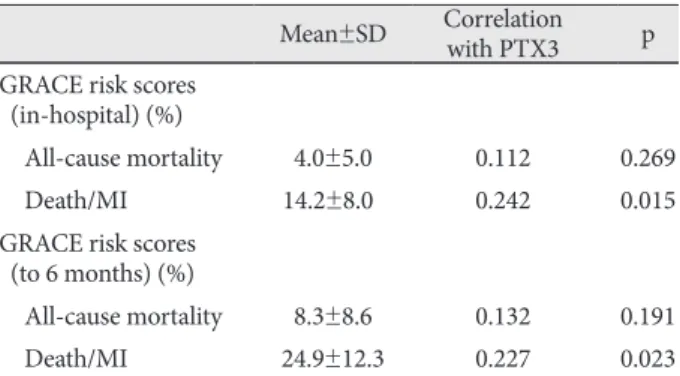
The serum PTX3 concentration was significantly correlat- ed to death/MI in-hospital (r=0.242, p=0.015) and death/MI to 6 months (r=0.227, p=0.023). The serum PTX3 concentra- tion was not correlated to all-cause mortality in-hospital (r=

0.112, p=0.269) and to 6 months (r=0.132, p=0.191) (Table 2).

The serum PTX3 concentration exhibited a significant in-

crease in STEMI (2.4±2.1 ng/mL) as compared to the UAP group (1.3±0.9 ng/mL) with a p=0.017. But there was no sig- nificant difference between the NSTEMI and UAP groups (1.9±1.4 ng/mL vs. 1.3±0.9 ng/mL, p=0.083, respectively), as well as between the STEMI and NSTEMI groups (2.4±2.1 ng/mL vs. 1.9±1.4 ng/mL, p=0.185, respectively) (Fig. 2).

Among the parameters determining the GRACE risk scores, the degree of Killip class in congestive heart failure (CHF) was independently associated with the supramedian PTX3 con- centration [odds ratio: 4.221 (95% confidence interval: 1.038-

A

B

C

D

E

F

Fig. 1. The relationship between PTX3 and several biomarkers. PTX3: pentraxin 3, CRP: C-reactive protein, CK-MB: creatine kinase myo- globulin, IMA: ischemia modified albumin, BNP: brain natriuretic peptide, pro-BNP: pro-brain natriuretic peptide.

PTX3 (ng/mL)

PTX3 (ng/mL)

PTX3 (ng/mL)

PTX3 (ng/mL)

PTX3 (ng/mL)

PTX3 (ng/mL) C-reactive protein

CK-MB

Troponin T

r=0.199 p=0.058

r=0.022 p=0.830

r=0.332 p=0.001

r=0.159 p=0.296

r=0.260 p=0.074 r=-0.103 p=0.375 Ischemia modified albumin

BNP

pro-BNP

C- re ac tiv e p ro te in (m g/ dL ) ck -M B (n g/ dL ) Tr op on in T (n g/ dL ) Is ch em ia m od ifi ed al bu m in (U /m L) BN P (p g/ m L) pr o- BN P (p g/ m L)

0.0 12.00

200.0 5,000

500 400 300 200 100 0 9.00

150.0

5.00

3,000

6,000 4,000

9,000 6.00

100.0

3.00

2,000

3,000 3.00

50.0

1.00

1,000

0 0.00

0.0 0

3.0 6.0 9.0

0.0 3.0 6.0 9.0 1.0 3.0 5.0 7.0

0.0 3.0 6.0 9.0

0.0 3.0 6.0 9.0

0.0 3.0 6.0 9.0

(5)

4.787), p=0.040] (Table 3).

The cut-off value of serum PTX3 concentration (0.88 ng/

mL) shows a sensitivity (87.5%) and a specificity (69.1%) for predicting the probability of all-cause mortality in-hospital (>3%), as the highest tertile of GRACE risk assessment, and the cut-off value of serum PTX3 concentration (0.92 ng/mL) shows a sensitivity (78.2%) and a specificity (50.0%) for predi- cting the probability of death/MI in-hospital (>5%) (Fig. 3).

Discussion

Although CRP has been used as a worldwide diagnostic bio- marker in ischemic heart diseases, the increased serum CRP levels in the acute conditions such as ACS have been consid- ered a nonspecific response to myocardial injury,

21)

and the Table 2. The relationship between PTX3 and GRACE risk scores

Mean±SD Correlation

with PTX3 p

GRACE risk scores (in-hospital) (%)

All-cause mortality 4.0±5.0 0.112 0.269

Death/MI 14.2±8.0 0.242 0.015

GRACE risk scores (to 6 months) (%)

All-cause mortality 8.3±8.6 0.132 0.191

Death/MI 24.9±12.3 0.227 0.023

PTX3: pentraxin 3, GRACE: global registry of acute coronary events, SD: standard deviation, MI: myocardial infarction

Table 3. Multivariate analysis

Variables Odds ratio 95% confidence

interval p

Age 1.039 0.996-1.083 0.074

Heart rate 0.995 0.972-1.019 0.706

Systolic blood pressure 0.995 0.976-1.014 0.599 Serum creatinine 0.956 0.485-1.887 0.898

Killip class 2.229 1.038-4.787 0.040

ST segment deviation 1.909 0.778-4.682 0.158

CK-MB 0.998 0.982-1.013 0.096

Troponin T 1.674 0.804-3.485 0.168

Among the parameters determining the GRACE risk scores, the degree of Killip class in congestive heart failure was independently associated with the supramedian PTX3 concentration (1.47 ng/mL).

GRACE: global registry of acute coronary events, CK-MB: creatine ki- nase myoglobulin

PT X3 (n g/ m L)

0.0

STEMI (n=76) 1.4±2.1

1.9±1.4

p=0.185 p=0.083

p=0.017

1.3±0.9

NSTEMI (n=38) UAP (n=23) 1.0

2.0 3.0 4.0 5.0 6.0

Fig. 2. The relationship between PTX3 and ACS, including STEMI, NSTEMI and UAP groups. PTX3: pentraxin 3, ACS: acute coronary syndrome, STEMI: ST segment elevation myocardial infarction, NSTEMI: non-ST segment elevation myocardial infarction, UAP: un- stable angina pectoris.

A 1-specificity B 1-specificity

AUC=0.686 95% CI (0.578-0.793) Sensitivity 87.5%

Specificity 69.1%

AUC=0.686 95% CI (0.558-0.814) Sensitivity 78.2%

Specificity 50.0%

Se ns iti vi ty Se ns iti vi ty

0.0 0.2 0.0 0.2

1.0 1.0

0.8 0.8

0.6 0.6

0.4 0.4

0.2 0.2

0.0 0.0

0.4 0.6 0.8 1.0 0.4 0.6 0.8 1.0

Fig. 3. ROC curve. The cut-off value of serum PTX3 concentration 0.88 ng/mL shows a sensitivity 87.5% and a specificity 69.1% for predict-

ing the probability of all-cause mortality in-hospital (>3%), as the highest tertile of GRACE risk assessment in (A), and the cut-off value of

serum PTX3 concentration 0.92 ng/mL shows a sensitivity 78.2% and a specificity 50.0% for predicting the probability of death/MI in-hospital

(>5%) in (B). ROC: receiver operating characteristics, AUC: area under curve, CI: confidence interval, PTX3: pentraxin 3, GRACE: global reg-

istry of acute coronary events, MI: myocardial infarction.

(6)

actual role of CRP in the pathogenesis of heart damage is still debated.

22)23)

Peri et al.

8)

reported serum PTX3 as an early indicator of AMI in humans and with no correlation be- tween serum concentrations of PTX3 and CRP.

The GRACE risk scoring system, a multinational registry involving all subsets of ACS including STEMI, NSTEMI and UAP, derived from clinical parameters at the time of hospital- ization, was found to accurately predict mortality at 6 mon- ths.

10)

Parameters in this GRACE scoring system are age, his- tory of CHF, history of MI, elevated resting heart rate, low sys- tolic blood pressure on arrival, ST-segment depression, ele- vated initial serum creatinine, and elevated cardiac enzymes in-hospital.

10)

Recently, Latini et al.

9)

reported the acute-phase protein PTX3 as a predictor of 3-month mortality after adjust- ment for major risk factors and other acute-phase prognostic markers. In our results, the role of PTX3 as a prognostic bio- marker was shown by an increased serum PTX3 that was closely related to death due to MI, in-hospital or to 6 months, in ACS patients, including STEMI, NSTEMI, and UAP groups.

Recently, several studies have mentioned that the plasma PTX3 level had increased in patients with heart failure and was independently associated with an increased risk for car- diac events.

24)25)

Suzuki et al.

24)

demonstrated that the concen- tration of plasma PTX3 levels was significantly higher in pa- tients with heart failure than in control subjects and increas- ed with advancing New York Heat Association (NYHA) func- tional class, especially in severe patients with heart failure and NYHA class III or IV. In this study, the serum PTX3 con- centration was significantly correlated to Troponin T and the degree of Killip class, in CHF, among the parameters determin- ing the GRACE risk scores, and the degree of Killip class was independently associated with an incremental change in the serum PTX3 level. To establish the role of PTX3 in the patho- physiology of CHF, further investigations are required in larg- er populations via multicenter trials.

Inflammatory mediators are intimately associated with the cascade of events leading to atherosclerotic plaque initia- tion, development, and rupture. A study by Inoue et al.

26)

com- pared 52 patients with stable angina pectoris (SAP) to 16 pa- tients with UAP and reported that PTX3 was not associated with coronary risk factors including hypertension, diabetes mellitus and hyperlipidemia; the value of PTX3 was signifi- cantly higher in the UAP than in the SAP group. They suggest- ed that the levels of plasma PTX3 had increased in patients with arterial inflammation, especially UAP, and that the detec- tion of PTX3 was due to PTX3 having originated from the atherosclerotic plaque itself, thereby reflecting active athero- sclerosis. Therefore, ‘PTX3’ will be useful for the prediction of UAP.

In contrast, Salio et al.

27)

reported, in a mouse model, that PTX3 plays a nonredundant, regulatory, cardioprotective role in AMI and suggested that modulation of the complement

cascade contributes to the cardioprotective function of PTX3.

Although our data found much evidence converging to sup- port Inoue’s report, we need to conduct further research in a larger population.

Kotooka et al.

28)

reported that PCI also induces a signifi- cant inflammatory reaction in the injured vessel wall and en- hances plasma PTX3 concentration that leads to the develop- ment of neointimal thickening and restenosis after coronary stenting. However, to elucidate the mechanism of in-stent re- stenosis after PCI, more analysis of PTX3 is warranted.

Limitations

There are several limitations in our present study. First, there is the limitation of “time gap” between the sampling of PTX3 during the procedure and the calculation of GRACE risk score at admission, including the difference of “door to balloon time” (STEMI : NSTEMI : UAP; 2.6±2.4 : 8.9±9.7 : 17.2±7.2, respectively, p=0.001). Second, despite several studi- es indicating PTX3 as a prognostic biomarker of ACS, a nor- mal range for PTX3 levels has not been established. Last, our investigators suggest that the actual long-term outcomes in ACS patient subjects could be confirmed via future follow- up coronary angiography or telephone interview.

Conclusion

The Killip class that reflects CHF is an independent factor associated with an incremental change in the serum PTX3 level. Our investigators suggest that the serum PTX3 level pro- vides important information for risk stratification of CHF di- agnosis, among the parameters determining GRACE risk sco- res of ACS subjects, including subtypes STEMI, NSTEMI and UAP.

Acknowledgments

This study was supported by a grant from the Seoul R & BD Program of the Republic of Korea (#10526).

REFERENCES

1) Noh HJ, Kwon NH, Joo SB. Severity of coronary atherosclerosis:

influence of metabolic syndrome risk factor clustering and hs-CRP. Ko- rean Circ J 2006;36:802-8.

2) Doo YC, Park WJ, Park SH, et al. The optimal timing to measure C-re- active protein to predict cardiac events in patients with unstable an- gina. Korean Circ J 2001;31:290-6.

3) Kim TI, Chae SC, Yang DH, et al. Short-term prognostic value of CRP in the patients with acute coronary syndrome. Korean Circ J 2000;30:

1387-94.

4) Haverkate F, Thompson SG, Pyke SD, Gallimore JR, Pepys MB.

Production of C-reactive protein and risk of coronary events in stable and unstable angina. European Concerted Action on Thrombosis and Disabilities Angina Pectoris Study Group. Lancet 1997;349:462-6.

5) Rossi E, Biasucci LM, Citterio F, et al. Risk of myocardial infarction and angina in patients with severe peripheral vascular disease: predic- tive role of C-reactive protein. Circulation 2002;105:800-3.

6) Rolph MS, Zimmer S, Bottazzi B, Garlanda C, Mantovani A, Hansson

GK. Production of the long pentraxin PTX3 in advanced atheroscle-

rotic plaques. Arterioscler Thromb Vasc Biol 2002;22:e10-4.

(7)

7) Garlanda C, Bottazzi B, Bastone A, Mantovani A. Pentraxins at the crossroads between innate immunity, inflammation, matrix deposition, and female fertility. Annu Rev Immunol 2005;23:337-66.

8) Peri G, Introna M, Corradi D, et al. PTX3, a prototypical long pentrax- in, is an early indicator of acute myocardial infarction in humans. Circul- ation 2000;102:636-41.

9) Latini R, Maggioni AP, Peri G, et al. Prognostic significance of the long pentraxin PTX3 in acute myocardial infarction. Circulation 2004;110:

2349-54.

10) GRACE Investigators. Rationale and design of the GRACE (global re- gistry of acute coronary events) project: a multinational registry of pa- tients hospitalized with acute coronary syndrome. Am Heart J 2001;141:

190-9.

11) Eagle KA, Goodman SG, Avezum A, Budaj A, Sullivan CM, López- Sendón J. Practice variation and missed opportunities for reperfu- sion in ST-segment-elevation myocardial infarction: findings from the global registry of acute coronary events (GRACE). Lancet 2002;359:

373-7.

12) Granger CB, Goldberg RJ, Dabbous O, et al. Predictors of hospital mor- tality in the global registry of acute coronary events. Arch Intern Med 2003;163:2345-53.

13) Eagle KA, Lim MJ, Dabbous OH, et al. A validated prediction model for all forms of acute coronary syndrome: estimating the risk of 6- month postdischarge death in an international registry. JAMA 2004;

291:2727-33.

14) Das R, Kilcullen N, Morrell C, Robinson MB, Barth JH, Hall AS. The British Cardiac Society Working Group definition of myocardial in- farction: implications for practice. Heart 2006;92:21-6.

15) Smith SC Jr, Feldman TE, Hirshfeld JW Jr, et al. ACC/AHA/SCAI 2005 guideline update for percutaneous coronary intervention: a report of the American College of Cardiology/American Heart Association Task Force on Practice Guidelines (ACC/AHA/SCAI Writing Commit- tee to Update the 2001 Guidelines for Percutaneous Coronary Interven- tion). J Am Coll Cardiol 2006;47:e1-121.

16) Anderson JL, Adams CD, Antman EM, et al. ACC/AHA 2007 guide- lines for the management of patients with unstable angina/non-ST- Elevation myocardial infarction: a report of the American College of Cardiology/American Heart Association Task Force on Practice Guidelines (Writing Committee to Revise the 2002 Guidelines for the Management of Patients With Unstable Angina/Non-ST-Elevation Myocardial Infarction) developed in collaboration with the American College of Emergency Physicians, the Society for Cardiovascular An- giography and Interventions, and the Society of Thoracic Surgeons endorsed by the American Association of Cardiovascular and Pul- monary Rehabilitation and the Society for Academic Emergency Medicine. J Am Coll Cardiol 2007;50:e1-157.

17) Antman EM, Hand M, Armstrong PW, et al. 2007 Focused Update of the ACC/AHA 2004 Guidelines for the Management of Patients With

ST-Elevation Myocardial Infarction: a report of the American College of Cardiology/American Heart Association Task Force on Practice Guide- lines: developed in collaboration With the Canadian Cardiovascular Society endorsed by the American Academy of Family Physicians: 2007 Writing Group to Review New Evidence and Update the ACC/AHA 2004 Guidelines for the Management of Patients With ST-Elevation Myocardial Infarction, Writing on Behalf of the 2004 Writing Commit- tee. Circulation 2008;117:296-329.

18) Bassand JP, Hamm CW, Ardissino D, et al. Guidelines for the diagno- sis and treatment of non-ST-segment elevation acute coronary syn- dromes. Eur Heart J 2007;28:1598-660.

19) King SB 3rd, Smith SC Jr, Hirshfeld JW Jr, et al. 2007 Focused Up- date of the ACC/AHA/SCAI 2005 Guideline Update for Percutane- ous Coronary Intervention: a report of the American College of Cardi- ology/American Heart Association Task Force on Practice Guidelines:

2007 Writing Group to Review New Evidence and Update the ACC/

AHA/SCAI 2005 Guideline Update for Percutaneous Coronary In- tervention, Writing on Behalf of the 2005 Writing Committee. Circula- tion 2008;117:261-95.

20) King SB 3rd, Smith SC Jr, Hirshfeld JW Jr, et al. 2007 focused update of the ACC/AHA/SCAI 2005 guideline update for percutaneous coro- nary intervention: a report of the American College of Cardiology/Ame- rican Heart Association Task Force on Practice guidelines. J Am Coll Cardiol 2008;51:172-209.

21) de Beer FC, Hind CR, Fox KM, Allan RM, Maseri A, Pepys MB. Meas- urement of serum C-reactive protein concentration in myocardial isch- aemia and infarction. Br Heart J 1982;47:239-43.

22) Verma S, Devaraj S, Jialal I. Is C-reactive protein an innocent by- stander or proatherogenic culprit?: C-reactive protein promotes ath- erothrombosis. Circulation. 2006;113:2135-50.

23) Scirica BM, Morrow DA. Is C-reactive protein an innocent bystander or proatherogenic culprit?: the verdict is still out. Circulation 2006;113:

2128-34.

24) Suzuki S, Takeishi Y, Niizeki T, et al. Pentraxin 3, a new marker for vas- cular inflammation, predicts adverse clinical outcomes in patients with heart failure. Am Heart J 2008;155:75-81.

25) Kotooka N, Inoue T, Aoki S, Anan M, Komoda H, Node K. Prognos- tic value of pentraxin 3 in patients with chronic heart failure. Int J Car- diol 2008;130:19-22.

26) Inoue K, Sugiyama A, Reid PC, et al. Establishment of a high sensi- tivity plasma assay for human pentraxin3 as a marker for unstable angina pectoris. Arterioscler Thromb Vasc Biol 2007;27:161-7.

27) Salio M, Chimenti S, De Angelis N, et al. Cardioprotective function of the long pentraxin PTX3 in acute myocardial infarction. Circula- tion 2008;117:1055-64.

28) Kotooka N, Inoue T, Fujimatsu D, et al. Pentraxin3 is a novel marker

for stent-induced inflammation and neointimal thickening. Atheroscle-

rosis 2008;197:368-74.

수치

Fig. 1. The relationship between PTX3 and several biomarkers. PTX3: pentraxin 3, CRP: C-reactive protein, CK-MB: creatine kinase myo- myo-globulin, IMA: ischemia modified albumin, BNP: brain natriuretic peptide, pro-BNP: pro-brain natriuretic peptide
Table 3. Multivariate analysis

참조

관련 문서