A More Appropriate Cardiac Troponin T Level That Can Predict Outcomes in End-Stage Renal Disease Patients
with Acute Coronary Syndrome
Dong-Ryeol Ryu,
1* Jung Tak Park,
2* Jung Hwa Chung,
1Eun Mi Song,
1Sun Hee Roh,
1Jeong-Min Lee,
1Hye Rim An,
1Mina Yu,
1Wook Bum Pyun,
1Gil Ja Shin,
1Seung-Jung Kim,
1Duk-Hee Kang,
1and Kyu Bok Choi
11Department of Internal Medicine, School of Medicine, Ewha Womans University, Seoul;
2Department of Internal Medicine, Yonsei University College of Medicine, Seoul, Korea.
Received: July 8, 2010 Revised: September 28, 2010 Accepted: October 14, 2010
Corresponding author: Dr. Kyu Bok Choi, Department of Internal Medicine, School of Medicine,
Ewha Womans University, 911-1 Mok-dong, Yangcheon-gu, Seoul 158-710, Korea.
Tel: 82-2-2650-5375, Fax: 82-2-2650-2505 E-mail: [email protected]
*Dong-Ryeol Ryu and Jung Tak Park contributed equally to this work.
Abstract presented at the Renal Week 2009 of the American Society of Nephrology, San Diego, CA, USA in October 30, 2009.
∙ The authors have no financial conflicts of interest.
© Copyright:
Yonsei University College of Medicine 2011 This is an Open Access article distributed under the terms of the Creative Commons Attribution Non- Commercial License (http://creativecommons.org/
licenses/by-nc/3.0) which permits unrestricted non- commercial use, distribution, and reproduction in any medium, provided the original work is properly cited.
Purpose: Cardiac troponin T (cTnT), a useful marker for diagnosing acute myo- cardial infarction (AMI) in the general population, is significantly higher than the usual cut-off value in many end-stage renal disease (ESRD) patients without clini- cally apparent evidence of AMI. The aim of this study was to evaluate the clinical usefulness of cTnT in ESRD patients with acute coronary syndrome (ACS). Ma- terials and Methods: Two hundred eighty-four ESRD patients with ACS were enrolled between March 2002 and February 2008. These patients were followed until death or June 2009. Medical records were reviewed retrospectively. The cut- off value of cTnT for AMI was evaluated using a receiver operating characteristic (ROC) curve. We calculated Kaplan-Meier survival curves, and potential outcome predictors were determined by Cox proportional hazard analysis. Results: AMIs were diagnosed in 40 patients (14.1%). The area under the curve was 0.98 in the ROC curve (p<0.001; 95% CI, 0.95-1.00). The summation of sensitivity and spec- ificity was highest at the initial cTnT value of 0.35 ng/mL (sensitivity, 0.95; speci- ficity, 0.97). Survival analysis showed a statistically significant difference in all- cause and cardiovascular mortalities for the group with an initial cTnT ≥0.35 ng/
mL compared to the other groups. Initial serum cTnT concentration was an inde- pendent predictor for mortality. Conclusion: Because ESRD patients with an ini- tial cTnT concentration ≥0.35 ng/mL have a poor prognosis, it is suggested that ur- gent diagnosis and treatment be indicated in dialysis patients with ACS when the initial cTnT levels are ≥0.35 ng/mL.
Key Words: Acute coronary syndrome, cardiac troponin T, end-stage renal dis- ease
INTRODUCTION
Cardiovascular disease is the most common cause of mortality in end-stage renal
ness of cTnT in ESRD patients with ACS using receiver operator characteristic (ROC) curve and survival analyses.
MATERIALS AND METHODS
Patient population
This study included ESRD patients on maintenance hemo- dialysis (HD) or continuous ambulatory peritoneal dialysis (CAPD) with ACS between March 2002 and February 2008 at Ewha Womans University Mokdong Hospital in Seoul, Korea. We retrospectively reviewed demographic, clinical, and laboratory data using the medical records. We excluded patients <18 years of age and with the following conditions: skeletal muscle trauma, myositis, rhabdomyoly- sis, and seizures. Cardiovascular disease was defined as a history of AMI, angina, coronary artery bypass grafting, stroke, transient ischemic attack, or peripheral vascular dis- ease given by the patient and confirmed from the medical notes.
According to the definition of an AMI by the joint Euro- pean Society of Cardiology and American College of Car- diology Committee in 2000, AMI was diagnosed in patients with a typical rise and gradual fall of CK/CK-MB with at least one of the following: ischemic symptoms, develop- ment of pathologic Q waves or changes in the ST segment on the ECG, or coronary artery intervention.
13Follow-up data of the enrolled subjects were reviewed until death or June 2009. The date of death was defined as the end point. In the case of patients who did not have fol- low-up until December 2009, an inquiry was made by phone call. Patients who underwent revascularization after enrollment were not treated as censored in the analysis.
Laboratory measurements
The serum cTnT concentration by the third generation cTnT test and the serum CK-MB level were measured on the Elecsys 2010 immunoassay analyzer (Roche Diagnostics, Mannheim, Germany). The third generation cTnT test uses the same monoclonal antibodies (M11.7 and M7) as the second generation test, but is standardized with human re- combinant cTnT instead of bovine cTnT. The detection limit and concentration corresponding to the 10% total co- efficient of variation of the assay are <0.01 and 0.03 ng/mL, respectively. The medical decision cut-off for AMI on the ROC curve was 0.1 ng/mL.
14Serum total cholesterol, low-density lipoprotein (LDL)- disease (ESRD) patients.
1-4The death rate from cardiovas-
cular disease in ESRD patients is 20-40 fold higher than in the general population.
5The prevalence of coronary artery disease in ESRD patients has been reported to be as high as 73%,
6and 72% of ESRD patients with an acute myocardial infarction (AMI) do not survive 2 years.
7Therefore, it is in- creasingly apparent that chronic renal dysfunction alone is an independent risk factor for the development of coronary artery disease.
3The diagnosis of AMI has traditionally relied upon the combination of chest pain, electrocardiographic (ECG) man- ifestations, and elevations in serum biomarkers of cardiac injury. However, chest symptoms and ECG abnormalities are frequently atypical or absent in ESRD patients, which may delay diagnosis and adversely affect outcomes.
8As a result, the diagnosis of AMI has increasingly depended upon evaluation of blood biomarkers, particularly troponins.
Cardiac troponin T (cTnT) and I (cTnI) are cardiac regulato- ry proteins that control the calcium-mediated interaction of actin and myosin. Because of their increased specificity com- pared with creatine kinase-MB (CK-MB) and other mark- ers, serum troponins are the preferred marker for diagnosis of AMI.
Because morbidity and mortality due to coronary heart dis- ease are extremely high in ESRD patients, sensitive and spe- cific screening tests for diagnosing AMI are needed. Howev- er, cTnT is significantly higher than the usual cut-off value (0.1 ng/mL) in many ESRD patients without clinically ap- parent evidence of AMI, so the specificity of cTnT has been reported to be as low as 46% in long-term hemodialysis pa- tients.
9A study involving ESRD patients without clinical or ECG evidence of acute ischemia reported up to 71% of pa- tients with increased cTnT using the first generation cTnT assay, and the number declined to 17% when a more cardi- ac-specific, second generation cTnT assay was used.
10However, there has been little data reported on the clinical efficacy of cTnT measured by the third generation assay in patients with ESRD.
An elevated level of cTnT is also used as a predictive fac- tor for adverse outcomes among asymptomatic dialysis pa- tients. A meta-analysis of 28 studies consisting of 3,931 as- ymptomatic ESRD patients concluded that elevated cTnT levels were associated with an increased mortality risk.
11In addition, an increased cTnT independently predicted short- term prognosis in patients with acute coronary syndrome (ACS).
12The aim of this study was to evaluate the clinical useful-
was no significant difference in the number of patients on these medications.
Determination of a more appropriate cTnT cut-off value for AMI
AMIs were diagnosed in 40 patients (14.1%), and coronary angiography was performed in 52 patients (18.3%). Twen- ty-six patients (9.2%) underwent percutaneous coronary in- tervention; the remaining patients were treated medically.
The ROC curve of cTnT for AMIs is shown in Fig. 1. The area under the curve (AUC) was 0.98 in the ROC curve (p<0.001; 95% CI, 0.95-1.00). The summation of sensitivi- ty and specificity was highest at the initial cTnT value of 0.35 ng/mL; the sensitivity was 0.95 and the specificity was 0.97 (Table 2).
cholesterol, total calcium, phosphorus, uric acid, albumin, and CK concentrations were measured by an autoanalyzer (Hitachi 7600; Hitachi, Ltd., Tokyo, Japan). The high sensi- tivity C-reactive protein (hsCRP) levels were determined us- ing Hitachi7605 analyzer (Hitachi Ltd.).
Statistical analyses
Statistical analysis was performed using SPSS software for Windows, version 15.0 (SPSS Inc., Chicago, IL, USA). All data were expressed as mean±SD or median (interquartile range, IQR) unless otherwise specified. The cut-off value of cTnT for an AMI was evaluated using a ROC curve. To de- termine the prognostic value of the initial serum cTnT con- centrations in ESRD patients, we calculated survival curves using the Kaplan-Meier method. The potential outcome pre- dictors were evaluated by Cox proportional hazard analysis to determine the risk of all-cause and cardiovascular mor- talities in ESRD patients. p values <0.05 were considered statistically significant.
RESULTS
Baseline characteristics
This study included 284 ESRD patients on maintenance HD or CAPD between March 2002 and February 2008.
These patients presented with acute chest pain or discom- fort, and were promptly diagnosed with ACS.
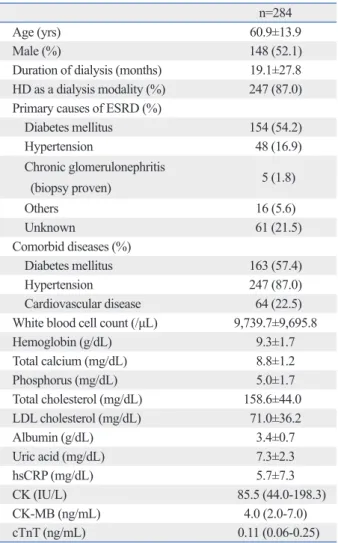
The demographic, clinical, and baseline laboratory find- ings for all patients are summarized in Table 1. The mean patient age was 60.9±13.9; 148 patients (52.1%) were males.
Of the 284 patients, 247 (87.0%) and 37 (13.0%) were managed with HD and CAPD, respectively. The mean du- ration of dialysis was 19.1±27.8 months. Primary causes of ESRD were diabetes mellitus in 154 patients (54.2%), hy- pertension in 48 patients (16.9%), biopsy-proven primary chronic glomerulonephritis in 5 patients (1.8%), others (e.g., polycystic kidney disease and lupus nephritis) in 16 patients (5.6%), and unknown in 61 patients (21.5%). The median CK activity was 85.5 IU/L (IQR, 44.0-198.3 IU/L), the me- dian CK-MB was 4.0 ng/mL (IQR, 2.0-7.0 ng/mL), and the median cTnT was 0.11 ng/mL (IQR, 0.06-0.25 ng/mL).
When the use of aspirin (39.1% vs. 42.5%, p=0.441), beta- blockers (27.8% vs. 29.2%, p=0.780), HMG-CoA reduc- tase inhibitors (13.4% vs. 16.5%, p=0.339), and renin an- giotensin system blockers (35.9% vs. 37.5%, p=0.722) were compared before and after event occurrence, there
Table 1. Baseline Patient Characteristics
n=284
Age (yrs) 60.9±13.9
Male (%) 148 (52.1)
Duration of dialysis (months) 19.1±27.8 HD as a dialysis modality (%) 247 (87.0) Primary causes of ESRD (%)
Diabetes mellitus 154 (54.2)
Hypertension 48 (16.9)
Chronic glomerulonephritis
(biopsy proven) 5 (1.8)
Others 16 (5.6)
Unknown 61 (21.5)
Comorbid diseases (%)
Diabetes mellitus 163 (57.4)
Hypertension 247 (87.0)
Cardiovascular disease 64 (22.5) White blood cell count (/μL) 9,739.7±9,695.8
Hemoglobin (g/dL) 9.3±1.7
Total calcium (mg/dL) 8.8±1.2
Phosphorus (mg/dL) 5.0±1.7
Total cholesterol (mg/dL) 158.6±44.0
LDL cholesterol (mg/dL) 71.0±36.2
Albumin (g/dL) 3.4±0.7
Uric acid (mg/dL) 7.3±2.3
hsCRP (mg/dL) 5.7±7.3
CK (IU/L) 85.5 (44.0-198.3)
CK-MB (ng/mL) 4.0 (2.0-7.0)
cTnT (ng/mL) 0.11 (0.06-0.25)
Male, primary kidney disease, and co-morbid disease are expressed as the number (percent) and CK, CK-MB, and cTnT are expressed as the me- dian (interquartile range). Other data are expressed as the mean±SD.
HD, hemodialysis; ESRD, end-stage renal disease; LDL, low-density li- poprotein; hsCRP, high sensitivity C-reactive protein; CK, creatine kinase;
cTnT, cardiac troponin T; CK-MB, creatine kinase-MB.
MI; RR: 3.74; 95% CI: 1.36-10.26; p=0.010), initial serum cTnT (RR: 1.12; 95% CI: 1.06-1.18; p=0.000), serum albu- min (RR: 0.43; 95% CI: 0.28-0.67; p=0.000), WBC count (RR: 1.03; 95% CI: 1.01-1.05; p=0.015), and hsCRP levels (RR: 1.10; 95% CI: 1.05-1.15; p=0.000) were significant factors for predicting all-cause mortality. However, gender, history of hypertension or cardiovascular disease, dialysis modality, and duration of dialysis were not significantly re- lated to all-cause mortality. When adjustments were made in a multivariate Cox regression model, age (RR: 1.06;
Clinical outcomes during the follow-up period
The patients were followed for up to 88 months (median, 19 months). During the follow-up period, 87 patients (30.6%) died, 37 (13.0%) of whom died of cardiovascular causes.
Other causes of mortality were infection in 20 patients (7.7%), unknown in 17 patients who were pronounced dead on arrival (6.0%), and others (e.g., malignancy, upper gas- trointestinal bleeding, and hepatic encephalopathy) in 11 patients (3.9%).
Since the 99th percentile and cut-off value of cTnT for AMI in the general population are known to be 0.01 ng/mL and 0.1 ng/mL,
15respectively, and the summation of sensitivi- ty and specificity was shown to be highest at 0.35 ng/mL in the current study, the enrolled patients were divided into four groups on the basis of initial cTnT concentrations: 1) cTnT
≤0.01 ng/mL; 2) 0.01<cTnT<0.1 ng/mL; 3) 0.1≤cTnT<0.35 ng/mL; and 4) cTnT≥0.35 ng/mL. Kaplan-Meier survival analysis showed a statistically significant difference in all- cause mortality for the group with initial >cTnT 0.35 ng/mL compared to the other groups (log rank; p<0.001). This effect was more prominent in cardiovascular mortality (Fig. 2).
Univariate Cox regression analysis revealed that age (RR:
1.06; 95% CI: 1.04-1.08; p=0.000), diabetes mellitus (RR:
2.63; 95% CI: 1.62-4.28; p=0.000), ST elevation AMI (STE-
Table 2. Diagnostic Sensitivity, Specificity, PPV, and NPV According to Various Cutoff Values of cTnT
cTnT (ng/mL) 0.01 0.05 0.1 0.15 0.20 0.25 0.30 0.35 0.40 0.45 0.5 1.0
Sensitivity (%) 100 100 98 98 95 95 95 95 85 83 83 70
Specificity (%) 19 32 65 77 82 90 94 97 97 98 99 100
PPV (%) 17 19 28 41 47 61 73 83 83 87 92 100
NPV (%) 100 100 99 99 99 99 99 99 98 97 97 95
cTnT, cardiac troponin T; PPV, positive predictive value; NPV, negative predictive value.
Fig. 1. Receiver operator characteristic (ROC) curve of cardiac troponin T (cTnT) for diagnosing acute myocardial infarction. The area under the curve (AUC) was 0.98 (p<0.001; 95% CI, 0.95-1.00). The cTnT value of 0.35 ng/mL of- fers the best overall sensitivity and specificity; the sensitivity was 0.95 and the specificity was 0.97.
Fig. 2. Kaplan-Meier survival curves according to initial cardiac troponin T (cTnT) levels. (A) The all-cause mortality rate in the group with initial cTnT ≥ 0.35 ng/mL is significantly higher compared to the other groups by log-rank test (p<0.001). (B) The cardiovascular mortality rate in the group with initial cTnT ≥0.35 ng/mL is also significantly higher than in the other groups (p<0.001).
0.0
1-specificity
0.0 0.2 0.4 0.6 0.8 1.0
Sensitivity
0.2 0.4 0.6 0.8 1.0
Cumulative survivalCumulative survival
0.0
0.0 0.2
0.2 0.4
0.4 0.6
0.6 0.8
0.8 1.0
1.0 0
0
4798 9346
47 9893 46
2578 7326
22 7873 26
585 536
2 5853 6
39 33
3833 18 13
1813
20
20 40
40
Time (months)
Time (months) 60
60
80
80
100
100
Number at risk cTnT≤0.01 0.01<cTnT<0.1 0.1≤cTnT<0.35 0.35≤cTnT
Number at risk cTnT≤0.01 0.01<cTnT<0.1 0.1≤cTnT<0.35 0.35≤cTnT
Initial troponin T (ng/mL) cTnT≤0.01 0.01<cTnT<0.1 0.1≤cTnT<0.35 0.35≤cTnT
Initial troponin T (ng/mL) cTnT≤0.01 0.01<cTnT<0.1 0.1≤cTnT<0.35 0.35≤cTnT
A
B
it had the highest sensitivity and specificity in ESRD pa- tients with ACS. In addition, all-cause and cardiovascular mortalities of patients whose initial cTnT levels were ≥0.35 ng/mL were much higher than the other groups.
A cTnT level of 0.1 ng/mL is currently used as the cut-off value for AMIs in the general population. In ESRD pa- tients, however, a number of studies have reported that false positive elevations in cTnT level, even without evidence of myocardial injury, are not uncommon.
16-19Several studies have suggested the following possible reasons for elevated cTnT without myocardial damage: left ventricular hyper- trophy, endothelial dysfunction, leakage of free cytosolic troponin pool, stretch-mediated troponin release, and im- paired renal excretion.
17-19In this study, the summation of sensitivity and specificity of cTnT for AMI in ESRD patients with ACS peaked at 0.35 ng/mL. At a value of 0.1 ng/mL, the sensitivity was 98%, yet the specificity was only 65%. Although AMI is such a seri- ous complication that it is important for the screening test to have high sensitivity, a 35% false positive rate cannot be ig- nored. Therefore, we suggest that an initial cTnT concentra- tion of 0.35 ng/mL in ESRD patients with ACS is a more ap- propriate cut-off value for AMI, even though patients with lower levels of cTnT should also be carefully monitored.
Plasma concentrations of total CK are also elevated in 42% of ESRD patients without myocardial damage,
20and 95% CI: 1.02-1.09; p=0.001), diabetes mellitus (RR: 2.91;
95% CI: 1.24-6.84; p=0.015), serum cTnT (RR: 1.12; 95%
CI: 1.03-1.22; p=0.008), and hsCRP levels (RR: 1.09; 95%
CI: 1.04-1.15; p=0.000) were independent predictors for all-cause mortality (Table 3).
Factors correlated with cardiovascular mortality were also evaluated with univariate Cox regression analysis. Age (RR: 1.07; 95% CI: 1.04-1.10; p=0.000), diabetes mellitus (RR: 2.11; 95% CI: 1.04-4.29; p=0.038), initial serum cTnT (RR: 1.16; 95% CI: 1.09-1.24; p=0.000), and STEMI (RR: 9.98; 95% CI: 3.48-28.65; p=0.000) were significant.
However, gender, history of hypertension or cardiovascular disease, dialysis modality, duration of dialysis, serum albu- min, WBC count, and hsCRP levels were not significantly related to cardiovascular mortality. In a multivariate Cox regression model, age (RR: 1.06; 95% CI: 1.03-1.09;
p=0.000), serum cTnT (RR: 1.14; 95% CI: 1.05-1.22;
p=0.001), and STEMI (RR: 3.91; 95% CI: 1.30-11.78;
p=0.015) were independent predictors for cardiovascular mortality (Table 4).
DISCUSSION
In the present study, we demonstrated that an initial cTnT of 0.35 ng/mL was the best cut-off value for AMI because
Table 3. Results of the Cox Proportional Hazards Analysis Showing Hazard Ratios and 95% Confidence Intervals for All-Cause Mortality
Univariate model Multivariate model*
HR 95% CI p value HR 95% CI p value
Age (yrs) 1.06 1.04-1.08 0.000 1.06 1.02-1.09 0.001
Female (vs. male) 0.82 0.54-1.26 0.367 - - -
Diabetes mellitus 2.63 1.62-4.28 0.000 2.91 1.24-6.84 0.015
Hypertension 0.70 0.40-1.25 0.232 - - -
Cardiovascular disease 1.45 0.92-2.30 0.112 - - -
Patients on CAPD (vs. HD) 1.34 0.74-2.42 0.340 - - -
Dialysis duration (months) 1.00 0.99-1.01 0.898 - - -
cTnT (ng/mL) 1.12 1.06-1.18 0.000 1.12 1.03-1.22 0.008
0.01<cTnT<0.1 (vs. ≤0.01 ng/mL) 4.11 1.41-11.96 0.000 - - -
0.1≤cTnT<0.35 (vs. ≤0.01 ng/mL) 7.81 2.77-22.03 0.000 - - -
0.35≤cTnT (vs. ≤0.01 ng/mL) 13.27 4.57-38.53 0.000 8.65 1.01-74.01 0.049
hsCRP (mg/dL) 1.10 1.05-1.15 0.000 1.09 1.04-1.15 0.000
WBC (103/μL) 1.03 1.01-1.05 0.015 - - -
Albumin (g/dL) 0.43 0.28-0.67 0.000 - - -
STEMI (vs. NSTEMI and non-AMI) 3.74 1.36-10.26 0.010 - - -
HR, hazard ratio; CI, confidence interval; CAPD, continuous ambulatory peritoneal dialysis; HD, hemodialysis; hsCRP, high sensitivity C-reactive protein;
WBC, white blood cell count; STEMI, ST elevation myocardial infarction; NSTEMI, non ST elevation myocardial infarction; AMI, acute myocardial infarction;
cTnT, cardiac troponin T.
*Adjusted for age, diabetes, serum cTnT and hsCRP level.
lar mortality. In this study, patients with an elevated cTnT level≥0.35 ng/mL had a significantly higher risk for all- cause and cardiovascular mortality.
Based on univariate Cox regression analysis, factors cor- related with all-cause mortality were age, diabetes, STEMI, initial serum cTnT, serum albumin, WBC counts, and hsCRP levels. After adjustments, age, diabetes, serum cTnT, and hsCRP levels still had statistical significance. When the pa- tients were divided into four groups according to the initial serum concentration of cTnT, all-cause mortality rate in pa- tients with a moderate increase in cTnT (0.1≤cTnT<0.35 ng/mL) was not significantly different compared to patients with small (0.01<cTnT<0.1 ng/mL) or large (cTnT≥0.35 ng/mL) increases in cTnT by log-rank test. However, patients with a cTnT ≥0.35 ng/mL had a significantly worse progno- sis than all other groups, showing a higher death rate with a risk ratio of 8.65 compared to patients with a cTnT ≤0.01 ng/
mL. Because infection was the second most common cause of mortality, the WBC count and hsCRP level are thought to be significantly correlated with all-cause mortality rate.
Cardiovascular mortality was associated with age, diabe- tes, initial serum cTnT, and STEMI based on univariate Cox regression analysis. In the multivariate model, age, serum cTnT, and STEMI were independent predictors for cardio- vascular mortality. In the Kaplan-Meier survival analysis for cardiovascular mortality, patients with a large increase in 30-50% of asymptomatic HD patients exhibit an elevation
in the CK-MB fraction.
21,22Moreover, 18-31% of patients with an ACS have elevated cTnT levels without an increase in the CK-MB fraction.
23,24Therefore, we performed sur- vival analyses to confirm the validity of the ROC results.
An elevation in serum cTnT levels is a well-known predic- tive factor for all-cause and cardiovascular mortality in as- ymptomatic ESRD patients.
16,25-28Although the reasons for the association between elevated levels of cTnT and a poor prognosis are not clear, the possibility has been suggested that patients with increased cTnT have diffuse coronary ar- tery disease.
27,29Increased serum troponin levels are highly prognostic for cardiac and all-cause mortality among patients with chronic kidney disease with ACS.
12,30In the GUSTO-IV trial, ele- vated cTnT independently predicted the 30-day prognosis in all patients, and patients with creatinine clearance in the lowest quartile (<58 mL/min) also showed poor outcomes;
12however, only 11 of 7,033 patients had severe renal impair- ment with a creatinine clearance <10 mL/min. In addition, it was reported that elevations in cTnI levels in patients with renal impairment undergoing an evaluation for myo- cardial ischemia were at substantially higher risk for all- cause and cardiovascular mortality.
30We identified elevated cTnT levels in ESRD patients presenting with ACS as an independent predictive factor for all-cause and cardiovascu-
Table 4. Results of the Cox Proportional Hazards Analysis Showing Hazard Ratios and 95% Confidence Intervals for Cardio- vascular Mortality
Univariate model Multivariate model*
HR 95% CI p value HR 95% CI p value
Age (yrs) 1.07 1.04-1.10 0.000 1.06 1.03-1.09 0.000
Female (vs. male) 0.78 0.41-1.51 0.471 - - -
Diabetes mellitus 2.11 1.04-4.29 0.038 - - -
Hypertension 1.11 0.39-3.14 0.84 - - -
Cardiovascular disease 1.25 0.60-2.58 0.552 - - -
Patients on CAPD (vs. HD) 1.45 0.60-3.49 0.408 - - -
Dialysis duration (months) 0.99 0.96-1.02 0.419 - - -
cTnT (ng/mL) 1.16 1.09-1.24 0.000 1.14 1.05-1.22 0.001
0.01<cTnT<0.1 (vs. ≤0.01 ng/mL) 2.38 0.64-8.86 0.194 - - -
0.1≤cTnT<0.35 (vs. ≤0.01 ng/mL) 2.65 0.71-9.84 0.145 - - -
0.35≤cTnT (vs. ≤0.01 ng/mL) 11.74 3.37-40.91 0.000 6.01 1.58-22.84 0.008
hsCRP (mg/dL) 1.06 0.97-1.16 0.221 - - -
WBC (103/μL) 1.01 0.96-1.07 0.625 - - -
Albumin (g/dL) 0.82 0.34-2.01 0.665 - - -
STEMI (vs. NSTEMI and non-AMI) 9.98 3.48-28.65 0.000 3.91 1.30-11.78 0.015
HR, hazard ratio; CI, confidence interval; CAPD, continuous ambulatory peritoneal dialysis; HD, hemodialysis; hsCRP, high sensitivity C-reactive protein;
WBC, white blood cell count; STEMI, ST elevation myocardial infarction; NSTEMI, non ST elevation myocardial infarction; AMI, acute myocardial infarction;
cTnT, cardiac troponin T.
*Adjusted for age, STEMI, and serum cTnT level.
comparison of methods for determining if cardiovascular disease is a predictor of mortality in dialysis patients. Am J Kidney Dis 1994;23:382-8.
2. Parfrey PS, Foley RN. The clinical epidemiology of cardiac dis- ease in chronic renal failure. J Am Soc Nephrol 1999;10:1606-15.
3. Sarnak MJ, Levey AS, Schoolwerth AC, Coresh J, Culleton B, Hamm LL, et al. Kidney disease as a risk factor for development of cardiovascular disease: a statement from the American Heart Association Councils on Kidney in Cardiovascular Disease, High Blood Pressure Research, Clinical Cardiology, and Epidemiology and Prevention. Circulation 2003;108:2154-69.
4. Cheung AK, Sarnak MJ, Yan G, Berkoben M, Heyka R, Kaufman A, et al. Cardiac diseases in maintenance hemodialysis patients:
results of the HEMO Study. Kidney Int 2004;65:2380-9.
5. Foley RN, Parfrey PS, Sarnak MJ. Clinical epidemiology of car- diovascular disease in chronic renal disease. Am J Kidney Dis 1998;32:S112-9.
6. Joki N, Hase H, Nakamura R, Yamaguchi T. Onset of coronary ar- tery disease prior to initiation of haemodialysis in patients with end-stage renal disease. Nephrol Dial Transplant 1997;12:718-23.
7. Collins AJ, Li S, Ma JZ, Herzog C. Cardiovascular disease in end- stage renal disease patients. Am J Kidney Dis 2001;38:S26-9.
8. Sosnov J, Lessard D, Goldberg RJ, Yarzebski J, Gore JM. Differ- ential symptoms of acute myocardial infarction in patients with kidney disease: a community-wide perspective. Am J Kidney Dis 2006;47:378-84.
9. Willging S, Keller F, Steinbach G. Specificity of cardiac troponins I and T in renal disease. Clin Chem Lab Med 1998;36:87-92.
10. McLaurin MD, Apple FS, Voss EM, Herzog CA, Sharkey SW.
Cardiac troponin I, cardiac troponin T, and creatine kinase MB in dialysis patients without ischemic heart disease: evidence of cardi- ac troponin T expression in skeletal muscle. Clin Chem 1997;43:
976-82.
11. Khan NA, Hemmelgarn BR, Tonelli M, Thompson CR, Levin A.
Prognostic value of troponin T and I among asymptomatic pa- tients with end-stage renal disease: a meta-analysis. Circulation 2005;112:3088-96.
12. Aviles RJ, Askari AT, Lindahl B, Wallentin L, Jia G, Ohman EM, et al. Troponin T levels in patients with acute coronary syndromes, with or without renal dysfunction. N Engl J Med 2002;346:2047- 13. Alpert JS, Thygesen K, Antman E, Bassand JP. Myocardial infarc-52.
tion redefined--a consensus document of The Joint European So- ciety of Cardiology/American College of Cardiology Committee for the redefinition of myocardial infarction. J Am Coll Cardiol 2000;36:959-69.
14. Wu AH, Valdes R Jr, Apple FS, Gornet T, Stone MA, Mayfield- Stokes S, et al. Cardiac troponin-T immunoassay for diagnosis of acute myocardial infarction. Clin Chem 1994;40:900-7.
15. Apple FS, Wu AH, Jaffe AS. European Society of Cardiology and American College of Cardiology guidelines for redefinition of myocardial infarction: how to use existing assays clinically and for clinical trials. Am Heart J 2002;144:981-6.
16. Apple FS, Murakami MM, Pearce LA, Herzog CA. Predictive value of cardiac troponin I and T for subsequent death in end- stage renal disease. Circulation 2002;106:2941-5.
17. Freda BJ, Tang WH, Van Lente F, Peacock WF, Francis GS. Car- diac troponins in renal insufficiency: review and clinical implica- tions. J Am Coll Cardiol 2002;40:2065-71.
18. Hamm CW, Giannitsis E, Katus HA. Cardiac troponin elevations
cTnT (≥0.35 ng/mL) had a greater mortality rate. The hazard ratio of cardiovascular death in patients with a cTnT ≥0.35 ng/mL was 6.01-fold higher than patients with a cTnT ≤0.01 ng/mL. Therefore, an initial serum cTnT level ≥0.35 ng/mL is an independent predictor for all-cause and cardiovascular mortality.
There were several limitations to this study. First, the study was a relatively small-sized retrospective study from a single center. Therefore, larger prospective studies are needed to confirm the findings. Second, levels of CK/CK- MB were used as serologic markers for the diagnostic crite- ria of AMI in this study, and the measurement of CK/CK- MB for diagnosing AMI has some known shortcomings.
Of note, we excluded patients with skeletal muscle injuries and defined AMI as a temporal change of CK/CK-MB, rather than a single increased value. Third, we were unable to simultaneously measure serum cTnI levels. cTnT is more frequently elevated than cTnI among asymptomatic pa- tients with renal insufficiency due to the relatively higher levels of an unbound cytosolic pool of cTnT and the higher molecular weight.
24In addition, time-dependent change of cTnT could not be evaluated due to the lack of repeated measurements of cTnT levels. Finally, we could not obtain data on risk factors, such as hemodynamic status and echo- cardiographic features, along with medical history, such as smoking habits or family history, due to deficiencies in our database.
In conclusion, although moderate elevations of cTnT are common in ESRD patients without AMI, measurement of cTnT is useful for diagnosing AMI or predicting outcomes.
In addition, ESRD patients with an initial cTnT concentra- tion ≥0.35 ng/mL seem to have a poor prognosis. There- fore, we recommend that urgent diagnosis and treatment be indicated for ESRD patients with ACS when their initial cTnT levels are ≥0.35 ng/mL, due to the reasonable predic- tive capacity of cTnT.
ACKNOWLEDGEMENTS
This work was supported by a grant from the West Seoul Division of Korean Dialysis Physician’s Association.
REFERENCES
1. Farias MA, McClellan W, Soucie JM, Mitch WE. A prospective
dant creatine kinase-MB and troponin measurements in acute cor- onary syndromes. J Am Coll Cardiol 2006;47:312-8.
25. Dierkes J, Domrose U, Westphal S, Ambrosch A, Bosselmann HP, Neumann KH, et al. Cardiac troponin T predicts mortality in pa- tients with end-stage renal disease. Circulation 2000;102:1964-9.
26. Deegan PB, Lafferty ME, Blumsohn A, Henderson IS, McGregor E. Prognostic value of troponin T in hemodialysis patients is inde- pendent of comorbidity. Kidney Int 2001;60:2399-405.
27. deFilippi C, Wasserman S, Rosanio S, Tiblier E, Sperger H, Toc- chi M, et al. Cardiac troponin T and C-reactive protein for predict- ing prognosis, coronary atherosclerosis, and cardiomyopathy in patients undergoing long-term hemodialysis. JAMA 2003;290:
353-9.
28. Havekes B, van Manen JG, Krediet RT, Boeschoten EW, Vanden- broucke JP, Dekker FW; NECOSAD Study Group. Serum tropo- nin T concentration as a predictor of mortality in hemodialysis and peritoneal dialysis patients. Am J Kidney Dis 2006;47:823-9.
29. Jung HH, Ma KR, Han H. Elevated concentrations of cardiac tro- ponins are associated with severe coronary artery calcification in asymptomatic haemodialysis patients. Nephrol Dial Transplant 2004;19:3117-23.
30. Kontos MC, Garg R, Anderson FP, Tatum JL, Ornato JP, Jesse RL. Outcomes in patients admitted for chest pain with renal fail- ure and troponin I elevations. Am Heart J 2005;150:674-80.
in patients without acute coronary syndrome. Circulation 2002;
106:2871-2.
19. Diris JH, Hackeng CM, Kooman JP, Pinto YM, Hermens WT, van Dieijen-Visser MP. Impaired renal clearance explains elevated tro- ponin T fragments in hemodialysis patients. Circulation 2004;109:
23-5.
20. Soffer O, Fellner SK, Rush RL. Creatine phosphokinase in long- term dialysis patients. Arch Intern Med 1981;141:181-8.
21. McLaurin MD, Apple FS, Voss EM, Herzog CA, Sharkey SW.
Cardiac troponin I, cardiac troponin T, and creatine kinase MB in dialysis patients without ischemic heart disease: evidence of cardi- ac troponin T expression in skeletal muscle. Clin Chem 1997;43:
976-82.
22. Apple FS, Sharkey SW, Hoeft P, Skeate R, Voss E, Dahlmeier BA, et al. Prognostic value of serum cardiac troponin I and T in chronic dialysis patients: a 1-year outcomes analysis. Am J Kid- ney Dis 1997;29:399-403.
23. Kleiman NS, Lakkis N, Cannon CP, Murphy SA, DiBattiste PM, Demopoulos LA, et al. Prospective analysis of creatine kinase muscle-brain fraction and comparison with troponin T to predict cardiac risk and benefit of an invasive strategy in patients with non-ST-elevation acute coronary syndromes. J Am Coll Cardiol 2002;40:1044-50.
24. Newby LK, Roe MT, Chen AY, Ohman EM, Christenson RH, Pollack CV Jr, et al. Frequency and clinical implications of discor-