Interstitial Cystitis/Painful Bladder Syndrome: Prevalence Estimates, Quality of Life and Depression among Older Adult Korean Women. What is already known about the topic? 1) Interstitial Cystitis/Painful bladder syndrome (IC/PBS) is a chronic, painful, inflammatory condition of the bladder wall. 2) Previous studies examining the preva- lence and impact were focused on middle life women and not elderly women. 3) Epidemiologic studies of IC/PBS have been predominantly conducted in Western countries and little research reported in Asian countries.
Key Words : Cystitis, Interstitial, Aged, Women, Prevalence,
Quality of life, Depression
INTRODUCTION
Age-related changes in bladder function have been des- cribed by many researchers. Interstitial cystitis (IC)/painful bladder syndrome (IC/PBS), overactive bladder, and uri-
nary incontinence are more commonly found in women than as compared to men (Shiroky, 2004). IC/PBS is a chronic, painful, inflammatory condition of the bladder wall (Evans & Sant, 2007). In 2002 the International Continence Society (ICS) established IC/PBS as a clinical syndrome.
IC is most prevalent in midlife women, however, it is also commonly reported by women 60~69 years old (Ito, Ueda, Honma, & Takei, 2007; Temml et al., 2007) and the prevalence of moderate/severe IC symptoms was highest in the oldest age group (Temml et al., 2007). In the litera- ture the terms IC, PBS, and IC/PBS are often used inter- changeably suggesting that actual number of patients suf- fering from urinary tract pain syndromes may go under reported (Michael, Kawachi, Stampfer, Colditz, & Curhan, 2000).
Epidemiologic studies of IC/PBS have been predomi- nantly conducted in Western countries. Investigators in the U. S., Canada, and Austria report a prevalence rate of
주요어 : 간질성 방광염 여성노인 유병률 삶의 질 우울, , , ,
Address reprint requests to : Kim, Jeung-Im, Department of Nursing, Soon Chun Hyang University, 366-1 Ssangyong-dong, Chonan 330-090, Korea. Tel: 82-2-709-9495, Fax: 82-41-575-9347, E-mail: [email protected]
✻The authors wish to acknowledge the assistance of all elderly women who participated in this study. Conflicts of interest: None declared.
✻This research was supported by Soon Chun Hyang University.
✻The study was approved by Institutional Research Ethics Board in Soon Chun Hyang University.
투고일 :2009년10월30일 1차심사완료일:2009년11월25일 2차심사완료일:2009년11월30일 게재확정일:2009년12월 일5 Korean J Women Health Nurs Vol. 15, No. 4, 381-386, December, 2009 10.4069/kjwhn.2009.15.4.381
Original Article
Interstitial Cystitis/Painful Bladder Syndrome: Prevalence Estimates, Quality of Life and Depression among Older Adult Korean Women
Kim, Jeung-Im
1· Margaret M Heitkemper
21Associate Professor, Department of Nursing, Soon Chun Hyang University,
2Professor, College of Biobehavioral Nursing & Health Systems, University of Washington, USA
한국 여성노인의 간질성방광염의 유병률 삶의 질 우울 연구, ,
김증임
1·Margaret M Heitkemper
2순천향대학교 간호학과 부교수1,워싱턴대학교 간호대학 교수2
Abstract
7.9% to 43.2% (Nickel, Teichman, Gergoire, Clark, & Dow- ney, 2005; Temml et al., 2007). In a sample of American women, Rosenberg et al found that 17.5% of 2043 women (age 18~92 yr) (Rosenberg, Page, & Hazzard, 2007b). In contrast to studies of western women, a Japanese study found the prevalence of IC/PBS to be lower, i.e., 4.5 patients per 100,000 women (Ito, Miki, & Yamada, 2000).
Whether this lower prevalence of IC/PBS is common to other Asian countries is not known. It needs to be studied that Korean women are more like Japanese or western women in the prevalence of IC/PBS.
Due to the symptoms associated with IC/PBS, women with this condition often report reductions in physical function, increases in psychological distress, and decrea- ses in quality of life (QOL) (Arnold et al., 2004). Through some reports, patients with IC have decreased function- ing in various areas, including difficulty performing nor- mal activity due to physical limitations, less energy, and poor social functioning (Michael et al, 2000); poor quality of life and depression (Rothrock, Lutgendorf, Hoffman, &
Kreder, 2002). Another study reported the degree of limitation in psychosocial and physical functioning was associated with symptom severity (Michael et al., 2000).
The impact of IC/PBS on daily functioning may be greatest in elderly women, but this remains to be studied and determined. Also there was rarely reported about the prevalence of IC/PBS and its impact of quality of life and depression using a sample of elderly women. Especially it was rarely reported about the prevalence of IC/PBS and its adverse effects related with symptoms of IC/PBS in Korea.
Using a sample of older adult Korean women, the current study aimed to estimate the prevalence of IC/PBS symptoms, severity and risk for IC; to determine the rela- tionships among IC/PBS and general characteristics, de- pression, and QOL; and to compare women with symp- toms of IC/PBS to those without symptoms on general characteristics, depression, and QOL scores.
METHODS
1. Study Design
A descriptive co-relational design was used to esti- mate the prevalence of IC/PBS symptoms and describe the relationships among symptoms, general sample characteristics, depression and QOL in older Korean women.
2. Participants
Women were recruited via postings on bulletin board at 3 elderly welfare centers in the metropolitan area of Seoul, Korea. Women who were 60 years of age and
older and living in the community were invited to participate in the study. Data were collected from May 1 to June 30, 2007. The study was approved by Institu- tional Research Ethics Board in university. After the informed consent was explained, written informed consent was obtained. The interviews were conducted by two researchers and five research assistants. The interviews took approximately 30 minutes.
3. Measurements
1) IC/ PBS Symptom Measures
The English version of Interstitial Cystitis Symptom Index/ Interstitial Cystitis Problem Index (ICSI/ICPI;
O'Leary, Sant, Fowler, Whitmore, & Spolarich-Kroll, 1997) was tested their reliability and validity by other researchers (Kushner, & Moldwin, 2006; Sirinian, Aze- vedo, & Payne, 2005; Lubeck, Whitmore, Sant, Alvares- Horine, & Lai, 2001). The participants were asked for about their symptoms during the past month (ICSI) and the problems arising from each of these four symptoms (ICPI). The ICSI/ICPI scores were summed from scores on the 4 questions respectively. The total ICSI score ranges from 0 to 20 and ICPI score from 0 to 16. Reli- ability of the Korean version of ICSI/ICPI (ICSI/ICPI-K) used here Cronbach's =.830. ⍺
2) Psychological distress: Korean Geriatric Depression Scale (KGDS)
The Korean version of S-Geriatric Depression Scale (KGDS) was used. Its original version is Short form GDS
(Yesavage, Brink, et al., 1983). KGDS is composed of 15 items, the same items as developed (Choi, Chae, Kim, &
Jeon, 2004). Scores of 5, 9, and 12 were used to classify patients as mildly, moderately, and severely depressed, respectively. In this research, its reliability was Cron- bach's =.772. ⍺
3) Health-related Quality of Life (HRQOL): the King's Health Questionnaire (KHQ)
The KHQ is a disease-specific health-related QOL (HRQOL) instrument developed by Kelleher et al (Kel- leher, Cardozo, Khullar, & Salvatore, 1997). It consists of two single-item questions to address life interference and life satisfaction, and seven multi-item domains. The seven multi-item domains include role limitations, physical and social limitations, personal relationships, emotions, sleep and energy (Homma & Uemura, 2004).
The KHQ was validated linguistically in the Korean
language (Oh, Park, Paick, Park, & Choo, 2005) and
formalized (Oh & Ku, 2007). Higher scores on KHQ
indicate more limitations. In this study, internal con-
sistency reliability was Cronbach's =.934. ⍺
4. Analysis
SPSS/WIN 15.0 program was used to do statistical analysis. The prevalence and urologic characteristics were analyzed by frequency, mean, and severity. Cor- relations among demographic characteristics, ICSI-K and ICPI-K, KGDS, and KHQ were analyzed by Pearson correlation. Group differences in variables by ICSI-K cut-off score 5 were analyzed by ANOVA.
RESULTS
1. General demographic characteristics
The demographic characteristics of the women are shown in Table 1. The women were on average 74.3 years old, and widowed (87%).With regard to health habits, 30% reported engaging in sports and 50% had sleeping difficulties. Sixty percent of the women repor-
ted that they experienced depression with most rating it as 'mild'. The most commonly reported medical condi- tion was hypertension.
The mean scores for the King's Health Questionnaire (KHQ) were 15.42 (7.34), which including physical and social limitations 5.22 (2.38), psychological emotions 4.05 (2.08), sleep and energy 3.06 (1.73), role limitation of daily activities 2.65 (1.29), and personal relationships 0.58 (1.44) in details.
2. Prevalence of IC / PBS symptoms, severity and the risk for IC
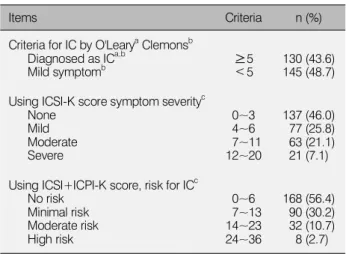
Overall the prevalence rate of IC was 43.6% (130 wo- men) using a cut-off of 5 the score on the ICSI. However, when a more rigorous score of 7 was used, the pre- valence rate decreased to 16.2%. The prevalence of mild to severe IC symptoms using ICSI-K was 54%. The percentage at risk for IC using summed scores of ICSI-K and ICPI-K) was 43.6% (Table 2).
3. Relationships of ICSI-K and ICPI-K to general characteristics
The ICSI-K score was positively related to age, general health perception and co-morbidity. And the ICPI-K score was positively related to health perception and
Table 1. General characteristics of the Korean elderly women(N=298)
Variables n (%) or M±SD
Age (year) 74.3±6.20
Body mass index (BMI) (kg/m2) 23.7±3.97 Marital status
Widowed Have husband
259 (86.9) 39 (13.1) General health perception (1~5)
Very good (1) Good (2) Moderate (3) Bad (4) Very bad (5)
3.21±0.87 10 (3.4) 51 (17.1) 130 (43.6) 90 (30.2) 17 (5.7) Healthy habits (1~7)
Sleep for 7~8 hours Having a breakfast Not having a snack Care to have a little salt Not smoking
Taking a walk Doing sports
4.40±1.37*
150 (50.3) 265 (88.9) 205 (68.8) 162 (54.4) 277 (93.0) 181 (60.7) 86 (28.9) Medical condition
Hypertension Diabetes mellitus Cardiac disease Vaginitis Stroke Cervix cancer
0.84±0.92*
142 (47.7) 38 (12.8) 30 (10.1) 18 (6.0) 16 (5.4) 7 (2.3) Geriatric depression scale (KGDS)
No depression Mild depression ( 5)≥ Moderate depression ( 9)≥ Severe depression ( 12)≥
5.98±3.60 117 (39.3) 102 (34.2) 71 (23.8) 8 (2.7) King's health questionnaire (KHQ) 15.42±7.34
*The mean for the number responded.
Table 2. Prevalence, severity & risk for ICSI/ICPI-K among older
Korean women (N=298)
Items Criteria n (%)
Criteria for IC by O'LearyaClemonsb Diagnosed as ICa,b
Mild symptomb ≥5
5
< 130 (43.6) 145 (48.7) Using ICSI-K score symptom severityc
NoneMild Moderate Severe
0~34~6 12~207~11
137 (46.0) 77 (25.8) 63 (21.1) 21 (7.1) Using ICSI+ICPI-K score, risk for ICc
No risk Minimal risk Moderate risk High risk
0~67~13 14~23 24~36
168 (56.4) 90 (30.2) 32 (10.7) 8 (2.7) IC=interstitial cystitis; ICSI/ICPI-K=interstitial cystitis symptom index/
interstitial cystitis problem index-Korean version.
aO'Leary, M., Sant, G., Fowler, F. J., Whitmore, K., & Spolarich-Kroll, J. (1997). The interstitial cystitis symptom index and problem index.
Urology, 49, 58-63.
bClemons, J. L., Arya, L. A., & Myers, D. L. (2002). Diagnosing interstitial cystitis in women with chronic pelvic pain. Obstet Gynecol 100, 337-341.
cTemml, C., Wehrberger, C., Riedl, C., Ponholzer, A., Marszalek, M., &
Madersbacher, S. (2007). Prevalence and correlates for interstitial cystitis symptoms in women participating in a health screening project. Eur Urol, 5(3), 803-809.
co-morbidity. However BMI (body mass index) and healthy habits were not significantly related to both of ICSI-K and ICPI-K (Table 3).
4. Relationships of ICSI-K and ICPI-K to KGDS and KHQ
The ICSI-K scores had moderate correlations with KHQ and had mild correlations with KGDS; The ICPI had strong positive correlations with KHQ and had mild correlations with KGDS. KHQ scores had mild positive correlation with KGDS. As shown in Table 4, the higher the IC symptom score and the higher IC problem score, higher the KHQ scores.
5. Differences in variable by ICSI severity cut-off score
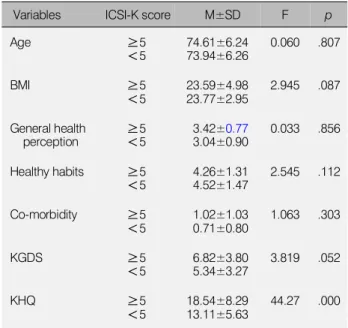
Based on the cut-off score 5 on the ICSI-K, age, BMI, general health perception, healthy habits, co-morbidity, KGDS scores, and KHQ scores were compared by inde- pendent sample tests. KHQ scores were significantly higher in women with symptoms of IC/PBS as com- pared to those without symptoms (F=44.3, p<.0001).
Both depression and BMI tended to be greater in women with IC/PBS as compared to those without symptoms (F=3.819, p=.052; F=2.945, p=.087, respectively). How- ever, no other group differences were found in age, general health perception, health habits and co-morbi- dity (Table 5).
DISCUSSION
In the current study using the ICSI-K and a cut-off score of 5, we found the prevalence of IC in older Korean women to be 43.6%. Using a more rigorous score of 7, the prevalence rate was 16.2%. Thus, the prevalence IC/PBS in this sample of older Korean women is similar to that observed in Western samples (Temml et al., 2007). Using a similar cut-off level, studies conducted in Australia, Europe, and the U. S. have found rates of 7.9% to 43%
(Nickel et al, 2005; Temml et al., 2007), while a study performed in Japan found only 4.5 patients per 100,000 women with IC/PBS. However, the prevalence of IC in a subgroup of older Japanese women is similar to that found in the current study (Ito et al., 2007; Ito et al., 2000;
Temml et al., 2007).
The current study also demonstrates that the pre- valence rate of IC in older Korean women depends on the cut-off score used. The prevalence rate in this study was higher than in a study of American women which used an ICSI score of 5, but lower than a study in which 4 was used as the cut-off point (Clemons, Arya, & Myers, 2002). It remains to be determined whether a cut-off score of 4 or 5 rather than 7 would be more clinically useful in detecting IC/PBS and ultimately its prevention and management. Clemons et al (2002) using a score of 5 or more on the ICSI had a sensitivity of 94%, a positive predictive value of 53%, and a negative predictive value of 93%, using a receiver operator characteristic curve.
Thus, additional work is needed particularly in older
Table 3. Relationships of ICSI-K and ICPI-K to general charac-teristics
Variables Age BMI Health
perception Healthy habits Co-
morbidity ICSI-K .133* -.017 .235*** -.036 .186**
ICPI-K .097 -.077 .275*** -.067 .133*
BMI=body mass index; ICSI-K=interstitial cystitis symptom index- Korean version; ICPI-K=interstitial cystitis problem index-Korean version.
*p<.05, ** p<.01 *** p<.001
Table 4. Bivariate correlations among ICSI-K, ICPI-K, KGDS and KHQ
Variables ICSI-K ICPI-K KGDS
ICPI-K .674*
KGDS .294* .376*
KHQ .428* .626* .331*
ICSI-K=interstitial cystitis symptom index-Korean version; ICPI-K= inter- stitial cystitis problem index-Korean version; KGDS=Korean version of geriatric depression symptoms; KHQ=king's health questionnaire.
*p<.01.
Table 5. Differences by ICSI-K cut-off score
Variables ICSI-K score M±SD F p
Age ≥5
5
< 74.61±6.24
73.94±6.26 0.060 .807
BMI ≥5
5
< 23.59±4.98
23.77±2.95 2.945 .087 General health
perception ≥5 5
< 3.42±0.77
3.04±0.90 0.033 .856 Healthy habits ≥5
5
< 4.26±1.31
4.52±1.47 2.545 .112 Co-morbidity ≥5
<5
1.02±1.03
0.71±0.80 1.063 .303
KGDS ≥5
5
< 6.82±3.80
5.34±3.27 3.819 .052
KHQ ≥5
<5
18.54±8.29
13.11±5.63 44.27 .000 BMI=body mass index; ICSI-K=interstitial cystitis symptom index- Korean version; KGDS=Korean version of geriatric depression symp- toms; KHQ=king's health questionnaire.
populations to develop a clinically useful tool to deter- mine those at risk for a diagnosis of IC/PBS.
Understanding the presenting symptoms of urinary frequency, urinary urgency, and pelvic pain in the presence of otherwise normal physical findings can enhance the primary care providers' ability to appro- priately identify the disease. Early identification may allow initiation of therapy or referral before the problem becomes refractory to standard treatment (Rosenburg, Newman, & Page, 2007a).
The current study also shows that IC/PBS is asso- ciated with a number of challenging symptoms inclu- ding voiding at night, frequent voiding in the day time, urgency, and pelvic pain in older Korean women. Noctur- nal enuresis was the most frequent symptom reported as 83.3% in this sample. This percentage is similar to 83.4% found with a sample of Austrian women over the age of 60 (Temml et al., 2007) but higher than that found in Japanese (72.2%; Ito et al., 2007) or Taiwanese samples (46.9% (Lin, Ng, Chen, Hu, & Chen, 2004).
Nocturnal enuresis results in sleep disturbances which has been linked to depression (Rothrock et al., 2002).
Management of nocturnal enuresis as well as other symptoms of IC/PBS may be an important step towards improving overall QOL in older women.
Women with IC/PBS also report other medically unexplained urologic symptoms including overactive bladder syndrome (OBS) (Buffington, 2004). In the cur- rent study, symptoms of IC/PBS were found to be asso- ciated with physical interference, psychological distress, and lower QOL in Korean women similar to that noted in western women (Arnold et al., 2004; Michael et al., 2000). This constellation of symptoms and their disrup- tion in normal sleep may contribute to the reduced QOL noted in this sample of women.
A limitation of the current study is that no biomarker for IC/PBS was used, but tools such as the ICSI/ICPI may serve as an initial screening measure to evaluate the prevalence of IC/PBS and related psychological distress symptoms. Another limitation of the current study is that the sample was self-referred for participation. Indeed a higher prevalence of women with IC/PBS may have been found if the participants had been recruited from a clinic population.
Conclusion
In conclusion, we found that almost half of older Korean women in this sample had IC/PBS symptoms using IC/PBS cut-off score of 5 and this rate was similar to that noted in Western women. Interstitial cystitis symptoms and problems impacted limitation in life highly. Therefore we suggest it needs to be developed
therapeutic intervention for older Korean women with IC/PBS symptoms. This study will be an important bridge in IC/PBS issues and contribute the develop- ment of program for elderly women with IC/PBS sym- ptoms.
References
Arnold, R., Ranchor, A. V., Sanderman, R., Kempen, G.
I., Ormel, J., & Suurmeijer, T. P. (2004). The relative contribution of domains of quality of life to overall quality of life for different chronic diseases. Qual Life
Res, 13(5), 883-896.Buffington, C. (2004). Comorbidity of interstitial cystitis with other unexplained clinical conditions. J Urol,
172, 1242-1248.Choe, M. A., Chae, Y. R., Kim, J. I., & Jeon, M. Y. (2006).
A comparison of health status, health-related life habits, activities of daily living and biophysical in- dex between Korean and Japanese elderly. J Korean
Acad Adult Nurs, 18(4), 612-621.Clemons, J. L., Arya, L. A., & Myers, D. L. (2002). Diag- nosing interstitial cystitis in women with chronic pel- vic pain. Obstet Gynecol, 100, 337-341.
Evans, R. J., & Sant, G. R. (2007). Current diagnosis of in- terstitial cystitis: An evolving paradigm. Urology, 69 (Suppl 4A), 64-72.
Homma, Y., & Uemura, S. (2004). Use of the short form of King's Health Questionnaire to measure quality of life in patients with an overactive bladder. BJU Int,
93,1009-1013.Ito, T., Miki, M., & Yamada, T. (2000). Interstitial cystitis in Japan. BJU Int, 86(6), 634-637.
Ito, T., Ueda, T., Homma, Y., & Takei, M. (2007). Recent trends in patient characteristics and therapeutic choi- ces for interstitial cystitis: analysis of 282 Japanese patients. Int J Urol, 14(12), 1068-1070.
Kelleher, C. J., Cardozo, L. D., Khullar, V., & Salvatore, S.
(1997). A new questionnaire to assess the quality of life of urinary incontinent women. Br J Obstet Gynaecol,
104, 1374-1379.Kushner, L., & Moldwin, R. M. (2006). Efficiency of Que- stionnaires used to screen for interstitial cystitis. J
Urol, 176, 587-592.Lin, T.-L., Ng, S.-C., Chen, Y.-C., Hu, S.-W., & Chen, G.-D. (2004). What affects the occurrence of nocturia more: menopause or age? Maturitas, 50(2), 71-77.
Lubeck, D. P., Whitmore, K., Sant, G. R., Alvarez-Horine, S., & Lai, C. (2001). Psychometric validation of the O'leary-Sant interstital cystitis symptom index in a clinical trial of pentosan polysulfate sodium. Urology,
57(Suppl 6A), 62-66.Michael, Y., Kawachi, I., Stampfer, M., Colditz, G., &
Curhan, G. (2000). Quality of life among women with interstitial cystitis. J Urol, 164(2), 423-427.
Nickel, J. C., Teichman, J. M. H., Gergoire, M., Clark, J., &
Downey, J. (2005). Prevalence, diagnosis, characteri- zation and treatment of prostatitis, interstitial cystitis, and epidigymitis in the outpatient urological prac- tice: The Canadian PIE study. Urology, 66, 935.
O'Leary, M., Sant, G., Fowler, F. J., Whitmore, K., &
Spolarich-Kroll, J. (1997). The interstitial cystitis symp- tom index and problem index. Urology, 49, 58-63.
Oh, S. J., & Ku, J. H. (2007). Comparison of three dis- ease-specific quality of life questionnaires (Bristol fe- male lower urinary tract symptoms, incontinence quality of life and King's Health Questionnaire) in women with stress urinary incontinence. Scand J Urol
Nephro, 41, 66-71.Oh, S. J., Park, H. G., Paick, S. H., Park, W. H., & Choo, M. S. (2005). Translation and linguistic validation of Korean version of the King's Health Questionnaire Instrument. Korean J Urol, 46(5), 438-450.
Rosenberg, M. T., Newman, D. K., & Page, S. A. (2007a).
Interstitial cystitis/painful bladder syndrome: symp- tom recognition is key to early identification, treat- ment. Cleve Clin J Med, 74(Suppl 3), S54-62.
Rosenberg, M. T., Page, S., & Hazzard, M. A. (2007b). Pre-
valence of interstitial cystitis in a primary care setting.
Urology, 69(Suppl 4), 48-52.
Rothrock, N., Lutgendorf, S., Hoffman, A., & Kreder, K.
(2002). Depressive symptoms and quality of life In patients with interstitial cystitis. J Urol, 167(4), 1763- 1767.
Shiroky, M. B. (2004). The aging bladder. Rev Urol, 6(1), S3-S7.
Sirinian, E., Azevedo, K., & Payne, C. (2005). Correlation between 2 interstitial cystitis symptom instruments. J
Urol, 173, 835-840.Son, H. M., & Kim, J. I. (2008). Evaluation of the inter- stitial cystitis symptom index and problem index- Korean version. Korean J Women Health Nurs, 14(4), 290-296.
Temml, C., Wehrberger, C., Riedl, C., Ponholzer, A., Marszalek, M., & Madersbacher, S. (2007). Prevalence and correlates for interstitial cystitis symptoms in women participating in a health screening project.
Eur Urol, 51(3), 803-809.