INTRODUCTION
Cardiovascular disease, including coronary artery diseases (CADs) is the one of the leading causes of death and illness in the developed world.
1-6Although tremendous investment has
revealed the pathogenesis of cardiovascular diseases, deaths from cardiovascular diseases are still increasing.
1-7Hence, to predict the survival rate from cardiovascular diseases, identi- fying novel prognostic markers is required, it would contribute to selecting better treatment options and reducing mortality.
MicroRNAs (miRNAs) are small (approximately 20 nucleo- tide) noncoding RNAs, that can dysregulate protein transla- tion by targeting messenger RNA.
8,9MiRNAs are involved in various biological and physiological processes.
8,10Further- more, recent studies have suggested that levels of circulating miRNAs from vessel walls and inflammatory cells might be po- tential biomarkers of cardiovascular diseases.
11,12Recent research has reported that some miRNAs are associ- ated with various diseases, including cancers, diabetes, and heart diseases.
13-17As the importance of miRNAs increases more
Received: February 1, 2018 Revised: March 12, 2018Accepted: March 14, 2018
Corresponding author: Prof. Yun Hak Kim, Department of Anatomy, School of Medi- cine, Pusan National University, 49 Busandaehak-ro, Mulgeum-eup, Yangsan 50612, Korea.
Tel: 82-51-510-8091, Fax: 82-51-510-8049, E-mail: [email protected]
•The authors have no financial conflicts of interest.
© Copyright: Yonsei University College of Medicine 2018
This is an Open Access article distributed under the terms of the Creative Com- mons Attribution Non-Commercial License (http://creativecommons.org/licenses/
by-nc/4.0) which permits unrestricted non-commercial use, distribution, and repro- duction in any medium, provided the original work is properly cited.
Prognostic Value of MicroRNAs in Coronary Artery Diseases: A Meta-Analysis
Ji Suk Kim
1,2, Kyoungjune Pak
1,3, Tae Sik Goh
1,4, Dae Cheon Jeong
5, Myoung-Eun Han
6, Jihyun Kim
2, Sae-Ock Oh
6, Chi Dae Kim
7, and Yun Hak Kim
1,61BEER, Busan Society of Evidence-based Mdicine and Research, Busan;
2Department of Family Medicine, BHS Han Seo Hospital, Busan;
3Departments of Nuclear Medicine and 4Orthopaedic Surgery, Pusan National University Hospital, Busan;
5Analytics Group, Deloitte Consulting LLC, Seoul;
6Departments of Anatomy and 7Pharmacology, School of Medicine, Pusan National University, Yangsan, Korea.
Purpose: Coronary artery diseases (CADs) are the leading causes of death in the world. Recent studies have reported that differ-
entially expressed microRNAs (miRNAs) are associated with prognosis or major adverse cardiac events (MACEs) in CAD patients.
In a previous meta-analysis, the authors made serious mistakes that we aimed to correct through an updated systematic review and meta-analysis of the prognostic value of altered miRNAs in patients with CADs.
Materials and Methods: We performed a systematic search of MEDLINE (from inception to May 2017) and EMBASE (from in-
ception to May 2017) for English-language publications. Studies of CADs with results on miRNAs that reported survival data or MACEs were included. Data were extracted from each publication independently by two reviewers.
Results: After reviewing 515 articles, a total eight studies were included in this study. We measured pooled hazard ratios (HRs)
and 95% confidence intervals (CIs) of miRNA 133a with a fixed-effect model (pooled HR, 2.35; 95% CI, 1.56–3.55). High expres- sion of miRNA 133a, 208b, 126, 197, 223, and 122-5p were associated with high mortality. Additionally, high levels of miRNA 208b, 499-5p, 134, 328, and 34a were related with MACEs.
Conclusion: The present study confirmed that miRNA 133a, which was associated with high mortality in CAD patients, holds
prognostic value in CAD. More importantly, this study corrected issues raised against a prior meta-analysis and provides accurate information.
Key Words: Coronary artery disease, microRNA, prognosis, meta-analysis
pISSN: 0513-5796 · eISSN: 1976-2437 Yonsei Med J 2018 Jun;59(4):495-500
https://doi.org/10.3349/ymj.2018.59.4.495
and more, new strategies based on miRNAs such as diagnostic and therapeutic targets have been developed.
8,12,13,16-18Of these, many researchers have suggested that miRNA or miRNA signa- tures may be diagnostic and prognostic biomarkers for hu- man diseases.
16,17During a study of the relationship between CADs and miRNAs, we found severe errors in a previous meta- analysis.
19Therefore, we conducted a systematic review and meta-analysis in the present study to better define the prognos- tic value of various miRNAs in patients with CADs.
MATERIALS AND METHODS
Eligibility and search strategy
We performed a systematic search of MEDLINE (from incep- tion to May 2017) and EMBASE (from inception to May 2017) for English-language publications using the keywords “coro- nary artery disease,” “NSTEMI,” “STEMI,” “cardiovascular dis- ease,” “microRNA,” “death,” “prognosis,” and “major adverse cardiovascular events (MACEs).” All searches were limited to human studies. The inclusion criteria were studies of coronary artery diseases that reported the results of miRNA expressions, survival data, and MACEs. Laboratory studies, reviews, letters, comments, and editorial materials were excluded. We also ex- cluded full-text articles that lacked sufficient data for calculat- ing hazard ratios (HRs) or odds ratios (ORs) using Engauge Digi- tizer (http://digitizer.sourceforge.net). If reported values were much different from calculated values by using Engauge Digi- tizer, we defined the paper as an inadequate article. Two au- thors performed the searches and screening independently, and discrepancies were resolved by consensus. A flowchart of the study selection process is shown in Fig. 1.
515 records identified through MEDLINE, EMBASE databases searching
277 records screened
76 full-text articles assessed for eligibility
8 studies included in meta-analysis
277 abstracts assessed for eligibility 201 abstracts excluded 238 records excluded - Non-English article, 12 - Non-human studies, 33 - Conference abstract, 193
Full-text articles excluded - Insufficient data, 29 - Inadequate data, 19 - Duplicate data, 20
Fig. 1. Flow chart of study selection. We excluded 201 abstracts that are laboratory studies, review articles, letters, and comments. We excluded full- text articles that have insufficient data for calculating hazard ratio or odds ratio using Engauge Digitizer. If reported values were much different from calculated values by using Engauge Digitizer, we defined the paper as an inadequate article.
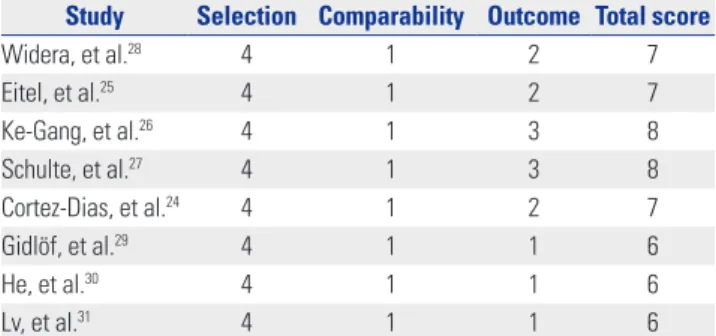
Table 1. Quality Assessment Based on the Newcastle-Ottawa Scale Study Selection Comparability Outcome Total score
Widera, et al.28 4 1 2 7
Eitel, et al.25 4 1 2 7
Ke-Gang, et al.26 4 1 3 8
Schulte, et al.27 4 1 3 8
Cortez-Dias, et al.24 4 1 2 7
Gidlöf, et al.29 4 1 1 6
He, et al.30 4 1 1 6
Lv, et al.31 4 1 1 6
Selection: representativeness of studies (maximum score-4), comparability:
comparability of studies (maximum score-2), outcome: assessment of out- come and follow-up (maximum score-3).
Quality assessment
The Newcastle-Ottawa scale was used to evaluate the quality of studies incorporated in this meta-analysis, which was done based on the following three aspects: selection of the study groups, comparability of the groups, and the outcome of in- terest. The lowest score was 0 and the highest was 9. Studies with a score ≥6 were considered as high quality.
20-22We set 12 months as an adequate follow-up length (Table 1).
Data extraction and statistical analysis
Data were extracted from the publications independently by two reviewers, and the following information was recorded:
first author, year of publication, country, miRNA expression analyzed, number of patients, and end points. The primary outcome was mortality defined as the time from the initiation of therapy until death from any causes. The secondary end- point was MACEs defined as cardiac death, heart failure, de- creased ejection fraction, or cardiogenic shock.
The effects of miRNA expressions on mortality were assessed
using HRs and on MACEs were assessed using ORs. In cases
of mortality, a univariate HR estimate and 95% confidence in- tervals (CIs) were extracted directly from each study, if pro- vided by the authors. Otherwise, p values of the log-rank tests, 95% CIs, number of events, and numbers of patients at risk were extracted to estimate the HR indirectly. Survival rates cal- culated from Kaplan-Meier curves were read using Engauge Digitizer, version 3.0 (http://digitizer.sourceforge.net) to re- construct the HR estimate and its variance, assuming that pa- tients were censored at a constant rate during follow-up. In case of MACEs, a multivariate OR estimate was extracted directly from each study. However, we could not perform meta-analy- sis because the variables were different in each of the studies.
The HRs and ORs were calculated on the basis of high expres- sion of miRNA, which means HR >1 and OR >1 implied poor prognosis and high MACEs for patients. Heterogeneity among studies was assessed using χ
2tests and I
2statistics. Heteroge- neity was considered to be low if I
2<25%, medium if between 25% and 75%, and high if I
2>75%. If there was obvious hetero- geneity (I
2>50%), the random-effects model was used, other- wise the fixed-model was used.
9Funnel plots were used to as- sess publication bias.
23Begg’s test and Egger’s test were also used to identify publication bias, and these tests were performed by using the ‘metafor’ package in R. The forest and funnel plots were depicted using Review Manager (RevMan, version 5.3:
The Nordic Cochrane Centre, The Cochrane Collaboration, 2014, Copenhagen, Denmark). p values <0.05 were considered to be statistically significant. The pooled HR and heterogeneity of miRNA 133a was calculated using Review Manager.
RESULTS
Study characteristics
The electronic search identified 515 articles. Non-human stud- ies (n=33), non-English articles (n=12), conference abstracts (n=193), and 201 studies that did not meet the inclusion criteria based on their title and abstract were excluded. After review- ing the full text of 76 articles, eight studies were eligible for in- clusion in the study (5 articles; prognosis in 1987 patients, 3 articles; MACEs in 792 patients) (Fig. 1). All of the included studies had a prospective design, and reported the prognostic value of six different miRNAs (122-5p, 126, 133a, 197, 208b, 223) in HRs
24-28and five different miRNAs (34a, 134, 208b, 328, 499- 5p) in OR.
29-31Included studies were performed recently (2011−2016), and the study characteristics are summarized in Table 2.
Quality assessment
The Newcastle-Ottawa scale indicated that the methodologi- cal quality of the included studies varied from 6 to 8. Three ar- ticles received a score of 6, three articles received a score of 7, and two articles received a score of 8 (Table 1).
Higher miRNA expression associated with worse prognosis of coronary artery diseases
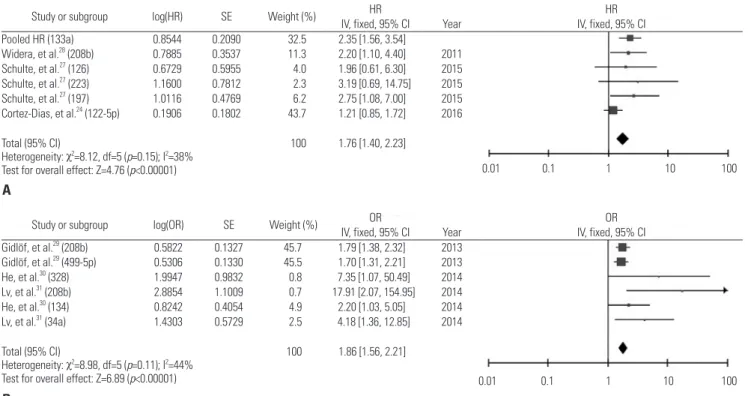
To analyze the prognostic value of high expression of miRNAs in CADs, forest plots with mortality and MACEs are depicted in Figs. 2 and 3. High expression of miRNA 133a, 208b, 126, 197, 223, and 122-5p were associated with high mortality (Fig. 2A).
The overall HR of all miRNAs for mortality was 1.76 (95% CI 1.40−2.23, p<0.00001) (Fig. 2A). High level of miRNA 208b, 499-
Table 2. Studies Included in This Meta-AnalysisStudy Year of
publication Country miRNA No. of patients
Follow up (month)
Study
design HR Assay
method Sample Mortality
Widera, et al.28 2011 Germany 208b*
133a† 444 6 P HR RT-PCR Plasma
Etel, et al.25 2012 Germany 133a* 216 6 P HR RT-PCR Serum
Ke-Gang, et al.26 2016 China 133a*
126‡ 312 24 P HR RT-PCR Plasma
Schulte, et al.27 2015 Germany 197‡
223‡ 873 48 P HR RT-PCR Serum
Cortez-Dias, et al.24 2016 Portugal 122-5p* 142 208 P HR RT-PCR Serum
Major adverse cardiac events
Gidlöf, et al.29 2013 Sweden 208b
499-5p 407 1 P OR RT-PCR Plasma
He, et al.30 2014 China 134
328 359 6 P OR RT-PCR Plasma
Lv, et al.31 2014 China 208b
34a 359 6 P OR RT-PCR Serum
HR, hazard ratio; OR, odds ratio; P, prospective.
Follow up; *Median, †Upper 25%, ‡Second tertile.
Study or subgroup log(HR) SE Weight (%) HR HR IV, fixed, 95% CI Year IV, fixed, 95% CI Widera, et al.28 (133a) 0.9163 0.3336 39.5 2.50 [1.30, 4.81] 2011
Eitel, et al.25 (133a) 1.0986 0.4467 22.0 3.00 [1.25, 7.20] 2012 Ke-Gang, et al.26 (133a) 0.6523 0.3380 38.5 1.92 [0.99, 3.72] 2016
Total (95% CI) 100 2.35 [1.56, 3.55]
Heterogeneity: χ2=0.69, df=2 (p=0.71); I2=0%
Test for overall effect: Z=4.08 (p<0.00001) 0.01 0.1 1 10 100
Fig. 3. Forest plot (A) and funnel plot (B) for mortality of microRNA 133a expression in patients with coronary artery diseases in this meta-analysis. SE, standard error; HR, hazard ratio; CI, confidence interval.
0 0.1 0.2 0.3 0.4 0.5
SE [log(HR)]
HR
0.01 0.1 1 10 100
A
B
Study or subgroup log(HR) SE Weight (%) HR HR
IV, fixed, 95% CI Year IV, fixed, 95% CI Pooled HR (133a) 0.8544 0.2090 32.5 2.35 [1.56, 3.54]
Widera, et al.28 (208b) 0.7885 0.3537 11.3 2.20 [1.10, 4.40] 2011 Schulte, et al.27 (126) 0.6729 0.5955 4.0 1.96 [0.61, 6.30] 2015 Schulte, et al.27 (223) 1.1600 0.7812 2.3 3.19 [0.69, 14.75] 2015 Schulte, et al.27 (197) 1.0116 0.4769 6.2 2.75 [1.08, 7.00] 2015 Cortez-Dias, et al.24 (122-5p) 0.1906 0.1802 43.7 1.21 [0.85, 1.72] 2016
Total (95% CI) 100 1.76 [1.40, 2.23]
Heterogeneity: χ2=8.12, df=5 (p=0.15); I2=38%
Test for overall effect: Z=4.76 (p<0.00001)
Study or subgroup log(OR) SE Weight (%) OR OR
IV, fixed, 95% CI Year IV, fixed, 95% CI Gidlöf, et al.29 (208b) 0.5822 0.1327 45.7 1.79 [1.38, 2.32] 2013
Gidlöf, et al.29 (499-5p) 0.5306 0.1330 45.5 1.70 [1.31, 2.21] 2013 He, et al.30 (328) 1.9947 0.9832 0.8 7.35 [1.07, 50.49] 2014 Lv, et al.31 (208b) 2.8854 1.1009 0.7 17.91 [2.07, 154.95] 2014 He, et al.30 (134) 0.8242 0.4054 4.9 2.20 [1.03, 5.05] 2014 Lv, et al.31 (34a) 1.4303 0.5729 2.5 4.18 [1.36, 12.85] 2014
Total (95% CI) 100 1.86 [1.56, 2.21]
Heterogeneity: χ2=8.98, df=5 (p=0.11); I2=44%
Test for overall effect: Z=6.89 (p<0.00001)
0.01 0.1 1 10 100
0.01 0.1 1 10 100
A
B
Fig. 2. Systematic summary for prognostic values of miRNAs with CADs. (A) Forest plots for mortality of miRNA expression in patients with CADs. (B) Forest plots for major adverse cardiac events of miRNA expression in patients with CADs. HR, hazard ratio; OR, odds ratio; SE, standard error; CI, con- fidence interval; miRNA, microRNA; CAD, coronary artery disease.
5p, 134, 328, and 34a showed significance with MACEs (over- all OR 1.86, 95% CI 1.56−2.21, p<0.00001) (Fig. 2B).
We analyzed prognostic significance between mortality and expression of miRNA 133a that were studied by three inde-
pendent articles. We applied the fixed-effect model on miRNA 133a because we determined that heterogeneity was low through various statistical values (χ
2=0.69, p=0.71, I
2=0%) (Fig.
3A). As shown in Fig. 3A, the pooled HR of miRNA 133a for
mortality was 2.35 (95% CI 1.56−3.55, p<0.0001), which means high expression of miRNA 133a showed a strong relationship with high mortality in CADs.
Publication bias
The funnel plot in this meta-analysis seemed symmetrical (Fig.
3B). The results of Begg’s and Egger’s test were not significant (Table 3). These results suggested no evidence for publication bias.
DISCUSSION
A systematic review and meta-analysis provides significant in- formation to researchers, such that analysis performed incor- rectly can cause serious problems. In a previous meta-analysis, the authors made severe mistakes when they extracted and merged various results. First, the authors changed some ORs in references to HRs, and then the changed HRs that were com- bined with other HRs from other researches.
29-32Because OR is quite different from HR, they should not be combined in the meta-analysis. Second, they merged HRs from univariate analysis with other HRs from multivariate analysis.
19Univariate analysis is the simplest statistical method because it only con- siders only one variable, whereas multivariate analysis involves analysis of more than one variable at a time. For that reason, HRs from univariate analysis are not that same as HRs from multivariate analysis, even though they can be calculated us- ing same data.
29-31Time-to-event outcomes are the most impor- tant factors in prognostic studies; however, the authors in the previous meta-analysis misused the mean follow-up months from reference.
33For these reason, we corrected critical prob- lems of the previous meta-analysis
19and updated recent results on the prognostic value of miRNAs in CADs to help scientists in- terested in miRNA research.
Circulating miRNAs have emerged as potential diagnostic markers in various diseases, including CADs, due to their ac- cessibility by drawing a patient’s blood.
24-33In this study, we found that high levels of circulating miRNA 133a, 208b, 126, 197, 223, and 122-5p in CAD patients were related with high mor- tality.
24-28In addition, high expression of miRNA 208b, 499-5p, 134, 328, and 34a were associated with MACEs.
29-31Although many miRNAs in this study were found to be associated with prognosis of CADs patients, most of them were identified only by a single report, except miRNA 133a.
24-31Therefore, we have shown through meta-analysis of miRNA 133a that high expres- sion of it is associated with a poor prognosis of CADs.
MiRNAs are known to be important regulators of all major cel- lular functions, including differentiation, proliferation, apop-
Table 3. Begg’s and Egger’s Test for Evaluating Publication BiasHazard ratio p value of Begg’s test p value of Egger’s test
Overall 0.2493 0.3333
tosis, and angiogenesis.
25,34Among them, miRNA 133a has been widely reported as a regulator of cardiomyocyte proliferation, and tumor-suppressor.
35-38Moreover, recent studies found that increased levels of circulating miRNA 133a in CADs patients, which had correlation with troponin.
13,28,29,39,40In this meta-anal- ysis, three articles showed consistent results suggesting that high expression of miRNA 133a is strongly associated with poor prognosis in CAD patients (Fig. 3).
25,26,28Several limitations need to be considered when interpreting the results of the current study, although this study has an ad- vantage because it corrects previous miscalculations.
19Although included studies in this study addressed diverse miRNAs, we could not perform a systematic review of the relationship be- tween miRNA expressions and MACEs because the data were analyzed by multivariate analyses using different variables.
Thus, large prospective studies will be required to confirm our findings and would be helpful to developing prognostic mark- ers of CADs.
In summary, despite the limitations, this comprehensive systematic review and meta-analysis reveals that circulating miRNAs, especially miRNA 133a, could be potential prognostic markers of CADs. The most important aspect of this study is that it can prevent problems caused by previously erroneous studies.
ACKNOWLEDGEMENTS
This work was supported by grants from Basic Science Re- search Program through the National Research Foundation of Korea (NRF) grant funded by the Korea government (MSIP, NRF-2016R1A2B4014593; MOE, NRF-2016R1A6A3A11931738), the Medical Research Center (MRC) Program through the Na- tional Research Foundation of Korea (NRF) grant funded by the Korea government (MSIP) (NRF-2015R1A5A2009656).
ORCID
Ji Suk Kim https://orcid.org/0000-0003-0813-9341 Yun Hak Kim https://orcid.org/0000-0002-9796-8266
REFERENCES
1. Nabel EG. Cardiovascular disease. N Engl J Med 2003;349:60-72.
2. Roth GA, Forouzanfar MH, Moran AE, Barber R, Nguyen G, Fei- gin VL, et al. Demographic and epidemiologic drivers of global cardiovascular mortality. N Engl J Med 2015;372:1333-41.
3. Roth GA, Nguyen G, Forouzanfar MH, Mokdad AH, Naghavi M, Murray CJ. Estimates of global and regional premature cardiovas- cular mortality in 2025. Circulation 2015;132:1270-82.
4. Kim YH, Lee SJ, Seo KW, Bae JU, Park SY, Kim EK, et al. PAF en- hances MMP-2 production in rat aortic VSMCs via a β-arrestin2- dependent ERK signaling pathway. J Lipid Res 2013;54:2678-86.
5. Kim YH, Bae JU, Lee SJ, Park SY, Kim CD. SIRT1 attenuates PAF- induced MMP-2 production via down-regulation of PAF receptor expression in vascular smooth muscle cells. Vascul Pharmacol
2015;72:35-42.
6. Kim YH, Bae JU, Kim IS, Chang CL, Oh SO, Kim CD. SIRT1 pre- vents pulmonary thrombus formation induced by arachidonic acid via downregulation of PAF receptor expression in platelets.
Platelets 2016;27:735-42.
7. Lozano R, Naghavi M, Foreman K, Lim S, Shibuya K, Aboyans V, et al. Global and regional mortality from 235 causes of death for 20 age groups in 1990 and 2010: a systematic analysis for the Global Burden of Disease Study 2010. Lancet 2012;380:2095-128.
8. Ha M, Kim VN. Regulation of microRNA biogenesis. Nat Rev Mol Cell Biol 2014;15:509-24.
9. Kim YH, Goh TS, Lee CS, Oh SO, Kim JI, Jeung SH, et al. Prognos- tic value of microRNAs in osteosarcoma: a meta-analysis. Onco- target 2017;8:8726-37.
10. Wiemer EA. The role of microRNAs in cancer: no small matter.
Eur J Cancer 2007;43:1529-44.
11. Fichtlscherer S, De Rosa S, Fox H, Schwietz T, Fischer A, Liebetrau C, et al. Circulating microRNAs in patients with coronary artery disease. Circ Res 2010;107:677-84.
12. Latronico MV, Condorelli G. MicroRNAs and cardiac pathology.
Nat Rev Cardiol 2009;6:419-29.
13. D’Alessandra Y, Devanna P, Limana F, Straino S, Di Carlo A, Bram- billa PG, et al. Circulating microRNAs are new and sensitive bio- markers of myocardial infarction. Eur Heart J 2010;31:2765-73.
14. Heneghan HM, Miller N, Kerin MJ. Role of microRNAs in obesity and the metabolic syndrome. Obes Rev 2010;11:354-61.
15. Mitchell PS, Parkin RK, Kroh EM, Fritz BR, Wyman SK, Pogosova- Agadjanyan EL, et al. Circulating microRNAs as stable blood- based markers for cancer detection. Proc Natl Acad Sci U S A 2008;
105:10513-8.
16. Christopher AF, Kaur RP, Kaur G, Kaur A, Gupta V, Bansal P. Mi- croRNA therapeutics: discovering novel targets and developing specific therapy. Perspect Clin Res 2016;7:68-74.
17. Huang W. MicroRNAs: biomarkers, diagnostics, and therapeutics.
Methods Mol Biol 2017;1617:57-67.
18. Chan D, Ng LL. Biomarkers in acute myocardial infarction. BMC Med 2010;8:34.
19. Cao W, Guo Q, Zhang T, Zhong D, Yu Q. Prognostic value of mi- croRNAs in acute myocardial infarction: a systematic review and meta-analysis. Int J Cardiol 2015;189:79-84.
20. Shao Y, Geng Y, Gu W, Huang J, Ning Z, Pei H. Prognostic signifi- cance of microRNA-375 downregulation in solid tumors: a meta- analysis. Dis Markers 2014;2014:626185.
21. Wang J, Yu M, Guan S, Zhang G, Wang J, Cheng Y. Prognostic sig- nificance of microRNA-100 in solid tumors: an updated meta- analysis. Onco Targets Ther 2017;10:493-502.
22. Stang A. Critical evaluation of the Newcastle-Ottawa scale for the assessment of the quality of nonrandomized studies in meta- analyses. Eur J Epidemiol 2010;25:603-5.
23. Egger M, Davey Smith G, Schneider M, Minder C. Bias in meta- analysis detected by a simple, graphical test. BMJ 1997;315:629-34.
24. Cortez-Dias N, Costa MC, Carrilho-Ferreira P, Silva D, Jorge C, Calisto C, et al. Circulating miR-122-5p/miR-133b ratio is a specific early prognostic biomarker in acute myocardial infarction. Circ J 2016;80:2183-91.
25. Eitel I, Adams V, Dieterich P, Fuernau G, de Waha S, et al. Relation of circulating MicroRNA-133a concentrations with myocardial
damage and clinical prognosis in ST-elevation myocardial infarc- tion. Am Heart J 2012;164:706-14.
26. Ke-Gang J, Zhi-Wei L, Xin Z, Jing W, Ping S, Xue-Jing H, et al. Eval- uating diagnostic and prognostic value of plasma miRNA133a in acute chest pain patients undergoing coronary angiography. Medi- cine (Baltimore) 2016;95:e3412.
27. Schulte C, Molz S, Appelbaum S, Karakas M, Ojeda F, Lau DM, et al.
miRNA-197 and miRNA-223 predict cardiovascular death in a co- hort of patients with symptomatic coronary artery disease. PLoS One 2015;10:e0145930.
28. Widera C, Gupta SK, Lorenzen JM, Bang C, Bauersachs J, Beth- mann K, et al. Diagnostic and prognostic impact of six circulating microRNAs in acute coronary syndrome. J Mol Cell Cardiol 2011;
51:872-5.
29. Gidlöf O, Smith JG, Miyazu K, Gilje P, Spencer A, Blomquist S, et al. Circulating cardio-enriched microRNAs are associated with long-term prognosis following myocardial infarction. BMC Car- diovasc Disord 2013;13:12.
30. He F, Lv P, Zhao X, Wang X, Ma X, Meng W, et al. Predictive value of circulating miR-328 and miR-134 for acute myocardial infarc- tion. Mol Cell Biochem 2014;394:137-44.
31. Lv P, Zhou M, He J, Meng W, Ma X, Dong S, et al. Circulating miR- 208b and miR-34a are associated with left ventricular remodeling after acute myocardial infarction. Int J Mol Sci 2014;15:5774-88.
32. Devaux Y, Vausort M, McCann GP, Kelly D, Collignon O, Ng LL, et al. A panel of 4 microRNAs facilitates the prediction of left ven- tricular contractility after acute myocardial infarction. PLoS One 2013;8:e70644.
33. Olivieri F, Antonicelli R, Spazzafumo L, Santini G, Rippo MR, Ga- leazzi R, et al. Admission levels of circulating miR-499-5p and risk of death in elderly patients after acute non-ST elevation myocar- dial infarction. Int J Cardiol 2014;172:e276-8.
34. Bartel DP. MicroRNAs: genomics, biogenesis, mechanism, and function. Cell 2004;116:281-97.
35. Kano M, Seki N, Kikkawa N, Fujimura L, Hoshino I, Akutsu Y, et al. miR-145, miR-133a and miR-133b: tumor-suppressive miRNAs target FSCN1 in esophageal squamous cell carcinoma. Int J Can- cer 2010;127:2804-14.
36. Liu N, Bezprozvannaya S, Williams AH, Qi X, Richardson JA, Bas- sel-Duby R, et al. microRNA-133a regulates cardiomyocyte prolif- eration and suppresses smooth muscle gene expression in the heart. Genes Dev 2008;22:3242-54.
37. Vo NK, Dalton RP, Liu N, Olson EN, Goodman RH. Affinity purifi- cation of microRNA-133a with the cardiac transcription factor, Hand2. Proc Natl Acad Sci U S A 2010;107:19231-6.
38. Wu ZS, Wang CQ, Xiang R, Liu X, Ye S, Yang XQ, et al. Loss of miR- 133a expression associated with poor survival of breast cancer and restoration of miR-133a expression inhibited breast cancer cell growth and invasion. BMC Cancer 2012;12:51.
39. Kuwabara Y, Ono K, Horie T, Nishi H, Nagao K, Kinoshita M, et al.
Increased microRNA-1 and microRNA-133a levels in serum of patients with cardiovascular disease indicate myocardial damage.
Circ Cardiovasc Genet 2011;4:446-54.
40. Wang R, Li N, Zhang Y, Ran Y, Pu J. Circulating microRNAs are promising novel biomarkers of acute myocardial infarction. In- tern Med 2011;50:1789-95.