137
ABBREVIATIONS: C2, C2-ceramide; MAPK, mitogen-activated protein kinase; PKC, protein kinase C; myr-PKC, N-myristoylated peptides;
SMC, smooth muscle cells; PMA, Phorbol 12 myristate 13-acetate.
Corresponding to: Uy Dong Sohn, Department of Pharmacology, College of Pharmacy, Chung Ang University, 221, Heuksuk-dong, Dongjak-gu, Seoul 156-756, Korea. (Tel) 82-2-820-5614, (Fax) 82-2- 824-8018, (E-mail) [email protected]
Relaxation Effect of Synthetic Ceramide Analogues in Cat Esophageal Smooth Muscle Cells
Doo Won Lee, Sun Young Park, Jung Su Ryu, Sung Hyo Kim, Chae Uk Im, Su Hang Choi, Se Eun Lee, Sung Kwon Ko1, and Uy Dong Sohn
College of Pharmacy, Chung Ang University, 1Department of Oriental Medical Food & Nutrition, Semyung University, Jecheon 390-711, Korea
Ceramide has emerged as a novel second messenger for intracellular signalling. It is produced from sphingomyelin and is involved in the control of cell differntiation, proliferation, and apoptosis. C2- ceramide, short chain ceramide, plays a role in mediating contraction of cat esophageal smooth muscle cells. We examined the effect of synthesized ceramide analogues on the C2-ceramide and ACh-induced contraction in esophageal smooth muscle cells isolated with collagenase. CY3523, CY3525, or CY3723 inhibited C2-ceramide induced contraction, in a time dependent manne. Each analogue also inhibited the contraction in concentration dependent manners. CY 3523, CY 3525, and CY 3723 had no effect to the contraction induced by PMA. The inhibition with CY3523, CY3525 and CY3723 on the C2- ceramide induced contraction was recovered by PMA. These analogues decreased the density of MAPK bands (p44/42 or p38) in the western blot. These results suggest that ceramide analogues can inhibit C2-ceramide induced contraction via PKC and MAPK dependent pathway.
Key Words: Mitogen-activated protein kinase, Smooth muscle, Protein kinase C, C2-ceramide
INTRODUCTION
Sphingolipids such as ceramide and sphingosine have shown as novel intracellular signal mediators. The ceram- ide is important for the intracellular signaling pathways responding to various cytokines and stress (Hannun, 1996).
It is known that ceramide involved in cellular signaling is produced from sphingomyelin (SM) by the action of endoge- nous neutral and acid (Okazaki, 1989) sphingomyelinase (SMase) (Schwandner et al, 1998), which catalizes the break- down of sphingomyelin to form ceramide and phosphrylcho- line (Hannun, 1996) or by de novo synthesis (Bose et al, 1995).
Ceramide, released as a consequence of sphingomyelin pathway, is thought to play a role in fundamental process such as cell proliferation, membrane-receptor function, on- cogenesis, and immune inflammatory responses. It has been shown that ceramide induced a sustained contraction of smooth muscle cells through a pathway that involves the activation of mitogen-activated protein kinase (MAPK) (Sbrissa et al, 1997). Thus ceramide could be an important mediator of smooth muscle cell contraction.
C2 ceramide, the permeable short-chain ceramide, in- duced the contraction of feline esophageal smooth muscle cells, and that the contraction can be mediated via a PKC- and MAPK- pathway (Shin et al, 2002). Acethylcholine (ACh) released from the postganglionic parasympathetic
nerve, activates the muscarinic receptors. Muscarinic re- ceptors transduce ACh signals by activating guanine nu- cleotide-binding proteins (G proteins) to regulate gen- eration of second messengers and Ca2+ signaling (Hosey et al., 1996). It has been shown that esophageal smooth mus- cle cell contraction in response to maximum effective dose of ACh is mediaed by PKC-dependent pathway.
ACh-induced contraction of circular muscle of the esoph- agus is independent on calmodulin and mediated through a protein kinase C (PKC)-dependent pathway (Sohn et al, 1995), involving a calcium-insensitive PKC-ε (Sohn et al, 1997) In this pathway, calcium is required for activation of phospholipases and production of the second messengers diacylglycerol (DAG) and arachidonic acid (AA) (Sohn et al, 1994). When the second messengers are present, contrac- tion can proceed even in the absence intracellular calcium (Sohn et al, 1995).
PKC is present in the cell cytoplasm and upon agonist stimulation, rapidly translocates to the particulate or mem- brane fraction observed by western immunoblot analysis and immunofluorescence studies (Crabos et al, 1992; Sohn et al, 1997).
Mitogen activated protein kinases (MAPKs) including ex- tracellular signal-regulated kinase (ERK), c-Jun N-termi- nal kinase/stress-activated protein kinase (JNK/SAPK) and p38 are important to the transduction of extracellular sig- nals from the membrane to the nucleus. The ERKs are stimulated by mitogenic factors such as growth factors and
In this study, we investigated the inhibitory effect of new synthetic ceramide analogues on the contractions induced by C2-ceramide and ACh in feline esophagus smooth muscle cells.
METHODS Materials
C2-ceramide was purchased from Tocris Cookson Ltd.
(Avonmouth Bristol, UK); SDS sample buffer from Owl sci- entific, Inc (Woburn, MA); PBS from Boehringer Mannheim (Indianapolis, IN); acethylcholine (ACh), Phorbol 12 myr- istate 13-acetate (PMA), anisomycin, HEPES, collagenase type F, ammonium persulfate, ponseu S, bovine serum al- bumin, leupeptin, aprotinin, β-mercaptoethanol, EGTA, EDTA, and other reagents were purchased from Sigma (St Louis, MO). Syntheic ceramide analogues were obtained from the Department of Medicine and Organic chemistry, College of Pharmacy, Chung-Ang University.
Preparation of dispersed single cells
Single muscle cells were isolated as previously described (Sohn et al., 1995). Muscle strips were incubated in Krebs solution containing 10 mM N-2-hydroxyethylpiperazine-N'- 2-ethane sulfonic acid (HEPES), 0.09 mg/ml soybean tryp- sin inhibitor, 10% bovine serum albumin (BSA) and 0.1%
collagenase (Type II, Worthington Biochemicals. Freehold, NJ) and equilibrated with 95% O2∼5% CO2 to maintain pH 7.45±0.05 at 31oC. The composition of the solution was as follow : (in mM) 118 NaCl, 4.8 KCl, 1.2 MgSO4, 24 NaHCO3, 1.2 KH2PO4, 11 glucose, and 2.5 CaCl2. After in- cubation, the tissue was washed with 50 ml enzyme-free solution on 360μm Nitex filter and reincubated in en- zyme-free solution at 31oC and gassed with 95% O2/5% CO2
and the cells were allowed disperse spontaneously for 10∼
20 min. Suspensions of single muscle cells were harvested by filtration through 500μm Nitex mesh. Throughout the entire procedure, it was optimally agitated the fluid to avoid cell contraction in response to mechanical stress.
Measurement of contraction
Contraction of isolated muscle cells was measured by scanning micrometry. An aliquot of cell suspension contain- ing 104 muscle cells/ml was added to Krebs solution con- taining the test agents. The reaction was terminated by ad- dition of formalin to final concentration of 5%. A drop of the cell-suspension was placed on a glass slide and covered by a cover slip and the edges were sealed with clear nail enamel to prevent evaporation. The length of muscle cells treated with a contractile agent was measured at random by scanning micrometry, phase contrast microscope (model
sustained plateau.
Phospho-MAPK western blots
Previously frozen samples were homogenized in a buffer a containing 20 mM Tris, 0.5 mM EDTA, 0.5 mM EGTA, 10 (g/ml leupeptin, 10μg/ml aprotinin, 10 mM β-mercap- toethanol (pH 7.5). Samples homogenates were then cen- trifuged for 10 min at 4°C, and the supernatants were collected. Aliquots were subjected to electrophoresis on 10%
SDS-polyacrylamide gel and transferred onto nitrocellulose membrane. Membranes were blocked in a PBS containing 5% dry milk for 2h before an overnight incubation in a PBS solution containing 0.1% BSA and a phosphospecific p44/
p42 MAPK (Tyr-202/Tyr-204) or p38 MAPK antibody.
Membranes were washed using PBS containing 0.05%
tween 20 and then incubated with horseradish peroxidase- conjugated secondary antibody (dilution 1:2000) for 1h.
Immunoreactive bands were visualized by enhanced chemi- luminescence. Developed films from enhanced chemilumi- nescence were scanned and analyzed using NIH Image.
Data analysis
The data are expressed as the means±S.E.M. and the statistical differences between means were determined by Student's t test. Differences between multiple groups were tested using anlysis of variance (ANOVA) for repeated mea- sures.
RESULTS
Inhibition of C2-ceramide and ACh-induced contraction of feline esophagus smooth muscle cells by CY3523, CY3525 and CY3723
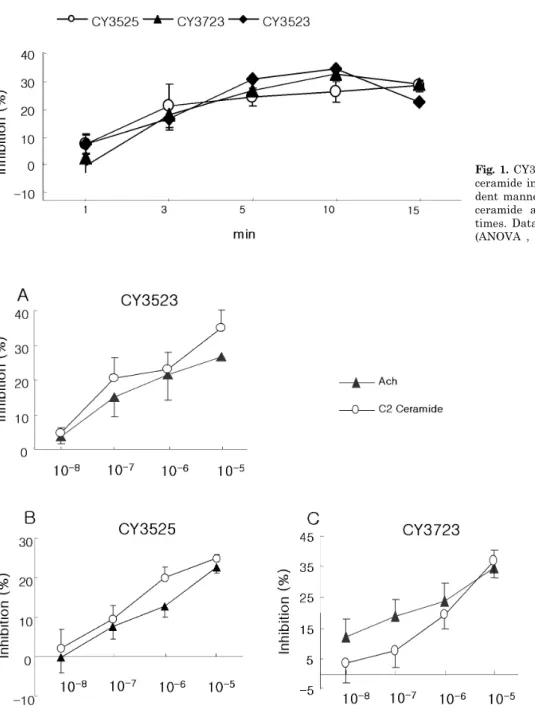
Our studies have shown that CY3523, CY3525 and CY3723 (10 5 M) had an inhibitory effect on C2-ceramide induced contraction of feline esophageal smooth muscle cells. But other analogues, CY3125, CY3225 and CY3325 had not. CY3523, CY3525 and CY3723 (10 5 M) inhibited the contraction induced by C2-ceramide, which was peaked at 5 min (27.39±3.5% inhibition) and the inhibition was sus- tained at a plateau (26.87±7.2%) at 15 min (Fig. 1).
The inhibitory action of CY3523, CY3525 and CY3723 was concentration-dependent. Isolated smooth muscle cells were stimulated for 5 min with 10 8 M∼10 5 M. The maximal response was seen at 10 5 M. CY3723 showed the strongest inhibition. C2-ceramide induced smooth muscle cell contraction was inhibited to 36.9%, and ACh induced contraction was inhibited to 34.4% by CY3723 (Fig.
1). The effect of CY3723 was concentration dependent and maximal effect was showed at 10 5 M. CY3523 showed 35.1% inhibition to C2-ceramide induced contraction and 26.8%
Fig. 1. CY3523, CY3525, CY3723 inhibited C2 ceramide induced contraction in a time-depen- dent manner. Isolated cells were incubated in ceramide amalogues (10 5 M) for indicated times. Data are means±S.E. of 4 experiments (ANOVA , p<0.001).
Fig. 2. Dose-dependent contractile inhibition response of smooth mu- scle cells from feline esophagus to CY3523 (A), CY3525 (B), or CY3723 (C). Isolated smooth muscle cells were incubated in CY3523 for 5min for indicated dose, then stimulated for 30 s with ACh (10 9 M) and C2 ceramide (10 7 M). Data are means±
S.E. of 4 experiments (ANOVA, p<
0.001).
inhibition to ACh induced contraction (Fig. 2). CY3525 showed 24.9% inhibition to C2- ceramide induced contractio n, and 22.7% inhibition to ACh (Fig. 2).
CY3523, CY3525, and CY3723 had no effect on pho- rbol 12 myristate 13-acetate (PMA) induced contrac- tion
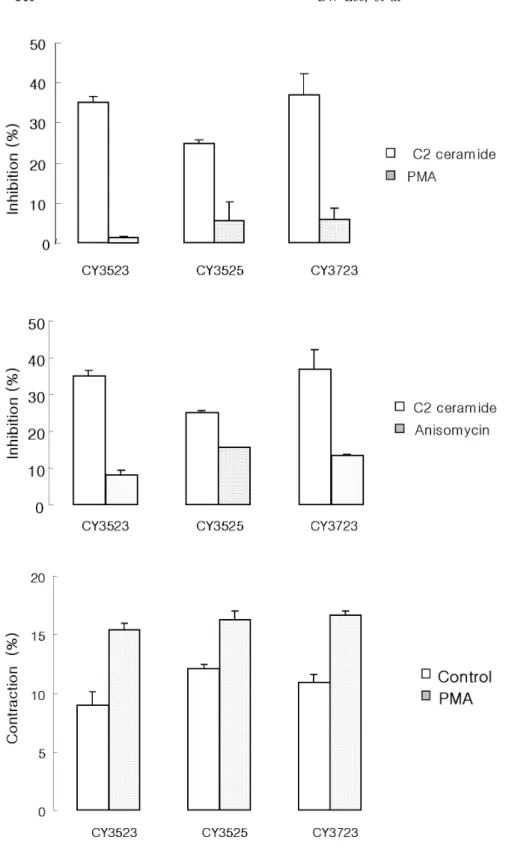
Phorbol 12 myristate 13-acetate (PMA), is known as a PKC activator. In this study, PMA induced 10∼14% con- traction on feline esophageal smooth muscle cell (100 nM, incubated for 10 min). Isolated smooth muscle cells were incubated with CY3523, CY3525 and CY3723 (10 5 M) for 5 min (Fig. 3). CY3523 had no effect on PMA induced
contraction. CY3525 or CY3723 showed only 5.4% or 5.8%
inhibition, respectively.
Anisomycin induces smooth muscle contraction and the effect was reduced by CY3523, CY3525 and CY3723
Anisomycin is known to activate MAPK. In this study, anisomycin showed 10∼12% smooth muscle cell con- traction (500ng/ml, incubated for 1 min). CY3523 inhibited the anisomycin-induced contraction to 8.1%. CY3525 or CY3723 showed 15.8% or 13.4% inhibition, respectively (Fig. 4).
Fig. 4. Effect of CY3523, CY3525, and CY3723 on anisomycin induced contraction.
Anisomycin (p38 MAPK activator) produced contraction. CY3523, CY3525 and CY3723 had a little contractile inhibition of aniso- mycin induced contraction.
Fig. 5. The effect of phorbol 12 myristate 13-acetate (PMA) on CY3523, CY3525, CY3723. Inhibition of C2-ceramide induced contraction by ceramide anaogues was recovered with PMA (100 nM, PKC acti- vator) treatment. Data are means±S.E. of 4 experiments (student t-test, p<0.01).
Fig. 3. Effect of CY3523, CY3525, and CY3723 on PMA induced contraction.
Isolated smooth muscle cells were treated with CY3523, CY3525 and CY3723 (10 5 M, incubated 5 min). No inhibitory effect was shown with phorbol 12 myristate 13-acetate (PMA), PKC activator.
C2-ceramide induced contraction was recovered by the treatment with PMA.
Isolated cells were incubated with CY3523, CY3525 and CY3723, 10 5 M, for 5 min and C2-ceramide was added to these cells. Then PMA was treated and incubated for 5 min.
The inhibition of C2-ceramide induced contraction was re- covered by PMA (Fig. 5). The contraction rate reduced to 10% was raised to 16% and this rate is similar to the con-
traction rate induced by PMA only.
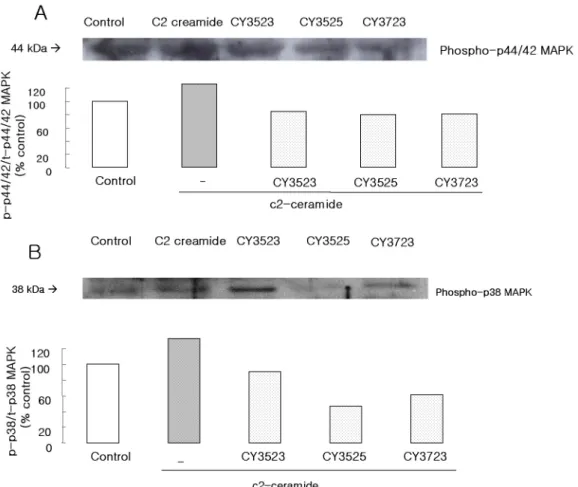
The effect on the 42/ 44 MAPK activity of the analogues Western blot analysis of homogenates derived from esophageal smooth muscle cells using antibodies to p42/44 MAPK showed that ceramide analogues inhibited the acti- vation of p42/44 MAPK. Cells were cultured with CY3523, CY3525, and CY3723, and then stimulated with ceramide,
Fig. 6. The effects on the analogues of MAPK acti- vation. (A) Phosphorylated p44/42 MAPK was de- tected with anti-phospho p44/42 MAPK antibody.
In lower panel, the each level on the control dis- played as the ratio of pho- spho- p44/42 divided by total p44/42 MAPK density (n=3). (B) p38 MAPK was inhibited by synthetic cera- mide analogues. Phospho- rylated p38 MAPK was detected with anti-phospho p38 MAPK antibody. In lower panel, the each level on the control displayed as the ratio of phospho- p38 density divided by total p38 MAPK density (n=3).
and immunodetection of p42/44 MAPK was performed. As shown in Fig 6A, the densitiy of detection band of p42/44 MAPK was decreased when treated with ceramide analogues.
C2-ceramide induced contraction in cat esophageal smooth muscle cells was known to be mediated by PKC and MAPK activated pathway. It is possible that the inhibitory effect of ceramide analogues can occur by the inhibition of PKC and MAPK activated pathway.
Cells were precultured with CY3523, CY3525, and CY3723, and then stimulated with ceramide, and immunodetection of p38 MAPK was performed. As shown in Fig 6B, p38 MAPK band density was increased when stimulated with ceramide. CY3523, CY3525, or CY3723 had inhibitory effect on the band density of p38 MAPK. It is possible that p38 MAPK is responsible for the contraction induced by C2- ceramide.
DISCUSSION
In this experiments, the synthetic ceramide analogues showed the inhibition on the contraction induced by C2- ce- ramide as well as ACh. In contrast, the analogues had no effect on phorbol 12 myristate 13-acetate (PMA) induced contraction. PMA is known as an allosteric PKC activator like DAG. The allosteric activator evokes this intramole- cular control by inducing a conformational change in the molecule that might liberate the substrate binding domain from the pseudosubstrate, thereby activating the enzyme.
In this study, the inhibition of C2-ceramide induced con- traction was recovered by PMA. This result represents that the inhibitory effect of synthetic ceramide analogues to the C2-ceramide induced contraction is evoked by inhibition of upstream pathway of PKC.
It is known that C2-ceramide and ACh induced con- traction is mediated via PKC dependent pathway, ACh-in- duced contraction of esophageal smooth muscle cell is in- dependent on calmodulin and is mediated through a protein kinase C (PKC)-dependent pathway (Sohn et al, 1995), in- volving a calcium-insensitive PKC-ε. (Sohn et al, 1997). Acti- vated CaM-dependent pathways inhibit PKC-dependent pathways, this switch mechanism might be regulated by Ca2+ in the LES (Sohn et al, 2003). In the esophageal smooth muscle cells, ACh stimulates receptor-medated acti- vation of PLA2, PLD, and phosphatidyl choline specifeic PLC, and produces AA and DAG. AA and DAG activate PKC-ε DAG synergistically and calcium-independently.
Western blot anlysis showed that p42/44 MAPK activity stimulated by C2-ceramide was inhibited by treatment with CY3523, CY3525 and CY3723. PKC-dependent contraction in ESO and LES is mediated by the following two distinct MAPK pathways: ERK1/2 and HSP 27-linked p38 MAPK (Cao et al, 2003). p42/44 MAPK was known to induce con- traction of smooth muscle cells via activation of PKC by ceramide. C2 ceramide produced the contraction of smooth muscle cells of cat oesophagus. The Contraction is mediated by PKC-epsilon, resulting in the activation of p42/44 MAPK (Shin et al, 2007).
bited.
Anisomycin is known to activate MAPK. In this study, the each analogue inhibited the ansomycin induced con- traction may suggest that the contraction is mediated by the increase of the MAPK activity.
Western bolt analysis showed that the density of p38MAPK was increased when stimulated with C2- ceramide. It was known that the smooth muscle cells contraction induced by C2-ceramide is mediated by MAPK. With this result, it is possible that p38 MAPK may be involved in this contractile pathway, but is not the main subtype of the enzyme acting in contractile response.
CY3523 had a different effect on the activation of p38 MAPK. CY3523 increased the band density of p38 MAPK in western blot anlysis. In contrast, ceramide analogues involving CY3523, had an inhibitory effect on the activation of p42/44 MAPK. The inhibition of p42/44 activation may be induced by the upstream inhibition of PKC activation involved in this contractile response. CY3523 activated p38 MAPK, but the enzyme is not involved in the main stream of C2-ceramide induced contractile reponse, so it had no ef- fect on the contraction of smooth muscle cells.
In summary, CY3523, CY3525 and CY3723 inhibited C2-ceramide and ACh induced contraction, which is medi- ated by PKC and MAPK involved pathway. The inhibitory effect to C2-ceramide induced contraction by CY3523, CY3525 and CY3723 is possibly induced by the activation of ceram- idase by synthetic ceramide analogues.
REFERENCES
Bose R, Verheij M, Haimovitz-Friedman A, Scotto K, Fuks Z, Kolesnick R. Ceramide synthase mediates daunorubicin-induced apoptosis: an alternative mechanism for generating death signals. Cell 82: 405−414, 1995
Cao W, Sohn UD, Bitar KN, Behar J, Biancani P, Harnett KM.
MAPK mediates PKC-dependent contraction of cat esophageal and lower esophageal sphincter circular smooth muscle. Am J Physiol Gastrointest Liver Physiol 285: G86−95, 2003
SJ, Allen C, Biegel JA, Yanofsky RA, Feldman GL, Brodeur GM.
Familial predisposition to neuroblastoma does not map to chromosome band 1p36. Cancer Res 56: 3421−3425, 1996 Okazaki M. An acoustical analysis of TMJ sounds and its clinical
importance. Shoni Shikagaku Zasshi 27: 101−119, 1989 Powis G. Anticancer drugs acting against signaling pathways. Curr
Opin Oncol 7: 554−559, 1995
Powis G, Hill SR, Frew TJ, Sherrill KW. Inhibitors of phospholipid intracellular signaling as antiproliferative agents. Med Res Rev 15: 121−138, 1995
Sbrissa D, Yamada H, Hajra A, Bitar KN. Bombesin-stimulated ceramide production and MAP kinase activation in rabbit recto- sigmoid smooth muscle cells. Am J Physiol 272: G1615−1625, 1997
Schwandner R, Wiegmann K, Bernardo K, Kreder D, Kronke M.
TNF receptor death domain-associated proteins TRADD and FADD signal activation of acid sphingomyelinase. J Biol Chem 273: 5916−5922, 1998
Shin CY, Lee YP, Lee TS, Song HJ, Sohn UD. C(2)-ceramide- induced circular smooth muscle cell contraction involves PKC- epsilon and p44/p42 MAPK activation in cat oesophagus. Mitogen- activated protein kinase. Cell Signal 14: 925−932, 2002 Shin CY, Lee YP, Song HJ, Je HD, Sohn UD. Cyclic AMP dependent
down regulation in the relaxation of smooth muscle cells of cat esophagitis. Archives of Pharmacal Research 30: 715−722, 2007 Sohn UD, Chiu TT, Bitar KN, Hillemeier C, Behar J, Biancani P.
Calcium requirements for acetylcholine-induced contraction of cat esophageal circular muscle cells. Am J Physiol 266: G330−
338, 1994
Sohn UD, Han B, Tashjian AH Jr, Behar J, Biancani P. Agonist- independent, muscle-type-specific signal transduction pathways in cat esophageal and lower esophageal sphincter circular smooth muscle. J Pharmacol Exp Ther 273: 482−491. 1995 Sohn UD, Park JH, Lee TS, Shin CY, Jeong JH, Kim JH, Je HD,
Dartt DA, Zoukhri D, Choi HC, Lee KY. Differential regulation by Ca(2+) of calmodulin- and PKC-dependent contractile pathways in cat lower oesophageal sphincter. Auton Autacoid Pharmacol 23: 307−317, 2003
Sohn UD, Zoukhri D, Dartt D, Sergheraert C, Harnett KM, Behar J, Biancani P. Different protein kinase C isozymes mediate lower esophageal sphincter tone and phasic contraction of esophageal circular smooth muscle. Mol Pharmacol 51: 462−470, 1997