• 검색 결과가 없습니다.

Effects of Age on Arterial Stiffness and Blood Pressure Variables in Patients with Newly Diagnosed Untreated Hypertension

N/A
N/A
Protected

Academic year: 2022

Share "Effects of Age on Arterial Stiffness and Blood Pressure Variables in Patients with Newly Diagnosed Untreated Hypertension"

Copied!
7
0
0

로드 중.... (전체 텍스트 보기)

전체 글

(1)

Korean Circulation Journal

Introduction

Hypertension (HT), defined as sustained elevation of brachial blood pressure (BP), is a well-known risk factor for all-cause mortality, car-

Print ISSN 1738-5520 • On-line ISSN 1738-5555

Effects of Age on Arterial Stiffness and Blood Pressure Variables in Patients with Newly Diagnosed Untreated Hypertension

Soo Kyung Cho, MD 1 , Sang Ki Cho, MD 1 , Kye Hun Kim, MD 2 , Jae Yeong Cho, MD 2 , Hyun Ju Yoon, MD 2 , Nam Sik Yoon, MD 2 , Young Joon Hong, MD 2 , Hyung Wook Park, MD 2 , Ju Han Kim, MD 2 ,

Youngkeun Ahn, MD 2 , Myung Ho Jeong, MD 2 , Jeong Gwan Cho, MD 2 , and Jong Chun Park, MD 2

1

Department of Internal Medicine, Christian Hospital, Gwangju,

2
Department of Cardiology, Translational Research Center on Aging, Chonnam National University Hospital, Gwangju, Korea

Background and Objectives: To investigate the impact of age on arterial stiffness and blood pressure (BP) variables in newly diagnosed untreated hypertension (HT).

Subjects and Methods: A total of 144 patients with newly diagnosed untreated HT were divided into two groups: young group (age

≤50 years, n=71), and old group (age >50 years, n=73). BP variables were measured on office or 24 hours ambulatory BP monitoring (ABPM). Parameters of arterial stiffness were measured on pulse wave velocity (PWV). Pulse wave analysis (PWA) was compared.

Results: Although office BP and pulse pressure (PP) were significantly (p<0.05) higher in the young group than in the old group, BP and PP on ABPM were not significantly different. Central systolic BP and PP, augmentation pressure, augmentation index on PWA, and PWV were significantly higher or faster in the old group compared to that in the young group. Age showed significant positive correlation with both PWV and PWA variables in the young group with HT. However, age only showed significant positive correlation with PWV in the old group with HT. In the young group with HT, PWA variable showed better correlation with age than PWV.

Conclusion: Considering BP levels on ABPM, office BP is prone to be overestimated in young patients with HT. Parameters of arterial stiff- ness measured by PWV and PWA were more affected by age rather than by BP level in patients with HT. Therefore, PWA variable might be a more sensitive marker of arterial stiffness in young patients with HT. However, PWV might be a better marker for old patients with HT.

(Korean Circ J 2015;45(1):44-50)

KEY WORDS: Hypertension; Vascular stiffness; Aging.

Received: May 15, 2014

Revision Received: August 1, 2014 Accepted: October 17, 2014

Correspondence: Kye Hun Kim, MD, Department of Cardiology, Transla- tional Research Center on Aging, Chonnam National University Hospital, 42 Jebong-ro, Dong-gu, Gwangju 501-757, Korea

Tel: 82-62-220-6978, Fax: 82-62-223-3105 E-mail: [email protected]

• The authors have no financial conflicts of interest.

This is an Open Access article distributed under the terms of the Creative Commons Attribution Non-Commercial License (http://creativecommons.

org/licenses/by-nc/3.0) which permits unrestricted non-commercial use, distribution, and reproduction in any medium, provided the original work is properly cited.

diovascular morbidity, and mortality.

1)

Previous studies have shown that optimal treatment for HT can decrease cardiovascular events such as stroke and heart failure.

2)

However, many patients with HT on office BP measurements are not truly hypertensive. They are so called white coat HT (WCH). Therefore, recent guideline for the man- agement of HT recommends 24 hours ambulatory BP monitoring (ABPM) or home BP monitoring to identify patients with true HT be- fore initiating anti-hypertensive therapy.

3)

ABPM is also useful for the identification of non-dipper associated with stroke, target organ damage, and other cardiovascular events.

4-7)

Therefore, ABPM is an important tool not only for the diagnosis of true HT, but also for risk stratification or clinical decision making of therapeutic strategy for patients with HT.

8)9)

Arterial stiffness is now an established risk factor and prognostic

indicator of cardiovascular disease or events. It can be non-invasive-

ly evaluated by measuring pulse wave velocity (PWV) and pulse wave

(2)

analysis (PWA).

10)

PWV is associated with future cardiovascular events in HT

11)

in the elderly

12)13)

or end-stage renal disease,

14)15)

even in the general population.

16)17)

Central aortic pressure and its related vari- ables can be reliably measured by PWA to predict cardiovascular events more accurately than brachial pressures in hypertensive patients.

18)19)

Although both HT and age are associated with param- eters of arterial stiffness, the impact of age on arterial stiffness in patients with newly diagnosed untreated HT has been poorly eval- uated. Furthermore, the differences between office BP measurement and 24 ABPM according to age were poorly evaluated. Therefore, the aim of the present study was to investigate age related differ- ences on parameters of arterial stiffness in patients with true HT on 24 hours ABPM who were suspected of HT on office BP measure- ments.

Subjects and Methods

Study subjects

Among 176 patients who were suspected of HT on office BP mea- surements, a total of 147 patients had true HT on 24 hours ABPM.

Of the 147 patients, 3 who did not have PWV or PWA measurements were excluded. Therefore, a total of 144 patients were included in this study. They were divided into two groups: young group (age

≤50 years, 71 patients, 42 males, mean age of 35.7±9.8 years), and old group (age >50 years, 73 patients, 34 males, mean age of 60.9±

7.9 years). Vascular age is usually accelerated after menopause.

The mean age of menopause in Korea is 49.7 years. Therefore, the age of 50 years was used as cut-off value for grouping in the pres- ent study. This study was a single center, prospective, and observa- tional study. The study protocol was approved by the Institutional Review Board of our institution. Patients who agreed to participate in the present study and gave informed consent were enrolled. Ex- clusion criteria were: 1) prior history of coronary intervention or myocardial infarction, 2) significant arrhythmias including atrial fi- brillation, 3) combined cardiac diseases including significant valvu- lar heart diseases, cardiomyopathy, or heart failure, 4) known renal insufficiency, 5) medication history that might affect BP levels, 6) peripheral vascular disease with ankle-brachial index <0.9, 7) vascu- litis disorders, and 8) major life threatening illness.

Definition of hypertension

The definition of HT was complied with the current guideline.

3)

Systolic BP ≥140 mm Hg and/or diastolic BP ≥90 mm Hg was de- fined as HT on office BP measurement and 24 hours average systolic BP ≥130 mm Hg and/or diastolic BP ≥80 mm Hg was defined as HT on ABPM in the present study.

Measurement of blood pressure

Office BP was measured in triplicates at brachial artery of the non-dominant arm by using optimal cuff and mercury sphygmoma- nometer after at least 10 minutes of resting in seated position.

ABPM was recorded using a validated oscillometric device (TONO- PORT V, firmware Version 1.4, GE Medical systems, Berlin, Germany).

The device allowed automatic measurement of BP every 15 minutes from 7 a.m. to 10 p.m. and every 30 minutes from 10 p.m. to 7 a.m.

Measurement of arterial stiffness

Pulse wave velocity was measured non-invasively by using com- mercially available VP-2000 (Colins, Kyoto, Japan). PWV measure- ments were performed by a single well-trained clinical technician at supine position in a quiet and temperature controlled room af- ter at least 10 minutes of rest. Heart-femoral PWV (hfPWV) and brachial-ankle PWV (baPWV) were measured and used for analysis.

Arterial waveforms and central BPs were obtained by using Sphyg- moCor PWA device (AtCor Medical, Sydney, Australia). After obtain- ing radial arterial waveform by using applanation tonometry, the central aortic pressure parameters including central aortic systolic and diastolic BP, augmentation pressure (AP), and augmentation index (AI) were obtained by using computerized transfer function.

AP was defined by the difference between aortic systolic pressure and inflection pressure. AI was calculated as {AP/aortic pulse pres- sure (PP)}×100.

Statistical analysis

The differences of categorical variables were evaluated by chi- square test. Continuous variables were compared using indepen- dent t-test. Pearson’s correlation coefficients were used to explore bivariate association between examined variables. Statistical Pack- age for the Social Sciences (SPSS) for Windows, version 18.0 (SPSS Inc., Chicago, IL, USA) was used for all analyses. Data are presented as percents or mean±standard deviation. Statistical significance was considered when p was less than 0.05.

Results

Baseline clinical characteristics

The baseline characteristics were summarized in Table 1. Office systolic and diastolic BP and PP were significantly (p<0.05) elevat- ed in the young group than in the old group. The level of cholester- ol was significantly (p<0.05) elevated in the old group than in the young group.

Differences of blood pressure variables between the groups

The differences of BP measurements between the two groups

(3)

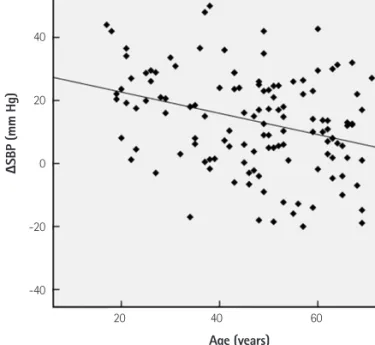
were summarized in Table 2. Office systolic and diastolic BP and PP were significantly (p<0.05) higher in the young group than in the old group. However, BP measurements on 24 hours ABPM were not significantly different between the groups. Overall, the difference of systolic BP between office and 24 hours ABPM (office systolic BP-systolic BP on 24 ABPM) showed significant negative correlation

with age (r=-0.320, p<0.001) (Fig. 1).

Differences of parameters of arterial stiffness

The differences of parameters of arterial stiffness between the two groups were summarized in Table 3. Central systolic BP, PP, AP, and AI on PWA were significantly (p<0.05) higher in the old group than in the young group. However, central diastolic BP was not sig- nificantly different between the two groups. HfPWV and baPWV were significantly (p<0.05) faster in the old group than in the young group (Table 3).

Table 1. Baseline clinical characteristics between the young and old group Young group

(n=71)

Old group

(n=73) p

Age (years) 35.7±9.8 60.9±7.9 <0.001

Males (%) 42 (59.2) 34 (46.6) 0.131

Body mass index (kg/m

2

) 25.0±3.0 24.2±2.9 0.079 Office SBP (mm Hg) 161.0±19.6 149.1±16.8 <0.001

Office DBP (mm Hg) 95.7±13.2 88.4±11.6 0.001

Office PP (mm Hg) 65.3±14.4 60.7±11.2 0.036

Smoking (%) 10 (14.1) 9 (12.3) 0.899

Diabetes mellitus (%) 6 (8.5) 6 (8.2) 0.960

Total cholesterol (mg/dL) 187.1±29.0 206.3±42.6 0.005

LDL-C (mg/dL) 117.0±27.1 130.0±39.2 0.048

HDL-C (mg/dL) 52.2±14.7 57.2±18.1 0.100

Triglyceride (mg/dL) 130.8±76.4 142.3±69.4 0.389

hs-CRP (mg/dL) 0.3±0.9 0.1±0.2 0.433

Homocysteine (umol/L) 10.3±5.5 9.8±3.3 0.582

LVH on ECG (%) 34 (47.9) 30 (41.1) 0.412

Young group: age ≤50 years, Old group: age >50 years. SBP: systolic blood pressure, DBP: diastolic blood pressure, PP: pulse pressure, LDL-C: low den- sity lipoprotein-cholesterol, HDL-C: high density lipoprotein-cholesterol, hs-CRP: high sensitivity C-reactive protein, LVH: left ventricular hypertro- phy, ECG: electrocardiography

Table 2. Differences of blood pressure variables between the young and old group

Young group (n=71)

Old group

(n=73) p

Office SBP (mm Hg) 161.0±19.6 149.1±16.8 <0.001

Office DBP (mm Hg) 95.7±13.2 88.4±11.6 0.001

Office PP (mm Hg) 65.3±14.4 60.7±11.2 0.036

24 hours SBP (mm Hg) 142.9±12.1 141.2±13.2 0.422

24 hours DBP (mm Hg) 91.4±10.5 90.7±11.4 0.689

24 hours PP (mm Hg) 51.5±8.6 51.2±10.0 0.876

Day SBP (mm Hg) 145.5±12.7 142.7±10.9 0.152

Day DBP (mm Hg) 93.4±10.7 91.5±8.9 0.248

Day PP (mm Hg) 52.1±8.6 51.2±7.6 0.491

Night SBP (mm Hg) 133.3±13.0 131.8±15.3 0.531

Night DBP (mm Hg) 83.5±10.9 83.4±10.0 0.960

Night PP (mm Hg) 49.8±8.9 48.4±10.6 0.392

Young group: age ≤50 years, Old group: age >50 years. SBP: systolic blood pressure, DBP: diastolic blood pressure, PP: pulse pressure

Fig. 1. Correlation of the difference of systolic blood pressure (ΔSBP) on of- fice or 24 hours ambulatory blood pressure measurements with age in pa- tients with hypertension. Age showed significant negative correlation with ΔSBP.

60

40

20

0

-20

-40

Age (years)

∆SBP (mm Hg)

20 40 60 80 r=-0.320, p<0.001

Table 3. Differences of parameters of arterial stiffness between the young and old group

Young group (n=71)

Old group

(n=73) p

Heart-femoral PWV (cm/s) 826.4±118.3 1018.6±205.4 <0.001 Brachial-ankle PWV (cm/s) 1392.3±187.1 1646.7±295.7 <0.001

Ankle-brachial index 1.1±0.1 1.2±0.1 0.004

Central SBP (mm Hg) 129.5±14.2 136.3±15.5 0.047

Central DBP (mm Hg) 88.1±10.3 87.7±10.9 0.856

Central PP (mm Hg) 41.4±9.6 48.6±10.9 0.003

AP (mm Hg) 11.7±7.9 18.4±7.6 <0.001

AI (%) 25.9±15.7 36.0±10.3 0.001

Young group: age ≤50 years, Old group: age >50 years. PWV: pulse wave velocity, SBP: systolic blood pressure, DBP: diastolic blood pressure, PP:

pulse pressure, AP: augmentation pressure, AI: augmentation index

(4)

Correlation between parameters of arterial stiffness and age Overall, age showed significant positive correlation with hfPWV (r=0.617, p<0.001) and baPWV (r=0.598, p<0.001) (Fig. 2). Age also showed significant positive correlation with central systolic BP (r=

0.287, p=0.009) and PP (r=0.414, p<0.001). AP and AI also showed significant positive correlation with age (r=0.549, r=0.544, p<0.001, respectively) (Fig. 3). However, central diastolic BP did not show correlation with age (r=-0.030, p>0.05).

The correlation of parameters of arterial stiffness with age be- tween the two groups were summarized in Table 4. In the young HT

group, age showed significantly positive correlation with hfPWV, baPWV, AP, AI, and central systolic BP. However, central diastolic BP and PP did not show correlation with age. In the old HT group, age showed significant positive correlation with hfPWV and baPWV.

However, PWA variables did not show any correlation with age.

Discussion

The present study evaluated the impacts of age on parameters of arterial stiffness and BP in patients with newly diagnosed untreated Fig. 3. Correlation of augmentation pressure (AP) (A) and augmentation index (AI) (B) with age in patients with hypertension. Age showed significant positive correlation with both AP and AI in patients with hypertension.

40

30

20

10

0

-10

80

60

40

20

0

-20

Age (years) Age (years)

AP (mm Hg) AI (%)

20 40 60 80 20 40 60 80

r=0.549, p<0.001 r=0.544, p<0.001

A B

Fig. 2. Correlation of heart-femoral (hfPWV) (A) and brachial-ankle pulse wave velocity (baPWV) (B) with age in patients with hypertension. Age showed sig- nificant positive correlation with both hfPWV and baPWV in patients with hypertension.

2000

1750

1500

1250

1000

750

3000

2500

2000

1500

1000

Age (years) Age (years)

HfPWV (cm/s) BaPWV (cm/s)

20 40 60 80 20 40 60 80

r=0.617, p<0.001 r=0.598, p<0.001

A B

(5)

HT. The results of the present study demonstrated several impor- tant findings. Firstly, office BP measurement considering BP levels on 24 hours ABPM is prone to be overestimated in young HT pa- tients than in old HT patients. Secondly, peripheral BP measure- ments cannot reflect central BP indices appropriately, especially in young HT patients. Thirdly, in HT patients, parameters of arterial stiffness are more significantly affected by age rather than the lev- els of BP. Fourthly, AP and AI showed better correlation with age than PWV in the young HT group. However, age showed significant positive correlation only with PWV in the old HT group.

As in WCH, office BP is usually greater than home BP or ambula- tory BP in most HT patients. This phenomenon of difference between office BP and average daytime ambulatory BP or home BP in pa- tients with HT is called white-coat effect (WCE).

20)

WCH or WCE is a relatively common finding in patients with elevated BP. Previous studies have shown that WCH were more prevalent among non- smokers, females, and older age.

21)22)

In contrary to these studies, young age was found to be an independent predictor of WCH in a study of Pickering et al.

23)

and Pickering.

24)

Results of the present study were consistent with the study of Pickering et al.

23)

and Pick- ering

24)

except that the present study was conducted only in pa- tients with HT. Although BP levels on 24 ABPM were not different between the two groups in the present study, office BP was signifi- cantly greater in young HT patients than in old HT patients, sug- gesting that WCE in young HT patients has a higher prevalence.

Park et al.

25)

using Korean subjects found that age was not a pre- dictor of WCH. To clarify the issue regarding the impact of age on WCE among HT patients, further controlled study with a larger population is merited.

Central BP is defined as the BP of the aorta and carotid artery. Aor- tic pressure reflects afterload of the heart. Diastolic aortic pressure is a major determinant of coronary perfusion. Theoretically, central BP would be a better predictor of future cardiovascular events than brachial BP. The results of Strong Heart Study

26)

support this

hypothesis by demonstrating that central aortic PP and arterial stiff- ness are more strongly related to vascular hypertrophy and the ex- tent of carotid atherosclerosis than brachial pressure. Furthermore, central PP was a better predictor of future cardiovascular outcome than brachial PP in the Strong Heart Study.

26)

In the present study the relationship between peripheral BP and central BP according to the age group of HT patients was evaluated. Although central systolic BP was lower in the young HT group than in the old HT group, peripheral systolic BP was significantly higher in the young group than in the old group in the present study. This observation might be explained by the phenomenon called “pressure wave am- plification.” As the pulse wave propagated from the central aorta to the peripheral arterial tree, diastolic and mean BP did not change significantly across the arterial tree. However, systolic BP could be significantly amplified, the so called “pressure wave amplification”.

27)

Because this phenomenon is more common and marked in young people than in old people, the peripheral systolic BP might be sig- nificantly higher in the young HT group than in the old HT group in the present study. Results of the present study suggested that pe- ripheral BP was prone to be overestimated in young HT patients than in old HT patients. Our results also suggested that the mea- surement of peripheral BP might not reflect central hemodynamics that is more closely associated with actual cardiovascular risk in young HT patients. Therefore, to evaluate actual cardiovascular risk, it would be advisable to measure central hemodynamics before ini- tiating antihypertensive therapy, especially for young HT patients.

Arterial stiffness, an established risk factor of cardiovascular dis- ease, is one of the best prognostic indicators of future cardiovascu- lar events in HT patients.

10-17)

Both age and BP levels are well known major determinants of arterial stiffness. However, the impact of age on parameters of arterial stiffness among HT patients has been poorly studied. Although the level of peripheral BP was higher in the young HT group than in the old HT group, PWV was significantly faster and AI or AP was significantly higher in the old HT group. The results of the present study suggested that parameters of arterial stiffness were more significantly affected by age rather than the level of BP in patients with untreated HT. The correlation of param- eters of arterial stiffness with age were different between the two groups in the present study. In the young HT group, both PWV and PWA variables showed significant positive correlation with age. In addition, PWA variables such as AI and AP showed better correla- tion with age than PWV variables. However, in the old HT group, age only showed significant positive correlation with PWV in the pres- ent study. These findings are quite similar to the results of Anglo- Cardiff Collaborative Trial (ACCT) except that the study population of the ACCT was healthy and normotensive individuals.

28)

The re- sults of ACCT suggested that AI might be a more sensitive marker Table 4. Correlation of parameters of arterial stiffness with age in each group

Young group (n=71) Old group (n=73)

r p r p

Heart-femoral PWV 0.396 0.006 0.370 0.006

Brachial-ankle PWV 0.414 <0.001 0.496 <0.001

Central SBP 0.446 0.007 0.072 0.848

Central DBP 0.303 0.085 -0.201 0.170

Central PP 0.334 0.050 0.216 0.148

AP 0.677 <0.001 0.170 0.260

AI 0.694 <0.001 0.105 0.489

Young group: age ≤50 years, Old group: age >50 years. PWV: pulse wave velocity, SBP: systolic blood pressure, DBP: diastolic blood pressure, PP:

pulse pressure, AP: augmentation pressure, AI: augmentation index

(6)

for arterial stiffening and risk in young individuals, but aortic PWV might be a better measure for old individuals.

26)

The results of the present study suggested that PWA variables might be a more sen- sitive marker of arterial stiffness and risk in young HT patients, but PWV would be a better marker of arterial stiffness in old HT patients.

The present study has potential limitations. Firstly, the number of study population was relatively small. Thus, it may result in selec- tion bias that might affect statistical analysis. Secondly, although the present study enrolled patients with newly diagnosed untreat- ed HT without known major cardiovascular diseases, the presence of atherosclerotic cardio-cerebro-vascular disease associated with ar- terial stiffness cannot be completely excluded. Thirdly, the results of BP measurement, especially in 24 ABPM, might be affected by dif- ferent degree of physical activity or other factors. Fourthly, TONO- PORT V was used for 24 ABPM measurements in the present study because this device was the only available device in our institution during the study period. However, the accuracy of this device is not well validated. Thus, the device used might be a limitation of the present study. Fifthly, male was predominant in the young group and female was predominant in the old group, even though the gender distribution was not different statistically. Because PWV or PWA data can be affected by body habitus, the gender difference between the two groups is another limitation of the present study.

Sixthly, the prevalence of left ventricular hypertrophy on electro- cardiography was higher in the young group than in the old group, even though it was not statistically different. To clarify this discrep- ancy, other surrogate markers of target organ damage such as the degree of microalbuminuria should be addressed. However, other surrogate markers of target organ damage were not evaluated in the present study. Therefore, it is another major limitation of the present study.

In conclusion, the results of the present study suggested that of- fice BP, considering BP levels on 24 ABPM, is prone to be overesti- mated in young HT patients than in old HT patients, suggesting that WCE has a higher prevalence in young HT patients. The parameters of arterial stiffness measured by PWV and PWA were more affected by age rather than BP level among HT patients. PWA variables might be a more sensitive marker for arterial stiffness in young HT patients, but PWV might be a better marker for old HT patients.

References

1. Rutan GH, Kuller LH, Neaton JD, Wentworth DN, McDonald RH, Smith WM. Mortality associated with diastolic hypertension and isolated systolic hypertension among men screened for the Multiple Risk Fac- tor Intervention Trial. Circulation 1988;77:504-14.

2. Turnbull F; Blood Pressure Lowering Treatment Trialists’ Collaboration.

Effects of different blood-pressure-lowering regimens on major car-

diovascular events: results of prospectively-designed overviews of ran- domised trials. Lancet 2003;362:1527-35.

3. McManus RJ, Caulfield M, Williams B; National Institute for Health and Clinical Excellence. NICE hypertension guideline 2011: evidence based evolution. BMJ 2012;344:e181.

4. Staessen JA, Bieniaszewski L, O’Brien E, et al. Nocturnal blood pressure fall on ambulatory monitoring in a large international database. The

“Ad Hoc’ Working Group. Hypertension 1997;29(1 Pt 1):30-9.

5. Phillips RA, Butkevich A, Sheinart KF, Tuhrim S. Dipping is superior to cusums analysis in assessment of the risk of stroke in a case-control study. Am J Hypertens 2001;14(7 Pt 1):649-52.

6. Verdecchia P, Schillaci G, Borgioni C, Ciucci A, Pede S, Porcellati C. Am- bulatory pulse pressure: a potent predictor of total cardiovascular risk in hypertension. Hypertension 1998;32:983-8.

7. Zweiker R, Eber B, Schumacher M, Toplak H, Klein W. “Non-dipping” re- lated to cardiovascular events in essential hypertensive patients. Acta Med Austriaca 1994;21:86-9.

8. Khattar RS, Senior R, Swales JD, Lahiri A. Value of ambulatory intra- arterial blood pressure monitoring in the long-term prediction of left ventricular hypertrophy and carotid atherosclerosis in essential hy- pertension. J Hum Hypertens 1999;13:111-6.

9. Sega R, Facchetti R, Bombelli M, et al. Prognostic value of ambulatory and home blood pressures compared with office blood pressure in the general population: follow-up results from the Pressioni Arteriose Monitorate e Loro Associazioni (PAMELA) study. Circulation 2005;111:

1777-83.

10. Lee SJ, Park SH. Arterial ageing. Korean Circ J 2013;43:73-9.

11. Boutouyrie P, Tropeano AI, Asmar R, et al. Aortic stiffness is an inde- pendent predictor of primary coronary events in hypertensive pa- tients: a longitudinal study. Hypertension 2002;39:10-5.

12. Meaume S, Benetos A, Henry OF, Rudnichi A, Safar ME. Aortic pulse wave velocity predicts cardiovascular mortality in subjects >70 years of age. Arterioscler Thromb Vasc Biol 2001;21:2046-50.

13. Sutton-Tyrrell K, Najjar SS, Boudreau RM, et al. Elevated aortic pulse wave velocity, a marker of arterial stiffness, predicts cardiovascular events in well-functioning older adults. Circulation 2005;111:3384-90.

14. Blacher J, Guerin AP, Pannier B, Marchais SJ, Safar ME, London GM.

Impact of aortic stiffness on survival in end-stage renal disease. Circu- lation 1999;99:2434-9.

15. Pannier B, Guérin AP, Marchais SJ, Safar ME, London GM. Stiffness of capacitive and conduit arteries: prognostic significance for end-stage renal disease patients. Hypertension 2005;45:592-6.

16. Willum-Hansen T, Staessen JA, Torp-Pedersen C, et al. Prognostic value of aortic pulse wave velocity as index of arterial stiffness in the general population. Circulation 2006;113:664-70.

17. Mattace-Raso FU, van der Cammen TJ, Hofman A, et al. Arterial stiff- ness and risk of coronary heart disease and stroke: the Rotterdam Study. Circulation 2006;113:657-63.

18. Pauca AL, O’Rourke MF, Kon ND. Prospective evaluation of a method for estimating ascending aortic pressure from the radial artery pres- sure waveform. Hypertension 2001;38:932-7.

19. Williams B, Lacy PS, Thom SM, et al. Differential impact of blood pres-

sure-lowering drugs on central aortic pressure and clinical outcomes:

(7)

principal results of the Conduit Artery Function Evaluation (CAFE) study.

Circulation 2006;113:1213-25.

20. Tsai PS. Determinants of the white-coat effect in normotensives and never-treated mild hypertensives. Clin Exp Hypertens 2003;25:443-54.

21. Dolan E, Stanton A, Atkins N, et al. Determinants of white-coat hyper- tension. Blood Press Monit 2004;9:307-9.

22. Staessen JA, O’Brien ET, Atkins N, Amery AK. Short report: ambulatory blood pressure in normotensive compared with hypertensive subjects.

The Ad-Hoc Working Group. J Hypertens 1993;11:1289-97.

23. Pickering TG, James GD, Boddie C, Harshfield GA, Blank S, Laragh JH.

How common is white coat hypertension? JAMA 1988;259:225-8.

24. Pickering T. Ambulatory blood pressure monitoring: an historical per- spective. Clin Cardiol 1992;15(5 Suppl 2):II3-5.

25. Park SH, Bang DW, Seo J, et al. Comparison of the ambulatory blood pressure with the clinical blood pressure and electrocardiographic left ventricular hypertrophy. Korean J Med 2007;72:181-90.

26. Roman MJ, Devereux RB, Kizer JR, et al. Central pressure more strongly relates to vascular disease and outcome than does brachial pressure:

the Strong Heart Study. Hypertension 2007;50:197-203.

27. Agabiti-Rosei E, Mancia G, O’Rourke MF, et al. Central blood pressure measurements and antihypertensive therapy: a consensus document.

Hypertension 2007;50:154-60.

28. McEniery CM, Yasmin, Hall IR, et al. Normal vascular aging: differential

effects on wave reflection and aortic pulse wave velocity: the Anglo-

Cardiff Collaborative Trial (ACCT). J Am Coll Cardiol 2005;46:1753-60.

수치

Table 1. Baseline clinical characteristics between the young and old group Young group  (n=71) Old group(n=73) p Age (years) 35.7±9.8 60.9±7.9 &lt;0.001 Males (%) 42 (59.2) 34 (46.6) 0.131
Fig. 2. Correlation of heart-femoral (hfPWV) (A) and brachial-ankle pulse wave velocity (baPWV) (B) with age in patients with hypertension

참조

관련 문서