Corresponding author: Gun-Woo Kim, Assistant Professor, Dept. of Urban Design and Landscape Ecological Architecture, Graduate School of Urban Studies, Hanyang University, Seoul 04763, Korea, Tel.: +82-2-2220-0274, E-mail: [email protected]
도시 화훼경관 유형화에 관한 연구
- 문헌 및 전문가 FGI를 중심으로 -
윤덕규
*
․김건우**
*
한양대학교 도시대학원 도시설계․경관생태 조경학과 박사과정․
**한양대학교 도시대학원 도시설계․경관생태 조경학과 조교수
A Study on Urban Flower Landscape Type Classification
- Focused on Literature and Expert FGI -
Yoon, Duck-Kyu
*
․Kim, Gun-Woo**
*
Ph.D. Candidate, Dept. of Urban Design and Landscape Ecological Architecture, Graduate School of Urban Studies, Hanyang University
**
Assistant Professor, Dept. of Urban Design and Landscape Ecological Architecture, Graduate School of Urban Studies, Hanyang University
ABSTRACT
The purpose of this study is to classify types of urban flower landscape. As a result of the study, first, through literature and case review, it was found that the four elements of place element, form element, natural element, artificial element, should be included in the sentence and key expression for defining the concept of flower landscape. In contemplating these four elements, a newly reconstructed concept of flower landscape was presented. This is expected to be the basis for the flower landscape integration theory. Second, flower landscape was defined as a genre and a unit of urban landscape. In addition, in order to build a system of flower landscape as a specialized area, after considering the concept, characteristics, and functions of a large category of urban landscape, its hierarchical categories with flower landscape were newly arranged.
Thus, the flower landscape as an urban landscape was suggested. Third, in order to provide rational selection materials to consumers through type classification, related theories were investigated by expanding not only to the flower field, but also to the urban planning and urban ecology fields. 41 elements for the type classification were extracted, and 4 core elements were derived through the clustering process. Based on the 4 elements as the classification criteria, through the opinion verification from the FGI with experts, 9 types of middle-classification and 30 types of small-classification were derived. As a follow-up research suggestion, if a valid type is additionally established through a monitoring in the type application process, and more specified application types are developed and organized by expanding second-level classification hierarchy to the third-level hierarchy, this will lead to great studies improving the system of the types.
Key Words: Urban Landscape, Elements of Type Classification
Ⅰ. 서론
1. 연구의 배경 및 목적
현재 화훼 산업은 그 규모면에서 1조 원을 상회하는 시장이 형성되어 있을 만큼 시장 크기가 커지고 광범위한 분야에서 다 양하게 이용되고 있다. 소득 수준이 높은 유럽 선진국 사례에 서 보듯, 경관적 가치재로서의 도시 화훼는 소득과 밀접한 관 계가 있으며, 우리나라도 인당 국민소득 3만 달러 시대, 쾌적한 도시환경의 중요한 요소라고 볼 수 있다. 즉, 현재는 시기적으 로 도시경관의 외연 확대와 소재 개발이 중요한 시점으로서 도 시 화훼에 대한 체계적인 유형 분류가 중요하다. 그러한 환경 에도 불구하고 화훼와 관련된 기존의 연구들은 개념의 정의도 국지적이고 협소할 뿐만 아니라, 화훼경관의 도시경관성을 규 명하는 측면에서 한계를 지니고 있다. 이런 현상하에서 본 연 구의 배경은 첫째, 도시경관으로서 화훼경관의 시대적 역할이 증대되고 있고, 둘째, 화훼경관 관련 이론의 부족, 셋째, 화훼경 관 유형화 정립의 필요성 대두이다. 또한, 본 연구는 다양하게 존재하는 화훼경관의 양상들을 타당한 기준에 의해 분류하는 유형화 작업과 그 과정을 통해 유형의 체계를 구축하고자 한다.
따라서, 본 연구의 목적은 이와 같은 배경을 바탕으로 첫째, 화 훼경관이 도시경관의 한 장르로 그리고 도시경관의 단위로 왜 정의되고 연구할 필요가 있는지를 밝혀 전문영역으로서 체계 구축, 둘째, 도시 화훼경관 유형화를 통한 화훼경관 통합 이론 의 기초자료를 제공하기 위함이다.
2. 연구의 범위 및 방법
도시경관의 한 장르로서 도시 화훼경관과 관련된 이론을 고
찰하고 그 이론적 토대 위에 도시 화훼경관의 새로운 개념을 재구성하였다. 또한, 연구 방법적 측면에서 선행연구를 바탕으 로 인접 분야까지 포함한 유형화 분류 요소들을 조사하였고 최 근 경향이나 해외 사례 등을 종합하여 도시 화훼경관에 응용할 만한 요소를 도출한 후 전문가 표적 집단 면접(FGI) 검증을 통해 화훼경관 유형화를 완성하였다.
Ⅱ. 이론 고찰
1. 화훼경관 개념
화훼경관에 대한 개념은 화훼분야에서 불리는 여러 개념과 도시경관 분야에서 통칭되는 여러 개념 사이에서 많은 용어들 을 동원하고 조합하여 가장 적합한 개념을 가공하고 만들어 정 리하는 과정이 필요하다. Kang(2001)은 ‘주된 소재를 꽃으로 하여 때와 장소, 또는 목적에 따라서 생각이나 표현하고 싶은 것들을 점, 선, 면, 공간, 색, 재질, 운동감 등의 요소를 조합하 여 하나의 미적인 형태를 구성하는 것이며 여기에는 디자이너 가 가지고 있는 사상과 미적 감각이 반영된다’고 하였고, Son (2004)은 ‘화훼장식물이란 관상 화훼식물을 주 소재로 한 인간 의 창의력과 표현 능력을 활용하여 공간의 기능과 미적 효율성 을 높여주는 장식물을 제작하거나 설치 및 유지 관리하는 기술’
이라고 정의하였다.
2. 화훼경관의 개념 재구성
화훼경관의 개념은 첫째, Yoon(2006) 문헌을 참조하여 연구 자가 재정리한 화훼사를 통해 본 화훼경관 유사개념 11가지,둘
국문초록
본 연구는 도시 화훼경관의 유형화에 관한 연구로서 연구결과, 첫째, 문헌과 사례를 통하여 화훼경관의 개념이 정리되 기 위해서는 개념의 핵심 어휘와 문장에 공간적 요소, 형태적 요소, 자연적 요소, 인공적 요소라는 4가지 요소가 포함되어야 함을 선행연구를 통해 발견하였으며, 이 네 가지 요소를 통섭하는 화훼경관 개념을 새롭게 재구성하여 제시하였다. 화훼경 관 통합 이론의 기초자료가 될 것이다. 둘째, 화훼경관이 도시경관의 한 장르로 그리고 도시경관의 단위로 정의되고 전문영역으로서 체계 구축을 위해 도시경관이라는 커다란 범주 안에서 도시경관의 개념과 특성, 기능을 고찰하고, 그 안에서 화훼경관과의 위계화 범주를 새롭게 정리하여 화훼경관의 도시경관성을 제시하였다. 셋째, 유형화를 통한 수요자 들의 합리적인 선택자료 제시를 위해 화훼분야는 물론, 도시계획, 도시생태 분야까지 확장하여 관련 이론을 고찰하였으며, 유형화 요소 41개를 추출하였고 군집화 과정을 통해 4개의 핵심 유형화 요소를 도출하였으며, 4개의 요소를 분류 준거로 전문가 FGI에서 의견과 검증의 과정을 거쳐 중분류 9개, 소분류 30개 유형을 도출하여 제시하였다. 향후 연구과제로는 유형 적용과정에서 모니터링을 통해 유효한 유형의 추가 설정과 2단계 분류 위계를 3단계 위계로 확장하여, 보다 세분화된 적용 유형의 개발과 정리를 한다면 유형의 체계를 보다 발전시키는 좋은 연구가 될 것으로 보인다.
주제어: 도시경관성, 유형화 요소
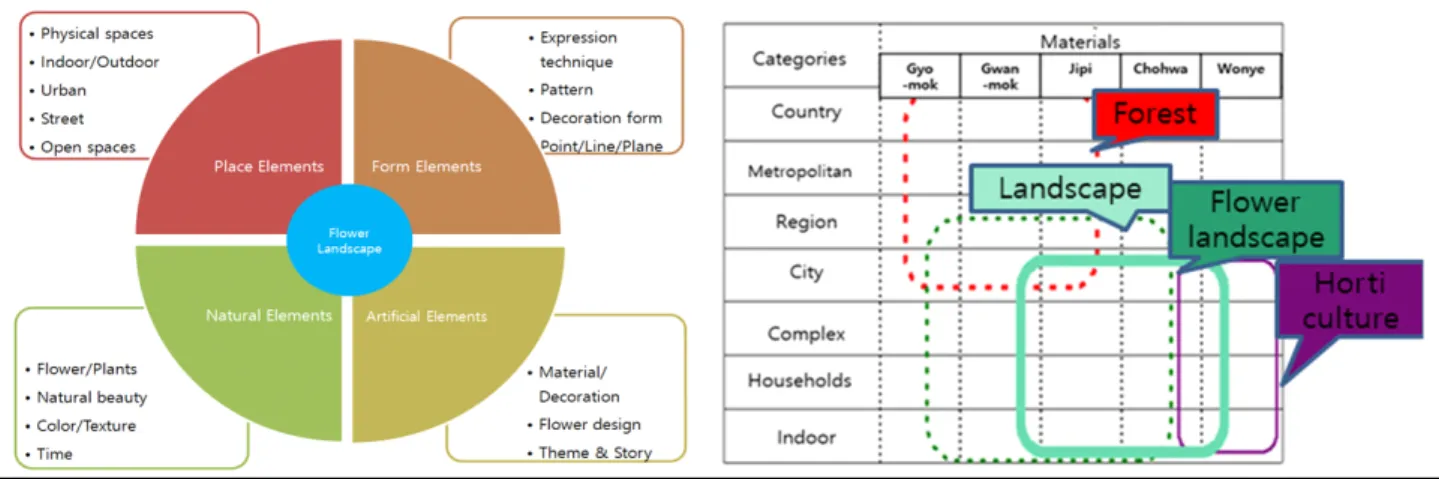
째, 화훼분야에서 학술적 정리과정 없이 일반 사용용어로 통용 되는 유사개념 12가지, 셋째, 선행 연구논문에서 화훼경관 관련 유 사개념이 언급된 12편의 자료를 참고하였다. 선행연구 고찰을 통해 본 화훼경관 관련 유사개념의 초기는 공간적 범위에서 실 내 중심이었던 것이 옥외를 향하게 되고, 공간의 개념이 확장되 면서 옥외 환경에 필요한 새로운 개념들이 생겨난다. 선행연구를 통해 도출한 화훼경관의 개념을 결정하는 핵심 4요소는 공간적 요 소, 형태적 요소, 자연적 요소, 인공적 요소이다(Figure 1 참조).
선행연구 분석을 통해 도출된 화훼경관의 핵심 4요소를 기 반으로 화훼경관 개념을 정리하면 ‘도시 화훼경관이란 도시(공 간적 요소)에 도입된 경관의 주요 재료인 화훼(자연적 요소)의 활용 범위를 도시적 스케일로 확장해서 바라보는 관점으로 인 간이 정주하는 도시 공간에서 꽃과 식물(자연적 요소)이라는 주재료의 속성을 도시경관의 구성요소인 건축물, 오픈스페이스 (인공적 요소) 등과 조화롭도록 인간이 창의력을 발휘(인공적 요소)하여 미적 효율성과 생태적 순환체계가 작동되도록 만들 어진 화훼기반의 의도된 전망이나 경치(형태적 요소)라고 개 념화할 수 있다’ 이를 요약하여 정리하면, “도시 화훼경관이란 경관재로서 도입된 화훼의 활용 범위를 도시적 스케일에서 바 라보는 관점으로 인간이 정주하는 도시 공간에서 꽃과 식물이 라는 주재료가 지니고 있는 속성 즉, 심미성, 생태성 인자가 도 시 구성요소와 결합하여 도시 공간의 미적 효율성과 생태적 도 시기능이 작동되도록 만들어진 화훼기반의 의도된 전망이나 경치”를 말한다.
3. 화훼경관의 도시경관성
Yoon(2016)는 ‘인류 역사속에서 인간과 식물은 불가분성을 가져왔으며, 식물이 기본적으로 가지고 있는 본성을 인간이 도시환경에 맞추는 과정에서 부분적 조작에 의해 재탄생한 것이 화훼장식이다. 또, 화훼장식물은 꽃이나 꽃과 직접 관련 된 것, 또는 그 이미지가 주체가 되지만 인간의 창조적 활동
이 그 속에 담겼을 때 비로소 작품으로 아름답게 표현된다’라 고 하였다. 이는 화훼경관과 도시민의 밀접한 관계의 설명이 다(Figure 2 참조). 도시경관으로서 화훼경관의 역할과 비중 은 첫째, 화훼경관은 도시민의 감성을 자극하고 밝은 도시를 유지하며, 삶을 쾌적하게 하는 중요한 도시환경의 요소이다.
둘째, 화훼경관은 인간의 다양한 활동이 이루어지는 도시에서 도시의 개성과 특성을 빠르고 이미지화하는 효과 연출이 즉 각적으로 가능하다. 셋째, 도시는 끊임없이 변화한다는 속성 을 가지고 있는데, 이런 다양한 사회 구성원들의 생각과 문화, 시시각각 변하는 생활 트랜드가 화훼의 속성인 시간의 유한 함, 자연성과 흡사하다. 넷째, 화훼경관은 도시 공간에 대한 이미지를 상승시키고, 살아 있는 식물이 주는 자연미와 화려 함, 생동감을 느끼게 해주어 회색의 도시를 녹색의 자연 친화 적인 분위기를 유도한다.
4. 시사점 도출
기존 연구의 한계점으로 화훼경관 개념에 관한 연구는 화훼 관련 선행 연구의 대다수가 실내 화훼장식물로서 공간 배치 특 성이 실내로 한정되고, 실외 도시경관적 차원의 규정과 개념은
Figure 1. The system of flower landscape and categorization
Figure 2. Hierarchy for the flower landscape and urban landscape Material: Reorganized the classification of landscape form from Lim(2014).
미흡하다. 실외와는 다소 차이가 있는 실내 중심의 개념이 일 부 활용될 수밖에 없었고, 또 화훼경관 개념을 도출하는 과정 에서 학술적 개념 정리가 안 된 시중에서 통용되는 용어들을 추려서 연구자가 정리하였지만, 그 개념들을 그대로 채택할 수 없어 Figure 1에서처럼 문헌과 일반통용 용어 분석을 통해 추 출된 핵심 4요소를 기반으로 연구자가 새롭게 개념을 재구성하 였다. 불가피하지만 이 과정에서 연구자의 관점이 다소 관여된 한계를 갖는다. 실내 화훼장식 중심의 연구가 대부분을 차지한 가운데 실외 연구는 최근에 정원 붐과 관련하여 정원에 대한 경향, 특성, 유형을 분석하는 보고나 연구가 많아지고 있는 것 은 분명해 보인다. Jung(2016)에 의하면 ‘사회적 인식변화뿐 아니라 정책적으로 ‘수목원 정원의 조성 및 진흥에 관한 법률’
개정을 계기로 정원문화 확산과 정원산업활성화 논의와 한국 조경학회의 정원연구센터 설립, 한국정원디자인학회 활동 등이 전반적인 정원 관련 연구의 활발함의 예시’라고 하였다. 다만, 정원과 화훼경관은 범위와 대상, 개념이 다르다. 정원이 화훼경 관의 한 유형이라고 보았을 때 정원보다 상위 단위라고 볼 수 있는 도시적 스케일의 화훼경관이 아직 개념과 체계를 뚜렷하 게 못 갖추고 있다는 측면은 화훼경관의 전문영역화 과정에 한 계를 갖고 있다는 것을 나타낸다. 이에 본 연구에서는 기존 선 행연구와의 차별화를 다음과 같이 가져가고자 한다. 화훼경관 이 도시경관의 한 장르로, 그리고 도시경관의 단위로 왜 정의 하고 연구할 필요가 있는지, 시계열적 분석을 통한 도시 화훼 경관의 개념을 제시하고 도시경관성을 규명한다, 그리고 선행 연구와 사례조사를 통해 도시 화훼경관 유형화 작업을 전문가 FGI를 통해 진행하면서 유형의 타당성 확보와 수요자들에게 합리적이고 효율적인 화훼경관 유형의 선택자료를 제시한다는 측면에서 기존 연구들과의 차별성이 있다.
Ⅲ. 분석의 틀
1. 화훼경관 유형화 요소 도출을 위한 국내, 국외 사례 선정기준
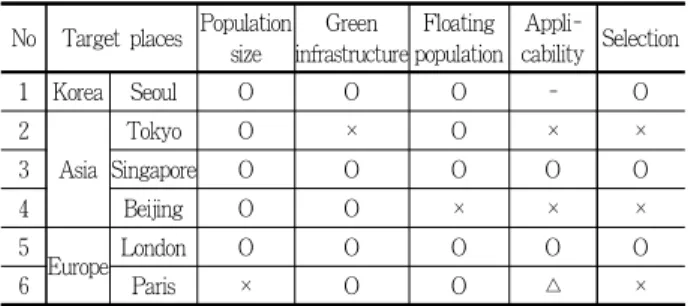
사례조사를 통한 대상지는 서울과 인구 규모나 면적이 유사 한 대도시들을 기준으로 하였다. 인구가 1,000만에 이르는 서울 을 도시문제와 도시 복잡성에서 그에 버금가는 규모의 대도시 와 비교함으로써 경관 전략 또는 화훼경관 방식에 대한 모티브 와 시사점을 찾을 수 있지 않을까 판단하였다. ①인구 규모는 500만 이상, ②그린인프라는 인당 공원면적 10m
2이상, ③유동 인구는 연간 외국인 관광객 1,000만 명 이상, ④화훼경관 연출 의 국내 적용성 등을 기준으로 하였다(Figure 1 참조).
첫째, 인구 500만 기준은 고밀화 도시로서 도시 특성을 충분 히 담아내고 있기 위해서이고 파리가 요건을 충족시키지 못했 다. 둘째, 인당 공원면적 10m
2이상은 공간별, 형태별, 재료별
화훼경관의 사례가 일반화된 도시의 요건으로 보았으며 도쿄 가 4.5m
2로 여건을 충족하지 못했다. 셋째, 유동인구 외국인 관 광객 연간 1,000만 명 이상으로 하였고, 관광도시이자 거점 도 시로서 유동인구가 많아 정원, 식물, 꽃을 도시 이미지로 적극 활용하는 매개 변수의 척도로 판단하였으며 베이징이 요건을 충족하지 못하였다. 넷째, 연출 적용성은 화훼경관의 국내 적용 정도나 활동가들의 국내 유입 정도 등을 종합적으로 고려하였 다. 최종 대상지는 서울, 싱가포르, 런던이다(Table 1 참조).
2. 도시 화훼경관 유형화 요소 도출을 위한 자료의 수집 방법
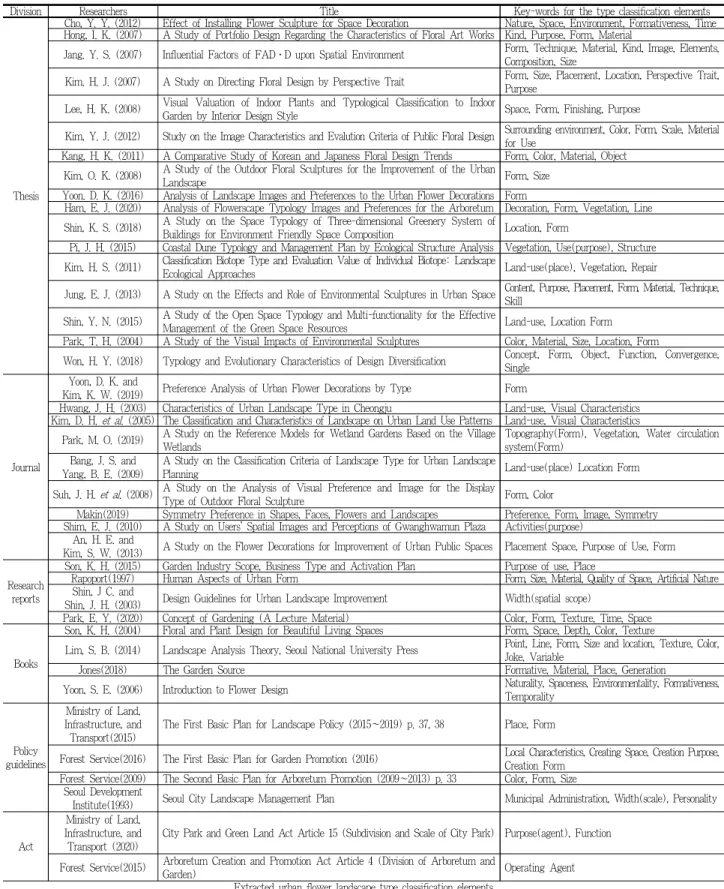
도시 화훼경관의 유형화 요소 도출을 위해 같은 맥락에 있는 기존의 선행연구를 살펴보고, 도시 화훼경관 유형화의 분류 근 거가 될 수 있는 구성요소를 도출하였다. 그리고 산림청, 국토 교통부, 각 지자체에서 제공하는 경관 관련 지침을 비롯하여 광역시도별 경관계획, 정원 및 산림 계획 관련 가이드라인 및 연구보고서를 수집하여 도시 화훼경관 유형화 구성요소 도출 에 활용하였다. 국내 및 해외 사례와 관련해서는 도시와 관련 된 설명자료, 사진자료, 현지답사 등을 통해 자료를 수집하였다 (Table 5 참조).
3. 도시 화훼경관 유형화 요소 도출을 위한 자료의 구축 방법
본 연구에서는 선행연구 및 사례 연구를 통해 도출된 화훼경 관 유형화 분류의 기준이 되는 요소들 중 유사 요소군별로 군 집화하고 이 요소들의 재분류와 재분류된 요소를 기준으로 유 형화 과정을 밟는 방식으로 진행하였고, 타당성을 확보하기 위 해 전문가들의 경험을 통한 의견을 수렴하고자 FGI를 실시하 였다(Figure 3 참조).
4. 전문가 표적집단면접(FGI)을 활용한 요소 도출 방법 표적 집단 선정은 화훼 관련 조경설계 및 계획 분야, 화훼, 정원 관련 연구자, 화훼 전문 시공 분야, 공사감독(발주처) 분
No Target places Populationsize Green
infrastructure Floating population Appli-
cability Selection
1 Korea Seoul O O O - O
2 Asia
Tokyo O × O × ×
3 Singapore O O O O O
4 Beijing O O × × ×
5 EuropeLondon O O O O O
6 Paris × O O △ ×
Table 1. Selection of the target place
야 등 화훼 조경실무 전문가를 중심으로 구성하였다.
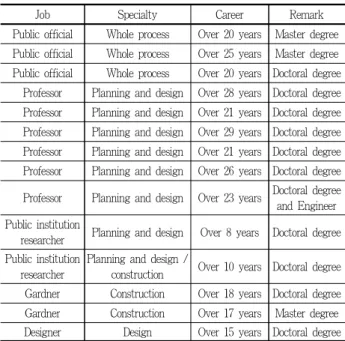
해당분야 경력은 최소 8년 이상에서 최고 33년으로 실무에 대한 업무 파악이 가능한 범위로 설정하였고, 학위는 석사학위 이상을 가진 사람을 대상으로 하여 실무와 이론을 겸비할 수 있는 전문가를 선정하였다. FGI를 위한 자료는 앞서 설명한 바 와 같이 구축한 자료를 제공하였고(Table 2 참조), 전문가 FGI 는 2020년 6월 7일~17일까지 1단계, 2020년 6월 19일~30일까 지 2단계로 두 번에 걸쳐 실시하였다(Table 3 참조). 코로나19 라는 세계적 팬더믹 상황을 반영하여 방문인터뷰, 이메일을 통 한 서면 인터뷰 방식으로 진행하였으며 답변에 대한 추가 질문 은 전화와 이메일을 통해서 진행하였다. 유형의 최종 합의 방 법은 FGI 참석자들의 단일합의에 의한 판단을 기준으로 하였 다. 14명의 전문가를 구성하여 도시 화훼경관에 적용 가능한
화훼경관 유형의 분류 요소 도출과 요소를 기준으로 유형화를 전개하였다(Table 4 참조). 요소 도출을 위한 최종 합의 방식 은 앞서 3장에서 설명하였듯이 FGI 대상자들의 단일합의에 의 한 판단을 기준으로 하였다. 전문가 FGI는 2020년 6월 7일~17 일까지 1단계, 2020년 6월 19일~30일까지 2단계로 두 번에 걸 쳐 실시하였다.
Ⅳ. 도시 화훼경관 유형화
1. 선행연구 기반의 도시 화훼경관 유형화 요소 도출 및 유형화
1) 로우데이터의 재구성을 통한 유형화 요소 도출
전문가 FGI 가이드라인에서 제시되었던 선행 연구자료에 대 해서는 전문가들의 의견을 반영하였고, 도시 화훼경관 유형화 요소 도출을 위해서는 기존의 선행연구는 물론 범위를 확장하 여 화훼장식, 화예 디자인, 정원 식재, 비오톱, 도시경관, 도시 계획, 토지이용 등 다양한 인접 분야까지 넓혀 진행하였다. 또 연관된 유형화 요소 도출을 위해 학위논문, 학술지, 연구보고, 단행본, 정책 지침, 법규자료 등을 고르게 배분하여 어느 한 부 문에 편중되지 않도록 하였으며, 국내와 해외자료, 그리고 석사 학위 논문과 박사학위 논문을 안배하여 총 40편의 연구자료에 서 화훼경관 유형화 요소를 도출하고자 하였다.
추출된 요소들은 Park(2004), Jun(2009), Kang(2011), Kim (2012), Cho(2012), Jung(2013), Pi(2015), Shin(2018), Park (2019), Yoon and Kim(2019) 등 기존 관련 연구고찰을 통해 총 41개의 요소가 추출되었다(Table 5 참조).
Fields Subjects Date Interview
method Interview time Total 2 persons of
public officials June 7, 2020
~ June 17 (1st: elements for classification)
June 19, 2020
~June 30 (2nd: type classification)
- Visiting - Written interview - Telephone
interview
Visiting: 2 hours Written interview:
- Collected 10 days after sending an email Telephone interview:
- Further questions Planning
and designing
6 persons of professors 3 persons of
researchers 1 person of planner Construc-
tion 2 persons of gardner
Table 3. Summary of FGI with the experts
Division Presented Items
Literature and
previous studies Data on classification elements derived through previous studies on flower and adjacent fields
Objective data Photographs of domestic and foreign cases supporting the elements related to classification
Table 2. Guidelines presented in the FGI with the experts Figure 3. Components derivation of urban flower landscape and
the process of type classification
Job Specialty Career Remark
Public official Whole process Over 20 years Master degree Public official Whole process Over 25 years Master degree Public official Whole process Over 20 years Doctoral degree
Professor Planning and design Over 28 years Doctoral degree Professor Planning and design Over 21 years Doctoral degree Professor Planning and design Over 29 years Doctoral degree Professor Planning and design Over 21 years Doctoral degree Professor Planning and design Over 26 years Doctoral degree Professor Planning and design Over 23 years Doctoral degreeand Engineer Public institution
researcher Planning and design Over 8 years Doctoral degree Public institution
researcher Planning and design /
construction Over 10 years Doctoral degree Gardner Construction Over 18 years Doctoral degree Gardner Construction Over 17 years Master degree Designer Design Over 15 years Doctoral degree Table 4. Status of the experts participated in FGI
Division Researchers Title Key-words for the type classification elements
Thesis
Cho, Y. Y. (2012) Effect of Installing Flower Sculpture for Space Decoration Nature, Space, Environment, Formativeness, Time Hong, I. K. (2007) A Study of Portfolio Design Regarding the Characteristics of Floral Art Works Kind, Purpose, Form, Material
Jang. Y. S. (2007) Influential Factors of FAD․D upon Spatial Environment Form, Technique, Material, Kind, Image, Elements, Composition, Size
Kim. H. J. (2007) A Study on Directing Floral Design by Perspective Trait Form, Size, Placement, Location, Perspective Trait, Purpose
Lee, H. K. (2008) Visual Valuation of Indoor Plants and Typological Classification to Indoor
Garden by Interior Design Style Space, Form, Finishing, Purpose
Kim, Y. J. (2012) Study on the Image Characteristics and Evalution Criteria of Public Floral Design Surrounding environment, Color, Form, Scale, Material for Use Kang, H. K. (2011) A Comparative Study of Korean and Japaness Floral Design Trends Form, Color, Material, Object
Kim, O. K. (2008) A Study of the Outdoor Floral Sculptures for the Improvement of the Urban
Landscape Form, Size
Yoon. D. K. (2016) Analysis of Landscape Images and Preferences to the Urban Flower Decorations Form
Ham, E. J. (2020) Analysis of Flowerscape Typology Images and Preferences for the Arboretum Decoration, Form, Vegetation, Line Shin, K. S. (2018) A Study on the Space Typology of Three-dimensional Greenery System of
Buildings for Environment Friendly Space Composition Location, Form
Pi, J. H. (2015) Coastal Dune Typology and Management Plan by Ecological Structure Analysis Vegetation, Use(purpose), Structure Kim, H. S. (2011) Classification Biotope Type and Evaluation Value of Individual Biotope: Landscape
Ecological Approaches Land-use(place), Vegetation, Repair
Jung, E. J. (2013) A Study on the Effects and Role of Environmental Sculptures in Urban Space Content, Purpose, Placement, Form, Material, Technique, Skill Shin, Y. N. (2015) A Study of the Open Space Typology and Multi-functionality for the Effective
Management of the Green Space Resources Land-use, Location Form
Park, T. H. (2004) A Study of the Visual Impacts of Environmental Sculptures Color, Material, Size, Location, Form
Won, H. Y. (2018) Typology and Evolutionary Characteristics of Design Diversification Concept, Form, Object, Function, Convergence, Single
Journal
Yoon, D. K. and
Kim, K. W. (2019) Preference Analysis of Urban Flower Decorations by Type Form
Hwang, J. H. (2003) Characteristics of Urban Landscape Type in Cheongju Land-use, Visual Characteristics Kim, D. H. et al. (2005) The Classification and Characteristics of Landscape on Urban Land Use Patterns Land-use, Visual Characteristics
Park, M. O. (2019) A Study on the Reference Models for Wetland Gardens Based on the Village
Wetlands Topography(Form), Vegetation, Water circulation
system(Form) Bang, J. S. and
Yang, B. E. (2009) A Study on the Classification Criteria of Landscape Type for Urban Landscape
Planning Land-use(place) Location Form
Suh, J. H. et al. (2008) A Study on the Analysis of Visual Preference and Image for the Display Type of Outdoor Floral Sculpture Form, Color
Makin(2019) Symmetry Preference in Shapes, Faces, Flowers and Landscapes Preference, Form, Image, Symmetry Shim, E. J. (2010) A Study on Users’ Spatial Images and Perceptions of Gwanghwamun Plaza Activities(purpose)
An, H. E. and
Kim, S. W. (2013) A Study on the Flower Decorations for Improvement of Urban Public Spaces Placement Space, Purpose of Use, Form Research
reports
Son, K. H. (2015) Garden Industry Scope, Business Type and Activation Plan Purpose of use, Place
Rapoport(1997) Human Aspects of Urban Form Form, Size, Material, Quality of Space, Artificial Nature Shin, J C. and
Shin, J. H. (2003) Design Guidelines for Urban Landscape Improvement Width(spatial scope)
Park, E. Y. (2020) Concept of Gardening (A Lecture Material) Color, Form, Texture, Time, Space Books
Son, K. H. (2004) Floral and Plant Design for Beautiful Living Spaces Form, Space, Depth, Color, Texture
Lim, S. B. (2014) Landscape Analysis Theory, Seoul National University Press Point, Line, Form, Size and location, Texture, Color, Joke, Variable
Jones(2018) The Garden Source Formative, Material, Place, Generation
Yoon, S. E. (2006) Introduction to Flower Design Naturality, Spaceness, Environmentality, Formativeness, Temporality
Policy guidelines
Ministry of Land, Infrastructure, and
Transport(2015) The First Basic Plan for Landscape Policy (2015~2019) p. 37, 38 Place, Form
Forest Service(2016) The First Basic Plan for Garden Promotion (2016) Local Characteristics, Creating Space, Creation Purpose, Creation Form
Forest Service(2009) The Second Basic Plan for Arboretum Promotion (2009~2013) p. 33 Color, Form, Size Seoul Development
Institute(1993) Seoul City Landscape Management Plan Municipal Administration, Width(scale), Personality Act
Ministry of Land, Infrastructure, and
Transport (2020) City Park and Green Land Act Article 15 (Subdivision and Scale of City Park) Purpose(agent), Function Forest Service(2015) Arboretum Creation and Promotion Act Article 4 (Division of Arboretum and
Garden) Operating Agent
Extracted urban flower landscape type classification elements
Form/ Decoration Method/ Line/ Formative/ Point/ Technique/ Space/ Place/ Environmentality/ Location/ Placement/ Scale/ Size/ Material/ Naturality/ Finishing/
Time/ Vegetation/ Color/ Texture/ Visual Characteristics/ Joke / Content/ Purpose/ Concept/ Purpose of use/ Structural/ Objectified/ Depth/ Convergence/
Variable/ Kind/ Repair/ Function/ Object/ Image/ Preference/ Symmetry/ Timing/ Theme/ Composition (41)
Table 5. Derivation of type classification elements of flower landscape through the previous studies and the extracted elements for type classification of urban flower landscape
선행연구 자료와 전문가 FGI 결과를 반영한 군집화에 의해 도출된 유형 요소들의 빈도분석을 한 결과, ‘형태’에 속하는 요 소의 빈도는 36회, ‘장소’와 관련된 요소의 빈도는 40회, ‘재료’
와 관련된 요소의 빈도는 33회, ‘용도’ 관련된 요소의 빈도는 14 회 나머지 기타 15개 항목에 걸쳐서 각각 1~2회 정도의 빈도 가 확인되었다(Table 6 참조).
군집화의 기준은 군집의 성격 및 내용의 유사성에 따라 1차 로 연구자가 분류한 후 전문가 FGI를 통해 수정 보완 과정을 거쳤으며, 군집을 대표하는 통합적인 네이밍은 빈도수가 많은 용어로 제시하였고 전문가 FGI에서도 모두 동의하였다(Table 7, Table 8 참조).
선행 연구의 빈도분석과 전문가 FGI 확인 과정을 통해 확정
Division of the
studies Key-words related to type classification elements
Form Place Material Purpose
1 Nature, Space, Environment, Formativeness, Time 0 0 0 0 0
2 Kind, Purpose, Form, Material 0 0 0
3 Form, Technique, Material, Kind, Image, Elements, Composition, Size 0 0 0 0 0 4 Form, Size, Placement, Location, Perspective Trait, Purpose 0 0 0 0 0 0
5 Space, Form, Finishing, Purpose 0 0 0 0
6 Surrounding Environment, Color, Form, Scale, Material for Use 0 0 0 0 0
7 Form, Color, Material, Object 0 0 0
8 Form, Size 0 0
9 Form 0 10 Decoration, Form, vegetation, Line 0 0 0 0
11 Location, Form 0 0
12 Vegetation, Use(purpose), Structure 0 0
13 Land-use(place), Vegetation, Repair 0 0
14 Content, Purpose, Placement, Form, Material, Technique, Skill 0 0 0 0 0 0
15 Land-use, Location Form 0 0 0 16 Color, Material, Size, Location, Form 0 0 0 0 0 0
17 Concept, Form, Object, Function, Convergence, Single 0 0
18 Land-use, Visual Characteristics 0 0
19 Land-use, Visual Characteristics 0 0
20 Topography(Form), Vegetation, Water Circulation System (Form) 0 0
21 Land-use(place) Location Form 0 0 0 22 Form, Color, 0 0 0
23 Preference, Form, Image, Symmetry 0 24 Activities(purpose) 0
25 Placement Space, Purpose of Use, Form 0 0 0
26 Purpose of use, Place 0 0
27 Form, Size, Material, Quality of Space, Artificial Nature 0 0 0 0 0 28 Width (spatial scope) 0
29 Color, Form, Texture, Time, Space 0 0 0 0 30 Form, Space, Depth, Color, Texture 0 0 0
31 Point, Line, Form, Size and Location, Texture, Color, Joke, Variable 0 0 0 0 0 0 0 0 32 Formative, Material, Place, Generation 0 0 0
33 Naturality, Spaceness, Environmentality, Formativeness, Temporality 0 0 0 0
34 Place, Form 0 0
35 Local characteristics. Creating Space, Creation Purpose, Creation Form 0 0 0 0
36 Color, Form, Size 0 0 0
37 Municipal Administration, Width(scale), Personality 0 0 0 0
38 Purpose(agent), Function 0 39 Operating Agent
Total 27 2 2 2 1 2 8 12 3 5 2 5 5 8 2 2 2 4 3 7 4 1 1 6 2 5
Sum 36 40 33 14
Table 6. Clustering of revised type classification elements and frequency
된 유형화 요소 즉, 유형의 최종 분류 기준은 형태(form)․장 소(place)․재료(material)․용도(purpose)의 4개 요소이며, 정 리하면 Table 9와 같다.
2) 도출 요소 활용을 통한 유형화(전문가 FGI-2차) 2차 전문가 FGI는 2020년 6월 19일~27일까지 실시하였다.
방식은 1차와 같은 방식으로 2020년 코로나 19라는 국제적 팬 데믹 상황이라는 특수한 여건으로 인해 이메일을 통한 인터뷰 및 방문, 전화통화 방식을 병행하여 진행했다. 2차는 FGI 1차 에서 유형화와 관련하여 구체적인 코멘트나 방향을 제시한 6명 의 전문가로 압축해 진행되었다.
(1) 형태 요소에 따른 유형화
Kim(2007), Jang(2007), Hong(2007), Lee(2008), Kim(2011), Kim(2012) 등 다수의 연구에서 유형 관련 연관 요소 중의 하 나로 ‘형태’가 언급되거나 제시되고 있다. 분류의 기준과 관련 해서 FGI 의견은 형태는 형(形), 즉 shape로 보아야 하며 공간 형태에 의한 분류 즉, 2차원/3차원의 관계로 접근해야 하는 것 에 일부 이견도 있었지만 대체로 합의하였고, 유형화 내용과 관련한 FGI 의견 쟁점은 색상이나 질감을 어떻게 보는가였다.
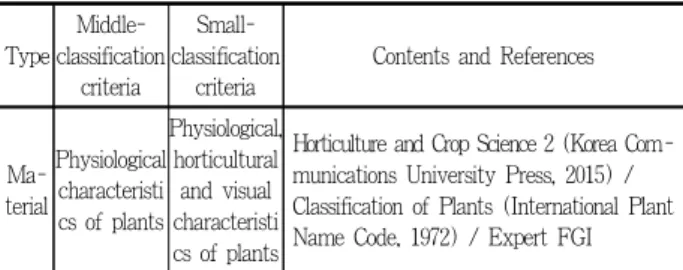
화훼는 특성상 색상이나 질감 자체가 화훼의 생리적 특성이므 로 형태보다는 소재로 분류되는 것이 바람직하다는 의견으로 합의되었다.
선행연구와 전문가 FGI를 바탕으로 한 유형 정리는 현재 도 시 화훼경관에 적용될 수 있는 중분류 유형을 평면형과 입체형 으로 분류되고, 다시 평면형은 소분류로 점형, 선형, 면형으로
분류되고 입체형은 소분류로 수직 벽면형, 컨테이너형, 오브제 활용형, 화훼조형물형으로 분류하였다(Table 10, Table 11, Table 12 참조).
(2) 장소 요소에 따른 유형화
Hwang(2003), Park(2004), Kim(2007), Kim(2011), Cho(2012), Shin(2015) 등 다수의 선행연구에서 유형 관련 연관 요소 중의 하나로 ‘장소’가 언급되거나 제시되고 있다. 분류의 기준과 관 련해서 FGI 의견 쟁점은 장소는 유형화 요소로서 부적합하다 는 의견이 있었지만, 앞선 선행연구에서 유형화 요소로서 ‘장 소’가 40회의 빈도수를 보이면서 유형화 4개 요소 중 중요한 요 소로서 위상을 갖고 있다라는 결과와 FGI에서 다른 전문가들 이 이견이 없었다.
선행연구와 전문가 FGI를 바탕으로 한 유형 정리는 도시 화 훼경관 ‘장소’ 요소에 따른 유형화는 중분류 ‘건축물형’과 ‘오픈 스페이스형’으로 분류하고 ‘건축물형’은 다시 소분류로 주거지 형, 상업지형, 공공 및 업무지형, 중분류 ‘오픈스페이스형’은 소 분류로 광장형, 가로형, 연결 시설지형, 테마지형, 공원녹지지 형으로 분류하였다(Table 13, Table 14, Table 15 참조).
Classification Criteria Contents and References
Clustering Similarity of the feature of the cluster and the content of
the item
Reflection of the Concept of the Items in Previous Studies
and FGI Opinions Naming Frequency Cases from Previous Studies
and FGI Verification Table 7. Cluster classification and naming criteria
Clustering of the elements (frequency) Criteria by clusters Integrated naming
(Based on frequency) Form(29)/ Decoration method(2)/ Line(2)/ Formative(2)/ Point(1)/ Technique(2) A cluster related to visually recognized form or shape Form Space(8)/ Place(12)/ Environmentality(3)/ Location(5)/ Placement(2)/ Scale(5)/
Size(5)/ A place-related cluster where organic activities occur
with location and size Place
Material(8)/ Naturality(2)/ Finishing(2)/ Time(2)/ Vegetation(4)/ Color(7)/
Texture(3)/ Visual Characteristics(4)/ Joke(1) A material-related cluster with color, texture, shape
beauty, and flower physiological properties Material Content(1)/ Purpose of Use(6)/ Concept(2)/ Purpose(5)/ A purpose-related cluster for beneficial use as needed Purpose Structural(2)/ Objectified(2)/ Depth(1)/ Convergence(1)/ Variable(1)/ Kind(1)/
Repair(1)/ Function(2)/ Object(1)/ Image(2)/ Preference(1)/ Symmetry(1)/
Period(1)/ Topic(1)/ Composition(2)
Clustering is not possible because of no similarity between items.
No items with significant frequency. Else Table 8. Clustering and naming of type classification elements according to similarity
Urban flower landscape type classification elements 형태(Form) 장소(Place) 재료(Material) 용도(Purpose) Table 9. Final urban flower landscape type classification elements
Type Middle- classification
criteria
Small-classification
criteria Contents and References
FormSpatial form classification (2D and 3D)
Shape of ground / Form of 3D
function
Application of Formative Classification System towards Spaces / Landscape Type Classification Method of the Japanese Urban Landscape Plan / Urban Landscape Type of Seoul City Landscape Management Plan (Seoul Development Institute, 1993) / FGI with Experts
Type 10. Classification criteria for revised form elements
(3) 재료 요소에 따른 유형화
Rapoport(1997), Park(2004), Jang(2007), Kim(2007), Kang (2011), Kim(2011), Kim(2012) 등 다수의 선행연구에서 유형 관련 연관 요소 중의 하나로 ‘재료’가 언급되거나 제시되고 있다.
유형화 내용과 관련해서 FGI 의견은 소재에서 화훼를 초화 류로 한정 짓고, 화관목은 제외하는 것이 체계적일 것 같다는 의견에 대해서도 화훼경관의 유형화 작업이 최초라는 점을 감 안하여 분류 체계상 목본류도 화훼경관의 범위이기 때문에 분 류체계 내에서 수용해야 하고, 화관목뿐만 아니라 목본류로 바 꾸어 재료의 확장성을 감안한 분류체계로 정리하였다.
선행연구와 전문가 FGI를 바탕으로 한 유형 정리는 전문가 FGI를 통해 수정된 도시 화훼경관 ‘재료’ 요소에 따른 유형화 는 중분류는 ‘초본형’, ‘혼합형’, ‘목본형’으로 분류하고, 중분류
‘초본형’은 소분류 초본 색상형, 초본 질감형, 초본 형태미형, 중분류 ‘혼합형’은 소분류 혼식 색상형, 혼식 질감형, 혼식 형태 미형으로 중분류 ‘목본형’은 소분류 목본 색상형, 목본 질감형,
목본 형태미형으로 분류하였다(Table 16, Table 17, Table 18 참조).
Classification criteria Middle-classification Small-classification
Form
Plane
Point type Line type Plane type
Solid
Vertical wall type Container type
Object type Flower sculpture type Table 11. Type classification based on revised form elements of urban
flower landscape
Middle-
classification Small-
classification Type definition
Building type
Residential
area A flower landscape providing aesthetic and eco- logical efficiency while supporting residential functions Business
area
A flower landscape providing aesthetic and eco- logical efficiency while supporting commercial func- tions
Public and work area
A flower landscape providing aesthetic and eco- logical efficiency while supporting public and work functions
Open space type
Plaza A flower landscape providing aesthetic and eco- logical efficiency while supporting plaza function
Street A flower landscape created with lines and points along the street making the street environment pleasant
Connection facility area
A continuous flower landscape created in a hanging or mounted form using existing facilities such as guardrails, bridge railings, pedestrian railings, and square railings at the entrance to the city center
Theme facility area
A flower landscape created at short-term or temporary events such as expo, fairs, sports festival, local festivals, or flower festivals
Parks and green area
A flower-centered landscape specially created for theme/appreciation/seasonality/experience in urban park and green area
Table 15. Definition by type according to place elements Type Middle-
classification criteria
Small- classification
criteria Contents and references
Place Land-use Land-use
Urban Ecology Status of the Ministry of Environment / Urban Landscape Type of Urban Planning Ordinance in Seoul (Seoul Development Institute, 1993) / Land-Use Criteria in Urban Landscape Classification by Urban Planning Regulations of Local Governments / FGI with Experts
Table 13. Classification criteria for revised place elements
Middle-
classification Small-
classification Type definition
2D
Point
Fixed and fragmented shape of points. Or a flower landscape created in a small space without per- spective (e.g, Hanpyeong Garden, Guerrilla Gardens, a spae space, Traffic Island, etc.)
Line A flower landscape in the form of a line with a narrow and long shape with a sense of rhythm Plane A flower landscape in a flat surface where you
can feel perspective
3D
Vertical wall
type A flower landscape that is planted vertically using plantable vertical structures or supports Container
type
A flower landscape that fire-type structures with mobility are used for planting in variable places or urban pavement where planting is difficult.
Object type
A flower landscape that provides a point of interest by using the unique color, texture, and shape of various and dissimilar materials Flower
sculpture type
A flower landscape that utilizes 3D modeling by planting flowers on structures designed for plant growth
Table 12. Definition by type according to form elements
Classification criteriaMiddle-classification Small-classification
Place
Building type
Residential area Business area Public and work area
Open space type
Plaza Street Connection facility area
Theme facility area Parks and green area Table 14. Type classification based on revised place elements of urban
flower landscape
(4) 용도 요소에 따른 유형화
Kim(2007), Hong(2007), Lee(2008), Shim(2010), An and Kim(2013), Jung(2013), Son(2015), Pi(2015) 등 다수의 선행
연구에서 유형 관련 연관 요소 중의 하나로 ‘용도’가 언급되거 나 제시되고 있다. 분류의 기준과 관련해서 FGI쟁점으로 비물 리적 요소인 ‘용도성’은 ‘장소’와도 상당히 밀접한 인과관계가 있다고 보며, 따라서 장소 내에 비물리적 요소인 용도성이 어 느 정도 의미를 내포하고 있는 것 같으므로 두 가지를 합치거 나 ‘장소’의 내용에 ‘용도’을 포함하는 방안도 검토가 필요하다 는 의견을 개진하였다. 많은 선행연구에서 ‘용도’는 독립적 분 류 항목으로써의 지위를 빈도수 측면에서 부여받고 있어 별도 유형 항목으로 분류했다.
선행연구와 전문가 FGI를 바탕으로 한 유형 정리 도시 화훼 경관 ‘용도’ 요소에 따른 유형화는 중분류는 ‘감상형’과 ‘활동형’
으로 중분류하였고, ‘감상형’은 소분류로 관상형, 전시형, 관광 형으로, ‘활동형’은 소분류로 체험형, 치유형, 생산형으로 분류 하였다(Table 19, Table 20, Table 21 참조).
3) 선행연구 기반의 도시 화훼경관 유형의 종합
앞서 각 관련 분야별 지침과 정책자료, 선행연구 등의 고찰 을 통해 도출된 형태(form)․장소(place)․재료(material)․용 도(purpose) 4개의 주요 유형화 요소를 분류의 기준으로 삼아 선행 이론고찰과 전문가 FGI 과정을 통하여 도시 화훼경관 유 형화 과정을 중분류, 소분류로 심도 있게 진행하였다. 도시 화 훼경관 유형화를 위한 1차 분류기준을 도출하기 위하여 선행연 구에서 종합한 내용으로 전문가 표적 집단 면접(Focus Group Interview: FGI)을 실시하였으며, 1차 총 14명, 2차 6명의 전문 가를 구성하였다. 도시 화훼경관에 적용 가능한 화훼경관 유형 의 분류 요소 도출과 그 요소를 기준으로 유형화를 전개하였고,
Type Middle-classification criteria
Small- classification
criteria Contents and References
terialMa-
Physiological characteristi cs of plants
Physiological, horticultural and visual characteristi cs of plants
Horticulture and Crop Science 2 (Korea Com- munications University Press, 2015) / Classification of Plants (International Plant Name Code, 1972) / Expert FGI Table 16. Classification criteria for revised material elements
Classification criteriaMiddle-classification Small-classification
Material
Herbaceous plant type
Herbaceous plant color type Herbaceous plant texture type
Herbaceous plant form type Mixed
type
Mixed color type Mixed texture type
Mixed form type Woody plant
type
Woody plant color type Woody plant texture type
Woody plant form type Table 17. Type classification based on revised material elements
of urban flower landscape
Middle-
classification Small-
classification Type definition
Herbaceous plant type
Herbaceous plant color
type
A flower landscape where the color of herbaceous plant is the main reason for material selection Herbaceous
plant texture type
A flower landscape where the texture of herba- ceous plant is the main reason for material selection Herbaceous
plant form type
A flower landscape where the form of herba- ceous plant is the main reason for material selection
Mixed type
Mixed color
type A flower landscape where the color of mixed plant is the main reason for material selection Mixed
texture typeA flower landscape where the texture of mixed plant is the main reason for material selection Mixed form
type A flower landscape where the form of mixed plant is the main reason for material selection
Woody plan type
Woody plant
color type A flower landscape where the color of woody plant is the main reason for material selection Woody plant
texture typeA flower landscape where the texture of woody plant is the main reason for material selection Woody plant
form type A flower landscape where the form of woody plant is the main reason for material selection Table 18. Definition by type according to material elements
Classification criteriaMiddle-classification Small-classification
Purpose
Appreciation type
Viewing type Exhibition type
Tourism type Activity
type
Experience type Healing type Producing type Table 20. Type classification based on revised purpose elements of
urban flower landscape Type Middle-
classification criteria
Small- classification
criteria Contents and References
Pur-
pose Purpose of
use Use
behaviors
‘Easy Garden Guidelines' (Forest Service, 2019) / Seoul City Landscape Management Plan Landscape Type Classification Standard.
(Seoul Basic Landscape Plan, 2013-2020) / Landscape Analysis Theory (Lim, 2014) / FGI with experts
Table 19. Classification criteria for revised purpose elements
중분류 9개, 소분류 30개를 도출하였다(Table 22 참조).
2. 사례 도시(국내 및 해외) 화훼경관 유형 분석 1) 서울시
우리나라 대표도시, 광화문광장과 서울광장을 축으로 세종 로 정부 청사, 서울시청, 공공 및 업무지와 상가, 주택이 어우러 져 다양한 얼굴로 다양한 공간의 성격을 가지고 있다. 서울정 원박람회의 매년 개최를 통한 정원 붐 조성, 각 자치구의 꽃도 심 만들기 사업 등, 화훼경관의 관심과 도입이 확대되는 추세
Middle-classification Small-
classification Type definition
Appreciation type
Viewing
type A flower landscape that gets pleasure by viewing intuitively
Exhibition type
A flower landscape that arranged and directed by plans and themes (flower exhibitions, flower fairs, show garden, etc.)
Tourism type
A flower landscape created for the purpose of attracting tourists (Jeju rape flowers, Gunpo azalea flowers, etc.)
Activity type
Experience
type A flower landscape created to experience care, play, utilization, and harvest
Healing
type A flower landscape created for fragrance, emotional stability, air purification, and pharmacological effects Producing
type A flower landscape created for income through processing, sales, and derivation of flowers Table 21. Definition by type according to purpose elements
Classification criteriaMiddle-classification Small-classification
Form
Plane
Point type Linear type
Plane type
Solid
Vertical wall type Container type Object utilization type Flower sculpture type
Place
Building type
Residential area Business area Public and work area
Open space type
Plaza Street Connection facility area
Theme facility area Parks and green area
Material
Herbaceous plant type
Herbaceous plant color type Herbaceous plant texture type
Herbaceous plant form type Mixed
type
Mixed color type Mixed texture type
Mixed form type Woody plant
type
Woody plant color type Woody plant texture type
Woody plant form type
Purpose
Appreciation type
Viewing type Exhibition type
Tourism type Activity
type
Experience type Healing type Producing type Table 22. The revised type classification of urban flower landscape
Figure 4. Types of urban flower landscape introduced in Seoul
이며, 선행연구에서 도출한 24개 화훼경관 유형을 설치 사례지 방문을 통해 확인할 수 있었다(Figure 4 참조).
2) 런던시
런던은 시대적, 환경적 여건에 의해 일찍부터 정원문화가 발 전한 정원 선진국이다. 따라서 런던 도심의 일상에서 화훼는 친숙한 도시 활동의 구성요소이자 도시의 얼굴이다. 공원, 가 로, 상업지, 업무지, 주택가를 망라하고 다양한 유형의 꽃장식 물과 도시 화훼경관을 쉽게 볼 수 있다. 4계절 플라워 쇼가 있 고, 정원 생활은 런던 시민들의 일상이다. 런던의 정원연출기법 은 국내에도 많이 유입되고 있는 추세이며, 선행연구에서 도출 한 24개 화훼경관 유형을 설치 사례지 방문을 통해 확인할 수 있었다(Figure 5 참조).
3) 싱가포르시
싱가포르는 정원 도시라고 한다. 현대적인 건축물의 집합장 처럼 보이지만 싱가포르의 도시는 끊임없는 녹지 축의 연결이 다. 녹지축에 둘러쌓인 도심은 그린인프라 기반 위에서 녹색의 생명 경관이 작동하는 방식으로 회색의 도시가 아닌 녹색으로 서 향후 세계 모든 도시 발달의 모델이 되는 곳이기도 하다. 또 한, 싱가포르는 꽃과 식물을 Show적 연출을 통해 세계적 관광 상품으로 만들어낸 우수한 화훼경관 운영 모델을 갖고 있는 곳 이다. 선행연구에서 도출한 24개 화훼경관 유형을 설치 사례지 방문을 통해 확인할 수 있었다(Figure 6 참조).
4) 사례의 종합
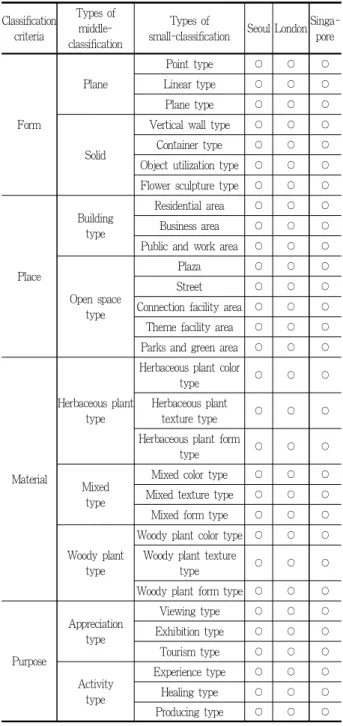
도시 화훼경관 유형이 적용된 서울, 런던, 싱가포르시, 도시 사례 3개를 살펴보았다. 선행 연구의 유형화 과정에서 분류의 준거가 되는 장소, 형태, 재료, 용도에 의해 유형화된 화훼경관 30개 유형이 3개 사례 도시에 일반적으로 적용되고 있음을 알 수 있었다. 기후와 문화, 역사, 삶의 환경은 형식적인 측면에서 모두 차이가 있지만, 도시라는 속성, 또 그 도시에서 살아가는 사람들의 미적, 생태적 지향이 다르지 않고, 또한 도시 계획상 의 토지이용 관점이 유사하기 때문에 도시경관에서 그리고 화 훼경관에서 공통점이 나타난 것으로 보인다(Table 23 참조).
3. 도시 화훼경관 유형 도출 1) 도시 화훼경관 유형 종합
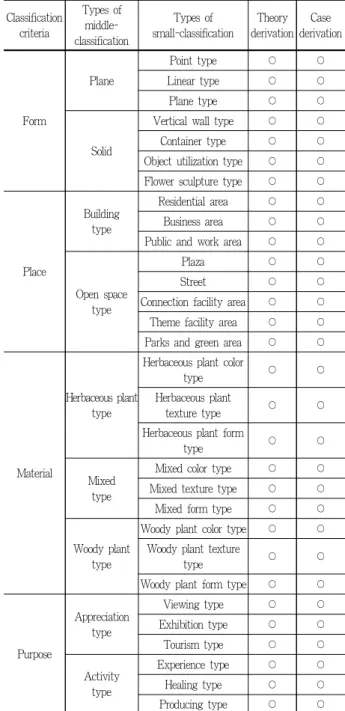
앞서 선행연구들과 법규 및 정책, 지침 등의 검토로 정리된 화훼경관 유형과 국내 및 해외 사례 연구에서 도출된 도시 화 훼경관 유형을 종합하면 Table 24와 같이 형태, 장소, 재료, 용 도로 분류할 수 있었다. 선행연구에서 도출된 주요 30개 유형 은 사례연구에서도 거의 일치된 형태로 방문 확인할 수 있었다.
따라서 본 연구에서 정리된 도시 화훼경관 유형은 보편적이고
타당한 분류가 되었음을 확인하였다(Table 24 참조).
2) 도시 화훼경관 유형 모델
(1) 유형별 조합을 통한 유형 모델의 도출 과정
이렇게 분류된 유형을 매트릭스 조합 방식에 의거하여 유형 모델 48개를 도출하였다. 유형 모델을 도출하는데 있어 핵심
Figure 5. Types of urban flower landscape introduced in London
사항은 유형 분류코드를 만들었는데 대분류인 장소는(P), 형태 (F), 재료(M)으로 하였고 각각 중분류 또는 소분류에서 P1(주 거지형), P2(상업지형), ..., F1(평면형), F2(입체형), ... M1(초 본형), M2(혼합형)... 등으로 각각 구분하였다. 요소 조합 과정 에서 장소를 기준으로 하여 세로축에 놓고 가로축에는 형태, 재료 항목을 배치하였다. 그리고 형태, 재료는 중분류 유형을 조합항목으로 하였고, 장소는 소분류 항목을 조합항목으로 하 였는데, 이는 도시라는 공간에서 장소적 특성을 보다 세분화된
단위까지 반영한 유형 모델을 도출해야 본 연구의 목적 중 하 나인 다양한 도시 공간에 적용 가능한 화훼경관 유형을 도출하 여 수요자의 합리적인 선택기준 제공을 달성할 수 있기 때문이 다. 형태, 장소, 재료의 경우처럼 물리적인 유형과 용도의 경우 처럼 비물리적인 유형이 있는데, 유형 모델을 도출하는 과정에 서는 물리적 형상이나 물리적 특성을 조합하여 유형 모델을 도 출하는 것이므로 비물리적인 유형인 용도는 조합항목에서 제 외하였다(Table 25 참조).
Figure 6. Types of urban flower landscape introduced in Singapore
Classification criteria
Types of middle- classification
Types of
small-classification Seoul London Singa-pore
Form
Plane
Point type ○ ○ ○
Linear type ○ ○ ○
Plane type ○ ○ ○
Solid
Vertical wall type ○ ○ ○
Container type ○ ○ ○
Object utilization type ○ ○ ○ Flower sculpture type ○ ○ ○
Place
Building type
Residential area ○ ○ ○
Business area ○ ○ ○
Public and work area ○ ○ ○
Open space type
Plaza ○ ○ ○
Street ○ ○ ○
Connection facility area ○ ○ ○ Theme facility area ○ ○ ○ Parks and green area ○ ○ ○
Material
Herbaceous plant type
Herbaceous plant color
type ○ ○ ○
Herbaceous plant
texture type ○ ○ ○
Herbaceous plant form
type ○ ○ ○
Mixed type
Mixed color type ○ ○ ○
Mixed texture type ○ ○ ○
Mixed form type ○ ○ ○
Woody plant type
Woody plant color type ○ ○ ○ Woody plant texture
type ○ ○ ○
Woody plant form type ○ ○ ○
Purpose
Appreciation type
Viewing type ○ ○ ○
Exhibition type ○ ○ ○
Tourism type ○ ○ ○
Activity type
Experience type ○ ○ ○
Healing type ○ ○ ○
Producing type ○ ○ ○
Table 23. Type classification of the urban flower landscape of the case cities