http://dx.doi.org/10.4174/astr.2016.90.1.1 Annals of Surgical Treatment and Research
Biologic subtype is a more important prognostic factor than nodal involvement in patients with stages I and II breast carcinoma
Hyosun Kim, Jihyoung Cho, Sun Young Kwon1, Sun Hee Kang
Departments of Surgery and 1Pathology, Keimyung University School of Medicine, Daegu, Korea
INTRODUCTION
Breast cancer has been shown to be a heterogeneous group of diseases at the molecular, pathological, and clinical level.
Intrinsic subtypes of breast cancer, according to gene expres
sion profiling, were first recognized by Perou et al. [1]. Many studies have shown that each subtype has different histo
pathological presentations and prognostic outcomes [24].
However, gene expression profiling to identify breast cancer subtypes is not routinely used in the clinical setting due to its
high cost. Each subtype has been revealed to have characteristic immunohistochemical (IHC) profiles according to estrogen receptor (ER), progesterone receptor (PR), human epidermal growth factor receptor 2 (HER2), and Ki67 expression status.
Guidelines recommend treatment of breast cancer patients according to intrinsic subtype, as diagnosed by IHC staining of these surrogate markers [5,6].
Nonetheless, axillary lymph node metastasis remains a powerful prognostic factor that affects decisionmaking regar
ding the use of adjuvant chemotherapy in early breast cancer.
Purpose: Nodal infiltration has been one of the most important prognostic factors in breast cancer. In recent decades, risk stratification has greatly changed, and is applied in accordance with hormone receptor and human epidermal growth factor receptor 2 (HER2) status. We compared the prognostic power of tumor subtype to nodal involvement in early breast cancer.
Methods: We reviewed the medical records of 505 patients who had curative surgery for stage I or II breast cancer. We analyzed clinicopathologic factors according to tumor subtype and nodal involvement. Tumors were classified into 4 subtypes according to immunohistochemical status of estrogen receptor, progesterone receptor, HER2, and Ki67 labeling index. Disease-free survival (DFS) and overall survival were analyzed.
Results: There were 363 node-negative patients (71.9%) and 142 node-positive patients (28.1%). Luminal A, Luminal B, HER2, and triple-negative breast cancer subtypes were composed of 207 (41.0%), 147 (29.1%), 42 (8.3%), and 109 patients (21.6%), respectively. The median follow-up period was 89.5 months. Node negative-luminal A subtype showed the best prognosis with regard to 5-year DFS, and the pN1-triple negative subtype was associated with the shortest DFS (95.1% vs.
67.8%; hazard ratio, 9.554; P < 0.001). However, the node negative-triple negative subtype was associated with a worse 5-year DFS than the pN1-luminal A subtype ([86.4%; hazard ratio, 2.647; P = 0.048] vs. [93.2%; hazard ratio, 2.061; P = 0.194]).
Conclusion: Node negative-triple negative breast cancer was associated with a poorer prognosis than pN1-luminal A subtype. Tumor subtype has greater prognostic power compared to nodal status in early breast cancer.
[Ann Surg Treat Res 2016;90(1):1-9]
Key Words: Breast neoplasms, Lymphatic metastasis, Prognosis, Triple negative breast neoplasms
Reviewed January February March April May June July August September October November December
Received May 27, 2015, Revised September 1, 2015, Accepted September 1, 2015
Corresponding Author: Sun Hee Kang
Department of Surgery, Keimyung University School of Medicine, 56 Dalseong-ro, Jung-gu, Daegu 41931, Korea
Tel: +82-53-250-7322, Fax: +82-53-250-7322 E-mail: [email protected]
Copyright ⓒ 2016, the Korean Surgical Society
cc Annals of Surgical Treatment and Research is an Open Access Journal. All articles are distributed under the terms of the Creative Commons Attribution Non- Commercial License (http://creativecommons.org/licenses/by-nc/4.0/) which permits unrestricted non-commercial use, distribution, and reproduction in any medium, provided the original work is properly cited.
Tamoxifen and trastuzumab have contributed to decreased recurrence and mortality in hormone receptorpositive and HER2positive breast cancer patients. However, cytotoxic chemotherapy remains the mainstay of treatment for many early breast cancer patients, especially nodepositive or ER and HER2negative patients. In these cases, it is not clear which patients will benefit more from chemotherapy: nodepositive early breast cancer or nodenegative patients with a poor prognostic subtype. In this study, we compared the recurrence rates in early breast cancer patients from two groups of patients with extremely different subtypes and nodal status, luminal Anode positive (pN1) type and triple negative breast cancer (TNBC)node negative (pN0) type, which are usually treated with chemotherapy and/or endocrine treatment.
METHODS
Patients
We retrospectively reviewed the medical records of 945 breast cancer patients who had curative surgery at our institution between 2003 and 2009. Of these patients, we excluded those with bilateral breast cancer, neoadjuvant chemotherapy, in situ carcinoma, tumor size less than 0.5 cm, stage III or IV breast cancer, metastatic carcinoma from other origin, and tumors of nonepithelial origin. Finally, 505 patients were included (Fig. 1).
All pathologic records included primary tumor characteristics, such as tumor size, stage, tumor grade, ER, PR, and HER2 status, and Ki67 labeling index. Systemic adjuvant chemotherapy, endocrine treatment, and radiotherapy were performed in accordance with clinical guidelines. Pathologic staging was based on the 7th American Joint Committee on Cancer criteria
[7]. Following surgery, patients underwent regular followups at 6month intervals during the first 5 years, followed by annual followup. Types of recurrence included local and regional recurrence, and distant metastasis.
Immunohistochemistry for surrogate markers
Tissue samples were fixed in neutral buffered formalin and embedded in paraffin. Fourmicrometerthick sections were immunostained for ER, PR, HER2, and Ki67. IHC was performed, following epitope retrieval, using a polymer detection system with antibodies against ER (clone SP1, Neomarkers, Lab Vision Co., Fremont, CA, USA; 1:500 dilution), PR (clone SP2, Neomarkers, Lab Vision Co.; 1:400 dilution), HER2 (clone CB11, Novocastra, Newcastle upon Tyne, UK; 1:500 dilution), and Ki67 (clone MIB1, Dako, Glastrup, Denmark; 1:1000 dilution) according to manufacturers’ recommendations. Hormone receptors were defined as positive when ≥10% of nuclei showed positive staining. For HER2 staining, intense staining (3+) or amplification of the her2/neu gene using fluorescence in situ hybridization was regarded as positive. Ki67 was scored as the percentage of positively stained nuclei out of 1,000 cells counted. Breast cancers were divided into four subtypes, as per recommendations from the 13th International Breast Cancer Conference held at St Gallen, Switzerland in 2013: luminal A (ER positive, PR positive, Ki67 < 20%, HER2 negative), luminal B (ER positive, PR negative or Ki67 > 20% or HER2 positive), HER2 (ER negative, PR negative, HER2 positive), and TNBC (ER negative, PR negative, HER2 negative) [5].
Statistical analysis
The patients were divided into two groups according to
945 Newly diagnosed breast cancer who had received radical surgery from 2003 to 2009
929 Epithelial originated breast cancer
690 Stage 1 4 epithelial originated breast cancer
678 Stage 1 3 breast cancer
505 Patients with early breast cancer were included
16 Patients with nonepithelial originated breast tumor and metastatic carcinoma from other origin were excluded
127 Patients with DCIS or LCIS were excluded
52 Patients with bilateral breast cancer were excluded 60 Patients who had neoadjuvant chemotherapy were
excluded
12 Patients with stage 4 were excluded
173 Patients with stage T1micN0M0, T1aN0M0 and
stage 3 were excluded Fig. 1. Description of study pop
ulation. DCIS, ductal carcinoma in situ; LCIS, lobular carcinoma in situ.
nodal involvement, and independent ttest, Pearson chisquare test, and Fisher exact test were used to analyze the differences between the nodenegative and nodepositive groups. Disease
free survival (DFS) and overall survival (OS) were analyzed for all patients; DFS was defined as the time period from the date of first diagnosis to the date when a recurrence was diagnosed by radiologic imaging or pathological confirmation. OS was defined as the period from the date of diagnosis with breast cancer to the date of death. The KaplanMeier method, with log rank test, was used to analyze the DFS and OS, and the Cox proportional hazard regression model was used to compare the prognostic power of nodal status and subtype using PASW Statistics ver. 18.0 (SPSS Inc., Chicago, IL, USA). To compare the timedependent risk of recurrence, the hazard function ratios of the different subtypes were analyzed during the observed followup period using STATA 13 (StataCorp LP., College Station, TX, USA). Values of P ≤ 0.05 were considered as statistically significant.
RESULTS
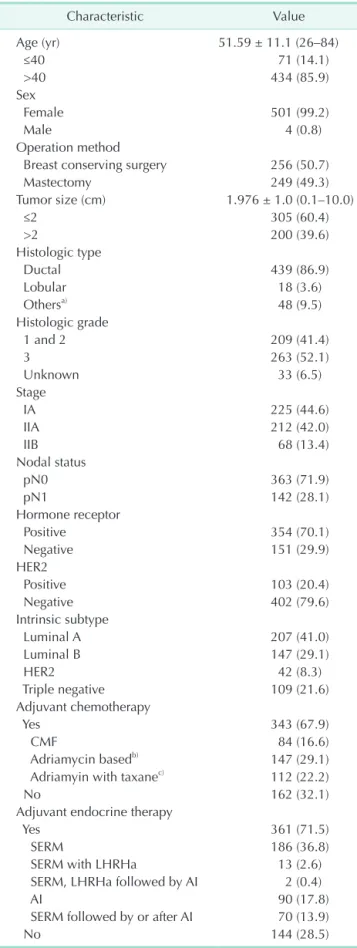
Clinicopathologic characteristics are described in Table 1.
Mean patient age was 51.6 years (range, 26–84 years). Path
ologically node-negative patients comprised 71.9% of the total number of patients, and node positivity was seen in 28.1%
of patients. Of the 505 patients included in the study, 44.6%
had stage I breast cancer and 55.4% had stage II breast cancer.
Hormone receptor positivity was seen in 70.1% of patients, and HER2 was positive in 20.4% of cases. Luminal A, luminal B, HER2, and triple negative subtypes, as defined using surrogate markers, accounted for 41%, 29.1%, 8.3%, and 21.6% of breast tumors, respectively.
Adjuvant chemotherapy was administered to 67.9% of patients.
Chemotherapy regimens used included cyclophosphamide
methotrexatefluorouracil (CMF), adriamycinbased regimens, and adriamycin plus taxane regimens. Adjuvant endocrine treatment was performed to 98% of hormone receptor-positive patients with tamoxifen or aromatase inhibitor. Adjuvant radiotherapy, including postmastectomy radiotherapy, was administered to 212 patients (42.0%), and nine patients with HER2 overexpression were treated with adjuvant trastuzumab for 1 year. The median followup duration for all patients was 89.5 months (range, 2–136 months). The 5year and 10year DFS for all cases were 90.6% and 86.3%, respectively.
Comparative analysis showed that there were more mas
tectomies performed in the nodepositive group than in pathologic nodenegative patients (P = 0.006). Ductal carci
noma as histologic type was more frequently found in node
positive group than nodenegative group. Hormone receptor positivity was more prominent in nodepositive group (P = 0.041), however HER2 status and distribution of subtypes
Table 1. Clinicopathologic characteristics
Characteristic Value
Age (yr) 51.59 ± 11.1 (26–84)
≤40 71 (14.1)
>40 434 (85.9)
Sex
Female 501 (99.2)
Male 4 (0.8)
Operation method
Breast conserving surgery 256 (50.7)
Mastectomy 249 (49.3)
Tumor size (cm) 1.976 ± 1.0 (0.1–10.0)
≤2 305 (60.4)
>2 200 (39.6)
Histologic type
Ductal 439 (86.9)
Lobular 18 (3.6)
Othersa) 48 (9.5)
Histologic grade
1 and 2 209 (41.4)
3 263 (52.1)
Unknown 33 (6.5)
Stage
IA 225 (44.6)
IIA 212 (42.0)
IIB 68 (13.4)
Nodal status
pN0 363 (71.9)
pN1 142 (28.1)
Hormone receptor
Positive 354 (70.1)
Negative 151 (29.9)
HER2
Positive 103 (20.4)
Negative 402 (79.6)
Intrinsic subtype
Luminal A 207 (41.0)
Luminal B 147 (29.1)
HER2 42 (8.3)
Triple negative 109 (21.6)
Adjuvant chemotherapy
Yes 343 (67.9)
CMF 84 (16.6)
Adriamycin basedb) 147 (29.1)
Adriamyin with taxanec) 112 (22.2)
No 162 (32.1)
Adjuvant endocrine therapy
Yes 361 (71.5)
SERM 186 (36.8)
SERM with LHRHa 13 (2.6)
SERM, LHRHa followed by AI 2 (0.4)
AI 90 (17.8)
SERM followed by or after AI 70 (13.9)
No 144 (28.5)
(continued to the next page)
were not statistically different between two groups. Adjuvant chemotherapy was predominantly performed more in nodepositive group (P < 0.001). Adjuvant radiotherapy was performed more in nodenegative group (P < 0.001), because more breast conserving surgeries was done in nodenegative group. Other factors, such as age, tumor size, histologic grade, or adjuvant endocrine treatment did not show statistical differences (Table 2).
The nodepositive group was associated with significantly worse 5year and10year DFS compared to the nodenegative group (87% vs. 92.4%, 79.3% vs. 85.1%, P = 0.005) (Fig. 2A); the TNBC subtype showed the worst 5year and 10year DFS when compared to the luminal A subtype (82.4% vs. 94.1%, 79.9% vs.
92.9%, P = 0.010) (Fig. 2B).
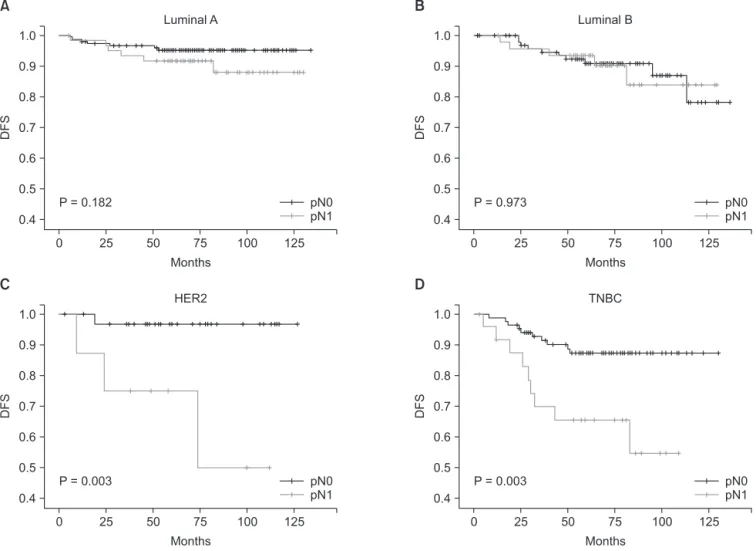
In luminal A and B disease, there were no statistically signi
ficant differences in DFS between the pN0 and pN1 groups.
However, in the HER2 and TNBC types, there were evident statistical differences in DFS between the pN0 and pN1 groups (Fig. 3A–D). Analysis of hazard ratios for all 505 patients showed that the pN1 group was associated with 2.81fold increase in DFS compared to the pN0 group, and the TNBC subtype was associated with a 2.58fold increase in DFS compared to the Table 1. Continued
Characteristic Value
Adjuvant radiotherapy
Yes 212 (42.0)
Whole breast 203 (40.2)
Whole breast with regional node 7 (1.4) Postmastectomy radiotherapy 2 (0.4)
No 293 (58.0)
Recurrence
Yes 51 (10.1)
Locoregional only 17 (3.4)
Distant metastasis only 21 (4.2) Locoregional and distant 13 (2.6)
No 454 (89.9)
Survival
Yes 481 (95.2)
No 24 (4.8)
Values are presented as mean ± standard deviation (range) or number (%).
HER2, human epidermal growth factor receptor 2; CMF, cyclo
phosphamaide + methotrexate + 5fluorouracil; SERM, selective estrogen receptor modulator; LHRHa, luteinizing hormone
releasing hormone analogue; AI, aromatase inhibitor.
a)Histology of “Others” includes papillary, mixed, tubular, meta
plastic, adenoid cystic, adenosquamous, apocrine, cribriform, medullary, squamous, poorly differentiated carcinoma. b)Adria
mycin based regimen includes adriamycin + cyclophosphamide, 5fluo rouracil + adriamycin + cyclophosphamide and 5fluo
rouracil + epirubicin + cyclophosphamide. c)Adriamycin with taxane regimen includes adriamycin + paclitaxel and adriamycin + doxetaxel.
Table 2. Clinicopathologic factors according to nodal status Characteristic pN0 (n = 363) pN1 (n = 142) Pvaluea)
Age (yr) 0.992
≤40 51 (14.0) 20 (14.1)
>40 312 (86.0) 122 (85.9)
Operation method 0.006
Breast conserving surgery 198 (54.5) 58 (40.8)
Mastectomy 165 (45.5) 84 (59.2)
Tumor size (cm) 0.116
≤2 227 (62.5) 78 (54.9)
>2 136 (37.5) 64 (45.1)
Histologic type 0.016
Ductal 308 (84.8) 131 (92.3)
Lobular 12 (3.3) 6 (4.2)
Others 43 (11.8) 5 (3.5)
Histologic grade 0.999
1 and 2 151 (44.3) 58 (44.3)
3 190 (55.7) 73 (55.7)
Hormone receptor 0.041
Positive 245 (67.5) 109 (76.8)
Negative 118 (32.5) 33 (23.2)
HER2 0.813
Positive 75 (20.7) 28 (19.7)
Negative 288 (79.3) 114 (80.3)
Intrinsic subtype 0.184
Luminal A 146 (40.2) 61 (43.0)
Luminal B 99 (27.3) 48 (33.8)
HER2 34 (9.4) 8 (5.6)
Triple negative 84 (23.1) 25 (17.6)
Adjuvant chemotherapy <0.001
Yes 214 (59) 129 (90.8)
CMF 79 (21.8) 5 (3.5)
Adriamycin basedb) 131 (36.1) 16 (11.3) Adriamyin with taxanec) 4 (1.1) 108 (29.8)
No 149 (41) 13 (9.2)
Adjuvant endocrine therapy 0.101
Yes 252 (69.4) 109 (76.8)
No 111 (30.6) 33 (23.2)
Adjuvant radiotherapy <0.001
Yes 170 (46.8) 42 (29.6)
No 193 (53.2) 100 (70.4)
Recurrence 0.004
Yes 28 (7.7) 23 (16.2)
Locoregional only 11 (3.0) 6 (4.2) Distant metastasis only 9 (2.5) 12 (8.5) Locoregional and distant 8 (2.2) 5 (3.5)
No 335 (92.3) 119 (83.8)
Survival 0.295
Yes 348 (95.9) 133 (93.7)
No 15 (4.1) 9 (6.3)
Values are presented as number (%).
HER2, human epidermal growth factor receptor 2; CMF, cyclo
phosphamaide + methotrexate + 5fluorouracil (5FU).
a)The chisquare test was used to identify the differences in varia
bles between groups according to nodal status. b)Adriamycin based regimen includes adriamycin + cyclophosphamide, 5FU + adria
mycin + cyclophosphamide and 5FU + epirubicin + cyclophos
phamide. c)Adriamycin with taxane regimen includes adriamycin + paclitaxel and adriamycin + doxetaxel.
luminal A subtype (Table 3). In order to analyze the effect of lymphnode involvement and intrinsic subtypes on DFS in breast cancer patients, we performed subgroup analysis
according to the following combination groups: luminal A with pN0, luminal A with pN1, TNBC with pN0, and TNBC with pN1.
As expected, the longest 5year DFS was seen in the luminal
pN0 pN1 0
0.9 0.8 0.7 0.6 0.5 0.4
DFS
A
Months
125 1.0
25 50 75 100 0
0.9 0.8 0.7 0.6 0.5 0.4
DFS
B
Months
125 1.0
25 50 75 100
Luminal A Luminal B HER2 TNBC
P = 0.005 P = 0.010
Fig. 2. Diseasefree survival (DFS) of total patients according to nodal status (A) and intrinsic subtype (B). HER2, human epi
dermal growth factor receptor 2; TNBC, triple negative breast cancer.
pN0 pN1 0
0.9 0.8 0.7 0.6 0.5 0.4
DFS
A
Months
125 1.0
25 50 75 100 0
0.9 0.8 0.7 0.6 0.5 0.4
DFS
B
Months
125 1.0
25 50 75 100
P = 0.182 P = 0.973
Luminal A Luminal B
pN0 pN1
pN0 pN1 0
0.9 0.8 0.7 0.6 0.5 0.4
DFS
C
Months
125 1.0
25 50 75 100 0
0.9 0.8 0.7 0.6 0.5 0.4
DFS
D
Months
125 1.0
25 50 75 100
P = 0.003 P = 0.003
HER2 TNBC
pN0 pN1
Fig. 3. (A–D) Subgroup analysis of diseasefree survival (DFS) according to intrinsic subtype and nodal status. HER2, human epidermal growth factor receptor 2; TNBC, triple negative breast cancer.
A-pN0 group (95.1%, P < 0.001). TNBC-pN0 were associated with shorter 5-year DFS (87.3% vs. 91.7%) and higher hazard ratio (2.64 vs. 2.06) when compared to the luminal ApN1 group.
There were not statistically significant differences between the 10year DFS of the luminal ApN1 and TNBCpN0 groups (P = 0.618). The hazard ratio for recurrence of the TNBCpN1 group was 9.55 (Table 4). While the hazard function for recurrence in the luminal ApN1 group showed a bimodal peak, the TNBC
pN0 group was associated with a higher hazard, but most recurrences occurred within 60 months (Fig. 4).
We compared the clinicopathologic factors in following groups: TNBCpN0 group and luminal ApN1 group. Histologic grade 3 was more frequent in the TNBCpN0 group than in the luminal ApN1 group. No differences in age, surgical procedure, or tumor size were seen between two groups. The TNBC
pN0 group included more stage I patients and was associated with less chemotherapy (77.4%; CMF 34.5%, adriamycin-based
regimen 40.5%, adriamycin plus taxane regimen 2.4%) and endocrine treatment, due to the lack of lymph node involve
ment and hormonereceptor negativity in this group. The luminal ApN1 group had more stage II patients and more frequent use of chemotherapy (93.4%; CMF 4.9%, adriamycin based regimen 14.8%, adriamycin plus taxane 73.8%) and endocrine treatment (Table 5).
DISCUSSION
Involvement of axillary nodes has been the most important prognostic factor for breast cancer. Decisions regarding the use of adjuvant treatment in breast cancer have also largely been based on axillary node involvement. However, since the subtyping of breast cancer using gene expression profiling by Perou et al. [1], heterogeneity in breast cancer has been widely studied. This led to recommendations for adjuvant treatment of early breast cancer according to ER and HER2 status since the 9th St Gallen International Breast Cancer Conference in 2005;
the National Comprehensive Cancer Network guidelines also recommend similar subtypebased adjuvant treatment.
Many recent studies have shown prognostic differences between different intrinsic subtypes, but most of these studies have included only nodenegative breast cancer or both early and advanced breast cancer. In several studies of axillary node
negative breast cancer, poor prognosis was associated with hormone receptornegative, HER2, and TNBC subtypes. A largescale study that included axillary nodenegative patients showed that overexpression of HER2 was poor prognostic factor for recurrence [8]. In studies of patients with nodenegative small tumors, <1 cm in size, the HER2 and TNBC subtypes Table 3. Hazard ratio for diseasefree survival of total patients
using Cox proportional regression model
Variable HRa) 95% CI Pvalue
pN1 disease 2.813 1.512–5.231 0.001
Subtype
Luminal B type 1.870 0.851–4.111 0.119
HER2 type 1.432 0.377–5.445 0.598
TNBC type 2.580 1.103–6.032 0.029
Age less than 40 yr 3.307 1.793–6.098 <0.001 Histologic grade 3 1.313 0.638–2.701 0.459 Tumor size ≥ 2 cm 1.796 0.985–3.276 0.056 HR, hazard ratio; CI, confidence interval; HER2, human epidermal growth factor receptor 2; TNBC, triple negative breast cancer.
a)Hazard ratio of 5 variables was estimated with Cox proportional hazard regression model with adjustment to negative node status, luminal A subtype, age over 35 years, histolotic grade 1 or 2 and tumor size less than 2 cm.
Table 4. Hazard ratio for diseasefree survival in luminal A type and triple negative type combined with nodal status
Type
Diseasefree
survival (%) HR (95% CI) Pvalue 5 Year 10 Year
Luminal A
with pN0 95.1 95.1 1 (reference) Luminal A
with pN1 91.7 87.8 2.061 (0.693–6.132) 0.194 TNBC with
pN0 87.3 87.3 2.647 (1.007–6.956) 0.048 TNBC with
pN1 65.5 54.6 9.554 (3.554–25.683) <0.001 HR, hazard ratio; CI, confidence interval; TNBC, triple negative breast cancer.
0 0.0010
0.0005
0
Progressionhazardrate
Follow-up time (mo)
125 0.0015
25 50 75 100
DFS Luminal A with pN1 TNBC with pN0
Max (HR) 0.11%
0.17%
Time (mo) 27 23
Fig. 4. Progression hazard rate for recurrence between lu
minal A type with pN1 and triple negative type with pN0. DFS, diseasefree survival; TNBC, triple negative breast cancer.
were associated with shorter distant relapsefree survival compared to the luminal A subtype, which warrants the consideration of systemic chemotherapy in spite of small tumor size [9,10].
However, the pattern of recurrence differs between different subtypes, irrespective of nodal status. Hormone receptor
negative breast cancer shows of the highest rate of recurrence
within 5 years, while hormone receptorpositive luminal type breast cancer shows lower hazards for recurrence within 5 years than hormone receptornegative breast cancer, and much lower but persistent risk for recurrence after 5 years [1113].
These studies demonstrate that followup duration of longer than 5 years is mandatory, and cumulative hazards and hazard ratios must both be taken into account when comparing the recurrence pattern between different subtypes.
We analyzed the recurrence pattern of the luminal ApN1 and TNBCpN0 groups in early breast cancer to compare the prog
nostic power of nodal involvement and intrinsic subtypes. In the analysis of 5year DFS, luminal ApN1 was associate with longer DFS compared to the TNBC-pN0 group (91.7% vs. 87.3%, P = 0.618), in spite of its higher nodal stage. However, there were no statistical differences in 10year DFS between the two groups, and this is due to the late recurrence after 5 years in luminal A with pN1 group than TNBC with pN0 group as shown in hazard rate function graph.
Cytotoxic systemic chemotherapy is the mainstay of adju
vant treatment in TNBC, but tumor size and node involve
ment are currently the deciding factor for chemotherapy.
Chemosensitivity tests were examined in various ways in vitro tests, however any specific regimen was not found to have selective effect according to breast cancer subtypes [14].
In clinical setting, classical CMF, anthracyclinebased regi
mens and taxanecontaining regimens have all been used as adjuvant treatment for TNBC. However, the superiority of any one regimen is still a cause of debate. The classical CMF regimen has recently been suggested to be effective in TNBC.
Moreover, it also has the advantage of a low toxicity profile and lower cost, compared to the other regimens [1517]. Rocca et al. [18] have reported that an epirubicincontaining regimen was associated with longer DFS and OS in early TNBC. The benefits of taxane in the treatment of TNBC type have also been reported in several [1921]. However, selective use of taxane is not routinely recommended in nodenegative early TNBC. Many of the studies carried out to analyze the efficacy of chemotherapy regimens in TNBC are retrospective in nature.
Recently reported, large multiinstitutional studies have not recommended chemotherapy for all subtypes of T1abN0M0 breast cancer because they show excellent prognosis with or without chemotherapy [22]. Platinum compounds, poly ADP ribose polymerase (PARP) inhibitors, epidermal growth factor receptor (EGFR) antibodies, antiangiogenic drugs, and mammalian target of rapamycin (mTOR) inhibitors have been studied in large randomized controlled trials of recurrent or metastatic TNBC patients [2326]; several phase III trials, analyzing the efficacy of adjuvant treatment in TNBC, are ongoing using various chemotherapeutic agents [27].
In conclusion, intrinsic subtype is an independent prognostic factor for recurrence, and its prognostic power is similar to Table 5. Comparison of clinicopathologic factors between
node positive luminal A type and node negative triple negative type
Characteristic Luminal A with
pN1 (n = 61) TNBC with
pN0 (n = 84) Pvalue
Age (yr) 0.498
≤40 13 (21.3) 22 (26.2)
>40 48 (78.7) 62 (73.8)
Operation method 0.689
Breast conserving
surgery 27 (44.3) 40 (47.6)
Mastectomy 34 (55.7) 44 (52.4)
Tumor size (cm) 0.212
≤2 34 (55.7) 38 (45.2)
>2 27 (44.3) 46 (54.8)
Histologic type 0.050
Ductal 59 (96.7) 76 (90.5)
Lobular 2 (3.3) 1 (1.2)
Others 0 (0) 7 (8.3)
Histologic grade <0.001
1 and 2 36 (62.1) 8 (9.9)
3 22 (37.9) 73 (90.1)
Stage <0.001
I 0 (0) 37 (44)
IIA 34 (55.7) 45 (53.6)
IIB 27 (44.3) 2 (2.4)
Adjuvant chemotherapy <0.001
Yes 57 (93.4) 65 (77.4)
No 4 (6.6) 19 (22.6)
Adjuvant endocrine
therapy <0.001
Yes 58 (95.1) 10 (11.9)
No 3 (4.9) 74 (88.1)
Adjuvant radiotherapy 0.196
Yes 19 (31.1) 35 (41.7)
No 42 (68.9) 49 (58.3)
Recurrence 0.695
Yes 6 (9.8) 10 (11.9)
Locoregional only 0 (0) 2 (2.4) Distant metastasis
only 4 (6.6) 3 (3.6)
Locoregional and
distant 2 (3.3) 5 (6.0)
No 55 (90.2) 74 (88.1)
Survival 0.965
Yes 58 (95.1) 80 (95.2)
No 3 (4.9) 4 (4.8)
Values are presented as number (%).
nodal involvement in early breast cancer. Further evaluation to delineate the intrinsic subtypes through gene analysis is indeed. Luminal A subtype breast cancer patients appear to have a decreased need for chemotherapy, even if they are pathologically 1-3 node involved, and TNBC patients may need more intensive adjuvant treatment, even in nodenegative early
stage cases.
CONFLICTS OF INTEREST
No potential conflict of interest relevant to this article was reported.
1. Perou CM, Sorlie T, Eisen MB, van de Rijn M, Jeffrey SS, Rees CA, et al. Molecular portraits of human breast tumours. Na
ture 2000;406:74752.
2. Sorlie T, Perou CM, Tibshirani R, Aas T, Geisler S, Johnsen H, et al. Gene expres
sion patterns of breast carcinomas distin
guish tumor subclasses with clinical im
plications. Proc Natl Acad Sci U S A 2001;
98:1086974.
3. Sorlie T, Tibshirani R, Parker J, Hastie T, Marron JS, Nobel A, et al. Repeated ob
servation of breast tumor subtypes in independent gene expression data sets.
Proc Natl Acad Sci U S A 2003;100:8418
23.
4. Prat A, Perou CM. Deconstructing the molecular portraits of breast cancer. Mol Oncol 2011;5:523.
5. Goldhirsch A, Winer EP, Coates AS, Gelber RD, PiccartGebhart M, Thurlimann B, et al. Personalizing the treatment of women with early breast cancer: highlights of the St Gallen International Expert Consensus on the Primary Therapy of Early Breast Cancer 2013. Ann Oncol 2013;24:220623.
6. National Comprehensive Cancer Network.
NCCN clinical practice guidelines for treatment of cancer by site: breast cancer [Internet]. Fort Wathington (PA): National Comprehensive Cancer Network; c2015 [cited 2015 Feb 5]. Available from: http://
www.nccn.org/professionals/physician_
gls/f_guidelines.asp.
7. Edge SB, Compton CC. The American Joint Committee on Cancer: the 7th edi tion of the AJCC cancer staging manual and the future of TNM. Ann Surg Oncol 2010;17:
14714.
8. Chia S, Norris B, Speers C, Cheang M, Gilks B, Gown AM, et al. Human epider
mal growth factor receptor 2 overexpres
sion as a prognostic factor in a large tissue microarray series of nodenegative breast cancers. J Clin Oncol 2008;26:5697704.
9. Park YH, Kim ST, Cho EY, Choi YL, Ok ON, Baek HJ, et al. A risk stratification by hormonal receptors (ER, PgR) and HER
2 status in small (< or = 1 cm) invasive breast cancer: who might be possible can
didates for adjuvant treatment? Breast Cancer Res Treat 2010;119:65361.
10. Amar S, McCullough AE, Tan W, Geiger XJ, Boughey JC, McNeil RB, et al. Prog
nosis and outcome of small (<=1 cm), nodenegative breast cancer on the basis of hormonal and HER2 status. Oncologist 2010;15:10439.
11. Dignam JJ, Dukic V, Anderson SJ, Mamounas EP, Wickerham DL, Wolmark N. Hazard of recurrence and adjuvant treatment effects over time in lymph nodenegative breast cancer. Breast Cancer Res Treat 2009;116:595602.
12. Liu X, Guan Y, Wang Y, Zhang W, Liu S, Wang L, et al. Relationship between che
motherapy and prognosis in different subtypes of nodenegative breast cancer.
Tumour Biol 2014;35:85819.
13. Ribelles N, PerezVilla L, Jerez JM, Pajares B, Vicioso L, Jimenez B, et al. Pattern of recurrence of early breast cancer is dif
ferent according to intrinsic subtype and proliferation index. Breast Cancer Res 2013;15:R98.
14. Chang J, Lee A, Lee J, Lim W, Sung SH,
Moon BI. Correlation between the mole
cular subtype of breast cancer and the in vitro adenosine triphosphatebased chemosensitivity assay. J Korean Surg Soc 2013;84:31320.
15. Munzone E, Curigliano G, Burstein HJ, Winer EP, Goldhirsch A. CMF revisited in the 21st century. Ann Oncol 2012;23:30511.
16. Cheang M, Chia S, Tu D, Jiang S, Shepherd L, Pritchard K, et al. Anthracyclines in basal breast cancer: the NCICCTG trial MA5 comparing adjuvant CMF to CEF [abstract].
J Clin Oncol 2009;27(15 Suppl). Abstract No. 519.
17. Colleoni M, Cole BF, Viale G, Regan MM, Price KN, Maiorano E, et al. Classical cyclo
phosphamide, methotrexate, and fluo
rouracil chemotherapy is more effective in triplenegative, nodenegative breast cancer: results from two randomized trials of adjuvant chemoendocrine therapy for nodenegative breast cancer. J Clin Oncol 2010;28:296673.
18. Rocca A, Bravaccini S, Scarpi E, Mangia A, Petroni S, Puccetti M, et al. Benefit from anthracyclines in relation to biological profiles in early breast cancer. Breast Cancer Res Treat 2014;144:30718.
19. Hugh J, Hanson J, Cheang MC, Nielsen TO, Perou CM, Dumontet C, et al. Breast cancer subtypes and response to docetaxel in nodepositive breast cancer: use of an immunohistochemical definition in the BCIRG 001 trial. J Clin Oncol 2009;27:1168
76.
20. Martín M, Segui MA, Anton A, Ruiz A, Ramos M, Adrover E, et al. Adjuvant docetaxel for highrisk, nodenegative
REFERENCES
breast cancer. N Engl J Med 2010;363:
220010.
21. Jacquin JP, Jones S, Magne N, Chapelle C, Ellis P, Janni W, et al. Docetaxel
containing adjuvant chemotherapy in patients with early stage breast cancer:
consistency of effect independent of nodal and biomarker status: a metaan
alysis of 14 randomized clinical trials.
Breast Cancer Res Treat 2012;134:90313.
22. VazLuis I, Ottesen RA, Hughes ME, Mamet R, Burstein HJ, Edge SB, et al.
Outcomes by tumor subtype and treat
ment pattern in women with small, nodenegative breast cancer: a multiinsti
tutional study. J Clin Oncol 2014;32:214250.
23. Foulkes WD, Smith IE, ReisFilho JS.
Triplenegative breast cancer. N Engl J Med 2010;363:193848.
24. Gelmon K, Dent R, Mackey JR, Laing K, McLeod D, Verma S. Targeting triplenega
tive breast cancer: optimising therapeutic outcomes. Ann Oncol 2012;23:222334.
25. Yadav BS, Sharma SC, Chanana P, Jhamb S. Systemic treatment strategies for triple
negative breast cancer. World J Clin Oncol 2014;5:12533.
26. Abramson VG, Lehmann BD, Ballinger TJ, Pietenpol JA. Subtyping of triplenegative breast cancer: implications for therapy.
Cancer 2015;121:816.
27. Joensuu H, Gligorov J. Adjuvant treat
ments for triplenegative breast cancers.
Ann Oncol 2012;23 Suppl 6:vi405.