Effect of Dynamic Flow on the Structure of Inhibition Layer in Hot-dip Galvanizing
Young Sool Jin1,†, Myung Soo Kim1, Su Young Kim1, and Doo Jin Paik2
1POSCO Technical Research Labs., 699 Gumho-dong, Gwangyang, Korea
2Surface Treatment Department, POSCO Kwangyang Steel Works, 699 Gumho-dong, Gwangyang, Korea (Received October 9, 2009; Revised February 25, 2011; Accepted February 25, 2011)
The effect of dynamic flow or forced convection were investigated and compared on the formation of inhibition layer, galvanizing and galvannealing reactions through the hot-dip galvanizing simulator with the oscillation of specimen in zinc bath, continuous galvanizing pilot plant with zinc pumping system through the snout and continuous galvanizing operation with Dynamic GalvanizingTR system. The interfacial Al pick-up was not consistent between the results of simulator, pilot plant and line operation, but the morphology of inhibition layer became compact and refined by the forced convection. The growth of Fe-Zn intermetallics at the interface was inhibited by the forced convection, whereas the galvannealing rate would be a little promoted.
Keywords : dynamic flow, hot-dip galvanizing, galvannealing zinc loath
†Corresponding author: [email protected]
1. Introduction
Aluminium in zinc bath is well known to be an im- portant element in hot-dip galvanizing and galvannealing from it's inhibition effect on Fe-Zn intermetallic growth.
The thin inhibition layer is mainly composed of Fe-Al or Fe-Al-Zn intermetallics formed at the interface of steel/
melt, which is involved to Al pick-up at the initial stage of hot-dip galvanizing. The behavior of Al pick-up is known to be affected by the steel compositions and galva- nizing conditions such as line speed, strip entry temper- ature, bath composition and temperature,1) but there would be little research works to investigate the effect of forced convection or dynamic flow.
As the previous works, the influence of flow speed was investigated on the growth of Fe-Al alloy using a hot-dip galvanizing simulator equipped with the cylindrical rotat- ing specimens, which represented that Al amount of Al-Fe alloy were increased with increasing flow speed.2) The spe- cialized experiments with a rotating zinc pot suggested that the initial Al take-up at very short immersion times was much higher than supposed in literature, and turbulent conditions resulted in an important decrease of Al take-up without impairing the inhibition quality.3) The dynamic ef- fect in galvanizing of high strength steels was investigated
with the simulator equipped with zinc stirring system by an axial pump, and the results were that zinc agitation promotes the coating wettability for the steels alloyed with high Mn and Si, and the bath stirring influences the iron/zinc reactivity more significantly in the lower Al con- tent like galvannealing.4) ZQ/DynamicGalvanizingTR tech- nology has been claimed to provide the opportunity to pro- duce an excellent GI coating with lower bath Al content close to 0.15% by a turbulent impingement of the melt against the strip during the initial stage of immersion.5) However, such previous works didn't deal with the effect of additional forced convection on the interfacial reactivity or Al pick-up connected with the galvanizing or galvan- nealing reaction.
The present work is tried to understand the effect of forced convection or dynamic flow on the interfacial and subsequent reaction in the lower Al bath condition like galvannealing, comparing through the hot-dip galvanizing simulator with the oscillation of specimen in zinc bath, continuous galvanizing pilot plant with zinc pumping sys- tem through the snout and continuous galvanizing oper- ation equipped with Dynamic GalvanizingTR system.
2. Hot-dip galvanizing simulation
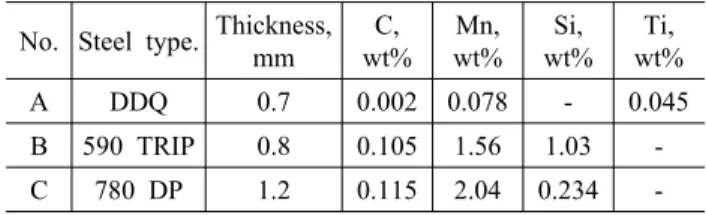
The substrate material used in this study were DDQ, TRIP steel with a tensile strength of 590 MPa and DP steel with a tensile strength of 780 MPa as shown in Table
0 .0 0 .2 0 .4 0 .6
S ta tic O s c illa tio n
Al Content in Coating(wt%
0.00 0.05 0.10 0.15
Static Oscillation Al at the interface(mg/m2 )
0 5 10 15
Static O scillation
Fe Content in Coating(wt%)
DDQ 590TR 780DP
Fig. 1. Comparison of coating composition for the galvanized and galvannealed samples.
1. For the precise experiments, 'Multi-purpose Hot-dip Galvanizing Simulator' made by IWATANI Corp. was used. The specimen was oscillated in zinc bath by up and down movements to simulate the forced convection. The oscillation mode was 16 mm of distance at 5 times/sec and the dipping time was 3 seconds. The galvanizing and galvannealing conditions were summarized in Table 2, and the the annealing for heat treatment and galvannealing temperature were different according to the steel types.
The coating weights were 48 g/m2 for DDQ and 780 DP, and 42 g/m2 for 590 TRIP. The compositions of coat- ing layers are compared in Fig. 1 for Al content, Al pick-up at the interfacial of the galvanized and Fe content of the galvannealed coating. The differences between the static and oscillating mode were not much except for Fe content of the galvannealed coating, and Al pick-up at the interface for 590 TRIP with higher Si content was much lower than other steels. The alloying degrees of galvan- nealed coating were decreased in DP and TRIP containing Si despite of higher alloying temperature than DDQ. Fe
Table 1. Chemical compositions of steel types used No. Steel type. Thickness,
mm
C, wt%
Mn, wt%
Si, wt%
Ti, wt%
A DDQ 0.7 0.002 0.078 - 0.045
B 590 TRIP 0.8 0.105 1.56 1.03 -
C 780 DP 1.2 0.115 2.04 0.234 -
Table 2. Galvanizing and galvannealing conditions for the experiments
Annealing temp.(℃)
Dipping temp.
Pot temp.
Pot Al content.
GA temp.
(℃) (A)840, (B)810,
(C)790 480 ℃ 457 ℃ 0.136 wt%(A)480, (B)610, (C)500
content were increased by oscillating specimen in zinc bath for DP and TRIP steel, which suggests the structure of inhibition layer to affect the galvannealing reaction would be different between the the static and oscillating mode.
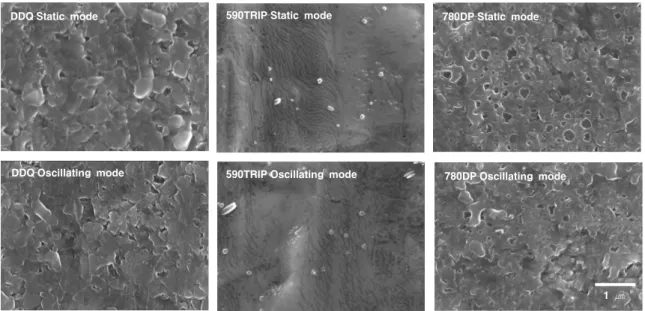
Fig. 2 shows the surface structure of interfacial layer after removing the upper galvanized coating layer. The differences are not much between the static and oscillating mode, but the oscillation seems to give slightly more uni- form and compact structures in DDQ and DP steels.
Especially, the coverage and uniformity of interfacial layer were improved by oscillating the specimen in DP steel.
The interfacial layer for TRIP steel seems to be very thin and not crystalline, which was somewhat different from DDQ or DP steels with the crystalline type.
The surface morphology for the galvannealed coatings are compared in Fig. 3 with steel types and flow mode.
The alloyed surface is mainly composed of refined δ-phase for DDQ steel, and the effect of oscillating specimen would be negligible. In TRIP steel, the coarse grains as- sumed δ-phase are formed on the surface, which becomes more uniform by oscillating specimen. The assumed η -phase remains on the surface relating to the lower Fe content in DP steel, and the oscillating mode promotes the alloying reaction and gives favorable effect for galvan- nealing as shown in Fig. 1.
In hot-dip galvanizing simulation to investigate the ef- fect of forced convection, Al content of coating layer and Al pick-up at the interface were similar between the static and the oscillating mode, but there were some differences among the steel types. TRIP steel containing higher Si represented the lower interfacial reactivity with Al of zinc bath. The interfacial or inhibition layer would become more uniform and compact, while the galvannealing re- actions were promoted by oscillating specimen, especially notable for DP steel. That could be related with the change in the structure of interfacial layer by the oscillating effect, but the more detailed works would be required. The addi-
780DP‐Static mode 590TRIP‐Static mode
DDQ‐Static mode
780DP‐Oscillating mode 590TRIP‐Oscillating mode
DDQ‐Oscillating mode
1 ㎛
Fig. 2. Surface structure of interfacial layer for hot-dip galvanizing for static and dynamic experiments.
780DP‐Dynamic mode 590TRIP‐Dynamic mode
DDQ‐Dynamic mode
DDQ‐Static mode 590TRIP‐Static mode 780DP‐Static mode
Fig. 3. Surface structure of the galvannealed coating for static and oscillating experiments.
Table 3. General specification of POSCO’s CGL pilot plant *Coil size : 0.4~1.4mm(t) x 100~300mm(w), Max. 3 ton
Line speed Pretreatment → Heating furnace → Zinc pot → GA furnace → Cooling Max. 40mpm Alkali dip +
Electrolytic
Induction + Electric
heater STS 316 Induction, 125KHz Air + Mist cooling
tion of forced convection or dynamic flow to the strip seems to be more effective in DP and TRIP steel contain- ing high Mn and Si than Ti-stabilized extra low carbon steel for the interfacial Al pick-up and the subsequent gal- vannealing reaction .
3. CGL pilot test
The general layout and specifications of the pilot plant are summarized in Table 3, which is located at Kwangyang Technical Research Labs. of POSCO. To impart the dy- namic flow around the strip entry position in the zinc bath,
Table 4. Test conditions for CGL pilot plant
Line speed Annealing Snout pump FCS temp. Zinc bath Galvanneal
30mpm (A)840 ℃, (B)810, (C)810
3.7KW, 0,800, 1700 rpm
470, 490,
510 ℃ 457~459 ℃, Eff. Al 0.127%
(A,C) 480~520, (B) 580~620 ℃
Fig. 4. Snout configuration.
0.02 0.03 0.04 0.05 0.06 0.07
0 800 1700
Pump Speed (rpm) Al Pick-up (g/㎡)
Open -FCS 470℃
Close -FCS 490℃
DDQ
TRIP590 780DP
0.02 0.03 0.04 0.05 0.06 0.07
0 800 1700
Pump Speed (rpm) Al Pick-up (g/㎡)
Open -FCS 470℃
Close -FCS 490℃
Open -FCS 470℃
Close -FCS 490℃
DDQ
TRIP590 780DP
Fig. 5. Variation of Al pick-up at the interface with snout pump speed and strip entry temperature.
780DP‐Pump Speed 1700rpm 590TR‐Pump Speed 1700rpm
DDQ‐Pump Speed 1700rpm
780DP‐Pump Speed 0rpm DDQ‐Pump Speed 0rpm 590TR‐Pump Speed 0rpm
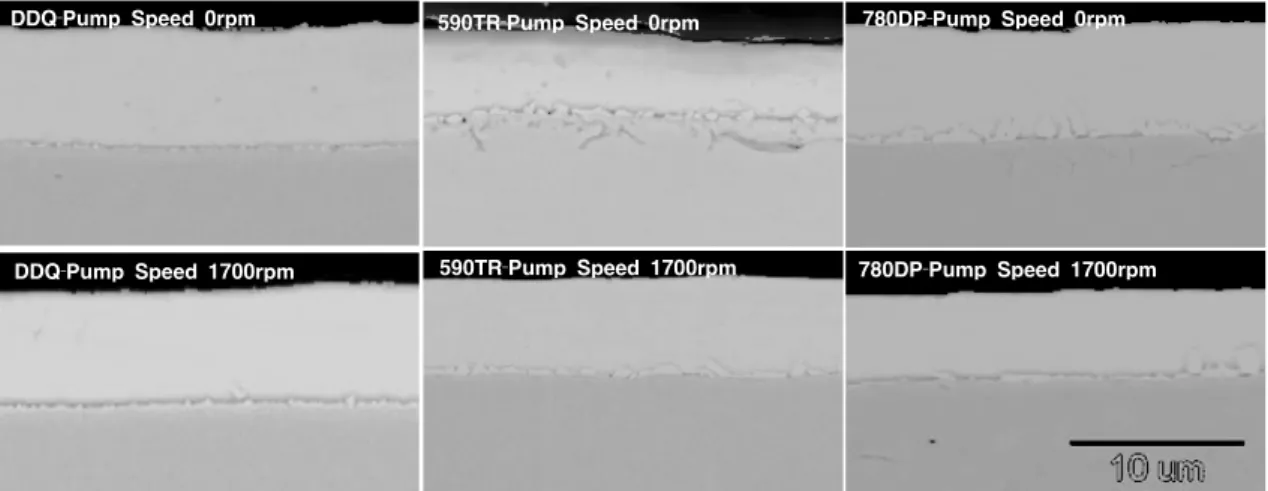
Fig. 6. Structure of galvanized coating layer with and without snout pumping.
the pumps of impeller type were attached to both side walls of snout snorkel as shown in Fig. 4. The steel types of coils tested were same as Table 1 with the width of 200 mm, and the galvanizing and galvannealing conditions are shown in Table 4. The annealing and galvannealing temperature were different according to the steel types as the hot-dip galvanizing simulator tests.
3.1 Analysis of the galvanized coating
The coating weight and Al content were 50~55 g/m2 and 0.24~0.29 wt.% for DDQ, 30~35 g/m2 and 0.24~0.34 wt.% for TRIP, and 38~48 g/m2 and 0.23~0.27 wt.% for
DP steel, respectively. The effects of snout pump speed were not much, while the increase of strip entry temper- ature (FCS temp.) attributed to the increase of coating weight and Al content at the same wiping conditions. Fig.
5 shows the variations of Al pick-up content at the inter- face, which was slightly decreased with increasing snout pump speed for TRIP, but reversed for DDQ and similar for DP steel. The increase of FCS temp. contributed to a little increase of Al pick-up for DDQ, but was not con- sistent for TRIP and DP steels. Generally, the increase of interfacial Al pick-up results in the increase of coating Al content, but some different data were noticed.
590TR‐Pump Speed 1700rpm
DDQ‐Pump Speed 1700rpm 780DP‐Pump Speed 1700rpm
DDQ‐Pump Speed 0rpm 590TR‐Pump Speed 0rpm 780DP‐Pump Speed 0rpm
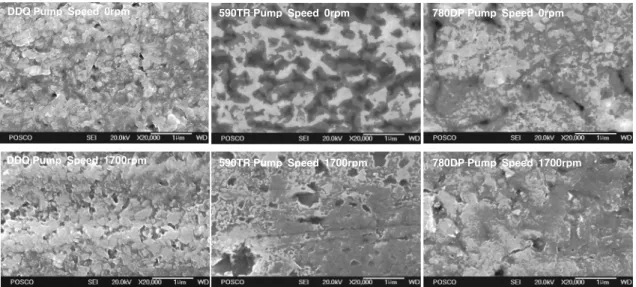
Fig. 7. Surface structure of interfacial layer for hot-dip galvanizing with and without snout pumping.
Fig. 6 shows the cross section view of GI coating layer.
The effect of pump speed was not observed for DDQ, but the growth of δ-phase at the interface was observed to be retarded by operating the snout pump for TRIP and DP steels.
Fig. 7 represents the morphology of inhibition layer, which was little changed by snout pumping for DDQ, while it becomes more compact and uniform by applying snout pump for TRIP and DP, especially, the inhibition layer seems to represent the irregular structure without snout pumping for TRIP steel.
3.2 Galvannealing reaction
The galvannealing temperature were different with steel types, especially higher temperature applied for TRIP due to Si effect to retard Fe-Zn alloying, and FCS temperature were controlled to 490 ℃. Fig. 8 compares the alloying degree with pumping speed for 3 different steel types. Fe content of the galvannealed coating was slightly increased with increasing pumping speed, more notable in TRIP steel, which indicates the retarding effect of Si on the Fe-Zn alloying reaction was a little decreased by applying snout pump. On the observation of cross-sectional views for galvannealed coating, the coating structure of TRIP was more different than other steels from the snout pump- ing, so the unalloyed portion were remained in case of no snout pumping. The powdering property was influenced by Fe content of coating, but the effect of steel type was not observed.
The effect of dynamic flow by snout pumping is more notable in TRIP and DP containing Si and Mn than DDQ on the formation of inhibition layer and the galvannealing behavior, especially the dynamic flow around strip entry
10 11 12 13 14 15 16
0 800 1700
Pump Speed (rpm) Fe Content in Coating (wt%) DDQ-480℃
590TR-600℃
780DP-500℃
Fig. 8. Comparison of galvannealing rate with snout pump speed and steel types.
into zinc bath would be helpful to improve the coating properties for TRIP steel.
4. Dynamic galvanizing trial
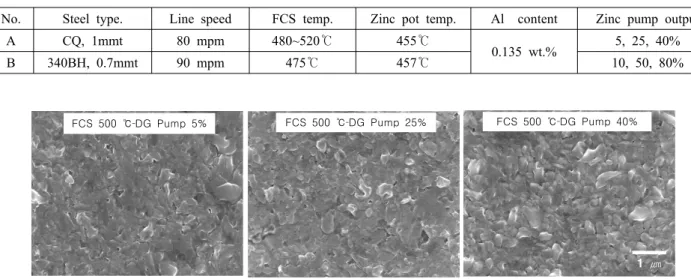
The effect of dynamic flow was evaluated by installing ZQ/Dynamic GalvanizingTM system at #2 CGL of Kwang- yang Steel Works. The system was composed of flow chamber, pumps and cooling tubes supplied by GSI Tech., USA. Since it's difficult to define the testing conditions in line operation, the testing condition was varied on the same coil. Table 5 summarizes the steel types used and galvanizing conditions in the line operation.
For No.A coil test, Al content of the coating were 0.34~0.35 wt.% regardless of testing conditions, and the
Table 5. Testing conditions of line operation for evaluation of dynamic flow
No. Steel type. Line speed FCS temp. Zinc pot temp. Al content Zinc pump output
A CQ, 1mmt 80 mpm 480~520℃ 455℃
0.135 wt.% 5, 25, 40%
B 340BH, 0.7mmt 90 mpm 475℃ 457℃ 10, 50, 80%
FCS 500 ℃‐DG Pump 25% FCS 500 ℃‐DG Pump 40%
FCS 500 ℃‐DG Pump 5%
1 ㎛ Fig. 9. Surface structure of inhibition layer with zinc pump ratio and FCS temperature (No.A coil)
10 ㎛ Zinc pump output : 10% Zinc pump output : 80%
0.08 0.1 0.12 0.14 0.16
0 30 60 90
Zinc pump output (%)
Al at the interface (g/m2)
Top side Bottom side
10 ㎛ Zinc pump output : 10% Zinc pump output : 80%
0.08 0.1 0.12 0.14 0.16
0 30 60 90
Zinc pump output (%)
Al at the interface (g/m2)
Top side Bottom side 0.08
0.1 0.12 0.14 0.16
0 30 60 90
Zinc pump output (%)
Al at the interface (g/m2)
Top side Bottom side
Fig. 10. Al pick-up at the interface and surface structure of interface layer with zinc pump ratio (No.B coil).
interfacial Al pick-up were 0.092~0.102 g/m2, which were slightly increased with increasing zinc pump output. Fig.
9 compares the structure of interfacial layer with FCS tem- perature and zinc pump output ratio. The inhibition layer would become a little compact with increasing zinc pump output, in which non-layer sites were decreased with high- er FCS temperature. The galvannealing reaction was slightly retarded by increasing zinc pump output ratio. For No.B coil test with extra-low carbon steel, it's difficult to explain the differences in the interfacial layer and gal- vannealing behavior. Fig. 10 shows the interfacial Al con- tent and the inhibition layer morphology with variation of zinc pump output. The differences in the interfacial Al content seems to be decreased between top and bottom side with increasing zinc pump output, but it's difficult to say the differences are meaningful.
Fig. 11 illustrates some data for the relations of Al con- tent in the zinc bath with Al content of the coating layer, which were obtained from the galvannealing operations
for conventional and Dynamic GalvanizingTR process tried at #2 CGL of Kwangyang Steel Works. The DGTR process can impart the dynamic flow during the initial stage of
0.14 0.16 0.18 0.20 0.22 0.24 0.26
0.122 0.127 0.132 0.137 0.142 Total Al Content in Pot (wt%)
Al Content in Coating (wt%)
Conventional Dynamic Galva.
C.W : 48~52g/m2 L/S : 90~125mpm
0.14 0.16 0.18 0.20 0.22 0.24 0.26
0.122 0.127 0.132 0.137 0.142 Total Al Content in Pot (wt%)
Al Content in Coating (wt%)
Conventional Dynamic Galva.
Conventional Dynamic Galva.
C.W : 48~52g/m2 L/S : 90~125mpm
Fig. 11. Relations of Al content in zinc bath with Al content in coating layer.
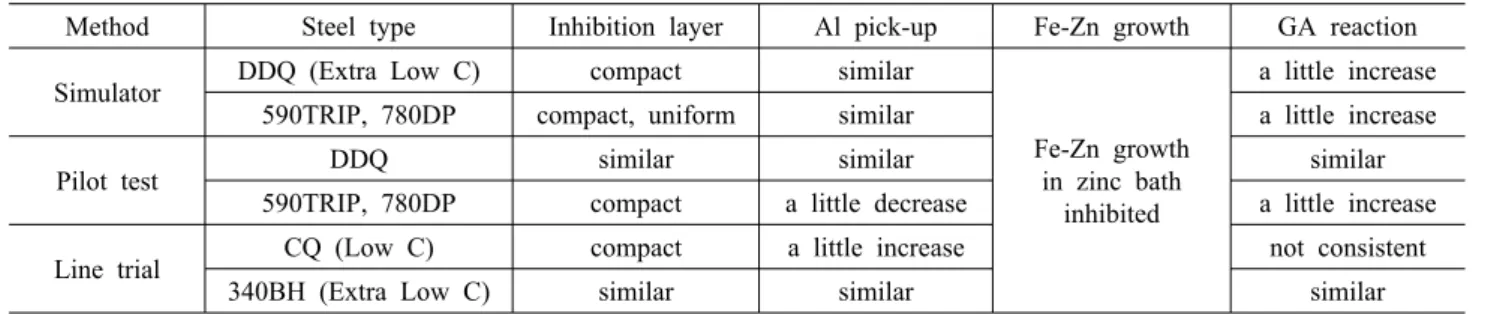
Table 6. Summary of the effect by introducing dynamic flow or forced convection
Method Steel type Inhibition layer Al pick-up Fe-Zn growth GA reaction
Simulator DDQ (Extra Low C) compact similar
Fe-Zn growth in zinc bath
inhibited
a little increase
590TRIP, 780DP compact, uniform similar a little increase
Pilot test DDQ similar similar similar
590TRIP, 780DP compact a little decrease a little increase
Line trial CQ (Low C) compact a little increase not consistent
340BH (Extra Low C) similar similar similar
strip immersion into zinc bath, which would contribute to the increase of Al content in the coating layer compared to the conventional process without the dynamic flow ef- fect, although other operating conditions could be affected such as FCS temperature, line speed, bath temperature, and etc.
5. Summary
The effect of dynamic flow or forced convection were investigated and compared on the formation of inhibition layer, galvanizing and galvannealing reactions through hot-dip galvanizing simulator, continuous galvanizing pilot plant and continuous galvanizing line equipped with ZQ/
Dynamic Galvanizing SystemTR., which would be sum- marized as the following table.
The interfacial Al pick-ups were not consistent between the results of simulator, pilot plant and line operation, but the surface structures of inhibition layers became compact and refined by introducing the forced convection or dy- namic flow. The interfacial growths of Fe-Zn interme- tallics were inhibited, whereas the alloying rate for galvan- nealing would be a little increased by the dynamic effect.
The difference of inhibition layer and galvannealing rate
from the dynamic floe was more dominant, especially in case of TRIP steel, which indicates the retarding effect of Si on the galvannealing rate decreased. Such dynamic effects in zinc bath could be an alternative to improve the galvanizing and galvannealing reaction for high strength steels with higher Mn and Si content. It would be not easy to explain the effect of dynamic flow in the operating line explicitly due to the various process con- ditions concerned, but a little differences from the conven- tional process were confirmed such as the interfacial Al pick-up increased, the compact strucure of inhibition layer and the growth of Fe-Zn intermetallics retarded.
References
1. Dubois Michel Quai du Halage, Proc. of Galvatech '98 p. 634 (1998).
2. M. Isobe CAMP-ISIJ, 11, 1210 (1998).
3. P. Toussaint Proc. of Galvatech '98, p. 141 (1998).
4. L. Bordignon Proc. of Galvatech 2001 p. 573 (2001).
5. P. Sippola, American Galvanizers Association 2001, Portland, Oregon.