Introduction
The intraocular pressure (IOP)-lowering effect of selec- tive laser trabeculoplasty (SLT) in glaucoma eyes has been
well established. The IOP-lowering efficacy of SLT varies from 11–40% based on the type of glaucoma and the obser- vational period.1-3 Factors such as baseline IOP have been suggested to be predictive factors for successful SLT treat- ment.4,5 Other factors such as age, total amount of energy, and angle pigmentation have also been suggested as possi- ble predictive factors.5-7
SLT has been widely used as the primary treatment for glaucoma instead of IOP-lowering medications.8,9 In addi- tion, SLT has also been used as an additional treatment or alternative treatment to decrease the number of medications, and eventually to avoid surgery.10-12 Clinically, it is sometimes
선택적 레이저 섬유주성형술의 단기 및 장기 예후와 연관된 인자
Predictive Factors Associated with Short-term and Long-term Outcomes of Half Angle Selective Laser Trabeculoplasty
한종철
1, 서 울
2, 김시범
1, 기창원
1Jong Chul Han, MD1, Wool Suh, MD, PhD2, Si Bum Kim, MD1, Changwon Kee, MD, PhD1
성균관대학교 의과대학 안과학교실1, 한림대학교 의과대학 안과학교실2
1Department of Ophthalmology, Sungkyunkwan University School of Medicine, Suwon, Korea
2Department of Ophthalmology, Hallym University College of Medicine, Chuncheon, Korea
Purpose: To evaluate the diagnostic capability of quantified optic nerve head (ONH) depth analysis system incorporated in the Nonmyd-WX 3D retina camera (Kowa, Tokyo, Japan) in discriminating between glaucoma suspects and glaucoma subjects.
Methods: The present study included the eyes with unilateral or bilateral primary open angle glaucoma (POAG) using maximal dose glaucoma medications. Success was defined as an intraocular pressure (IOP) reduction ≥ 20% compared to baseline. To investigate the factors associated with short-term and long-term response to SLT, univariate and multivariate logistic regression analyses using a generalized estimating equation model were performed.
Results: In this study, 184 eyes in 147 patients were included. In multivariate analysis, higher baseline IOP was associated with positive short-term and long-term response (p = 0.026; p = 0.019, respectively). Secondary treatment was associated with negative short-term and long-term response in multivariate analysis (p = 0.006; p = 0.008, respectively). Severe trabecular meshwork (TM) pigmentation was associated with positive short-term response (p = 0.019). The correlation between IOP responses in both eyes was significant at 1 month and 6 months postoperatively (p < 0.001; p = 0.006, respectively). The correlation between IOP responses on primary and secondary half angle SLT treatments was significant at 3 months and 6 months postoperatively (p = 0.003; p = 0.005, respectively).
Conclusions: Short-term and long-term outcomes of half angle SLT were positively associated with baseline IOP and negatively associated with secondary SLT treatment. Severe TM pigmentation was positively associated with short-term response of SLT. IOP response correlations between bilateral treatment cases and between primary and secondary SLT were significant.
Key words: Trabecular meshwork, Glaucoma, Lasers
Received: 2017. 5. 6. Revised: 2017. 5. 28.
Accepted: 2017. 6. 7.
Corresponding Author: Changwon Kee, MD, PhD
Department of Ophthalmology, Samsung Medical Center, Sungkyunk- wan University School of Medicine, #81 Irwon-ro, Gangnam-gu, Seoul 06351, Korea
Tel: +82-2-3410-3548, Fax: +82-2-3410-0074 E-mail: [email protected]
* Conflict of Interest: None to declare.
* Financial Support: None
necessary to delay surgical treatment for weeks or months for various reasons. In these cases, it is important to understand the predictive factors associated with short-term IOP response as well as long-term IOP response. However, the predictive factors associated with successful IOP response according to postoperative period are not yet well known.
The outcomes of the half angle SLT (180 degree SLT) have been compared with that of the 360 degree SLT. Nagar et al suggested that success rates did not differ between 180 and 360 degrees SLT.13 In other previous studies, 360 degree SLT showed lower IOP14, smaller IOP-fluctuations15 than half angle SLT. However, reducing the number of laser spots may increase the repeatability of SLT and reduce the potential tissue damage to the TM. Therefore, the purpose of this study was to investigate predictive factors that affect short-term (3 months) and long-term outcomes (1 year) of half angle SLT in glaucoma eyes with maximal-dose glau- coma treatments. Furthermore, we intended to compare the outcomes between both eyes and between primary and secondary treatments.
Materials and Methods
Subjects
The present study was retrospective designed and data were collected from patient medical records. This study was approved by the Institutional Review Board of Samsung Medical Center and adhered to the tenets of the Declaration of Helsinki. Patients with primary open angle glaucoma (POAG) with maximal dose treatments (over three glauco- ma eyedrops) for IOP control and who eventually underwent SLT in Samsung Medical Center from January 2013 to Jan- uary 2015, were included. Initial IOPs were over 21 mmHg in the included eyes. Eyes with previous ocular surgeries, except uncomplicated cataract, were excluded. Eyes with history of Argon laser trabeculoplasty were also excluded.
The treatment was explained to each patient, and patients who provided written informed consent were enrolled.
All patients underwent routine ophthalmologic examina- tions including slit-lamp examination and Goldmann appla- nation tonometry. After treatment, per routine protocol in
the glaucoma clinic, the patients underwent ophthalmologic examinations such as Goldmann applanation tonometry at 1 week, 1 month, 3 months, and every 6 months thereafter.
The trabecular meshwork (TM) was visualized over 360 degree for proper application of laser spots. A surgeon (CK) evaluated the level of angle pigmentation on the day of SLT treatment. The level of pigmentation was graded from 1+
(light pigmentation) to 4+ (heavy pigmentation). The levels were divided into mild (1+ and 2+) and severe (3+ and 4+) based on the level of pigmentation based on Spaeth gonio- scopic grading system.16
Procedure technique
All SLT procedures were performed using the Ellex Tango ophthalmic laser system (Ellex, Adelaide, South Australia, Australia). All procedures were performed using a gonio- lens by two surgeons (JCH and CK). Approximately 50 non-overlapping spots were applied to the inferior 180° of the TM. If the short-term IOP response at postoperative 3 months was not enough, the secondary half angle SLT was applied to the superior 180° of the TM. The energy level was 0.7–1.0 mJ according to the TM response. Patients used 0.1% flumetholone eye drops for a week after SLT and con- tinued preoperative glaucoma medications.
Definition of success
Successful short-term SLT response was defined as IOP reduction ≥ 20% at 3 months after SLT as compared with the baseline IOP. IOP reduction ≥ 20% at 1 year after SLT as compared with the baseline IOP was defined as success- ful long-term SLT response. In case the patients underwent glaucoma surgery after SLT, it was regarded as the treat- ment failure.
Statistical analysis
Descriptive statistics (number, percentage of each cate- gorical variable, and the mean ± standard deviation of each continuous variable) were used to determine demographic, systemic and ocular parameters. For cases with bilateral or secondary SLT treatment, each case was regarded as clustered data. To investigate the factors associated with
short-term and long-term response to SLT, univariate and multivariate logistic regression analyses using a generalized estimating equation model were performed. Independent variables including age, male gender, left eye, secondary treatment, diabetes mellitus (DM), systemic hypertension (HTN), surgical history of cataract, severe TM pigmen- tation and baseline IOP were analyzed. Parameters with a P-value of less than 0.2 in the univariate analysis were in- cluded in the multivariate model.
In cases with bilateral SLT treatment, the association be- tween the outcomes of the right and left eye was evaluated using Pearson’s correlation approach and the correlation co- efficient (R) was calculated. Similarly, in cases with second-
ary SLT treatments, the association between the outcomes of primary and secondary SLT treatments was evaluated using Pearson’s correlation approach and the correlation co- efficient (R) was calculated. When IOP responses after SLT between the eyes with mild and severe angle pigmentation were compared, independent t-test was used.
All statistical analyses were performed with SPSS soft- ware version 18.0 (SPSS, Inc., Chicago, IL, USA). A p-val- ue of less than 0.05 was considered statistically significant.
Results
A total of 184 eyes (47.3% of left eyes) in 147 patients were Table 2. Logistic regression using generalized estimating equation model for short-term response of SLT
Parameters Univariate analysis Multivariate model
Estimate 95% CI p-value Estimate 95% CI p-value
Age 0.005 -0.015 to 0.025 0.674
Male gender -0.149 -0.814 to 0.517 0.662
Left eye 0.070 -0.391 to 0.531 0.765
Baseline IOP 0.190 0.032 to 0.348 0.038 0.128 0.077 to 0.179 0.026
Secondary treatment -1.218 -1.930 to -0.506 0.001 -1.391 -1.582 to -0.260 0.006 Diabetes mellitus -0.337 -1.244 to 0.570 0.467
Hypertension 0.005 -0.717 to 0.727 0.989
Surgical history, cataract -0.184 -0.854 to 0.485 0.589
Severe TM pigmentation 0.727 0.065 to 1.390 0.031 0.798 0.133 to 1.463 0.019
SLT = selective laser trabeculoplasty; CI = confidence interval; IOP = intraocular pressure; TM = trabecular meshwork.
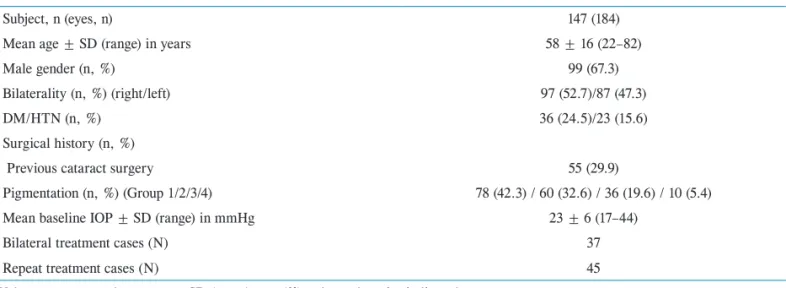
Table 1. Baseline characteristics
Subject, n (eyes, n) 147 (184)
Mean age ± SD (range) in years 58 ± 16 (22–82)
Male gender (n, %) 99 (67.3)
Bilaterality (n, %) (right/left) 97 (52.7)/87 (47.3)
DM/HTN (n, %) 36 (24.5)/23 (15.6)
Surgical history (n, %)
Previous cataract surgery 55 (29.9)
Pigmentation (n, %) (Group 1/2/3/4) 78 (42.3) / 60 (32.6) / 36 (19.6) / 10 (5.4)
Mean baseline IOP ± SD (range) in mmHg 23 ± 6 (17–44)
Bilateral treatment cases (N) 37
Repeat treatment cases (N) 45
Values are presented as mean ± SD (range) or n (%) unless otherwise indicated.
DM = diabeters mellitus; HTN = systemic hypertension; IOP = intraocular pressure; SD = standard deviation.
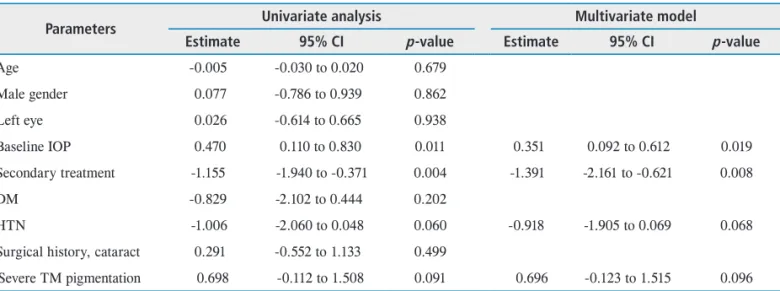
Table 3. Logistic regression using generalized estimating equation model for long-term response of SLT
Parameters Univariate analysis Multivariate model
Estimate 95% CI p-value Estimate 95% CI p-value
Age -0.005 -0.030 to 0.020 0.679
Male gender 0.077 -0.786 to 0.939 0.862
Left eye 0.026 -0.614 to 0.665 0.938
Baseline IOP 0.470 0.110 to 0.830 0.011 0.351 0.092 to 0.612 0.019
Secondary treatment -1.155 -1.940 to -0.371 0.004 -1.391 -2.161 to -0.621 0.008
DM -0.829 -2.102 to 0.444 0.202
HTN -1.006 -2.060 to 0.048 0.060 -0.918 -1.905 to 0.069 0.068
Surgical history, cataract 0.291 -0.552 to 1.133 0.499
Severe TM pigmentation 0.698 -0.112 to 1.508 0.091 0.696 -0.123 to 1.515 0.096 SLT = selective laser trabeculoplasty; CI = confidence interval; IOP = intraocular pressure; DM = diabetes mellitus; HTN= systemic hypertension; TM = trabecular meshwork.
A B
C D
Figure 1. A scatter plots that compare the postoperative IOP decrease in both eyes at 1 month (A), 3 months (B), 6 months (C) and 12 months (D). At 1 month and 6 months, the proportions of IOP decrease were correlated between both eyes (p < 0.001; p = 0.006, respec- tivel). IOP = intraocular pressure.
included in the present study. The overall success rate was 63.0% at 3 months and 53.9% at 1 year. Average age was 58
± 16 years and 99 patients (67.3%) were male. Among all patients, 36 (24.5%) had DM and 23 (15.6%) had HTN. A total of 18 eyes (10.3%) had prior history of glaucoma sur- geries and 55 eyes (29.9%) had cataract surgeries. All eyes were classified into four groups based on the angle pigmen- tation: 78 eyes (42.3%) were grade 1; 60 eyes (32.6%) were grade 2; 36 eyes (19.6%) were grade 3; and 10 eyes (5.4%) were grade 4. Mean baseline IOP was 23 ± 6 mmHg.
Bilateral SLT treatments were performed in 37 patients and secondary SLT treatments were performed in 45 eyes of 45 patients (Table 1).
The factors associated with short-term and long-term response
When the factors associated with short-term response were investigated, high baseline IOP showed a positive as- sociation in univariate and multivariate analyses (p = 0.038;
p = 0.026, respectively). Secondary treatments were nega- tively associated with short-term response in univariate and multivariate analyses (p = 0.001; p = 0.006, respectively).
Severe TM pigmentation was positively associated with short-term response in univariate and multivariate analyses (p = 0.031; p = 0.019, respectively) (Table 2).
When factors associated with long-term response were investigated, high baseline IOP also showed a positive as- sociation in univariate and multivariate analyses (p = 0.011;
p = 0.019, respectively). Secondary treatments were nega-
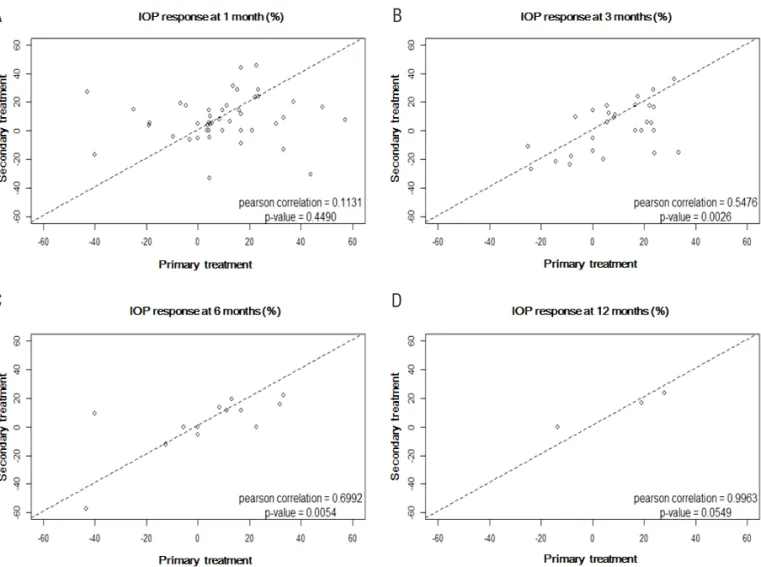
A B
C D
Figure 2. A scatter plots that compare the postoperative IOP decrease of primary and secondary treatments at 1 month (A), 3 months (B), 6 months (C) and 12 months (D). At 3 month and 6 months, the proportions of IOP decrease were correlated between primary and secondary treatments (p = 0.003; p = 0.005, respectively). IOP = intraocular pressure.
tively associated with long-term response in univariate and multivariate analyses (p = 0.004; p = 0.008, respectively).
HTN was negatively associated with long-term response and severe TM pigmentation showed a positive association, but this did not reach statistical significance (Table 3).
Comparisons of treatment responses between both eyes and between primary and secondary treatments
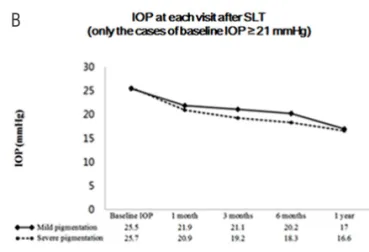
In the case of bilateral SLT treatment, the correlations between the SLT responses of the right and left eyes was significant at 1 month (R = 0.581, p < 0.001) and 6 months (R = 0.551, p = 0.006) postoperatively (Fig. 1). In cases with secondary SLT treatments, the correlation between the responses to primary and secondary treatments was signif- icant at 3 months (R = 0.548; p = 0.003) and 6 months (R = 0.699; p = 0.005) postoperatively (Fig. 2). When the cases were divided into two groups – mild and severe pigmen- tation based on the angle pigmentation –baseline IOP was significantly higher in the severe pigmentation group com- pared to the mild pigmentation group (Fig. 3A). When only
cases with baseline IOP ≥ 21 mmHg were included, the two groups showed no significant differences in IOP during the observation period (Fig. 3B). However, when only cases with baseline IOP < 21 mmHg were included, severe pig- mentation group showed significantly lower IOP at 1, 3, and 12 months after SLT treatment (Fig. 3C).
Discussion
The present study identified predictive factors of short- term and long-term response after half angle SLT treatment in POAG eyes with maximal dose IOP treatments. To ana- lyze factors such as the effect of bilateral treatment, or be- tween primary and secondary half angle SLT treatment, a generalized estimating equation was used for the statistical analysis. As reported previously, high baseline IOP was as- sociated with short-term and long-term IOP response after SLT treatment. It is well known that high baseline IOP is the most important predictive factor of successive SLT out- come.17-19 In addition, in the present study, angle pigmenta-
A B
C
Figure 3. The differences in intraocular pressure (IOP) response after selective laser trabeculoplasty (SLT) between the eyes with mild and severe angle pigmentation. (A) No significant difference in IOP was shown at each visit after SLT except the baseline. (B) When only the cases ≥ baseline IOP ≥ 21 mmHg were included, no significant dif- ference in IOP was shown at each visit after SLT. (C) When only the cases < baseline IOP < 21 mmHg, the IOP response in severe angle pigmentation was significantly larger at 1 month, 6 months and 1 year.
tion was associated with short-term IOP lowering response.
Secondary SLT treatment was shown to be negatively asso- ciated with short-term and long-term outcomes. However, the prognosis of secondary SLT treatment was correlated with the primary SLT response. The responses of both eyes after SLT treatment were correlated.
The success rate in the present study was 63.0% at 6 months and 53.9% at 1 year. This is a relatively lower rate than that reported in previous studies.3,20,21 We speculate that, compared to previous studies, there were differenc- es in the present study in the number of medications and the diagnoses of included cases. Our study included only maximal-dose medical treatment cases. Maximal medical treatment at baseline is known as a predictive factor of poor outcome in SLT.17 Woo et al showed that the glaucoma eyes with using more medications required further laser or sur- gery.22 Furthermore, the present study included the POAG eyes with secondary half angle SLT treatment (24.5%). The secondary SLT treatment was identified as a predictive fac- tor of poor outcome in the present study; thus, the overall success rate of the present study might be lower than that of previous studies.
Angle pigmentation was associated with short-term IOP response in the present study. Angle pigmentation was not definitely associated with the outcome of SLT in previous studies.19,23 A randomized clinical trial also showed no sig- nificant difference in angle pigmentation between success and non-success groups.4 However, the previous clinical trial directly compared the sum of the angle pigmentations (grade 1 to 4) between success and non-success groups.
In our study, we divided patients into mild and severe pig- mentation groups and analyzed the association using mul- tivariate analysis. Considering that the mechanism of SLT is related to selective destruction of pigmented trabecular meshwork cells, it is plausible that angle pigmentation is associated with the outcome of SLT.1 In addition, angle pig- mentation can induce higher baseline IOP; thus, good short- term IOP response may be related to the effect of higher baseline IOP. However, in the present study, severe pigmen- tation was associated with better IOP response than mild pigmentation only in eyes with baseline IOP < 21 mmHg.
This result suggests that the mechanism of IOP response based on the angle pigmentation may be independent of baseline IOP.
The IOP lowering effect of severe pigmentation was not significant in the long-term results. We postulated that pig- ments might again accumulate at the trabecular meshwork.
After accumulation of pigmentation at the trabecular mesh- work, the resistance of trabecular outflow may be increased, and eventually IOP may increase again. This may be the one of the reasons why previous studies reported no associ- ations between angle pigmentation and IOP response after SLT treatment.4,24,25
The present study showed a significant positive correla- tion between the IOP responses of both eyes after SLT. The results of our study are consistent with those of previous studies. In previous study, Shazly et al. showed that IOP 3 month after SLT was a predictor of long-term success in the fellow eye.26 In addition, Lee et al. demonstrated that IOP response in both eyes was correlated after bilateral SLT.27 In our study, we also demonstrated that significant correlations of both IOP responses to SLT exist at 1 month and 6 months postoperative. We speculated that this might be because both eyes have similar function and TM structure. In clinic, through the observation of clinical course in one eye after SLT treatment, a clinician may be able to predict the out- come of SLT treatment in the second eye.
The IOP response to secondary half angle SLT was also significantly correlated with the IOP response to primary half angle SLT. However, secondary SLT treatment was also a predictive factor of poor outcome. One possible reason is that the eyes with secondary SLT may have worse TM conditions. Therefore, secondary SLT in these eyes may be a negative predictive factor of SLT outcome. Second, it is possible that secondary SLT may eventually decrease trabecular outflows. However, SLT has been suggested to improve trabecular outflows.28,29 SLT uses less than 1% of the energy required for ALT and, usually does not result in fibrosis or scarring.30 Previously, secondary SLT has been reported to be effective even after primary 360 degree SLT treatment.31-33 Furthermore, in the present study, SLT treat- ment was performed in each eye only at 180 degrees of TM,
so it is unlikely that the poor outcome of secondary SLT is the results of damage to the TM. To better understand the effect of SLT on TM, further studies to investigate the ef- fect of the secondary SLT are warranted.
Our study has several limitations. First, it is retrospective in design. The clinical decision making could have been affected by each situation at that time. Some patients with failure could have had another procedure or treatment and affected the results. Second, the eyes were observed for a relatively short period < 1 year, which limited our study re- sults, and thus the results should be interpreted only in case of observational period < 1 year. Third, in the present study, though severe pigmentation was found to be associated with good short-term IOP response, the previous study reported that the eyes with deeply pigmented TM also had IOP ele- vation after SLT treatment from a few days to 3 months.34 It should be kept in mind that close observation may be need- ed after SLT treatment in the eyes with heavily pigmented TM.
In conclusion, the short-term and long-term outcomes of SLT were positively associated with baseline IOP and nega- tively associated with secondary SLT treatment. Severe TM pigmentation was associated with short-term response of SLT; however, it was not significantly associated with long- term response.
References
1. Latina MA, Park C. Selective targeting of trabecular meshwork cells: in vitro studies of pulsed and CW laser interactions. Exp Eye Res 1995;60:359-71.
2. Stein JD, Challa P. Mechanisms of action and efficacy of argon laser trabeculoplasty and selective laser trabeculo- plasty. Curr Opin Ophthal 2007;18:140-5.
3. Wong MO, Lee JW, Choy BN, Chan JC, Lai JS. System- atic review and meta-analysis on the efficacy of selective laser trabeculoplasty in open-angle glaucoma. Surv Oph- thalmol 2015;60:36-50.
4. Hodge WG, Damji KF, Rock W, et al. Baseline IOP pre- dicts selective laser trabeculoplasty success at 1 year post- treatment: results from a randomised clinical trial. Br J Ophthalmol 2005;89:1157-60.
5. Ayala M, Chen E. Predictive factors of success in selective
laser trabeculoplasty (SLT) treatment. Clin Ophthalmol 2011;5:573-6.
6. Latina MA, Sibayan SA, Shin DH, et al. Q-switched 532- nm Nd:YAG laser trabeculoplasty (selective laser trabecu- loplasty): a multicenter, pilot, clinical study. Ophthalmol- ogy 1998;105:2082-8; discussion 2089-90.
7. Kano K, Kuwayama Y, Mizoue S, Ito N. Clinical results of selective laser trabeculoplasty. Nippon Ganka Gakkai zasshi 1999;103:612-6.
8. Nagar M, Luhishi E, Shah N. Intraocular pressure control and fluctuation: the effect of treatment with selective laser trabeculoplasty. Br J Ophthalmology 2009;93:497-501.
9. Joshi HB, Chitale SV, Nagarajan M, et al. A prospective randomized single-blind comparison of ureteral stents com- posed of firm and soft polymer. J Urol 2005;174:2303-6.
10. Gracner T. Intraocular pressure response to selective laser trabeculoplasty in the treatment of primary open-angle glaucoma. Ophthalmologica 2001;215:267-70.
11. Cvenkel B. One-year follow-up of selective laser tra- beculoplasty in open-angle glaucoma. Ophthalmologica 2004;218:20-5.
12. Lai JS, Chua JK, Tham CC, Lam DS. Five-year follow up of selective laser trabeculoplasty in Chinese eyes. Clin Exp Ophthal 2004;32:368-72.
13. Nagar M, Ogunyomade A, O’Brart DP, et al. A ran- domised, prospective study comparing selective laser tra- beculoplasty with latanoprost for the control of intraocular pressure in ocular hypertension and open angle glaucoma.
Br J Ophthalmol 2005;89:1413-7.
14. Shibata M, Sugiyama T, Ishida O, et al. Clinical results of selective laser trabeculoplasty in open-angle glaucoma in Japanese eyes: comparison of 180 degree with 360 degree SLT. J Glaucoma 2012;21:17-21.
15. Prasad N, Murthy S, Dagianis JJ, Latina MA. A comparison of the intervisit intraocular pressure fluctuation after 180 and 360 degrees of selective laser trabeculoplasty (SLT) as a primary therapy in primary open angle glaucoma and ocu- lar hypertension. J Glaucoma 2009;18:157-60.
16. Spaeth GL, Aruajo S, Azuara A. Comparison of the con- figuration of the human anterior chamber angle, as de- termined by the Spaeth gonioscopic grading system and ultrasound biomicroscopy. Trans Am Ophthalmol Soc 1995;93:337-47; discussion 47-51.
17. Lee JW, Liu CC, Chan JC, Lai JS. Predictors of success in selective laser trabeculoplasty for chinese open-angle glaucoma. J Glaucoma 2014;23:321-5.
18. Song J, Lee PP, Epstein DL, et al. High failure rate associ- ated with 180 degrees selective laser trabeculoplasty. J
Glaucoma 2005;14:400-8.
19. Martow E, Hutnik CM, Mao A. SLT and adjunctive medical therapy: a prediction rule analysis. J Glaucoma 2011;20:266-70.
20. Rosenfeld E, Shemesh G, Kurtz S. The efficacy of selec- tive laser trabeculoplasty versus argon laser trabeculoplas- ty in pseudophakic glaucoma patients. Clin Ophthalmol 2012;6:1935-40.
21. Liu Y, Birt CM. Argon versus selective laser trabeculo- plasty in younger patients: 2-year results. J Glaucoma 2012;21:112-5.
22. Woo DM, Healey PR, Graham SL, Goldberg I. Intraocular pressure-lowering medications and long-term outcomes of selective laser trabeculoplasty. Clin Exp Ophthalmol 2015;43:320-7.
23. Hirneiß C, Sekura K, Brandlhuber U, et al. Corneal bio- mechanics predict the outcome of selective laser trabecu- loplasty in medically uncontrolled glaucoma. Graefe’s Arch Clin Exp Ophthalmol 2013;251:2383-8.
24. Melamed S, Ben Simon GJ, Levkovitch-Verbin H. Selec- tive laser trabeculoplasty as primary treatment for open- angle glaucoma: a prospective, nonrandomized pilot study.
Arch Ophthalmol 2003;121:957-60.
25. Koucheki B, Hashemi H. Selective laser trabeculoplasty in the treatment of open-angle glaucoma. J Glaucoma 2012;21:65-70.
26. Shazly TA, Latina MA. Intraocular pressure response to selective laser trabeculoplasty in the first treated eye vs the fellow eye. Arch Ophthalmol 2011;129:699-702.
27. Lee JW, Wong MO, Wong RL, Lai JS. Correlation of Intraocular Pressure Between Both Eyes After Bilateral Selective Laser Trabeculoplasty in Open-angle Glaucoma.
J Glaucoma 2016;25:e248-52.
28. Dueker DK, Norberg M, Johnson DH, et al. Stimulation of cell division by argon and Nd:YAG laser trabeculo- plasty in cynomolgus monkeys. Invest Ophthalmol Vis Sci 1990;31:115-24.
29. Alvarado JA, Alvarado RG, Yeh RF, et al. A new insight into the cellular regulation of aqueous outflow: how tra- becular meshwork endothelial cells drive a mechanism that regulates the permeability of Schlemm’s canal endo- thelial cells. Br J Ophthalmol 2005;89:1500-5.
30. Kramer TR, Noecker RJ. Comparison of the morphologic changes after selective laser trabeculoplasty and argon la- ser trabeculoplasty in human eye bank eyes. Ophthalmol- ogy 2001;108:773-9.
31. Hong BK, Winer JC, Martone JF, et al. Repeat selective laser trabeculoplasty. J Glaucoma 2009;18:180-3.
32. Khouri AS, Lari HB, Berezina TL, et al. Long term effica- cy of repeat selective laser trabeculoplasty. J Ophthalmic Vis Res 2014;9:444-8.
33. Polat J, Grantham L, Mitchell K, Realini T. Repeatabil- ity of selective laser trabeculoplasty. Br J Ophthalmol 2016;100:1437-41.
34. Harasymowycz PJ, Papamatheakis DG, Latina M, et al.
Selective laser trabeculoplasty (SLT) complicated by intra- ocular pressure elevation in eyes with heavily pigmented trabecular meshworks. Am J Ophthalmol 2005;139:1110-3.