ABSTRACT
Background and Purpose: The purpose of this study was to investigate the prevalence of mortality during hospitalization among patients diagnosed with delirium at geriatric consultations requested in the previous one year, together with the factors affecting this.
Methods: The electronic medical records of geriatric consultations requested from the psychiatry department between January 1, 2019 and December 31, 2019 were examined from the automation system. The 200 geriatric delirium patients were included in the study. Patients' age, sex, length of hospital stay (LOHS), time between hospitalization and consultation, the department requesting consultation, reason for consultation request, psychiatric recommendations after consultation, reason for hospitalization, number of comorbid medical diseases, number of daily medications used, and history of psychiatric disease were retrieved from the electronic medical records in the automation system.
Results: LOHS and time from hospitalization to consultation were longer in the exitus group. Numbers of comorbid disease and daily medications used were higher in the died patients. Male gender, higher numbers of comorbid diseases, and daily medications were predictors of death.
Conclusions: Early detection of delirium may be important for short term results of disease.
When evaluating these patients, reviewing the drugs used as much as possible can affect the outcome of the disease.
Keywords: Delirium; Aged; Consultation; Death; Male; Length of Stay
INTRODUCTION
The proportion of the geriatric population to the general population is increasing worldwide as life expectancy increases. In 2000, those who aged 65 years or more accounted for 5.6% of the population in Turkey. This is predicted to rise to 10.2% in 2023 and more in subsequent years.1 The age of 65 is a symbolic one generally adopted for the geriatric population. Due to their increasing prevalence in the geriatric era, delirium and dementia are frequently found in geriatric patients.2
Original Article
Received: Feb 7, 2021 Revised: May 29, 2021 Accepted: May 30, 2021 Correspondence to Selçuk Özdin
Psychiatry Department, Ondokuz Mayıs University, Faculty of Medicine, Kurupelit Campus, Samsun 55200, Turkey.
E-mail: [email protected]
© 2021 Korean Dementia Association This is an Open Access article distributed under the terms of the Creative Commons Attribution Non-Commercial License (https://
creativecommons.org/licenses/by-nc/4.0/) which permits unrestricted non-commercial use, distribution, and reproduction in any medium, provided the original work is properly cited.
ORCID iDs Selçuk Özdin
https://orcid.org/0000-0003-1127-1132 Recep Bolat
https://orcid.org/0000-0002-0007-2261 Conflict of Interest
The authors have no financial conflicts of interest.
Author Contributions
Conceptualization: Özdin S; Data curation:
Özdin S, Bolat R; Formal analysis: Özdin S;
Investigation: Özdin S, Bolat R; Methodology:
Özdin S, Bolat R; Project administration: Özdin S; Resources: Özdin S, Bolat R; Supervision:
Özdin S; Visualization: Bolat R; Writing - original draft: Özdin S; Writing - review &
editing: Bolat R.
Selçuk Özdin ,1 Recep Bolat 2
1Psychiatry Department, Ondokuz Mayıs University, Faculty of Medicine, Samsun, Turkey
2Tokat Mental Health Hospital, Tokat, Turkey
Mortality Rates during Hospitalization and Affecting Factors in Geriatric
Delirium Patients: a Retrospective
Cohort Study
The one-year mortality rate after psychiatric consultation is 15.2%.3 Malignancy and delirium have been identified as conditions that can increase the risk of mortality. An extended time between hospitalization and consultation,3 a prolonged total duration of hospitalization, and an advanced age4 are associated with mortality. Patients with delirium during consultation have been found to have higher one-year mortality rate after psychiatric consultation than patients with depression.4
Delirium is a neurocognitive disorder that develops rapidly. Attention and awareness are principally affected in patients with delirium, with fluctuations throughout the day.
Delirium derives from changes in cerebral functions due to an underlying medical cause.5 The prevalence of delirium is increasing together with increases of medical diseases in the geriatric era. The significance of delirium at advanced age derives from its close association with mortality independently of other accompanying factors. The one-year mortality rate in geriatric patients with delirium is 60%, increasing to 72.2% at the end of 5 years.6 In addition, 14.7% of geriatric patients with delirium die during hospitalization. Approximately 70% of delirium consultation requests are made by internal medicine departments.
Inappropriate benzodiazepine use in delirium is more frequent in surgical departments than in internal medicine departments. However, there is no difference in mortality between the 2 departments.7 Comorbidity of delirium and dementia can increase mortality.8 Diagnosis of delirium increases the probability of first-time hospitalization in the geriatric era.9 It can also increase the probability of subsequent re-hospitalization10 and prolongs the time to discharge.11 Several variables such as anemia, electrolyte imbalance, nutrition disorders, medications employed, decreased function in sensory organs, infection, trauma, and malignancies commonly seen in the geriatric era play a preparatory role in delirium.12 Mortality is not associated with diagnostic features of delirium of acute onset or disorganized thinking, although impaired attention and altered state of consciousness can affect the mortality. The risk of mortality increases 2.31-fold in patients meeting all diagnostic criteria for delirium and 1.26-fold in those with subsyndromal delirium.13
The purpose of this study was to investigate mortality during hospitalization among patients diagnosed with delirium at geriatric consultations requested in the previous one year, together with factors affecting this mortality.
METHODS
Electronic medical records of geriatric consultations requested from the Psychiatry Department between January 1, 2019 and December 31, 2019 were examined from the hospital automation system, including psychiatric consultation reports, daily progress notes, discharge summaries, expiration summaries, and medication administration records. Delirium diagnosis was based on clinical examination at the time of consultation.
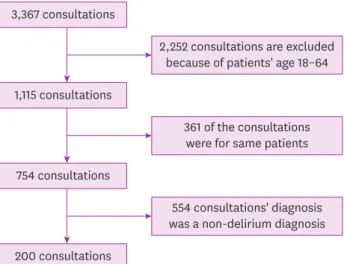
Of a total of 3,367 consultations (age ≥18 years) during the study period, 1,115 involved the geriatric population (age ≥65 years). These 1,115 consultations were requested for 754 different patients. Consultation notes of these 754 patients were examined and all patients diagnosed with delirium were identified. At the end of these procedures, 200 patients were identified as being diagnosed with delirium (Fig. 1). The delirium was diagnosed according to Diagnostic Statistical Manual of Mental Disorders 5 diagnostic criteria (disturbance in attention and awareness, additional disturbance in cognition, evidence of a direct physiological consequence of another medical condition, substance intoxication
or withdrawal, development in a short period of time).5 All geriatric delirium patients were included in this study. Age, sex, length of hospital stay (LOHS), time between hospitalization and consultation, the department requesting consultation, reason for consultation request, psychiatric recommendations after consultation, reason for hospitalization, number of comorbid medical diseases, number of daily medications used, repeat consultation requests, history of psychiatric disease, neuroimaging findings, and information concerning administration of general anesthesia during hospitalization of these patients were retrieved from their electronic medical records in the hospital automation system. Laboratory findings (hemoglobin, creatinine, aspartate transaminase, and sodium) and accompanying chronic diseases (hypertension, diabetes mellitus, acute/chronic kidney disorder, malignancy, infection, cardiovascular disorder) of patients when they were hospitalized were also noted. If more than one reason was present on the consultation request note, all reasons were included in this study. Departments from which consultations were requested were classified as surgery and internal medicine. Since information for comorbid medical diseases was unavailable for 4 patients, they were not included in the calculation for the number of comorbid diseases. Number of daily medications used was calculated as the number of daily drugs used by the patient in the week preceding discharge or death. Hydration therapy and drugs used during resuscitation were not included when calculating daily medication numbers. Approval for the study was granted by the Ondokuz Mayıs University Medical Faculty Clinical Research Ethical Committee (No. 2020/144).
Statistical analysis
All statistical analyses were performed using SPSS 22.0 software (SPSS Inc., Chicago, IL, USA). Chi-square test was applied for comparing categorical variables. Numerical variables were expressed as mean±standard deviation (SD), while categorical variables were expressed as number (%). Student's t-test was used to compare numerical variables between 2 groups.
Binary logistic regression analysis was applied to predict mortality following consultation.
Age, sex, LOHS, time between hospitalization and consultation, department requesting consultation, drug recommendation, number of comorbid medical diseases, number of daily medications used, repeat consultation requests, and information concerning administration of general anesthesia during hospitalization were used as covariates. For all tests, p-values
<0.05 were regarded as statistically significant.
3,367 consultations
1,115 consultations
754 consultations
2,252 consultations are excluded because of patients' age 18–64
361 of the consultations were for same patients
554 consultations' diagnosis was a non-delirium diagnosis 200 consultations
Fig. 1. Flowchart showing patient selection.
RESULTS
Sociodemographic and clinical characteristics of patients are summarized in Table 1. The mean age±SD of geriatric patients diagnosed with delirium was 77.3±7.2 years. There were 129 (64.5%) male patients. The mean LOHS was 25.6±27.99 days. The mean time between the first day of hospitalization and the day when consultation was requested was 10.7±12.4 days. A total of 78 (39%) patients died during hospitalization. One hundred fifty-seven (78.5%) of department-requested consultations were from the internal medicine department.
General anesthesia was administered to 33 (16.5%) patients during hospitalization. The most common reasons for consultation requests were agitation (n=64, 32%) and hallucination (n=33, 16.5%). Psychosocial recommendations and drug therapy were advised for the majority of consultations (n=158, 79%). The drug most frequently recommended was haloperidol (n=143, 71.5%). The most common reasons for hospitalization were cancer and associated problems (n=65, 32.5%) and problems caused by acute-chronic renal failure (n=33, 16.5%). The mean daily number of medications was 8.5±4.6 and the mean number of comorbid diseases was 2.9±1.5. Diagnosis of dementia was present in 14 (7%) patients. Repeat consultations were requested for 53 (26.5%) patients following the initial consultation. Twenty-nine (14.5%) patients had a history of psychiatric disease prior to hospitalization.
It was observed that the mean age of the discharged patients was lower than the patients who died. LOHS and time elapsing from the first day to consultation were longer in the exitus group. No differences in department-requested consultation, recommendation of drug therapy, drug groups recommended, repeat consultation requests, or application of general anesthesia during hospitalization were observed between groups. Hemoglobin level was found to be lower in patients who died than in patients who survived. Numbers of comorbid diseases and daily medications used were higher in exitus patients. While the rate of diabetes and hypertension was found to be higher in patients who died, the rate of kidney diseases (chronic or acute) was found to be higher in survived patients. The most common reasons of death were malignancy (24.4%) and sepsis (19.3%). Results of comparison of sociodemographic and clinical characteristics between groups are shown in Table 2.
Mortality was higher in patients with delirium due to infection (6/11, 54%) and delirium whose aetiology was being investigated (19/29, 65%). Those whose reasons for consultation were depressive symptoms (5/9, 55%) and sleep-wake problems (12/26, 46%) had higher mortality rates than other consultation reasons.
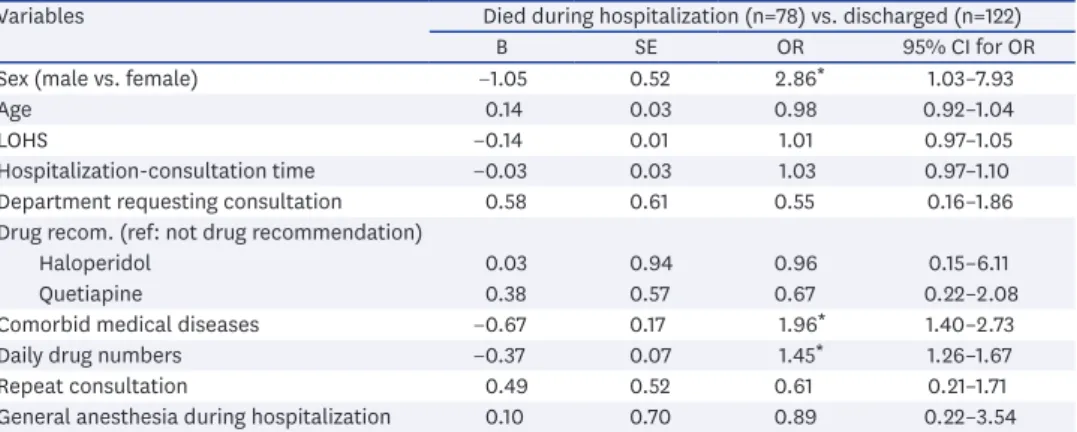
Male gender in geriatric delirium consultations and greater numbers of comorbid diseases and daily medications used were identified as variables showing statistically significant effects on mortality during hospitalization. Data for the model are shown in Table 3.
Table 1. Sociodemographic and clinical features of delirium patients
Variables Value
Sex
Male 129 (64.5)
Female 71 (35.5)
Age 77.3±7.2
Result of hospitalization
Discharged 122 (61)
Died 78 (39)
Hospitalization-consultation time 10.7±12.4
LOHS 25.60±27.99
Department requesting consultation
Internal medical department 157 (78.5)
Surgical medical department 43 (21.5)
Reasons for consultation
Agitation 64 (32)
Hallucination 33 (16.5)
Delirium 30 (15)
Sleep-waking problems 26 (13)
Disorientation 23 (11.5)
Depression-anxiety 14 (7)
Impaired consciousness 8 (4)
Others* 9 (4.5)
Recommendations after consultation
Psychosoc+Psychophar 158 (79)
Psychophar 18 (9)
Psychosoc 11 (5.5)
Others† 13 (6.5)
Recommended drug
Haloperidol 143 (71.5)
Quetiapine 36 (18)
Benzodiazepine 1 (0.5)
Reason for hospitalization
Cancer and associated problems 65 (32.5)
ARF-CRF 33 (16.5)
Cardiovascular problems 29 (14.5)
Etiological research 29 (14.5)
Shortness of breath-pneumonia 20 (10)
Infection 11 (5.5)
Others‡ 13 (6.5)
Daily No. of medications 8.5±4.6
Comorbid medical diseases 2.9±1.5
MRI (n=38)
Space-occupying lesion 3
Ischemia 4
Normal Imaging 31
Repeated consultation
Yes 53 (26.5)
No 147 (73.5)
History of psychiatric disease
Yes 29 (14.5)
No 171 (85.5)
Accompanying dementia
Yes 14 (7)
No 186 (93)
General anesthesia during hospitalization
Yes 33 (16.5)
No 167 (83.5)
Values are presented as number (%) or mean±standard deviation.
LOHS: length of hospital stay, Psychosoc: psychosocial recommendations, Psychophar: psychopharmacological recommendations, ARF: acute renal failure, CRF: chronic renal failure, MRI: magnetic resonance imaging.
*Etiological research, suicide ideation, noncompliance to treatment, psychotic sypmtoms; †Medication if needed, no recommendation; ‡Trauma, cerebrovascular accident, cirrhosis.
Table 2. Comparison of sociodemographic and clinical features of geriatric delirium patients who died during hospitalization and those who were discharged from the hospital
Variables Died (n=78) Discharged (n=122) p-value
Age 74.9±6.6 78.8±7.3 >0.001
LOHS 39.5±16.7 16.7±15.6 >0.001
Hospitalization-consultation time 17.0±15.6 6.6±7.3 >0.001
Department requesting consultation 0.183
Internal medical department 65 92
Surgical medical department 13 30
Drug recommendation 0.122
Yes 67 113
No 11 9
Recommended drug 0.412
Haloperidol 52 91
Quetiapine 14 22
Repeated consultation 0.826
Yes 20 33
No 58 89
General anesthesia during hospitalization 0.465
Yes 11 22
No 67 100
Hemoglobin 12.2±1.2 12.7±1.0 0.005
Sodium 134.8±4.5 135.9±5.3 0.125
AST 58.0±28.9 52.4±22.8 0.131
Creatinine 1.0±0.3 1.1±0.3 0.070
Comorbid medical diseases 3.8±1.3 2.3±1.4 >0.001
Hypertension 55 (70.5) 67 (54.9) 0.027
Diabetes mellitus 54 (69.2) 50 (41.0) >0.001
Malignancy 30 (38.5) 35 (28.7) 0.150
Chronic/acute kidney disorder 6 (7.7) 27 (22.1) 0.007
Infection 6 (7.7) 5 (4.1) 0.277
Cardiovascular disorders 8 (10.3) 21 (17.2) 0.173
Daily No.of medications 12.2±4.3 6.2±3.1 >0.001
Causes of death (n=78)
Malignancy 19 (24.4)
Sepsis 15 (19.3)
Renal failure 13 (16.7)
Diseases of the circulatory system 11 (14.1)
Pneumonia 8 (10.2)
Other reasons 8 (10.2)
Unknown reasons 4 (5.1)
Values are presented as number (%) or mean±standard deviation. Italic values are statistical significant results.
LOHS: length of hospital stay, AST: aspartate aminotransferase.
Table 3. Results of mulivariate binary logistic regression analysis of factors that might affect death in geriatric delirium patients
Variables Died during hospitalization (n=78) vs. discharged (n=122)
B SE OR 95% CI for OR
Sex (male vs. female) −1.05 0.52 2.86* 1.03–7.93
Age 0.14 0.03 0.98 0.92–1.04
LOHS −0.14 0.01 1.01 0.97–1.05
Hospitalization-consultation time −0.03 0.03 1.03 0.97–1.10
Department requesting consultation 0.58 0.61 0.55 0.16–1.86
Drug recom. (ref: not drug recommendation)
Haloperidol 0.03 0.94 0.96 0.15–6.11
Quetiapine 0.38 0.57 0.67 0.22–2.08
Comorbid medical diseases −0.67 0.17 1.96* 1.40–2.73
Daily drug numbers −0.37 0.07 1.45* 1.26–1.67
Repeat consultation 0.49 0.52 0.61 0.21–1.71
General anesthesia during hospitalization 0.10 0.70 0.89 0.22–3.54
CI: confidence interval, OR: odds ratio, SE: standart error, LOHS: length of hospital stay.
*p<0.001.
DISCUSSION
Findings of this study showed that: 1) 39% of geriatric delirium patients died during hospitalization; 2) the majority of delirium patients were men; 3) the most commonly observed reasons for department-requested consultations were agitation and hallucination;
and 4) psychosocial recommendations together with drug therapy were frequently used in treatment. Haloperidol was the most frequently recommended medication. In geriatric delirium patients who died, LOHS and the time between hospitalization and consultation were longer. In addition, the number of drugs used and the number of comorbid medical diseases were higher in geriatric delirium patients who died. Male gender and greater numbers of comorbid medical diseases and medications used were found to be predictors of mortality during hospitalization in geriatric delirium patients.
Delirium is a neurocognitive disorder that can develop within a short period of time, particularly involving impairment of attention and awareness. It is also accompanied by other cognitive disorders. It may be a hyperactive, hypoactive, or mixed type. The hyperactive type is characterized by agitation, emotional lability, and lack of cooperation with health care.5 The hyperactive type is the most common form among patients diagnosed in the geriatric era because it is easier to be diagnosed. The fact that agitation and hallucination were the most common reasons for consultation requests in the present study might also derive from the fact that they were easier to be identified.14 One reason for this might be that delirium is less frequently diagnosed in women as its association with hyperactive delirium symptoms is observed more frequently in men while hypoactive delirium symptoms are more frequently found in women.15 Male gender has been identified as a risk factor for hyperactive delirium and agitation symptoms.16 An association between patient deaths within one year of psychiatric consultation and diagnosis of delirium has also been reported.3 One previous study has reported a mortality rate of 14.7% during hospitalization among delirium patients.7 The mortality in the present study was 39%. One probable reason for such difference might be because delirium patients were not sufficiently recognized in our hospital or because consultation was not requested unless the patient's condition worsened even if delirium was recognized. Consistent with this, 72% of geriatric delirium patients hospitalized for treatment were not recognized in one previous study, with reasons being institutional, individual, or patient-specific.17 On the other hand, even if delirium is diagnosed, fewer psychiatric consultations might have been requested.18 Previous studies have reported that earlier requests for psychiatric consultation and compliance with recommendations made by patient's primary physician could lead to earlier discharge.19,20 Similar to results of the present study, shorter LOHS and shorter time between hospitalization and consultation were also observed in discharged geriatric delirium patients in those previous studies.19,20 From that perspective, it may be concluded that early psychiatric consultation is important.
Previous studies have also shown that routine evaluation of patients for early diagnosis of delirium can reduce mortality rates.21 Patients who died during hospitalization in this study were younger than those who discharged. This might be attributed to the high proportion of men enrolled in our study. This might be because delirium has a more severe impact on women at later ages while it has a more severe impact on men at earlier ages.22
Delirium is a neurocognitive disease developing within a short period of time in which neuronal functions are affected through systemic causes.5 There are several preparatory and precipitating factors. Advanced age and male gender are unmodifiable risk factors. Various systemic diseases and conditions can also modify delirium. Thus, precautionary measures
can be taken.12 Delirium has been associated with mortality independently of other variables.
It has also been shown that it can increase the risk of mortality more than other psychiatric diagnoses. Male gender, hypertension, and Alzheimer disease have been identified as variables determining the mortality of patients with delirium.6 The most important step in the treatment of delirium is treating underlying preparatory factors (particularly diseases and using medications).23 However, during delirium, individuals may become more susceptible to diseases and side-effects of medications in association with changes in the central nervous system. On the other hand, homeostatic mechanisms are less tolerant of stressors in older ages than in younger ages.24 Increasing drug use and higher number of accompanying medications can also exacerbate frailty. Increased frailty and inadequate homeostatic mechanisms are linked to mortality.25 For these reasons, greater numbers of medications used and higher numbers of comorbid diseases being linked to mortality might be regarded as an expected finding, although they did not exhibit a preparatory effect on delirium.
As a result, in delirium of the geriatric period, patients may need to be followed up closely in case of an excess of accompanying medical diseases and medications.
One limitation of the present study was that it was performed retrospectively. In addition, the severity of delirium was not measured. Another limitation of this study was that the study sample was small. Thus, generalization of study results might not be appropriate. Since only consultations requested from psychiatry were evaluated, cases where consultation was not desired or overlooked might have decreased the generalizability of this study.
REFERENCES
1. Turkish Statistical Institute. Turkish Statistical Institute website [Internet]. Ankara: Turkish Statistical Institute; 2020 [cited 2020 Nov 19]. Available from: https://www.tuik.gov.tr/.
2. Grossberg GT. Geriatric psychiatry--an emerging specialty. Mo Med 2010;107:401-405.
PUBMED
3. Tennen GB, Rundell JR, Stevens SR. Mortality in medical-surgical inpatients referred for psychiatric consultation. Gen Hosp Psychiatry 2009;31:341-346.
PUBMED | CROSSREF
4. Tsai MC, Weng HH, Chou SY, Tsai CS, Hung TH, Su JA. One-year mortality of elderly inpatients with delirium, dementia, or depression seen by a consultation-liaison service. Psychosomatics 2012;53:433-438.
PUBMED | CROSSREF
5. American Psychiatric Association. Neurocognitive Disorders. 5th ed. Washington, D.C.: American Psychiatric Association; 2013.
6. Tosun Tasar P, Sahın S, Akcam NO, Dınckal C, Ulusoy MG, Sarıkaya OF, et al. Delirium is associated with increased mortality in the geriatric population. Int J Psychiatry Clin Pract 2018;22:200-205.
PUBMED | CROSSREF
7. Restrepo D, Duque M, Montoya L, Berrouet MC, Rojas M, Lopera G, et al. Risk factors and hospital mortality in surgical and non-surgical patients with delirium. Rev Colomb Psiquiatr (Engl Ed) 2018;47:148-154.
PUBMED | CROSSREF
8. Morandi A, Di Santo SG, Zambon A, Mazzone A, Cherubini A, Mossello E, et al. Delirium, dementia, and in-hospital mortality: the results from the Italian delirium day 2016, a national multicenter study. J Gerontol A Biol Sci Med Sci 2019;74:910-916.
PUBMED | CROSSREF
9. Kim S, Park JH, Won CW. Combined effects of four major geriatric syndromes on adverse outcomes based on Korean National Health Insurance claims data. Geriatr Gerontol Int 2018;18:1463-1468.
PUBMED | CROSSREF
10. Tardivel M, Muller F, Tortrat D, Lechowski L, Teillet L. Rehospitalization following a stay in geriatric rehabilitation wards: rates and predictive factors. Geriatr Psychol Neuropsychiatr Vieil 2018;16:263-268.
PUBMED | CROSSREF
11. Moore G, Hartley P, Romero-Ortuno R. Health and social factors associated with a delayed discharge amongst inpatients in acute geriatric wards: a retrospective observational study. Geriatr Gerontol Int 2018;18:530-537.
PUBMED | CROSSREF
12. Maldonado JR. Delirium pathophysiology: an updated hypothesis of the etiology of acute brain failure. Int J Geriatr Psychiatry 2018;33:1428-1457.
PUBMED | CROSSREF
13. Diwell RA, Davis DH, Vickerstaff V, Sampson EL. Key components of the delirium syndrome and mortality: greater impact of acute change and disorganised thinking in a prospective cohort study. BMC Geriatr 2018;18:24.
PUBMED | CROSSREF
14. Fong TG, Tulebaev SR, Inouye SK. Delirium in elderly adults: diagnosis, prevention and treatment. Nat Rev Neurol 2009;5:210-220.
PUBMED | CROSSREF
15. Trzepacz PT, Franco JG, Meagher DJ, Lee Y, Kim JL, Kishi Y, et al. Delirium phenotype by age and sex in a pooled data set of adult patients. J Neuropsychiatry Clin Neurosci 2018;30:294-301.
PUBMED | CROSSREF
16. Kanbayashi Y, Hatano Y, Hata Y, Morita T, Fukui K, Hosokawa T. Predictive factors for agitation severity of hyperactive delirium in terminally ill cancer patients in a general hospital using ordered logistic regression analysis. J Palliat Med 2013;16:1020-1025.
PUBMED | CROSSREF
17. Teodorczuk A, Reynish E, Milisen K. Improving recognition of delirium in clinical practice: a call for action. BMC Geriatr 2012;12:55.
PUBMED | CROSSREF
18. Chen KY, Evans R, Larkins S. Why are hospital doctors not referring to consultation-liaison psychiatry? - a systemic review. BMC Psychiatry 2016;16:390.
PUBMED | CROSSREF
19. Oldham MA, Chahal K, Lee HB. A systematic review of proactive psychiatric consultation on hospital length of stay. Gen Hosp Psychiatry 2019;60:120-126.
PUBMED | CROSSREF
20. Wood R, Wand AP. The effectiveness of consultation-liaison psychiatry in the general hospital setting: a systematic review. J Psychosom Res 2014;76:175-192.
PUBMED | CROSSREF
21. Codling D, Hood C, Bassett P, Smithard D, Crawford MJ. Delirium screening and mortality in patients with dementia admitted to acute hospitals. Aging Ment Health 2021;25:889-895.
PUBMED | CROSSREF
22. Serpytis P, Navickas P, Navickas A, Serpytis R, Navickas G, Glaveckaite S. Age- and gender-related peculiarities of patients with delirium in the cardiac intensive care unit. Kardiol Pol 2017;75:1041-1050.
PUBMED | CROSSREF
23. Oh ES, Fong TG, Hshieh TT, Inouye SK. Delirium in older persons: advances in diagnosis and treatment.
JAMA 2017;318:1161-1174.
PUBMED | CROSSREF
24. Petropoulou C, Chondrogianni N, Simões D, Agiostratidou G, Drosopoulos N, Kotsota V, et al. Aging and longevity. A paradigm of complementation between homeostatic mechanisms and genetic control? Ann N Y Acad Sci 2000;908:133-142.
PUBMED | CROSSREF
25. Hategan A, Bourgeois JA, Hirsch C, Giroux C. Geriatric Psychiatry: a Case-Based Textbook. Berlin:
Springer; 2018.