Copyright © 2018 The Korean Society for Bone and Mineral Research
This is an Open Access article distributed under the terms of the Creative Commons Attribution Non-Commercial Li- cense (http://creativecommons.org/licenses/by-nc/4.0/) which permits unrestricted non-commercial use, distribu- tion, and reproduction in any medium, provided the original work is properly cited.
Relationship between Bone Density, Eating Habit, and Nutritional Intake in College Students
Hee-Sook Lim1,2, Sung-In Ji2, Hyeonji Hwang2, Jeongmmok Kang2, Yoon-Hyung Park2, Hae-Hyeog Lee3, Tae-Hee Kim3
1Department of Food and Nutrition, Yeonsung University, Anyang;
2Department of Preventive Medicine, Soonchunhyang University College of Medicine, Cheonan;
3Department of Obstetrics and Gynecology, Soonchunhyang University College of Medicine, Bucheon, Korea
Background: The importance of bone health is emphasized throughout the life cycle.
Young adults have problems with bone health due to irregular lifestyle and unbalanced diet, but studies related to them are insufficient. The purpose of this study was to mea- sure the bone mineral density (BMD) of college students and to analyze the differences in BMD according to lifestyle. Methods: BMD was measured by bone ultrasound in 161 male and female college students. The questionnaire was surveyed about lifestyle, eat- ing habits, and nutrient intake status. Results: Osteopenia was 8.8% in male and 10.8%
in female. The body fat percentage of female was significantly higher than male. Male college students, smoking, fast food consumption, and overeating rate were significant- ly higher than female. Nutrient intake was not significantly different between male and female students. But energy and vitamin A and C levels were inadequate, and protein and sodium intake was excessive compared with the recommended nutrient intake for Koreans. BMD was significantly lowest in male who often intake fast food than male who did not intake at all or intake sometimes. Female who often intake fast food had significantly lower BMD than female who did not eat at all. Conclusions: College stu- dents have different BMDs according to lifestyle. There was a difference in BMD accord- ing to smoking and fast food consumption.
Key Words: Bone density · Habits · Nutritional status · Students
INTRODUCTION
Interest in health is increasing with increasing life expectancy, emphasizing the importance of life cycle health care, not only for the elderly, but also for young adults and adolescents. Fracture and osteoporosis are common diseases, and their prevalence is increasing steadily.[1] An effective way of preventing adult osteopo- rosis is to maximize bone mass during adolescence. Maximum bone mass is reach- ed around 30 years, and it is affected by genetic and environmental factors.[2] The National Institutes of Health (NIH) reported that failure to reach adequate bone mass in children and adolescents, including those in their 20s, could lead to os- teoporosis without accelerating bone loss.[3] The main environmental factors af- fecting bone mineral density (BMD) are physical activity, lifestyle, and nutrient in- take.[4,5] In particular, bone mass decreases more rapidly during pregnancy, de- Corresponding author
Yoon-Hyung Park
Department of Preventive Medicine, Soonchunhyang University College of Medicine, 31 Suncheonhyang 6-gil, Dongnam-gu, Cheonan 31151, Korea Tel: +82-41-570-2483
Fax: +82-41-575-2406 E-mail: [email protected] Received: August 2, 2018 Revised: August 11, 2018 Accepted: August 17, 2018
No potential conflict of interest relevant to this article was reported.
Original Article
pISSN 2287-6375 eISSN 2287-7029
livery, and menopause in female.[6]
College students are at an age transitioning to adult- hood, physically and socially. Being away from parental control of food intake, students become responsible for their diet, which should be sustained with adequate nutri- tion. However, many studies pointed out problems in col- lege students’ dietary habits such as irregular and skipping meals, inappropriate snacks, increased frequency of eating out, low nutrient density, and fast food intake.[7,8] Recent- ly, to obtain an ideal body shape, certain nutrients have been intensively consumed, and the intake of carbohy- drate-based meals such as Cupbap and Mini-kimbap has also increased.[9,10] Healthy lifestyle and dietary habits should be established in young adults to maintain maxi- mum bone mass, but research on this subject is insufficient.
The purpose of this study was to investigate the dietary habits, nutrient intake, and BMD of college students and to identify the differences in bone density according to gen- der and lifestyle.
METHODS 1. Study subject
The subjects of the study were 168 college students. The purpose and method of the study were explained to them, and those who agreed answered a questionnaire and were evaluated in terms of anthropometry, BMD, and nutrient intake status. Seven participants were excluded because of incomplete data; finally, 161 students were included in the study (68 male and 93 female). We obtained Institutional Review Board (IRB) approval (IRB No. 1040875-201411-SB- 028) from Soonchunhyang University on the design and progress of the overall research.
2. Study method and variables
The body mass index, body fat percentage, and body fat mass were measured by using a bio-electrical impedance fatness analyzer (InBody 720; Biospace Co., Seoul, Korea).
The BMD of the subjects was measured using quantitative ultrasonography QUS-2 (Metra Biosystems Inc., Mountain View, CA, USA) and calculated by broadband ultrasound attenuation. The BMD value was calculated by T-score, ac- cording to World Health Organization conversion standard (normal, -1.0; osteopenia, -1.0 to -2.5; osteoporosis, -2.5 or less),[11] and analyzed. The general information, lifestyle,
and eating habits were surveyed, including sex, age, alco- hol consumption, smoking status, and regular exercise. We were also asked to quantify their frequency of eating fast food (often: twice a week or more; sometimes: fewer than once a week to 3 times a month; almost never: fewer than twice a month), overeating (often, sometimes, almost nev- er), coffee consumption (often: three times a week or more;
sometimes: 3 times a week or fewer, almost never: 2 times a month or fewer). Fast food means ramen, hamburger, fried potatoes, chicken, pizza, donut and etc. Data on di- etary intake were collected using the 24-hr recall method for 3 days and intakes of nutrients were analyzed with the CAN program (The Korean Nutrition Society, version 5.0).
3. Statistical analysis
SPSS 18.0 programs (SPSS Inc., Chicago, IL, USA) was used for the statistical analysis. All data were reported as mean±standard deviation or as numbers and percentag- es. To identify the factors that differed between the 2 or 3 groups, demographic factors and BMD were compared by conducting an independent t-test or one-way analysis of variance (ANOVA) test after confirming distribution nor- mality. When significant difference appeared among the BMD in groups, turkey’s multi-range test was conducted as post-hoc test. Furthermore, the equal variance test, χ2 test, or Fisher’s exact test was used for categorical variables. A P-value of less than 0.05 was considered significant.
RESULTS
1. Demographic factors and BMD of the subjects
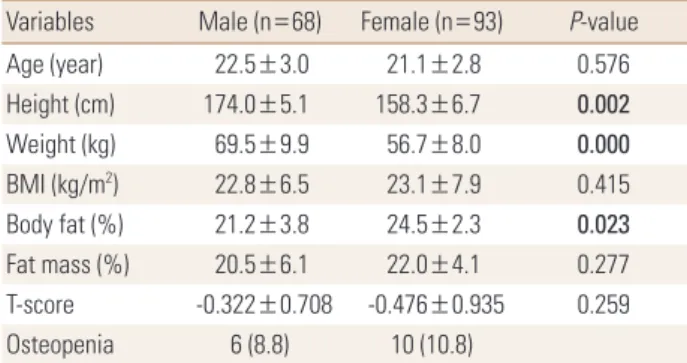
The general characteristics of the subjects are given in Table 1. Female subjects had higher body fat percentage, and the difference was statistically significant. There was no significant difference in BMD between gender (Table 1).2. Comparison of health related habit of the subjects
The proportion of alcohol consumption and smoking were significantly higher in male students compared with female students, but the fast food intake and overeating rate were higher in male students. Regular exercise and coffee consumption rates were higher in male students than in female students, but there was no significant dif- ference between the 2 groups (Table 2).
Table 1. General characteristics of the subjects
Variables Male (n=68) Female (n=93) P-value
Age (year) 22.5±3.0 21.1±2.8 0.576
Height (cm) 174.0±5.1 158.3±6.7 0.002
Weight (kg) 69.5±9.9 56.7±8.0 0.000
BMI (kg/m2) 22.8±6.5 23.1±7.9 0.415
Body fat (%) 21.2±3.8 24.5±2.3 0.023
Fat mass (%) 20.5±6.1 22.0±4.1 0.277
T-score -0.322±0.708 -0.476±0.935 0.259
Osteopenia 6 (8.8) 10 (10.8)
The data is presented as mean±standard deviation or number (%).
BMI, body mass index.
Table 2. Health behavior and dietary habit of the subjects Variables Male (n=68) Female (n=93) P-value Alcohol consumption
Yes 65 (95.6) 70 (75.3) 0.002
No 3 (4.4) 23 (24.7)
Smoking
Yes 41 (60.3) 26 (28.0) 0.019
No 27 (39.7) 67 (72.0)
Regular exercise
No 53 (77.9) 82 (88.2) 0.415
Yes 15 (22.1) 11 (11.8)
Fast food consumption
Often 42 (61.8) 41 (44.1) 0.028
Sometimes 21 (30.9) 38 (40.9)
Almost none 5 (7.4) 14 (15.1)
Overeating
Often 15 (22.1) 16 (17.2) 0.006
Sometimes 49 (72.1) 51 (54.8)
Almost none 4 (5.9) 26 (28.0)
Coffee consumption
Often 52 (76.5) 58 (62.4) 0.286
Sometimes 11 (16.2) 22 (23.7)
Almost none 5 (7.4) 13 (14.0)
The data is presented as number (%).
Table 3. Nutrient intakes of the subjects
Variables Male (n=68) Female (n=93)
P-value
Intake Requirement Intake Requirement
Energy (kcal) 2,170.9±539.7 2,600 1,881.8±808.2 2,100 0.169
Carbohydrate (g) 304.7±94.9 279.0±74.8 0.221
Protein (g) 83.2±29.6 65 72.7±25.6 55 0.380
Fat (g) 52.1±26.9 44.1±23.6 0.177
Vitamin A (RE) 602.6±796.9 800 490.9±585.6 650 0.112
Vitamin B1 (mg) 1.3±0.7 1.2 1.2±0.5 1.1 0.525
Vitamin B2 (mg) 1.6±0.7 1.5 1.3±0.7 1.2 0.442
Vitamin C (mg) 80.6±56.6 100 95.9±90.4 100 0.081
Calcium (mg) 575.2±282.2 800 428.1±5,308.7 700 0.257
Sodium (mg) 5,735.3±1,215.0 1,500a) 4,990.7±860.9 1,500a) 0.356
Iron (mg) 12.2±3.2 10 14.1±2.5 14 0.315
The data is presented as mean±standard deviation or number (%).
a)Data represented as adequately intake.
RE, retinol equivalents.
3. Comparison of nutrient intakes of the subjects
Nutrient intake status was analyzed through daily food intake survey, and the actual intake was compared with the nutritional recommendation for Koreans.[12] First, the intake of nutrients, except vitamin C and iron, as a whole was higher in male college students, but there was no sig- nificant difference in nutrient intake between the 2 groups.However, energy and vitamin A and C levels were inade- quate, and protein and sodium intake was excessive com- pared with the recommended nutrient intake for Koreans (Table 3).
4. Comparison of BMD according to the health habit
There were significant differences in lifestyle and eating habits according to gender both male and female had low
BMD when they were drinking and smoking. However, there was a significant difference according to smoking status in male college students. Lower intake of fast food intake had higher BMD, with significant difference between
male and female college students. There was no significant difference in overeating (Fig. 1).
DISCUSSION
The purpose of this study was to examine the BMD of college students and to determine the difference in BMD according to eating habits. The mean BMD of male and fe- male college students was -0.387±0.672, which was slight- ly lower in female college students. In the study of 222 col- lege students by Choi and Chung [13], the mean bone density was -0.233±0.94 and the rate of osteopenia was 24.8%. The subjects in this study had lower BMD but lower rate of osteopenia. In a study of 1,039 subjects,[14] the mean T-score was 1.38±6.99 and the rate of osteopenia was 7.8%. The subjects’ bone density and rate of osteope- nia were higher. Recently, the prevalence of osteoporosis and cost of health insurance for patients with osteoporosis as well as its social burden have been steadily increasing.
[15] Therefore, it is best to prevent osteoporosis through aggressive management in young adulthood.
Analysis of the lifestyle and dietary behaviors of college students showed that the inadequate ratio of all variables was higher in male students than in female students. Drink- ing, smoking, fast food intake, and overeating were signifi- cantly different between the 2 groups. Protein intake was high, and calcium and vitamin A and C were below recom-
mended levels. In a study by Kim et al.[16], there was con- sensus that male college students had higher rates of drink- ing and smoking than female college students. In addition, the results of this study were higher than those of 68.7% of college students. Kim [17] reported that coffee consump- tion affected the eating patterns and nutrient intake of college students. Previous studies [18,19] on nutrition in college students showed that intake of carbohydrates and dietary fiber decreased and intake of protein, fat, choles- terol, and sodium increased. Because of westernized eat- ing habits, increase in single-person households, busy dai- ly life due to part-time work, and increase in the rate of eating out, the eating habit of university students is unbal- anced, with low consumption of vegetable and fruit, which can cause health problems.[20,21]
We also compared the difference in BMD between the 2 groups. The T-score was within the normal range, but smok- ing and fast food intake were significantly different. Male college students who are smoking and college students who frequently eat fast food had significantly lower BMD.
Nicotine in tobacco has been shown to decrease estrogen secretion, which inhibits calcium dissolution in bone, and to accelerate the conversion of estradiol to lower metabo- lites, thus affecting calcium and vitamin D metabolism.[22]
According to Kim et al.[15], rate of fast food intake was 72%, followed by hamburgers, fried potatoes, chicken, and pizza. Calcium intake was the most insufficient among the Fig. 1. Comparison of bone mineral density level by the health related habit status.
0.1 0 -0.1 -0.2 -0.3 -0.4 -0.5
-0.6 Male Female Male Female Male Female Male Female
Alcohol consumption Smoking Fast-food consumption Overeating
Yes
-0.282
-0.485-0.474
-0.526 -0.11
-0.51 -0.402
-0.543 -0.114
-0.535 0.002
-0.366
P=0.003 P=0.002
P<0.001 P<0.015
-0.472 -0.308
-0.33 -0.284
-0.362 -0.397
-0.493 -0.496
No Often Sometimes None
nutrients. However, the results of this study are not similar to those of other studies, and they are difficult to general- ize because this is a study on college students.
This study had some limitations. This study was a pro- spective single college study and the size of samples was small. Furthermore, the scale of the region is not reflected and it is not comparable between countries, which makes it difficult to represent Korean college students. The sub- jects were divided into the variables and compared the BMD, which was found to be significant, but it could not interpreted as affecting the BMD because it was a simple comparison.
Based on the results of this study, the bone density of college students was determined to be normal, but the rate of osteopenia was high and the lifestyle of male stu- dents was worse than that of female students. Finally, con- sidering that smoking and fast food may correlate the bone density of college students, nutrition education and man- agement should be done to provide more concrete solu- tions such as quitting smoking and fast food intake and performing appropriate exercises. In the future, more at- tention should be paid to the BMD of young adults, and further studies is needed.
ACKNOWLEDGMENT
This research was supported by High Value-added Food Technology development program, Ministry of agriculture, Food and Rural Affairs, Republic of Korea (116029-03-3- HD040)
REFERENCES
1. Ha YC, Park YG, Nam KW, et al. Trend in hip fracture inci- dence and mortality in Korea: a prospective cohort study from 2002 to 2011. J Korean Med Sci 2015;30:483-8.
2. Armas LA, Recker RR. Pathophysiology of osteoporosis:
new mechanistic insights. Endocrinol Metab Clin North Am 2012;41:475-86.
3. Spencer H, Kramer L. NIH consensus conference: osteopo- rosis. Factors contributing to osteoporosis. J Nutr 1986;116:
316-9.
4. Gourlay ML, Hammett-Stabler CA, Renner JB, et al. Associ- ations between body composition, hormonal and lifestyle factors, bone turnover, and BMD. J Bone Metab 2014;21:61-8.
5. Cvijetic S, Baric IC, Satalic Z, et al. Influence of nutrition and lifestyle on bone mineral density in children from adop- tive and biological families. J Epidemiol 2014;24:209-15.
6. Rezaei A, Dragomir-Daescu D. Femoral strength changes faster with age than BMD in both women and men: a bio- mechanical study. J Bone Miner Res 2015;30:2200-6.
7. Shin HJ, Cho E, Lee HJ, et al. Instant noodle intake and di- etary patterns are associated with distinct cardiometabol- ic risk factors in Korea. J Nutr 2014;144:1247-55.
8. Cha E, Burke LE, Kim KH, et al. Prevalence of the metabolic syndrome among overweight and obese college students in Korea. J Cardiovasc Nurs 2010;25:61-8.
9. Plotnikoff RC, Costigan SA, Williams RL, et al. Effectiveness of interventions targeting physical activity, nutrition and healthy weight for university and college students: a sys- tematic review and meta-analysis. Int J Behav Nutr Phys Act 2015;12:45.
10. Cho J, Lee HE, Kim SJ, et al. Effects of body image on col- lege students' attitudes toward diet/fitness apps on smart- phones. Cyberpsychol Behav Soc Netw 2015;18:41-5.
11. The Korean Society for Bone and Mineral Research. Physi- cian’s guide for diagnosis & treatment of osteoporosis.
2015 [cited by 2018 June 11]. Available from: http://www.
ksbmr.org/image/journal/골다공증%20지침서2015_final_
1002.pdf
12. The Korean Nutrition Society. Dietary reference intakes for Koreans 2015. Sejong: Ministry of Health and Welfare, The Korean Nutrition Society; 2015.
13. Choi SN, Chung NY. Bone density, nutrient intake, blood composition and food habits in non-smoking and non-al- cohol drinking male university students. Korean J Food Cult 2010;25:389-99.
14. Kwon S, Lee BK, Kim HS. Relation between nutritional fac- tors and bone status by broadband ultrasound attenua- tion among college students. J Korean Soc Food Sci Nutr 2009;38:1551-8.
15. Kim HY, Ha YC, Kim TY, et al. Healthcare costs of osteopo- rotic fracture in Korea: information from the national health insurance claims database, 2008-2011. J Bone Metab 2017;
24:125-33.
16. Kim KW, Shin EM, Moon EH. A study on fast food consump- tion, nutritional knowledge, food behavior and dietary in- take of university students. J Korean Diet Assoc 2004;10:
13-24.
17. Kim SH. Coffee consumption behaviors, dietary habits, and
dietary nutrient intakes according to coffee intake amount among university students. J Nutr Health 2017;50:270-83.
18. Ahn Y, Kim KW. Beliefs regarding vegetable consumption, self-efficacy and eating behaviors according to the stages of change in vegetable consumption among college stu- dents. Korean J Community Nutr 2012;17:1-13.
19. Lee YJ, You JS, Chang KJ. Dietary habits score, nutrients in- take and dietary quality related to coffee consumption of college students in Incheon. J Nutr Health 2013;46:560-72.
20. Chung KH, Shin KO, Jung TH, et al. Study on the dietary
habit, nutrient intake, and health status according to their majors among college women in Sahmyook university. J Korean Soc Food Sci Nutr 2010;39:826-36.
21. You JS, Park JY, Chang KJ. A case-control study on the di- etary taurine intake, nutrient status and life stress of func- tional constipation patients in Korean male college stu- dents. J Biomed Sci 2010;17 Suppl 1:S41.
22. Yoon V, Maalouf NM, Sakhaee K. The effects of smoking on bone metabolism. Osteoporos Int 2012;23:2081-92.