INTRODUCTION
Neoadjuvant chemotherapy (NC) has traditionally been re- garded as the standard for care in patients with locally advanced breast cancer with the purpose of achieving both local and sys- temic control [1-4]. In recent years, with the advent of more ef- fective chemotherapeutic drugs, NC is being administered to patients with operable breast cancer with the aim of breast conservation after shrinkage of the primary tumor [5,6]. An- other advantage of NC is that it can be used as an in vivo che- mosensitivity test, allowing for a rapid individual evaluation of a regimen [7]. Local clinical response to NC might also be a
predictor of response to distant micrometastases and eventual outcome. Prognostic factors are important for clinical decision making and for tailoring treatment of individual patients with cancer. Axillary lymph node (ALN) status is the single most reliable prognostic indicator of early breast cancer, followed by primary tumor size. However, downstaging of both the prima- ry tumor and ALN involvement by NC results in a loss of tradi- tional prognostic factors. With increased use of NC, outcomes must be predicted to provide tailored treatment for patients treated with NC. Only a few studies have investigated concern- ing the prognostic factors related to long term survival in pa- tients with operable breast cancer treated with NC. In 2000, the results of a phase II trial were published for 73 patients with stage II/III breast cancer, comparing FEC (5-FU, epirubicin, and cyclophosphamide) and MMM (mitoxantrone, metho- rtexate, and mitomycin) in the Journal of the Korean Surgical Society [8]. The aim of this retrospective study was to identify the reliable long-term prognostic factors in patients with stage II/III breast cancer treated with an adjuvant extension of NC.
Prognostic Factors in Patients with Stage II/III Breast Cancer Treated with Adjuvant Extension of Neoadjuvant Chemotherapy: A Retrospective Cohort Study with Ten-Years of Follow-Up Data
Jeryong Kim, Jinsun Lee, Eilsung Chang, Kwangsun Suh1, Cheoljoo Lee, Jongtae Jee, Hyungsub Shin
Departments of Surgery, 1Pathology, Research Institute for Medical Science, Chungnam National University College of Medicine, Daejeon, Korea ORIGINAL ARTICLE
Purpose: The aim of this retrospective study was to identify the reliable long term prognostic factors in patients with stage II/III breast cancer who were treated with an adjuvant extension of neoadjuvant chemotherapy (NC). Methods: Women under the age of 70-years, with previously untreated clinical stage II and III breast cancer, were treated with NC, which was comprised of three cycles of FEC (5-FU, epirubicin, and cyclophosphamide every 3 weeks) or MMM (methotrexate, mitoxantrone, and mito- mycin-C every 3 weeks) with an adjuvant extension of three cycles of the same regimen. Results: Cumulative 10-years disease-free survival (DFS) was 87.3% for patients with a good response and 55.5% for patients with no response (p=0.032); 92.9% for node negative patients, 75.0% for 1-3 positive nodes, 50.0% for 4-9 positive nodes and no survival for 10 or more positive nodes (p<
0.001). Cumulative 10-years overall survival (OS) was 89.1% for patients with good response and 55.5% for patients with no re- sponse (p=0.024); 95.2% for node negative patients, 80.0% for 1-3 positive nodes, 50.0% for 4-9 positive nodes and no survival for 10 or more positive nodes (p<0.001). No significant difference was observed in DFS and OS between the FEC and MMM treat- ed groups. Conclusion: Based on a review of data with a long fol- low-up, only the clinical response to NC and the absolute number of metastatic axillary lymph node identified at surgical staging were independent predictors of both DFS and OS in patients with stage II/III breast cancer patients treated with adjuvant extension of NC.
Key Words: Breast neoplasms, Neoadjuvant therapy, Prognosis
Correspondence: Jeryong Kim
Department of Surgery, Chungnam National University Hospital, 640 Daesa-dong, Jung-gu, Daejeon 301-721, Korea
Tel: +82-42-280-7184, Fax: +82-42-257-8024 E-mail: [email protected]
*This work was supported by the 2010 Chungnam National University Hospital research grant.
Received: December 1, 2010 Accepted: February 7, 2011
Cancer
METHODS
Eligibility criteria
Women under the age of 70-years with previously untreated clinical stage II and III breast cancer, who had suspicious ALN involvement or tumors larger than 3 cm, were eligible for the study according to the American Joint Committee on Cancer 5th edition. The Institutional Review Board approved the study (IRB: 1002-19), and all patients provided written informed consent. Other eligibility criteria included adequate perfor- mance status (Eastern Cooperative Oncology Group [ECOG]
performance status ≤1); adequate hematology (hemoglobin,
≥10 g/dL; absolute neutrophil count, ≥1.5×10⁹/L; and plate- lets, ≥100×109/L), renal (serum creatinine, ≤1.5 upper nor- mal limits), and liver (AST, ALT, and alkaline phosphatase all
≤1.5×upper limit of normal, and bilirubin within normal limits) function; and have no evidence of metastatic disease.
Patients were excluded if there was any evidence of active car- diac disease or a history of malignancy at another site.
Treatment scheme
Patients were treated with NC comprised of three cycles of FEC (500 mg/m2 5-FU, 75 mg/m2 epirubicin, 500 mg/m2 cy- clophosphamide every 3 weeks) or MMM (40 mg/m2 metho- trexate, 8 mg/m2 mitoxantrone, 8 mg/m2 mitomycin-C every 3 weeks) with an adjuvant extension of three cycles of the same regimen. The regimen was chosen according to patient’s own preference with regard to alopecia. The clinical response was assessed after two consecutive cycles of preoperative chemo- therapy. An early operation was performed 2-3 weeks after dis- continuing the chemotherapy for resectable tumors in cases of tumor progression after two cycles of preoperative chemother- apy. All patients underwent ALN dissection either with mas- tectomy or lumpectomy. After operative treatment, adjuvant chemotherapy was administered with three cycles of the same regimen for those who achieved objective clinical response, but six cycles of switching regimen, either FEC or MMM, were administered for those who had stable disease or progression (Figure 1). Radiation therapy began within 4 weeks after the last cycles of chemotherapy, if indicated. Tamoxifen was ad- ministered after the chemo-radiation for 5 years when the hor- mone receptor was positive.
Evaluation of clinical response and toxicity
Clinical response was assessed by a physical examination and ultrasonography for bidimensionally measurable disease according to standard Union Internationale Contra le Cancer (UICC) criteria. During the physical examination, we used a transparent grid for mapping the extent of the tumor at the
beginning and again after the two cycles of NC. A clinical com- plete response (cCR) was defined as the disappearance of all known disease and a clinical partial response (cPR) was de- fined as reduction of 50% or greater in the product of the two largest perpendicular dimensions of the primary lesion. Pro- gressive disease (PD) was defined as an increase of more than 25% in the product of the two largest perpendicular dimen- sions of the primary tumor or the appearance of new lesions.
Stable disease (SD) was represented by a less than 50% decrease or a less than 25% increase in the product of the two largest perpendicular dimensions of the primary tumor. A pathologi- cal complete response (pCR) was defined as no residual tumor cells in the breast and axilla based on histopathology of the operative specimens following NC. The number of involved ALN was recorded from the axillary dissection specimen by the pathologist. Toxicity was graded according to the ECOG common toxicity criteria.
Survival analysis
Overall survival (OS) and disease-free survival (DFS) were considered from the onset of NC and from the day of surgery, respectively. A statistical analysis was conducted using the SPSS version 12.0 (SPSS Inc., Chicago, USA). A univariate survival analysis was performed with the Kaplan-Meier method, and comparisons between curves were performed with the log- rank test. Factors were entered into a Cox multivariate regres- sion model to analyze the potential simultaneous effect of the significant predictors of DFS and OS identified by the univari- Figure 1. Treatment scheme of chemotherapy. FEC=5-FU+epirubicin+
cyclophosphamide; MMM=methotrexate+mitoxantrone+mitomycin-C.
Yes
FEC MMM
Objective response after 2 cycles Complete 3 cycles
Operation Operation
Opposite regimen × 6 cycles Same regimen × 3 cycles
No
ate analysis. Patient follow-up was performed in the clinic un- til either death or the patient’s last visit on or before December 2007 in both the FEC and MMM groups. Survival data were provided by the Korea National Statistical Office for those un- available for follow-up.
RESULTS
Patient characteristics
From February 1991 to October 1998, seventy three pa- tients diagnosed with breast cancer, with a tumor size ≥3 cm or clinically axillary node positive, were enrolled for the phase II trial. Patients with known distant metastases were excluded.
The mean age of patients was 45.5±1.2 years (range, 27-69).
The median follow-up period was 135 months (range, 6-186).
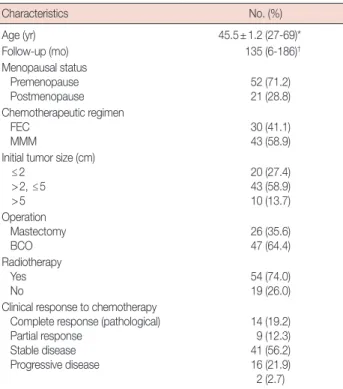
The clinical characteristics of the patients are shown in Table 1.
No significant difference was observed with regard to clinico- pathological parameters between the FEC and MMM groups.
Clinical response and toxicity
An overall objective clinical response was observed in 75.4%
(cCR, 19.2%; cPR, 56.2%) of the patients including nine cases (12.3%) of pCR (Table 1). The remaining 24.6% showed SD (21.9%) and PD (2.7%), respectively. Pretreatment tumor size
and age were significantly related to clinical response to NC (Table 2). Smaller tumors showed a better response to NC than larger tumors (p=0.001). Patients older than 35-years of age showed a better response to NC than younger patients (p=
0.047). No significant difference was observed with regard to clinical response to NC between the FEC and MMM groups.
According to the ECOG common toxicity criteria, no signifi- cant difference was observed with regard to grade 3/4 severe toxicities. Reversible alopecia and mild to moderate nausea were more common in the FEC group than in the MMM group.
Prognostic factors affecting DFS and OS
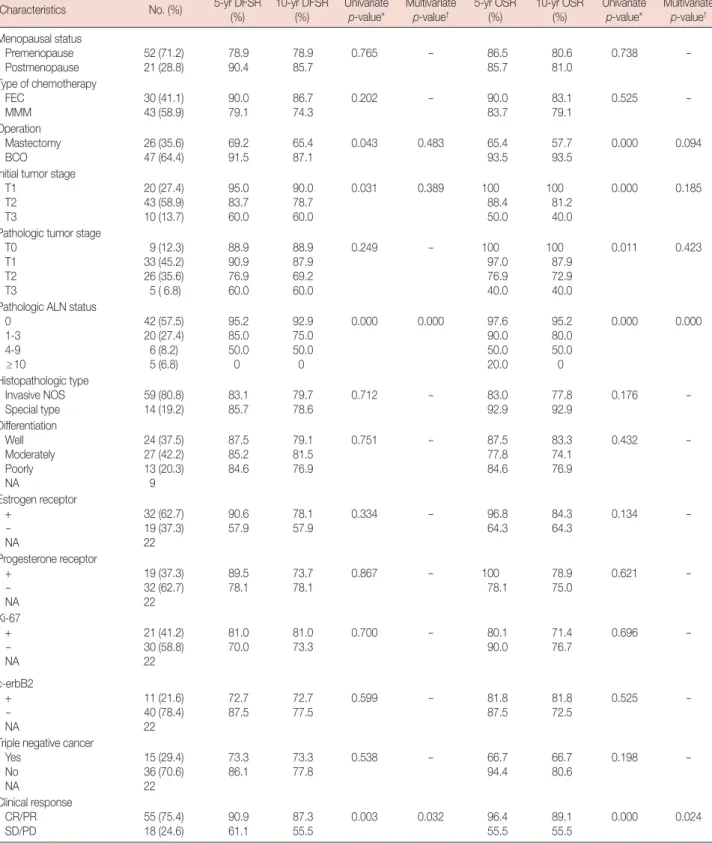
A univariate analysis showed that initial tumor stage, patho- logical ALN status, and clinical response were prognostic fac- tors of DFS and OS. Additionally, pathological tumor stage was associated with OS in the univariate analysis. However, a multivariate analysis indicated that DFS and OS were signifi- cantly related to the clinical response and the number of in- volved ALNs (Table 3). Cumulative 10-year DFS was 87.3%
Table 1. Clinical characteristics of patients (n=73)
Characteristics No. (%)
Age (yr) 45.5±1.2 (27-69)*
Follow-up (mo) 135 (6-186)†
Menopausal status Premenopause Postmenopause
52 (71.2) 21 (28.8) Chemotherapeutic regimen
FEC
MMM 30 (41.1)
43 (58.9) Initial tumor size (cm)
≤2 >2, ≤5 >5
20 (27.4) 43 (58.9) 10 (13.7) Operation
Mastectomy BCO
26 (35.6) 47 (64.4) Radiotherapy
Yes No
54 (74.0) 19 (26.0) Clinical response to chemotherapy
Complete response (pathological) Partial response
Stable disease Progressive disease
14 (19.2) 9 (12.3) 41 (56.2) 16 (21.9) 2 (2.7)
SE=standard error; FEC=fluorouracil+epirubicin+cyclophosphamide; MMM=
mitoxantrone+methotrexate+mitomycin; BCO=breast conserving operation.
*Mean±SE (range); †Median (range).
Table 2. Significance of various factors on clinical response to chemo- therapy
Response
Total
(n=73) p-value*
CR/PR, No. (%) (n=55)
SD/PD, No. (%) (n=18) Age (yr)
≤35
>35 5 (50.0)
50 (79.4) 5 (50.0) 13 (20.6) 10
63
0.047
Menstrual status Premenopause
Postmenopause 39 (75.0)
16 (76.2) 13 (25.0) 5 (23.8) 52
21 NS
Chemotherapeutic regimen FEC MMM
24 (80.0) 31 (72.1)
6 (20.0) 12 (27.9)
30 43
NS
Histopathologic type Invasive NOS Special type
42 (71.2) 13 (92.9)
17 (28.8) 1 (7.1)
59 14
0.093
Initial tumor size (cm) ≤2
>2, ≤5 >5
18 (90.0) 34 (79.1) 3 (30.0)
2 (10.0) 9 (20.9) 7 (70.0)
20 43 10
0.001
Pathologic axillary nodal status 0 1-3 >4
36 (85.7) 14 (70.0) 5 (45.5)
6 (14.3) 6 (30.0) 6 (54.5)
42 20 11
0.005
Operation Mastectomy
BCO 12 (46.2)
43 (91.5) 14 (53.8)
4 (8.5) 26
47
0.000
CR=complete response; PR=partial response; SD=stable disease; PD=pro- gressive disease; NS=not significant; FEC=fluorouracil, epirubicin, cyclophos- phamide; MMM=mitoxantrone, methotrexate, mitomycin; NOS=not other- wise specified; BCO=breast conserving operation.
*Linear-by-linear association.
Table 3. Analysis of factors affecting disease-free survival rates (DFSR) and overall survival rates (OSR)
Characteristics No. (%) 5-yr DFSR
(%)
10-yr DFSR (%)
Univariate p-value*
Multivariate p-value†
5-yr OSR (%)
10-yr OSR (%)
Univariate p-value*
Multivariate p-value† Menopausal status
Premenopause
Postmenopause 52 (71.2)
21 (28.8) 78.9
90.4 78.9
85.7 0.765
- 86.5
85.7 80.6
81.0 0.738 -
Type of chemotherapy FEC
MMM 30 (41.1)
43 (58.9) 90.0
79.1 86.7
74.3 0.202 -
90.0
83.7 83.1
79.1 0.525 -
Operation Mastectomy
BCO 26 (35.6)
47 (64.4) 69.2
91.5 65.4
87.1
0.043 0.483 65.4
93.5 57.7
93.5 0.000 0.094
Initial tumor stage T1
T2 T3
20 (27.4) 43 (58.9) 10 (13.7)
95.0 83.7 60.0
90.0 78.7 60.0
0.031 0.389 100
88.4 50.0
100 81.2 40.0
0.000 0.185
Pathologic tumor stage T0
T1 T2 T3
9 (12.3) 33 (45.2) 26 (35.6) 5 ( 6.8)
88.9 90.9 76.9 60.0
88.9 87.9 69.2 60.0
0.249 - 100
97.0 76.9 40.0
100 87.9 72.9 40.0
0.011 0.423
Pathologic ALN status 0
1-3 4-9 ≥10
42 (57.5) 20 (27.4) 6 (8.2) 5 (6.8)
95.2 85.0 50.0 0
92.9 75.0 50.0 0
0.000 0.000 97.6
90.0 50.0 20.0
95.2 80.0 50.0 0
0.000 0.000
Histopathologic type Invasive NOS Special type
59 (80.8) 14 (19.2)
83.1 85.7
79.7 78.6
0.712 - 83.0
92.9
77.8 92.9
0.176 -
Differentiation Well Moderately Poorly NA
24 (37.5) 27 (42.2) 13 (20.3)
9
87.5 85.2 84.6
79.1 81.5 76.9
0.751 - 87.5
77.8 84.6
83.3 74.1 76.9
0.432 -
Estrogen receptor +
- NA
32 (62.7) 19 (37.3) 22
90.6 57.9
78.1 57.9
0.334 - 96.8
64.3
84.3 64.3
0.134 -
Progesterone receptor +
- NA
19 (37.3) 32 (62.7) 22
89.5
78.1 73.7
78.1 0.867 - 100
78.1 78.9
75.0 0.621 -
Ki-67 + - NA
21 (41.2) 30 (58.8) 22
81.0
70.0 81.0
73.3 0.700 - 80.1
90.0 71.4
76.7 0.696 -
c-erbB2 + - NA
11 (21.6) 40 (78.4) 22
72.7 87.5
72.7 77.5
0.599 - 81.8
87.5
81.8 72.5
0.525 -
Triple negative cancer Yes
No NA
15 (29.4) 36 (70.6) 22
73.3
86.1 73.3
77.8 0.538 - 66.7
94.4 66.7
80.6 0.198 -
Clinical response CR/PR SD/PD
55 (75.4) 18 (24.6)
90.9 61.1
87.3 55.5
0.003 0.032 96.4
55.5
89.1 55.5
0.000 0.024
EC=fluorouracil+epirubicin+cyclophosphamide; MMM=mitoxantrone+methotrexate+mitomycin; BCO=breast conserving operation; NOS=not otherwise speci- fied; ALN=axillary lymph node; NA=not available; CR=complete response; PR=partial response; SD=stable disease; PD=progressive disease.
*Log-rank test; †Cox multivariate regression model.
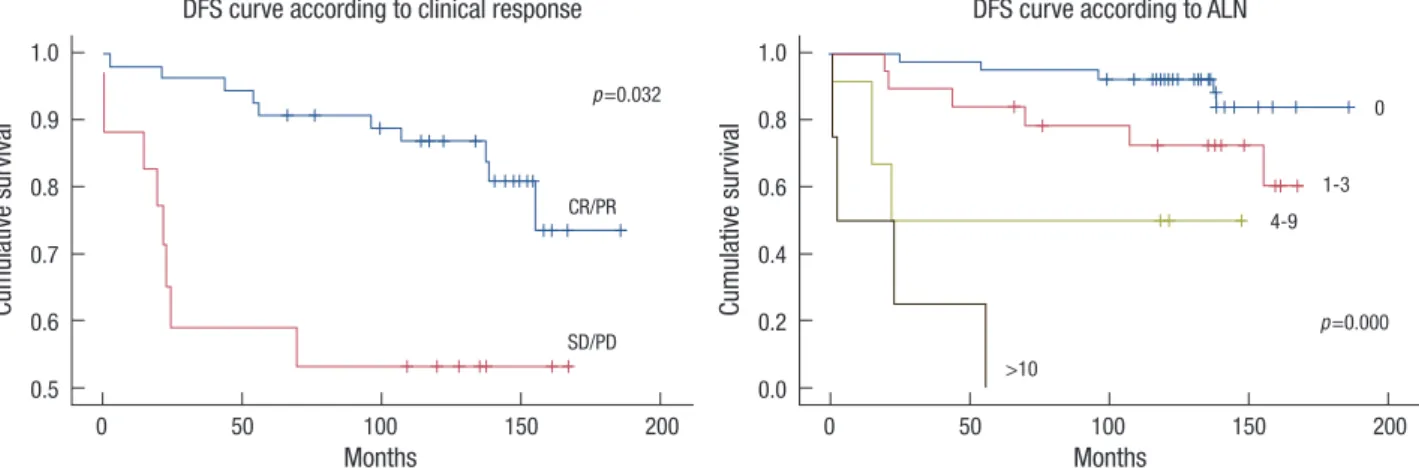
for patients with CR/PR, 55.5% for patients with SD/PD (p=
0.032), 92.9% for node negative patients, 75.0% for patients with 1-3 positive nodes, 50.0% for patients with 4-9 positive nodes, and no survival for patients with 10 or more positive nodes (p<0.001, Figure 2). Cumulative 10-year OS was 89.1%
for patients with CR/PR, 55.5% for patients with SD/PD (p=
0.024), 95.2% for node negative patients, 80.0% for patients with 1-3 positive nodes, 50.0% for patients with 4-9 positive nodes, and no survival for patients with 10 or more positive nodes (p<0.001, Figure 3). No significant difference was ob- served in DFS and OS between the FEC and MMM groups.
Histopathological type, differentiation, hormone receptor, Ki- 67, c-erbB2, and triple negative cancer were not predictive of DFS or OS. All of these pathological findings and biological markers (hormone receptor, Ki-67, c-erbB2) were examined in postoperative specimens.
DISCUSSION
The clinical characteristics of the patients were remarkable in terms of the high proportion of young premenopausal pa- tients. The median age of the studied patients was far below 50 years because breast cancer in Korean women tends to occur earlier than in Western countries, showing a peak incidence in the 40s [9]. In general, Korean women who have breast tu- mors larger than 3 cm are not candidates for breast conserv- ing operations because they have smaller breasts than those of women from western countries. NC for patients with breast cancer is currently used with the main aim of achieving path- ological complete remission and improving survival. Second, it is used to conserve the breast and axilla due to tumor down- staging. The main problem with NC is the loss of traditional prognostic markers such as tumor size or axillary LN status.
pCR following NC is a well known powerful prognostic
Figure 2. Disease-free survival (DFS) curves according to the clinical response to chemotherapy and pathological axillary lymph node (ALN) status us- ing the Kaplan-Meier statistical method and the log-rank test.
CR=complete response; PR=partial response; SD=stable disease; PD=progressive disease.
Cumulative survival Cumulative survival
Months
CR/PR
>10
0
1-3 4-9
SD/PD
Months
p=0.032
p=0.000
DFS curve according to clinical response DFS curve according to ALN
0 50 100 150 200 0 50 100 150 200
1.0 0.9 0.8 0.7 0.6 0.5
1.0 0.8 0.6 0.4 0.2 0.0
Figure 3. Overall survival curves according to the clinical response to chemotherapy and pathological axillary lymph node (ALN) status using the Kaplan-Meier statistical method and the log-rank test.
CR=complete response; PR=partial response; SD=stable disease; PD=progressive disease.
Cumulative survival Cumulative survival
Months Months
p=0.024 p=0.000
Overall survival curve according to clinical response Overall survival curve according to ALN
0 50 100 150 200 0 50 100 150 200
1.0 0.9 0.8 0.7 0.6 0.5
1.0 0.8 0.6 0.4 0.2 0.0 CR/PR
>10
0 1-3
4-9
SD/PD
marker for longer survival. Unfortunately, the vast majority of patients treated with NC will not have a pCR, and no guide- lines exist for these patients. This is the most important prob- lem in the field of NC and needs to be resolved through large randomized clinical trials to identify a tailored treatment. Two large randomized trials, the EORTC 10902 and the NSABP B-18, reported that clinical and pathological responses were be long term prognostic factors following NC. In a study from Korea, initial clinical stage, estrogen receptor, bcl-2, and triple negative phenotype were statistically significant variables which impacted on OS [10]. In our study, based on a review of data with a long follow-up, the clinical or pathological re- sponse to neoadjuvant chemotherapy and the absolute num- ber of metastatic ALNs identified at surgical staging were in- dependent predictors of both DFS and OS. The clinical re- sponse to NC was related to tumor size and age: tumor re- sponse was more marked in smaller tumors and older patients
≥35 years (Table 2). However, most groups have reported no influence of age or menopausal status on the response to che- motherapy. Jacquillat et al. [11] reported that tumor response is inversely related to age. A cCR was achieved in 18% of pa- tients less than 50 years of age compared to 37% of those who were over 50 years (p=0.007). It is well known that patients with large tumors are less likely to have a pCR compared to those with smaller tumors, because larger tumors tend to have decreased drug delivery by inefficient blood flow and relative- ly high intratumoral pressure [12]. Achieving cCR without pCR following NC may be associated with partial eradication of the micrometastasis. pCR following NC is infrequent:
12.3% in our series, 11% in the NSABP B-18 trial, and 4% in the EORTC trial 10902 [1,13,14]. In the current study, surgery was performed in all patients with cCR because of the reported significant increase in locoregional recurrences when only ra- diotherapy was administered without surgery in the case of cCR [15]. As observed, tumor progression during NC is rare:
2.7% in our series, 1.4% in the EORTC trial 10902, and 3% in the NSABP B-18 trial [1,13,14]. Results from NSABP B-18 show no statistically significant differences in DFS and OS re- garding sequencing chemotherapy preoperatively or postop- eratively between the neoadjuvant and adjuvant groups. How- ever, there were trends in favor of preoperative chemotherapy for DFS and OS in women under 50 years (hazard ratio [HR], 0.85, p=0.090 for DFS; HR, 0.81, p=0.060 for OS). Five-year DFS also demonstrated a strong trend in favor of the neoadju- vant group (HR, 0.81, p=0.053) [13]. Considering the relative- ly younger age of the Korean patients with breast cancer as compared with women from Western countries, the benefit from NC might be more considerable for Korean patients with breast cancer than for women from Western countries. In
the current study, chemotherapy was performed with an adju- vant extension of NC for those whom achieved an objective clinical response to NC. According to the results of the in vivo chemosensitivity test, these patients could have better clinical outcome by changing the resistant chemotherapeutic regimen to a non-cross-resistant chemotherapeutic regimen. However, in the MDACC trial, the change to a non-cross-resistant regi- men in an adjuvant setting did not improve the outcome for the patients with a poor response to NC [16]. The NSABP B-27 trial did not identify any group of patients who would benefit from adding neoadjuvant or adjuvant docetaxel che- motherapy in patients who received four cycles of neoadju- vant doxorubicin and cyclophosphamide [4,13]. In the B-27 trial, treatment was not based on in vivo chemosensitivity test which was applied in the current study. Currently, the role of combining a neoadjuvant and adjuvant chemotherapy regi- men is unclear. pCR rate, which is an indicator of good clini- cal outcome, increases by adding neoadjuvant or adjuvant se- quential taxane, or by adding more cycles of NC or a combi- nation of trastuzumab with NC [4,13,17-20]. However, it is unclear whether these results will translate into an improve- ment in survival. In the Nottingham experience, six cycles of preoperative FEC chemotherapy has resulted in a better re- sponse and a significantly better outcome to six cycles of pre- operative MMM chemotherapy [21]. However, in our study, neither clinical response nor long term clinical outcome were different between the FEC and MMM groups. This was possi- bly due to the limitation of a smaller sample size and a differ- ent treatment schedule. Generally, ALN status is regarded as the most important surrogate marker for patients with breast cancer, and ALN dissection is an integral part of the accepted management of breast cancer. NC completely eradicates axil- lary metastatic disease in approximately 20% to 40% of pa- tients before ALN dissection [4,13,22]. In the current study, neg- ative ALN metastasis was significantly higher in the responsive group (36/55) than in the non-responsive group (6/18) (Table 2). One study from M.D. Anderson suggests that axillary irra- diation without ALN dissection may provide adequate local control in patients with at least a partial response of the pri- mary tumor to NC and a clinically negative axilla [23]. Dav- eau et al. [24] reported that omission of axillary irradiation in patients with no pathologic ALN involvement after NC re- sulted in no increase in the risk of distant metastasis, locore- gional recurrence, or death. Furthermore, ALN dissection can be avoided through sentinel LN biopsy after NC in virtually all patients and accurately selected patients who required com- plete level I and II ALN dissection [25]. In terms of axillary treatment, the responsive group could have had more chance to avoid ALN dissection or irradiation than the non-respon-
sive group. There has been some debate on the role of ALN status following NC as a prognostic factor [10,26]. Based on a review of data with a long follow-up, ALN status after NC was still the most powerful prognostic indicator followed by clini- cal response in the current study. Thus, patients with partial or minor response following NC can be further stratified with respect to DFS and OS by the number of involved ALNs.
CONFLICT OF INTEREST
The authors declare that they have no competing interests.
REFERENCES
1. Fisher B, Brown A, Mamounas E, Wieand S, Robidoux A, Margolese RG, et al. Effect of preoperative chemotherapy on local-regional disease in women with operable breast cancer: findings from National Surgical Adjuvant Breast and Bowel Project B-18. J Clin Oncol 1997;15:2483-93.
2. Hortobagyi GN, Blumenschein GR, Spanos W, Montague ED, Buzdar AU, Yap HY, et al. Multimodal treatment of locoregionally advanced breast cancer. Cancer 1983;51:763-8.
3. Kuerer HM, Newman LA, Smith TL, Ames FC, Hunt KK, Dhingra K, et al. Clinical course of breast cancer patients with complete pathologic primary tumor and axillary lymph node response to doxorubicin-based neoadjuvant chemotherapy. J Clin Oncol 1999;17:460-9.
4. Mamounas EP. NSABP Protocol B-27. Preoperative doxorubicin plus cyclophosphamide followed by preoperative or postoperative docetax- el. Oncology (Williston Park) 1997;11(6 Suppl 6):37-40.
5. Kimura M, Sano M, Fujimori M, Nakagomi H, Negishi T, Yanagita Y, et al. Neoadjuvant paclitaxel for operable breast cancer: multicenter phase II trial with clinical outcomes. Anticancer Res 2008;28:1239-44.
6. Kaufmann P, Dauphine CE, Vargas MP, Burla ML, Isaac NM, Gonzalez KD, et al. Success of neoadjuvant chemotherapy in conversion of mas- tectomy to breast conservation surgery. Am Surg 2006;72:935-8.
7. Forrest AP, Levack PA, Chetty U, Hawkins RA, Miller WR, Smyth JF, et al. A human tumour model. Lancet 1986;2:840-2.
8. Kim JR, Chang ES. Prognostic factors in breast cancer patients follow- ing neoadjuvant chemotherapy. J Korean Surg Soc 2000;59:729-37.
9. The Korean Breast Cancer Society. Nationwide Korean breast cancer data of 2002. J Korean Breast Cancer Soc 2004;7:72-83.
10. Keam B, Im SA, Kim HJ, Oh DY, Kim JH, Lee SH, et al. Prognostic im- pact of clinicopathologic parameters in stage II/III breast cancer treated with neoadjuvant docetaxel and doxorubicin chemotherapy: paradoxi- cal features of the triple negative breast cancer. BMC Cancer 2007;7:203.
11. Jacquillat C, Weil M, Baillet F, Borel C, Auclerc G, de Maublanc MA, et al. Results of neoadjuvant chemotherapy and radiation therapy in the breast-conserving treatment of 250 patients with all stages of infiltrative breast cancer. Cancer 1990;66:119-29.
12. Fernandez-Sanchez M, Gamboa-Dominguez A, Uribe N, Garcia-Ulloa AC, Flores-Estrada D, Candelaria M, et al. Clinical and pathological pre- dictors of the response to neoadjuvant anthracycline chemotherapy in
locally advanced breast cancer. Med Oncol 2006;23:171-83.
13. Rastogi P, Anderson SJ, Bear HD, Geyer CE, Kahlenberg MS, Robidoux A, et al. Preoperative chemotherapy: updates of National Surgical Adju- vant Breast and Bowel Project Protocols B-18 and B-27. J Clin Oncol 2008;26:778-85.
14. van der Hage JA, van de Velde CJ, Julien JP, Tubiana-Hulin M, Vander- velden C, Duchateau L. Preoperative chemotherapy in primary opera- ble breast cancer: results from the European Organization for Research and Treatment of Cancer trial 10902. J Clin Oncol 2001;19:4224-37.
15. Mauri D, Pavlidis N, Ioannidis JP. Neoadjuvant versus adjuvant system- ic treatment in breast cancer: a meta-analysis. J Natl Cancer Inst 2005;
97:188-94.
16. Knauer M, Haid A, Schneider Y, Köberle-Wührer R, Lang A, Winder T, et al. Adjuvant extension of chemotherapy after neoadjuvant therapy may not improve outcome in early-stage breast cancer. Eur J Surg Oncol 2009;35:798-804.
17. Han S, Kim J, Lee J, Chang E, Gwak G, Cho H, et al. Comparison of 6 cycles versus 4 cycles of neoadjuvant epirubicin plus docetaxel chemo- therapy in stages II and III breast cancer. Eur J Surg Oncol 2009;35:583-7.
18. Steger GG, Galid A, Gnant M, Mlineritsch B, Lang A, Tausch C, et al.
Pathologic complete response with six compared with three cycles of neoadjuvant epirubicin plus docetaxel and granulocyte colony-stimulat- ing factor in operable breast cancer: results of ABCSG-14. J Clin Oncol 2007;25:2012-8.
19. Untch M, Rezai M, Loibl S, Fasching PA, Huober J, Tesch H, et al. Neo- adjuvant treatment with trastuzumab in HER2-positive breast cancer:
results from the GeparQuattro study. J Clin Oncol 2010;28:2024-31.
20. Gianni L, Eiermann W, Semiglazov V, Manikhas A, Lluch A, Tjulandin S, et al. Neoadjuvant chemotherapy with trastuzumab followed by adju- vant trastuzumab versus neoadjuvant chemotherapy alone, in patients with HER2-positive locally advanced breast cancer (the NOAH trial): a randomised controlled superiority trial with a parallel HER2-negative cohort. Lancet 2010;375:377-84.
21. Mathew J, Asgeirsson KS, Agrawal A, Mukherjee A, Ellis IO, Cheung KL, et al. Neoadjuvant chemotherapy in locally advanced primary breast cancers: the Nottingham experience. Eur J Surg Oncol 2007;33:972-6.
22. Gralow JR, Burstein HJ, Wood W, Hortobagyi GN, Gianni L, von Minck- witz G, et al. Preoperative therapy in invasive breast cancer: pathologic assessment and systemic therapy issues in operable disease. J Clin Oncol 2008;26:814-9.
23. Singletary SE. Neoadjuvant chemotherapy in the treatment of stage II and III breast cancer. Am J Surg 2001;182:341-6.
24. Daveau C, Stevens D, Brain E, Berges O, Villette S, Moisson P, et al. Is re- gional lymph node irradiation necessary in stage II to III breast cancer patients with negative pathologic node status after neoadjuvant chemo- therapy? Int J Radiat Oncol Biol Phys 2010;78:337-42.
25. Schwartz GF, Tannebaum JE, Jernigan AM, Palazzo JP. Axillary sentinel lymph node biopsy after neoadjuvant chemotherapy for carcinoma of the breast. Cancer 2010;116:1243-51.
26. Pierga JY, Mouret E, Laurence V, Dieras V, Savigioni A, Beuzeboc P, et al.
Prognostic factors for survival after neoadjuvant chemotherapy in oper- able breast cancer. the role of clinical response. Eur J Cancer 2003;39:
1089-96.