Paclitaxel 정제를 위한 메조기공 알루미나 흡착제 평가
오현정, 정경열*, 김진현*
공주대학교화학공학부
Received : February 7, 2013 / Revised : March 13, 2013 / Accepted : March 22, 2013
서 론
Paclitaxel은주목 (yew tree)의표피에서발견된 diterpenoid 계열의항암물질로 난소암, 유방암, 카포시 종양(Kaposi's sarcoma) 및비소세포성 폐암(non-small cell lung cancer, NSCLC) 치료용으로 미국 FDA (U.S. Food and Drug
Administration) 허가를취득하여현재가장많이사용되고
있는항암제이다[16]. 또한류마티스성관절염, 알츠하이머 치료등의적용증이계속확대되고있으며, 여러다른치료 방법들과의복합처방에관한임상실험이진행중에있어향 후 paclitaxel 수요는계속늘어날전망이다[8].
Paclitaxel의주요생산방법에는세가지가있다. 첫째, 주 목나무(yew tree)에서직접추출하는방법[24]으로원료의 계속적인공급이어렵고추출/정제에도많은어려움이있으
며환경보호수인주목나무보호에도적합하지않은방식이 다. 둘째, 주목나무의 잎에서 전구체(baccatin III, 10- deacetylbaccatin III, 10-deacetylpaclitaxel 등)를 얻어 side chain을화학적으로결합하는반합성방법이다[1]. 이 방법역시전구체를주목나무에서직접얻어야하므로직접 추출의경우와마찬가지문제점들을가지고있다. 셋째, 주 목나무에서 callus를유도하고종균배양을거쳐주배양기에 서식물세포를배양하여얻는방법이다[10, 15]. 식물세포배 양방법은기후, 환경등의외부인자에의해영향을받지않 고생물반응기내에서안정적으로생산이가능하기때문에
일정한품질의 paclitaxel을대량생산할수있다는장점이
있다. 그외방법으로전합성방법[12]과미생물발효에의 한생산방법[22]이있으나 paclitaxel의수율이낮아상업화 에는아직어려움이많다.
그러므로현재식물세포배양으로부터여러단계의추출 및정제공정을거쳐높은순도의 paclitaxel을주로생산하 고있다. 일반적으로분리및정제과정은원료인바이오매 스(paclitaxel을함유한식물세포)로부터 paclitaxel을먼저 유기용매로추출하고, 전처리(pre-purification) 공정을거 쳐최종정제를통하여제품을생산하는공정으로이루어져 있는데, 이과정에서특히전처리공정은최종정제비용 에많은영향을미친다[12, 13, 22]. 기존의연구들[2, 4, 25]에 Evaluation of Mesoporous Alumina Adsorbent for the Purification of Paclitaxel. Oh, Hyeon-Jeong, Kyeong Youl Jung*, and Jin-Hyun Kim*. Department of Chemical Engineering, Kongju National University, Cheonan 330-717, Korea Several types of mesoporous alumina adsorbents with different physical properties were prepared by spray pyrolysis and were used for the separation/purification of the anticancer agent paclitaxel. The pore diameter of the adsorbents had a greater effect than did the surface area and the pore volume on the removal of plant-derived impurities. An appropriate pore diameter (~10.8 nm) was required for effective impurity removal. At a constant pore diameter, the surface area of the adsorbent affected not only the purity but also the yield of paclitaxel. Also, increasing the surface area of the adsorbent resulted in an increase in the adsorption of paclitaxel and impurities (biomass-derived tar and wax components). Removal of these impurities was con- firmed by HPLC analysis of the absorbent after the treatment and TGA of the organic substances that were bound to the adsor- bent.
Keywords: Paclitaxel, mesoporous alumina, adsorbent, physical property, purification
*Corresponding authors K. Y. J.
Tel: +82-41-521-9365, Fax: +82-41-554-2640 E-mail: [email protected]
J.-H. K.
Tel: +82-41-521-9361, Fax: +82-41-554-2640 E-mail: [email protected]
© 2013, The Korean Society for Microbiology and Biotechnology
서는정제를위한전처리공정으로고가의크로마토그래피
를 이용하고 있거나 전 처리 없이 추출을 거친 crude
paclitaxel을 HPLC (high performance liquid chromatography) 에의해서바로최종정제하게된다. 대체로바이오매스로부 터유기용매를이용하여 paclitaxel을추출하면순도는 0.5%
이하이며, 간단한전처리공정후에도 10% 정도의순도로
매우낮다. 이러한시료를바로 HPLC에의하여최종정제
할경우경제적측면에서많은문제가있으며또한 scale-up
및대량생산에많은어려움이따른다. 따라서전처리공정 을통하여시료의순도를가능하면높여 (최소 50% 이상) 주
어야최종정제, 특히 HPLC를이용한정제에서의비용을줄
일수있다.
전처리공정으로흡착제처리및침전에의해고순도의 crude paclitaxel을얻을수있는방법이보고되어있다[23].
식물유래타르및왁스성분을흡착제처리로제거한후에 침전공정에의하여높은순도(>50%)의 crude paclitaxel을 얻을수있어매우간단하고편리하게전처리할수있는방 법이다. 식물유래타르및왁스성분은 paclitaxel의분리/정
제에많은악영향을미치는데, 특히 HPLC 정제공정에서칼
럼의충진재(resin) 수명을단축시킬뿐만아니라처리량을
감소시키고많은양의유기용매사용을유발함으로전처리 공정에서반드시제거되어야한다[16]. 알루미나는우수한 표면화학적활성, 적절한비표면적과기공분포를가지고있
어흡착제로널리사용되고있다[18, 20]. 하지만알루미나
흡착제를이용한식물유래타르및왁스성분제거를통한
항암물질 paclitaxel 정제에관한체계적연구는매우미흡
한 실정이다. 따라서 본 연구에서는 분무열분해(spray
pyrolysis) 공정에의해제조된물리적특성이다른다공성
메조기공알루미나(mesoporous alumina) 흡착제의성능을 조사하였다. 또한일정한기공크기에서다양한종류의표면 적을가진알루미나흡착제를제조하여표면적변화에따른 흡착제처리효과를조사하였다. 궁극적으로식물세포배양 에의한항암물질 paclitaxel 정제를위하여, 알루미나흡착 제의물리적특성변화가흡착제처리효과에미치는영향 을자세히조사하고자하였다.
재료 및 방법
식물재료와 배양조건
본실험에사용된식물세포배양액은Taxus chinensis의잎
으로부터 얻은 세포주(cell line)를 이용하여 배양하였다.
Taxus chinensis로부터기원된현탁액세포는 24oC 암조건 에서 150 rpm으로교반하여배양하였다. 현탁(suspension) 세포는 수정된 Gamborg's B5 배지[5], 30 g/L sucrose, 10µM NAA (naphthalene acetic acid), 0.2 µM BA (6-
benzylamino purine), 1 g/L casein hydrolysate, 1 g/L 2- [N-morpholino]ethansulfonic acid (MES)에서배양하였다. 세포배양은 2주마다새로운배지로갈아주었으며생산과배 양을 연장시키기 위해 7일과 21일 째 되는 날에 1-2%의 maltose를첨가해 주고 elicitor로서 배양 초기에 4 µM의 AgNO3를첨가해주었다[3]. 식물세포배양(생물반응기부피: 32 M3, 배양 부피: 25 M3) 후 배양액으로부터 4,500 g decanter (Westfalia, CA150 Claritying Decanter)와 10,000 g 고속원심분리기(α-Laval, BTPX205GD-35CDEEP)를이용 하여식물세포와세포조각(cell debris)을연속조업으로회 수하였다. 회수한식물세포와세포조각(cell debris)을합하 여바이오매스라하였다. 본연구에 사용된바이오매스는 (주)삼양제넥스로부터제공받았다.
Paclitaxel 분석
Paclitaxel 함량 분석을 위해 HPLC system (Waters, USA)과 Capell Pak C18 (250×4.6 mm, Shiseido, Japan) 칼럼을사용하였다. 이동상은아세토니트릴과증류수혼합 용액(35/65-65/35, v/v, gradient mode)을 flow rate 1.0 ml/
min으로흘려주었다. 시료주입양은 20 µl이며 227 nm에서 UV에의해검출하였다. HPLC 분석은표준정량곡선을이용 하였으며표준시료는 Sigma-Aldrich 제품(순도: 95%)을사 용하였다[14].
흡착제 처리를 위한 시료준비
식물세포배양액으로부터회수한바이오매스와메탄올의 비율을 1/1 (w/v)로하여실온에서 30분동안추출하여여과 하고, 바이오매스에새로운메탄올을첨가하여동일한방법 으로 4회반복하여추출을수행하였다[10]. 추출여액을모 아농축기(CCA-1100, EYELA, Japan)에서 40oC, 감압상태
에서농축(원액의 30%)하고농축액에메틸렌클로라이드를
첨가(농축액의 25%)하고실온에서 30분동안액-액추출을 3회반복수행하였다. 액-액추출후상분리(phase separation) 를 통해 극성불순물은 상층인 메탄올 층으로 제거하고,
paclitaxel은하층인메틸렌클로라이드층으로회수하여실
온, 감압상태에서농축/건조하였다. 건조된시료를흡착제처 리에사용하였다[17]. 흡착제처리에사용된시료의순도는 10.6%이었다.
알루미나 흡착제 제조
분무열분해공정에의해다공성메조기공알루미나를제 조하였다. 알루미늄전구체로 aluminum nitrate [Al(NO3)3· 9H2O, Aldrich]를사용하였고, 기공형성을위한주형제로 는 poly (ethylene glycol)-block-Poly(propylene glycol)-block- Poly (ethylene glycol) (P123, Aldrich), cetyltrimethyl-
ammonium chloride (CTAC, Aldrich), cetyltrimethyl- ammonium bromide (CTAB, Aldrich, 98%)을사용하였다. 분무용액은알루미늄전구체를녹인용액에 CTAC, P123/
CTAB, P123/CTAC 및 P123을첨가하여제조하였다. 알루
미늄전구체의전체농도는 0.2 M로고정하였다. 평균기공
크기 3 nm, 4-5 nm, >10 nm의 알루미나 입자는 각각 CTAC, P123/CTAB 또는 P123/CTAC, P123을사용하여제 조하였다. 기공크기가다른네종류의알루미나(alumina I, alumina II, alumina III, alumina IV)의특성치는 Table 1 에나타내었다. 고정된기공크기에서알루미나의표면적은 템플릿의함량을변화시켜조절하였다. 알루미늄기준유기 템플릿 CTAC의몰비는 0.05-0.35, P123/CTAC의몰비는 0.03/0.3-0.5, P123의몰비는 0.03로고정시켜주었다. 제조 한분무용액은초음파액적발생장치(aerosol generator, 진 동자 6개, 1.7 MHz, 동림엔지니어링)를이용하여액적화를 한다음운반기체를통하여반응기내로이동시켰다. 운반기 체로는공기를사용하였으며, 유량은 10 L/min으로고정하
였다. 건조부와 반응부의 반응기는 길이 1200 mm, 직경
55 mm인석영관을각각사용하였다. 건조부를 two-zone으 로나누고각각의온도를 T1 = 150-300oC, T2 = 200-350oC, 반응부의온도는 T3 = 500-700oC로고정시켰다. 최종반응 부를통과한입자들은테플론필터를이용하여포집하였다. 제조된분말에잔존하는유기물들을없애기위해전기로내 에서소성시켜제거하였다. 전기로의온도는 550oC(승온속도
: 1oC/min) 공기분위기하에서 4시간동안소성시켰다. 소성 후얻은분말은질소흡착/탈착등온선은 200oC에서전처 리후 Micrometrics 사의 ASAP 2000을이용하여−196oC에 서측정하였다. 상대압력 0.06-0.3 범위에서흡착데이터와 BET (Brunauer-Emmett-Teller)법을이용하여표면적을계
산하였다[6]. 기공부피는상대압력 0.995에서흡착부피로부
터계산하였으며기공크기는 17-3000Å범위에서탈착등온 선으로부터 BJH (Barrett-Joyner-Halenda)법을 이용하여 계산하였다. 일정한기공크기에서다양한표면적을가지는
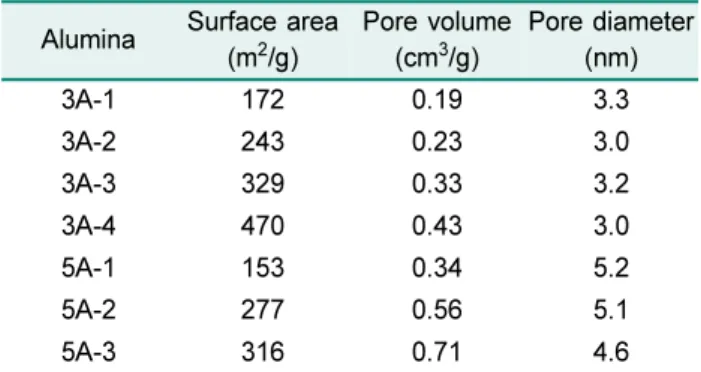
다공성메조기공알루미나흡착제는 Table 2에나타내었다.
흡착제 처리
건조된 crude extract를메틸렌클로라이드에 20% (v/w) 비율로녹이고흡착제 (adsorbent)인 mesoporous spherical alumina를건조된 crude extract 대비 50% (w/w) 비율로첨 가하여 40oC에서 30분동안교반하며반응시킨후여과하였 다. 여과액은 30oC, 감압상태에서건조하여헥산침전에이 용하였다.
헥산 침전
흡착제처리후건조된시료를메틸렌클로라이드에녹여 헥산에떨어뜨려침전을유도하여비극성불순물을제거하 였다(메틸렌클로라이드/헥산 = 1/10, v/v). 헥산침전후여 과를통하여얻어진침전물을 35oC에서 24시간진공건조하
였다. 건조된침전물의순도와수율을측정(HPLC 분석)하
여흡착제처리효과를확인하였다.
TGA 분석
Thermogravimetric analysis (TGA) (SDTQ600, Shimadzu,
Japan)를사용하여흡착제처리후흡착제에붙어있는불순
물 (유기물)의양을측정하였다. 온도를변화시킴에따른무 게의변화를측정하여유기물의양을정량분석하였으며 air 를주입하고온도는 800oC까지변화시켰다.
결과 및 고찰
알루미나의 물리적 특성변화에 따른 영향
분무열분해공정에의해물리적특성(표면적, 기공부피, 기 공지름)이 다른 네 종류의 다공성 메조기공 알루미나 (alumina I, alumina II, alumina III, alumina IV)를제조 하여흡착제처리실험을수행하였다. 네종류의알루미나를 사용하여흡착제처리와헥산침전을수행하여침전물을여 과/회수하고, 35oC에서 24시간동안진공건조하여 HPLC로 분석하였다. Fig. 1에서보는바와같이 alumina I, alumina II, alumina III 순으로기공지름이증가할수록 paclitaxel 순
Table 1. Physical properties of spherical mesoporous aluminas.
Alumina Surface area (m2/g)
Pore volume (cm3/g)
Pore diameter (nm)
Alumina I 329 0.33 3.2
Alumina II 277 0.56 5.1
Alumina III 256 1.01 10.8
Alumina IV 107 0.50 13.4
Table 2. Physical properties of 3.0-3.3 nm and 4.6-5.2 nm spherical mesoporous aluminas.
Alumina Surface area (m2/g)
Pore volume (cm3/g)
Pore diameter (nm)
3A-1 172 0.19 3.3
3A-2 243 0.23 3.0
3A-3 329 0.33 3.2
3A-4 470 0.43 3.0
5A-1 153 0.34 5.2
5A-2 277 0.56 5.1
5A-3 316 0.71 4.6
도와수율이증가하다 alumina IV에서다시순도와수율이
감소하는경향을보였다. Alumina III를사용하였을때가
장높은순도(~52.5%)와수율(~56.8%)의 paclitaxel을얻을 수있었다. 흡착제에붙은불순물의경향을확인하기위하여 흡착제처리후여과하여흡착제를회수하고이를메탄올로 세척하여 HPLC 분석을수행하였다[21]. Fig. 2에서보는바 와 같이 alumina III이 alumina I, alumina II, alumina IV에비하여많은불순물들이흡착/제거됨을알수있었다.
흡착제에붙은유기물의양을정량하기위해 TGA 분석을수
행하였다. Fig. 3에서보는바와같이흡착제에붙은유기물
의 양이 alumina III (30 wt%), alumina II (23.7 wt%), alumina IV (20.9 wt%), alumina I (18.8 wt%) 순으로 나 타나 alumina III에가장많은유기물(타르및왁스성분포 함)이흡착/제거됨을정량적으로확인할수있었다. 이러한 결과로부터알루미나흡착제의물리적특성에서표면적과 기공부피보다는기공크기(기공지름)이흡착제처리효과에 많은 영향을미침을 알수있었다. 특히적절한 기공지름
(~10.8 nm)에서식물유래타르및왁스성분을포함한불순
물을제거하는데가장효과적임을알수있었다. 적절한기 공크기에서불순물들이효과적으로기공내부로확산되어
흡착제거되는것으로판단된다[11]. 이러한연구결과는활
성탄을이용하여타르성분을효과적으로제거하기위해서 는적당한기공크기의활성탄이요구된다는기존문헌[9] 보 고와일치하는것으로, 불순물(타르성분)이흡착제에효과적 으로흡착되기위해서는기공크기가매우중요한역할을하 기때문이다.
동일한 기공크기에서 알루미나의 표면적 변화에 따른 영향 알루미나흡착제의물리적인특성중식물유래타르및왁 스성분을포함한불순물을효과적으로제거하기위해서적 절한기공크기가필요함을알수있었다. 이를토대로일정 한기공크기에서다양한표면적을가지는다공성메조기공 알루미나를제조하여표면적변화에따른흡착제처리효과 를조사하였다. 본실험에서는일정한기공크기(기공지름: 3.0-3.3 nm)에서표면적이다른네종류의알루미나(Table
2, 3A-1~3A-4)를제조하여흡착제처리실험을수행하였다.
흡착제처리를한후헥산침전을수행한결과를 Fig. 4A에
나타내었다. 알루미나 3A-1 (172 m2/g), 3A-2 (243 m2/g), 3A-3 (329 m2/g), 3A-4 (470 m2/g) 순으로, 즉, 표면적이증 가할수록 paclitaxel 순도는조금씩증가함을알수있었다.
반면수율은표면적증가에따라거의변화가없다가 3A-4
(470 m2/g)에서오히려감소함을알수있었다. 이러한결과 는흡착제의표면적이증가할수록불순물이효과적으로제
거되어후속공정인헥산침전에서 paclitaxel 순도는증가
하는반면특정표면적이상에서는흡착되는 paclitaxel이많 Fig. 1. Effect of adsorbent on the purity and yield of paclitaxel
in hexane precipitation.
Fig. 2. HPLC chromatograms of washing solution after adsorbent treatment of alumina.
The arrow indicates the position of paclitaxel.
Fig. 3. Thermogravimetric analysis (TGA) curves of four types of alumina after adsorbent treatment.
아져 paclitaxel 수율은감소하는것으로판단된다[11, 21].
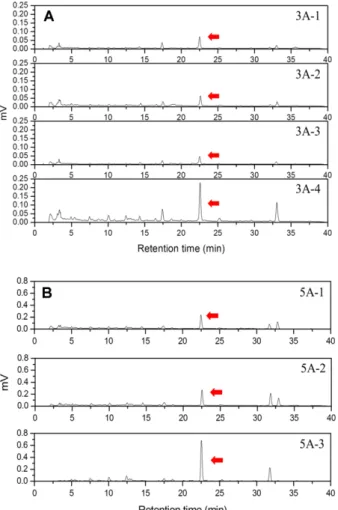
흡착제처리후흡착제에붙은성분들의경향을확인하기위 하여, 흡착제처리후여과하여흡착제를회수하고이를메 탄올로세척하여 HPLC 분석을수행하였다[21]. Fig. 5A에
서보는바와같이표면적변화에따라 HPLC 크로마토그램
에서피크패턴에차이를보임을확인할수있었다. 알루미 나 3A-1 (172 m2/g), 3A-2 (243 m2/g), 3A-3 (329 m2/g)에
비해 3A-4 (470 m2/g)에서 상대적으로 높은 불순물 및
paclitaxel 피크를확인할수있었다. 즉, 특정표면적이상 에서는바이오매스유래타르및왁스성분을포함한불순
물이외에도 paclitaxel이많이흡착되어후속공정인헥산
침전에서 paclitaxel 순도와수율에영향을미침을알수있
었다[11, 21]. 흡착제처리후흡착제에붙은유기물의양을
정량하기위하여, TGA 분석을수행하였다[21]. Fig. 6A에서 보는바와같이흡착제에붙은유기물의양은 3A-1 (15.8 wt%), 3A-2 (18.7 wt%), 3A-3 (18.8 wt%), 3A-4 (25.5 wt%) 순으 로나타났다. 표면적이증가할수록바이오매스유래유기물 이더많이흡착/제거됨을정량적으로확인할수있었다. 일 반적으로흡착제(예, 활성탄, 탄소물질)의표면적이클수록
바이오매스유래타르성분제거에효과적인기존의보고들 [7, 9, 19]와일치함을알수있었다.
일정한기공크기(기공지름: 4.6-5.2 nm)에서표면적이다 른세종류의알루미나(Table 2, 5A-1~5A-3)를제조하여흡 착제처리효과를조사하였다. 흡착제처리를한후헥산침
전을수행한결과를 Fig. 4B에나타내었다. 알루미나의표면
적이 증가할수록 paclitaxel 순도가증가하다가 5A-2 (277
m2/g)부터거의변화가없었다. 반면수율은표면적증가에
따라거의변화가없다가 5A-3 (316 m2/g)에서감소하였다. 흡착제처리후흡착제에붙은성분들의경향을확인하기위 하여, 흡착제처리후여과하여흡착제를회수하고이를메 탄올로세척하여 HPLC 분석을수행하였다[10]. Fig. 5B에 서보는바와 같이 5A-1 (153 m2/g), 5A-2 (277 m2/g)에비 해 5A-3 (316 m2/g)에서상대적으로높은 paclitaxel 피크를 확인할수있었다. 이러한이유는표면적이상대적으로큰 Fig. 4. Effect of adsorbent on the purity and yield of paclitaxel
in hexane precipitation: (A) 3.0-3.3 nm, (B) 4.6-5.2 nm.
Fig. 5. HPLC chromatograms of washing solution after adsorbent treatment with a pore size of (A) 3.0-3.3 nm and (B) 4.6-5.2 nm.
The arrow indicates the position of paclitaxel.
5A-3 (316 m2/g)에서 특히 paclitaxel이더 많이 흡착되어
paclitaxel 수율이감소하는것으로판단된다. 흡착제처리
후흡착제에붙은유기물의양을정량하기위하여, TGA 분
석을수행하였다[21]. Fig. 6B에서보는바와같이흡착제에 붙은 유기물의 양은 5A-1 (20.9 wt%), 5A-2 (22.7 wt%), 5A-3 (25.3 wt%)순으로나타났으며 5A-3 (316 m2/g)에서가 장많은유기물(타르및왁스성분포함)이흡착/제거됨을정 량적으로확인할수있었다.
요 약
바이오매스유래항암물질 paclitaxel 정제를위하여, 물리 적특성이다른메조기공알루미나흡착제를제조하여흡착 제처리효과를조사하였다. 알루미나의물리적특성중표 면적과기공부피보다는기공크기(기공지름)이흡착제처리 효과에많은영향을미쳤다. 특히적절한기공크기(기공지름:
10.8 nm)에서식물유래타르및왁스성분을포함한불순물
을제거하는데가장효과적이었다. 일정한기공크기에서흡
착제의표면적은 paclitaxel 순도뿐만아니라수율에많은영
향을미치며흡착제의표면적이증가할수록 paclitaxel과불 순물(바이오매스유래타르및왁스성분포함)의흡착정도 는증가하였다. 이러한불순물제거효과는흡착제처리후
흡착제를메탄올로세척하여 HPLC로분석한결과와흡착
제에붙은유기물의 TGA 정량분석결과로도확인할수있
었다.
Acknowledgements
This work was supported by a grant from the National Research Foundation of Korea (NRF) funded by the Korean Government (MEST) (No. 2011-0010907).
References
1. Baloglu, E. and D. G. Kingston. 1999. A new semisynthesis of paclitaxel from baccatin III. J. Nat. Prod. 62: 1068-1071.
2. Castor, T. P. 1998. Method and apparatus for isolating thera- peutic compositions from source materials. US Patent 5, 750, 709.
3. Choi, H. K., T. L. Adams, R. W. Stahlhut, S. I. Kim, J. H. Yun, B. K. Song, J. H. Kim, S. S. Hong, and H. S. Lee. 1999.
Method for mass production of taxol by semi-continuous cul- ture with Taxus chinensis cell culture. US Patent 5,871, 979.
4. ElSohly, H. N., E. M. Jr. Croom, M. A. ElSohly, and J. D.
McChesney. 1997. Methods and compositions for isolating taxanes. US Patent 5, 618,538.
5. Gamborg, O. L., R. A. Miller, and K. Ojima. 1968. Nutrient requirements of suspension cultures of soybean root cells.
Exp. Cell Res. 50: 151-158.
6. Gregg, S. J. and K. S. W. Sing. 1982. Adsorption, surface area and porosity, pp. 41-110. 2nd Ed. Academic Press, New York.
7. Hanaoka, T., K. Sakanishi, and T. Minowa. 2004. Hot gas cleaning of producer gas from biomass gasification using car- bonaceous materials as a bed additive. J. Jpn. Inst. Energy 83: 828-831.
8. Hsiao, J. R., S. F. Leu, and B. M. Huang. 2009. Apoptotic mechanism of paclitaxel-induced cell deathin human head and neck tumor cell lines. J. Oral. Pathol. Med. 38: 188-197.
9. Hu, X., T. Hanaoka, K. Sakanishi, T. Shinagawa, S. Matsui, M.
Tada, and T. Iwasaki. 2007. Removal of tar model compounds produced from biomass gasification using activated carbons.
J. Jpn. Inst. Energy 86: 707-711.
10. Hyun, J. E. and J. H. Kim. 2008. Microwave-assisted extrac- tion of paclitaxel from plant cell cultures. Korean J. Biotechnol.
Bioeng. 23: 281-284.
11. Jang, H. R., H. J. Oh, J. H. Kim, and K. Y. Jung. 2013. Synthe- Fig. 6. TGA curves of adsorbents with a pore size of (A) 3.0-
3.3 nm and (B) 4.6-5.2 nm after adsorbent treatment.
sis of mesoporous spherical silica via spray pyrolysis : pore size control and evaluation of performance in paclitaxel pre- purification. Micropor. Mesopor. Mater. 165: 219-227.
12. Kim, J. H., H. K. Choi, S. S. Hong, and H. S. Lee. 2001.
Development of high performance liquid chromatography for paclitaxel purification from plant cell cultures. J. Microbiol. Bio- technol. 11: 204-210.
13. Kim, J. H., I. S. Kang, H. K. Choi, S. S. Hong, and H. S. Lee.
2002. A novel pre-purification for paclitaxel from plant cell cul- tures. Process Biochem. 37: 679-682.
14. Kim, S. G. and J. H. Kim. 2009. Effect of pH on fractional pre- cipitation for pre-purification of paclitaxel from plant cell cul- tures. Korean J. Chem. Eng. 26: 449-452.
15. Kolewe, M. E., V. Gaurav, and S. C. Roberts. 2008. Pharma- ceutically active natural product synthesis and supply via plant cell culture technology. Mol. Pharm. 5: 243-256.
16. Kim, J. H. 2006. Paclitaxel : recovery and purification in com- mercialization step. Korean J. Biotechnol. Bioeng. 21: 1-10.
17. Kim, J. H. 2009. Optimization of liquid-liquid extraction condi- tions for paclitaxel separation from plant cell cultures. KSBB J.
24: 212-215.
18. Lippens, B. C. and J. J. Steggerda. 1970. Active alumina, pp. 171-211. In B. G. Linsen (ed.), Physical and chemical aspects of adsorbents and catalysts. Academic press, London.
19. Mastral, A. M., T. García, M. S. Callén, M. V. Navarro, and J.
Galbán. 2001. Removal of naphthalene, phenanthrene and pyrene by sorbents from hot gas. Environ. Sci. Technol. 35:
2395-2400.
20. Oberlander, R. K. 1984. Aluminas for catalysts: their prepara- tion and properties, pp. 63-112. In B. E. Leach (ed.), Applied inderstrial catalysis. Academic press, Orlando.
21. Oh, H. J., H. R. Jang, K. Y. Jung, and J. H. Kim. 2012. Evalua- tion of adsorbents for separation and purification of paclitaxel from plant cell cultures. Process Biochem. 47: 331-334.
22. Pyo, S. H., B. K. Song, C. H. Ju, B. H. Han, and H. J. Choi.
2005. Effects of adsorbent treatment on the purification of paclitaxel from cell cultures of Taxus chinensis and yew tree.
Process Biochem. 40: 1113-1117.
23. Pyo, S. H., H. B. Park, B. K. Song, B. H. Han, and J. H. Kim.
2004. A large-scale purification of paclitaxel from plant cell cultures of Taxus chinensis. Process Biochem. 39: 1985- 1991.
24. Rao, K. V., J. B. Hanuman, C. Alvarez, M. Stoy, J. Juchum, R.
M. Davies, and R. Baxley. 1995. A new large-scale process for taxol and related taxanes from Taxus brevifolia. Pharm.
Res. 12: 1003-1010.
25. Rao, K. V. 1997. Method for the isolation and purification of taxol and its natural analogues. US Patent 5,670, 673.