
다중규모 모사
Multiscale simulation for process development
[Ch. 1 Introduction]
in Computational multiscale modeling of fluids and solids by M.O. Steinhauser
Major: Interdisciplinary program of the integrated biotechnology
Graduate school of bio- & information technology Youngil Lim (N110), Lab. FACS
Youngil Lim (N110), Lab. FACS phone: +82 31 670 5207 (direct) phone: +82 31 670 5207 (direct)
Fax: +82 31 670 5445, mobile phone: +82 10 7665 5207 Fax: +82 31 670 5445, mobile phone: +82 10 7665 5207 Email:
Email: [email protected][email protected], homepage:, homepage: http://facs.maru.net http://facs.maru.net
Time and space
Four-dimensional space-time
Isaac Newton’s Principia (1687): physical
modeling of the world (calculus: differential equation with time and space)
Max Planck’s Quantum theory (1900):
Ch. 1. Introduction
Ch. 1.1 Physics on different length and time scales
Engineering design (process development)
Quantum mechanics
-Molecular mechanics -Monte Carlo simulation
Computational fluid dynamics (CFD)
Micro-flow dynamics
-Coarse-grained particle dynamics -Brownian dynamics
-Dissipative particle dynamics
Application of multi-scale simulation to chemical engineering:
Process and product engineering
Fig. 1.1 (p5, Steinhauser, 2007).
Katiritzky et al (1995), QSPR, Chem. Soc. Rev., 24, 279-287.
Ch. 1.1 QSPR (quantitative structure property relationships)
Data mining by machine learning
Physical/chemical properties
Molecular structure
Serine (amino acid)
Statistics & fitting
Molecular descriptors
Representation
atom-scale = ~ Å
Ch. 1.1 Physics on different length and time scales
(b)
Mesh scale = ~ mm
Particle-scale = ~ 10nm Electron-scale < Å
Bead-scale = ~ m
Fig. 1.4 & Fig. 1.5 (p13 – p14, Steinhauser, 2007).
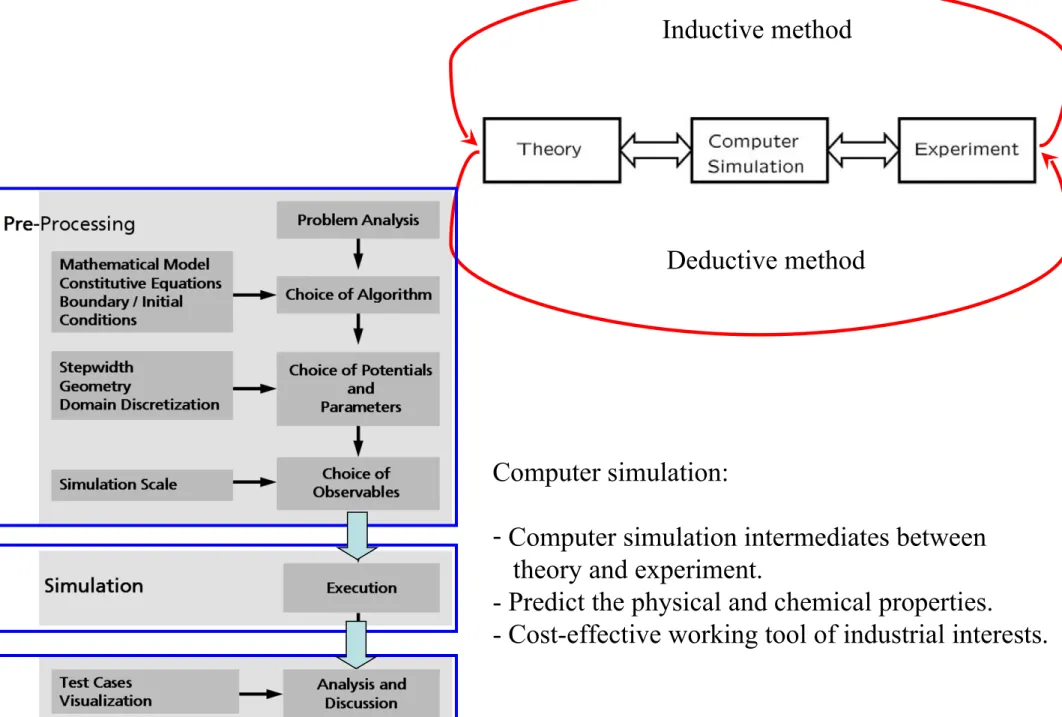
Ch. 1.3 The objective of experimental and theoretical physics
Inductive method
Deductive method
Computer simulation:
- Computer simulation intermediates between theory and experiment.
- Predict the physical and chemical properties.
- Cost-effective working tool of industrial interests.
![공정개발을 위한 다중규모 모사 Multiscale simulation for process development [General introduction]](data:image/gif;base64,R0lGODlhAQABAIAAAP///wAAACH5BAEAAAAALAAAAAABAAEAAAICRAEAOw==)