• 검색 결과가 없습니다.

A Minimally Invasive Approach for the Treatment of Mid-Aortic Syndrome in Takayasu Arteritis

N/A
N/A
Protected

Academic year: 2021

Share "A Minimally Invasive Approach for the Treatment of Mid-Aortic Syndrome in Takayasu Arteritis"

Copied!
4
0
0

로드 중.... (전체 텍스트 보기)

전체 글

(1)

ISSN: 2233-601X (Print) ISSN: 2093-6516 (Online)

− 399 −

This article was presented at the 293rd Seoul-Gyeonggi branch Monthly Meeting of the Korean Society for Thoracic and Cardiovascular Surgery.

Received: May 24, 2018, Revised: August 25, 2018, Accepted: August 27, 2018, Published online: December 5, 2018

Corresponding author: Joon Bum Kim, Department of Thoracic and Cardiovascular Surgery, Asan Medical Center, University of Ulsan College of Medicine, 88 Olympic-ro 43-gil, Songpa-gu, Seoul 05505, Korea

(Tel) 82-2-3010-5416 (Fax) 82-2-3010-6966 (E-mail) [email protected]

© The Korean Society for Thoracic and Cardiovascular Surgery. 2018. All right reserved.

This is an open access article distributed under the terms of the Creative Commons Attribution Non-Commercial License (http://creativecommons.org/

licenses/by-nc/4.0) which permits unrestricted non-commercial use, distribution, and reproduction in any medium, provided the original work is properly cited.

A Minimally Invasive Approach for the Treatment of Mid-Aortic Syndrome in Takayasu Arteritis

Keong Jun Ha, M.D. 1 , Won Chul Cho, M.D. 1 , Wan Kee Kim, M.D. 2 , Joon Bum Kim, M.D., Ph.D. 2

1

Department of Thoracic and Cardiovascular Surgery, Gangneung Asan Hospital, University of Ulsan College of Medicine,

2
Department of Thoracic and Cardiovascular Surgery, Asan Medical Center, University of Ulsan College of Medicine

A 61-year-old woman who presented with claudication and dyspnea on exertion was found to have severe calcified narrowing of the descending aorta and severe insufficiency of the aortic valve. These findings were compatible with Takayasu arteritis. To treat these hemodynamic abnormalities, extra-aortic bypass surgery combined with replacement of the aortic valve and ascending aorta-to-hemiarch replacement was performed through a separated upper hemi-sternotomy and limited median laparotomy. We present our successful surgi- cal experience with this case.

Key words: 1. Takayasu arteritis 2. Aortic bypass surgery 3. Minimally invasive surgery 4. Thoracic aorta

Case report

A 61-year-old woman visited the emergency de- partment because of severe dyspnea and claudication in both legs. The patient had been diagnosed with Takayasu arteritis (TA) 30 years previous. Angiotensin- receptor blockade had been prescribed to control the patient’s renovascular hypertension. The patient’s pulse pressure was elevated (152/50 mm Hg), and both femoral arteries were barely palpable. On ex- amination, a significant diastolic murmur was heard at the left parasternal second space. In the initial lab- oratory findings, the patient’s glomerular filtration rate was decreased (44 mL/kg/min/1.72 m

2

, Modifi- cation of Diet in Renal Disease equation), while in- flammatory markers were within the normal range

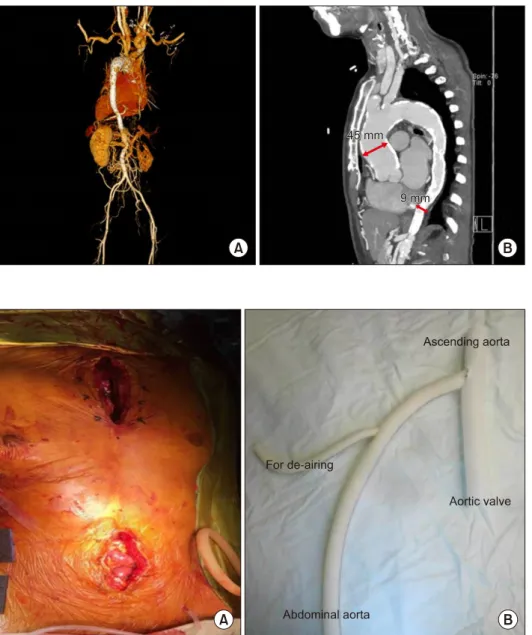
(C-reactive protein level, 0.41 mg/dL; erythrocyte sedimentation rate, 17 mm/hr). The ankle-brachial index (ABI) was 0.57 and 0.55 on the right and left sides, respectively. Computed tomography (CT) showed dilation of a porcelain ascending aorta (45 mm) with severe calcification and multifocal luminal narrowing of the descending aorta (Fig. 1). Echocardiography revealed severe regurgitation of the aortic valve (AV) and a left ventricular indexed diastolic diameter of 64 mm. Based on these findings, the decision was made to perform surgical correction.

The incisional approaches were similar to those re- ported previously [1]. In brief, a median upper ster- notomy was made for the AV and ascending aortic procedures (Fig. 2A). In addition, a small midline lap- arotomy (6 cm) was made to perform bypass anasto-

Korean J Thorac Cardiovasc Surg 2018;51:399-402 □ CASE REPORT □

https://doi.org/10.5090/kjtcs.2018.51.6.399

(2)

Keong Jun Ha, et al

− 400 −

Fig. 2. Intraoperative findings. (A) Double incisions for the surgical ap- proach (upper hemi-sternotomy and mini-laparotomy). (B) A preliminarily shaped hand-sewn graft.

Fig. 1. Preoperative computed to- mography. (A) Multifocal luminal narrowing in the descending aorta.

(B) The dilated ascending aorta with severe calcification of the aortic wall.

mosis at the abdominal aorta. A newly designed graft was prepared by connecting 2 differently shaped grafts (Hemashield graft; Boston Scientific, Boston, MA, USA) to reduce the cardiac ischemia time, saving time for additional anastomosis (Fig. 2B). Single arte- rial and venous cannulation was used at the in- nominate artery and right atrial auricle, respectively.

After aortotomy, the 3 AV leaflets were observed to be thickened and retracted. While lowering the body temperature to 25°C, the native AV was resected.

Under hypothermic circulatory arrest, hemiarch re- placement was performed with the assembled graft.

Thereafter, whole-body perfusion was restored.

During the re-warming of the patient’s body, AV re-

placement was performed using a mechanical pros- thesis (ATS open pivot bileaflet mechanical heart valve prosthesis, 24 mm; ATS Medical Inc., Minneapolis, MN, USA) with a continuous suture technique using 3 sets of Prolene 3-0 sutures (Ethicon Inc., Johnson

& Johnson, New Brunswick, NJ, USA). After weaning

the patient from cardiopulmonary bypass, the pre-

viously connected 20-mm graft was passed through

the diaphragm from the anterior mediastinum to the

intra-abdominal space (Fig. 3A, B). In the peritoneal

space, the graft was positioned to pass through the

transverse mesocolon. A graft to the abdominal aortic

anastomosis was achieved with side biting of the

aorta. The cardiopulmonary bypass, cardiac ischemia,

(3)

Minimally Invasive Appoach for the Treatment of Mid-Aortic Syndrome in Takayasu Arteritis

− 401 −

Fig. 3. The results of graft bypass.

(A) Replacement of the ascending aorta. (B) Bypass graft anastomosed at the abdominal aorta. (C) Postope- rative computed tomography show- ing well-maintained blood flow.

and circulatory arrest times were 97, 73, and 8 mi- nutes, respectively. The patient’s postoperative course was uneventful, without any complications. The pa- tient was transferred to the general ward on post- operative day 1 and discharged on postoperative day 10. Postoperative CT showed well-maintained graft patency and visceral organ perfusion (Fig. 3C). The postoperative ABI was 1.13 on the right side and 1.12 on the left side. The glomerular filtration rate increased to 71 mL/kg/min/1.72 m

2

. During 17 months of follow-up, the patient was free of any symptoms of heart failure, claudication, or end-organ dysfunction, and there were no notable complications.

Discussion

TA is a form of chronic granulomatous arteritis that mainly affects the aorta and its major branches.

In this patient, regurgitation of the AV was found, as well as severe calcified narrowing of the descending aorta and dilatation of the ascending aorta with calcification. The characteristic pathologic findings of TA are hypertrophy of the ascending aorta, fibrosis of the adventitia, thinning of the media, dis- appearance of elastic fibers, and inflammation of the vascular wall [2,3]. In this case, histological examina- tion of the ascending aortic wall showed non-specific aortitis in the adventitia and media. These findings

suggested that the disease of the ascending aorta was due to TA. Aortic regurgitation can also develop with TA, and is a risk factor for mortality. It is a fairly common complication of TA, as significant aort- ic regurgitation has been reported to occur in 18%

of TA patients in Korea [4]. In cases of aortic regur- gitation due to TA, the valve itself has no evidence of inflammation, and it is characterized by valvular thickening, fibrosis, and hyaline or myxoid changes [2,3]. In this case, the AV was thickened and retracted. The results of the pathologic analysis showed fibromyxoid degeneration with calcification.

A relationship between aortic regurgitation and de- generative or rheumatic changes cannot be ruled out, but in this case, aortic regurgitation seems to have been due to TA.

In patients with TA, the presence of narrowed

points in the thoracoabdominal aorta is related to

the presentation of hypertension in the upper ex-

tremity and claudication in the lower limb [1]. For

these patients, bypass graft interposition using a

small conduit has been often used; however, this ap-

proach has been revealed to be a significant risk fac-

tor for graft occlusion [1,5,6]. In order to improve

the patency of the bypass graft, the ascending aorta

has been considered to be the best proximal inflow

site. In the present case, the patient’s native ascend-

ing aorta was severely calcified and atherosclerotic,

(4)

Keong Jun Ha, et al

− 402 − and there was multifocal luminal narrowing in the distal aortic arch and descending aorta. Therefore, replacement of the ascending aorta and hemiarch was regarded as the ideal option to offer a clear-in- flow conduit without the risk of embolic stroke prior to the construction of the extra-anatomic bypass.

Matsuno et al. [7] reported that performing an ex- tra-anatomic aortic bypass between the ascending aorta and the abdominal aorta in patients with mid- dle aortic syndrome had several advantages. Blood flow bypass can be achieved through an extra-aortic graft despite diffuse tubular narrowing of the de- scending aorta, avoiding the substantial risks posed by extensive replacement of the descending aorta. In addition, it was possible to correct AV regurgitation and ascending aortic dilatation by a single operation in the present case. Reducing the extent of surgical incisions might have positively affected the patient’s perioperative pain level and pulmonary function. In conclusion, a double-minimal-incision approach may be a reasonable surgical option to treat patients with TA who present with similar conditions.

Conflict of interest

No potential conflict of interest relevant to this ar- ticle was reported.

References

1. Yun JK, Kim JB. Extra-anatomic aortic bypass for the man- agement of mid-aortic syndrome caused by Takayasu arteritis. Korean J Thorac Cardiovasc Surg 2015;48:70-3.

2. Matsubara O, Kagata Y, Imazeki N, et al. Aortic valve le- sions in Takayasu’s arteritis: pathologic examination of surgically removed and autopsied aortic valves in 12 patients. Proceedings of the 86th Annual Meeting of the United States and Canadian Academy of Pathology; 1997 Mar; Orlando, USA. Augusta (GA): The United States and Canadian Academy of Pathology; 1997.

3. Song JK, Jeong YH, Kang DH, et al. Echocardiographic and clinical characteristics of aortic regurgitation because of systemic vasculitis. J Am Soc Echocardiogr 2003;16:850-7.

4. Lee GY, Jang SY, Ko SM, et al. Cardiovascular manifes- tations of Takayasu arteritis and their relationship to the disease activity: analysis of 204 Korean patients at a sin- gle center. Int J Cardiol 2012;159:14-20.

5. Heinemann MK, Ziemer G, Wahlers T, Kohler A, Borst HG.

Extraanatomic thoracic aortic bypass grafts: indications, techniques, and results. Eur J Cardiothorac Surg 1997;11:

169-75.

6. Kim HJ, Choi JW, Hwang HY, Ahn H. Extra-anatomic as- cending aorta to abdominal aorta bypass in Takayasu ar- teritis patients with mid-aortic syndrome. Korean J Thorac Cardiovasc Surg 2017;50:270-4.

7. Matsuno Y, Mori Y, Umeda Y, Imaizumi M, Takiya H. A suc- cessful case of ascending aorta: abdominal aorta bypass for middle aortic syndrome. Vasc Endovascular Surg 2009;

43:96-9.

수치

Fig. 1. Preoperative computed to- to-mography. (A) Multifocal luminal  narrowing in the descending aorta
Fig. 3. The results of graft bypass.

참조

관련 문서

Second, as a direct impact, the abolishing of licensing gives both incumbent and entrants higher option value directly because the new facility based

The main objective of the Bi Regional Center for SMES Development is oriented towards generating the conditions of cooperation among the countries which

Current Tokyo is rich in green compared to other metro cities. In some parts, the greenery has been contributed by the many inherited gardens from the Edo era to today which

In a statement to Kuwait News Agency (KUNA) on the sidelines of a meeting of the Arab Parliament's Foreign Affairs Political and National Security

The meeting was attended by Assistant Foreign Minister for GCC Affairs, Ambassador, Nasser Al-Muzayyen, and Deputy Assistant Foreign Minister for the Office of the

“ Sheikh Nasser has a written message from HH the Amir, Sheikh Sabah Al-Ahmad Al-Jaber Al-Sabah to the Chinese President, Chi Gen Beng related to enhancing mutual

On his part, CEO of Express Roads Authority, Saud Al-Naqqi said that the heavy rains of the previous day led to clogging parts of the express

Kuwait will celebrate on Sunday the fourth anniversary of the UN honoring and proclamation of His Highness the Amir, Sheikh Sabah Al-Ahmad Al-Jaber Al-Sabah as