• 검색 결과가 없습니다.

Oral Syphilis Responds to Topical Antibiotic Therapy but Still Needs Definitive Systemic Treatment JOMP

N/A
N/A
Protected

Academic year: 2021

Share "Oral Syphilis Responds to Topical Antibiotic Therapy but Still Needs Definitive Systemic Treatment JOMP"

Copied!
5
0
0

로드 중.... (전체 텍스트 보기)

전체 글

(1)

pISSN 2288-9272 eISSN 2383-8493 J Oral Med Pain 2018;43(1):21-25 https://doi.org/10.14476/jomp.2018.43.1.21

Oral Syphilis Responds to Topical Antibiotic Therapy but Still Needs Definitive Systemic Treatment

Kyu-Hyeon Ahn 1 , Hyeong-Joon Ji 1 , Ok-Joon Kim 1 , Byung-Gook Kim 2 , Yeong-Gwan Im 3

1 Department of Oral Pathology, School of Dentistry, Dental Science Research Institute, Chonnam National University, Gwangju, Korea

2 Department of Oral Medicine, School of Dentistry, Chonnam National University, Gwangju, Korea

3 Department of Oral Medicine, Chonnam National University Dental Hospital, Gwangju, Korea

Received February 14, 2018 Revised March 8, 2018 Accepted March 9, 2018

Syphilis, one of the most common sexually transmitted diseases, is caused by the microorgan- ism Treponema pallidum. Syphilis consists of several clinical stages that may include signs in the oral and perioral regions. Syphilis is treated effectively with systemic antimicrobial therapy using antibiotics such as penicillin. This article describes a case where topical antibacterial therapy with doxycycline was effective in treating oral papular lesions associated with primary syphilis in a 24-year-old male. He was immediately referred to a dermatologist, and antibiotic therapy was administered in response to positive diagnostic test results for syphilis. Although oral syphilitic lesions may be resolved by dental professionals using topical treatments, syphi- litic infections should be managed in consultation with medical specialists using systemic anti- biotic therapy.

Key Words: Doxycycline; Oral mucosa; Oral syphilis

Correspondence to:

Yeong-Gwan Im

Department of Oral Medicine, Chonnam National University Dental Hospital, 33 Yongbong-ro, Buk-gu, Gwangju 61186, Korea

Tel: +82-62-530-5678 Fax: +82-62-530-5679 E-mail: [email protected]

JOMP Journal of Oral Medicine and Pain

Copyright Ⓒ 2018 Korean Academy of Orofacial Pain and Oral Medicine. All rights reserved.

CC

This is an open-access article distributed under the terms of the Creative Commons Attribution Non-Commercial License (http://creativecommons.org/licenses/by-nc/4.0/), which permits unrestricted non-commercial use, distribution, and reproduction in any medium, provided the original work is properly cited.

INTRODUCTION

Syphilis is one of the most common sexually transmit- ted diseases. It is usually spread by sexual contact with an infected individual. It is caused by the Gram-negative spi- rochete Treponema pallidum and has several clinical stag- es. Primary syphilis is characterized by chancres at the site of infection, which is usually in the genital area. However, syphilitic lesions can occur at other sites, including the oral and perioral regions (e.g., lips, tongue, and palate). 1-3) In pa- tients with secondary syphilis, oral lesions that resemble typical skin rashes or mucous patches may also occur. 4,5) Lesions in the oral cavity that include gummas on the hard palate may appear in tertiary syphilis. 1)

Several diagnostic tests can be used to screen for syphi- litic infections. These include the rapid plasma reagin and venereal disease research laboratory (VDRL) tests. The

diagnosis is confirmed by other tests, including the fluo- rescent treponemal antibody absorption (FTA-ABS) test, Treponema pallidum hemagglutination assay (TPHA), and immunohistochemical staining of biopsies to detect T.

pallidum. 6)

Penicillin is effective in treating syphilis, and parenteral administration of benzathine benzylpenicillin is used as a primary therapy. 7) Other antibiotics that are effective against syphilis include ceftriaxone, erythromycin, azithromycin, and doxycycline. 8)

Most previous case reports describing oral syphilitic le-

sions have emphasized the diagnostic process and the role

of dentists or primary healthcare providers in detecting

syphilis in patients. 3-5,9,10) In this case study, we adminis-

tered local antimicrobial therapy, which was effective in

promoting the healing of oral syphilitic lesions. We imme-

diately referred the patient to a dermatologist, and systemic

(2)

antibiotic therapy was provided to address the definitive di- agnosis of primary syphilis.

CASE REPORT

A 24-year-old male presented to the Department of Oral Medicine at Chonnam National University Dental Hospital with painful lesions on his palate and tongue. The lesions were on the uvula and the left lateral side of the tongue and had developed and enlarged over the preceding 1.5 months.

He felt pain when eating spicy food and swallowing, and this pain was at its most severe in the early morning. He

also reported influenza-like symptoms that had persisted for approximately 1 month and weight loss (6-7 kg). During the previous week, he had been treated by an otorhinolar- yngologist, but the therapy had been ineffective. He had no significant medical history of systemic disease.

Three papular-nodular lesions were observed in the oral cavity during a careful clinical examination. There was a round papular lesion on the mid-palate (2 mm in diameter), which was surrounded by a red halo. There were also two raised nodular lesions, one on the soft palate near the uvula (1.5 cm) and the other on the floor of the mouth (1.0 cm).

These lesions were plaque-like and irregular in shape (Fig.

Fig. 1. Locations of the syphilitic lesions before and after treatment with topical antibiotics. White arrows indicate the locations of the syphi-

litic lesions on the oral mucosa.

(3)

1). Apart from these mucosal lesions, there were no signs of pathology in the oral or perioral region. Panoramic radiog- raphy uncovered no lesions in the periapical region, para- nasal sinuses, or jaw bones.

Oral syphilis was considered as a tentative diagnosis be- cause the nodular lesions were irregular and softer than those associated with other soft tissue pathologies (e.g., irri- tation fibroma, pyogenic granulomas, squamous papilloma, and salivary gland mucoceles). Diagnostic laboratory tests were planned, including a Treponema pallidum antibody (TPA) immunoassay (ARCHITECT syphilis TP test; Abbott, Abbott Park, IL, USA), basic complete blood count, erythro- cyte sedimentation rate (ESR), and C-reactive protein (CRP) test, together with a medical consultation to screen for a syphilitic infection. While awaiting the results of these di- agnostic tests, short-term topical antimicrobial therapy was administered in an attempt to manage the oral lesions. Four tablets of doxycycline monohydrate (100 mg/tablet) were pulverized and added to 120 mL of water. The patient was instructed to gargle with this suspension for several minutes at least three times a day.

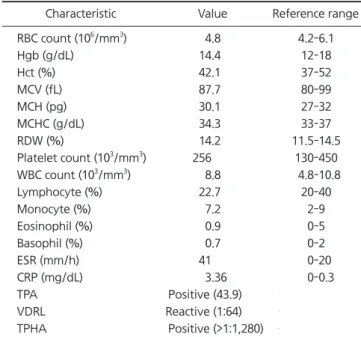
On his next visit, 1 week later, the patient reported that his oral symptoms had improved so much that even eat- ing spicy food was no longer painful. However, he also ex- plained that red macules had now appeared on his thigh. A careful inspection of the oral cavity showed that the mu- cosal lesions were so well healed that their original loca- tions were difficult to determine (Fig. 1). The laboratory test results (Table 1) revealed a high CRP level and ESR, and a positive TPA test.

For further evaluation and treatment, the patient was referred to the Department of Dermatology, Chonnam National University Hospital, where a dermatologist ob- served papules, plaques, and erosive patches in the geni- tal region and noted that there had been sexual contact 3 months before the genital lesions developed. The VDRL an- tigen test (Becton, Dickinson and Co., Franklin Lakes, NJ, USA) was positive and the confirmatory TPHA test (Serodia TPPA assay; Fujirebio Inc., Tokyo, Japan) indicated an ac- tive syphilitic infection (Table 1). Based on the diagnosis of primary syphilis, the patient was treated with three intra- muscular injections of 2.4 million units of benzathine ben- zylpenicillin at 1-week intervals.

DISCUSSION

The patient was diagnosed with primary syphilis based on his history, the presence of oral mucosal lesions, clinical findings, and diagnostic laboratory tests. The patient had sexual contact before the development of the genital le- sions. The morphology of the papular-nodular lesions in the oral mucosa was dissimilar to that typical of common oral mucosal pathologies, including fibroma, pyogenic granulo- mas, and squamous papilloma, but characteristic of syphi- litic lesions. The non-treponemal and treponemal assay test results confirmed this diagnosis. Biopsies and histopatho- logical examinations were not performed. The histopatho- logical features of primary syphilis include an ulcerated epithelial surface and chronic inflammatory infiltration of lymphocytes and plasma cells into the stroma and perivas- cular area. 11) In addition, immunohistochemical staining may confirm the presence of spirochetes at the junction be- tween the epithelium and superficial stroma, and surround- ing the blood vessels. 2,4,9,10)

Table 1. The results of the diagnostic laboratory tests

Characteristic Value Reference range

RBC count (10

6

/mm

3

) 4.8 4.2-6.1

Hgb (g/dL) 14.4 12-18

Hct (%) 42.1 37-52

MCV (fL) 87.7 80-99

MCH (pg) 30.1 27-32

MCHC (g/dL) 34.3 33-37

RDW (%) 14.2 11.5-14.5

Platelet count (10

3

/mm

3

) 256 130-450

WBC count (10

3

/mm

3

) 8.8 4.8-10.8

Lymphocyte (%) 22.7 20-40

Monocyte (%) 7.2 2-9

Eosinophil (%) 0.9 0-5

Basophil (%) 0.7 0-2

ESR (mm/h) 41 0-20

CRP (mg/dL) 3.36 0-0.3

TPA Positive (43.9)  

VDRL Reactive (1:64)  

TPHA Positive (>1:1,280)  

RBC, red blood cell; Hgb, hemoglobin; Hct, hematocrit; MCV, mean

corpuscular volume; MCH, mean corpuscular hemoglobin; MCHC,

mean corpuscular hemoglobin concentration; RDW, red blood cell

distribution width; WBC, white blood cell; ESR, erythrocyte sedi-

mentation rate; CRP, C-reactive protein; TPA, Treponema pallidum

antibody immunoassay; VDRL, venereal disease research laboratory

test; TPHA, Treponema pallidum hemagglutination assay.

(4)

Although the primary therapeutic agent used to treat syphilis is penicillin, 7) other antibiotics are also effective. 8,12) Doxycycline, ceftriaxone, tetracycline, and azithromycin are used as alternatives to treat early syphilis, and doxycycline and tetracycline can be used to treat late and latent syphi-

lis. 13,14) Doxycycline ( α -6-deoxy-5-hydroxytetracycline) is a

member of the tetracycline family; tetracyclines inhibit bac- terial protein synthesis specifically by binding to the 30S ribosomal subunit, and they have been used to successfully treat syphilis at various stages of the disease. 15) Tetracyclines have a broad spectrum of activity and are effective against most aerobic and anaerobic bacteria, Chlamydia, Mycoplasma, and Rickettsia, in addition to spirochetes.

Antibiotics are generally administered by enteral or par- enteral routes to act systemically. However, in this case, a topical antibiotic formulation was prepared. Doxycycline is stable at both acidic and basic pH values and is absorbed efficiently from the gastrointestinal tract. It is available as both a hydrated salt and in monohydrate form. Doxycycline monohydrate is insoluble in water and was used to treat this patient in an aqueous suspension. 16)

The oral syphilitic lesions had almost entirely healed within a week of the topical treatment being introduced.

Doxycycline eliminated the T. pallidum infection from the oral mucosal surface. Some of the doxycycline molecules probably permeated the oral epithelium and suppressed the bacteria within the subepithelium. 17) The oral lesions were able to heal once the causative microorganism was sup- pressed or eliminated.

There are two major routes for drugs to permeate the oral mucosa. Hydrophilic drugs can passively diffuse between cells, whereas hydrophobic drugs may permeate cells di- rectly and cross the epithelium by a transcellular route. 18) The thickness of the oral mucosa also affects its permeabili- ty. The thick keratinized epithelium contains lipid molecules that can act as a barrier, making it relatively impermeable.

In contrast, the non-keratinized epithelium of the mouth floor and buccal mucosa is more permeable. 19) In this pa- tient, the papular lesions were on the soft palate and mouth floor, which are covered with non-keratinized epithelium.

These areas are more permeable to water-soluble drugs than keratinized regions.

It should be emphasized that local therapy alone cannot

resolve a systemic infection and may delay definitive treat- ment, allowing the disease to progress to the next stage.

Patients could consider their oral lesions cured and they may not comply with further visits for a systemic antibiotic therapy. In addition, unusual oral or perioral lesions that may be signs of syphilis must be thoroughly evaluated us- ing the relevant diagnostic tests. If oral manifestations of syphilis are identified, consultation with a medical special- ist is mandatory. In this case, the patient was referred to a dermatologist when the diagnostic tests proved positive.

Primary syphilis was then confirmed, and definitive treat- ment began using systemic antibiotic therapy.

In conclusion, local antibacterial therapy was effective in promoting the healing of oral mucosal lesions in a young man with primary syphilis. However, although the oral le- sions were resolved using topical pharmacological therapy, consultation with medical specialists was necessary to con- firm the diagnosis and begin definitive therapy.

CONFLICT OF INTEREST

No potential conflict of interest relevant to this article was reported.

REFERENCES

1. Ficarra G, Carlos R. Syphilis: the renaissance of an old disease with oral implications. Head Neck Pathol 2009;3:195-206.

2. Fukuda H, Takahashi M, Kato K, Oharaseki T, Mukai H. Multiple primary syphilis on the lip, nipple-areola and penis: an immuno- histochemical examination of Treponema pallidum localization using an anti-T. pallidum antibody. J Dermatol 2015;42:515-517.

3. Seibt CE, Munerato MC. Secondary syphilis in the oral cavity and the role of the dental surgeon in STD prevention, diagnosis and treatment: a case series study. Braz J Infect Dis 2016;20:393-398.

4. Carbone PN, Capra GG, Nelson BL. Oral secondary syphilis. Head Neck Pathol 2016;10:206-208.

5. Murrell GL. Secondary syphilis oral ulcer. Otolaryngol Head Neck Surg 2009;140:942-943.

6. Ratnam S. The laboratory diagnosis of syphilis. Can J Infect Dis Med Microbiol 2005;16:45-51.

7. Douglas JM Jr. Penicillin treatment of syphilis: clearing away the shadow on the land. JAMA 2009;301:769-771.

8. Clement ME, Okeke NL, Hicks CB. Treatment of syphilis: a sys- tematic review. JAMA 2014;312:1905-1917.

9. Kelner N, Rabelo GD, da Cruz Perez DE, et al. Analysis of non- specific oral mucosal and dermal lesions suggestive of syphilis:

a report of 6 cases. Oral Surg Oral Med Oral Pathol Oral Radiol

(5)

2014;117:1-7.

10. Strieder LR, León JE, Carvalho YR, Kaminagakura E. Oral syphi- lis: report of three cases and characterization of the inflammatory cells. Ann Diagn Pathol 2015;19:76-80.

11. Neville BW, Damm DD, Allen CM, Chi AC. Oral and maxillofacial pathology. 4th ed. St. Louis: Elsevier; 2015. pp. 170-174.

12. Drago F, Ciccarese G, Broccolo F, et al. A new enhanced antibiot- ic treatment for early and late syphilis. J Glob Antimicrob Resist 2016;5:64-66.

13. Hook EW 3rd, Martin DH, Stephens J, Smith BS, Smith K. A ran- domized, comparative pilot study of azithromycin versus benza- thine penicillin G for treatment of early syphilis. Sex Transm Dis 2002;29:486-490.

14. Liang Z, Chen YP, Yang CS, et al. Meta-analysis of ceftriaxone compared with penicillin for the treatment of syphilis. Int J Anti-

microb Agents 2016;47:6-11.

15. Dai T, Qu R, Liu J, Zhou P, Wang Q. Efficacy of doxycycline in the treatment of syphilis. Antimicrob Agents Chemother 2016;61:e01092-16.

16. Beale JM Jr, Block JH. Wilson and gisvold’s textbook of organic medicinal and pharmaceutical chemistry. 12th ed. Baltimore: Lip- pincott Williams & Wilkins; 2011. pp. 307.

17. Zhang H, Zhang J, Streisand JB. Oral mucosal drug delivery:

clinical pharmacokinetics and therapeutic applications. Clin Phar- macokinet 2002;41:661-680.

18. Rathbone MJ, Pather I, Senel S. Chapter 2 overview of oral muco- sal delivery. In: Rathbone MJ, Senel S, Pather I, eds. Oral mucosal drug delivery and therapy. New York: Springer; 2015. pp. 17-22.

19. Patel VF, Liu F, Brown MB. Advances in oral transmucosal drug

delivery. J Control Release 2011;153:106-116.

수치

Fig. 1. Locations of the syphilitic lesions before and after treatment with topical antibiotics
Table 1. The results of the diagnostic laboratory tests

참조

관련 문서

According to above, liquid based cytology is considered to be adequate for routine oral examination or diagnostic tool for oral dysplasia and carcinoma

Eroticism make-up will be the best solution to appeal to the buyer and expression of make-up that is based on pure emotions and sexual tangle is developed by the needs of

Patient had laparoscopic surgery on the adnexal tumor and excised tissue was removed through Douglas pouch incision by single surgeon.. Results: The mean age

Diagnosis and Treatment of Oral admidstrated Bisphosphonate-related osteonecrosis of the jaw.. and implantation

The paper aims to analyze the 'Japanese Military Sexual Slavery' narrative and its perspectives in high school Korean history textbooks based on academia's

The purpose of this study was to investigate the effects of sound-finding strategies based on phonological awareness on word recognition, oral reading

His initial knowledge of the tradition was fragmentary because it was based on the literature that comprises this tradition and its descendants.. His initial

Based on the findings of this study, researcher concluded that externalization in narrative therapy needs to improve the therapeutic alliance and achieve