Research Article Open Access
The Effects of Aquatic Group Exercise on Body Composition and Mental Health of Elderly Women
Hae-An Ok
†Dept. of Sports and Health Management, Mokwon Univiersity
Received: December 7, 2016 / Revised: December 27, 2016 / Accepted: February 2, 2017
ⓒ 2017 J Korean Soc Phys Med
| Abstract |
1)PURPOSE: Regular physical activity in the elderly population has significant benefits for health. The purpose of this study was to investigate the effects of aquatic group exercise on body composition and mental health of the elderly females.
METHODS: This study included 40 elderly women. The aquatic group exercise program was performed for an hour a day, 3 times a week for 12 weeks with moderate-intensity level. The body composition, physical fitness mental health instruments were used to measure the outcome variables before and after the program. Data was analyzed with SPSS using descriptive statistics and the t-test.
RESULTS: It was found that the 12 week aquatic group exercise program had effects on body mass and BMR were significantly improved after the intervention of this study. In health related physical fitness, flexibility and sense of balance were significantly increased in the participants. In the mental health of the female elderly participants were evaluated in areas such as depression, sense of isolation, interpersonal
†Corresponding Author : [email protected]
This is an Open Access article distributed under the terms of the Creative Commons Attribution Non-Commercial License (http://creativecommons.org/licenses/by-nc/3.0) which permits unrestricted non-commercial use, distribution, and reproduction in any medium, provided the original work is properly cited.
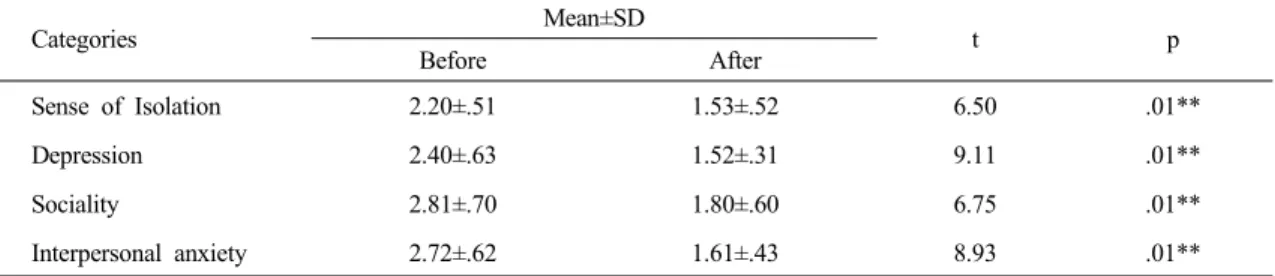
anxiety, and sociality. They showed significant change in a positive way.
CONCLUSION: It is suggested that aquatic group exercise should be activated and encouraged to enhance physical and mental health of elderly women and various types of manuals should be developed according to characteristics of programs to operate this exercise more effectively.
Key Words: Aquatic group exercise, Body mass index, Elderly women, Mental health, Physical fitness
Ⅰ. Introduction
The elderly population over 65 is increasing every year
in Korea by 12.7% as indicated by a study conducted in
2014. If adding pre-elderly, those who were born between
1955 and 1963, during baby boom, the elderly and
pre-elderly population reaches 33.5% (Statistics Korea,
2015). Such a rapid increase of the elderly population
creates various social problems in the area of jobs, leisure,
medical services, and also welfare (Kim, 2009). Prevalence
of disease among Korean elderly is constantly increasing
just like the trend of the aged population according to
National Statistics (Statistics Korea, 2015). Especially
medical expenses of the elderly over 65 in 2013 reached
17,528.3 billion won which is 34.5% of total medical expenses which is 50,742.6 billion won.
Remarkable medical improvement brought a longer average life expectancy. As living in the area of longevity, higher level of fitness is an essential and important factor for mental, social, and the quality of life. Therefore, the meaning of attending physical activities in the elderly is more important than in the young population (Williams et al., 1993). Particularly, active participation of the elderly in their physical activities will benefit not only themselves but also society (Reaven et al., 1991; Lee and Park, 2013).
According to World Health Organization (WHO), regular physical activity of moderate intensity in the elderly population has significant benefits for a happy life as well as physical, social, and mental health (WHO, 2016).
Compared with inactive elderly, the active had relatively lower prevalence in many diseases such as depression, cardiac disease, hypertension, stroke, type II diabetes, metabolic syndrome, rectal colon, and breast cancer.
Furthermore, it was reported that higher attendance of physical activities would restrain the aging process, and also prevents various geriatric illnesses (WHO, 2016).
It has been recommended that elderly and obese females reduce ground exercises and to increase aquatic exercise which would not be a burden while improving muscular power and widening the working range of joints (Choi et al., 2012; Jung et al., 2010; Lee et al., 2004). It is also reported that these exercises have beneficial effects on body composition (Park and Ahn, 2010), basic physical fitness factors such as improvement in muscular strength, flexibility, sense of balance, muscular endurance, increase of joint working range, and better quality of life (Jang, 2000; Kim and Kim, 2013; Lee et al., 2011; You and Lee, 2010).
Aquatic group exercise is one of the recommendable physical activities for the elderly. Especially, for surgical rehabilitation patients, the elderly, those who have weak physical fitness or those who are obese. Aquatic exercise
prevents overload on the body while increasing the amount and strength of muscle, and flexibility of joints (Kim et al., 2016; Lee et al., 2004).
Besides, recently such aquatic group exercise is evolving into new types of highly recommendable activities with recreational characteristics. Aquatic group exercise is a series of planned and programmed underwater exercises composed of various movements and games accompanied with the newest popular music rather than existing rehabilitation focused underwater exercise. Such aquatic group exercise improves not only health and strength of the elderly but also enhances their social activities.
Therefore, the elderly who participated in these exercises can improve or prevent mental illnesses such as isolation, depression, helplessness, and a sense of alienation by sympathizing and interacting with one another (Cho and Kim, 2012; Moon, 2014).
Nevertheless, there have not been many studies on the effects of aquatic group exercise on the change of body composition, and basic physical fitness. In particular, studies about effects of such aquatic group exercise on social wellbeing and mental health of the elderly have not been presented and studied (Song et al., 2011). Therefore, this study tries to identify effects of Aquatic group exercise for 12 weeks on body composition, basic physical fitness, as well as mental health of the elderly.
Ⅱ. Method
1. Subjects
The subjects of the study were 40 females from 65 to
80 years old who enrolled in aquatic group exercise for
the first time in 4 swimming pools in D metro city. All
the subjects were medically fit enough to participate in
underwater exercise. The criteria for selection of the
subjects in this study were those who agreed to participate
in the aquatic exercise program, those who were able to
Categories Exercises Intensity Warm Up
(10 min.) - Walking, Articulation exercises, Stretching. RPE 9 - 11
Primary Exercise (40 min.)
- Bounce-front, back, side(Tempo-half water tempo. water tempo) - Knee jogging-narrow wide cross.
- Jumping jack, Scissors, Pendulum leg swing, Leaping, Leg Curl, Twist, Mambo step, jazz kick& soccer kick, Kick-front, back, side.
- Frog jump, Tuck jump, Land jogging (Level 1, 2, 3), - Push and Jumping jack 8,
- Push 4 count 2 times and Jogging with chest shake 8 count), - (Push 8 count 2 times and Land jogging 8 count
- (Rock step–8 count) and (Wide Kick right to left side 8 count) - (Rock step–left to right side 8 count) + (Wide Kick left side 8 count) - (Push–from left foot 8 count) and turn(Push–right foot 8 count)
- Free style Pyramid, and Pattern style proceed with music and basic movement.
- Shoulder Movement (Shoulder flexion, extension, adduction, abduction, external and internal rotation, bicep curl)
RPE 11 - 13
Cool Down
(10 min.) - Static and dynamic stretching. RPE 9 - 11
Table 2. Aquatic Group Exercise Program
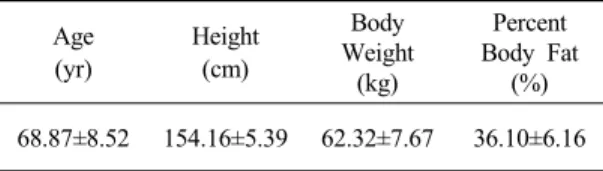
communicate and did not have cognitive impairment, those who did not have chronic diseases and physical defects or cardiopulmonary disorders that interfere with exercise, and was limited to those who did not participate in physical exercise or other exercise programs for the previous 6 months. And, for the ethical issue, the study was conducted after obtaining the participation agreement and were used a pseudonym to protect the identity and personal infor- mation. Their general characteristics are shown in (Table 1).
Age (yr)
Height (cm)
Body Weight (kg)
Percent Body Fat
(%) 68.87±8.52 154.16±5.39 62.32±7.67 36.10±6.16 Table 1. General Characteristics of Subjects (N=40)
2. Aquatic Group Exercise Program
The length of the pool is 5 lanes with a length of 25 m and a depth of 1.2 to 1.4 m. The pool was kept at
room temperature 28.5~29 ℃, relative humidity 60~70%, water temperature 28~30 ℃. In order to disinfect the swimming pool, it is the only safe chlorine currently used in Korea, and the concentration is .4~1.0ppm, which was to be automatically supplied to the concentration range by a computerized system the machine. In order to prevent safety accidents at the swimming pool during the class, the security officer was on duty at all times.
A total of 12 weeks of aquatic group exercise program was performed three times a week for 60 minutes per day, and it was conducted in the order of warm up exercise, main exercise, and cool down exercise as shown in (Table 2). The pool lighting was 200~500 Lux, which is the general indoor pool lighting according to the illumination standard.
The objective of the warm up exercise is to create a state of mind and body that can raise the effectiveness of primary movements.
To maintain a normal body temperature, this study used
10 minutes to walk slowly in the water (front, side, back),
arm waving, fast walking, and simple articulation as well as dynamic stretching. Also, a beat that is important for the movement of the subjects in the aquatic exercise and was designated at a speed of 110-130 bpm, while the warm and cooldown exercise was performed at 110 bpm.
In this exercise, using a rating of perceived exertion (RPE), the intensity of the adaptation was 9~10 (very light) for the first week, and 11~12 (light) for the second week.
The progressive increase method was applied to the exercise intensity of 11~13 (a little hard or hard). Exercises include making a circle for recreational game by pushing the side of the water, holding hands and clapping hands, and hip-dancing with hip-bumping. Next, to improve muscle strength and endurance, exercise was performed with an aqua rod to increase resistance. Finally, aerobic group exercise was performed by jogging or fast beat dancing.
The cool down exercise was performed with static and dynamic stretching for 10 minutes. Static stretching was stretched slowly by stretching, pulling and then held for 15 seconds.
3. Measurement
1) Body Composition Analysis (1) InBody Measurement
Body composition such as muscle amount, basal metabolic rate, percentage of body fat, and BMI (Body Mass Index, kg/m2) was measured by In-body 230 (Bio- space, Korea).
To verify the reliability of the InBody, So et al. (2012) conducted a study to compare body composition measure- ments taken with air displacement plethysmography (BOD POD) using eight-polar bioelectrical impedance analysis.
Pearson's r correlation showed that body composition measurements taken using the BOD POD and the eight polar BIA including InBody correlated significantly with respect to fat free mass (r=.911); (fat mass r=.938 ); and
% body fat (r=.871).
(2) Basal Metabolic Rate (BMR)
The basal metabolic rate is the energy consumed to maintain fundamental life phenomena such as nerve action, circulation, respiration, endocrine, digestion, body tem- perature maintenance and other cell action. According to Lim's (2016) study on the body composition, physical activity level, basal metabolic rate, and daily energy expenditure (DEE) of the elderly in Busan, DEE was calculated by H-B formula, DRI formula, Inbody meas- urement, and estimated energy requirements (EER) formula.
The correlation was found to be significantly high between .73 and .89.
2) Basic Physical Fitness
(1) Muscular Strength (Grip Strength) Measurement Choe et al.'s (2010) study on the evaluation of the Korean Version of Physical Activity Scale for the Elderly (K-PASE) developed the K-PASE, which can more easily and accurately measure physical activity of the elderly.
This tool was developed by Washburn et al. (1993).
Validity and reliability were verified through previous studies while the test-retest reliability was assessed over a 2 week interval (r=.94). The grip strength was measured in ㎏ units using the Lafayette Instrument tool (USA).
This study instructed that the arm be held firmly by the usual hand using the usual hand in the stance with 15 degrees apart to allow the body to fall 15 degrees and to open the legs naturally and then read the scale indicated by the needle while selecting the maximum value out of two trials.
(2) Flexibility Measurement
The flexibility measure (sit & reach) used in this study is based on the SFT (Senior Fitness Test) method developed by Rikli and Jones (2001) of the California State University.
Based on the reference value obtained by measuring over
7,000 people aged 60 to 94 years, moreover it has been
reported that it meets scientific criteria for reliability and
validity. The measurement of this study was conducted while taking precautions including careful alignment of the fingertips of both hands, avoiding bending forward with the recoil, placing the head between the arms when bending forward, and not bending the knee. From conducting the measure two times, the better grade was recorded and the unit was recorded with two decimal places.
(3) Balance Measurement (One leg balance with eyes open) In order to evaluate the static equilibrium of the study participants, this study was conducted with participants standing on one leg with eyes open which was designed specifically for the elderly. This measurement method referred to the studies of Araki et al. (2002) and Resnick et al. (2000) and the presentation material by Moon (2014).
In the measurement method, the subject stands barefoot and puts both hands on his/her waist, and bends the knee of a convenient foot and takes a posture in which the foot is raised about 15cm from the floor. Both eyes are opened with the start signal and the time that the balance is maintained is measured. The measurer stops the stopwatch when the subject's feet touch the floor, and either hand is released from the waist. From conducting the measure two times, the better result was recorded. The unit was expressed in seconds with the seconds rounded up. It is important that the knee of the line leg is not bent and that the body is not moved severely.
(4) Muscular Endurance (lying down and lifting up a leg for isometric endurance)
This study used the method to measure the muscular endurance of the entire flexor muscles of the abdomen designed by McGill (2002) and systemically utilized by Park et al. (2014). This study applied the slope at 30 to 40 degrees for the measurement. In the measurement, when the subject's pelvis, lumbar vertebra, thoracic vertebra, and head are in a comfortable and prostrated
position with the legs being contracted, both feet are lifted with the start signal and the test ended when participants' leg touched the floor.
3) Mental Health Measurement
To identify the effects of the program on mental health, this study used 4 scales such as sense of isolation, depression, sociality, and interpersonal anxiety which was used as psychological and social change questionnaire in
“Development of Silver Stretching program to Change Physical, Psychological and Social Health of the Elderly and Analysis of Its Effects” developed by Lim (2007).
Each question ask about mental health and used the Likert 5 scale. The questionnaire is composed of 16 questions on sense of isolation (α=.927), 17 questions on depression (α
=.923), 12 questions on sociality (α=.891), and 14 questions on interpersonal depression (α=.885). Reliability was relatively high as shown in parenthesis.
4. Data Analysis
Using SPSS-18.0(Statistical Package for the Science, Inc., Chicago, IL, USA), mean and standard deviation were calculated. The effects of the variables used in this study were abstracted per factors and the matching sample t-test was executed to verify the mean difference in each factor before and after the aquatic group exercise program.
Significance level was set as p<.05.
Ⅲ. Results
1. Result of Body Composition Analysis
When analyzing body composition before and after the 12 week aquatic group exercise program, it was found that there was significant change in body mass and basal metabolic rate (BMR) as shown in (Table 3) (p<.01).
Although there was change in BMI before and after
program, it was not statistically significant.
Categories Mean±SD
t p
Before After
Body Mass (kg) 21.66±3.75 23.07±2.81 -3.89 .01**
Basal Met. Rate (kcal) 1234±10.22 1286.50±29.82 -3.65 .01**
BMI (kg/m2) 26.23±2.91 26.04±2.91 1.58 .11
* p<.05, ** p<.01
Table 3. Body Composition Analysis (N=40)
Categories Mean±SD
t p
Before After
Sense of Isolation 2.20±.51 1.53±.52 6.50 .01**
Depression 2.40±.63 1.52±.31 9.11 .01**
Sociality 2.81±.70 1.80±.60 6.75 .01**
Interpersonal anxiety 2.72±.62 1.61±.43 8.93 .01**
* p<.05, ** p<.01
Categories Mean±SD
t p
Before After
Muscular Strength (kg) 22.91±3.91 23.72±3.53 -1.62 .11
Flexibility (cm) 13.20±6.22 16.91±6.40 -4.63 .01**
Balance (sec) 19.80±7.01 31.14±9.23 -3.70 .01**
Muscular Endurance
(frequency) 28.32±7.50 28.40±6.90 -.13 .89
* p<.05, ** p<.01