• 검색 결과가 없습니다.

Comparison Study for Body Composition and Physical Function Fitness to the According of Exercise Type in Elderly Women

N/A
N/A
Protected

Academic year: 2021

Share "Comparison Study for Body Composition and Physical Function Fitness to the According of Exercise Type in Elderly Women"

Copied!
10
0
0

로드 중.... (전체 텍스트 보기)

전체 글

(1)

JKSCI

Comparison Study for Body Composition and Physical Function Fitness to the According of Exercise Type in Elderly Women

1)

Jin-wook Lee*

*Professor, Dept. of Exercise Prescription & Rehabilitation, Dankook University, Cheon-An, Korea

[Abstract]

The purpose of this study was to examine the most suitable exercise for the elderly women by comparing the changes in body composition and physical function fitness after modern dance, aquarobic and combined exercise programs for the elderly women. The subjects of this study were 47 elderly women in J-do, chosen as MDG(n=13), AEG(n=11), CEG(n=11) and CG(n=12) for participated for 60 minutes/day and three times/wk for 12 weeks. The results of grip strength, chair stand, arm curl, 2 minute step, 244cm up and go was significantly than in the control group. Back scratch was decreased significantly after exercise only in the modern dance group and combined exercise group but there was no change in chair sit and reach. These results suggest that various exercises were found to play a positive role in maintaining and improving fitness for the elderly women. In addition, additional exercise programs are needed to improve flexibility and mobility of joints for the elderly. It is thought that it is important to voluntarily participate in a movement that suits your interests to make it sustainable.

▸Key words: Elderly Women, Modern Dance, Aquarobic Exercise, Combined Exercise, Body Composition, Physical Function Fitness

[요 약]

본 연구의 목적은 여성노인을 대상으로 모던댄스, 아쿠아로빅, 복합운동 프로그램을 실시한 후 신체조성과 신체기능체력에 대한 변화 비교하여 여성노인에게 가장 적합한 운동이 무엇인지를 살 펴보고자 실시되었다 . 연구의 대상자는 J도에 거주하는 노인여성 47명을 대상으로 MDG(n=13) AEG(n=11), CEG(n=11), CG(n=12)을 무작위로 집단을 모집하여 12주간 주3회 1시간씩 운동을 실시 하였다 . 이 연구의 결과 통제그룹에 비해 grip strength, chair stand, arm curl, 2 minute step, 244cm up and go에서 유의한 차이를 보였으며, Back scratch는 MDG와 CEG에서만 운동 후 유의하게 감 소하였으나 Chair sit and reach에서는 변화가 보이지 않았다. 본 연구결과 운동그룹 중 모던댄스 (MDG)가 운동 후 가장 많은 신체기능체력이 향상된 것으로 나타났으며, 노인들에게 유연성과 관 절의 가동성을 증진 시킬 수 있는 추가적인 운동프로그램이 필요하다 . 또한 자신의 흥미에 맞는 운동을 자발적으로 참여하여 지속성 있게 하는 것이 중요할 것으로 생각된다.

▸주제어: 여성노인, 모던댄스운동, 아쿠아로빅운동, 복합운동, 신체조성, 신체기능체력

∙First Author: Jin-wook Lee, Corresponding Author: Jin-wook Lee

*Jin-wook Lee ([email protected]), Dept. of Exercise Prescription & Rehabilitation, Dankook University

∙Received: 2020. 09. 24, Revised: 2020. 10. 16, Accepted: 2020. 10. 19.

Copyright ⓒ 2021 The Korea Society of Computer and Information http://www.ksci.re.kr pISSN:1598-849X | eISSN:2383-9945

(2)

N Age(yr) Height(cm) Weight(kg) SMM(kg) Body fat(%)

MDG(n=10) 71.69±4.06 155.67±4.57 61.48±8.08 21.36±1.83 33.89±5.34

AEG(n=10) 70.81±4.67 155.58±5.03 63.37±4.68 21.60±2.34 35.36±2.99

CEG(n=11) 71.55±1.30 156.21±2.58 60.61±9.11 20.21±2.32 32.90±5.91

CG(n=12) 72.36±2.58 153.86±5.38 60.77±2.90 20.51±0.86 34.67±3.24

Means±S.D, MDG; Mordern Dance Group, AEG: Aquarobic Exercise Group, CEG: Combined Exercise Group, CG: Control Group, SMM; Skeletal Muscle Mass

Table 1. Characteristics of Participants

I. Introduction

최근 초고령화에 과학 및 의학기술의 발전은 인간의 수 명을 연장시키는데 기여하였고 인간의 삶의 방식과 생활 기능을 편리하게 하는 변화는 생리적 노화현상과 생물학 적 잠재력 감소 현상을 자주 직면하게 한다.

노화(aging)는 주로 신체활동과 근육 질량의 감소로 인 해 다각적인 운동기능 변화가 나타나며, 스트레스 자극에 적응하는 능력이 떨어지고 항상성으로의 복귀가 느리게 나타나는데[1-2], 눈에 띄는 현상은 체력의 감소와 완전한 독립성을 상실이다[3].

노인의 생활습관에 따라 차이는 있지만, 70대 이후 신 체기능체력의 수준은 2배 이상 빠르게 감소한다[4]. 이러 한 신체기능체력의 감소는 일상생활활동(Activities of Daily Living, ADL)의 불편함으로 이어져, 가족과 보호기 관의 도움이 필요로 하는 노인들이 증가하고 있다. 따라서 노인들에게 적절한 수준의 신체 건강을 유지하는 것은 주 변의 도움 없이 독립적인 일상생활활동(ADL)을 수행하는 데 매우 중요하다[5-6].

일상생활활동의 독립성을 위해서는 근력, 근지구력, 심 폐지구력, 유연성 등이 중요한데, 노화가 진행될수록 악력 은 20%, 다른 골격근의 힘은 40% 이상 감소하며 70대 이 후에는 평형감각이 둔해져 순발력이 필요한 일상생활활동 (ADL)이 힘들어진다[7]. 또한 근력이 약해짐에 따라 골밀 도가 30 ~ 50% 이상 감소하고 척추와 무릎관절에 퇴행성 변화에 따라 낙상에 위험에 노출되어 있으며, 무엇보다 심 장의 기능이 떨어져 심폐기능이 감소되어[7-8], 운동을 통 해 이러한 신체기능체력을 향상시키는 것이 필요하다.

노인의 유산소 운동[9-10]과 저항운동[11-12]은 이러한 신체기능체력을 향상시킬 수 있으며, 특히 복합운동의 효과 에 대해 많은 연구가 진행되고 있다. 유산소 운동과 저항운동 단독으로도 운동효과가 나타나지만 복합운동은 다양한 운동 기능을 발달시킨다는 점에서 더 효과적이다[13-14].

운동은 노인의 다양한 체력을 향상시키는 효과가 나타 나지만 이를 유지하는 것도 중요하다. 운동참여를 지속하 기 위해서는 자발적인 참여를 유도하는 즐거움과 흥미유 발이 필요하며, 이를 위해 다양한 운동방법을 적용하는 것

이 필요하다. 노인들의 경우 신체적 능력이 저하되어 있기 때문에 쉬우면서도 근력과 심폐를 모두 향상시킬 수 있는 운동이 필요한데 그 중 아쿠아로빅운동은 물의 특성인 부 력에 의해 관절부하를 감소시키기 때문에 통증을 가지고 있는 노인들의 운동참여를 유도할 수 있을 뿐만 아니라 물 의 저항에 의해 움직임 향상 및 근력, 심폐지구력 등과 같 은 신체적 기능 향상시킬 수 있다[15-16]. 또한, 댄스스포 츠는 하체의 대근육을 많이 사용하여 노인의 체력 및 유연 성과 평형성에 긍정적인 역할을 하며[17-18], 음악을 통해 지루함을 방지할 수 있고, 파트너와 같이 운동하기 때문에 운동참여에 긍정적인 영향을 가져올 수 있다.

따라서 건강한 노후를 위해 노인들에게 다양한 형태의 신체활동과 운동들이 제시되고 있으며, 체력적 독립적 자 립이 필요한 노인들에게 자신에게 적합한 것은 무엇인지 또한 가장 높은 체력에 도달하고 오랫동안 유지시킬 수 있 는 운동이 무엇인지를 선택하는 것이 필요할 것이다.

본 연구는 운동유형에 따른 신체조성과 신체기능체력에 대한 변화를 살펴보기 위해 12주간 모던댄스운동, 아쿠아 로빅운동, 복합운동을 비교함으로써 여성노인의 체력 증진 을 위한 효과적인 운동프로그램의 기초자료를 제공하는데 있다.

II. Methods

1. Subjects

본 연구의 대상자는 J도에 거주하고 일상생활에 불편함

과 특정 의학적 질환이 없는 65~75세 노인여성을 대상으

로 실험의 목적을 충분히 설명한 후 자발적으로 참여 동의

서를 받아 실험을 진행하였다. 참여인원은 55명으로 무작

위 배정을 실시하였으나, 중도에 포기한 운동군 8명을(모

던댄스운동;1명, 아쿠아로빅운동: 3명, 복합운동; 3명, 대

조군 1명) 제외한 47명으로 모던댄스운동 그룹(MDG) 13

명 아쿠아로빅운동 그룹(AEG) 11명, 복합운동 그룹(CEG)

11명 통제그룹(CG) 12명으로 집단을 구성하였다. 연구의

대상자들의 신체적 특성은 <Table 1>과 같다.

(3)

Stage Time Type Moden dance exercise program Intensity

Warm-up 10 min Static stretch & Dynamic stretch RPE 10∼11

Main

Exercise 40 min

Rumba

Alemana to Rope Spinning, Opening out to Right & Left, Spiral, Fallaway Rock, Spot Turn, Kiki Walk, Three Alemana, Continues & Circular Hip Twist,

Sliding Doors, Advanced Hip Twist & Shadow Check, Three Threes

1~4 week RPE 10~11

5~8 week RPE 12~13,

9~12week RPE 13~15 Cha

Cha Cha

Basic movement;BM, New York, Spot Turn, Shoulder to Shoulder, Hand to Hand, Three cha cha, Time Step, Forward & Backward lock, Fan &

Hockey Stick, Natural Top&opening out movement, Closed Hip Twist

Jive

BM, Fallaway Rock & Throwaway, Link & Link Rock, Change of Places R & L/L & R, Change of Hands behind Back, Windmill, Stop & Go,

Whip Throwaway, Spanish Arms, Rolling off the Arm

Coll-down 10 min Static stretch & Dynamic stretch RPE 10∼11

Table 3. Moden dance exercise 2. Measurement

2.1 Body composition

신체구성은 체성분분석기(body composition Inbody 720, korea)를 사용해 BIA(Bioelectrical Impedance Analysis)방법으로 신장(cm), 체중(kg), 체지방률(body fat, %) 그리고 골격근량(Skeletal Muscle Mass, kg)을 운동 전·후 총 2회를 측정해 분석하였다.

2.2 Physical function fitness

신체기능체력검사는 악력과 Rikli & Jones[19]의 노인 체력검사(Senior fitness test; SFT) manual에 제시된 검 사항목을 측정하였다.

악력은 디지털악력계(TKK 5401; Takei Scientific Instruments Co., Niigata, Japan)를 사용하여 주축의 악 력을 각 2번씩 측정한 값들의 전체 평균값으로 구하였다.

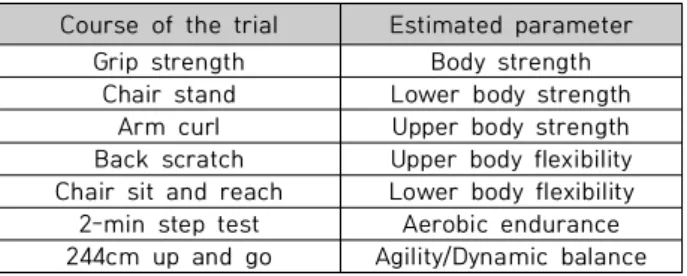
노인체력검사(SFT) 종목으로 하체근력을 평가하는 의자 에서 일어섰다 앉기(Chair stand, number), 상체근력을 평가하는 아령들기(Arm curl, 2kg/number), 상체의 유 연성을 평가하는 등 뒤에서 손잡기(Back scratch, cm), 하체의 유연성을 평가하는 의자 앉아 앞으로 굽히기 (Chair sit and reach, cm), 전신지구력을 평가하는 2분 제자리 걷기(2 minute step test, number), 민첩성과 동 적평형성을 평가하는 244cm 왕복걷기(244cm up and go, sec)를 실시하였다.

Course of the trial Estimated parameter Grip strength Body strength

Chair stand Lower body strength Arm curl Upper body strength Back scratch Upper body flexibility Chair sit and reach Lower body flexibility 2-min step test Aerobic endurance 244cm up and go Agility/Dynamic balance Table 2. Physical function fitness

3. Exercise Program

모든 운동 프로그램(모던댄스운동, 아쿠아로빅운동, 복 합운동)은 12주간 주 3회 1시간으로 준비·정리운동 10분, 본 운동 40분간 실시하였으며, 체력상태를 고려하여 운동 시 Borg[20]의 운동자각도(Rating of Perceived Exertion, RPE)를 이용해 운동 기간에 따라 11~15 단계 로 점진적으로 증가하였다.

3.1 Modern dance exercise

모던댄스 운동프로그램은 <Table 3>와 같이 김송은과 양상훈[21]의 운동 프로그램을 수정·보완하여 실시하였으 며, Rumba(25~27beats/min), Cha Cha Cha (30~32beats/min), Jave(42~44beats/min)로 선정하여 팝송과 왈츠 곡 및 모던음악 등을 활용하여 템포를 조절하 면서 실시하였다.

3.2 Aquarobic exercise

아쿠아로빅 운동프로그램은 <Table 4>와 같이 한국아 쿠아운동협회[22]의 프로그램을 수정·보안하여 전문 지도 자의 지도하에 실시하였으며, 음악 템포는 120~140bpm 내에서 운동자각도를 함께 고려하여 실시하였다.

3.3 Combined exercise

복합 운동프로그램은 ACSM[23]의 노인 유산소운동·근 력운동 권고사항을 참조하고 강설중과 류부호[24]와 변용 현[25] 연구의 운동프로그램을 수정 보완하여 구성하였다.

유산소 운동은 <Table 5>와 같이 Karvonen공식을 이용

한 여유심박수(HRR)의 40~60%인 저·중강도의 수준에서

실시하였고, 개별성의 원리를 적용하여 점진적으로 증가하

였으며, 저항성운동은 세라밴드를 사용하였으며 노인에게

권장되는 노란색 세라밴드(60cm, 신장강도 1.1kg)와 빨강

색 세라밴드 (60cm, 신장강도 2.0kg)를 사용하여 상·하체

각 부위별 운동으로 구성하였다.

(4)

Stage Time Week Aquarobic exercise program Intensity Warm-up 10 min stretching, slow walking, jumping, water pull, scissor, kicks 10∼11

RPE

Main

Exercise 40 min

1~2 bounce(front, back), slow kicks, kick & hold, kick & twist, kick & tuck 11∼12 RPE 3~6 kick bounce(front, back), kick jack, jumping jacks, twist jump, mule kick

jump, kick & back ward, jazz kick, Leg curl, Ankle inversion, eversion 12∼13 RPE 7~12 biking applications, jogging applications, kicking, couples gymnastics 13∼15

RPE Coll-down 10 min knee life & bounce, touch step side, shoulder punch , shoulder stretch,

shadow stretching

10∼11 RPE Table 4. Aquarobic exercise

Stage Time Type Combined exercise program Intensity

Warm-up 10 min Stretching

waking in place, neck extension/flexion stretch, standing knee lilt, back stretch ,torso rotations, overhead reach, arm circles, chest stretch, triceps stretch, shoulder and upper back stretch, forward leg hip swings, hip stretch, standing hamstring and calf stretch, standing quadriceps stretch, ankle circles

10∼11 RPE

Main

Exercise 40 min

Aerobic Ex. waking(treadmill) 40∼60

HRR(%)

Resistance Ex

knee push-up(band), band seated row, band shoulder press, band curl , band triceps extension, chair squat(band), chair lunge(band), bridging, ankle dorsiflexion(band), calf raise(band),

2~3set 8~15raps

11∼15 RPE

Coll-down 10 min Stretching

lats and post deltoid stretch, lumbar rotation stretch, thoracic extension stretch, lumber extension, cat and cow

thigh hug, resistance leg, piriformis stretch, seated hip external rotatot and hip extensor stretch, chair pigeon pose, ankle roll, childs pose, hip flexor stretch, ankle dorsiflexion and plantar flexion

10∼11 RPE Table 5. Combined exercise

4. Statistical analysis

본 연구에서 측정을 통해 수집된 모든 테이터는 SPSS(version 20.0 for Window)통계프로그램을 이용하 여 모든 항목 그룹별 각 변인들의 평균(M)과 표준편자(SD) 를 산출하였다.

신체조성과 신체기능체력 결과에 대한 운동그룹과 측정 시기간에 효과를 검증하기 위해 이원배치 분산분석(two–

way ANOVA)을 실시하였으며, 집단간에 차이를 분석하기 위해 사후검정은 Bonferroni Post-hoc을 사용하였다. 또 한 각 운동 그룹 내 운동 전·후의 차이를 분석하기 위해 대 응표본(paired sample) t-test를 실시하였다. 모든 유의성 검증 신뢰 수준은 α=.05로 하였다.

III. Results

1. Body composition

본 연구에서 운동 프로그램 적용에 따른 신체조성의 변 화를 비교한 결과는<Table 6>와 같다.

체중과 체지방률에서는 측정시기와 그룹간에 상호작용 효과가 나타나지 않았으며, 측정시기와 그룹간에도 변화가 나타나지 않았다.

골격근량에서는 그룹간에 유의한 차이가 나타났으며 (p<.001), 집단 간 비교의 사후검증 결과 대조군에 비해 모던댄스운동그룹, 아쿠아로빅운동그룹, 복합운동그룹에 서 유의하게 증가하였다.

2. Physical function fitness

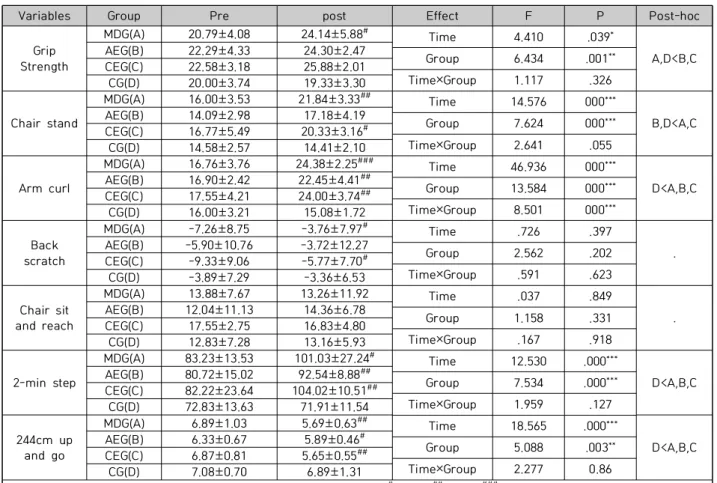
운동 프로그램 적용에 따른 신체기능체력의 변화를 비 교한 결과는<Table 7>와 같다.

2.1 Grip strength

악력에서 측정시기와 그룹간에 상호작용효과가 나타나

지 않았으나, 측정시기(p<.05)와 그룹간(p<.01)에서는 통계

적으로 유의한 차이가 나타났다. 집단 간 비교의 사후검증

결과 모던댄스운동그룹과 대조군에 비해, 아쿠아로빅운동

그룹, 복합운동그룹에서 유의하게 증가하였다. 12주간 운

동 후 모던댄스 운동그룹에서 유의하게 증가하였다(p<.05).

(5)

Variables Group Pre post Effect F P Post-hoc

Weight (kg)

MDG(A) 61.48±8.08 60.84±8.25 Time .003 .956

AEG(B) 63.37±4.68 62.50±6.50 Group .680 .567 .

CEG(C) 60.61±9.11 60.93±8.90

Time×Group .086 .968

CG(D) 60.77±2.90 60.65±2.80

Body fat (%)

MDG(A) 33.89±5.34 32.73±5.49 Time .754 .388

AEG(B) 35.36±2.99 33.38±2.85 Group 1.760 .161 .

CEG(C) 32.90±5.91 31.50±6.60

Time×Group .533 .661

CG(D) 34.67±3.24 35.84±2.85

SMM (kg)

MDG(A) 21.36±1.83 21.53±1.56 Time 1.104 .297

D<A,B,C

AEG(B) 21.60±2.34 22.43±2.47 Group 8.756 .000***

CEG(C) 22.21±2.32 22.54±2.55

Time×Group .131 .941

CG(D) 20.51±0.86 20.87±0.69

Means±S.D. MDG; Mordern Dance Group, AEG: Aquarobic Exercise Group, CEG: Combined Exercise Group, CG:

Control Group, Significant difference between pre and post t-test; #

p

<.05, ##

p

<.01, ###

p

<.001, Two-way between groups ANOVA; *

p

<.05, **

p

<.01, ***

p

<.001.

Table 6. Body composition

Variables Group Pre post Effect F P Post-hoc

Grip Strength

MDG(A) 20.79±4.08 24.14±5.88 # Time 4.410 .039 *

A,D<B,C

AEG(B) 22.29±4.33 24.30±2.47 Group 6.434 .001 **

CEG(C) 22.58±3.18 25.88±2.01

Time×Group 1.117 .326

CG(D) 20.00±3.74 19.33±3.30

Chair stand

MDG(A) 16.00±3.53 21.84±3.33 ##

B,D<A,C

Time 14.576 000 ***

AEG(B) 14.09±2.98 17.18±4.19 Group 7.624 000 ***

CEG(C) 16.77±5.49 20.33±3.16 #

Time×Group 2.641 .055

CG(D) 14.58±2.57 14.41±2.10

Arm curl

MDG(A) 16.76±3.76 24.38±2.25 ###

D<A,B,C

Time 46.936 000 ***

AEG(B) 16.90±2.42 22.45±4.41 ## Group 13.584 000 ***

CEG(C) 17.55±4.21 24.00±3.74 ##

Time×Group 8.501 000 ***

CG(D) 16.00±3.21 15.08±1.72

Back scratch

MDG(A) -7.26±8.75 -3.76±7.97 #

.

Time .726 .397

AEG(B) -5.90±10.76 -3.72±12.27 Group 2.562 .202

CEG(C) -9.33±9.06 -5.77±7.70 #

Time×Group .591 .623

CG(D) -3.89±7.29 -3.36±6.53

Chair sit and reach

MDG(A) 13.88±7.67 13.26±11.92

.

Time .037 .849

AEG(B) 12.04±11.13 14.36±6.78 Group 1.158 .331

CEG(C) 17.55±2.75 16.83±4.80

Time×Group .167 .918

CG(D) 12.83±7.28 13.16±5.93

2-min step

MDG(A) 83.23±13.53 101.03±27.24 #

D<A,B,C

Time 12.530 .000 ***

AEG(B) 80.72±15.02 92.54±8.88 ## Group 7.534 .000 ***

CEG(C) 82.22±23.64 104.02±10.51 ##

Time×Group 1.959 .127

CG(D) 72.83±13.63 71.91±11.54

244cm up and go

MDG(A) 6.89±1.03 5.69±0.63 ##

D<A,B,C

Time 18.565 .000 ***

AEG(B) 6.33±0.67 5.89±0.46 # Group 5.088 .003 **

CEG(C) 6.87±0.81 5.65±0.55 ##

Time×Group 2.277 0.86

CG(D) 7.08±0.70 6.89±1.31

Means±S.D, Significant difference between pre and post t-test; #

p

<.05, ##

p

<.01, ###

p

<.001, Two-way between groups ANOVA; *

p

<.05, **

p

<.01, ***

p

<.001.

Table 7. Physical function fitness

2.2 Chair stand

의자에서 일어섰다 앉기에서 측정시기와 그룹간에 상호 작용효과가 나타나지 않았으나, 측정시기(p<.001)와 그룹 간(p<.001)에서는 통계적으로 유의한 차이가 나타났다. 집 단 간 비교의 사후검증 결과 아쿠아로빅운동그룹과 대조 군에 비해 모던댄스운동그룹과 복합운동그룹에서 유의하

게 증가하였다. 12주간 운동 후 모던댄스 운동(p<.01)과 복합운동 그룹(p<.05)에서 유의하게 증가하였다.

2.3 Arm curl

아령 들기에서 측정시기와 그룹간에 상호작용효과가 나

타났으며(p<.001), 측정시기(p<.001)와 그룹간(p<.001)에

(6)

서도 통계적으로 유의한 차이가 나타났다. 집단 간 비교의 사후검증 결과 아쿠아로빅 운동그룹과 대조군에 비해 모 던댄스운동그룹과 복합운동그룹에서 유의하게 증가하였 다. 12주간 운동 후 모던댄스 운동그룹(p<.001), 아쿠아로 빅운동그룹(p<.05), 복합운동그룹(p<.05) 모두에서 유의하 게 증가하였다.

2.4 Back scratch

등 뒤에서 손잡기에서 측정시기와 그룹간에 상호작용효과 가 나타나지 않았으며, 측정시기와 그룹간에서도 변화가 나 타나지 않았다. 12주간 운동 후 모던댄스 운동그룹(p<.05), 복합운동그룹(p<.05) 모두에서 유의하게 감소하였다.

2.5 Chair sit and reach

의자 앉아 앞으로 굽히기에서 측정시기와 그룹간에 상 호작용효과가 나타나지 않았으며, 측정시기와 그룹간에서 도 변화는 나타나지 않았다.

2.6 2 minute step

2분 제자리 걷기에서 측정시기와 그룹간에 상호작용효 과가 나타나지 않았으나, 측정시기(p<.001)와 그룹간 (p<.001)에서는 통계적으로 유의한 차이가 나타났다. 집단 간 비교의 사후검증 결과 대조군에 비해, 모던댄스운동그 룹, 아쿠아로빅운동그룹, 복합운동그룹에서 유의하게 증가 하였다. 12주간 운동 후 모던댄스 운동그룹(p<.01), 아쿠 아로빅운동그룹(p<.05), 복합운동그룹(p<.05) 모두에서 유 의하게 증가하였다.

2.7 244cm up and go

244cm 왕복걷기에서 측정시기와 그룹간에 상호작용효 과가 나타나지 않았으나, 측정시기(p<.001)와 그룹간 (p<.05)에서는 통계적으로 유의한 차이가 나타났다. 집단 간 비교의 사후검증 결과 대조군에 비해, 모던댄스운동그 룹, 아쿠아로빅운동그룹, 복합운동그룹에서 유의하게 증가 하였다. 12주간 운동 후 모던댄스 운동그룹(p<.05), 아쿠 아로빅운동그룹(p<.01), 복합운동그룹(p<.05) 모두에서 유 의하게 증가하였다.

IV. Discussion

노화는 다양한 물리적 인지적 변화를 특징으로 하는 돌이 킬 수 없는 과정으로[26], 인간의 삶의 질을 높이기 위해서

는 단순한 수명연장 뿐만 아니라 일상생활활동(ADL)을 건 강하고 기능적, 독립적으로 수행하는 능력이 필요하다[27].

노인들에게 신체기능체력 평가는 근력 약화를 인지하는 것은 대근육군의 현저한 감소가 시작되는 시점부터이기 때문에[28] 위험 그룹을 식별하는 데 중요한 도구로 악력 (Grip Strength)은 근력을 평가하는 단순하고 간편하며 경제적인 도구로서 전신의 근력, 기능제한 및 저하 등의 건강관련 평가지표로 매우 유용하다[29-31]. 노인체력검 사(Senior Fitness Test; SFT)는 생리학적 단계의 운동수 행능력을 평가하며 일상적인 활동을 수행하는데 지장을 초래할 정도로 악화되는 것을 예방하는데 도움을 주는 것 으로 보고하고 있다[19].

본 연구에서 모든 운동 후 악력의 수치가 유의하게 높게 나타났으며, 12주간 운동 후 아쿠아로빅 운동그룹(AEG)과 복합운동그룹(CEG)이 모던댄스그룹(MDG)과 통제그룹(CG) 보다 높은 것으로 나타났다. 이는 아쿠아로빅운동[32-33], 복합운동[34-36] 선행연구의 결과를 뒷받침하고 있다.

악력은 노인들에게 중요한 지표로서 아쿠아로빅 운동은 물의 점성과 저항 같은 물리적 특성 때문에 인체의 움직임 과 방향에 더 많은 저항을 받음으로 악력운동에 효과를 주 었고 복합운동은 세라밴드를 활용한 근력운동이 효과를 본 것으로 판단된다. 노인들의 물건을 잡거나 들어 올리는 등의 일상생활수행능력과 만성질환 예방에 아쿠아로빅 운 동그룹(AEG)과 복합 운동그룹(CEG)은 긍정적인 역할을 할 것으로 생각된다.

하체근력과 파워를 평가하는 의자에서 일어섰다 앉기 (Chair stand)는 노쇠를 판별하고 신체활동 수준을 판별 하는데 효과적인 효과적이며[19]. 특히 노인의 경우 하체 의 근력이 감소되면 낙상 위험에 노출되기 싶다[37]. 본 연 구에서는 모든 운동 후 의자에서 일어섰다 앉기(Chair stand)의 횟수가 유의하게 증가하였으며, 12주간 운동 후 모던댄스그룹(MDG)과 복합운동그룹(CEG)이 아쿠아로빅 운동그룹(AEG)과 통제그룹(CG)보다 높은 것으로 나타났 다. 이는 모던댄스운동[21],[38], 복합운동[39-41]의 선행 연구의 결과를 뒷받침하고 있다.

따라서 노인들에게 체중부하 운동은 근육과 관절이 서 로 협동적이면서 동시발생적(Concurrent)으로 발생하기 때문에 일생생활 행위에 기능적으로 작용할 수 있다는 것 을 의미하며 이는 노인의 낙상 위험을 감소 시킬 수 있을 것으로 생각된다.

본 연구에서는 모든 운동 후 아령 들기(Arm curl)의 횟

수가 유의하게 증가하였다. 상체근력을 평가하는 아령 들

기(Arm curl)는 집안일, 식료품이나 물건을 나르기, 손자

(7)

를 앉을 때 필요한 신체기능체력 요인으로[19], 12주간 운 동 후 모던댄스 그룹(MDG), 아쿠아로빅 운동그룹(AEG), 복합 운동그룹(CEG)이 통제그룹(CG)보다 높은 것으로 나 타났다. 이는 모던댄스운동[32],[42-43], 복합운동[39-41]

이 노인들의 상체근력에 긍정적인 역할을 하다는 선행연 구의 결과를 지지한다. 이는 신체활동 및 다양한 운동은 노인에게 운동신경의 발화율(firing rate)과 운동단위 동원 능력을 향상 시켜 근육의 힘 발위능력을 증가시킨 것으로 생각된다.

본 연구에서는 모든 운동 후 2분 제자리 걷기(2 minute step)의 횟수가 유의하게 증가하였다. 심폐지구력을 평가 하는 2분 제자리 걷기(2 minute step)는 장거리 보행이나 계단 오르기, 쇼핑 및 관광에 필요한 신체기능체력 요인으 로[19], 12주간 운동 후 모던댄스그룹(MDG), 아쿠아로빅 운동그룹(AEG), 복합운동그룹(CEG)이 통제그룹(CG)보다 높은 것으로 나타났다. 이는 모던댄스운동[44-45], 아쿠아 로빅스운동[42-43], 복합운동[46]의 선행연구의 결과와 일 치하였다. 이는 큰 근육을 리드미컬하게 움직이게 함으로 써 하체근력의 향상과 함께 심폐지구력이 증가한 것으로 생각된다. 또한 신체활동의 양의 증가되고 에너지 소비를 향상시켜 만성질환의 위험률을 감소시킬 수 있어 독립적 인 생활을 영위하는데 노인들의 핵심이 되는 요인이다.

본 연구에서는 모든 운동 후 244cm 왕복걷기(244cm up and go)의 초가 유의하게 감소하였다. 민첩성, 동적평 형성, 및 보행능력을 평가하는 244cm 왕복걷기(244cm up and go)는 중~고강도의 보행, 균형을 유지하며 물체 주위를 움직일 수 있는 신체기능체력으로, 12주간 운동 후 모던댄스 그룹(MDG), 아쿠아로빅 운동그룹(AEG), 복합 운 동그룹(CEG)이 통제그룹(CG)보다 높은 것으로 나타났다.

이는 모던댄스 운동[44], 아쿠아로빅스 운동[42-43], 복합 운동[46]의 선행연구의 결과를 뒷받침하고 있다. 이는 민 첩성과 평행성을 향상시키기 위해서는 자세적인 조정과 속도에 관계되어 있는 다양한 시스템에 대한 다차원적인 접근이 필요하며, 모던댄스 운동은 체중 중심을 이동하여 춤사위와 함께 이루어져 포폭 추친력을 증가시켜서 아쿠 아로빅 운동은 다양한 방향으로 물의 저항을 속도를 조절 하여 움직임을 만들어서 복합 운동은 탄력밴드와 체중을 이용한 훈련은 무릎의 폄근을 6~13% 증가시킨다는 Aniansson 등[47]의 연구 결과를 지지하며 근육의 기능 개선이 신체의 기능적 안정성을 증진시켜 평형능력을 향 상 시킨 것으로 생각된다.

노인들에게 유연성은 일상생활활동을 수행하고 손상으 로부터 보호하는데 매우 중요한 요인이다[19]. 유연성은

연령이 증가함에 따라 저하되며[48] 그로 인한 관절가동범 위 감소는 신체활동의 감소로 이어져 낙상이나 관절 손상 을 가져올 위험이 커질 뿐만 아니라 독립적인 생활을 영위 하는데 부정적으로 작용하게 된다[49]. 정제순[50]은 근력 의 증가할수록 유연성도 증가한다고 하였다. 하지만 본 연 구에서는 등 뒤에서 손잡기(Back scratch)는 모던댄스그 룹(MDG)와 복합운동그룹(CEG)에서만 운동 후 유의하게 감소하였으나 앉아 앞으로 굽히기(Chair sit and reach) 에서는 변화가 보이지 않았다. 이는 노화가 진행 될수록 구조단백질인 콜라겐의 Type Ⅰ의 수치는 증가되고 결합 단백질인 엘라스틴은 퇴화되며, 노화로 인한 유연성 개선 에 한계가 있다는 Sharkey와 Gaskill[51]의 선행연구의 결과를 지지한다. 따라서 노인의 운동 프로그램 시 운동 초기에 유연성과 관절의 가동성 운동프로그램의 시간과 빈도를 증가시켜야 한다고 생각된다.

Ⅴ. Conclusions

본 연구는 체력적 독립적 자립이 필요한 노인들에게 자 신에게 가장 적합한 운동이 무엇인지 또한 체력 향상과 유 지가 가능한 운동이 무엇인지를 살펴보고자 여성노인을 대상으로 12주간 모던댄스운동, 아쿠아로빅운동, 복합운동 프로그램을 실시한 후 신체조성과 신체기능체력에 대한 변화를 살펴보기 위함이다.

12주간 운동 후 모던댄스그룹(MDG)은 6가지 신체기능 체력(악력, 의자에서 일어섰다 앉기, 아령 들기, 등 뒤에서 손잡기, 2분 제자리 걷기, 244cm 왕복걷기)에서 통계적으 로 유의한 향상을 보여 가장 많은 영역에서 효과가 나타났 다. 복합운동(CEG)은 5가지 신체기능체력(의자에서 일어 섰다 앉기, 아령 들기, 2분 제자리 걷기, 244cm 왕복걷기) 에서 아쿠아로빅 운동(AEG)은 3가지 신체기능체력(아령 들기, 2분 제자리 걷기, 244cm 왕복걷기)에서 긍정적인 영향을 주었다. 다양한 운동들은 여성 노인들에게 체력유 지 및 개선에 긍정적인 역할하며 신체활동 과 높은 수준의 체력은 건강하고 성공적인 노화와 놓은 삶의 질을 유지하 는데 중요한 요소이다.

따라서 본 결과를 종합해보면 노인들에게 유연성과 관

절의 가동성을 증진 시킬 수 있는 추가적인 운동프로그램

이 필요할 것으로 생각되며, 자신의 흥미에 맞는 운동을

자발적으로 참여하여 지속성 있게 하는 것이 중요할 것으

로 생각된다.

(8)

REFERENCES

[1] D. H. Paterson, G. R. Jones, and C. L. Rice, “Ageing and physical activity: evidence to develop exercise recommendations for older adults”, Applied physiology, nutrition, and metabolism, Vol. 32, No. S2E, pp. S69-S108, February 2007. DOI: 10.1139/H07-111.

[2] D. Umiastowska, and J. Kupczyk, “Factors Differentiating the Level of Functional Fitness in Polish Seniors”, International Journal of Environmental Research and Public Health, Vol. 17, No. 5, pp. 1699. March 2020. DOI: 10.3390/ijerph17051699.

[3] W. Osiński, “Aktywność fizyczna podejmowana przez osoby w starszym wieku. Antropomotoryka, Vol. 24, pp. 3-24, 2002.

[4] M. A. Rogers, and W. J. Evans, “Changes in skeletal muscle with aging: effects of exercise training”, Exercise and sport sciences reviews, Vol. 21, No. 1, pp. 65-102, January 1993.

[5] A. Knapik, A. Brzęk, A. Famuła-Wąż, W. Gallert-Kopyto, D.

Szydłak, C. Marcisz, and R. Plinta, “The relationship between physical fitness and health self-assessment in elderly”, Medicine, Vol. 95, No. 25, pp. 1027-1038, Jun 2019. DOI: 10.1097/MD.000 0000000015984.

[6] A. Pilotto, A. Cella, A. Pilotto, J. Daragjati, N. Veronese, C.

Musacchio, ... and F. Panza, “Three decades of comprehensive geriatric assessment: evidence coming from different healthcare settings and specific clinical conditions”, Journal of the American Medical Directors Association, Vol. 18, No. 2, pp. 192-e1, February 2017. DOI: 10.1016/j.jamda.2016.11.004.

[7] D. H. Choi, “Health Care and Exercise for the Elderly”, Korean Society for Health Promotion and Disease Prevention Autumn Conference”, pp. S376–S379, 2005.

[8] S. Y. Park, I. S. Shin, “Muscle Strengthening Effects of Exercise Programs for Preventing Falls Among the Elderly in Korea: A Meta-Analysis”, Physical Therapy Korea, Vol. 18 No. 3, pp. 38–

48, August 2020.

[9] H. J. Kim, J. S. Park, “The effects of Aerobic exercise intensity participation training on body composition, health related fitness and quality of life in elderly women” Korean Journal of Sport Science, Vol. 31 No. 1, pp. 35–47, March 2020.

[10] J. H. Han, J. E. Lee, J. H. Park, S. H. Lee, H. S. Kang, “Effect of a 12 Week-Aerobic Exercise Program on Physical Fitness, Depression, and Cognitive Function in the Elderly”, Exercise Science, Vol. 23, No. 4, pp. 375–385, November 2014.

[11] Y. S. Oh, W. Y. Park, “Effect of power resistance intervention on fitness and muscle mass and short physical performance battery in older women adults” Journal of the Korean Applied Science and Technology, Vol. 37, No. 1, pp. 114–123, February, 2020.

[12] K. R. Chung, S. Y. Kim, C. H. Choi, G. D. Park, “Effects of Exercise Intensity on an 8-Week Resistance Training to the Physical Fitness in the Elderly Women”, The Korean Journal of

Growth and Development, Vol. 16, No. 3, pp. 199–206, September 2008.

[13] E. L. Cadore, R. S. Pinto, M. Bottaro, and M. Izquierdo, “Strength and endurance training prescription in healthy and frail elderly”, Aging and disease, Vol. 5, No. 3, pp. 183-195, October 2014.

DOI: 10.14336/AD.2014.0500183.

[14] S. Eyigor, H. Karapolat, and B. Durmaz, “Effects of a group-based exercise program on the physical performance, muscle strength and quality of life in older women”, Archives of Gerontology and Geriatrics, Vol. 45, No. 3, pp. 259-271, November–December 2007. DOI: 10.1016/j.archger.2006.12.001.

[15] Y. S, Oh, “Effect of Aquatic Exercise on Body composition and Blood Lipids on Elderly Women: Meta-Ananlysis”, The Korean Society Of Sports Science, Vol. 28, No. 5, pp. 843–855, October 2019.

[16] M. Ariyoshi, K. Sonoda, K. Nagata, T. Mashima, M. Zenmyo, C. Paku, ... and. H. Akashi, (1999). “Efficacy of aquatic exercises for patients with low-back pain”, The Kurume medical journal, Vol. 46, No. 2, pp. 91–96, September 1999. DOI: 10.2739/ku rumemedj.46.91.

[17] D. R. Hopkins, B. Murrah, W. W. Hoeger, and R. C. Rhodes,

“Effect of low-impact aerobic dance on the functional fitness of elderly women”, The Gerontologist, Vol. 30, No. 2, pp. 189-192, April 1990. DOI: 10.1093/geront/30.2.189.

[18] E. Hui, B. T. K. Chui, and J. Woo, “Effects of dance on physical and psychological well-being in older persons”, Archives of gerontology and geriatrics, Vol. 49, No. 1, pp. e45-e50, July–

August 2009. DOI: 10.1016/j.archger.2008.08.006.

[19] R. E. Rikli, and C. J. Jones, “Senior fitness test manual”, Human kinetics. 2013.

[20] G. A. Borg, "Psychophysical bases of perceived exertion,"

Medicine & Science in Sports & Exercise. Vol. 14, No. 5, pp.

377-381, June, 1982. https://doi.org/10.1249/00005768-1982050 00-00012

[21] S. E. Kim, S. H. Yang, “The Effect of 12-Week Dance Sports of Body Composition, Daily Living Fitness, Blood Lipid in the Old Age Elderly Women” The Korean Journal of Sport, Vol.

15 No. 2, pp. 645–654, June 2017.

[22] Korea Aquatic Exercise Association, http://www.kaea.or.kr/, 2015 [23] ACSM, “ACSM’s Health related physical fitness assessment Manual 2ed”, American College of Sports Medicine. Lippincott Williams & Wilkins. 2010.

[24] J. K. Seol, B. H. Ryu, “Combined Exercise on HbA1c, Cardiovascular Disease Risk Factors, and Physical Fitness in Elderly Women with Type 2 Diabetes Mellius” The Asian Journal of Kinesiology, Vol. 16, No. 2, pp. 21-30, April 2014.

[25] Y. H. Byun, “Effects of the Long-Term Exercise on Body

Composition, Cardiovascular Health and Isokinetic Leg Strength

in Older Women Living in Residential Aged Care Facilities”,

(9)

Journal of Sport and Leisure Studies, Vol. 16 No. 8, pp. 551–562, July 2016.

[26] T. I. Hilgenkamp, R. van Wijck, and H. M. Evenhuis, “Physical fitness in older people with ID—Concept and measuring instruments: A review”, Research in developmental disabilities, Vol. 31, No. 5, pp. 1027-1038, September–October 2010. DOI:

10.1016/j.ridd.2010.04.012.

[27] V. Simpson, and, & L. Pedigo, “Health risk appraisals with aging adults: an integrative review”, Western journal of nursing research, Vol. 40, No.7, pp. 1049-1068, November 2018. DOI:

10.1177/0193945917740705.

[28] Y. S. Kim, O. Lee, J. H. Lee, J, H, Kim, B. Y. Choi, M. J.

Kim, T. G. Kim, “The Association between Levels of Muscle Strength and Fear of Falling in Korean Olders” The Korean Journal of Sports Medicine, Vol. 31 No. 1, pp. 13–19, May 2013.

[29] R. W. Bohannon, “Hand-grip dynamometry predicts future outcomes in aging adults”, Journal of geriatric physical therapy, Vol. 31, No. 1, pp. 3–10, February 2008. DOI: 10.1519/0013914 3-200831010-00002.

[30] H. G. Lawman, R. P. Troiano, F. M. Perna, C. Y. Wang, C.

D. Fryar, and C. L. Ogden, “Associations of relative handgrip strength and cardiovascular disease biomarkers in US adults, 2011–2012”. American journal of preventive medicine, Vol. 50, No. 6, pp. 677-683, June 2016. DOI: 10.1016/j.amepre.2015.1 0.022.

[31] T. Rantanen, S. Volpato, M. D. Luigi Ferrucci, M. D. Eino Heikkinen, L. P. Fried, and J. M. Guralnik, “Handgrip strength and cause‐specific and total mortality in older disabled women:

exploring the mechanism”, Journal of the American Geriatrics Society, Vol. 51, No. 5, pp. 636-641, April 2003. DOI: 10.1034 /j.1600-0579.2003.00207.x.

[32] K. S. Mun, J. M. Park, S. K. Ryu, J. Y. Cha, K. S. Hyun, “Effects of Aquatic Exercise for Health Related Fitness and Balance in the Elderly Women” Journal of Sport and Leisure Studies, Vol.

65, pp. 593–600, June 2016.

[33] Y. A. Park, D. H. Kim, “Effects of Aquarobics on Metabolic Syndrome and Health Fitness in Abdominally Obese Elderly Women”, Journal of the Korea Academia-Industrial cooperation Society, Vol. 16 pp. 5180–5188, August 2015.

[34] T. H. Kim, S. S. Joung, T. Y. Han, “8-weeks combined exercise on the senior fitness, liver function and index of arteriosclerosis in the female old adults” Korean Journal of Sports Science, Vol.

31 No. 1, pp. 1043–1052, December 2018.

[35] N. Y. Ahn, Y. S. Ju, G. H. Lee, K. J. Kim, “Changes of Body Composition, Physical Fitness, and Cognitive Function after 16-week Regular Exercise Training in Elder Women with Dementia”, Korea Coaching Development Center, Vol. 21 No.

1, pp. 110–117, March 2019.

[36] S. W. Jung, M. W. Seo, S. W. Kim, D. Y. Kim, J. K. Song,

“Effects of 16 weeks combined training on irisin, adipokines and bone metabolism markers expression and functional fitness and muscle function in elderly women with osteosarcopenic obesity”, Korean Journal of Sports Science, Vol. 6, No. , pp. 199–206, October 2017. DOI: 10.35159/kjss.2017.10.26.5.937.

[37] D. E. Warburton, N.Gledhill, and A. Quinney, “Musculoskeletal fitness and health”, Canadian journal of applied physiology, Vol.

26, No. 2, pp. 217-237, April, 2001. DOI: 10.1139/h01-013.

[38] Y. B. Lee, K. S. Cha, “Effects of 12-Week Dance Sports Exercise on Blood Pressure and Physical Fitness in Elderly Women”

Journal of The Korean Society of Living Environmental System, Vol. 13, No. 1, pp. 95–102, October 2006.

[39] G. E. Kwon, “Effect of combined exercise with elastic band on fitness factors of falls and cognitive function in the elderly women” unpublished a master's thesis, Korean National Sports University, February 2011.

[40] S. Y, Park, “The Effects of Exercise Type on Fall-Related Risk Factorsin the Elderly Women” Sports Science Review, Vol. 7 No. 1, pp. 23–35, November, 2013.

[41] K. H. Han, K. H. Bae, “The Effect of Different Exercise-based Interventions on Senior Fitness Test of Elderly”, The Korean Journal Physical Education, Vol. 57, No. 2, pp. 635–646, March 2018.

[42] C. H, Chae, C. I. Yang, M. S. Ko, “The Effects of Aquarobics on Body Composition, Physical Fitness Using SFT, and Metabolic Syndrome Risk Factors in Obese Elderly Women”, Korean Society of Growth and Development, Vol. 25 No. 2, pp.

237–244, May 2016.

[43] S. H. Yoo, C. I. Lee, C. S. Kwak, J. S. Yang, “The Effects of Aquacise on Fitness and Metabolic Syndrome Risk Factors in Senior Women”, Korean Acadaemy of Kinesiology, Vol. 12, No. 4, pp. 23–32, October 2010.

[44] H. J Kim, J. K. Byeon, H. J. Kim, S. H. Park, “The Effect of Korean dancing-oriented gymnastics on Physical fitness and Gait ability in Elderly women” The Korea dance education society, Vol. 22 No. 1, pp. 101–115, March 2011.

[45] H. Y, “Effects of the Customized Yoga and Korean Dance Program on Living Fitness and Cardiovascular Disease Risk Factors in Elderly Women”, Journal of The Korean Society of Living Environmental System, Vol. 16, No. 1, pp. 619–629, December 2009.

[46] S. M. Ko, J. H. Park, S, H, Kang, J. H, Kim, “Effects of Multicomponent Exercise Program on Functional Fitness and Balance in Community-Dwelling Elderly Women” Korean journal of physical education, Vol. 56, No. 3, pp. 575-588, May 2017. DOI: 10.23949/KJPE.2017.05.56.3.43.

[47] A. Aniansson, P. Ljungberg, Å.Rundgren, and H. Wetterqvist,

“Effect of a training programme for pensioners on condition and

muscular strength”, Archives of Gerontology and Geriatrics, Vol.

(10)

3, No. 3, pp. 229–241, October 1984. DOI: 10.1016/0167-49 43(84)90024-4.

[48] I. G. Fatouros, K. Taxildaris, S. P. Tokmakidis, V.

Kalapotharakos, N. Aggelousis, S. Athanasopoulos, ... and I.

Katrabasas, “The effects of strength training, cardiovascular training and their combination on flexibility of inactive older adults”, International journal of sports medicine, Vol. 23, No.

2, pp. 112-119, February, 2002. DOI: 10.1055/s-2002-20130.

[49] E. T. Howley, and B. D. Franks, “Health/Fitness Instructor's Handbook”, Human Kinetics Publishers, Inc., Marketing Director, Box 5076, Champaign, IL. 1986.

[50] J. S. Chung, “Effect of Leg Strength on Flexibility, Balance and Gait Characteristics in Elderly Women”, The Korean Journal of Growth and Development, Vol. 19, No. 3, pp. 233–239, September 2011.

[51] B. J. Sharkey, and S. E. Gaskill, “Fitness & health”, Human Kinetics. 2013.

Authors

Jin-wook Lee received B.S. degree in Korea University. in 1999. He received his M.S.

degree in sports medicine Ph.D. degree in physical education from the University of Dankook in 2010 and 2017, respectively.

Dr. Lee is a Assistant Professor at the Dept. of Exercise

Prescription & Rehabilitation, Dankook University, Korea. His

research interests are in sports medicine, exercise prescription,

sports Rehabilitation, exercise physiology.

수치

Table  1.  Characteristics  of  Participants
Table  3.  Moden  dance  exercise2.  Measurement
Table  7.  Physical  function  fitness

참조

관련 문서

The effect on combined aerobic exercise of fitness, physical activity in middle-aged obese women, Unpublished Master’s Thesis, Sangmyung University,

Effects of Hatha Yoga Exercise on Body Composition, Serum Lipids, and Health-Related Fitness of Obese Middle-Aged Women.. Do-Yeon Kim 1 , Jeong-Ah Lee 2 and Jum-Hong Yang

The effects of 12-week aerobic complex training and exercise intensities on %body fat, car- diovascular function, MDA, CRP, and homocysteine level in obese

Conclusion: We concluded that a 12-week combined exercise training program could be a good exercise program for improvement of the body composition, physical fitness

Effects of Aerobic Exercise Training and Natural Fermented Vinegar on Body Composition and Cardiopulmonary Function in Middle Aged Women.. Kijin Kim 1 , Nayoung Ahn 1 , Youngsik Ju 1

Association of Weekly Frequency of Exercise Participation with Body Composition and Inflammatory Markers in Korean Women.. Kijin Kim, Sanghyun

Purpose: To examine the effects of the aerobic exercise program on changing the body composition, blood lipids and self-esteem of the obese elderly women. Method:

The effects of the aerobic exercise training with resist -ance exercise on body composition and inflammation response in the elderly women.. Comparative