Journal of the Korean Chemical Society 2011, Vol. 55, No. 5
Printed in the Republic of Korea
http://dx.doi.org/10.5012/jkcs.2011.55.5.892
-892-
단신
(Notes)
TTF Derivatives Containing Phosphonic Acid Group As Potent Component for Organic-Inorganic Hybrid
Su-Kyung Lee and Dong-Youn Noh*
Department of Chemistry, Seoul Women’s University, Seoul 139-774, Korea. *E-mail: [email protected] (Received June 16, 2011; Accepted July 27, 2011)
Key words: TTF, phosphonic acid, organic-inorganic hybrid, electrochemistry, X-ray crystal structure
INTRODUCTION
Like ferrocene, tetrathiafulvalene (TTF) is a well- known electron donor molecule, which exhibits two reversible one-electron redox cycles.1 The two-step redox processes are shown in Scheme 1. Utilizing this property, a lot of TTF derivatives have been investigated for the development of organic magnets, sensors, conducting materials, etc.1 Various functional compounds such as thiophene,2 ferrocene3 and azobenzene,4 containing the phosphonic acid group have been investigated for the preparation of organic-inorganic hybrid materials exhib- iting catalytic activity, non-linear optical properties and photo-induced sensing. TTF amphiphiles with two phos- phonic acid moieties were also investigated for the purpose of developing Langmuir-Blodgett magnetic thin films.5
In this study, two mono-phosphonic acid derivatives of TTF (compounds 1b and 2b in Scheme 2) are synthesized, via the corresponding ethyl phosphonate derivatives, and characterized spectroscopically. Their electrochemical and
structural characterizations were also carried out. This search for a facile way of synthesizing monophosphonic acid derivatives was intended to be the first step in the preparation of zirconium phosphate-based two-dimensional magnetic materials.4
EXPERIMENTAL
The starting materials (CET-BMTTTF5 and CET-EDTTTF6) shown in Scheme 2 were prepared according to the pre- viously reported methods. Cesium hydroxide monohy- drate, diethyl 2-bromoethyl phosphonate, triethylamine, bromotrimethylsilane (TMSBr) and HPLC-grade organic solvents were commercially purchased and used as received.
The infrared spectra were recorded by the KBr pellet method on a Perkin Elmer Spectrum 100 in the range of 4000~400 cm-1. The 1H NMR spectra were obtained on a Bruker Avance 500 or 300 using CDCl3 as a solvent. Elec- trochemical studies were carried out at room temperature with a CHI 620A Electrochemical Analyzer (CHI Instru- ment Inc.) in a CH2Cl2 solution containing 0.5 mM of the sample and 0.1 M n-Bu4NPF6 as the supporting electro- lyte, using a Pt-button (r = 1 mm) working electrode, Ag/
AgCl reference electrode and Pt-wire (φ = 1 mm) counter electrode at a scan rate of 100 mV s-1. All redox potentials were referenced against the standard Fc/Fc+ redox couple (E1/2 = +0.504 V vs. Ag/AgCl).
Single crystals of compound 2b suitable for X-ray struc- ture analysis were grown by the slow-evaporation method in CDCl3. The X-ray crystallographic data was collected at 200(2) K on a SMART APEX CCD SYSTEM (Bruker) equipped with graphite-monochromated Mo Kα radiation (λ = 0.71073Å). The structure was solved by the direct method and refined by full-matrix least-squares analysis using anisotropic thermal parameters for non-hydrogen atoms with the SHELXTL program.7 The crystal data and Scheme 1. Two one-electron redox processes of TTF.
Scheme 2. Synthesis of compounds 1 and 2.
2011, Vol. 55, No. 5
TTF Derivatives Containing Phosphonic Acid Group 893
structure refinement parameters for 2b·Et3N·H2O are listed in Table 1. The detailed crystallographic informa- tion is available from the author on request.
Preparation of 1a To an anhydrous DMF solution (20 mL) of CET-BMTTTF (1.5 mmol, 572 mg) degassed for 30min was added dropwise to a minimum amount of a methanol solution of cesium hydroxide monohydrate (1.65 mmol, 277 mg) over a period of 20 min. During the course of this addition, the color of the solution mixture became dark (red-orange solution). After stirring this mix- ture for an additional 30 min, diethyl 2-bromoethyl phos- phonate (1.4 mmol, 0.25 mL) was added. The resulting dark brown mixture was stirred for 3 h. The white pre- cipitate was filtered off, and the solvent was removed in vacuo. The product was separated by column chromatog- raphy (SiO2, acetone: diethyl ether=3:2) as orange-brown oil. Yield: 62% (425 mg), 1H NMR (300 MHz, CDCl3, ppm) 6.44 (1H, CH, s), 4.15-4.06 (4H, CH2, m), 2.99-2.90 (2H, SCH2, m) 2.43 (6H, SCH3, s), 2.17-2.02 (2H, CH2P, m), 1.36-132 (6H, CH3, t), FT-IR (KBr, cm-1) 2982, 2921 (-CH3,
-CH2CH2-), 1477, 1424, 1391, 1368 (-CH2S-), 1243 (P=O), 1054, 1027, 964 (P-OEt), 888 (asym S-C-S str), 784, 771 (P-C), 528 (R(RO)2P=O).
Preparation of 2a Compound 2a was prepared by the same method as that employed for compound 1a using DMF (25 mL), CET-EDTTTF (0.70 mmol, 265 mg), CsOH (0.77 mmol, 129 mg), and diethyl 2-bromoethyl phos- phonate (0.77 mmol, 0.14 mL). Yield: 92% (318 mg), 1H NMR (300 MHz, CDCl3, ppm) 6.44 (1H, CH, s), 4.17- 4.06 (4H, CH2, m), 3.26 (4H, CH2CH2, s) 2.98-2.93 (2H, SCH2, m), 2.13-2.02 (2H, CH2P, m), 1.36-131 (6H, CH3, t), FT-IR (KBr, cm-1) 2980, 2926, 2853 (-CH2CH2-), 1716 (C=C), 1463, 1442, 1411, 1391, 1367 (-CH2S-), 1241 (P=O), 1056, 1028, 961 (P-OEt), 886 (asym S-C-S str), 803, 772 (P-C).
Preparation of 1b and 2b Triethylamine (0.58 mL, 28 eq.) was added to a dichloromethane solution (4 mL) of 1b (0.15 mmol, 74 mg) or 2b (0.15 mmol, 73 mg), to which TMSBr (0.56 mL, 28 eq.) was slowly added from a syringe.
During this addition, a white precipitate became evident in the flask. After stirring for 2 h, the solution was con- centrated in vacuo and methanol (4 mL) was added to the resulting residue followed by additional stirring for 4 h.
The product was concentrated in vacuo, dissolved in dichloromethane, and extracted by distilled de-ionized water. The extraction procedure using dichloromethane resulted in the product being obtained as orange brown oil. Single crystals of 2b were obtained in CDCl3.
1b: Yield: 54%, 1H NMR (500 MHz, CDCl3, ppm) 10.72 (2H ,OH, br), 6.26 (1H, CH, s), 3.11 (2H, SCH2, br) 2.44 (6H, SCH3, s), 2.02 (2H, CH2P, br), FT-IR (KBr, cm-1) 2972, 2919 (-CH3, -CH2CH2-), 2687 (P-OH), 1735 (C=C), 1456, 1428 (-CH2S-), 1291 (P=O), 1159 (P-O-H), 1047, 935 ((OH)2P=O), 804 (asym S-C-S str), 771 (P-C).
2b: Yield: 77%, 1H NMR (500 MHz, CDCl3, ppm) 11.84 (2H, OH, br), 6.36 (1H, CH, s), 3.29 (4H, CH2CH2, s), 3.02-2.99 (2H, SCH2, m), 1.98-1.91 (2H, CH2P, m), FT-IR (KBr, cm-1) 2977, 2928 (-CH2CH2-), 2678 (P-OH), 1488, 1452, 1422, 1392 (-CH2S-), 1287 (P=O), 1126 (P-O-H), 1073, 1061, 939, 920, 893 ((OH)2P=O), 835, 804 (asym S-C-S str), 771 (P-C).
RESULTS AND DISCUSSION
The TTF derivatives with ethylcyanide groups (CET- BMTTTF and CET-EDTTTF) synthesized by the phos- phite-based cross-coupling reaction6 were transformed into the corresponding diethyl phosphonate derivatives (1a and 2a, respectively). Subsequently, their treatment with Table 1. Crystal data and structure refinement parameters for
2b·Et3N·H2O
E.F C16 H26 N O4 P S7
F.W 551.77 Crystal system Triclinic
Space group P-1
a (Å) 9.8469(10)
b (Å) 10.1450(10)
c (Å) 13.0893(14)
α (°) 79.241(3)
β (°) 84.258(3)
γ (°) 74.892(2)
V (Å3) 1238.4(2)
Z 2
Dc (Mg/m3) 1.480
Abs. coeff. (mm-1) 0.724
F(000) 576
Crystal size (mm3) 0.21×0.17×0.06 θ range for data collec. 1.59 to 28.27°
Index ranges -13≤h≤13, -13≤k≤13, -17≤l≤12
Reflec. Collec. 9343
Indep. Reflec. 6073 [R(int) = 0.0739]
Completeness to θ = 28.27° 98.8%
Absorption correction None
Refinement method Full-matrix least-squares on F2 Data/restraints/parameters 6073/0/262
GOF on F2 0.770
Final R indices [I>2σ(I)] R1 = 0.0696, wR2 = 0.1220 Largest diff. peak and hole 0.632 and -0.642 e.Å-3
894 Su-Kyung Lee and Dong-Youn Noh
Journal of the Korean Chemical Society
TMSBr in the presence of triethylamine afforded the phosphonic acid derivatives (1b and 2b, respectively).
The isolated compounds were identified with 1H NMR and FT-IR spectroscopies.
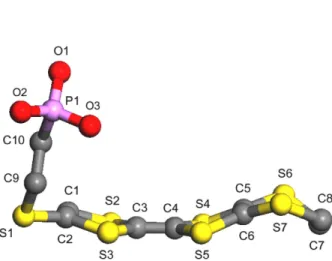
Single crystals of 2b were grown and its crystal struc- ture was analyzed by the X-ray diffraction method. The molecular structure of 2b (Fig. 1) shows that the TTF moi-
ety is slightly folded-up with the peripheral ethylene moi- ety folded downwards and the ethylphosphonic acid moiety is approximately vertical to the EDTTTF plane.
The intramolecular bond lengths and angles fell in the range of their averaged values.8 Only one intermolecular interaction shorter than the sum of their van der Waals radii (3.70Å)8 is observed, viz. S4...S5* (3.583Å; *-x+1, -y+1, -z).
Cyclic voltammetry (CV) and differential pulse volta- mmetry (DPV) measurements of 1b and 2b were per- formed and their parameters are listed in Table 2. The two compounds show the same redox behavior, exhibiting two reversible redox-cycles (Fig. 2) at almost the same poten- tials. These cycles are undoubtedly attributable to the two redox-steps of the TTF moiety. The half-wave potentials of the EDTTTF moiety in 2b (E11/2=0.610 V and E21/2= 1.035 V) are slightly more anodic than those of BMTTTF (0.608 V and 1.000 V), possibly due to the additional periph- eral 6-membered ring.
In summary, two TTF derivatives with the mono-phos- phonic acid group, which can be utilized as a potent com- ponent for functional organic-inorganic hybrids such as zirconium phosphate, were successfully synthesized in a facile way of reacting the corresponding ethyl phospho- nate with bromotrimethylsilane (TMSBr) and triethylamine, and characterized by 1H NMR and FT-IR spectroscopies.
Their electrochemical properties also indicate the pres- Fig. 1. Molecular structure of 2b with numbering scheme. The
hydrogen atoms and solvated molecules are omitted for clarity.
Selected bond lengths (Å) and angles (°): C1-C2 1.323(9), C3- C4 1.351(8), C5-C6 1.340(8), C7-C8 1.415(10), C9-C10 1.511(9), C10-P1 1.809(7), P1-O1 1.493(5), P1-O2 1.507(5), P1- O3 1.552(5), C4-C3-S2 123.3(5), C4-C3-S3 122.3(5), S2-C3-S3 114.4(4), C3-C4-S5 124.2(5), C3-C4-S4 121.9(5), S5-C4-S4 113.9(4), O1-P1-O2 115.5(3), O1-P1-O3 110.1(3), O2-P1-O3 109.9(3).
Table 2. The CV parameters (in V) of 1b and 2b.a
Compound E1pa E2pa E1pc E2pc E11/2 b E21/2b
1b 0.665 1.058 0.550 0.941 0.608 1.000
2b 0.674 1.100 0.545 0.970 0.610 1.035
aThe samples are dissolved in CH2Cl2 containing 0.1 M TBA⋅PF6 electrolyte and analyzed using a scan rate of 0.1 V/s, Pt-disk working elec- trode, Pt-wire counter electrode, and Ag/AgCl ref. electrode. All potential values are referenced to the Fc/Fc+ couple (E1/2 = +0.504 V).
bE1/2=(Epa+Epc) / 2
Fig. 2. The CV (A) and its DPV (B) of 1b measured in CH2Cl2 (Fc/Fc+=0.504 V vs. Ag/AgCl). Compound 2b shows identical patterns in its CV and DPV to those of 1b.
2011, Vol. 55, No. 5
TTF Derivatives Containing Phosphonic Acid Group 895
ence of the TTF moiety in the compounds. One of the compounds was also analyzed by the X-ray diffraction method.
Acknowledgments. This work was supported by a research grant from Seoul Women’s University (2010).
REFERENCES
1. (a) Yamada, J.; Sugimoto, T. TTF Chemistry: Fundamen- tals and Applications of Tetrathiafulvalene; Kodansha &
Springer: Tokyo, 2004. (b) Narita, M.; Pittman, C. U.
Synthesis 1976, 489. (c) Keief, A. Tetrahedron 1986, 42, 1209. (d) Williams, J. M.; Ferraro, J. R.; Thorn, R. J.;
Carlson, K. D.; Geiser, U.; Wang, H. H.; Kini, A. M.;
Whangbo, M.-H. Organic Superconductors (including Fullerenes): Synthesis, Structure, Properties and Theory;
Prentice Hall: Englewood Cliffs, NJ, 1992.
2. Gerbier, P.; Guérin, C.; Henner, B.; Unal, J. R. J. Mater.
Chem. 1999, 9, 2559.
3. Frantz, R.; Carré, F.; Durand, J. O.; Lanneau, G. F. New J. Chem. 2001, 25, 188.
4. Wu, A.; Talham, D. R. Langmuir 2000, 16, 7449.
5. Petruska, M. A.; Watson, B. C.; Meisel, M. W.; Talham, D. R. Chem. Mater. 2002, 14, 2011.
6. Kwon, S. Y.; Cho, J. H.; Lee, H. I.; Lee, U.; Noh, D. Y.
Inorg. Chem. Commun. 2005, 8, 510.
7. Sheldrick, G. M. SHELXTL, version 5, Bruker AXS: Mad- ison, Wisconsin, 1995.
8. Bondi, A. J. Phys. Chem. 1964, 69, 441.