https://doi.org/10.4094/chnr.2019.25.1.65
CHNR
Factors associated with Maternal Attachment of Breastfeeding Mothers
Sun-Hee Kim
Associate Professor, College of Nursing, Research Institute of Nursing Science, Daegu Catholic University, Daegu, Korea
Purpose: This study aimed to identify factors associated with maternal attachment of breastfeeding mothers, with a focus on the mothers' breastfeeding characteristics. Methods: Data were collected from 217 mothers who breastfed their healthy baby for 1 month after childbirth and had no postpartum complications. The data were analyzed by hierarchical regression analysis.
Results: The factors significantly associated with maternal attachment were an emotional exchange with one's baby (
β=.41, p<.001), breastfeeding confidence (
β=.20, p=.022), depression ('quite a bit or more',
β=-.18, p=.005), and depression ('a little',
β=-.14, p=.024). The model explained 38.4% of variance in maternal attachment. Conclusion: In order to improve attachment, nurses should be actively supported in helping mothers in the first month postpartum adapt to breastfeeding. Interventions to prevent postpartum depression should also be conducted.
Key words: Breast feeding; Mother-child relations; Object attachment; Psychological adaptation; Volition
INTRODUCTION
The positive impact of breastfeeding on mothers' health and the health and development of newborn babies has long been well known. In particular, breastfeeding is known to en- hance mothers' parenting behavior and bonding formation, as well as to improve attachment to the baby [1]. That is, maternal attachment builds up as a result of harmonious interactions during breastfeeding, which enables infants to receive visual, haptic, and auditory stimulation and mothers to learn the in- fants' patterns of behavior through direct sensory feedback.
As such, a number of authors have asserted that breastfeed- ing has positive effects on maternal attachment [2-4]. These opinions have encouraged mothers to choose breastfeeding over formula feeding for the purpose of maternal attachment development [5], although it has been found that mothers who bottle-fed their infants felt guilty [6]. However, claims of breastfeeding enhancing maternal attachment have been made with no concrete scientific and empirical evidence, and the universal assumption that breastfeeding exerts a positive influence on maternal attachment has been supported in some studies [4,7] and not supported in others [8,9]. The incon- sistent results of previous studies underscore the necessity of scientifically confirming which characteristics of breastfeed- ing behavior affect attachment.
Women experience diverse aspects of the breastfeeding adap- tation process immediately after childbirth. Breastfeeding adap- tation involves four aspects: the physiological aspect, which
Corresponding author Sun-Hee Kimhttps://orcid.org/0000-0001-8518-5670 College of Nursing, Daegu Catholic University,
33 Duryugongwon-ro, 17-gil, Nam-gu, Daegu 42472, Korea TEL +82-53-650-4831 FAX +82-53-650-4392
E-MAIL [email protected]
*This study was supported by research grants from Daegu Catholic University in 2018 (20181073).
Received Nov 27, 2018 Revised Dec 16, 2018 Accepted Dec 24, 2018
This is an Open Access article distributed under the terms of the Creative Commons Attribution Non- Commercial License (http://creativecommons.org/licenses/by-nc/4.0/) which permits unrestricted non- commercial use, distribution, and reproduction in any medium, provided the original work is properly cited.
involves the ability of the mother to provide an ample amount of breast milk for the baby and engage in convenient feeding sessions, as well as infants' ability to feed and grow; the self-concept aspect, which involves improving confidence in breastfeeding; the role functioning aspect, which refers to skill development for breastfeeding; and the interdependence as- pect, which describes how mothers become acquainted and exchange emotions with infants and receive social support for breastfeeding [10]. Breastfeeding adaptation is thought to be associated with attachment, but no definitive evidence for this yet exists.
Breastfeeding behavior is divided into exclusive, partial, and symbolic [11]. Exclusive breastfeeding is subdivided into two types: feeding with breast milk alone with no other liq- uids or solids, and breast milk occasionally supplemented with vitamins, minerals, water, or juice. Partial breastfeeding means that infants receive breast milk with complementary foods. Symbolic breastfeeding emphasizes the calm and com- fort of infants over nutrition through the provision of occa- sional, irregular, and small amounts of breast milk [11]. Little research has investigated the influence of breastfeeding fre- quency on maternal attachment.
Mothers' willingness to breastfeed is also a critical element in breastfeeding [12,13]. Studies indicate that pregnant wom- en are generally willing to breastfeed due to maternal-fetal at- tachment [14], though the relationship between maternal-fetal attachment and the willingness to breastfeed beyond the 12- month mark has not been reported.
Meanwhile, attachment develops over time, and secure attachment has been observed in the interactions between mothers and infants at 1 month of age [15]. Secure attachment is flexible and changeable depending on the family environ- ment [16]. In addition, breastfeeding is a stable pattern in the first postnatal month [17]. Therefore, if attachment is con- firmed at 1 month postpartum, attachment formation can be improved and attachment disorders can be prevented by ear- ly interventions. The study aimed at analyzing maternal at- tachment at 1 month postpartum and the characteristics of breastfeeding behavior that affected attachment.
1. Objectives
The purpose of this study was to investigate the associa- tions of factors related to mothers' breastfeeding with mater- nal attachment. The specific objectives of this study were as follows:
To investigate the degree of mothers' attachment with their infants, breastfeeding adaptation, and willingness to breastfeed.
To investigate differences in maternal attachment in ac-
cordance with the general characteristics of mothers' breastfeeding behavior.
To investigate the correlations of mothers' attachment with their infant, with breastfeeding adaptation and will- ingness to breastfeed.
To investigate factors associated with attachment be- tween infants and breastfeeding mothers.
METHODS 1. Research Design
The research employed cross-sectional and descriptive analyses to investigate the factors associated with the attach- ment of infants and breastfeeding mothers.
2. Research Subjects
The research subjects were mothers who had been breast- feeding a healthy infant since birth and had no maternal complications. The size of the sample was calculated using G*Power 3.1.9.2. For multiple regression analysis with a me- dium effect size of .15, a significance level of .05, a power of .95 and 17 predictors (eight demographic and breastfeeding char- acteristics, eight subcategories of breastfeeding adaptation, and willingness to breastfeed), the minimum number of sub- jects calculated was 208. Considering about 15% dropout rate, the targeted number of subjects was 240. The study analyzed materials from 217 of 219 survey respondents, excluding two dropouts.
3. Research Instrument 1) Maternal attachment
Maternal attachment is a term used to describe the degree of infant attachment as evaluated by the mother. In this study, maternal attachment was measured by the Korean version [18] of the Maternal Attachment Inventory developed by Mül- ler [19] after assessment of its reliability and validity. It is a mother-centered tool that directly measures maternal attach- ment and is composed of 26 questions that are scored on a Likert scale from 1 ('almost never') to 4 ('almost always'). The total score ranges from 26 to 104, with a higher score indicat- ing a greater degree of maternal attachment. In a reliability test of examinations performed at 4 weeks after delivery, the Cronbach's ⍺ coefficient was .85 when the scale was devel- oped [19], and it was .91 in this study.
2) Breastfeeding adaptation
Breastfeeding adaptation was measured using the tool de-
veloped by Kim [10]. This tool included 27 questions divided into eight subcategories: four items for an emotional exchange with one's baby, five for breastfeeding confidence, three for sufficient breast milk, four for the baby's feeding capability and growth, four for being familiar with one's baby, three for discomfort in breastfeeding, two for maintenance of breast milk volume, and two for getting support. Each question is evaluated on a Likert scale from 1 ('disagree') to 5 ('absolutely agree'). The total score ranges between 27 and 135, with higher scores indicating better adaptation to breastfeeding. Its reli- ability was confirmed through a Cronbach's ⍺ level of .82 in Kim's [10] study on the occasion of its development and a score of .88 in this study.
3) Willingness to breastfeed
Willingness to breastfeed was measured using the tool de- veloped by Kim and Nam [12] to evaluate willingness to breastfeed during the postpartum period, which Kim [20] ex- tended from 6 weeks to more than 12 months to reflect the rec- ommendations of the American Academy of Pediatrics. The total number of questions is four, and they are evaluated using a Likert scale that ranges from 1 ('not at all') to 7 ('extremely likely'). The range of the total score is between 4 and 28, and higher scores are associated with stronger willingness to breastfeed. The Cronbach's ⍺ was .97 when the tool was de- veloped [12] and .98 in this study.
4) Demographic and breastfeeding characteristics
Subjects were asked to report their demographic character- istics, including age, education, current working status, mar- ital satisfaction, number of children, and depression. The de- pression item was one question asking "How depressed are you now?" that was rated with a 4-point Likert scale (1=not at all, 2=a little, 3=quite a bit, 4=very much). Further items relat- ing to subjects' breastfeeding characteristics included the planned duration of breastfeeding and current breastfeeding type.
4. Data Collection Process
To recruit subjects, the directors of five postpartum care centers in Seoul metropolitan city and three other metropoli- tan cities were asked for support. The researcher visited the directors and explained the purpose of the research and how to collect the data, and delivered a publicity poster for recruit- ing volunteers. The data collection period was June 25 to September 21, 2018. With the aid of supporters from the or- ganizations, brochures describing the study were given to mothers who were breastfeeding. Postpartum care nurses were employed as research assistants who explained the study to
breastfeeding subjects and directly received their contact in- formation to send a link to an online survey. The contact in- formation of the subjects included their cellphone number or e-mail address. The researcher sent a guide letter and the link to 240 mothers who were in their fourth or fifth week after birth, with one or two more reminders, using SNS messages or e-mail. Only subjects who were breastfeeding at the time of the survey were eligible to participate in the online survey. A total of 219 subjects responded to the survey, two of whom did not complete the survey.
5. Ethical Considerations
Institutional review board approval was obtained before initiating the research (No. CUIRB-2018-0011, from the Bio- ethics Committee of the institution). The survey participants voluntarily clicked the link to the survey, where they were able to read a description of the research that presented its purpose and methods and explained confidentiality and ano- nymity, revocability, and the benefits and disadvantages of participating. Once participants voluntarily agreed to partic- ipate, they were allowed to begin the survey. Upon complet- ing the survey, an online thanks card and a small monetary token of appreciation (3,000 won) were sent using a mobile payment service. The data were stored in a safe, locked envi- ronment only accessible to the author. All files will be de- stroyed within 3 years of completing the analysis.
6. Data Analysis
The collected data were analyzed using IBM SPSS Statistics
25.0 in terms of frequency, percentage, mean and standard
deviation for factors relating to the subjects' general back-
ground. For maternal attachment, breastfeeding adaptation,
and willingness to breastfeed, mean and standard deviation
were used. The normality of the data was analyzed using the
Shapiro-Wilk test. The demographic and breastfeeding varia-
bles did not have a normal distribution. Thus, the Kruskal-
Wallis test followed by the Mann-Whitney U test with the
Bonferroni correction were used to analyze differences in ma-
ternal attachment according to demographic and breastfeed-
ing variables. Correlations among maternal attachment, breast-
feeding adaptation, and willingness to breastfeed were ana-
lyzed by Pearson correlation coefficients, and hierarchical
multiple regression analysis was used to determine the factors
that affected maternal attachment. In step 1, unique associa-
tions of demographic and breastfeeding characteristics with
maternal attachment were tested. The subcategories of breast-
feeding adaptation and willingness to breastfeed were added
in step 2, testing unique associations of the subcategories of
Table 1. Maternal Attachment according to Demographic and Breastfeeding Characteristics (N=217)
Variables Categories n (%) or M±SD M±SD H p
Age* (year) ≤29
30~39
≥40 Total subjects
53 (24.7) 154 (71.6) 8 (3.7) 32.34±4.06
3.62±0.34 3.67±0.28 3.75±0.24
0.95 .622
Education ≤High school
College or university Graduate school
16 (7.4) 175 (80.6) 26 (12.0)
3.74±0.34 3.66±0.28 3.62±0.31
3.87 .145
Current working status Unemployeda Maternity leaveb Workingc
106 (48.8) 105 (48.4) 6 (2.8)
3.70±0.24 3.63±0.32 3.40±0.35
6.24 .044
(a>b>c)†
Marital satisfaction* Very dissatisfied Dissatisfied Moderatea Satisfiedb Very satisfiedc Total subjects
0 (0.0) 0 (0.0) 16 (7.4) 113 (52.6) 86 (40.0) 4.31±0.63
- - 3.53±0.30 3.64±0.28 3.72±0.28
12.19 .002
(c>b>a)†
Number of children 1
2
≥3
Total subjects
147 (67.7) 56 (25.8) 14 (6.5) 1.40±0.64
3.65±0.30 3.66±0.27 3.79±0.20
3.49 .175
Depression Not at alla
A littleb
Quite a bit or morec‡
Total subjects
104 (47.9) 100 (46.1) 13 (6.0) 1.59±0.62
3.75±0.21 3.61±0.30 3.32±0.43
26.50 <.001
(a>b>c)†
Period planned for breastfeeding* (month)
≤6 7~12
≥13 Total subjects
105 (48.6) 99 (45.8) 12 (5.6) 8.46±3.91
3.65±0.32 3.68±0.26 3.66±0.23
0.34 .843
Current breastfeeding type Exclusive Partial Symbolic
61 (28.1) 130 (59.9) 26 (12.0)
3.68±0.28 3.67±0.27 3.55±0.40
1.80 .406
*Missing data were not included in the values; †The Kruskal-Wallis test was followed by the Mann-Whitney U test using the Bonferroni correction to adjust the probability; ‡'Very much' was included in 'quite a bit or more' because there was only one person who responded 'very much'.
breastfeeding adaptation and willingness to breastfeed with maternal attachment beyond the effects of demographic and breastfeeding characteristics.
RESULTS
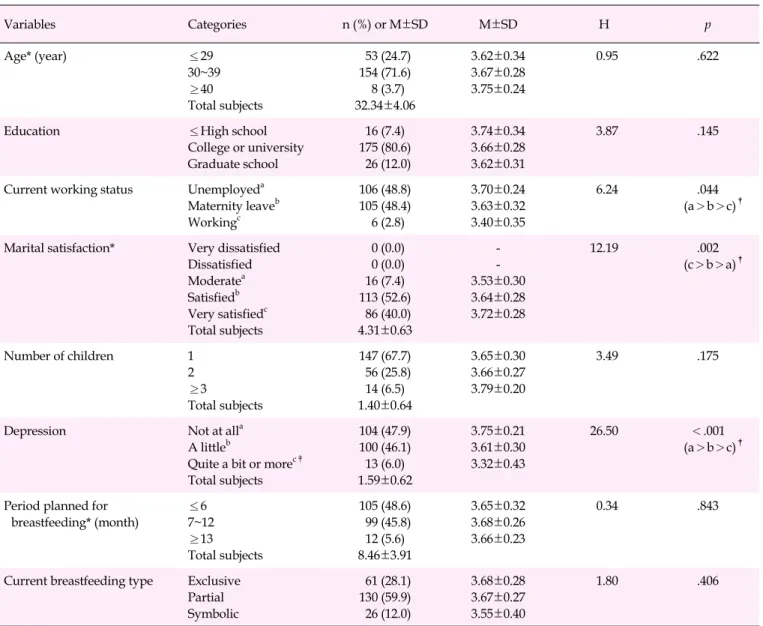
1. Demographic and Breastfeeding Characteristics The average age of the subjects was 32.34±4.06 years, with the majority of subjects in their 30s. The vast majority (80.6%) was college or university graduates and 48.8% were unem- ployed. Marital satisfaction received an average score of 4.31
± 0.63 points on average, and most subjects (67.7%) had one child. The score for depression was 1.59±0.62 points, and
47.9% and 46.1% of the subjects suffered from no depression and slight depression, respectively. The average planned duration of breastfeeding was 8.46±3.91 months, and most replies indicated that the planned duration was within 12 months. Furthermore, 59.9% of the subjects used partial breastfeeding (Table 1).
2. Degree of Maternal Attachment, Breastfeeding Adaptation, and Willingness to Breastfeed
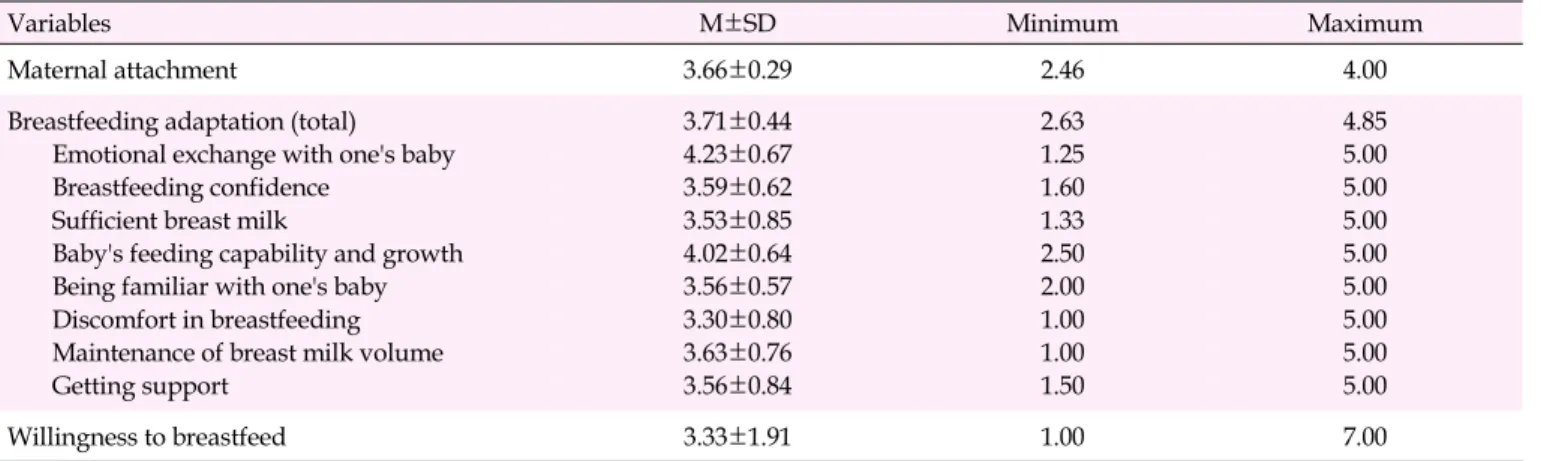
The scores for maternal attachment and breastfeeding
adaptation were 3.66±0.29 points and 3.71±0.44 points, res-
pectively. The scores for the subcategories of breastfeeding
adaptation were 4.23±0.67 for an emotional exchange with
Table 2. Degree of Maternal Attachment, Breastfeeding Adaptation, and Willingness to Breastfeed (N=217)
Variables M±SD Minimum Maximum
Maternal attachment 3.66±0.29 2.46 4.00
Breastfeeding adaptation (total) Emotional exchange with one's baby Breastfeeding confidence
Sufficient breast milk
Baby's feeding capability and growth Being familiar with one's baby Discomfort in breastfeeding Maintenance of breast milk volume Getting support
3.71±0.44 4.23±0.67 3.59±0.62 3.53±0.85 4.02±0.64 3.56±0.57 3.30±0.80 3.63±0.76 3.56±0.84
2.63 1.25 1.60 1.33 2.50 2.00 1.00 1.00 1.50
4.85 5.00 5.00 5.00 5.00 5.00 5.00 5.00 5.00
Willingness to breastfeed 3.33±1.91 1.00 7.00
Table 3. Correlations of Maternal Attachment, Breastfeeding Adaptation, and Willingness to Breastfeed (N=217)
Variables X2 X3 X4 X5 X6 X7 X8 X9 X10 X11
r r r r r r r r r r
X1 .45** .51** .38** .13* .29** .38** .20* .15* .14* .15*
X2 1 .57** .78** .67** .75** .78** .43** .59** .44** .45**
X3 1 .38** .24** .30** .36** .14* .18* .13 .32**
X4 1 .44** .53** .54** .29** .37** .18* .59**
X5 1 .49** .53** .06 .40** .17* .26**
X6 1 .59** .19* .35** .29** .18*
X7 1 .24** .38** .27** .28**
X8 1 .14* .06 .18*
X9 1 .49** .26**
X10 1 .08
X11 1
X1=Maternal attachment; X2=Breastfeeding adaptation (total); X3=Emotional exchange with one's baby; X4=Breastfeeding confidence;
X5=Sufficient breast milk; X6=Baby's feeding capability and growth; X7=Being familiar with one's baby; X8=Discomfort in breastfeeding;
X9=Maintenance of breast milk volume; X10=Getting support; X11=Willingness to breastfeed; *p<.050; **p<.001.
one's baby, 3.59±0.62 for breastfeeding confidence, 3.53±0.85 for sufficient breast milk, 4.02±0.64 for the baby's feeding ca- pability and growth, 3.56±0.57 for being familiar with one's baby, 3.30±0.80 for discomfort in breastfeeding, 3.63±0.76 for maintenance of the breast milk volume, and 3.56±0.84 for get- ting support. Willingness to breastfeed received a score of 3.33±1.91 points (Table 2).
3. Maternal Attachment according to Demographic and Breastfeeding Characteristics
Maternal attachment showed a significant relationship with subjects' current working status (H=6.24, p=.044), satisfaction (H=12.19, p=.002), and depression (H=26.50, p<.001) (Table 1).
4. Correlations among Maternal Attachment, Breast- feeding Adaptation, and Willingness to Breastfeed Maternal attachment was positively related to breastfeed- ing adaptation (r=.45, p<.001) and the subcategories of breast- feeding adaptation, an emotional exchange with one's baby (r=.51, p<.001), breastfeeding confidence (r=.38, p<.001), suf- ficient breast milk (r=.13, p=.049), the baby's feeding capability and growth (r=.29, p<.001), being familiar with one's baby (r=
.38, p<.001), discomfort in breastfeeding (r=.20, p=.004), main-
tenance of breast milk volume (r=.15, p=.033), and getting sup-
port (r=.14, p=.038). A positive correlation was also observed
between maternal attachment and willingness to breastfeed
(r=.15, p=.027)(Table 3).
Table 4. Factors associated with Maternal Attachment (N=217)
Step Variables B SE
β t (p) R2 Adjusted R2 F (p)
1 (Constant)
Current working status (unemployed) Marital satisfaction (moderate)*
Marital satisfaction (satisfied)† Depression (quite a bit or more)‡ Depression (a little)§
3.74 0.06 -0.08 -0.05 -0.40 -0.13
.04 .04 .08 .04 .09 .04
.11 -.07 -.09 -.31 -.22
100.02 (<.001) 1.75 (.082) -1.01 (.315) -1.26 (.208) -4.63 (<.001) -3.29 (.001)
.162 .142 8.08 (<.001)
2 (Constant)
Current working status (unemployed) Marital satisfaction (moderate)*
Marital satisfaction (satisfied)† Depression (quite a bit or more)‡ Depression (a little)§
Emotional exchange with one's baby Breastfeeding confidence
Sufficient breast milk
Baby's feeding capability and growth Being familiar with one's baby Discomfort in breastfeeding Maintenance of breast milk volume Getting support
Willingness to breastfeeding
2.60 0.06 -0.05 -0.01 -0.23 -0.08 0.17 0.09 -0.04 -0.02 0.08 0.01 0.00 0.00 -0.03
.17 .03 .07 .04 .08 .04 .03 .04 .02 .03 .04 .02 .03 .02 .01
.11 -.05 -.02 -.18 -.14 .41 .20 -.12 -.04 .15 .03 .01 -.01 -.17
15.01 (<.001) 1.89 (.061) -0.73 (.468) -0.37 (.715) -2.87 (.005) -2.28 (.024) 6.51 (<.001) 2.32 (.022) -1.60 (.111) -0.48 (.633) 1.90 (.059) 0.57 (.568) 0.15 (.879) -0.17 (.865) -2.42 (.061)
.384 .341 8.91 (<.001)
*Dummy coded (1=moderate, 0=satisfied, 0=very satisfied); †Dummy coded (1=satisfied, 0=moderate, 0=very satisfied); ‡Dummy coded (1=quite a bit
5. Factors associated with Maternal Attachment Hierarchical regression analysis was carried out to inves- tigate the relative effects of various factors on maternal at- tachment. First of all, after examining the Durbin-Watson sta- tistic, the tolerance, variance inflation factor (VIF), and the un- employed status variable were entered into the hierarchical regression analysis. However, the maternity leave status vari- able was excluded because multicollinearity between unem- ployed status and maternity leave status was suspected. The Durbin-Watson statistic was then 1.99, which indicated no au- tocorrelation, as it was close to the reference value of 2. Its tol- erance was .41 to .94, and the VIF ranged from 1.06 to 2.42.
Therefore, there was no multicollinearity problem with the in- dependent variables, and the regression model was confir- med to be appropriate.
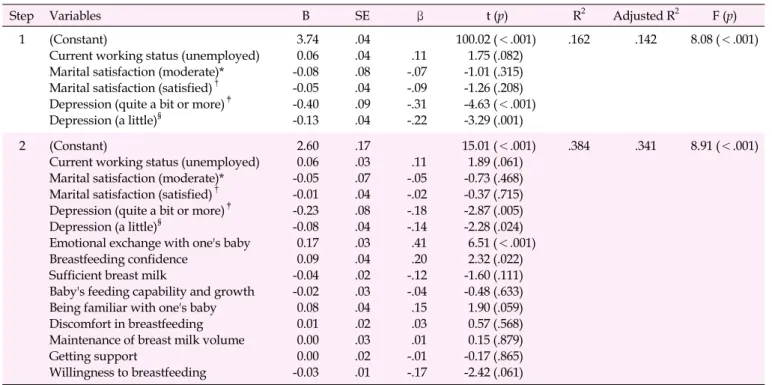
When demographic and breastfeeding characteristics were applied as independent variables in the first step of the hier- archical regression analysis, depression ('quite a bit or more',
β=-.31, p<.001) and depression ('a little',
β=-.22, p=.001) were found to have affected attachment. Those variables explained 16.2% of the variance in maternal attachment (Table 4).
The effects of the subcategories of breastfeeding adapta- tion and willingness to breastfeed on maternal attachment in the second step of the hierarchical regression analysis were tested while adjusting for demographic and breastfeeding characteristics. Of the breastfeeding adaptation subcategories,
an emotional exchange with one's baby (
β=.41, p<.001), breastfeeding confidence (
β=.20, p=.022), depression ('quite a bit or more',
β=-.18, p=.005), and depression ('a little',
β=-.14,
p=.024) were shown to have affected maternal attachment.The final model explained 38.4% of variance in maternal at- tachment. Two subcategories of breastfeeding adaptation ex- plained an additional 22.2% variance in maternal attachment beyond the effects of demographic and breastfeeding charac- teristics (Table 4).
DISCUSSION
In this study, the influence of the subcategories of breast-
feeding adaptation on maternal attachment was analyzed af-
ter controlling for demographic and breastfeeding character-
istics (22.2%) using hierarchical regression analysis. Our find-
ings suggest that women with high breastfeeding adaptation
will be better at forming attachment, implying that encourag-
ing breastfeeding will help build attachment. This study sup-
ports previous findings [4,7] that breastfeeding was asso-
ciated with attachment. Breastfeeding promotes attachment
because breastfed babies are more warm and cuddly, more co-
operative, and less demanding and angry than non-breastfed
babies [4]. However, previous studies have investigated the
relationship between the initiation or duration of breastfeed-
ing and maternal attachment, but have not revealed which
characteristics of breastfeeding are related to attachment [4,7].
However, this study has filled that gap. In addition, this study investigated postpartum attachment at an earlier stage than previous studies. Therefore, based on the results of this study, it was found that it is important to facilitate early success in breastfeeding to promote attachment formation.
The quality of attachment of an infant is related to inter- actions and experiences with caregivers [21]. This study re- vealed that an emotional exchange with one's baby was the most significantly associated factor with maternal attachment among the breastfeeding adaptation subcategories. In other words, exchanging positive emotions with an infant during breastfeeding has a connection with attachment. The sensi- tivity of the primary caregiver exerts influence not only on early mother-infant interactions, but also on the quality of the infants' attachment [22]. Breastfeeding creates considerable opportunities for mothers to learn patterns of their infants' be- havior through tactile and eye contact at an intimate distance.
The growing frequency of interactive behaviors, including an emotional exchange with one's infant, caused by mothers' careful observation of infants' feelings and reactions during breastfeeding is thought to exert an influence on maternal attachment. This finding is similar to the report indicating [23]
that kangaroo care, in which the baby is in direct contact with the mother's skin at close range, affects maternal attachment to premature babies. Therefore, it will be possible to improve attachment by continuously increasing opportunities for in- teraction after birth.
This study found that breastfeeding confidence was asso- ciated with maternal attachment, similarly to a report of a me- dium correlation between breastfeeding self-efficacy and ma- ternal attachment [24]. Comprehensive knowledge of breast- feeding, the ability to get useful information, and the con- fidence to overcome difficulties in breastfeeding encourage the mother to feel that she is important to the infant and to en- joy the time that she spends with the infant, which is why breastfeeding confidence affected maternal attachment. As noted above, maternal attachment increases in women who adapt to breastfeeding well by engaging in emotional ex- changes and developing breastfeeding confidence. Thus, it is essential to support and encourage mothers to adapt success- fully to breastfeeding.
In this study, depression was found to be associated with maternal attachment, as in another study that reported that depression during the postpartum period was related with bonding disorder [25]. Similarly, other study reported that mothers experiencing subclinical depressive symptoms 6~8 months after birth had lower maternal attachment than heal- thy mothers [26]. Furthermore, it is critical to observe depres- sion symptoms early and to prevent maternal attachment dis- order because depression in postpartum women interferes
with the improvement of attachment to 6-month-old babies [25]. However, these results should be interpreted cautiously because only one item was used to evaluate maternal depres- sion. Further research is required to confirm the relationship between depression in breastfeeding mothers and maternal attachment by applying a depression measurement tool with high levels of validity and reliability.
In this study, subjects who had experienced breastfeeding for 1 month showed a slightly elevated willingness to breast- feed for more than 12 months, but willingness to breastfeed was not a major factor associated with maternal attachment.
In this study, willingness to breastfeed referred to mothers' in- tent and efforts to breastfeed infants for more than 12 months, and the participants in this study were mothers who had breastfed exclusively, partially, or symbolically for only 1 month. Thus, maternal attachment at this time can be inter- preted as being formed irrespective of the willingness to breastfeed for a long period of time. This is partly explained by findings that breastfeeding behavior is not influenced di- rectly by the willingness to breastfeed for a long period be- cause that willingness is influenced by several other factors [12]. It is difficult to contextualize our findings regarding pro- spective willingness to breastfeed and maternal attachment because few previous studies have investigated this issue.
However, a previous retrospective study reported that the du- ration of breastfeeding contributed to secure attachment in 24-month-old babies [27], in contrast to this study. To summa- rize, this study revealed that there was no relationship be- tween maternal attachment and willingness to breastfeed, and this relationship was not investigated in previous studies.
Further research is needed to elucidate the association be- tween willingness to breastfeed and maternal attachment de- pending on the postpartum time point.
This research showed no relationship between maternal at- tachment and exclusive, partial, or symbolic breastfeeding.
This is similar to a previous finding that secure attachment had no relationship with exclusive or partial breastfeeding in addition to interactions with the infant [3]. Accordingly, ma- ternal attachment has no relationship with breastfeeding fre- quency, but attachment has been found to show a relationship with the interactions between mothers and infants and moth- ers' sensitivity [22].
Interpretation and generalization of these findings require
special caution because the research subjects were breastfeed-
ing mothers from limited areas and the study did not include
subjects who did not attend a postpartum care center. In addi-
tion, this study did not compare the maternal attachment of
women who did not breastfeed because it focused on the asso-
ciation between breastfeeding and maternal attachment in
breastfeeding women. Further research should compare ma-
ternal attachment between breastfeeding and non-breastfeed- ing women. Finally, the dropout rate of this study was lower than expected. The reason for this was that postpartum care nurses were employed as research assistants, who kindly re- quested participants to participate, had an intimate relation- ship with the postpartum mothers that continued after the mothers left the postpartum care center, and communicated through an easy and fast methods (one of the most used SNS in Korea) with one or two additional reminders within 1 week.
CONCLUSION
Enthusiastic support from professional nurses is necessary to promote breastfeeding adaptation in mothers, because an emotional exchange with infants and formation of breastfeed- ing confidence are the most important factors that contribute to maternal attachment in the first month of the postpartum period. Furthermore, in order to improve attachment, inter- ventions for early postpartum depression are needed. Further research should be conducted using tools with high reliability and validity for the purpose of reinvestigating the correlation of postpartum depression with maternal attachment. This re- search suggests that it would be promising for further re- search to consider confounding variables that can affect the relationships among return to the workplace, marital satis- faction, and attachment.
Conflict of interest
No existing or potential conflict of interest relevant to this article was reported.
REFERENCES
1. Jansen J, de Weerth C, Riksen-Walraven JM. Breastfeeding and the mother-infant relationship-A review. Developmental Review. 2008;
28(4):503-521. https://doi.org/10.1016/j.dr.2008.07.001
2. Leung AK, Sauve RS. Breast is best for babies. Journal of the National Medical Association. 2005;97(7):1010-1019.
3. Britton JR, Britton HL, Gronwaldt V. Breastfeeding, sensitivity, and attachment. Pediatrics. 2006;118(5):e1436-e1443.
https://doi.org/10.1542/peds.2005-2916
4. Gibbs BG, Forste R, Lybbert E. Breastfeeding, parenting, and infant attachment behaviors. Maternal and Child Health Journal. 2018;
22(4):579-588. https://doi.org/10.1007/s10995-018-2427-z 5. Gijsbers B, Mesters I, André Knottnerus J, Legtenberg AHG, van
Schayck CP. Factors influencing breastfeeding practices and post- ponement of solid food to prevent allergic disease in high-risk chil- dren: Results from an explorative study. Patient Education and Counseling. 2005;57(1):15-21.
https://doi.org/10.1016/j.pec.2004.03.012
6. Braimoh J, Davies L. When 'breast' is no longer 'best': Post-partum constructions of infant-feeding in the hospital. Social Science &
Medicine. 2014;123:82-89.
https://doi.org/10.1016/j.socscimed.2014.10.052
7. Scharfe E. Maternal attachment representations and initiation and duration of breastfeeding. Journal of Human Lactation. 2012;28 (2):218-225. https://doi.org/10.1177/0890334411429111
8. Jackson DB. The association between breastfeeding duration and at- tachment: A genetically informed analysis. Breastfeeding Medicine.
2016;11(6). https://doi.org/10.1089/bfm.2016.0036
9. Schulze PA, Carlisle SA. What research does and doesn't say about breastfeeding: A critical review. Early Child Development and Care. 2010;180(6):703-718.
https://doi.org/10.1080/03004430802263870
10. Kim SH. Development of a breast feeding adaptation scale (BFAS).
Journal of Korean Academy of Nursing. 2009;39(2):259-269.
https://doi.org/10.4040/jkan.2009.39.2.259
11. Labbok M, Krasovec K. Toward consistency in breastfeeding de- finitions. Studies in Family Planning. 1990;21(4):226-230.
12. Kim HS, Nam ES. Prediction of breastfeeding intentions and be- haviors: An application of the theory of planned behavior. Journal of Korean Academy of Nursing. 1997;27(4):796-806.
https://doi.org/10.4040/jnas.1997.27.4.796
13. Yang HJ, Seo JM. A structural model for primiparas' breastfeeding behavior. Journal of Korean Academy of Nursing. 2013;43(3):399- 408. https://doi.org/10.4040/jkan.2013.43.3.399
14. Huang HC, Wang SY, Chen CH. Body image, maternal-fetal at- tachment, and choice of infant feeding method: A study in Taiwan.
Birth. 2004;31(3):183-188.
https://doi.org/10.1111/j.0730-7659.2004.00303.x
15. Isabella RA, Belsky J. Interactional synchrony and the origins of in- fant-mother attachment: A replication study. Child Development.
1991;62(2):373-384.
16. Thompson RA, Raikes HA. Toward the next quarter-century:
Conceptual and methodological challenges for attachment theory.
Development and Psychopathology. 2003;15(3):691-718.
17. Huggins K, Ziedrich L. The nursing mother's guide to weaning.
2nd ed. Boston, MA: The Harvard Common Press; 2007. p. 26.
18. Shin H, Kim YH. Maternal attachment inventory: Psychometric evaluation of the Korean version. Journal of Advanced Nursing.
2007;59(3):299-307.
https://doi.org/10.1111/j.1365-2648.2007.04322.x
19. Müller ME. A questionnaire to measure mother-to-infant attach- ment. Journal of Nursing Measurement. 1994;2(2):129-141.
20. Kim SH. Factors explaining mothers' breastfeeding satisfaction.
Korean Journal of Women Health Nursing. 2009;15(4):270-279.
https://doi.org/10.4069/kjwhn.2009.15.4.270
21. Cerezo MA, Pons-Salvador G, Trenado RM, Sierra P. Mother-in- fant verbal and nonverbal interaction as predictor of attachment:
Nonlinear dynamic analyses. Nonlinear Dynamics, Psychology, and Life Sciences. 2016;20(4):485-508.
22. De Wolff MS, van Ijzendoorn MH. Sensitivity and attachment: A meta-analysis on parental antecedents of infant attachment. Child Development. 1997;68(4):571-591.
23. Cho ES, Kim SJ, Kwon MS, Cho H, Kim EH, Jun EM, et al. The ef- fects of kangaroo care in the neonatal intensive care unit on the physiological functions of preterm infants, maternal-infant attach- ment, and maternal stress. Journal of Pediatric Nursing. 2016;31 (4):430-438. https://doi.org/10.1016/j.pedn.2016.02.007
24. Cinar N, Köse D, Altinkaynak S. The relationship between mater- nal attachment, perceived social support and breast-feeding suffi- ciency. Journal of the College of Physicians and Surgeons Pakis- tan. 2015;25(4):271-275.
25. Kerstis B, Aarts C, Tillman C, Persson H, Engström G, Edlund B, et al. Association between parental depressive symptoms and im- paired bonding with the infant. Archives of Women's Mental Health. 2016;19(1):87-94.
https://doi.org/10.1007/s00737-015-0522-3
26. Behrendt HF, Konrad K, Goecke TW, Fakhrabadi R, Herpertz- Dahlmann B, Firk C. Postnatal mother-to-infant attachment in sub- clinically depressed mothers: Dyads at risk? Psychopathology.
2016;49(4):269-276. https://doi.org/10.1159/000447597
27. Weaver JM, Schofield TJ, Papp LM. Breastfeeding duration pre- dicts greater maternal sensitivity over the next decade. Develop- mental Psychology. 2018;54(2):220-227.
https://doi.org/10.1037/dev0000425