A total of 1,235 studies were retrieved on June 23, 2019, from 3 databases. Selected 59 studies were evaluated by year of publication, study type, subject condition/disease, acupoint, standards for reporting interventions in clinical trials of moxibustion (STRICTOM), Cochrane risk of bias (RoB), and risk of bias assessment tool for non-randomized study (RoBANS). Most studies were conducted in 2011, after which the number of studies decreased. The most common study type was 25 case reports (CR), 16 uncontrolled clinical trials (UCT), 11 randomized controlled trials (RCT), and 7 controlled clinical trials (CCT). Moxibustion treatment was mainly used for musculoskeletal and circulatory diseases/conditions. A total of 83 acupoints were used, A-shi points being the most used. As for STRICTOM, an average of 7.4 items were satisfactory for UCT and CR without a control group, and an average of 9.4 items were satisfactory for RCT and CCT.
RCT was assessed using the RoB, and many items were rated as uncertain. In this study, the need for RCT of moxibustion treatment in Korea was identified. The detailed description of study methods and results will provide evidence for the efficacy of moxibustion treatment in preventive and therapeutic aspects of Korean traditional medicine.
©2020 Korean Acupuncture & Moxibustion Medicine Society. This is an open access article under the CC BY- NC-ND license (http://creativecommons.org/licenses/by-nc-nd/4.0/).
Article history:
Submitted: October 1, 2019 Revised: November 12, 2019 Accepted: November 22, 2019 Keywords:
Indirect Moxibustion, Direct Moxibustion, Moxa, STRICTOM
https://doi.org/10.13045/jar.2019.00227 pISSN 2586-288X eISSN 2586-2898
Review Article
Recent Research Trends in Moxibustion Treatment in Korea
Ju-Hyeon Lee *, Doo-ree Hwang, Seung-Hyo Hong
Department of Acupuncture and Moxibustion Medicine, Dongseo Oriental Hospital, Seoul, Korea
ABSTRACT
Journal of Acupuncture Research
Journal homepage: http://www.e-jar.org
Introduction
Moxibustion therapy is a Korean traditional medicine treatment which involves burning Artemisiae Argi Foliumin onto the acupoint to apply both the drug and a warming action at the same time [1]. Moxibustion is an important treatment in Korean traditional medicine and to quote ≪Hwangjenaegyeong·Youngch u ·Guanneung≫ [2], “first acupuncture, second moxibustion, third herbal medicine”. It is important to note that, “it is appropriate to use moxibustion without acupuncture.” The indications for treatment are wide, and if acupuncture is ineffective at treating serious illness, it is replaced with moxibustion treatment. When looking at the ranking of the treatment fee under the 5 categories of medical care expenses ratio in Korean traditional medicine from 2004 to 2013, moxibustion was shown to be high ranking and placed after acupuncture and cupping. In addition, comparing the growth rate during the period, moxibustion increased by 398% compared to the 89% increase in acupuncture [3]. Public interest in moxibustion treatment and the utilization of Korean medicine doctors has increased, due to an aging society, and increasing social and medical interest in chronic diseases. Clinical
trials for moxibustion have also increased dramatically since 2000 [4]. However, relatively few studies have been conducted on moxibustion treatment in Korea compared to herbal medicine and acupuncture. Several studies have systematically reviewed a single condition/disease, but few studies have conducted a comprehensive and systematic examination of clinical studies performed in Korea. This study aimed to elucidate clinical research trends in moxibustion treatment in Korea in the last 20 years, to evaluate its use in clinical treatment.
Materials and Methods Database and search method
The analysis examined clinical research studies published over the last 20 years from 1999 to December 2018. The National Digital Science Library (NDSL), Research Information Sharing Service (RISS), Oriental Medicine Advanced Searching Integrated System (OASIS) were searched. In the NDSL database “Moxibustion (in Korean)” OR “Moxibustion Treatment (in Korean)” OR “indirect moxibustion (in Korean)” OR “direct moxibustion (in Korean)”
* Corresponding author. Ju-Hyeon Lee
Department of Acupuncture and Moxibustion Medicine, Dongseo Oriental Hospital, Seoul, Korea E-mail:[email protected]
ORCID: Ju-Hyeon Lee https://orcid.org/0000-0002-1430-0106
©2020 Korean Acupuncture & Moxibustion Medicine Society. This is an open access article under the CC BY-NC-ND license (http://creativecommons.org/licenses/by-nc-
nd/4.0/).
J Acupunct Res 2020;37(1):1-12 2
OR “moxa” OR “moxibustion” OR “Moxa (in Chinese character)”
search terms were used. In the RISS database “Moxibustion (in Korean)” OR “Moxibustion Treatment (in Korean)” OR “Moxa (in Chinese character)” search terms were used. In the OASIS database, the search terms “Moxibustion Treatment (in Korean)”
OR “indirect moxibustion (in Korean)” OR “direct moxibustion (in Korean)” OR “moxa” OR “moxibustion” were used. Research published in dissertations and journals were also included.
Selection and exclusion methods
Clinical articles published in Korea were selected and clinical listings without patients were excluded. Literature reviews, animal experiments, and moxibustion-related device studies were excluded in this review. Studies in which the Korean Medicine doctor did not directly perform moxibustion treatment were excluded from the study. In the moxibustion-related treatments of warming acupuncture, burning acupuncture, BUDDEUMI (Hanji, Busan, Korea) such as moxibustion, and other Korean traditional medicine treatments, a variety of devices were used, except if the effect of moxibustion treatment was not clearly known. Studies that confirm the effectiveness of moxibustion treatment were included in the study along with moxibustion therapy, and other treatment methods.
Select materials
The entire process of collection and screening of the data was carried out independently under the selection and exclusion criteria. Any discrepancies were reviewed by 2 independent researchers to find consensus, and input from third-party researchers was sought when agreement could not be reached.
Data extraction
In clinical studies, yearly changes, number of subjects, analysis of the study type, and the subject conditions/diseases and symptoms were analyzed using ICD-10. In addition, based on Standards for reporting interventions in clinical trials of moxibustion (STRICTOM), the contents of the moxibustion types, treatment frequency and duration, the number of repetitions used on each occasion, and used acupoints were analyzed.
Assessing the quality of research
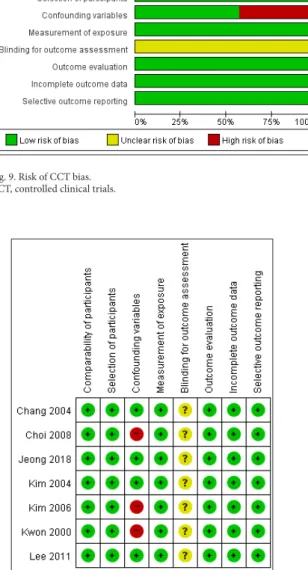
Risk of bias in randomized controlled trials (RCT) was assessed using the Cochrane risk of bias (RoB) tool [5]. In controlled clinical trials (CCT) the risk of bias assessment tool for non- randomized study (RoBANS) [6] was used. All items were evaluated when specified in the text of the selected study. In cases of disagreement between the evaluators, the opinions of third- party researchers were sought.
Results Search results
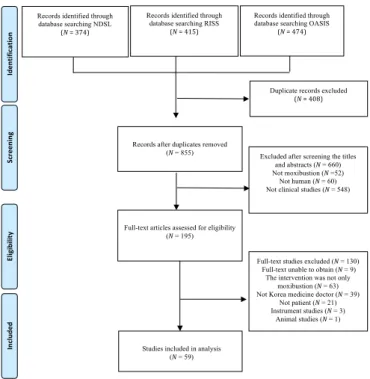
According to the parameters set in this study, searches were conducted in 3 Korean databases and 1,263 studies were retrieved from 1999 to December 2018. There were 855 studies initially selected, excluding 408 duplicate studies. There were 195 studies which were selected with the exception of 52 studies that did not perform moxibustion, 60 studies were not patient based, and 548 studies were not performed in clinics. Studies in which the full
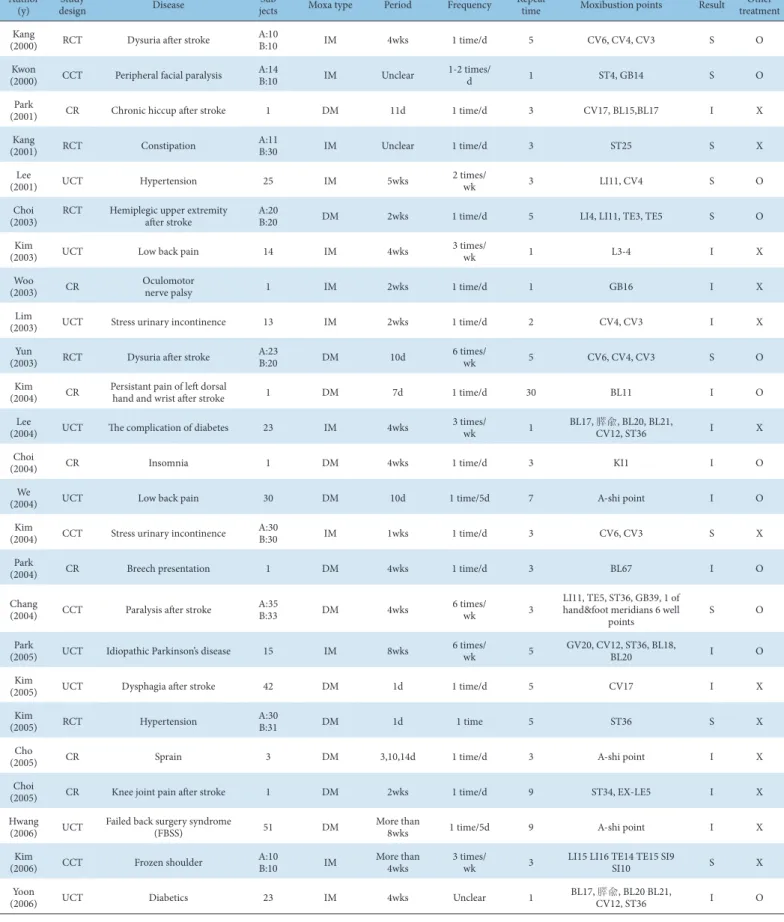
text was not available, the results of moxibustion treatment could not be clearly confirmed in combination with other treatments, treatments not directly administered by a Korean medicine doctor, non-patient studies, device studies, animal trials, and other factors were excluded. There were 59 studies finally selected for review (Fig. 1; Table 1).
Analysis
Classification by year
Looking at studies published between 1999 and 2018 there were, no publications in 1999, 2 in 2000 [7,8], 3 in 2001 [9-11], 0 in 2002, 5 in 2003 [12-16], 7 in 2004 [17-23], 5 in 2005 [24-28], 3 in 2006 [29-31], 4 in 2007 [32-35], 5 in 2008 [36-40], 6 in 2009 [41-46], 3 in 2010 [47-49], 9 in 2011 [50-58], 2 in 2012 [59,60], 1 in 2013 [61], 0 in 2014, 2 in 2015 [62,63], 0 in 2016, 1 in 2017 [64], and 1 in 2018 [65] (Fig. 2).
Classification by clinical study type
Case reports (CR) were the most common type of study with 25 cases (42%) published. There were 16 cases (27%) of uncontrolled clinical trials (UCT), 11 cases of RCT (19%), and CCT had the least number of cases (12%; Fig. 3).
The number of study subjects
There were 41 studies where less than 30 people (69.5%) were included in the study, 11 studies of 30-60 people (18.6%), 5 studies of less than 90 people (8.5%), and 2 studies of 90 or more (3.4%).
In the UCT studies, the number of patients was 6-42, with an average of 23.8. In RCT studies, the number of patients was 20-85, with an average of 42.09. In the CCT study, the number of subjects was at least 24 to a maximum of 122, with an average of 60.
Classification by subject condition/disease
Conditions/diseases were classified under the International Classification of Diseases (ICD-10). Conditions/diseases of
Fig. 1. Flow diagram according to the diagram of PRISMA.
PRISMA, preferred reporting items for systematic reviews and meta-analyses.
From: Moher D, Liberati A, Tetzlaff J, Altman DG, The PRISMA Group (2009). Preferred Reporting Items for Systematic Reviews and Meta- Analyses: The PRISMA Statement. PLoS Med 6(7): e1000097. doi:10.1371/journal.pmed1000097For more information, visit www.prisma-‐statement.org.
PRISMA 2009 Flow Diagram
Records identified through database searching NDSL
(N = 374)
Screening Included Eligibility Identification
Records after duplicates removed (N = 855)
Duplicate records excluded (N = 408)
Full-text articles assessed for eligibility (N = 195)
Full-text studies excluded (N = 130) Full-text unable to obtain (N = 9)
The intervention was not only moxibustion (N = 63) Not Korea medicine doctor (N = 39)
Not patient (N = 21) Instrument studies (N = 3)
Animal studies (N = 1)
Studies included in analysis (N = 59)
Excluded after screening the titles and abstracts (N = 660) Not moxibustion (N =52)
Not human (N = 60) Not clinical studies (N = 548) Records identified through
database searching RISS (N = 415)
Records identified through database searching OASIS
(N = 474)
Author (y) Study
design Disease Sub
jects Moxa type Period Frequency Repeat
time Moxibustion points Result Other treatment (2000) Kang RCT Dysuria after stroke A:10
B:10 IM 4wks 1 time/d 5 CV6, CV4, CV3 S O
(2000) Kwon CCT Peripheral facial paralysis A:14
B:10 IM Unclear 1-2 times/
d 1 ST4, GB14 S O
(2001) Park CR Chronic hiccup after stroke 1 DM 11d 1 time/d 3 CV17, BL15,BL17 I X
(2001) Kang RCT Constipation A:11
B:30 IM Unclear 1 time/d 3 ST25 S X
(2001) Lee UCT Hypertension 25 IM 5wks 2 times/
wk 3 LI11, CV4 S O
(2003) Choi RCT Hemiplegic upper extremity
after stroke A:20
B:20 DM 2wks 1 time/d 5 LI4, LI11, TE3, TE5 S O
(2003) Kim UCT Low back pain 14 IM 4wks 3 times/
wk 1 L3-4 I X
(2003) Woo CR Oculomotor
nerve palsy 1 IM 2wks 1 time/d 1 GB16 I X
(2003) Lim UCT Stress urinary incontinence 13 IM 2wks 1 time/d 2 CV4, CV3 I X
(2003) Yun RCT Dysuria after stroke A:23
B:20 DM 10d 6 times/
wk 5 CV6, CV4, CV3 S O
(2004) Kim CR Persistant pain of left dorsal
hand and wrist after stroke 1 DM 7d 1 time/d 30 BL11 I O
(2004) Lee UCT The complication of diabetes 23 IM 4wks 3 times/
wk 1 BL17, 膵兪, BL20, BL21,
CV12, ST36 I X
(2004) Choi CR Insomnia 1 DM 4wks 1 time/d 3 KI1 I O
(2004) We UCT Low back pain 30 DM 10d 1 time/5d 7 A-shi point I O
(2004) Kim CCT Stress urinary incontinence A:30
B:30 IM 1wks 1 time/d 3 CV6, CV3 S X
(2004) Park CR Breech presentation 1 DM 4wks 1 time/d 3 BL67 I O
Chang
(2004) CCT Paralysis after stroke A:35
B:33 DM 4wks 6 times/
wk 3 LI11, TE5, ST36, GB39, 1 of hand&foot meridians 6 well
points S O
(2005) Park UCT Idiopathic Parkinson’s disease 15 IM 8wks 6 times/
wk 5 GV20, CV12, ST36, BL18,
BL20 I O
(2005) Kim UCT Dysphagia after stroke 42 DM 1d 1 time/d 5 CV17 I X
(2005) Kim RCT Hypertension A:30
B:31 DM 1d 1 time 5 ST36 S X
(2005) Cho CR Sprain 3 DM 3,10,14d 1 time/d 3 A-shi point I X
(2005) Choi CR Knee joint pain after stroke 1 DM 2wks 1 time/d 9 ST34, EX-LE5 I X
Hwang
(2006) UCT Failed back surgery syndrome
(FBSS) 51 DM More than
8wks 1 time/5d 9 A-shi point I X
(2006) Kim CCT Frozen shoulder A:10
B:10 IM More than
4wks 3 times/
wk 3 LI15 LI16 TE14 TE15 SI9
SI10 S X
(2006) Yoon UCT Diabetics 23 IM 4wks Unclear 1 BL17, 膵兪, BL20 BL21,
CV12, ST36 I O
Table 1. Analysis of Moxibustion Treatment Studies.
RCT, randomized controlled trials; CCT, controlled clinical trials; CR, case reports; UCT, uncontrolled clinical trials; IM, indirect moxibustion; DM, direct moxibustion; S, significancy; I,
improvement; A, intervention group; B, control group.
J Acupunct Res 2020;37(1):1-12 4
Author (y) Study
design Disease Sub
jects Moxa type Period Frequency Repeat
time Moxibustion points Result Other treatment
(2007) Kang CR Sciatica 3 DM 8-10d 1 time/2d 5 A-shi point I O
(2007) Choi CR Jue zheng caused by Wang
Yang 1 IM 8wks Unclear 3 CV8 I O
(2007) Park CR Lumbar Herniation of
intervertebral disc 1 DM 9wks 1 time/d 3 L3-4, L4-5, L5-S1,
BL24,BL25,BL28 I O
(2007) Hur UCT Shoulder pain 11 IM Unclear Unclear 1 LI16 I X
(2008) Cho UCT Dysphagia after stroke 34 DM 1 1 time/d 5 CV17 I X
(2008) Lee CR Coldness and pain of both lower extremity from the
conus medullaris syndrome 1 DM 2wks 6 times/
wk 7 ST32 ST33 ST36 GB39 I O
(2008) Lee RCT Functional recovery on stroke A:21
B:21 IM 6wks 5 times/
wk 3 LI4 LI11 TE5 LR3 GB39
ST36 S O
(2008) Choi CCT Peripheral facial paralysis A:19
B:22 IM 2wks more
than Unclear 3 GB14 ST2 ST6 ST4 TE23
LI19/
LI4 ST36 CV12 CV4 LR3 S O
Chiang
(2008) UCT Primary dysmenorrhea 27 IM 3wks 2 times/
wk 3 SP6 S X
(2009) Doh RCT Degenerative knee arthritis A:10
B:10 IM 4wks 3 times/
wk 3 EX-LE5 ST35 SP10 ST32
LR8 GB34 SP9 S O
(2009) Lee CR Myelopathy hand
caused by cervical myelopathy 1 DM 9d 2 times/
d 7 EX-B2 TE6 LI4 TE3 SI3 SI2 I O
(2009) Park CR Chronic
low back pain 1 DM 2wks 3 times/
wk 3 BL23 BL24 BL25 I X
(2009) Kim CR Cancer pain 1 IM 27d 1 time/d 1 BL13 BL17 BL42 BL43 I O
(2009) Jo CR Prostatitis, benign prosthetic
hypertrophy 2 IM 1d 1 time/d 1 CV1 BL28 CV3 I X
Cheon
(2009) CR Low back pain 2 DM 58d/30d 1 time/d 10/7
GB34, GB36, GB37, GB38, GB39, BL21, BL22, BL23, BL24, BL25, BL26, BL43, BL14, GV3, BL25 A-shi
point
I O
(2010) Kim CR Nocturnal Enuresis 5 IM 2,4,6,10,12wks, Unclear 2 CV4 I O
(2010) Kim CR Low back pain of spinal
stenosis 1 DM 7d 1 time/d 5 GV3, BL24, BL25 BL26,
BL27 I O
(2010) Yoon UCT Peripheral Blood Flow with
Hemiplegia 13 DM 1d 1 time/d 5 LI4, TE3, TE5, LI11 S X
(2011) Kim RCT Low back pain of HIVD A:15
B:17 IM 9d 1 time/d 3 GV4, GV3, BL23 BL24,
BL25, BL26, BL36, GB30,
GB34 GB39, A-shi point S O
(2011) Lee CR Failed back surgery syndrome
(FBSS) 5 DM 10-15wks 1 time/
wk 1 A-shi point I X
(2011) Lee CCT Low back pain of HIVD A:49
B:46 DM 12d 1 time/2d 3 Popliteal crease I O
(2011) Cho CR Type 1 CRPS 1 IM 4wks 5 times/
wk 3 ST34 GB34
GB31 BL40 I X
(2011) Choi CR Intersection syndrome 1 DM 16d 5 times/
16d 1 A-shi point I X
(2011) Kim RCT Neck pain caused by Whiplash
Injury A:42
B:43 IM 5d 1 time/d 3 BL10, GB20, SI9, SI14, SI15,
SI13 S O
Table 1. (Continued).
RCT, randomized controlled trials; CCT, controlled clinical trials; CR, case reports; UCT, uncontrolled clinical trials; IM, indirect moxibustion; DM, direct moxibustion; S, significancy; I,
improvement; A, intervention group; B, control group.
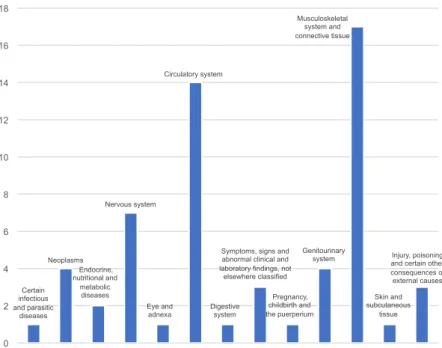
the musculoskeletal system and connective tissue were the most common and appeared in 17 studies (29%), followed by conditions/diseases of the circulatory system (14 studies, 24%), and conditions/diseases of the nervous system (7 studies, 12%).
Regarding signs and symptoms, and abnormal clinical and laboratory findings that were not classified elsewhere, there were 2 studies related to Nocturnal Enuresis and 1 study related to Jue Zheng caused by Wang yang. For conditions/diseases of the musculoskeletal system or connective tissue, there were 11 lower back-related studies, including low back pain, FBSS, lumbar herniated intervertebral disc, lumbar spinal stenosis, sciatica, and 2 studies on knee pain and 2 studies on shoulder pain.
Conditions/diseases of the circulatory system included 2 studies on hypertension, and 12 studies on illness after a stroke. In the illness after stroke studies, there were 5 studies related to Hemiplegic, 2 studies related to dysuria and dysphagia, and 1 study for each was related to chronic hiccup, knee joint pain, and persistent pain of the left dorsal part of the hand and wrist pain. For conditions/
diseases of the nervous system, 2 studies related to peripheral facial paralysis and 1 study each for insomnia, idiopathic Parkinson’s disease, conus medullaris syndrome, type of CRPS, and chronic fatigue syndrome (Fig. 4).
Analysis of the number of acupoints and acupoints used in the study
The number of acupoints used in a study varied between 1 and 10. The use of a single acupoint was the most common (14 studies), followed by 6 acupoints (8 studies). Of the studies that mentioned acupoint with A-shi point, there were 4 studies that could not accurately determine the number of acupoints (Fig. 5). A total of 83 acupoints were used in 59 studies. The most common was the
Author (y) Study
design Disease Sub
jects Moxa type Period Frequency Repeat
time Moxibustion points Result Other treatment
(2011) Yoon UCT Hemiplegia after stroke 23 DM 1d 1 time/d 5 LI4 LI11 TE3TE5 S X
(2011) Lee RCT Chronic cancer pain A:7
B:7 DM 7d 1 time/d 1 A-shi point S X
(2011) Kim UCT Cancer pain 6 IM 7d 6 times/
wk 3 CV4, CV6, CV12, PC8, KI1 S X
(2012) Son CR Chronic fatigue
syndrome(CFS) 1 IM 2wks 1 time/d 1 KI1 CV4 CV8 I O
(2012) Oh CR Degenerative knee arthritis
with osteochondroma 2 IM 4wks 3 times/
wk 3 GB34, SP9, SP10 ST34,
ST35, ST36 EX-LE5, A-shi
point I X
(2013) Oh RCT Degenerative knee arthritis A:34
B:31 IM 4wks 3 times/
wk 3 ST35, SP10, ST36 ST34,
SP9, A-shi point S X
(2015) Moon CR Verruca vulgaris 3 DM 3,19,30wks 1 time/
wk 5 A-shi point I O
(2015) Lee CR Generalized morphea 1 Unclear 12wks 1 time/d Unclear LU9 I O
(2017) Lee UCT Nocturia 31 DM 10d 1 time/d 1 CV6, CV4 I O
Jeong
(2018) CCT Traffic accident-Induced
lumbago A:56
B:56 IM 2wks 1 time/d 2 CV4, BL23 I O
RCT, randomized controlled trials; CCT, controlled clinical trials; CR, case reports; UCT, uncontrolled clinical trials; IM, indirect moxibustion; DM, direct moxibustion; S, significancy; I, improvement; A, intervention group; B, control group.
Table 1. (Continued).
Fig. 2. Analysis of the number of studies by year.
0 2 4 6 8 10
Fig. 2. Analysis of the number of studies by year
Fig. 3. Analysis of clinical study type.
CCT, controlled clinical trials; CR, case reports; RCT, randomized controlled trials; UCT, uncontrolled clinical trials.
CCT 7 12%
RCT 11 19%
CR 42% 25 UCT 27% 16
Fig. 3. Analysis of clinical study type.
RCT, Randomized Controlled Trials; CR, Case Reports; UCT, Uncontrolled Clinical Trials; CCT, Controlled Clinical Trials.
J Acupunct Res 2020;37(1):1-12 6
use of A-shi point which was used in 13 studies. CV4 and ST36 were used in 10 studies each. LI4, LI11, GB34, GB39, BL25 were individually used in 6 studies each. Five studies each individually used CV3, CV6, CV12, GV3, TE5, and BL26 (Table 2).
Multiple frequency acupoint analysis by condition/disease In studies of diabetes mellitus, both studies used ST36, CV12, BL17, BL20, BL21, and Chwesu. Where there was illness after stroke with hemiplegia, LI11, and TE5 were used in 5 studies, LI4 in 4 studies, TE3 in 3 studies, ST36, and GB39 in 2 studies each. In cases of dysphagia, both studies used CV17. Dysuria studies used CV3, CV4, CV6. For nocturnal enuresis, CV4 was used in both studies and in addition CV6 was used in 1 study. In peripheral facial palsy, 2 studies used ST4 and GB14, and in addition 1 study used ST2, ST6, TE23, LI19, LI4, ST36, CV12, CV4, and LR3.
For stress urinary incontinence, CV3 was used in 2 studies, and
CV4 and CV6 was used in 1 study each. In conditions/diseases of the musculoskeletal system and connective tissue, studies of the lumbar region (including lower back pain, lumbar herniated intervertebral disc, lumbar spinal stenosis, and sciatica) which used the A-shi point were the most frequently used (7 studies), followed by BL24 and BL25 which were used in 6 studies each, BL26 in 5 studies, and BL23 in 4 studies. All 3 studies related to degenerative knee arthritis used ST35, SP9, SP10, ST34, GB34, ST36, EX-LE5, and A-shi point. For studies using a single acupoint, LU9 was used for morphea treatment, BL67 was used for breech presentation, BL11 was used for persistent pain in the left dorsal part of the hand and wrist after a stroke, GB16 was used for oculomotor nerve palsy, KI11 was used for insomnia, CV8 was used for Jue Zheng caused by Wang yang, SP6 was used for primary dysmenorrhea, and ST25 was used for constipation (Table 1).
Fig. 4. Classification by subject disease according to International Classification of Diseases-10.
Certain infectious and parasitic
diseases Neoplasms
Endocrine, nutritional and
metabolic diseases
Nervous system
Eye and adnexa
Circulatory system
Digestive system
Symptoms, signs and abnormal clinical and laboratory findings, not
elsewhere classified Pregnancy, childbirth and the puerperium
Genitourinary system Musculoskeletal
system and connective tissue
Skin and subcutaneous
tissue Injury, poisoning and certain other consequences of external causes