INTRODUCTION
Obesity is a well-known risk factor for breast cancer, and obese women are likely to have metastatic breast cancer when they are first diagnosed, and to have a poor prognosis regard- less of their menopausal status (1, 2). Although the exact mechanism remains to be determined, the hormonal changes associated with obesity are considered to be responsible for this relationship, with particular emphasis being placed on the increased production of estrogen. Adipose tissue is well established that the source of estrogen production through aromatization of androgens which is derived from the adrenal gland (3). However, according to recent studies, the contri- bution to the development of breast cancer from obesity is not fully explained by increased estrogen levels only (4, 5).
Adipose tissue is not only a passive reservoir for energy storage but is now known to express and secrete a variety of metabolites, hormones, and cytokines, known as adipocyto- kines, which act at both the local and systemic level. These adipocytokines include leptin, adiponectin, complement com- ponents, plasminogen activator inhibitor-1, tumor necrosis factor- (TNF- ), interleukin-6 (IL-6), proteins of the renin- angiotensin system, and resistin (6).
Adiponectin is secreted from adipocytes exclusively and it
has been established that plasma adiponectin concentration is inversely correlated with the incidence of obesity, type 2 diabetes, and cardiovascular disease (7-9). Adiponectin was shown to have anti-inflammatory activity, a protective effect against metabolic disorders resulting from the insulin resis- tance, and improve endothelial dysfunction (10-12).
Resistin, named for resistance to insulin, is a unique sig- nalling molecule secreted from adipocytes. Circulating resistin levels are decreased by the anti-diabetic drug rosiglitazone, and increased in diet-induced and genetic forms of obesity. In addition, treatment of normal mice with recombinant resistin impairs glucose tolerance and insulin action. Insulin-stimu- lated glucose uptake by adipocytes is enhanced by neutraliza- tion of resistin and is reduced by resistin treatment. Thus, resistin may serve as a hormone that potentially links obesity to insulin resistance (13). However, the studies performed on humans lack coherence between the results, and further stud- ies are needed to ascertain the role of resistin (14, 15).
Interestingly, several recent case-control studies have shown that decreased adiponectin levels are associated with the inci- dence of breast cancer, but the correlation between serum adiponectin and breast cancer risk is not clear yet, and the molecular basis for the link remains poorly understood (16- 18). To our knowledge, the association of resistin with can-
Jee-Hyun Kang, Byung-Yeon Yu, Dae-Sung Youn*
Departments of Family Medicine, and General Surgery*, Konyang University Hospital, Daejeon, Korea
Address for correspondence Jee-Hyun Kang, M.D.
Department of Family Medicine, Konyang University Hospital, 685 Gasuwon-dong, Seo-gu, Daejeon 320-718, Korea
Tel : +82.42-600-9240, Fax : +82.42-600-9095 E-mail : [email protected]
*This study was supported by Konyang University Myung Gok Research Fund of 2004.
117
Relationship of Serum Adiponectin and Resistin Levels with Breast Cancer Risk
Obesity is one of the well-known risk factors of breast cancer. We evaluated the rela- tionship between serum adiponectin and resistin levels and breast cancer risk in 41 biopsy-proven breast cancer patients and 43 age- and body mass index-matched controls. The mean serum adiponectin level was lower in the breast cancer group than the control group (6.93±±3.2 g/mL, vs. 7.60±±3.5 g/mL), but this difference did not reach statistical significance (p=0.37). There was a statistically significant difference in serum resistin levels between the groups (breast cancer group 5.23±± 6.9 ng/mL vs. control 1.46±±2.0 ng/mL; p<0.001). The risk of breast cancer was significantly increased in the highest tertile group for serum resistin level compared to the lowest tertile group (adjusted odds ratio 2.77 [95% CI 1.40-5.50]). The lymph node metastasis was significantly increased in the patients with less than the median adiponectin level (p=0.017). In the patients whose resistin level was higher than the median, the frequency of tumor with the highest histological grade was significant- ly increased (p=0.025). In conclusions, both the low serum adiponectin levels and high resistin levels are likely to be associated with increased breast cancer risk in Korean women.
Key Words : Adiponectin; Resistin; Breast Neoplasms; Disease Susceptibility
Received : 15 February 2006 Accepted : 11 July 2006
cer has not been reported until now.
In this case-control study, we examined the relationship of serum adiponectin and resistin level with breast cancer risk in biopsy-proven breast cancer patients and age and body mass index-matched controls.
MATERIALS AND METHODS Subjects
From January 2005 to December 2005, forty-one female patients who were newly diagnosed with breast cancer and surgically treated at a University Hospital were enrolled into the study as patients group. Among women who visited the same hospital for annual health examinations, we selected 43 women with normal mammographic findings and no previ- ous history of any kind of cancer as age and body mass index- matched controls.
Anthropometric measurement and blood tests
Body weight was measured with light clothing on with up to 0.1 kg precision. Height was measured up to 0.1 cm.
The blood samples were collected within the week before surgery. Plasma glucose, adiponectin, and resistin concentra- tions were measured after overnight fasting for more than 12 hr. Plasma adiponectin was measured using human adi- ponectin ELISA kit (AdipoGen, Inc., Seoul, Korea) with a measurement range of 0.1-32 ng/mL, sensitivity of 0.1 ng/
mL, intra-assay reproducibility of 96.5%, and inter-assay repro- ducibility of 95.6%. Plasma resistin level was measured using human resistin ELISA kit (AdipoGen, Inc., Seoul, Korea) with a measurement range of 0.1-8 g/mL, sensitivity of 0.1 g/
mL, intra-assay reproducibility of 96.3%, and inter-assay repro- ducibility of 94.4%.
Clinicopathologic characteristics of tumor
Patients with breast cancer were classified according to the size of tumors (>2 cm or ≤2 cm) and status of lymph node metastasis (presence or absence). Histological grading of breast cancer was based on the Bloom-Richardson grading system.
The status of estrogen receptor and progesterone receptor were analyzed by imminohistochemical staining (DAKO, Carpin- teria, CA, U.S.A.).
Statistical analysis
Data are presented as means±S.D. Independent t-test was used to compare variables between case and control group except for menopausal status (chi-square test). To determine the risk of breast cancer according to the tertiles of plasma adiponectin and resistin levels, a multiple logistic regression
model was constructed. The correlation of plasma adiponectin or resistin concentration with clinicopathologic characteris- tics of tumors was analyzed by chi-square test. Pearson’s cor- relation coefficients were used to determine the relationships between plasma adiponectin, resistin, glucose, body mass index, and age. A log transformation of plasma resistin levels was carried out to achieve normal distribution. The level of significance was set at p<0.05 (two-tailed). Statistical calcu- lations were performed using SPSS for Windows V11.0 (SPSS Inc., Chicago, IL, U.S.A.).
RESULTS
Comparison of adiponectin and resistin levels
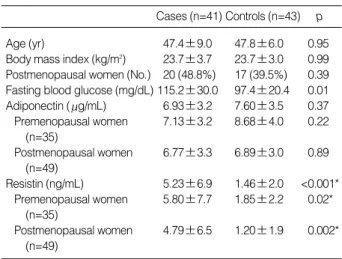
There was no significant difference in age, body mass index, and percentage of menopausal women (Table 1). The fasting glucose levels in the control group were significantly lower than those in the patients group (97.4±20.4 mg/dL vs. 115.2
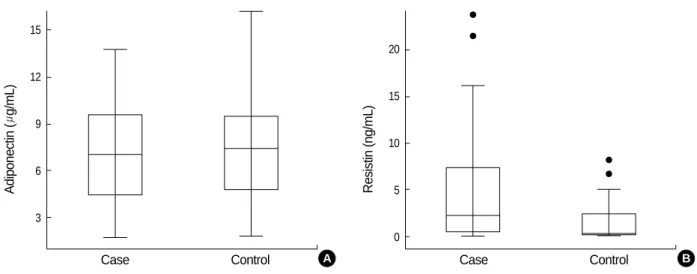
±30.3 mg/dL). The mean serum adiponectin level was lower in the breast cancer group than the control group (6.93±3.2 g/mL, vs. 7.60±3.5 g/mL), but this difference did not reach statistical significance (p=0.37). There was a statisti- cally significant difference in serum resistin levels between the groups (breast cancer group 5.23±6.9 ng/mL vs. control 1.46±2.0 ng/mL; p<0.001) (Fig. 1).
When serum adiponectin and resistin levels were compared in cases and controls according to menopausal status, serum resistin levels were significantly higher in the breast cancer group in both pre- and post-menopausal women (p=0.02, p=0.002; respectively). However, there was no significant difference in serum adiponectin levels between cases and con- trols in either pre- or post-menopausal women (p=0.22, p=
0.89; respectively) (Table 1).
Cases (n=41) Controls (n=43) p
Age (yr) 47.4±9.0 47.8±6.0 0.95
Body mass index (kg/m2) 23.7±3.7 23.7±3.0 0.99 Postmenopausal women (No.) 20 (48.8%) 17 (39.5%) 0.39 Fasting blood glucose (mg/dL) 115.2±30.0 97.4±20.4 0.01 Adiponectin ( g/mL) 6.93±3.2 7.60±3.5 0.37 Premenopausal women 7.13±3.2 8.68±4.0 0.22
(n=35)
Postmenopausal women 6.77±3.3 6.89±3.0 0.89 (n=49)
Resistin (ng/mL) 5.23±6.9 1.46±2.0 <0.001*
Premenopausal women 5.80±7.7 1.85±2.2 0.02*
(n=35)
Postmenopausal women 4.79±6.5 1.20±1.9 0.002*
(n=49)
Table 1.Clinical characteristics of cases and controls (mean± SD)
*Resistin level was transformed logarithmically before analysis.
Odds ratio of breast cancer according to tertiles of adipo- nectin or resistin levels
We estimated the odds ratio of breast cancer according to tertiles of adiponectin or resistin level using logistic regression analysis (Table 2). Those in the lowest tertile of plasma adipo- nectin had an odds ratio for highest tertile of 0.92 (95% CI 0.46-1.81) after being adjusted for age, body mass index, status of menopause, fasting glucose level, and plasma resistin levels.
The risk of breast cancer was significantly increased in the highest tertile group for plasma resistin level compared to the lowest tertile group (odds ratio 2.17 [95% CI 1.24-3.79]), and this significance remained after being adjusted for age, body mass index, status of menopause, serum glucose and adiponectin (adjusted odds ratio 2.77 [95% CI 1.40-5.50]).
Serum adiponectin levels and clinicopathological charac- teristics of tumors
We divided patients into two groups by the median level of adiponectin (7.08 g/mL), to investigate the relationship between serum adiponectin levels and clinicopathological
characteristics of tumor (Table 3). No significant difference was found in the frequency of large sized or highly differen- tiated tumors, or status of progesterone receptor. The lymph node metastasis (p=0.017) and negativity of estrogen recep- tor (p=0.032) were significantly increased in the patients with less than the median adiponectin level.
Serum resistin levels and clinicopathological characteris- tics of tumors
The patients were divided into the two groups according to the plasma resistin level. The cutoff value was defined as 2.42 ng/mL, the median levels of plasma resistin concentra- tion of the patients group. Comparing with two groups, there was no significant difference in frequency of large tumors (>2 cm), status of lymph node metastasis, or estrogen and progesterone receptor status (Table 3). However, in the pati-
Adiponectin (g/mL)
15
12
9
6
3
Case Control
Fig. 1.Serum adiponectin (A) and resistin (B) levels in cases and controls.
Resistin (ng/mL)
20
15
10
5
0
Case Control
Variable OR (95% CI)
Adiponectin
Model 1: adiponectin only 0.96 (0.57-1.64) Model 2: adiponectin+covariates in Table 1 0.97 (0.51-1.83) Model 3: adiponectin+resistin+covariates 0.92 (0.46-1.81)
in Table 1 Resistin*
Model 1: resistin only 2.17 (1.24-3.79)
Model 2: resistin+covariates in Table 1 2.75 (1.39-5.44) Model 3: adiponectin+resistin+covariates 2.77 (1.40-5.50)
in Table 1
Table 2.Multiple logistic regression-derived adjusted odds ratio (ORs) and 95% confidence interval (CI) for breast cancer for a change in serum adiponectin and resistin of 1 tertile in controls
*Resistin level was transformed logarithmically before analysis.
Adiponectin level ( g/mL)
<7.08 p
≥7.08
Resistin level (ng/mL)
<2.42 p
≥2.42 Tumor size
≤2 cm 13 (61.9) 8 (40.0) 0.161 8 (38.1) 13 (65.0) 0.085
>2 cm 8 (38.1) 12 (60.0) 13 (61.9) 7 (35.0) Lymph node metastasis
Negative 15 (71.4) 6 (33.3) 0.017 9 (45.0) 12 (63.2) 0.256 Positive 6 (28.6) 12 (66.7) 11 (55.0) 7 (36.8) Histological grade
1+2 13 (61.9) 15 (75.0) 0.368 11 (52.4) 17 (85.0) 0.025 3 8 (38.1) 5 (33.3) 10 (47.6) 3 (15.0) Estrogen receptor
Positive 10 (47.6) 3 (15.8) 0.032 7 (35.0) 6 (30.0) 0.736 Negative 11 (52.4) 16 (84.2) 13 (65.0) 14 (70.0) Progesterone receptor
Positive 14 (66.7) 7 (36.8) 0.059 11 (55.0) 10 (50.0) 0.752 Negative 7 (33.3) 12 (63.2) 9 (45.0) 10 (50.0) Table 3.Association between serum adiponectin or resistin lev- els and clinicopathological characteristics in breast cancer pa- tients (number, %)
B A
ents whose plasma resistin level was higher than the median value, the frequency of tumor with the highest histological grade was significantly increased (p=0.025).
Relationship between adiponectin, resistin and other variables
We investigated whether there was any relationship between the plasma adiponectin, resistin, glucose, body mass index and age. No significant correlation was found between plas- ma adiponectin and resistin concentration (control group r=
0.14, p=0.391; patients group r=-0.169, p=0.291). Plasma glucose level, body mass index and age did not have any signi- ficant relationship with plasma adiponectin or resistin levels.
DISCUSSION
Since the relationship of obesity to several forms of cancer has been known for a long time, researchers were trying to discover the possible role of adipocytokines in the regulation of carcinogenesis as another link between obesity and cancer.
Adiponectin recently gained interest in correlation with can- cer, and was inversely and independently associated with bre- ast, endometrial, gastric, prostate and colorectal cancer in case control studies (16-22). In our study, adiponectin level was lower in the breast cancer group than the control group, but this difference did not reach statistical significance. Plas- ma adiponectin levels were also negatively associated with progression of histological grade and tumor stage in patients with breast, prostate and gastric cancer (17, 20, 21). In this study, only the frequency of lymph node metastasis out of the several clinicopathological characteristics of tumor was significantly increased in the patients with low plasma adi- ponectin levels.
It has been reported that obesity-related breast cancer is more often estrogen receptor positive than is the general case, but this has not been a consistent finding (23). Our study showed that the frequency of the tumors with negative estro- gen receptor was significantly increased in the patients with less than the median adiponectin level. However, in the pre- vious study, the status of estrogen receptor and progesterone receptor did not affect the adiponectin levels in breast cancer patients, and no significant correlation was observed between the serum adiponectin and estrone levels in postmenopausal women (17, 18).
One possible mechanism explaining associations between obesity and cancer other than estrogen is hyperinsulinemia or insulin resistance. Insulin enhances the activity of insulin- like growth factor-1 (IGF-1), and high levels of circulating IGF-1 are correlated with risk of development of breast can- cer (24). However, Mantzoros et al. (16) reported that asso- ciations between serum adiponectin and breast cancer risk were independent of possible effects of major components of
the IGF system, leptin, and body mass index.
The molecular mechanism of the contributions of low serum adiponectin levels to carcinogenesis and progression of tumor is currently unknown. Recently, adiponectin has been reported to induce activation of caspase enzymes which leads to endothelial cell apoptosis, and the reduction of tumor neovascularization (25). In addition, adiponectin has a direct inhibitory effect on proliferation of vascular smooth muscle cells and myelomonocytic progenitors (26). In a recent study, adiponectin has been reported to induce growth arrest and apoptosis of MDA-MB-231 breast cancer cells (27). These results are speculated to infer that adiponectin may promote apoptosis directly by activation of apoptotic enzymes in the caspase cascade or modulation of expression of apoptosis- related genes.
To our knowledge, there has not been any report about the association between cancer and resistin. However, this study showed that the high level of resistin was associated with the risk of breast cancer, and this relationship was independent of age, body mass index, status of menopause, serum glucose and adiponectin. Moreover, in the patients whose plasma resistin level was higher than the median, the frequency of tumor with the highest histological grade was significantly increased. These results suggest the possibility that high serum resistin levels might be another adiponcytokine that contribute to increase breast cancer risk.
The relationship of serum resistin with insulin resistance is not established yet, because of discord among the previous human studies. Even though elevated blood glucose levels possibly affect proliferation of the breast cancer cell line, the logistic regression analysis showed that the relationship bet- ween the risk of breast cancer and serum resistin was inde- pendent of the fasting blood glucose level and adiponectin, which was inversely associated with insulin resistance.
Because the previous studies revealed that resistin is exp- ressed not only from adipose tissue but also from monocytes and macrophages, and correlated with C-reactive protein, TNF- , and IL-6 directly, the role of resistin as another marker of inflammation has received growing interest (28). Chronic inflammation is known to be one of the causes of cancer devel- opment, and inflammation may be represented by biomark- ers of early pathologic changes in breast cells and be associ- ated with risk for the development of breast cancer (29, 30).
Thus, the correlation between plasma resistin levels and breast cancer risk might be partly explained by inflammation.
There are several limitations of this study. The number of study subjects was limited, the risk factors of breast cancer such as family history of breast cancer, age of the menarche, and birth history were not controlled, and the causal relationship could not be revealed due to the case-control study design.
A study about the precise mechanism of the relationship of adiponectin and resistin with breast cancer risk, a large-scaled prospective study should be supported in the future.
In conclusion, the low serum adiponectin level and high
resistin level might be associated with increased breast can- cer risk, but only the difference of serum resistin levels reached statistical significance between breast cancer and control group.
The clinicopathologic characteristics of the tumor suggest- ed that these adipokines might influence the progression of breast cancer.
REFERENCES
1. Harvie M, Hooper L, Howell AH. Central obesity and breast can- cer risk: a systematic review. Obes Rev 2003; 4: 157-73.
2. Newman SC, Lees AW, Jenkins HJ. The effect of body mass index and oestrogen receptor level on survival of breast cancer patients.
Int J Epidemiol 1997; 26: 484-90.
3. Edman CD, Aiman EJ, Porter JC, MacDonald PC. Identification of the estrogen product of extraglandular aromatization of plasma an- drostenedion. Am J Obestet Gynecol 1978; 130: 439-47.
4. Verkasalo PK, Thomas HV, Appleby PN, Davey GK, Key TJ. Cir- culating levels of sex hormones and their relation to risk factors for breast cancer: a cross-sectional study in 1092 pre and postmenopausal women. Cancer Causes Control 2001; 12: 47-59.
5. Hankinson SE, Wilett WC, Manson JE, Colditz GA, Hunter DJ, Spei- gelman D, Barbieri RL, Spiezer FE. Plasma sex steroid hormone levels and risk of breast cancer in postmenopausal women. J Natl Cancer Inst 1998; 90: 1292-9.
6. Kershaw EE, Flier JS. Adipose tissue as an endocrine organ. J Clin Endocrinol Metab 2004; 89: 2548-56.
7. Matsuzawa Y, Funahashi T, Nakamura T. Molecular mechanism of metabolic syndrome X: contribution of adipocytokines adipocyte- derived bioactive substances. Ann N Y Acad Sci 1999; 892: 146-54.
8. Arita Y, Kihara S, Ouchi N, Takahashi M, Maeda K, Miyagawa J, Hotta K, Shimomura I, Nakamura T, Miyaoka K, Kuriyama H, Nishi- da M, Yamashita S, Okubo K, Matsubara K, Muraguchi M, Ohmoto Y, Funahashi T, Matsuzawa Y. Paradoxical decrease of an adipose- specific protein, adiponectin in obesity. Biochem Biophys Res Com- mun 1999; 257: 79-83.
9. Weyer C, Funahashi T, Tanaka S, Hotta K, Matsuzawa Y, Pratley RE, Tataranni PA. Hypoadiponectinemia in obesity and type 2 dia- betes: close association with insulin resistance and hyperinsulinemia.
J Clin Endocrinol Metab 2001; 86: 1930-5.
10. Fantuzzi G. Adipose tissue, adipokines, and inflammation. J Allergy Clin Immunol 2005; 115: 911-9.
11. Yamauchi T, Kamon J, Ito Y, Tsuchida A, Yokomizo T, Kita S, Sugi- yama T, Miyagishi M, Hara K, Tsunoda M, Murakami K, Ohteki T, Uchida S, Takekawa S, Waki H, Tsuno NH, Shibata Y, Terauchi Y, Froguel P, Tobe K, Koyasu S, Taira K, Kitamura T, Shimizu T, Nagai R, Kadowaki T. Cloning of adiponectin receptors that mediate antidi- abetic metabolic effects. Nature 2003; 423: 762-9.
12. Okamoto Y, Kihara S, Ouchi N, Nishida M, Arita Y, Kumada M, Ohashi K, Sakai N, Shimomura I, Kobayashi H, Terasaka N, Inaba T, Funahashi T, Matsuzawa Y. Adiponectin reduces atherosclerosis in apolipoprotein E-deficient mice. Circulation 2002; 106: 2767-70.
13. Steppan CM, Bailey ST, Bhat S, Brown EJ, Banerjee RR, Wright
CM, Patel HR, Ahima RS, Lazar MA. The hormone resistin links obesity to diabetes. Nature 2001; 409: 307-12.
14. Nagaev I, Smith U. Insulin resistance and type 2 diabetes are not related to resistin expression in human fat cells or skeletal muscle.
Biochem Biophys Res Commun 2001; 285: 561-4.
15. Macternan PG, Mcternan CL, Chetty R, Jenner K, Fisher FM, Lauer MN, Crooker J, Bernett AH, Kumar S. Increased resistin gene and protein expression in human abdominal adipose tissue. J Clin Endo- crinol Metab 2002; 87: 2407-10.
16. Mantzoros C, Petridou E, Dessypris N, Chavelas C, Dalamaga M, Alexe DM, Papadiamantis Y, Markopoulos C, Spanos E, Chrousos G, Trichopoulos D. Adiponectin and breast cancer risk. J Clin Endo- crinol Metab 2004; 89: 1102-7.
17. Miyoshi Y, Funahashi T, Kihara S, Taguchi T, Tamaki Y, Matsuzawa Y, Noguchi S. Association of serum adiponectin levels with breast cancer risk. Clin Cancer Res 2003; 9: 5699-704.
18. Chen DC, Chung YF, The YT, Chaung HC, Kuo FC, Fu OY, Chen HY, Hou MF, Yuan SS. Serum adiponectin and leptin levels in Tai- wanese breast cancer patients. Cancer Lett 2006; 237: 109-14.
19. Dal Maso L, Augustin LS, Karalis A, Talamini R, Franceschi S, Tri- chopoulos D, Mantzoros CS, La Vecchia C. Circulating adiponectin and endometrial cancer risk. J Clin Endocrinol Metab 2004; 89:
1160-3.
20. Ishikawa M, Kitayama J, Kazama S, Hiramatsu T, Hatano K, Nagawa H. Plasma adiponectin and gastric cancer. Clin Cancer Res 2005;
11: 466-7.
21. Goktas S, Yilmaz MI, Caglar K, Sonmez A, Kilic S, Bedir S. Prostate cancer and adiponectin. Urology 2005; 65: 1168-72.
22. Wei EK, Giovannucci E, Fuchs CS, Willett WC, Mantzoros CS. Low plasma adiponectin levels and risk of colorectal cancer in men: a prospective study. J Natl Cancer Inst 2005; 97: 1688-94.
23. Rose DP, Komninou D, Stephenson GD. Obesity, adipocytokines, and insulin resistance in breast cancer. Obes Rev 2004; 5: 153-65.
24. Pollak MN, Schernhammer ES, Hankinson SE. Insulin-like growth factors and neoplasia. Nat Rev Cancer 2004; 4: 505-18.
25. Brakenhielm E, Veitonmaki N, Cao R, Kihara S, Matsuzawa Y, Zhivo- tovsky B, Funahashi T, Cao Y. Adiponectin-induced antiangiogene- sis and antitumor activity involve caspase-mediated endothelial cell apoptosis. Proc Natl Acad Sci USA 2004; 101: 2476-81.
26. Yokota T, Oritani K, Takahashi I, Ishikawa J, Matsuyama A, Ouchi N, Kihara S, Funahashi T, Tenner AJ, Tomiyama Y, Matsuzawa Y.
Adiponectin, a new member of family of soluble defense collagens, negatively regulates the growth of myelomonocytic progenitors and the functions of macrophages. Blood 2000; 96: 1723-32.
27. Kang JH, Lee YY, Yu BY, Yang BS, Cho KW, Yoon DK, Roh YK.
Adipoenctin induces growth arrest and apoptosis of MDA-MB-231 breast cancer cell. Arch Phar Res 2005; 28: 1263-9.
28. Reilly MP, Lehrke M, Wolfe ML, Rohatgi A, Lazar M, Rader DJ.
Resistin is an inflammatory marker of atherosclerosis in human.
Cirulation 2005; 111: 932-9.
29. Shacter E, Weitzman SA. Chronic inflammation and cancer. Oncol- ogy (Huntingt) 2002; 16: 217-26, 229.
30. O’Byrne KJ, Dalgleish AG. Chronic immune activation and inflam- mation as the cause of malignancy. Br J Cancer 2001; 85: 473-83.