한국추진공학회 2009년도 추계학술대회 논문집 pp.459~468 2009 KSPE Fall Conference
* Associate professor, Moscow Aviation Institute1 ** 충남대학교 산학협력단
연락저자, E-mail: [email protected]
The uncertainty problem analysis of the engineering solution for prediction and estimation of the operating
regime to design of gas- hydro-dynamic systems
Lev Kartovitskiy* ․ Anton tsipenko* ․ Jihyung Lee**
ABSTRACT
Analysis of the uncertainty to have engineering solution of gas-dynamic and hydrodynamic problems is based on the comparison the prospective engineering solution with experimental result. In this paper, the mathematical model to estimate heat flux along gas-dynamic channel wall and the solution sequence are shown. Statistical information and generalizing experimental characteristics about gas- and hydro-dynamic channels were applied to the mathematical model.
As the results, it is possible to draw a conclusion that models of the integrated approach, using the averaged statistical data of generalizing characteristics for a turbulent flow, without consideration of the turbulent mechanism (characteristic pulsations), can predict a nominal operating regime for gas-dynamic and hydrodynamic systems. The probable deviation of operating regime for newly designed the gas-dynamic channel can achieve 20% from a regime predicted on a basis 1-D or 3-D modelling irrespective of a kind of used models.
Key Words: Heat Flux, Gas Dynamic Channel, Integrated Approach
1. Introduction
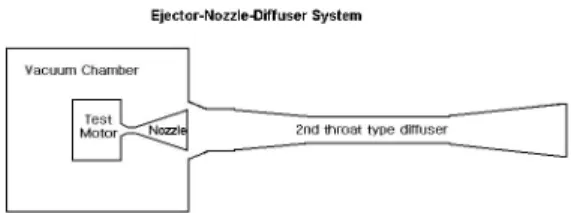
The object of research was represented by system " Ejector-Nozzle-Diffuser" Figure. 1 which must provide a required level of pressure in the vacuum chamber. The geometrical dimensions for gas-dynamic channel Figure.1 were chosen from a condition to keep a required level of pressure in the vacuum chamber. The ejection process is realized by the following mechanisms:
- difference of pressure between the nozzle exit section and the vacuum chamber
- the mechanism of gas viscous capture realized by pulsations of a gas flow
- distribution processes of indignations in a boundary layer
In a whole the influence of the specified mechanisms on the ejection process can be estimated only statistically. Hence, the stationary state of the gas-dynamic system has uncertainty because of a priori unknown disturbance. The stationary state uncertainty will be to have an influence on estimation of hydraulic losses and heat flux for the gas-dynamic channel on the basis of the
integrated equations of the moments and the energy, using the generalized experimental characteristics. In this connection the research of the uncertainty for the gas-dynamic state (distribution of local performances for gas flow) is significant problem as the state uncertainty for gas-dynamic systems directly influences on the result of gas-dynamic and thermal designing of system "
Ejector-Nozzle-Diffuser".
2. The computational scheme on the basis of integrated model
At choice of basic geometrical parameters for gas-dynamic channel, estimation of hydraulic losses and heat flux it is necessary to take into account existing experimental data for similar ejecting systems.
Fig. 1. Ejector-Nozzle Diffuser System
Studying of gas-dynamic processes for a supersonic gas ejector is based on modelling of exchange processes between a gas flow and a solid wall in a dynamic boundary layer.
The problem of the channel designing and prediction of regime its operating was solved on the basis 2D and 3D modelling.
The integrated model of a boundary layer [1]
was used for a prediction of local performances for the stationary average movement of gas.
Local performances for gas flow , are functions of gas flow parameters. The state of a boundary layer near a wall is estimated on the local performances of gas flow with use of the criteria equations and the parametric approximation. Using 2D and 3D approach the supersonic gas-dynamic channel Figure. 1 was designed under a condition to keep the nominal level of underpressure in the vacuum chamber 0.05 bar at ambient pressure 1bar. The problem of the energy exchange for gas-dynamic channel has been solved on basis of the asymptotic theory, that supposes for processes of friction and heat exchange there are laws as limiting formulas for following relations [1]:
*
Re*
0 f
f
c c
⎟⎟
⎠
⎞
⎜⎜
⎝
=⎛
Ψ
0 Re**i* S
St St
⎛ ⎞
Ψ = ⎜ ⎟
⎝ ⎠
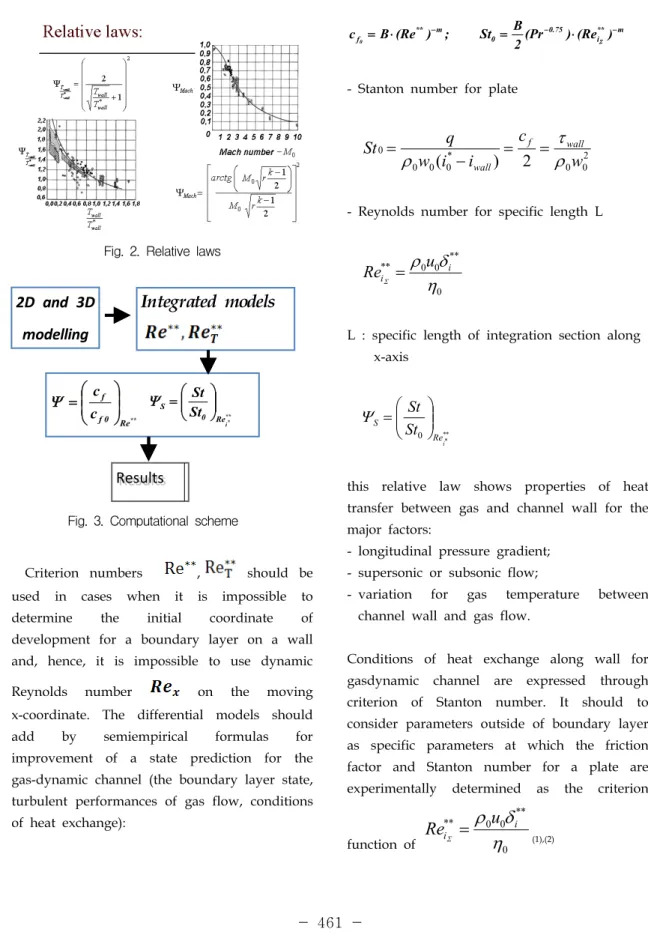
These relations express the asymptotic behavior for processes of friction and heat exchange for researched gas-dynamic channel comparatively processes of friction and heat exchange on a plate. The relative law of friction and the relative law of heat exchange are as function of two major factors (Figure.2):
- Mach number for gas flow : M0
- Temperature factor :
wall *
wall
T
T
Fig. 2. Relative laws
2D and 3D modelling
* Re* 0 f
f
c c
⎟ ⎟
⎠
⎞
⎜ ⎜
⎝
= ⎛ Ψ
*
**
Rei
0
S
St
St ⎟⎟
⎠
⎜⎜ ⎞
⎝
= ⎛ Ψ
Integrated models
Results Results
Fig. 3. Computational scheme
Criterion numbers , should be used in cases when it is impossible to determine the initial coordinate of development for a boundary layer on a wall and, hence, it is impossible to use dynamic Reynolds number on the moving x-coordinate. The differential models should add by semiempirical formulas for improvement of a state prediction for the gas-dynamic channel (the boundary layer state, turbulent performances of gas flow, conditions of heat exchange):
m
*
* i 75 . 0 0
m
*
*
f
(Pr ) (Re )
2 St B
; ) (Re B
c
0 = ⋅ − = − ⋅ Σ −- Stanton number for plate
0 0 2
* 0 0 0
0 ( ) 2 w
c i
i w
St q f wall
wall ρ
τ
ρ − = =
=
- Reynolds number for specific length L
0
0 0
η
δ ρ
Σ
*
*
* i
* i
Re = u
L : specific length of integration section along x-axis
Re*i**
S
St
St ⎟⎟
⎠
⎜⎜ ⎞
⎝
= ⎛
0
Ψ
this relative law shows properties of heat transfer between gas and channel wall for the major factors:
- longitudinal pressure gradient;
- supersonic or subsonic flow;
- variation for gas temperature between channel wall and gas flow.
Conditions of heat exchange along wall for gasdynamic channel are expressed through criterion of Stanton number. It should to consider parameters outside of boundary layer as specific parameters at which the friction factor and Stanton number for a plate are experimentally determined as the criterion
function of
0
0 0
η δ ρ
Σ
*
*
* i
* i
Re = u
(1),(2)
Fig. 4 Friction Factor and Stanton Number For the differential model [3] was used for calculation of the cooling channel
) F d D ( 2
u x
F p g x F G u t u u G
GDT 2
x
− −
∂
− ∂
∂ = + ∂
∂
∂ ρ ζ ρ
w rm p
p
P q
x Gc T t T u
Gc =
∂ + ∂
∂
∂
x 0 F G
t =
∂ + ∂
∂
∂ ρ
Fig. 5. Constructive scheme for cooling channel
Conditions of heat exchange determine the trend law of for wall temperature on the side of the cooling channel. Implementation of a condition for reliable cooling of a wall provides absence of boiling for liquid in the cooling channel [4].
)]
( T
[
T
wall_on_side_of_water<
saturation_water− 30
0÷ 50
0 Heat exchange was taken into account by statistics according to the table specified on Figure.6Fig. 6. Heat transfer conditions
Choice of pressure, temperatures of a cooling liquid on an entrance of the channel, heights of the cooling channel under condition determine the liquid consumption and length of individual section depending from the heat flux along gas-dynamic channel.
The height of the cooling channel can be chosen according to recommendations of Figure 7 [11].
According to these recommendations the constancy of hydraulic losses takes place if the space of the channel is higher 1,5mm.
Fig. 7. Height of cooling channel
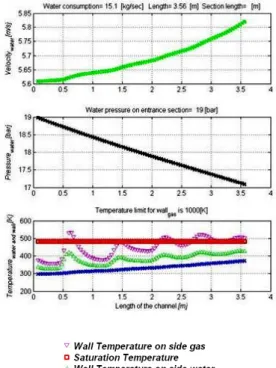
The estimation of processes for energy exchange between the supersonic gas flow and the solid wall was obtained Figure. 8. Also for the cooling system Figure. 8 the estimation of processes for energy exchange between the solid wall and cooling channel was obtained Figure 9.
The prediction problem of hydraulic losses and heat flux successfully are solved on the basis of an integrated method. However the mentioned above the uncertainty does not allow to obtain the unequivocal engineering solution. In this connection in the article the reasons bringing to uncertainty of solutions are considered on the basis of the analysis at comparison of modelling results and experimental data.
The experimental performances used in differential models have statistical dispersion for stationary states of a gas flow and practically never have unequivocal values (Figure.2,4,6). [1,2,5-10].
In particular, the fact of the dispersion for performance of the gasdynamic channel is connected with hysteresis process.
Fig. 8. Change of gas parameters
Fig. 9. Change of water parameters
3. The analysis of the state uncertainty causes for the gas-dynamic channel.
Approximations of the statistical generalized data and the criteria equations allow toestimate only nominal levels for gas-dynamic parameters. Hence, engineering solutions will contain uncertainty which is a error of designing. Uncertainty of solutions is a result of probable combination for:
- constructive factor;
- technological factor;
- non similarity for conditions of different experiments
- process of mixing for gases
- the nonlinear mechanism of the structure formation for gas flow in the channel;
- non adequacy of 2D and 3D models for predictions of gas flow state
- non robustness ofused computational
methods, and etc.
The experimental performance contains the information about state of turbulent flows and is used for estimation problems of a local parameters for newly created gas-dynamic channels. In this connection it is necessary to pay attention to a problem of structure formation for turbulent stationary flows.
Absolute level of losses and heat flux will be the same but discordance of the predicted level for pressure will displace the local zones of the interaction between oblique shock and the boundary layer. In this connection local overheating of the channel walls can be observed in experiment and consequently there will be a necessity to increase of the liquid consumption in some cooling sections.
The basic tendencies of development for applied researches and modelling in the field of fluid and gas mechanics are connected with searching of adequate mechanism of turbulence. 3D modelling gives the certain opportunities for science developers to execute the qualitative analysis of the solution and to receive the process visualization. However [12]
« the assumption put in a basis of equations Navier-Stokes is completely arbitrary and consequently it is impossible to be sure, that these equations correctly describe movement of a viscous liquid ».The basic inadequate postulates which used for development of the movement equations in form Navier-Stokes is pointed in [12], [14]. It is necessary to know the local spatial-time properties for turbulent viscosity and turbulent heat conductivity [13] to receive the solutions approached to properties of real process. Obviously, that the given problem is not solved adequately today.
Therefore Navier-Stokes equations are the approximating model of real properties of flow
and do not describe always successfully the gas-dynamic flows.
Taking into account the mentioned above reasons the integrated form for momentum equation and energy equation is the most adequate models for the engineering design.
The integrated form gives result within the range of an allowable error (uncertainty) for real technical systems, that is conditioned by measurement uncertainty and uncertainty of states for flow parameters. Integrated methods are satisfied for all field of hydro-gas parameters in a whole. The integrated approach improves adequacy for the integrated equation and gives more reliable quantitative result for solving technical problems [4].
The information concerning statistics about properties of gas- or hydro- flow is characterized by three components:
- The statistical information can be added into momentum equation and energy equation;
- representation of the statistical information has no constraint about spatially-time distribution of flow properties (only change for gas properties as function of key parameters of flow: temperature and pressure).
- prediction accuracy for processes in GDT channel is provided with feasibility criterion ratio
.
-gas viscous of flow beyond boundary layer
- gas viscous at wall temperature
Irregularity and changeability are characteristic properties for a field of parameters in a
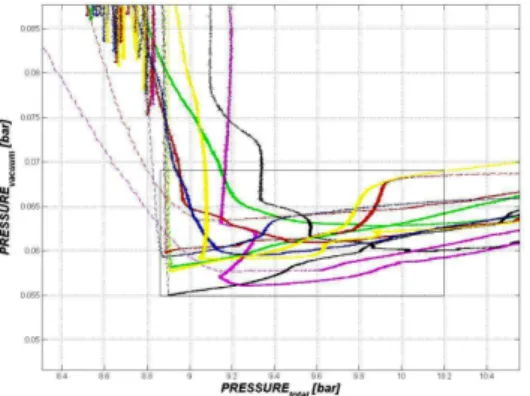
turbulent flow. For the gasdynamic channel (Figure.1) a experimental tests has been carried out. Tests have shown various levels of pressure in the vacuum chamber (the allocated rectangular area on Figure.10) for various laws of change for the total gas pressure in the nozzle chamber till the start moment of the ejector. The achievable probable level of pressure is different according to the mentioned above causes. Pressure pulsations were analyzed after start of the ejector which was started at the same pressure 8.54 bar in all cases. The allocated area on a Figure. 10 confirms, that there is a concept of plurality for turbulent structures (a lot of flow states) for processes of turbulence in gas flow at the same boundary conditions for average parameters [14].
The final state of gas flow (the flow structure formed in the channel) is defined by initial conditions in experiment. Plurality of the flow structures is not observed at numerical 3D modelling. More precisely speaking 3D modelling will not allow to generate the adequate irregular movements, for which the distributed states coincides with experimental distribution of points on the performance of real object.
Fig. 10. Realizations of flow states
The real gas flow has some possible equilibrium hydro-dynamic states, which are attractors [12]. In particular, the hysteresis phenomenon specifies that there are a several attractors in gas dynamic system. The possible equilibrium states is expressed as dispersion of experimental points on the performance of gasdynamic object (see a Figure. 9 and 10, 11 [2]).
Processes of energy exchange and mass exchange modelled by the integrated equations of a energy and momentum give one of probable solutions from domain of equilibrium states in the average, considering the constructive and technological dispersion, the nonlinear mechanism of flow structure formation, etc. According to [15] the initial state (history of process development) of the gasdynamic object has some degree of uncertainty.
The initial state can be set only as function of distribution density, specifying a range of definition for possible states of the gasdynamic object. Hence, it is necessary to set local properties of a gasdynamic flow as the function instead of a concrete point. Thus, it is necessary to consider the integrated method using the semiempirical theory of turbulence as the direction of the statistical theory of turbulence.
It is expedient to involve the mathematical statistics for solving the problem of gas dynamic design.
Fig. 11. Turbulent Prantdl Number
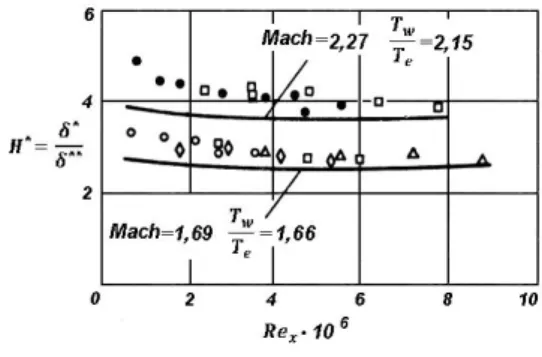
Fig. 12. Changes of shape parameter H along a wall of supersonic channel
The flow structure deformation is appeared as irregular behaviour of the gasdynamic process. The irregularity is the combination of joint influence of stochastics (uncertainty of random factors) and non linearity of gas-dynamic mechanisms.
In both cases, methods of probability theory and random processes, and also the methods of processing for time series and reasonable approximation of experimental data are the basic tool of research for the nonlinear properties in a gasdynamic flow. Therefore the gas-dynamic flow can be described by the distribution function for purposes of research.
As model of the distributed state for gas flow it is possible to use Levy's distribution (10)
[16].
( ) ( )
exp 1 , 1
2
exp 1 2 ln , 1
i i Sgn tg
i i Sgn
α α πα
μθ σ θ β θ α
μθ σ θ β θ θ α
π
⎧ ⎧ − ⎛ − ⎞ ⎫ ≠
⎪ ⎨ ⎜ ⎝ ⎟ ⎠ ⎭ ⎬
⎪ ⎩
⎨ ⎧ ⎛ ⎞ ⎫
⎪ ⎨ − ⎜ + ⎟ ⎬ =
⎪ ⎩ ⎝ ⎠ ⎭
⎩
Levy's distribution is characterized by key parameters:
α- Index of stability (statistical indicator of fractality) (0<α<2) .
β-skewness (-1<β<1) .
σ-scale parameter (σ>0), standard deviate for
normal distribution
μ-location parameter, mean of normal distribution
For experimental data it is desirable to use distributions which model the limiting sequences of distributions for a random variable with an any set of parameters of Levi's distribution α, β, σ, μ.
In this connection, there is an important concept α - steady distribution having domain of an attraction [13] which is characterized by steady statistics. The parameter of statistical stability α is connected with Hurst's parameter by ratio Hurst=1/ α. It should expect existence of steady parameter Hurst=1/ α for the gasdynamic system " Ejector - Nozzle-Diffuser
", taking into account limitation of distribution domain for probable states of gas flow Figure.
10.
The fractal dimension is entered for the description of the irregular processes properties. The model of the continuous flow in which physical process develops, is replaced by the model having more complex fractal structure. Such model in the greater degree corresponds to real physical process with prehistory.
Hurst's parameter can be used as a steady measure for comparison of various levels of pressure in the vacuum chamber in aggregate with other experimentally estimated parameters of distribution β, σ, μ
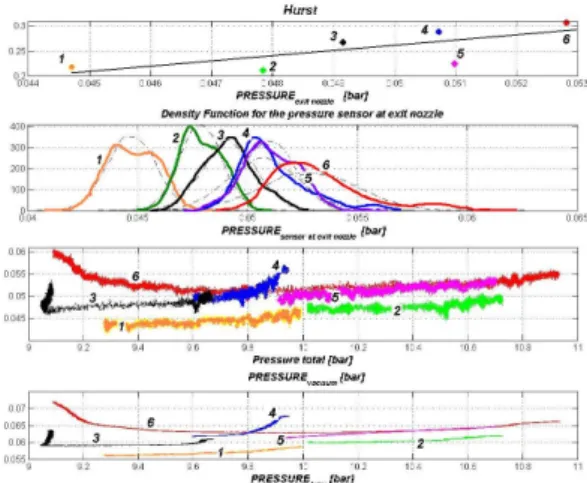
Processing of experimental data is shown on figure 13. The data are captured at testing system " Ejector - Nozzle - Diffuser" Figure. 1.
Hurst's parameter has been used to specify the gas flow structure. From processing experimental data follows, that there is obviously expressed correlation between Hurat's parameter and the average level of gas flow pressure at the nozzle exit section
Figure. 13a. The estimated correlation depends from prehistory of pressure process in the nozzle chamber. Points on the Figure. 13a correspond to the most probable values of distribution functions for stationary pressure at the nozzle exit section Figure. 13b.
Gauss's curves are superimposed on each experimental function of distribution to show the inadequacy of normal distribution model Figure. 13b. Stationary processes of pressure at the nozzle exit section and in the vacuum chamber are shown after the moment of ejector start on a Figure. 13c and 13d.
The trend of Hurst's parameter shows the ejecting properties in the anti persistence domain for stochastic process of supersonic flow. A high level of anti persistence (the point 1 corresponds to more often, intensive pulsations ofgas flow) forms the lengthy area of interaction for the flows moving from a supersonic nozzle and from the vacuum chamber. The high level of pressure anti persistence influences on the level of viscous capture and creates higher level of pressure in the vacuum chamber.
From Figure 13а it is visible, that the dispersion of experimental points is ~20 %.
The model described above has been focused on an average level of pressure 0.05 bar in the vacuum chamber and cannot predict a possible operating regime for the gasdynamic channel.
It is connected by that neither models of turbulence, nor the generalized experimental characteristics used in 1D, 2D and 3D models do not comprise the information about nonlinear mechanisms in a gas flow.
Therefore the concept of uncertainty arises during the solving of a design problem for gasdynamic channel.
Fig. 13a, b, c, d. Numbers of curves marked on figures correspond to the same process
4. Conclusions
From above the carried out analysis follows, it is impossible to find the designing solution in a point which fully corresponds to experimental test. The design solutions will be to have the domain of uncertainty. The uncertainty domain is determined by function of probable distribution for states (structures) of a gas flow. The design solution is not absolutely optimum in a point because of nonlinear mechanisms and stochastic factors which form the flow structure. The design solution will be optimum in the domain of probable states for gas flow.
The given conclusion completely will be coordinated with [15] "actually the point is the idealization instead of density". «Function of density reflects a level of our knowledge about system: the is more exact knowledge, the it is less domain in phase space on which the density is different from zero, i.e. that domain where there can be a system ».
The problem of adequate modelling for turbulence mechanism is connected with the mechanism of occurrence and development for
turbulent structures.
The considered method of designing for the gasdynamic channel should predict only geometrical domain where there is some engineering solution. The solution domain size depends on a spectrum of possible (probable) states for hydro-gas dynamic system.
References
1. Kutateladze S.S., Leontiev A.I. "Heat-mass transfer and friction in turbulent boundary layer ", Moscow, 1972.
2. Lapin J.V. "Turbulent boundary layer in supersonic gas flow", Nauka, 1982.
3. Abramovich G.N. "Applied Gas Dynamics", Moscow, "Nauka", Fifth edition, v.1, 1991, ISBN 5-02-014015-5
4. Isachenko V.P.,Osipova V.A. "Heat transfer", Moscow, 1981
5. McMillen E.L. and Larson R.E. Annular Heat Transfer Coefficients for Turbulent Flow. Trans. AIChE, vol. 40, pp177-202.
6. Monrad C.C. and Pelton J.F. Heat Transfer by Convection in Annular Space, Trans.AIChE, vol. 38, pp593-611.
7. Stein R.P. and Begell W., Heat Transfer to water in Turbulent Flow in Internally Heated Annuli AIChE, vol. 4, pp127-131.
8. Miller P. Byrnes J. and Benforrado D. Heat Transfer to Water in an Annulus AIChE, vol. 1, pp501-504.
9. Carpenter F., Colburn A. and Schoenborn E. Heat Transfer and Friction of Water in an Annular Space Trans. AIChE, vol. 42, pp165-187.
10. Krischer O., Warmeaustausch in Ringspalten bei laminarer und turbulenter Stromung, Chem. Ing. Tech., vol.33, pp.
13-19.
11. B.V.Dzubenko и other. «Intensification heat- and mass exchange for macro-, micro-, and nano- scales», Moscow,2008, ISBN 5-87911-166-0
12. Shlichting H. "Boundary-layer theory". New York: McGraw-Hill, 1955
13. Landau L.D, Livshits E.M, "Theoretical Physics", volume IV,"Hydrodynamics" 1988, ISBN 5-02-013850-9.
14. "Etudes about turbulence", collected papers,Moscow: Nauka, 1994, ISBN 5-02006902-7
15. I. Prigogine, I. Stengers, "Order Out of Chaos" : Bantam, 1984. ISBN-10:
0553343637. ISBN-13: 978-0553343632
16. Shiryev A.N. «Foundation of stochastic financial mathematics ». v.1, Facts. Models.
Moscow: FASIS, 1998.
![Fig. 4 Friction Factor and Stanton Number For the differential model [3] was used for calculation of the cooling channel](https://thumb-ap.123doks.com/thumbv2/123dokinfo/5357024.400410/4.808.84.386.125.400/friction-factor-stanton-number-differential-calculation-cooling-channel.webp)