대한지역사회작업치료학회지 제7권 제2호
The Journal of Korean Society of Community Based Occupational Therapy Vol. 7 No. 2 (August 2017), 33-45
ISSN 2234-0866 https://doi.org/10.18598/kcbot.2017.07.02.04
호스피스 작업치료에 관한 범위 고찰
김지윤*, 김환**
*부산대학교병원 재활의학과 작업치료실
**대구대학교 작업치료학과
— 국문초록 —
목적 : 본 연구는 호스피스 작업치료 연구방향과 한국 호스피스 작업치료 교육과정 개발에 필요한 기초 자료를 제공하 고 임상에서 호스피스 작업치료를 적용할 수 있는 방향을 알아보고자 했다.
연구방법 : 본 연구는 범위 고찰을 통하여 1980년에서 2013년 12월까지 발행된 논문을 CHINAHL, MEDLINE, Scopus 에서 검색하여 연구에 적합한 45개의 논문을 선정하였다. 선정된 논문은 연구 연도, 연구 출처, 저자특성, 연구 설계, 연구 대상, 연구 목적으로 분석하였다.
결과 : 첫째, 호스피스 작업치료 논문은 1980년대부터 꾸준히 게재되다 2000년도부터 그 수가 약 3배 증가하였다. 연구 출처는 총 21개 학술지로, 가장 많은 논문이 게재된 학술지는 American Journal of Occupational Therapy였다. 둘째, 호스피스 작업치료 논문의 저자 특성은 직업은 작업치료사가, 지역은 미국이 가장 많은 것으로 나타났다. 연구 설계 는 질적 연구가 양적 연구보다 약 4배 정도 많이 나타났다. 셋째, 호스피스 작업치료의 임상적 적용을 위한 중재 방법으로는 공예활동, 일상생활활동훈련, 이완요법, 보호자 교육, 영성의 적용 등이 있었다. 호스피스 작업치료에 적 용할 수 있는 이론적 방법으로는 하기-되기-되어가기 이론의 틀과 인간 작업 모델이 소개되었다. 교과과정과 임상 교육을 통해 호스피스 작업치료가 확대될 수 있도록 하며 죽음에 대한 이해와 대처 기술에 대한 꾸준한 교육의 필요 성이 언급되었다.
결론 : 호스피스 작업치료의 연구 방향과 논문 수의 증가는 호스피스완화의료의 발전과 그 흐름을 같이 하고 있는 것으 로 보여진다. 또한 호스피스 작업치료의 임상과 연구영역에서 균형적 연구가 이루어지고 있으며, 질적 연구를 통해 호스피스 작업치료의 다양한 주제를 심도 있게 연구하고 있다고 사료된다. 하기-되기-되어가기 이론의 틀과 인간 작업 모델은 임상에 적용 가능한 이론으로 사용될 수 있을 것이며, 학교에서는 교육 과정을 개발하고 임상에서는 여러 교육을 제공하고 적극적인 참여를 통해 우리나라에서도 호스피스 작업치료가 시작되는 거점을 마련할 필요가 있을 것으로 사료된다.
주제어: 호스피스, 완화의료, 작업치료, 범위 고찰
* 이 논문은 석사학위 논문임
교신저자: 김환([email protected])
접수일: 2017. 07. 20. 심사일: 2017. 07. 21. 게재승인일: 2017. 08. 20.
Ⅰ. 서 론
고령화와 암환자 증가 등으로 인한 말기질환 환자가 증가로 치료를 중심으로 하는 보건의료뿐만 아니라 건강 증진, 재활 등으로 영역이 확대되고 있고 그에 따라 말기 질환 환자와 그 가족들의 건강 서비스와 삶의 질에 대한 요구도 증가하고 있는 추세이다(황희경 등, 2002). 호스 피스(hospice)란 임종 6개월 이내의 말기환자와 가족을 위한 프로그램으로 편안한 죽음을 맞이할 수 있도록 의 학적으로 관리함과 동시에 말기에 발생할 수 있는 여러 가지 증상을 경감시키기 위해 신체적, 정서적, 사회적, 영 적으로 도우며 사별가족의 고통과 슬픔을 경감시키기 위 해 지지와 격려를 제공하는 총체적인 돌봄이며 환자의 삶의 질을 높이는 것이다(김수지 등, 2001).
캐나다 작업치료사 협회는 모든 사람들은 마지막 삶의 질을 높이기 위한 권리를 가지고 있고 이것은 자신에 대 한 죽음을 결정하고, 고통에서 해방되며 자신의 의지에 따라 사랑하는 사람들 사이에 있는 것을 선택할 수 있다 고 하였다(CAOT, 2011). 호스피스 완화의료에서 작업치 료사의 역할은 환자의 통증과 괴로움을 경감시켜주고, 의미 있고 목적 있는 일상생활 작업에 참여하도록 도와 주어 삶의 질이 높아지도록 도와주는 것이다(AOTA, 2011). 또한 작업치료사는 삶의 마지막 기간 동안 환자와 가족이 감정적, 사회적 적응을 할 수 있도록 도와주고, 사 별 후 가족이 새로운 역할에 적응하도록 돕는다(AOTA, 1986). 완화의료에서 작업치료사는 편안한 자세를 취할 수 있도록 해주고, 통증을 예방하거나 감소하는 치료를 하고, 육체적으로 견딜 수 있는 활동을 제공하고, 죽음에 대한 계획을 준비하도록 창의적인 활동을 제공할 수 있 다(Pedretti et al., 2001). 그리고 환자와 보호자가 통증과 스트레스를 잘 조절하여 자신의 작업에 잘 참여하게 해 주어 삶의 질과 일상생활 활동이 좋아지게끔 해준다 (CAOT, 2005). 호스피스 완화의료를 받는 입원환자가 지역사회로 돌아가면서 호스피스 작업치료사가 하는 역 할에 대한 중요도가 점점 증가하고 완화의료 전문가로서 의 역할이 중요하게 강조되고 있다(Maher et al., 2013).
학문의 발전을 위해서는 다양한 연구가 이루어져야 하 며 전문 분야에서 일정기간 동안 시행된 연구 논문들을 분석하고 평가하는 것은 미래의 균형 있는 발전을 위한 토대가 되고, 지난 연구 업적에 대한 분석과 평가는 필요 없는 반복 연구를 피하고 선행 연구 결과로부터 미래의 후속 연구에 바람직한 방향을 제시해 줄 수 있다(이영은
과 최은정, 2011). 이에 작업치료 분야에서 호스피스 작 업치료의 연구 동향을 분석하여 호스피스 작업치료의 발 전에 기여할 필요가 있으며 이를 위해서 국외에서 연구 된 호스피스 작업치료 연구 논문을 대상으로 연구 동향 을 파악하여 향후 국내 작업치료 분야에서 호스피스 연 구 방향을 모색하고 연구의 탐색을 활성화하고자 한다.
Ⅱ. 연구 방법
범위 고찰(scoping review, 또는 scoping study)이란 연구 영역이 복잡하거나 이전에 광범위한 고찰 연구를 한 적이 없는 연구에서, 연구 영역의 핵심 개념과 연구의 주된 자료, 증거를 빠르게 찾아 연구를 시작할 수 있게 하는 것이다. 범위 고찰은 총 6개의 단계로 이루어지며 각 단계는 다음과 같다(Arksey et al., 2005; Levac et al., 2010).
1단계, 연구 질문 정하기(identifying the research question) 2단계, 관련 연구 확인하기(identifying relevant studies) 3단계, 연구 선택(study selection)
4단계, 데이터 기록하기(charting the data)
5단계, 결과를 대조, 요약, 보고하기(collating, summarizing, and reporting result)
6단계, 조언(consultation)
1. 연구 질문 정하기
범위 고찰에서 검색 전략에 대한 방법을 세우기 위해 서는 연구 질문이 필요하며, 연구 질문은 넓게 선정해야 많은 문헌을 찾을 수 있다(Arksey et al., 2005). 찾고자 하는 문헌의 범위 안에서 집중되어 나타나는 것이 연구 질문으로 선택된다(Levac et al., 2010). 이에 본 연구에서 는 “호스피스 작업치료 연구가 어떤 방향으로 이루어지 며, 교육과정 개발과 임상에서 호스피스 작업치료를 적 용할 수 있는 방향은 무엇인가?”로 설정하였다.
2. 관련 연구 확인
본 연구는 1980년부터 2013년까지 외국에서 발표된 호스 피스 작업치료 논문을 대상으로 하였다. 검색에 사용된 데이
CHINAHL n= 117, MELINE n= 31, Scopus n= 163 total n= 311
↓ 196 articles excluded for duplication
n= 115
↓ 61 papers excluded for
paper title, abstract reading, exclusion criteria
n= 54↓ 15 article added google scholar 2, back referencing 11, related journal searching 2
n= 69
↓ no 8 articles
n= 61
↓ 16 papers excluede reading full text
total n= 45
Figure 1. Data collection and selection process 터베이스는 Cumulative Index to Nursing and Allied Health
Literature (CINAHL), MEDLINE, Scopus이다. 검색 키워 드는 (occupational therapy AND hospice care) or (occupational therapy AND palliative care) or (occupational therapy AND terminal care) or (occupational therapy AND end of life care)로 설정하였다.
3. 연구 선택
연구를 위한 논문의 기준은 1980년에서 2013년 12월까 지 학술지에 게재된 영어로 작성된 논문을 포함 기준으 로 선정하였고, 영어 이외의 다른 언어로 된 논문, 컨퍼런 스 또는 프레젠테이션 논문, 북 리뷰나 개인적 경험에 대 한 기고문, 책 또는 단행본은 배제하였다. 자료 수집과 선정, 추출에 대한 과정은 Figure 1에서 나타내었다.
4. 데이터 기록
1) 연구 연도
1980년도부터 2013년도까지 45편의 논문을 기존 연구 의 기준(이영은과 최은영, 2011; 황인철 등, 2013)을 참고 하여 5년 단위로 나누어 분석하였다.
2) 연구 출처
연구가 게재된 학술논문을 작업치료 논문과 호스피스
완화의료 관련 논문으로 분류, 분석하였다.
3) 저자의 특성
제 1저자만의 정보를 이용하고, 저자의 특성은 지역과 직업으로 구분하였다.
4) 연구 설계
양적 연구(quantitative research)와 질적 연구(qualitative research)로 분류하였다. 양적 연구는 실험 연구와 비실 험 연구로 나누고, 비실험 연구는 조사연구, 상관관계연 구, 비교연구, 예측연구 등으로 나누었다. 질적 연구는 현 상학적 연구, 문화기술지, 민족지적 연구 등으로 나누었 다(성태제와 시기자, 2008; 이효선, 2005; 성남용, 2009;
이영은과 최은영, 2011; 황인철 등, 2013).
5) 연구 대상
연구 대상은 사람인 경우와 사람 이외의 대상으로 분 류하였다. 사람은 환자, 가족, 치료사 및 의료 종사자 등 으로 구분하고 사람 이외의 대상은 문헌분석, 모형개발, 이론분석 등으로 구분하였다.
6) 연구 목적
각 논문을 분석하여 연구 설계별로 연구 목적과 연구 결과에 대해 간단하게 기술하였다.
Ⅲ. 연구 결과 1. 연구 연도 분석
전체 45편의 논문을 5년 단위로 살펴보면 1980년∼
1984년까지는 4편(8.8%), 1985년∼1989년까지 2편 (4.4%), 1990년∼1994년까지는 1편(2.2%), 1995년∼1999 년까지는 4편(8.8%)으로 나타나다가 2000년∼2004년까 지 11편(24.4%)으로 약 3배 이상 증가하여 2005년∼2009 년까지 12편(26.6%), 2010년∼2013년까지 11편(24.4%)으 로 게재된 논문 편수가 증가하는 경향을 보이고 있다.
2. 연구 출처별 분석
호스피스 작업치료의 연구 출처를 분석한 결과를 살펴 보면, 논문이 게재된 학술지의 종류는 총 21편이다. 가장 많은 호스피스 작업치료 논문이 게재된 학술지는 American Journal of Occupational Therapy로 총 7편의 논문이 게재되었다. 그 뒤로 Australian Occupational Therapy Journal과 Canadian Journal of Occupational Therapy가 각 5편, European Journal of Palliative Care 가 4편, British Journal of Occupational Therapy, Palliative and Supportive Care, Palliative and Supportive Care, Physical & Occupational Therapy in Geriatrics는 각 3편, OTJR: Occupation, Participation and Health는 2편, 나머지 논문은 각 1편씩 게재되었다.
작업치료 학술지에 게재된 논문은 총 29편(64.4%), 완화 의료 관련 학술지에는 16편(35.6%)이 게재되어 약 2배 정도의 차이를 보였다. 5년 단위로 논문 게재 편수를 살 펴보면 작업치료 학술지에는 1980년대부터 호스피스 작 업치료 관련 논문이 게재되다 1990년∼1994년에는 0편 으로 논문이 게재되지 않은 것을 제외하면 지속적으로 논문이 게재되고 있었다. 완화의료 관련 학술지는 1980 년대까지는 게재된 논문이 0편이었다가 1990년대 들어 서며 조금씩 증가하였다. 2005년∼2009년에 접어들면서 7편으로 게재 논문수가 크게 늘었다.
3. 저자의 특성에 따른 분석
저자의 직업은 작업치료사가 18명, 교수 10명, 강사 5 명, 박사 3명, 석사 4명, 학생 2명, 의사 1명, 국립호스피
스연구소 직원 1명, 직업이 명확히 표기되지 않은 1명이 었다. 지역은 미국 13명, 캐나다 5명으로 북미권에서 가 장 많이 나타났고 호주는 11명, 유럽에서는 영국 7명, 덴 마크 1명, 포르투갈 1명, 아시아에서는 홍콩 1명, 싱가포 르 1명이었고 남아프리카에서 1명으로 나타났다.
4. 연구 설계에 따른 분석
총 45편의 논문에서 양적 연구는 7편(15.6%), 질적 연 구는 33편(73.3%), 기타 연구 5편(11.1%)으로 분석되어 질적 연구가 양적 연구에 비하여 약 4배 이상 연구되었 다(표 4). 양적 연구 7편중 비무작위 연구가 1편(2.2%), 조사연구 5편(11.1%), 종단연구 1편(2.2%)이었다. 질적 연구는 33편 중 고찰연구가 8편(17.8%), 사례연구가 7편 (15.5%), 근거이론연구가 5편(11.1%), 민족지연구가 4편 (8.9%), 현상학적 연구가 3편(6.7%), 내용분석이 2편 (4.4%), 델파이 조사연구, 테마분석연구, 내러티브 분석 이 각 1편이었다. 그 외 체계적 고찰이 1편, 질적 연구와 양적 연구가 혼합된 연구가 4편이었다.
5. 연구 대상에 따른 분석
총 45편의 논문에서 사람을 대상으로 한 연구는 30(66.7%)편이고 사람 이외의 대상에 대한 연구는 15(33.3%)편으로 사람을 대상으로 한 연구가 약 2배 정 도 많이 연구되었다. 사람을 대상으로 한 연구를 살펴보 면 환자는 13편(28.9%), 작업치료사는 6편(13.4%), 학생 1편(2.2%), 보호자 1편(2.2%), 그밖에 여러 대상을 복합 적으로 다룬 논문은 9편이었다. 사람 이외의 대상에 대한 논문은 호스피스 작업치료 역할 및 이론에 관한 논문이 10편(22.2%), 모델 연구가 2편(4.4%), 그 외 시간, 도구 또는 저자의 경험이 대상인 논문이 각 1편씩이었다. 표 5 에서 자세한 분석을 나타내었다.
6. 연구 목적에 따른 분석
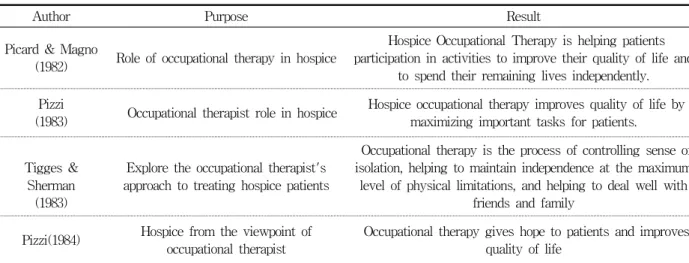
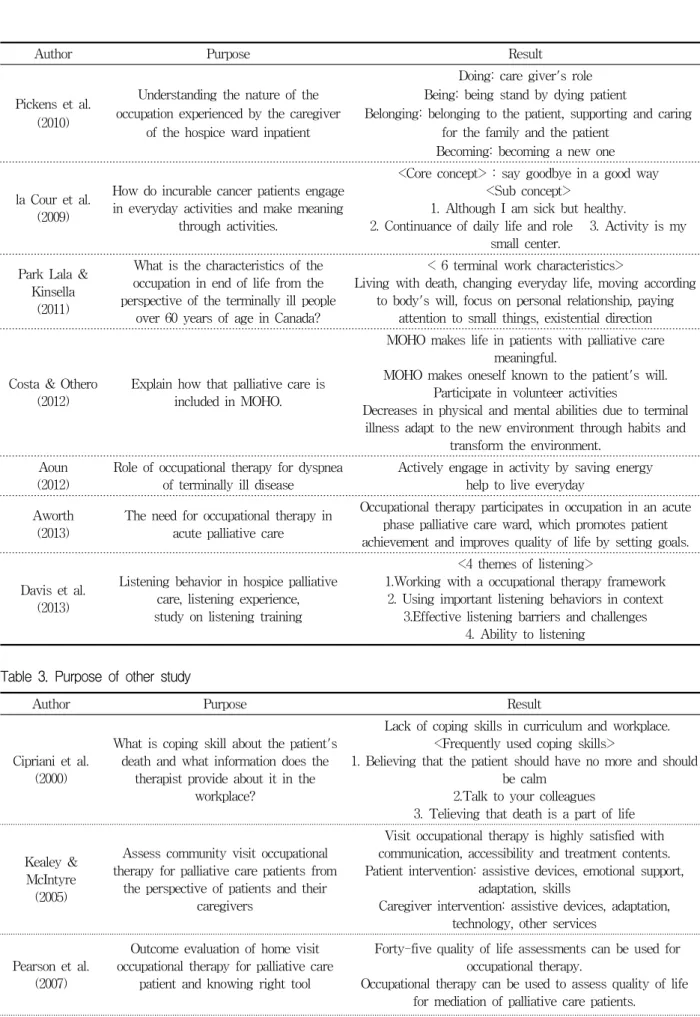
연구 목적은 연도순으로 연구 결과와 함께 Table 1, 2, 3에서 나타내었다.
Author Purpose Result Picard & Magno
(1982) Role of occupational therapy in hospice
Hospice Occupational Therapy is helping patients participation in activities to improve their quality of life and
to spend their remaining lives independently.
Pizzi
(1983) Occupational therapist role in hospice Hospice occupational therapy improves quality of life by maximizing important tasks for patients.
Tigges &
Sherman (1983)
Explore the occupational therapist's approach to treating hospice patients
Occupational therapy is the process of controlling sense of isolation, helping to maintain independence at the maximum level of physical limitations, and helping to deal well with
friends and family Pizzi(1984) Hospice from the viewpoint of
occupational therapist
Occupational therapy gives hope to patients and improves quality of life
Table 1. Purpose of Quantitative study
Aurthor Purpose Result
Rose (1999)
The attitude and thought of occupational therapist using spirituality in palliative care
Spirituality is an important element of health and rehabilitation.
Spirituality is a client centered multidisciplinary approach
Littlechild (2004)
Explain the introduction, development and potential of hospice occupational therapy at the McMillan
Center in the UK
The role of occupational therapy is to improve function, return home
Approaches to physical and mental problems Activity was limited for anxiety and fatigue The core evaluation and intervention is the area
of occupational therapy
Cooper
&
Littlechild (2004)
To assess the time usage of mediation and diagnosis used by palliative care occupational
therapists
<Use time>
29% direct, indirect use 71%
<Time use by intervention>
Evaluation 40%, use of tools 19%, symptom control 18%
<Time use by diagnosis>
Unknown cancer, CNS disease, head and neck cancer
Lee et al.
(2005)
Assess the effectiveness of occupational therapy to increase independent eating in patients with
terminal cancer with upper limb damage
Occupational therapy is effective for patients with terminal cancer who eat independently
The effect is greatest until 1 week after training
Hoy et al.
(2008)
Review the time to perform occupational therapy during the home visit assessment phase 4
Distribution of time Average total time 199-335 minutes
Days: 10.5-14.8 days Use a lot of time to prepare, move
Jeyasingam et al.
(2008)
Identify unmet daily activities of patients and caregivers in an inpatient ward
Patient's Unmet Daily Activity - Stair, Transfer, Bating Care giver's Unmet Daily Activity - Stair, Ambulation, Transfer, Leisure Squire
(2011)
Exploring the value of occupational therapy input in a multidisciplinary approach
Fast occupational therapy can be initiated early on the bed
Table 2. Purpose of Qualitative study
Author Purpose Result
Folts et al.
(1986)
Describe the process in a two-student hospice clinical practice
<Clinical practice in 5-step process>
Step 1, knowledge acquisition, process selection Step 2, Knowing your personal and professional values
Step 3, Observation of department meetings Step 4, evaluation and treatment Step 5, Night care and patient death Lloyd
(1989)
Assessment and treatment of occupational therapy to maximize the work role of
terminally ill patients
Occupational therapists listen to the important goals of the patient, provide information to the patient and the family, help them to live effectively and improve their quality of life
Dawson (1993)
Understanding, documenting, and knowing the value of hospice group occupational therapy and suggesting ways to promote
hospice occupational therapy
<Gruop therapy>
Promoting communication, socialization, positive effects of controlling, sharing and remembering your own life, group
interaction, sharing, caring, remembering
Dawson
&
Barker (1995)
Information about Australian hospice occupational therapists, their role, and the
need for training
In the 20-40 year-old women mostly part-time work.
About half of those who completed the hospice occupational therapy curriculum. Role of occupational therapy in hospice
is to help solve problems, educate, and engage in creative activities. University education needs and responses that
deviate from the typical tasks of the treatment process.
Bye (1998)
Principles of occupational therapy, end of life patient's needs, stalwarts on
experience
The core concept of occupational Therapy Principles is to confirm life: the preparation of death.
<9 subgroups>
Planning for referrals, assessments, setting goals, planning for losses, normalizing through changes in reality, treating patients, caring for, helping to end, and safely helping.
Armitage &
Crowther (1999)
The role of occupational therapist with case study
Occupational therapies help patients to assess their physical, mental, and social factors and improve their quality of life.
Rahman (2000)
Role of occupational therapy in hospice and whether occupational therapists supported two states of life and death in
terminally ill patients
<Role of occupational therapy>
Major of hospice is providing comfortable care by adjusting the needs of patients and families
1. Loss (working towards death): accepting death 2. Journey with patient: relationship with patient
3. Use of occupational therapy 4. Divided role: supporting both life and death
C. Reid & J. Reid (2000)
Kind of occupational therapy roles associated with death and role effect on
patient through MOHO
Professional, family, and friends have a role as caregivers beyond the process of death and survival. This is possible by habit and technique. The effect on the patient has an
associated balance.
Unruh et al.
(2000)
Gardening is personally meaningful activities to give terminal cancer patients.
<6 key concepts>
1. Physical elements of gardening 2. Communicating with living
3. Meeting personal needs 4. Reflection of life 5. Rewards through gardening
6. Willingness to gardening
Lyons et al.
(2002)
Watching doing-being-becoming framework about the occupation of people
suffering from incurable diseases
Ddoing: after losing the valuable occupation that strives to maintain the physical and mental functions Becoming: feeling for ones own value through self-exploration and participating in social relations occupation
Becoming: getting new learning opportunities and helping
others
Author Purpose Result Prochnau et al.
(2003)
Investigate the experience of personal-professional connections of palliative care occupational therapists
<Core Concepts>
1. Satisfaction 2. Hardships and difficulties 3.
Compensation strategy 4. Spiritual 5. Growth
Jacques &
Hasselkus (2004)
Study on complex occupation in the process of death and dying among patients, families and health workers
<4 occupation from death>
1. To do what is problem; continuation of life 2. To get everything right and let go; preparation for death
3. It takes a long time to die; waiting 4. Quiet goodbye
<Meaning of occupation>
It is significant that they participate in occupation selected by those who are about to die. Good death is the experience
of death experienced by the patient, the family, and the medical staff.
la Cour (2005)
Terminally ill patients found the elements that participate in creative activities
Participation in creative activities leads to greater participation in daily life and culture <Factors that link creativity to life>
1. generous acceptance environment 2. the progress of creation - change of process
3. approaching close to possible goals Marcil
(2006) Role of occupational therapy in hospice
Occupational Therapy helps improve the quality of life by helping to participate in meaningful occupation that the
patient thinks to control pain and symptoms la Cour et al.
(2007)
Significance of progressive cancer patients participating in the creative activities of
palliative care
Creativity facilitates the patient's life.
Instead of a life and will tell the way to replace Joubert et al.
(2008)
Effect of AIDS patient occupational therapy
To promote the physical and mental of the patient should perform the activities of daily living independently
Teo (2009)
In palliative care more about the spiritual needs of patients and the role of
occupational therapy
The role of occupational therapy in palliative care 1. Providing meaningful and purposeful activities to the
patient and helping spiritual care
2.Mmake occupation fundamentally meaningful through spiritual activity or occupation
3. Awakening deep emotions and having important social and personal value
Warne & Hoppes (2009)
The meaning of hospice for occupational therapist students,
Challenges, Finding through the author's experience in education
Students become confused as they look after dying patients, and clinicians can help such students.
Halkett et al.
(2010)
Explore the potential barriers to mitigate occupational therapy in Western Australia,
occupational therapists and medical professionals are saying
<4 potential barriers>
1. Decrease in understanding of palliative care 2. Lack of publicity for palliative care
3. Lack of funding
4. Limitation of research on occupational therapy in palliative care
Hoppes & Segal (2010)
The characteristics of 3 special occupation and reactions that appear after the death
of a family member
1. Acceptance of occupation: adaptation to a changed reality 2. Absorption of occupation: replacing lost work with
another work
3. Consolidation of persistent operations: connecting
reduced and lost operations to new operations
Author Purpose Result
Pickens et al.
(2010)
Understanding the nature of the occupation experienced by the caregiver
of the hospice ward inpatient
Doing: care giver's role Being: being stand by dying patient
Belonging: belonging to the patient, supporting and caring for the family and the patient
Becoming: becoming a new one
la Cour et al.
(2009)
How do incurable cancer patients engage in everyday activities and make meaning
through activities.
<Core concept> : say goodbye in a good way <Sub concept>
1. Although I am sick but healthy.
2. Continuance of daily life and role 3. Activity is my small center.
Park Lala &
Kinsella (2011)
What is the characteristics of the occupation in end of life from the perspective of the terminally ill people
over 60 years of age in Canada?
< 6 terminal work characteristics>
Living with death, changing everyday life, moving according to body's will, focus on personal relationship, paying
attention to small things, existential direction
Costa & Othero (2012)
Explain how that palliative care is included in MOHO.
MOHO makes life in patients with palliative care meaningful.
MOHO makes oneself known to the patient's will.
Participate in volunteer activities
Decreases in physical and mental abilities due to terminal illness adapt to the new environment through habits and
transform the environment.
Aoun (2012)
Role of occupational therapy for dyspnea of terminally ill disease
Actively engage in activity by saving energy help to live everyday
Aworth (2013)
The need for occupational therapy in acute palliative care
Occupational therapy participates in occupation in an acute phase palliative care ward, which promotes patient achievement and improves quality of life by setting goals.
Davis et al.
(2013)
Listening behavior in hospice palliative care, listening experience, study on listening training
<4 themes of listening>
1.Working with a occupational therapy framework 2. Using important listening behaviors in context
3.Effective listening barriers and challenges 4. Ability to listening
Author Purpose Result
Cipriani et al.
(2000)
What is coping skill about the patient's death and what information does the
therapist provide about it in the workplace?
Lack of coping skills in curriculum and workplace.
<Frequently used coping skills>
1. Believing that the patient should have no more and should be calm
2.Talk to your colleagues 3. Telieving that death is a part of life
Kealey &
McIntyre (2005)
Assess community visit occupational therapy for palliative care patients from
the perspective of patients and their caregivers
Visit occupational therapy is highly satisfied with communication, accessibility and treatment contents.
Patient intervention: assistive devices, emotional support, adaptation, skills
Caregiver intervention: assistive devices, adaptation, technology, other services
Pearson et al.
(2007)
Outcome evaluation of home visit occupational therapy for palliative care
patient and knowing right tool
Forty-five quality of life assessments can be used for occupational therapy.
Occupational therapy can be used to assess quality of life for mediation of palliative care patients.
Table 3. Purpose of other study
Author Purpose Result
Meredith (2010)
Educational information for occupational therapy students and exploration of regulations required by universities
Expansion of college education for palliative care, Continuing education for student education and clinicians, Education of useful contents, Optimized education course
needed
Keesing &
Rosenwax (2011)
To understand the needs and daily experiences of patients and caregivers and
determine the number and coverage of Western Australian occupational therapists
4.9% of occupational therapists in Western Australia work in palliative care.
<4 core concept>
1. Progress of non-participation as a result of deprivation of occupation
2. Loss of influence through a palliative care system 3. Failure to adequately describe occupation in palliative care
4. Occupational therapists feel frustrated because of limited opportunities to care for dying people
Ⅳ. 고찰
호스피스 작업치료 연구는 2000년대에 들어서며 연구 가 크게 증가하는 경향을 보였다. 이는 노령 인구 증가와 함께 암환자와 만성질환환자들이 늘어나며 호스피스완 화의료에 대한 요구가 증가하고 서비스의 성장이 그 주 된 원인으로 생각된다(WPCA, 2014). 그리고 호스피스완 화의료의 역사, 발전과 함께 작업치료의 연구도 호스피 스완화의료의 발전과 함께 연구를 했기 때문으로 생각된 다. 작업치료 학술지에 게재된 호스피스 작업치료 연구 논문은 호스피스완화의료 관련 학술지에 실린 것에 비해 약 2배 이상 많은 연구 논문이 게재되었다. 이는 호스피 스완화의료 관련 학술지에는 작업치료보다는 의학, 간호 등의 다른 연구 분야가 논문의 대다수를 차지하기 때문 으로 생각된다. 그리고 작업치료 학술지 이외에 호스피 스완화의료 관련 학술지에도 게재가 되는 것은 호스피스 가 다양한 전문가가 참여하는 연구를 지향하는 방향과도 일치한다. 지역과 연구 주제에 대해 함께 살펴보면, 미국 의 연구주제는 주로 호스피스 작업치료 역할에 대한 이 론 연구가 많고, 캐나다는 호스피스에서 작업의 의미에 대한 연구가 많았다. 호주에서는 호스피스 작업치료 배 치에 필요한 작업치료사의 인원이나 교육, 인원에 대한 연구가 주로 이루어졌다. 유럽은 호스피스 작업치료의 역할에 대한 실제 연구가 많았다. 이것은 각 국가의 의료 정책과 의료보험 체계, 사회, 문화적 차이, 호스피스 작업 치료의 위치에 따라 다른 것으로 생각된다. 연구 설계는 질적 연구가 양적 연구보다 약 4배 많은 것으로 분석되 었다. 이것은 호스피스 환자의 특성과 호스피스 윤리상 실험연구 같은 양적 연구에 적합하지 않기 때문으로 생
각되며 호스피스가 환자와 가족의 요구를 중요시하고 삶 의 질을 최우선으로 놓기 때문에 호스피스 작업치료의 이론과 중재에 대해 더 깊은 연구를 할 수 있어서 질적 연구를 많이 한 것으로 생각된다. 양적 연구는 조사연구 가 많이 이루어졌다. 질적 연구는 고찰연구와 사례연구 가 많이 나타났다. 고찰연구는 여러 문헌을 통해 연구에 필요한 주제와 내용에 대해 파악할 수 있는데 호스피스 작업치료에 대한 주제와 연구 내용에 대해 파악하기 위 해서라고 생각된다. 사례연구는 현상과 맥락사이의 경계 가 불분명하고 실제 상황에 대한 동시대 현상을 개별적 경험을 통해 알아가는 연구이다(Woodside, 2010). 호스 피스 작업치료를 받은 환자나 호스피스 작업치료사의 경 험을 통해 연구 성과를 얻는데 적합하기 때문에 다수의 연구가 수행되었을 것으로 보인다. 연구 대상에서 환자 와 치료사에 대한 연구가 많았는데 보호자도 호스피스의 대상에 포함되므로 더 많은 연구가 필요하다고 생각된 다. 사람 이외의 대상에 대한 연구는 호스피스 작업치료 에 대한 논문이 많았다. 대부분 호스피스 작업치료에 대 한 역할에 대해 고찰한 논문이 대부분이었다. 이는 초기 1980년대 호스피스 논문 다수가 호스피스에서 작업치료 의 역할에 대해 소개하고 있고, 호스피스 작업치료에 대 한 인식과 이해가 부족하여 연구가 많이 진행된 것으로 보인다. 호스피스 작업치료에 대한 도구, 모델 등에 대한 다양한 연구가 필요할 것으로 사료된다.
임상적 활용을 위한 방법들은, 활동(activity), 일상생 활활동훈련, 이완요법, 보호자 교육, 영성의 적용 등이 본 연구를 통해 분석되었다. 활동은 공예활동을 주 2-3회 1 시간 30분 이상 적용하는 것으로 나타났고, 말기 질환으 로 신체적 활동의 제한으로 인한 일상생활활동의 감소를
치료하고, 통증, 호흡곤란 등을 이완요법을 통해 조절하 도록 하고 있었다. 환자뿐만 아니라 보호자도 치료 대상 으로 보았고 영성의 적용에 대해 언급하고 있었다. 본 연 구를 통해 분석된 논문에서 호스피스 작업치료시 치료를 위해 환자들에게 주어진 활동은 목공, 비누 만들기, 정원 가꾸기, 그림그리기, 도자기 만들기, 팔찌 만들기 같은 공 예활동이 많았다. 그룹치료 시에는 화장하기 같은 활동 도 사용하였다. 시간은 주 2-3회로 한 회기 당 1시간 30 분∼2시간 30분 정도의 시간을 소요했다. 이러한 공예활 동은 치료적으로 가치가 있는 것으로 공예 활동에 참여 하는 것은 치료적 매체(media)로써 치료를 선택할 때 많 은 도움을 준다. 그리고 의미 있고 목적 있는 활동을 통 해 환자 중심의 치료 목표를 성취하는데 도움을 준다 (Harris, 2008).
활동에 참여하게 되면 자신의 현재 상태를 알고 죽음 을 대면하고 있다는 사실을 깨닫는다. 이런 활동은 죽음 을 준비하는 좋은 과정이며 환자의 삶을 반영하게 되어 자신에 대해 좀 더 객관적으로 알 수 있다. 그리고 활동 에 참여하면서 남은 삶에 대한 긍정적이고 희망적인 생 각을 가지게 되고, 비록 병을 가지고 있지만 건강하다는 느낌을 가지게 된다. 다른 사람들과 활동에 참여하며 소 속감과 통합되는 느낌, 교감을 하게 되어 자신의 존재감 을 느낄 수 있다. 또한 활동은 즐거움을 주고 활동을 하 면서 자신의 신체와 감정, 정신적인 요소들을 스스로 조 절하고 자유를 느끼게 된다.
환자가 병에 걸리게 되면 보호자는 자신의 고유한 작 업역할의 변화를 겪는다. 호스피스에서 보호자의 역할은 환자의 신체 증상을 관리하고, 환자의 곁에 머물며 환자 를 지지해주고 환자에게 감정을 표현하는 것이다. 보호 자로써 작업 역할이 지나치게 되면 작업 불균형을 초래 한다. 그리고 환자와 사별 후 보호자는 또 다른 작업 역 할에 놓이게 된다. 여기서 작업치료사는 작업 역할의 변 화에 잘 적응할 수 있게 도와주며, 새로운 작업을 찾아주 고, 기존의 작업들과 잘 통합되도록 도와줄 수 있다.
분석 결과 호스피스 병동에서 일하는 작업치료사는 평 가에 40%의 시간을 할애하고, 가정 방문 시에는 평가의 준비와 가정 방문 이동에 많은 시간의 비중을 차지하는 것으로 나타났다. 평가는 호스피스 작업치료에 있어 중 요한 부분이다. 호스피스 작업치료의 평가 과정은 환자 에게 적절한 작업을 선택하고 환자에게 맞는 역할을 찾 기 위해 환자의 작업 역사(occupational history)에 대해
조사한다. Lee 등(2005)의 연구에서 말기 환자의 먹기 독 립성 증진을 위한 작업치료 전후 평가로 바델 평가 (barthel index)와 먹기 독립성 척도(scale of feeding independence)를 이용하였다. Jeyasingam 등(2008)의 연 구에서는 완화의료 병동에 입원한 환자와 보호자의 충족 되지 않은 일상생활 동작 평가시 Australian Modified Karnofsky Performance Scale(A-KPS), Screening Tool-Activities Daily of Living(ST-ADL)을 사용하여 일상생활동작에 대한 수행과 만족도를 평가하였다.
Davis 등(2013)의 연구에서 경청(listening)은 환자가 자신의 이야기와 감정을 표현하고 마음을 여는 방법이라 고 하였다. 경청으로 중재 과정에서 환자의 표현을 통해 치료 효과에 대해 미리 알아볼 수 있고, 표준화된 평가도 구를 사용하기 전에 경청을 통해 환자의 작업 역사를 듣 고 환자에게 꼭 필요한 평가가 무엇인지 가늠해 볼 수 있 을 것이다. 호스피스 작업치료에 따로 적용되는 도구는 없지만, 일반적으로 작업치료 평가 시 쓰는 도구를 이용 하되 환자의 상태에 맞게 유동적으로 사용하고, 모든 평 가 항목을 다 수행하고자 환자를 압박하거나 다그치는 행동은 삼가야 할 것이다.
Lyons 등(2002)과 Pickens 등(2010)은 하기-되기-되 어가기 이론의 틀(doing-being-becoming theoretical framework)을 가지고 호스피스 작업치료에 적용하여 설 명하였다. 하기는 환자가 말기 질환으로 인해 자신이 수 행하던 작업을 잃어버리게 되면 작업치료를 통해 자신이 가진 작업을 유지하고 신체적, 정신적 기능이 나빠지지 않게 유지하는 것이다. 보호자는 환자를 돌보고 환자의 통증과 여러 증상들을 관리 하는 역할을 한다. 되기는 환 자가 작업치료 프로그램에 참여하면서 다른 사람들이 반 겨주고, 서로간의 상호작용, 만남, 접촉 등으로 사회적 관 계와 자기탐구를 하게 되어 자기 자신이 가치 있음을 느 끼게 되는 것이다. 보호자는 죽음의 과정에 있게 되고, 환자의 곁에 머물며 자신의 존재를 느끼게 된다. 되어가 기는 호스피스 작업치료 프로그램에 참여한 환자가 자신 에게서 새로운 능력이 있음을 알게 되고 이것을 다른 사 람에게 기여하고 싶어 하는 것이다.
Kielhofner가 말하는 인간 작업 모델(the model of human occupation, MOHO)은 호스피스 철학과 같이 환 자 중심의 접근법이다. Costa와 Othero(2012)에 의하면, 작업치료사는 인간 작업 모델 이론을 바탕으로 호스피스 환자가 작업적 정체성을 가지게 해주고, 삶을 유지하면
서 새로운 삶을 위해 환자를 평가하고, 삶의 질을 증진시 키거나 유지하도록 도와줄 수 있다고 언급하였다.
호스피스 작업치료의 전문가를 양성하기 위한 대학 교 육과정은 필수적이지만 아직 우리나라에서는 그 교육이 미미하다. Meredith(2010)는 호스피스 작업치료 교육을 받은 임상가들은 임상 경험을 통해 호스피스완화의료에 대한 더 많은 교육이 필요하다고 이야기하고 있다. 호스 피스 교육을 받은 치료사가 관련 시설에서 일할 확률이 더 높고, 교육을 받지 못한 사람은 호스피스완화의료 기 관에서 일하는 기간이 짧다. 이에 Meredith는 호스피스 완화의료에 대한 대학교육의 확대, 학생교육과 임상가를 위한 지속적인 교육이 필요하며, 최적화된 교육 과정이 필요하다고 말하고 있다. Folts 등(1986), Warne과 Hoppes(2009)는 작업치료를 배우는 학생은 호스피스로 임상 실습을 나가기 전에 호스피스에 대한 사전 지식을 공부하고 준비가 되어 있어야 한다고 말했다. 학생은 임 상 실습을 통해 작업치료의 효과와 작업치료의 의미, 그 리고 환자를 통해 여러 가지를 배우게 된다. 그리고 이러 한 교육 과정을 통해 학생은 죽음에 대한 두려움과 슬픔 등을 다양하게 느끼게 되는데, 환자를 밤새 돌보고 장례 식에 참여하는 활동을 통해 개인적으로 느끼는 여러 감 정과 전문가로서의 입장을 잘 정리하도록 교수와 임상가 가 지도해야 한다. 호스피스에 대해 교육을 받은 사람이 그 이해도가 높고 좀 더 전문적으로 일할 수 있다.
Ⅴ. 결론
본 연구의 결과를 통하여 호스피스 작업치료의 연구 방향과 논문 수의 증가는 호스피스완화의료의 발전과 그 흐름을 같이 하고 있는 것으로 보여진다. 또한 호스피스 작업치료의 임상과 연구영역에서 균형적 연구가 이루어 지고 있으며, 질적 연구를 통해 호스피스 작업치료의 다 양한 주제를 심도 있게 연구하고 있다고 사료된다. 하기- 되기-되어가기 이론의 틀과 인간 작업 모델은 임상에 적 용 가능한 이론으로 사용될 수 있을 것이며, 학교에서는 교육 과정을 개발하고 임상에서는 여러 교육을 제공하고 적극적인 참여를 통해 우리나라에서도 호스피스 작업치 료가 시작되는 거점을 마련할 필요가 있을 것으로 사료 된다.
REFERENCE
Kim, S. G., Oh, S. J., Choi, H., S., (2001). Hospice, care
for love. Seoul: a publishing company Sumoon.
Sung, N., Y. (2009). This allows you to write better
papers. Seoul: a publishing company Chomtop.
Sung, T., J. (2008). Research Methodology. Seoul: a publishing company Hakji.
Lee, Y., E. (2011). Trend in research on hospice care in korea. The Korean Journal of Hospice and
Palliative Care, 14(3), 152-162.
Lee, H., S. (2005). Qualitative Research: Interpretation
and Understanding. Paju: a publishing company
Hakhyun.Hwang, I., C., Kang, K., A., An, H., H. (2013). Analysis of research papers published by the Korean Journal of Hospice and Palliative Care(The first issue∼
2012). The Korean Journal of Hospice and
Palliative Care, 16(2), 74-79.
Hwang, H., K., Lee, S., U. (2000). A study on community-oriented hospice care enhance quality of life of the terminally ill patients. The Korean
Association for Survey Research, Fall Conference Presentation, 2002(0), 343-362.
American Occupational Therapy Association. (1986).
Occupational therapy and hospice (position Paper).
American journal of Occupational Therapy, 40(12),
839-840.American Occupational Therapy Association. (2011).
The role of occupational therapy in end-of-life care. American journal of Occupational Therapy,
65(suppl.), S66-S75.
Arksey, H. & O'Malley, L. (2005). Scoping studies:
Towards a methodological framework. International
Journal of Social Research Methodology, 8(1), 19-32.
Canadian Association of Occupational Therapy. (2005).
Occupational therapy and end of lif care. Canadian
Journal of Occupational Therapy, 72(2), 121.
Canadian Association of Occupational Therapy. (2011).
CAOT Position Statement: Occupational Therapy and End of Life care. http://www.caot.ca/default.as
p?pageid=1284
Harris, E. (2008). The meanings of craft to occupational therapist. Australian Occupational Therapy Journal,
55, 133-143.
Levac, D., Colquhoun, H., & O'brien, K. (2010). Scoping studies: advancing the methodology. Implementation
Science, 5(69), 1-9.
Pedretti, L. W., & Early, M. B. (2001). Occupational
Therapy, Practice skills for Physical Dysfunction.
5th edition. Philadelphia, Mosby.
Woodside, G. (2010). Case study research : theory,
methods, practice. 1st edition e-book. Bingley,
Emerald Group Publishing Limited.Worldwide Palliative Care Alliance. (2014). Global atlas of palliative care at the end of life. http://www.wh o.int/cancer/publications/palliative-care-atlas/en/
Abstract
Scoping Review of Occupational Therapy in Hospice and Palliative Care
Kim, Ji-yoon*, M.Sc., O.T., Kim, Hwan**, Ph.D., O.T.
*Dept. of Occupational Therapy, Pusna National University Hospital
**Dept. of Occupational Therapy, Daegu University
Objective : This study is to provide basic data for hospice occupational therapy and to develop hospice occupational therapy curriculum in Korea.
Methods : 45 articles were selected from CINAHL, MEDLINE, and Scopus, which were published from 1980 to 2013. The selected articles were analyzed in term of study year, study source, author's characteristics, study subjects, and study designs.
Results : The number of studies have increased steadily since the 1980's. A total of 21 research journals was published, and the most highest published journals were American Journal of Occupational Therapy.
Qualitative research methodology was employed four times more than quantitative research methodology.
Interventions included various formats such as crafts, ADLs trainings, relaxation techniques, care giver educations and applications of spirituality. The doing-being-becoming theoretical framework and the model of human occupation applied to hospice or palliative patients as a theoretical foundation.
Conclusion : Hospice occupational therapy has been developed along with hospice and palliative medicine.
There also appeared to be a balance on both clinical trials and researches The hospce occupational therapy care has being studied deeply with various topic. More efforts on curriculum developments as well as clinical advances pertinent to the palliative care should be proceed to warrant making the start of the hospice and palliative occupational therapy in Korea.
Key words : Hospice, Palliative care, Occupational therapy, Scoping review